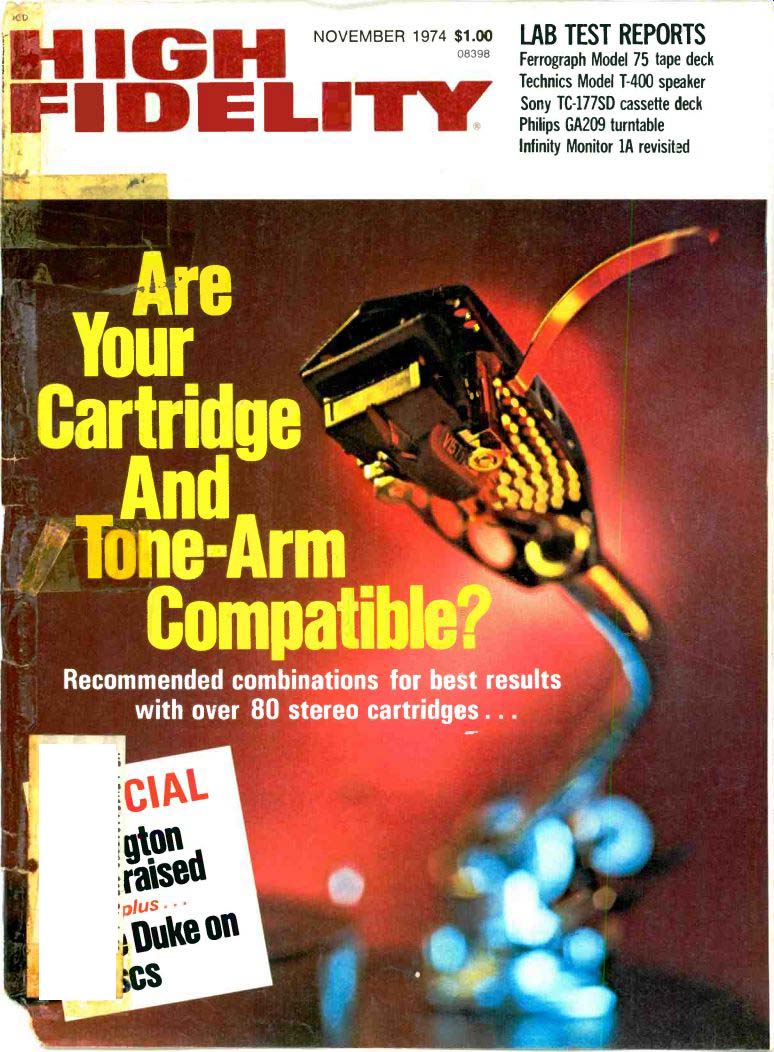
PICKING A PICKUP (i.e., phono cartridge)
by Larry Zide
Why are some makers reluctant to recommend an arm and cartridge match?
by Larry Zide
We all know that cartridge and arm must be matched for good results. But what governs the compatibility match, and why are some manufacturers reticent about recommendations?
WE TEND TO take for granted the interchangeability and compatibility of one component with another. And, for the most part, we do so with impunity. No where, however, is the problem of matching components more critical than in those used for playing records.
Most pickup cartridges will, physically, fit into most tone arms today; that's not the problem. Dimensions are relatively standardized, but other factors are not. Will changer A trip properly with cartridge B? How will cartridge C track record warps in tone arm D? Do the adjustments on turntable ensemble E have sufficient range to allow use of pickup F? Accompanying this article you will find lists of cartridge manufacturers showing their recommendations for the turntables that will perform correctly with their pickups. Why have such a list? Does it tell all you need to know? Read on.
The tone arm has only one job-holding the cartridge at the correct geometrical relationship to the record groove and at the correct tracking force.
That sounds simple, but no arm does its job perfectly. Every arm has frictional resistance. The record groove is doing the actual work. Via the stylus assembly, it is dragging the arm across the record, revolution by revolution. No arm goes that route without some resistance.
A changer or automatic single-play turntable may compound the problems. [See Mr. Zide's article (with Michael Marcus) on turntables; HF, May 1974.] For present purposes the most important factor is tripping force. The changer may track satisfactorily at 1 gram while the record is playing but require more than 1 gram to trip the changer cycle at the end of the record. When this is true, the stylus may simply be pulled out of the leadout groove following the music and the changer will re fuse to "change." And in the process the stylus assembly can even be damaged-a hard failing to diagnose, though the kind of lateral stylus displacement it causes can seriously affect separation.
In other words, it is not enough to compare recommended tracking force (of the pickup) with available tracking-force settings (on the arm) to determine compatibility. Nor is it necessarily safe to accept verbatim, in this respect, the manufacturers' specs for tripping force. Even if your turntable meets specs when it is new (and many companies specify on the basis of average predictable performance), it may not when dirt and wear begin to at tack its innards. Some margin between specified tripping force and actual tracking-force settings certainly is desirable.
Vertical Tracking Force
In the jargon of high fidelity a "light-tracking" pickup has been equated with a "high-performance" pickup, though the two are not the same.
While it's true that most of the best pickups generally can be tracked at very low VTFs (say, about 1 gram), misapplication of the fact has led to the irrational importance that has been placed on low tracking forces.
You must begin by understanding that lighter is good but lightest may not be. A stylus tracking at twice its optimum VTF is wearing itself and the groove a little faster than it might. Maybe you'll get only 800 plays out of the diamond instead of 1,000.
But a stylus loaded with insufficient VTF will bounce around in heavily modulated grooves, banging against the walls and damaging them.
That's not good. So in general, when a range of 1/4 to 11/2 grams is given, assume that the 1/4 refers only to a perfect mating of the cartridge to an ideal arm. It seldom happens. In the real world I gram usually is preferable to 3/4 gram for a cartridge with such a rating.
But the undue emphasis on super-low tracking forces poses less obvious pitfalls for the user in search of high performance. Not only may he choose a pickup whose recommended tracking range is on the low side for his turntable assembly, but he may actually be encouraged to do so in some cases by the manufacturer or dealer who sells the turntable! Let's say that a popular high-performance cartridge is rated for 3/4 to 1 1/2 grams; a changer manufacturer's top model will perform at 1 1/2 grams. The company doesn't want to rule out this popular cartridge (after all, some potential customers already will have the cartridge) and is, in fact, justified in specifying it as appropriate for the top changer under ideal conditions. Less than ideal conditions (perhaps excessive speaker feedback or inordinately warped records or dust in the tone-arm bearings) may. however, prevent satisfactory performance. Where does one draw the line? Or the purchaser may end up with a mismatch via another route. The dealer offers a series of turn tables (including the top changer) on a one-cent deal with a series of cartridges-not including the 3/4-1 1/2 gram model. Then, for an extra $10 or $20, he may offer the "step-up" cartridges like that model. This looks like a very good deal, though the match may be questionable.
So in matching pickup VTF recommendations to arm performance. just as in matching them to tripping-force specs, it is advisable to allow a little leeway.
Warped Records
Two aspects of cartridge-arm compatibility are dramatized by warped records. The first has to do with moving mass. A low-mass arm-meaning a light arm and one whose weight is concentrated as much as possible near the pivot-can be defeated by installing a heavy cartridge. If you are undecided between two cartridges and like their performance equally well, choose the lighter one: if the weight difference is significant, it probably will play warped records better.
The reason for this can be explained by remembering a law of physics: A moving mass continues to "want" to move. A heavy arm, rising to track a warp, wants to continue to rise for an instant at the top of the warp; and it wants to push down against the record (drastically increasing the momentary stylus force) at the trough. The low-mass arm wants to do the same things, of course, but with proportionately less force to its "desires." So the stylus is less likely to lose contact with the groove at the peak of the upswing or to "bottom" during the downswing.
The other factor involved in proper tracking of warped discs (and no record is perfectly flat) is stylus compliance. Any cartridge-arm combination resonates at a particular frequency, the frequency and the severity of the resonance being dependent on both the arm's mass and the compliance of the stylus. For most combinations this resonance will occur at frequencies well below 20 Hz. Obviously, you will say, the resonance should be below audibility (that is. below 20 Hz) to prevent exaggeration of any rumble components derived from the turntable or from the record. True, but warp itself represents a kind of "rumble" to the extent that it is an extremely low-frequency "modulation" of the record's surface. And in fact a cartridge-arm resonance that is excessive in amplitude can exaggerate the problems of tracking warped discs, particularly when the resonance is too low in frequency.
It has been found that a resonance of 7 to 15 Hz is optimum since warp "frequencies" tend to be lower. The resonant frequency of the combination can be reduced either by increasing the mass of the arm (including the cartridge) or by increasing the dynamic compliance of the stylus assembly. Dynamic compliance is not the same thing as static compliance (the "compliance spec" normally shown), so even given the formula for the resonance frequency plus a "full" set of specs for both the cartridge and the arm it is not possible to calculate the resonance. But the mass of most current arms is low enough to allow use of very compliant styli without undue worry about warps. The possibility of mismatch remains, however.
It is exaggerated by the excessive emphasis that has been put on stylus compliance. Like tracking-force range, compliance has been assumed as a criterion of merit by the buying public: "The higher the compliance, the better the cartridge." The proposition simply won't hold water, but it has cajoled turntable owners into choosing super-com pliant cartridges-and therefore, on occasion, into greater tracking problems with warped discs than need be.
Evaluating the Specs
Some manufacturers are unwilling to say which of their pickups will track with another manufacturer's tone arm. They argue that they can control the quality and specifications of their own cartridges but not those of another company's product.
Not only may they find that a changer that "will track at 1 gram" actually needs 2 grams to trip, but there's no guarantee that a year from now the same model may not have been revised to trip at 1 gram, or 3 grams. Even if a cartridge manufacturer goes to the time (and expense) of testing a given turn table for compatibility, his findings can be invalidated in short order. And with so many models on the market the prospect of testing his pickup in each-and of doing so on a continuing basis-is not encouraging.
But without such complete testing some incompatibility "sleepers" are bound to remain. For ex ample, the Decca pickups listed in the table have an unusually strong magnetic field. The Philips turntables shown as "compatible" for the pickups do not have nonferrous platters. The result, some users report, is so much attraction between magnet and platter that the stylus assembly bottoms. Phil ips confirms this experience by stating that the combination is incompatible.
One of Decca's importers, in denying the incompatibility, states that his company regularly uses the combination in demonstrating speakers but never has had a case of bottoming. The importer adds, however, that tracking force on the Philips normally is set to 2 grams-rather low for this particular cartridge, though the magnetic attraction between pickup and platter presumably adds to the actual VTF.
Are the two incompatible? You can call it either way, depending on your point of view.
The question of compatibility does not admit of entirely unequivocal answers. But no manufacturer wants his product to be used in a combination that will reflect badly on it. And some cartridge makers (Stanton is among those on the chart that stand out) go to great lengths to help their customers choose wisely in spite of all that mitigates against their doing so.
In a way, the credibility crunch is hardest on those companies that offer both pickups and arms or turntable ensembles, because when specifying in one area they must deal with competitors' products in the other. Let's say that you are a manufacturer and that you know your popular pickup to be only a marginal match for your competitor's Micro-miracle turntable. If you say the two are compatible, you may cause problems both for yourself and for your competitor. If you say they're incompatible, you leave yourself open to charges of let ting commercial considerations cloud your judgment: Aren't you trying to downgrade the competing Micromiracle? The charts that accompany this article were constructed entirely from information provided by the cartridge manufacturers. All of the problems discussed above can be read into those charts. This should not be taken as a condemnation of manufacturers' specifications. Rather, it is an index of a significant problem that exists and-so far-has resisted successful across-the-board solution. Use the tables as a starting point by all means, keeping in mind the basic rule that the better pickups are de signed to work well in the better arms, and vice versa. That is, the manufacturer's need to produce equipment that will work well with other components of the same class generally is reliable insurance against serious problems.
++++++++++++++++
Which Cartridges Go with Which Tone Arms?
17 Manufacturers State Their Recommendations
PHONO CARTRIDGES | TURNTABLE and TONE ARMS*
-----------------
AUDIO DYNAMICS: Declines to provide information due to affiliation with BSR. Believes data could be misconstrued as knocking a competitor and would only add to customer's confusion.
AUDIO-TECHNICA: Audio-Technica Company has been gathering data on available turntables and tone arms, but no firm recommendations were available by press time.
-----------
B & O
MMC-6000:
MMC-4000:
SP-14:
SP-12:
AUDIO-TECHNICA: AT-1003, AT-1005. B 8 0: Beogram 4002. CONNOISSEUR: BD-2/C.
SME: 3009 3009/S2. SONY: PS-2251. STAX: UA-7. TECHNICS: SP-1200, SP-1100A, SP-10. THORENS: TD-125AB.
AUDIO-TECHNICA: AT-1003, AT-1005. B & O: Beogram 3000. BSR: 810. CONNOISSEUR:
BD-2/C DUAL: 1229, 1218, 1216, 1214, 701. LENCO: L-85, L-78, L-75. MINACORD:
770H, 760, 660H, 50H Mk. II, 50H. JVC: VL-8. PHILIPS: GA-212, SL-8E. ST-4. SANSUI: SR-2050C. SME: 3009/2, 3009. SONY: PS-2251. STAX: UA-7. TECHNICS: SP-1200, SP-1100A. THORENS: TD-160C, TD-125AB YAMAHA: YP-700.
ACOUSTIC RESEARCH: AR-XB AUDIO-TECHNICA: AT-1003, AT-1005. B&O: Beogram 3000. BSR: 810. CONNOISSEUR: BD-2'C. DUAL: 1229, 1218, 1216, 1214, 701.
EMPIRE: 598-2. GARRARD: Zero 100C GLENBURN: 2110. JVC: VL-8. LENCO: L-85, L-78, L-75, B 52. MIRACORD: 770H. P-E: PE-3015, PE-3012. PHILIPS: GA-308, GA-212. PIONEER: All models. RASCO: ST-4. REALISTIC: Lab 36-A. ReK-0-Ku': CVS-12. SANSUI: SR-2050C, SR-1050C. SANYO: TP-805A SME: 3009/2, 3009. Sow: PS-2251. STAX: UA-7. TECHNICS: SP-1200 SP-1100A. SP-10. THORENS: TD-160C, TD-125AB TOSHIBA: SR-40E.
YAMAHA: YP-700.
AUDIO-TECHNICA: AT-1005, AT-1003 B & O: Beogram 3000 CONNOISSEUR: BD-2/C.
DUAL: 1229, 1218, 1216, 1214, 701. EMPIRE: 598 GARRARD: Zero 100C. Zero 92, SL-
95B JVC: VL-8. Loco: L-85, L-78, L-75. B-52 MIRACORD: 770H, 760, 660H, 50H Mk.
-------------------
Note: Model numbers represent integrated turntable-arm ensembles except for Ortofon, Rek-O-Kut, and SME, which offer separate tone arms Compatibility information supplied by the cartridge manufacturers.
-------------------
II, 50H PHILIPS: GA-212 PIONEER: All models. RASCO: SL-8E. ST-4 REALISTIC: Lab-
36A REK-o-Kut: CVS-12. SANSUI: SR-2050C. SANYO: TP-805A. SME: 3009 S2, 3009.
SONY: PS-2251. STAX: UA-7. TECHNICS: SP-1200. SP-1100A, SP-10. Thorens: TD 160C, TD-125AB. YAMAHA: YP-700.
DECCA
London B & O: All models. BSR: All models. CONNOISSEUR: All models DECCA: International tone arm. DUAL: All models. EMPIRE: All models. GARRARD: Zero 100, 401 Export Mk.-5
JVC: All models Lenco: All models LINNSONDER: LP-12. P-E: All models PHILIPS: All models. RASCO: SL-8E REK-O-Kut: All models.
SANSUI: All models SME: 3009 S2 SME: 3009 S2
SONY: All models SS1: All models. TECHNICS: All models
THORENS: 125 Mk. II.
London Mk.-5 Same as Export Model.
ELAC
STS-444-E
B & O: Beogram 3000. BSR: 810. DUAL: 1229. 701.EMPIRE: 208. GARRAD: Zero 100C.
LENCO: L-85, L-78, L-75. MIRACORD: 770H, 760, 50H Mk. II. P-E: PE-3060. PHILIPS: GA-
212 PIONEER: PL-51, PL-35. SANSUI: SR-2050C, SR-1050C, TP-80. Sour: PS-5520.
TECHNICS: SL-1200. SL-1100. THORENS: TD-160C, TD-125 Mk. II. YAMAHA: YP-700.
STS-344-E ACOUSTIC RESEARCH: AR-XB. B & O: Beogram 3000. BSR: 810, 710. DUAL: 1229, 1218, 1216, 701. EMPIRE: 208. GARRARD: Zero 100C. LENCO: L-85, L-78, L-75. MIRACORD: 770H, 760, 50H Mk. II. P-E: PE-3060, PE-3015. PHILIPS: GA-212. PIONEER: PL-51, PL-
35. SANSUI: SR-2050C, SR-1050C, TP-80. SONY: PS-5520. TECHNICS: SL-1200, SL-
1100. THORENS: TD-160C, TD-125 Mk. II. YAMAHA: YP-700.
STS-344-17 ACOUSTIC RESEARCH: AR-XB. B & O: Beogram 3000. BSR: 810, 710. DUAL: 1229, 1218, 1216, 1214, 701. EMPIRE: 208. GARRARD: Zero 100C, SL-92. LENCO: L-85, L-78, L-75, B-52. MIRACORD: 770H. 760, 625, 50H Mk. II. P-E: PE-3060, PE-3015, PE-3012. PHIL IPS: GA-308, GA-212. PIONEER: PL-51, PL-35, PL-12D. SANSUI: SR-2050C, SR-1050C, TP-80. SONY: PS-5520. TECHNICS: SL-1200, SL-1100. THORENS: TD-160C, TD-125 Mk.
II. YAMAHA: YP-700.
STS-244-E ACOUSTIC RESEARCH: AR-XB. B & O: Beogram 3000 BSR: 810. 710. DUAL: 1218, 1216, 1214. G : SL 92. LENCO: L-75, B-52. MIRACORD: 625. P-E: PE-3015, PE-3012.
PHILIPS: GA-308. PIONEER: PL-12D.
STS-244-17 Same as Model STS-244-E.
EMPIRE
DUAL: 1229. EMPIRE: 598, 498, 398. GARRARD: Zero 100C MIRACORD: 770H, 50H. PIO NEER: PL-61. SME: 3009. SONY: PS-2251. TECHNICS: SL-1200. THORENS: TD-125 Mk.
4000D/II BIC: 980. BSR: 810. DUAL: 1229, 1218. EMPIRE: 598, 496, 398. GARRARD: Zero 100C, Zero 92. MIRACORD: 770H, 50H. P-E: PE-3060. PIONEER: PL-61. SME: 3009. SONY: PS-
2251. TECHNICS: SL-1200. THORENS: TD-125 Mk. II.
4000D/I BIC: 980, 960. BSR: 810, 610AX, 510. DUAL: 1218, 1216. EMPIRE: 598, 498, 398. GAR RARD: Zero 100C. Zero 92. GLENSURN: All models. Lenco: All models. MIRACORD:
770H, 50H P-E: PE-3060. PIONEER: PL-61. SME: 3009. SONY: PS-2251. TECHNICS: SL-
1200. THORENS: TD-125 Mk. II.
2000E/111 BIC: 980, 960. BSR: 810. DUAL: 1219. 1218. 1216. EMPIRE: 598. 498. 398 G Zero 100C. LENCO: All models. MIRACORD: 770H, 50H PIONEER: PL-61. SME: 3009.
SONY: PS-2251. TECHNICS: SL-1200. THORENS: TD-125 MK. II.
2000E/II BIC: 980, 960. BSR: 810, 610AX, 510. DUAL: 1228, 1218, 1216 EMPIRE: 598, 498, 398.
G : Zero 100C, Zero 92. GLENSURN: All models. Lenco: All mode's. MIRACORD:
770H, 50H P-E: PE-3060. PIONEER: PL-61 SONY: PS-2251 THORENS: TD-125 Mk. II.
2000E/1 ACOUSTIC RESEARCH: AR-XB. BIC: 960 BSR: 810, 610AX, 510. DUAL: 1218. 1216 GARRARD: Zero 100C, Zero 92, 82 GLENSURN: All models LENCO: All models. P-E: PE-
3060. PIONEER: PLA-35. SONY: PS-5520. THORENS: TD-160C 2000E ACOUSTIC RESEARCH: AR-XB. BIC: 980. BSR: 610AX, 510. DUAL: 1216 GARRARD: 82.
GLENBURN All models. PIONEER: PLA-35. SONY: PS-5520. THORENS: TD-160C.
2000 Same as Model 2000E, except not compatible with BIC 980 1000ZE / X DUAL: 1229. EMPIRE: 598, 498, 398. GARRARD: Zero 1000. MIRACORD: 770H, 50H. PIO NEER: PL-61. SME: 3009. SONY: PS-2251 TECHNICS: SL-1200 THORENS: TD-125 Mk.
999VE /X BSR: 810. DUAL: 1229, 1218. EMPIRE: 598, 498, 398 GARRARD: Zero 1000, Zero 92.
MIRACORD: 770H, 50H. P-E: PE-3060. PIONEER: PL-61 SME: 3009. SONY: PS-2251.
TECHNICS: SL-1200. THORENS: TD-125 Mk. II.
999TE/X Same as Model 99VE X. except also is compatible with DUAL 1216 and all LENCO models.
999SE /X ACOUSTIC RESEARCH: AR-XB. BSR: 810, 610AX, 510. DUAL: 1218, 1216. EMPIRE: 598, 498, 398 GARRARD: Zero 100C, Zero 92 GLENBURN: All models LENCO: All models.
MIRACORD: 7701-I. 50H. P-E: PE-3060. PIONEER: PL-61, P _A-35. SME: 3009. SONY: PS-
5520, PS-2251. TECHNICS: SL-1200. THORENS: TD-160C, TD-125 Mk. II.
999E /X ACOUSTIC RESEARCH: AR-XB. BSR: 810, 610AX, 510. DUAL: 1218, 1216. G Zero 100C, Zero 92. 82. GLENSURN: All models. LENCO: All models. PIONEER: PLA-35.
SONY: PS-5520. THORENS: TD-160C.
90EE/X ACOUSTIC RESEARCH: AR-XB. BSR: 610AX, 510. G . 82. GLENBURN: All models.
P-E: PE-3060. PIONEER: PLA-35. SONY: PS-5520. THORENS: TD-160C.
909/X Same as Model 90EE /X. except not compatible with GARRARD or GLENBURN models shown.
-----------------
440D Same as Model 999SE /X, except not compatible with Acoustic RESEARCH AR-XB, is compatible with G 82.
660E/X Same as Model 4400, except is not compatible with BSR 810 66PE/X Same as Model 660E/X.
66LE/X BSR: 610AX, 510. DUAL: 1216. GARRARD: Zero 92. 82. GLENBURN: All models.
LENCO:
All models. P-E: PE-3060. PIONEER: PLA-35. SONY: PS-5520.
66E/X Same as Model 66LE /X.
66/X Same as Model 66LE /X.
GRADO FTR + FTE + FCR + FCE + FTR + 1 FCR + 1 F3E + F-2 + F-1 + JVC 4MD-20X
Works in all changers and turntables tracking between 1.5 and 3.0 grams.
Same as Model FTR + .
Same as Model FTR + .
Same as Model FTR + Works in all changers and turntables tracking between 1.0 and 2.0 grams.
Same as Model FTR + 1.
Same as Model FTR + 1.
Same as Model FTR + 1.
Same as Model FTR + 1.
JVC: VL-8, VL-5.
MICRO-ACOUSTICS ODC-1 Series ACOUSTIC RESEARCH: All models. AUDIO-TECHNICA: All models. BSR: All models except 310X. CONNOISSEUR: All models.
DUAL: All models. EMPIRE: All models. GARRARD:
All models except 40B. JVC: All models. LeNco: All models. MIRACORD: All models.
PANASONIC: All models. P-E: All models. PHILIPS: All models. PIONEER: All models.
RABCO: All models. REK-O-KuT: All models. SANSUI: All models. SANYO: All models.
SME: All models. SONY: All models. SSI: All models. TECHNICS: All models. THORENS:
All models. YAMAHA: All models.
ORTOFON SL-15E BSR: 810. DUAL: 1229, 1218, 701. EMPIRE: 598-2, 498A. 398A. GARRARD: Zero 100C.
Zero 92. JVC: VL-8. MIRACORD: 770H, 760, 50H Mk. II. ORTOFON: AS212TA. P-E: PE-
3060. PIONEER: PL-61. RABCO: SL-8E. SANSUI: SR-2050C, SR-212. SME: 3009/S2.
SONY: PS-5520, PS-2251. TECHNICS: SL-1200, SP-12. THORENS: TD-165, TD-160C, TD-125 Mk. II.
M-15E BSR: 810. DUAL: 1229, 1218, 701. G : Zero 100C, Zero 92. JVC: VL-8. MIRA CORD: 770H, 760, 50H Mk. II. ORTOFON: AS-212TA. P-E: PE-3060. PHILIPS: GA-212.
PIONEER: PL-61. RABCO: SL-8E. SANSUI: SR-2050C. SME: 3009/S2. SONY: PS-2251.
TECHNICS: SL-1200. SP-12. THORENS: TD-160C, TD-125 Mk. II.
M-15 Same as Model M-15E. F-15E
ACOUSTIC RESEARCH: AR-XA. BSR: 810, 710. 610AX, 510, 310. DUAL: 1229, 1218, 1216, 1214, 701. EMPIRE: 598-2.498, 398. GARRARD: Zero 100C, Zero 92, 82, A-70, 62, 40B. GLENBURN: All models JVC: VL-8. LENCO: All models. MIRACORD: 770H, 760.
750 Mk. II, 50H Mk. II. ORTOFON: AS-212TA. P-E: PE-3060, PE-3015, PE-3012. PHILIPS:
GA-407, GA-308, GA-212. PIONEER: PL-61, PL-12AC. RABCO: SL-8E. ST-4. SANSUI:
SR-2050C, SR-212. SME: 3009/S2. SONY: PS-5520, PS-2251. TECHNICS: SL-1200.
SP-12. THORENS: TD-165. TD-160C, TO-125 Mk. II.
F-15 Same as Model F-15E.
PANASONIC EPC-460C
3.2-gram cartridge is compatible with tone arms able to track at less than 2.5 grams.
Needs bias voltage normally supplied by preamp in specially designed CD-4 demodulator.
PICKERING XV-15DCF Series 1200E
ACOUSTIC RESEARCH: AR-XB. BIC: 980. 960. DUAL: 1228, 701, 601 GARRARD: Zero 100C, Zero 92. 82 P-E: PE-3048. PHILIPS: GA-209S. PIONEER: PL-45. PLA-35, PL-12D, PL-10. SONY: PS-5550, PS-5520, PS-2251, PS-2250 TECHNICS: SL-1200, SL-
1100, SP-10. THORENS: TD-165, TD-125 Mk. II.
750E Same as Model 1200E.
400E Same as Model 1200E, except also compatible with PHILIPS GA-407.
350 Same as model 400E.
200E BSR: 620, 520 DUAL: 1226, 1225, 1216, 1215, 1214. PHILIPS: GA-407.
150 Same as Model 200E.
140E BSR: 260.
100 Same as Model 140E.
V-15 Micro IV Series AME Same as Model 400E.
ATE Same as Model 200E.
ACE Same as Model 140E.
AM Same as Model 400E.
AT Same as Model 200E.
AC Same as Model 140E.
-----------------------
RADIO SHACK
Realistic/Shure Series
R-700E: REALISTIC: Realistic / Miracord 45.
R-27E: REALISTIC: Realistic /Miracord 40C, Realistic Lab-36A.
R-47EB: REALISTIC: Lab-34B.
R-7C" REALISTIC: Lab-12B.
--------------
REK-O-KUT
F-3 REK-O-Kut: S-320.
----------
SHURE
V-15 Type III Compatible with precision quality tone arms and automat c turntables capable of tracking at 1.25 grams or less.
M91ED Compatible with high-quality tone arms and automatic turntables capable of tracking at 1.5 grams or less.
M75ED Type 2 Same as Model M91ED.
M75EJ Type 2 Compatible with standard tone arms and automatic turntables tracking at from 1.5 to 3 grams.
M75ECS Recommended for older manual tone arms and changers requiring 2 to 4 grams of tracking force.
M75CS Recommended for upgrading older, heavier-tracking cartridges or for virtually any tone arm or changer tracking at from 3 to 5 grams.
STANTON
780/4D0 Compatible with turntables properly wired for 100-pF capacitance load.
681EEE
ACOUSTIC RESEARCH: AR-XA, AR-XB. BSR: 810, 710. DUAL 1229, 1219, 1218, 1019, 1015, 701, 601. GARRARD: Zero 100C, Zero 92, SL-95, SL-95B, 82. LENCO: L-85, L-78, L-75. MIRACORD: 770H, 760, 750, 660, 650, 50H Mk. II. P-E: PE-3060, PE-3048, PE-
2040, PE-2038, PE-2035. PHILIPS: GA-212, 209S. PIONEER: PL-61, PL-51, PL-45, PL-41D, PLA-35, PL-12D. RABCO: SL-8E. SANSUI: SR-2050C, SR-1050C. SONY: PS-5550, PS-5520, S-2251, PS-2250, PS-1800, PS-1800A. SME: 3012. 3009. TECHNICS: SL-1200, SL-1100, SP-10. Termites: TD-165C, TD-160C, TD-125AB Mk. II.
681EE Same as Model 681 EEE, except not compatible with PIONEER models shown.
681A Acoustic RESEARCH: AR-XA, AR-XB. BSR: 810, 710, 620. 610, 520, 510 CONNOIS SEUR: BD-1, BD-2. DUAL: 1229, 1226, 1225, 1219, 1218, 1216, 1215, 1214, 1019, 1015, 1010. GARRARD: Zero 100, Zero 92, SL-95, SL-95B, SL-75, SL-72B, SL-55, Lab 80 Mk.
II, Lab 80, A-70, 82, 70, 62. GLENEURN: 2155, 2130, 2110. LENCO: L-85, L-78, L-75, B 52. MIRACORD: 770H, 760, 750, 660, 650, 625, 50H MK. II, 1811, M-10, M-10F. M-10H. P E: PE-3060, PE-3048, PE-3015, PE-3012, PE-2040, PE-2038, PE-2035, PE-2010, PE-
2005. PHILIPS: GA-407, GA-308, GA-212, 209S. PIONEER: PL-61, PL-51, PL-45, PL-41D, PLA-35, PL-12D. RABCO: SL-8E, ST-4. SANSUI: SR-2050C, SR-1050C. SONY: PS-
5550, PS-5520, PS-2251, PS-2250, PS-1800, PS-1800A. SME: 3012, 3009, TECHNICS:
SL-1200, SL-1100, SP-10. THORENS: TD-165C, TD-160C, TD-125AB Mk. B.
600EE Same as Model 681EEE, except also compatible with GLENBURN 2155.
600E BSR: 620, 610, 520, 510, 310, 260 CONNOISSEUR: BD-1, BD-2. DUAL: 1226, 1225, 1216, 1215, 1214, 1010. G : SL 75, SL-72B, SL-55, SL-40B, Lab 80 Mk. II, Lab 80, A-70, 70, 62, 50 Mk. II, 50, 40. GLENSURN: 2130, 2110 Loam B-52. MIRACORD: 625, 18H, M-10, M-10F, M-10H. P-E PE-3015, PE-3012, PE-2010, PE-2005. PHILIPS:
GA-407, GA-308. RASCO: ST-4.
600AA P-E: PE-3060, PE-3048, PE-2040, PE-2038, PE-2035. RASCO: SL-8E.
600A ACOUSTIC RESEARCH: AR-XA, AR-XB. BSR: 810, 710, 620. 610, 520, 510, 310, 260.
CONNOISSEUR: BD-1, BD-2. DUAL: 1229, 1226, 1225, 1219, 1218, 1216, 1215, 1214, 1019, 1015, 1010, 701, 601. G : Zero 100, Zero 92, SL-95, SL-95B, SL-75, SL- 72B, SL-55, SL-40B, Lab 80 Mk. II, Lab 80, A-70, 82, 70, 62, 50 Mk. II, 50, 40. GLENBURN: 2155, 2130, 2110. LENCO: L-85, L-78, L-75, B-52. MIRACORD: 770H, 760, 750, 660, 650, 625, 18H, M-10, M-10F, M-10H. P-E: PE-3015, PE-3012, PE-2010, PE-2005.
PHILIPS: GA-407, GA-308, GA-212. 209S. PIONEER: PL-61, PL-51, PL-45, PL-41D, PLA-35, PL-120. RABCO: ST-4. SANSUI: SR-2050C, SR-1050C. SONY: PS-5550, PS-
5520, PS-2251, PS-2250, PS-1800, PS-1800A. SME: 3012, 3009. TECHNICS: SL-1200, SL-1100, SP-10. THORENS: TD-165C, TD-160C, TD-125AB Mk. II.
500EE Same as Model 600EE.
500E Same as Model 600E.
500AA Same as Model 600EE.
500AL BSR: 310, 260. GARRARD: SL-40B, 50 Mk. II, 50, 40.
500A BSR: 620, 610, 520, 510, 310, 260. DUAL: 1226, 1225, 1216, 1215, 1214, 1010. GAR RARD: SL-75, SL-72B, SL-55, SL-40B, Lab 80 Mk. II, Lab 80 A-70, 70, 62, 50 Mk. II, 50, 40. GLENSURN: 2130, 2110. LENCO: 3-52. MIRACORS: 625, i 8H, M-10, M-10F, M-10H.
P-E: PE-3015, PE-3012, PE-2010, PE-2005. PHILIPS: GA-407, GA-308. RASCO: ST-4.
------------
TOSHIBA
C401S/S2200 ACOUSTIC RESEARCH: AR-XB. AUDIO-TECHNICA: AT-1005, AT-1003. BSR: 810, 710.
Gum.: 1229, 1218, 1216, 701. EMPIRE: 598-2.014mm:1: Zero 100C, SL-95B. JVC: VL-8.
Lance: L-85, L-78. MIRACORD: 760, 50H Mk. II. PHILIPS: GA-212. PIONEER: PL-61, PL-
51, PLA-35, PL-220. SME: 3012, 3009. TECHNICS: SL-1200, SP-1100A. THORENS:
125B Mk. II. TOSHIBA: SR-80, SR-50, SR-40E.
------------------------
++++++++++++++++
-------------
(High Fidelity)
Also see:
EQUIPMENT REPORTS: Ferrograph Model 7504HDAW open-reel tape deck; Technics Model T-400 speaker system; Philips GA-209 turntable; Sony Model TC-177SD stereo cassette deck; Infinity Monitor 1A re-monitored