by Edward Greenfield
[Mr. Greenfield, HIGH FIDELITY/MUSICAL AMERICA'S London correspondent, is music critic of The Guardian. His book on Andre Previn is published in England by Ian Allan Ltd. ]
The Metamorphosis of Andre Previn
In Britain, Previn is more than a great conductor-he's a national institution.
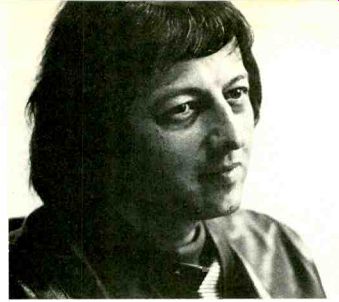
ASK ANY BRITISH passerby to name a conductor, and the first answer will al most certainly be Andre Previn. That is the sort of impact he has had on an audience far wider than those who normally buy records or go to concerts. On BBC Television, Previn's "Music Nights" attract audiences of many mil lions, several times as many as those for potential rivals, and that is so not only for Beethoven or Tchaikovsky, but for a centennial tribute to Vaughan Williams or a program of French music as well.
A couple of Christmases ago it seemed only natural when the peak comedy program of the day, the "Morecambe and Wise Show," featured Previn in a knockabout takeoff on a concerto rehearsal. In finely tailored insults he gave as good as he got. The following Christmas he returned, along with other Morecambe and Wise guests, for a series of "Whatever happened to ... ?" clips.
Previn was shown with a peaked cap over his Beatle cut, holding a ticket ma chine on the platform of a London bus a different sort of conductor.
When Previn was given his own chat show as well as a new music series this past summer, he had Morecambe and Wise as his first interviewees. His second choice was equally significant: the Rt.
Hon. Edward Heath, M.P., now leader of the opposition and an honorary member of the London Symphony Orchestra, of which Previn has been principal conductor since 1968. John Culshaw, once Decca/London's pioneering producer and now head of music on BBC Tele vision, was shaken rigid to see Previn actually wearing a collar and tie. Previn explained that the tie, chosen by his wife (Mia Farrow, also present), was the only one in his wardrobe and that he felt he owed it to the occasion to wear it. But then who should come around the corner but the former prime minister wearing a chunky sweater and no tie.
From all this-and remembering Previn's spotlight career from his teens on ward, through Oscars for film music in Hollywood, jazz piano records, Broad way musicals, and headline marriages it would be easy to conclude that he is a master of publicity rather than a major musician, a pop figure impossible to take seriously in Beethoven's Ninth.
What the British public knows-some thing the American public has perhaps been slower to appreciate, the pop image being more firmly established-is that everything he does is genuine. When he clowns with Morecambe and Wise, he does it not patronizingly to feed his image, but because he enjoys it. He talks to Edward Heath in the same straight-
from-the-shoulder terms he will use with a star-struck kid who asks for an auto graph or, for that matter, a television audience of millions. Everyone who sees a Previn program knows exactly what he is like to talk to.
From the journalistic point of view, al most anything he says is naturally and spontaneously "good copy." He is incapable of being boring, and that goes not only for television programs before mil lions and for conventional press conferences, but for orchestral rehearsals too.
If his work in the MGM studios taught him anything (and he would say it was vital in his development), it was how to work with first-rate musicians, to challenge them, not to bore them, to keep ahead of them but to remain a control ling equal.
His first day as a conductor, when as a teenager he scored his first feature film, the musicians tested him by tuning to A fiat instead of A. Only as he raised his baton did he say brightly, "Right, every body, transpose a half-tone up." After that it was reasonably plain sailing. "As soon as I had conducted for two days I realized that it was all I ever wanted to do. It was an instant and complete revelation." Previn stories are legion. In rehearsal he suddenly asks blankly, "What's that?" Told that it is a triangle, he comments sourly, "Sounds more like cuff links." Or, rehearsing the Leicestershire Schools Orchestra on a particularly illuminating television program, "The Other LSO," he doesn't even stop during a wild run through of Glinka's Russian and Ludmila Overture. At one point the violins come to grief on a rushing phrase, and Previn happily snaps: "Better luck next time!" His comments are tough but constructively so. Professional players, he tells the young musicians, have a way of looking at the conductor without seeming to.
"Now you seem to look, but don't!" He adds with a grin: "Do take an occasional look-you'd be surprised." He goes on to say that he really would rather have a horrendous mistake in playing that was really meant than a perfectly correct "Oh God, I hope I'm right." Not once does he patronize the youngsters. He never patronizes any audience-on television, in the concert hall-and that plainly is the secret of his success. He has his share of showmanship, but it is the actual communication that matters to him, not the means. With all the publicity, he could no doubt have commanded an audience on any terms in the beginning, but the way audiences return, whether for television, concerts, or records (in Britain he sells more records than Karajan), confirms that the promise is kept. After a concert I have seen him drained to the dregs, only to perk up within minutes to a fresh challenge-a story to tell, a sharp comment to make.
He drives himself mercilessly all day every day.
The ever-present parallel is Leonard Bernstein, and there Previn with a deferential shrug does not dissent. Bernstein was indeed a formative influence at several stages. A conscript U.S. Army sergeant at the time of the Korean War ("Well, I could read!", he says, explaining his promotion that far), he first heard Bernstein conduct in San Francisco and was swept away by what struck him as a maelstrom. Two days later, at his next conducting lesson with Pierre Monteux (he was then one of two Monteux pupils), he was asked to conduct the opening of the Brahms Fourth Symphony.
After a few bars Monteux beckoned.
"You went to see Mr. Bernstein? Go back and do it again." After the rehearsal he took Previn aside: "Dear boy, before you try to impress the ladies in the mezzanine, make sure the horns come in!" If Bernstein was communicating an intense experience, Previn came to understand, the showmanship was incidental. And professionalism, not good salesmanship, has won Previn his place in the music world today. From his earliest years in Berlin he was given an intensive classical training at the insistence of his father, who to the end of his days shrugged at any of Andre's Hollywood successes: "Well, it isn't the Eroica." When the LSO made its surprise choice of Previn (a long shot was made at Bern stein, a closer-aimed one at Solti), it was largely because of his efficiency in rehearsal, his ability to get first-rate results with the minimum of pain, the maximum of enjoyment and excitement.
Previn represents the second generation of conductors determined, like Bernstein, to turn their backs on the old mandarin image. "He is everybody's kid brother," says his own big brother (six years older), also a British resident and a successful man in film production. It is not an image that Previn, now in his mid-forties, can perpetuate forever, but he still shows no inclination toward musical high priesthood.
He is always ready to deflate himself, but only so long as it helps his ultimate authority. "Who Needs a Conductor?" was the title of one of his most successful television programs, and with tongue in cheek he demonstrated that the LSO can give a perfectly acceptable performance of a Mozart symphony without anyone wagging a stick. He also showed a rival's trick for coordinating the difficult opening of Strauss's Don Juan: starting be fore the applause stops.
If Previn is not apt to discuss his own technique in depth, it is not for want of self-analysis. Watching his first rehearsal in Salzburg's Grosses Festspielhaus, I saw clearly the technical acuteness: casing the acoustic, adjusting the LSO's sections to the decay time, very different from the Royal Festival Hall's.
It was significant too that his main offering at that important Salzburg con cert-the first ever by a visiting British orchestra-was the first Austrian performance of Shostakovich's Eighth Sym phony (which he had recorded a few months earlier). His concentration over the enormous spans of the opening slow movement and of the last three linked movements deeply impressed the notoriously conservative audience. Formerly counted a brilliant exponent of colorful extrovert music (notably the Russians), Previn now makes his deepest mark in music with a spiritual content too. Hence the Shostakovich Eighth, the most spiritual of that composer's fifteen sym phonies. Similarly on overseas tours he has programmed the two most restrained of Vaughan Williams' symphonies, the Third (Pastoral) and Fifth. Those, he knew, would demonstrate better than anything the special qualities the LSO has acquired in his tenure.
You will still occasionally hear that the LSO has been "Americanized," but that is not even a half-truth. In an important sense it was more American-sounding when Previn took over. Nowadays a smoother, silkier string tone is encouraged (still searingly brilliant when necessary); long-held diminuendos at the ends of movements have you catching your breath. The LSO horn section is the most smoothly coordinated of any in London, not at all brash, while significantly Previn encouraged the appointment of Jack Brymer, Beecham's clarinetist for years in the RPO, as the LSO principal.
Manifestly the orchestra is less abrasive than it was, which I fear is what British commentators, however misleadingly, mean by "American-sounding." Previn himself may do almost any musical job you could name with seeming ease, but that ease is deceptive: He knows what the struggle is like. As a conductor, he is unusually perceptive working with concerto soloists, which reflects not only his clear head and professionalism (helped by his own experience as a virtuoso pianist, with Bernstein among others), but also his uncanny ability to understand the problems of others.
The most difficult struggle has been disentangling himself from his pop success. At thirty he decided that if he stayed in Hollywood much longer he would never escape and so chose to stump the less-than-glamorous (and drastically less remunerative) symphonic circuit. (Even now, as a topflight conductor based in Britain, his earnings cannot compare with his latter-day Hollywood income.) The Houston Symphony named him to succeed Barbirolli as principal conductor, but that was only a temporary stop on the way to the LSO post, which he had already confessed publicly meant more to him than any other.
It still does. He still insists that his tele vision programs and recordings be done with his own orchestra, and though dissenting voices in the orchestra murmur from time to time (hankering no doubt after the mandarin figures of old) no one doubts that Previn is a decisive force in the LSO's success in the concert hall and on record. He may not be the most thorough of orchestral trainers-he is too quick for that, hates to weary his players-and sometimes the string section would welcome a good spell in the class room, but the LSO remains the most consistently inspired of London's orchestras, and for that Previn must take much of the credit.
However Anglicized his life has be come (he loves the Surrey countryside where he and Mia have a delightful early-eighteenth-century home), he keeps, in every sense, his American ac cent. I teased him recently when his narration for Britten's Young Person's Guide to the Orchestra had him saying "brahss" with an English "a" sound, but that is very much an exception. If he is happier in England, it may be partly that he has effectively escaped the unwelcome side effects of his pop success. He can write the occasional musical (his latest, on J. B.
Priestley's The Good Companions with lyrics by Johnny Mercer, has recently opened in London), indulge his catholic musical taste, appear on television, and still emerge as above all a great conductor.
As yet, even in Britain it is color rather than classicism that dominates. But those who remember his Beethoven Ninth at the Festival Hall or his playing of Mozart concertos (whether conducting from the keyboard or with Sir Adrian Boult) and those who relish his annual feast of family chamber music in the Queen Elizabeth Hall during South Bank Summer Music know how wide-ranging his talent is.
In Europe at least the movie-based reputation has long receded behind his hard-won new status. "For heaven's sake," he answered when, at the music editor's request, I asked how he feels about the lingering image problem at home, "there ought to be a statute of limitations. I haven't done a Hollywood film since 1962, and I only see movies on aircraft." The training and experience of his Hollywood years (which, it should be re membered, came in addition to, not in stead of, a normal classical training) have been of lasting value in his "serious" work. Looking at his incredibly var ied career, one is apt to conclude that even the most unlikely corners of it have led almost inevitably to the end result: a compleat musician in an age of soul-destroying specialization, one driven to communicate at every level.
++++++++++++++++
-------------
(High Fidelity)
Also see: