An Ambience Reproduction Speaker System -- by David L. Clark & Bernhard F. Muller; photos by David Carlstrom
"Ambience", as applied to sound, means the sensation of the acoustical space in which a sound is produced. This is generally an enjoyable sensation, and audiophiles have spent much effort over the years to reproduce it. While stereo sound systems can reproduce the recorded ambience quite well, the addition of side and/or rear speakers fed by a delayed version of the signal can dramatically improve ambience reproduction. This is not to be confused with quadraphonic sound and there should be no awareness of sound coming from behind the listener.
Ambience systems are still in an experimental stage and proponents do not yet agree about how they work.
Two basic philosophies can be considered: 1) Extraction of ambience in formation already existing on most two-channel discs and tapes. 2) Synthesis of an ambience by production of a series of delayed "echoes." When synthesis is used, it is usually combined with the extraction technique. In either case, a delay of 10 to 100 milliseconds (ms) is used and the signal emanates from speakers to the sides or rear of the listener.
The delay allows the signal from the front speakers to arrive at the listener first. This is important for two reasons:
1) When any two speakers are reproducing the same sound, the ear tends to perceive the sound as emanating from the nearer speaker even if the loudness of that speaker is much lower. This is the well known Haas effect. The time delay to the rear speakers insures that their sound will arrive after that from the front speakers. Thus rear speakers can be operating, but not heard as independent sources. 2) One of the most important properties of concert hall ambience is the time required for the first reflection to reach the listener. If the delay time is set to approximately match this hall characteristic, an important element of ambience reproduction is achieved.
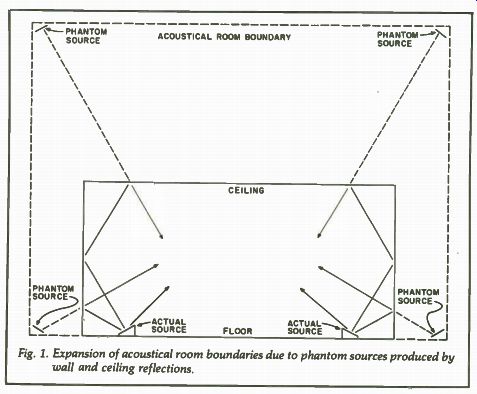
Fig. 1
STEREO AND AMBIENCE
In a natural recording, the delayed reflections are picked up by the stereo microphones, but the stereo speakers do not reproduce the direction from which the reflections came. The listening room wall has reflections from all directions, but they are so closely spaced after the initial sound that they only produce "living room" ambience and partially mask the concert hall's delayed reflections. Side or rear speakers can approximate the direction of arrival of the important first reflection. Thus delay and direction combine to "extract" ambience while preserving a frontal sound. It is important to note that no precise acoustic phasing is used. Therefore, precise listener positioning is not required.
When the audiophile uses delay only to feed the rear speakers of a "quad" system the quality of ambience reproduction is usually only fair. Most manufacturers of delay units incorporate some recirculation which produces multiple echoes to partially synthesize ambience. This helps, but in the authors' opinion, always sounds a bit faked. In any case, it strays too far from an ideal approach to be intellectually satisfying.
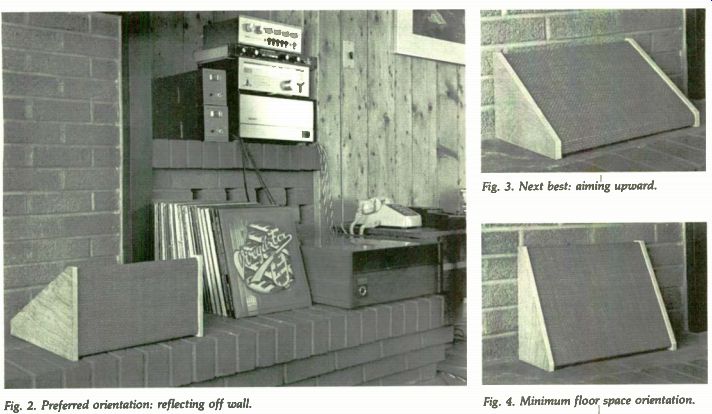
Fig. 2. Preferred orientation: reflecting off wall.
Fig. 3. Next best: aiming upward.
Fig. 4. Minimum floor space orientation.
REALISTIC AMBIENCE ELEMENTS
It appears we need not only a solid "first reflection" from one direction, but additional reflections and from other directions, more closely duplicating the concert hall experience.
This thinking and subsequent experiments leads us to propose the specialized ambience system of six to eight speakers arranged around the listening room walls, which we describe in this article.
Speakers designed for ambience reproduction must meet a different set of requirements from those for stereo speakers or even rear speakers for quad. Good localization and imaging are exactly what we do not want, as this would tend to make the listener aware of the ambience speaker as a sound source. Smooth response is, if anything, even more important than in the "main" system as any coloration tends to call attention to the speaker.
We have experimented with a number of ambience systems and have found two channel delay feeding ambience speakers to give the most natural results. The authors' experiments included using difference in formation un-delayed and delayed, sum information delayed, and stereo delayed. The optimum delay depended on the type of music being played, and a reverb effect with recirculated delay only "muddied" the sound. Whether all.
the ambience speakers were connected in phase, out of phase or in random phase resulted in different effects, but all were pleasant.
WHERE DO WE AIM?
During listening evaluations in the design stages of the ambience speakers we used a delay of difference information fed to all speakers in phase. Source material was primarily classical music from disks. Initially we used a pair of conventional high quality bookshelf type speakers. The most satisfactory results were achieved with the speakers situated to the side of and behind the listener. "Pointing" away and slightly upwards toward a wall. We achieved good results in this manner, but the optimal listening area was small and level adjustment was critical to avoid "hearing" the ambience speakers. We decided to adopt the angled wall reflection principle for the final design, but further experimentation was clearly necessary.
The wall reflection aiming of the ambience speakers works so well, we believe, because it produces "phantom" sources outside of the room boundaries. The phantom source effect, illustrated in Fig. 1, is much like the visual images which would appear if the room had mirrored walls. The larger number of sources reduces the ability to localize any one source and also increases the number of directions from which the sound arrives. Both effects, in our judgment, more closely approximate the reflections one receives in a good concert hall.
In our next experiment, we distributed ten small speakers about the walls of the room including the one in front of the listener. Things got very interesting because level setting and listener position both became non critical. It was possible to be anywhere in the room, even very near one of the ambience speakers and not be sonically aware of it's presence. It became almost painful to turn off the ambience and listen to the lifeless sound coming from the front speakers alone.
WHICH SHAPE BOX?
Having decided on a system of multiple speakers reflecting from walls, we next optimized the design of the small speakers. The Phillips AD5061 5-inch full range driver was chosen on a price/performance basis. A sealed enclosure was chosen for its smooth low frequency rolloff and hence good transient response. A cabinet volume of 8.21 liters (500 in^3) gives a critically damped response down to 125Hz and controlled cone excursion below that.
We first constructed a nearly cubical box of 8.21 liters with the driver firing at a 20° angle from the top. This shape's deficiency in bass and considerable coloration made it un suitable. We traced both problems to diffraction around the baffle. At certain frequencies the sound bounced up from the floor and combined, out of phase, with the directly radiated sound.
We then designed a thin, wedge shaped 8.21 liter cabinet with the driver facing upward. The bass was restored and the coloration disappeared. Apparently the speaker was effectively "flush mounted" in the floor.
We noticed that as the speaker was moved toward the wall ( < 0.3M) to get the desired reflection, another coloration would develop and become severe at very close spacings. As we altered the wedge angle to make the speaker fire more directly at the wall, the coloration became worse. With large angles from the wall, such as aiming straight up, the reflection action disappeared. By experimentation we chose as ideal an angle of 60° from the wall.
This gave a desirable reflection path with minimum coloration at a reasonable distance from the wall.
In some rooms it may be impossible to fire all the speakers at the wall. Figs. 2, 3, and 4 show other possible orientations. In practice some of the speakers may have to be "stored" flat against the wall and brought out only for "serious listening." Fig. 5 shows the response curve with eight units operating. It is smooth with a "natural" looking high frequency rolloff due to room absorption.
BUILDING THEM
Construction is straightforward (see Figs. 6, 7, and 8). After gluing, the front panels may be fastened together with an insulation stapler and the brace ...
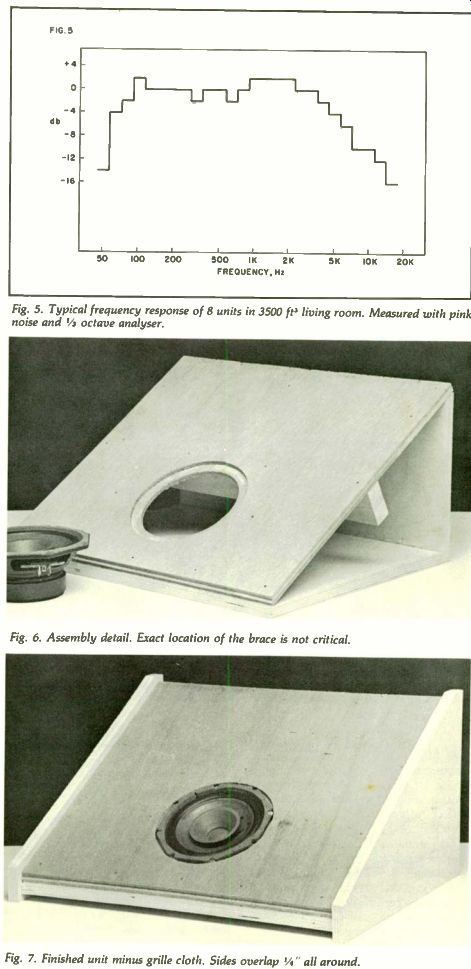
Fig. 5. Typical frequency response of 8 units in 3500 ft^3 living room. Measured
with pink noise and 1-3 octave analyzer.
Fig. 6. Assembly detail. Exact location of the brace is not critical.
Fig. 7. Finished unit minus grille cloth. Sides overlap 1/4" all around.
...added as shown. The easiest procedure is to assemble the bottom, back and sides first. After the glue is dry, the front panel is added and glued. If you have a router, it is better to make the front panel out of a single piece of 0.5" plywood and rout out the speaker recess. Fill the entire cabinet loosely with 1ft^2 of 3.5" thick building insulation Fiberglas . Make sure the box is airtight.
Fig. 8. Cutting guide for pieces of cabinet, one enclosure. If the builder has a router the speaker front panel can be made from 0.5 " plywood and routed deep enough to mount the driver flush with the front face of the cabinet. Baffle board should be stained or painted black so speaker is not visible after grille cloth is mounted.
Fig. 9. Speaker hookup diagrams. A. Four 8 ohm speakers per channel in series/parallel. B. Three 8 ohm speakers per channel, parallel with an added 1.2 ohm resistor to raise impedance to 4 ohm, the minimum most amplifiers drive comfortably.
The speaker can be mounted without screws using "silicone seal" but may be troublesome to remove later. A better, more flexible alternative is non hardening "weather caulk" and screws.
If you install insulated spade type solderless connectors you will be able to experiment more easily with phasing and channel reversal.
Ten to 15 watts per speaker should be sufficient. An integrated amplifier with tone controls would be ideal since this would allow broad spectrum balancing. Eight speakers should be hooked up four to a channel in series/parallel. If only six speakers are used, they should be hooked up three per channel in parallel. Since some amplifiers become unhappy with a 2 Vail load, a 1.212 10 watt resistor can be used in series with the speakers, (see Figs. 8a and 8b). This reduces damping slightly but has a negligible effect on sound.
FINAL RESULTS
The end result of our work is a system which has produced the only spectacular improvement in the authors' sound systems in over ten years of reducing "TIM", sub-woofing, time aligning and dozens of other "upgrades."
Also see: