How to Improve That Small, Cheap Speaker --by Paul J. Stamler photos by the author.
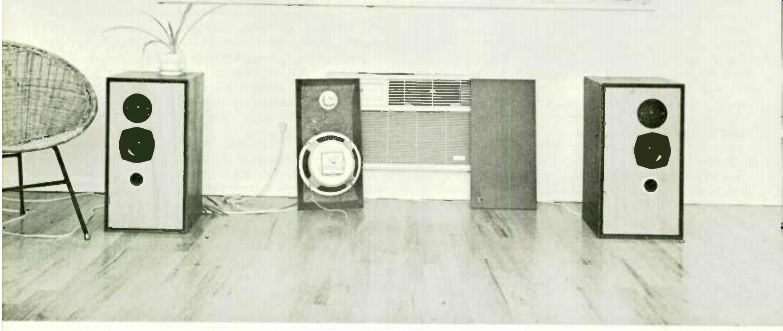
Author's two modified speakers and his disassembled central bass speaker.
The modified units cover all but the very lowest bass, below 40Hz.
by Paul J. Stamler
For the audiophile of average means the pursuit of high-quality sound is frustrating. Prices are going up like helium balloons, and the number of genuinely low-priced, natural-sounding components can be counted on one hand.
My own system can best be described as "rock-bottom audio amateur"-AR turntable, homebuilt Quest preamp, modified Dynaco Mark IV power amps, and a battered Teac reel-to-reel deck-representing a total cash outlay of around $200, exclusive of speakers. The signal sources are OK, if not spectacular; the electronics are top-notch.
The speakers, however, are another story. They were a high school graduation present back in 1967 (is it that long ago?) and were far from the state-of the-art even then. Time has not improved them. I've known they were the weak point in the system for quite a while, but put off replacing them because I could not afford anything I liked.
I took the speakers apart a few times to replace loose mounting screws (acquiring some nicely magnetized screwdrivers in the process), and noticed the cabinet itself was well made.
When W. J. J. Hoge's excellent article on vented-box speaker design appeared (Audio, August, 1978, pp. 47-55) 1 decided to take the plunge and replace the drivers. (I was also egged on by a persistent buzzing in one of the tweeters.) The resultant speaker systems, while nowhere near the cosmically unaffordable state-of-the art (Quantum Reference Sources, Double Quads and the like), are nonetheless quite easy to listen to, and I venture to say they outdo in naturalness any other system in the $70-apiece range-which is what they cost.
DRIVER SELECTION
I first established the box's approximate internal volume. With due measurement I came up with about 36 liters; now to check out some bass drivers.
In his Table I Hoge lists appropriate specifications for a number of available woofers: diameter, free-air resonance (f,), total system Q (Q ri), equivalent air mass (Vas), and reference efficiency. Since my cabinet is limited to drivers of 10' diameter or less, my choice was narrowed to six drivers: the KEF B110 and B200, the CTS 6W10C and 10W18C, the Eminence EM40 and the Australian Magnavox 8-30. The next question was fundamental: what did I want the speakers to do? Here let me emphasize an important fact: with the exception of pipe organs, synthesizers, and the seldom-used lower eight notes on a piano, virtually no music has sounds below 42Hz, low E on a bass fiddle or bass guitar. In fact, on most available records, if anything below 40Hz is audible, it's likely to be cutting-lathe rumble, air conditioning noise, or warp -not music.
I can sense the "hall-ambience" fanatics out there gearing up for conniptions at that last statement, so let me hastily rejoin that while they may be right about some of the better classical recordings, I listen most to recordings of traditional folk music of one sort or another; most of this is recorded with multi-mike close-up techniques, eliminating hall ambience.
(An exception is Missouri Friends of the Folk Arts' marvelous recording, I'm Old But I'm Awfully Tough -field recordings of Ozark vocal and instrumental music, recorded using coincident microphones and mastered with exceptionally high quality. For details write Missouri Friends of the Folk Arts, Box 307, New Haven, MO 63068.) So for most purposes, a cutoff frequency (f3) of 40-45Hz is entirely adequate. But an adequate cutoff is not enough: the frequency response must also be reasonably flat, free from major dips and peaks. Hoge gives two equations, derived from the pioneering work of A. N. Thiele and R. H. Small, that make these calculations relatively simple:
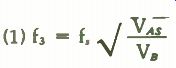
... where VB = the internal volume of the box.
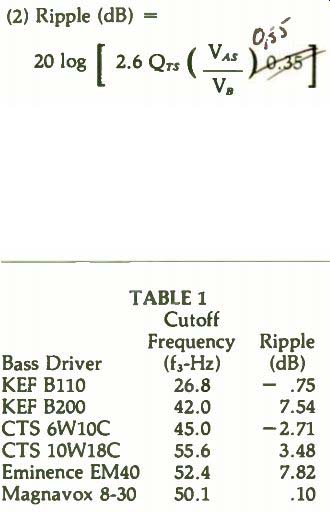
(2) Ripple (dB) =
So let's haul out our log tables and do some computations. (I do not own a calculator!) Given an approximate VB of 36 liters, we come up with the following figures: TABLE 1 Cutoff Frequency Ripple Bass Driver (f3-Hz) (dB) KEF B110 26.8 - .75 KEF B200 42.0 7.54 CTS 6W10C 45.0 -2.71 CTS 10W18C 55.6 3.48 Eminence EM40 52.4 7.82 Magnavox 8-30 50.1 .10 Clearly we can eliminate the KEF B200, Eminence EM40, and CTS 10W18C for high cutoffs, high ripple, or both; the CTS 6W10C might be acceptable, but it still has almost 3dB of upper-bass dip (the negative sign denotes a dip well above f3, whereas a positive sign means a peak just above f3). And although the Magnavox is very flat, it cuts off at 50Hz -besides being hard to get. So by process of elimination we arrive at the B110.
Note the various possible com promises: we could have sacrificed some bass response with the Magnavox and gained efficiency (its reference efficiency is .86%, as opposed to .18% for the B110). The B110's response is a bit lower than I'd like, leading to its lower efficiency (see Hoge for the cabinet size/frequency response/efficiency tradeoff). We must consider one other factor.
The B110 was designed to cover both bass and midrange frequencies, and is known to be a very high-quality per former in the midrange; it is used in the Webb transmission-line speaker and the LS3/5a, among other fine systems.
Much of the driver's lack of midrange coloration can be attributed to its small size and to the fact that its cone is fabricated from Bextrene. This doped-plastic material allows a cone to be made both stiffer and lighter than an equivalent-sized paper cone, thereby achieving better transient response with less cone breakup. Bextrene is also more opaque acoustically, meaning that sounds reflected within the cabinet will be less audible through the cone, and it is less susceptible to changes in temperature and humidity than paper.
So, taking all these factors into ac count, I settled on the KEF B110 for the bass driver and the KEF T27 for the tweeter (why break up a proven combination?).
DESIGN
Now it was time to begin working more exactly. I found the box's internal volume to be 25.0 X 27.5 X 54.0cm., for a volume of 37.125 liters. The corner blocks and braces inside the box added up to 1.142 liters, the speaker magnet occupied the equivalent of two cylindrical sections totaling .151 liters (V = Height • Trr2) and the speaker's truncated cone occupied .082 liters
(V = ( ri 2Hi - r 22H2) . -J )
...where n and H, refer to the base radius and height, respectively, of the cone un-truncated, while r 2 and H2 refer to the base radius and height of the truncation. All these items added up to 1.374 liters, so the net internal volume was 37.125 - 1.374 = 35.751 liters.
I realize these calculations, particularly those involving the cone volume, may seem to be a bit hairsplitting. And so they are, but they're fun -and in the case of a bigger driver than the B110, they would make considerably more difference.
Using 35.75 liters as my calculated box volume (we'll let that 5th significant figure drift away), I computed f3 as 26.94Hz, and the ripple came out as - ,73dB -not bad. The next step was to calculate h, the frequency to which I had to tune the box: ...
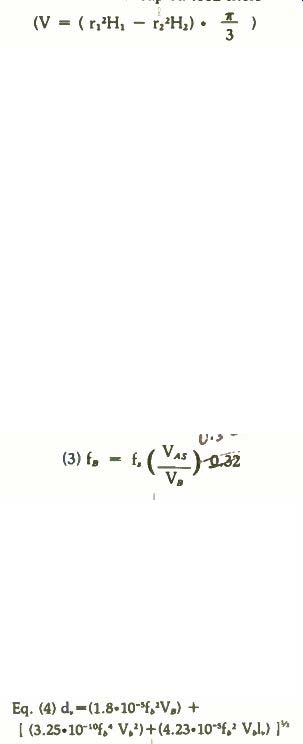
... which came out to 28.34Hz. To achieve a tuned box, one can either use a simple port (hole in the wall of the box) or a ducted port, of greater length and diameter. I decided to try the simple port first. Given VB, ft, and l v (the thickness of the panel - in other words, the length of the port), the necessary diameter (d) is given by the following ghastly equation:
Eq. (4)
For a tube with an inner diameter of 4.6cm, the length worked out to 13.99cm, not bad at all. (A larger diameter yields a longer duct.) The design was now almost complete, ex cept for one thing. We calculated the volume of the box to be 35.75 liters, taking into account the volume of the drivers, bracing, etc. But we must also take the volume of the vent into ac count as well. It does not form part of the box volume. The vent's volume works out to .232 liters, so the new box volume is 35.52 liters. If we recalculate we have f3 = 27.03Hz; fi , = 28.39Hz; l k = 14.04 cm, and Ripple = - ,71dB. Since 1„ changed by a mere half millimeter it is probably not worth it to go around again, but some designs may make enough difference for the third iteration. The design is now complete.
Gulp! After wading through this mess, I came up with a vent diameter of 2.1cm-awfully small. A hole this small tends to create air turbulence and whooshing noises -more realistic with pipe organs and calliopes, perhaps, but not generally desirable. So I decided to try a ducted port instead. If dv now is used to denote the internal diameter of the duct, and 1, is the length of the duct then:
[5] <5)i. - »»/.y1 -' - * B
CONSTRUCTION
Building the speaker was fairly straightforward. I cut the new front panel from 1" Luan mahogany, but another well-seasoned hardwood would have done as well, as would hardwood plywood or top-quality chipboard. I chose the mahogany because 1 liked its looks. Bob Abrams, a fine St. Louis instrument-maker and musician, and Peter Lippincott, itinerant carpenter and contra-dance caller, helped me with the woodwork.
We mounted the baffle-board in the box with the same screws that held the old ones; I marked the spots from the inside of the cabinet with a gimlet, then drilled my %" pilot holes. We cut out the speaker holes with a jigsaw.
The woofer mounted with bolts and T-nuts, and here I ran into a small problem: a 1" thick mahogany panel is actually 3/4" thick (damn this nonsense!), and the fixing bolts supplied by KEF are %" long, not enough to clear the panel and engage the T-nuts. Since I discovered this at 11:00 on a Saturday night, I borrowed some longer bolts from a very good friend, screwed in the woofer to engage the T-nuts, then removed the long bolts and replaced them with KEF's originals which look ed better.
The tweeter mounted easily with wood screws. I made the duct from a section of mailing tube, soaked in polyurethane varnish to improve its stiffness, and I mounted it in its hole with a somewhat unorthodox sealant, cornstarch-and-soda modeling clay. It seems to work all right, and should present no problems as long as no one spills beer on it.
The crossover's external mounting
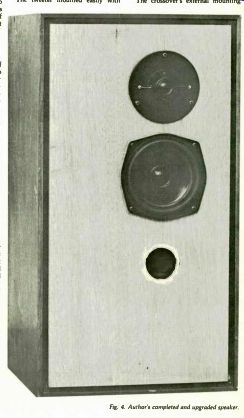
Fig. 4. Author's completed and upgraded speaker.
will facilitate possible biamping, should I get ambitious later on; I brought out the driver wires through small holes in the back, sealed with more modeling clay. I feel a bit more dubious about the clay here, and may replace it with epoxy one of these days.
I first damped down the box's internal reflections with 1" fiberglass sheets on the walls, but I replaced them after a few days with a 6" batt of fiber-glass from the local Speakercraft.
The bass sounded tighter with the thin fiberglass, but there was an overall boxy sound that the 6" batts tend to diminish.
Fig
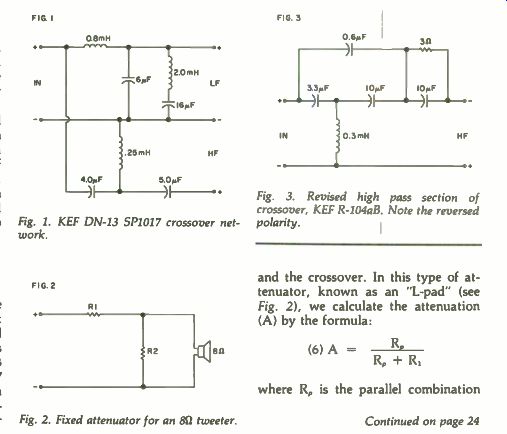
1. KEF DN-13 SP1017 crossover network.
Fig. 3. Revised high pass section of crossover, KEF R-104aB. Note the reversed polarity.
CROSSOVER
As I was in a hurry to finish these speakers, I chose the route of least resistance (leaving capacitance and inductance aside) and used KEF's stock dividing network, the DN-13 (see Fig. 1). 1 discovered the T27 tweeter is pretty hot compared with the B110 woofer, and installed a simple attenuator between the tweeter FIG 2 an Fig. 2. Fixed attenuator for an 8Q tweeter.
and the crossover. In this type of attenuator, known as an "L-pad" (see Fig. 2), we calculate the attenuation (A) by the formula: (6) A = R, Rp + R, where Rp is the parallel combination
o f Ri and the speaker's 8-Ohm impedance. Since and Ri + Rp = 8 ohms, in order to properly terminate the crossover net work we can combine equations to obtain:
(8) R, = 8(1-A) (9) R„ = 8 - Ri (10) R = --- = ---- (1/R„, - 1/8 (1/RP) -.125
To save a little work, Table 2 lists the appropriate values for various levels of attenuation. (I finally settled on 14dB.)
TABLE 2 Attenuation Ri Q R2 Q
.707 (3dB) 2.4 19
.500 (6dB) 4.0 8.0
.316 (10dB) 5.5 3.6
.250 (12dB) 6.0 2.7
.200 (14dB) 6.4 2.0
HOW DO THEY SOUND NOW? and HOW MUCH BETTER COULD THEY SOUND?
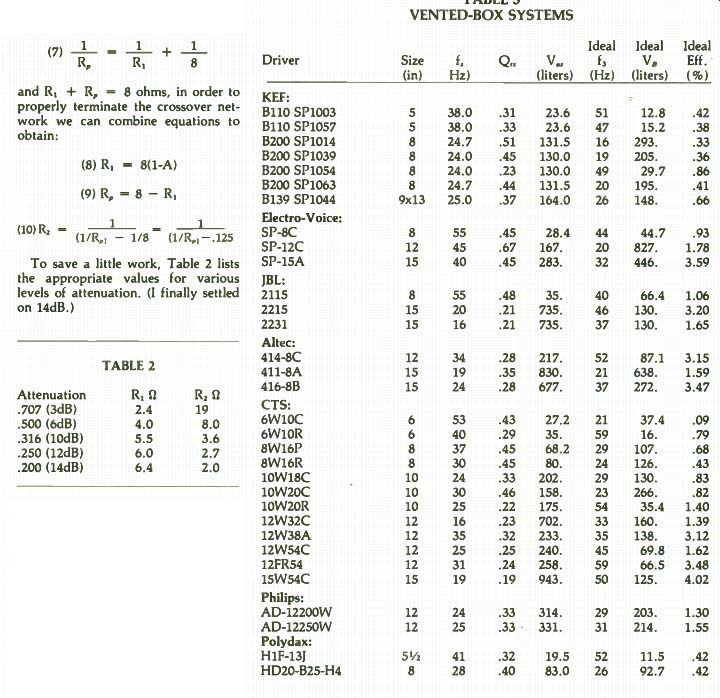
TABLE 3 VENTED-BOX SYSTEMS
Now that the tweeter has been tamed, the speakers sound pretty good, although not perfect. My eventual plan is to replace the fiberglass with BAF wadding, which should stamp out much of the boxiness without over-deadening the bass. I should emphasize that the bass-deadening is quite slight, and still much preferable to the former boxiness -not to mention still sounding much better than the speakers did originally.
Another mechanical improvement high on my list is the installation of braces across all the long panels (1 X 1's should be adequate) and panel damping with bitumenized felt. Researchers have more strongly realized the importance of panel resonances in re cent years - in some commercial speaker systems, including some very expensive ones, the panels radiate more at certain frequencies than the drivers! I can feel some vibration in these speakers on bass notes, which I shouldn't be able to do, so some panel damping and bracing is definitely in order.
With the BAF wadding replacing the fiberglass (less toxic, too), and the panels well-damped, the boxiness should be thoroughly banished. BAF wadding and bitumenized felt are both available by mail order from Falcon Electronics, Tabor House, Norwich Road, Mulbarton, Norwich, Norfolk NR48JT, England - their catalogue is an absolute goldmine for the home speaker constructor, and is available for a dollar bill. They even include sample swatches of grille cloths! The one remaining problem is a slightly sizzly high end, and the insertion of further attenuation cuts the lower frequencies (around 3.5-8kHz) too much. That this is not an inherent problem with the T27 tweeter is shown by its superb performance in the KEF R-104aB system and the Rogers LS3/5a. Both these speakers, it is instructive to note, use highly complex crossovers to deal with precisely this problem; Martin Colloms, in his excellent High Performance Loudspeakers (New York, Wiley, 1978), outlines the approach KEF's engineers took to solving the problem, which is an outgrowth of the fact that a speaker coil is far from being a resistive load.
The new R-104aB network, shown in Fig. 3, provides a more accurate frequency and phase response for the T27 than the stock network, and 1 may in stall it. Another possibility is the LS3/5a crossover. The latter, as well as the treble section of the R-104aB, is also available from Falcon Electronics.
Whatever I do to the crossover, I'll probably replace all the capacitors with mylars, just on general principles.
Or I may simply bi-amp the things, using the two Acrosound amps that have been gathering dust in a closet for a while.
Following the lead of Rogers, AR, Electro-Voice and other manufacturers, I added a ring of absorbent material around the tweeter to eliminate cabinet-edge diffraction and woofer-cone reflection and cavity resonance. The difference is dramatic, and not at all subtle: the slight hollowness of the midrange simply vanished, the tizzy quality on the top changed to a much cleaner, more effortless sound, and the stereo imaging improved drastically. I would strongly urge anyone whose speakers do not have some form of diffraction prevention (meaning nearly everyone) to try the experiment. Make a doughnut shaped ring out of a wad of ordinary drugstore type cotton by poking a hole in the center and spreading the fibers.
Attach it to the front of the speaker, surrounding the tweeter with a space of about 1cm between the doughnut and the tweeter. Make sure the cotton is flush with the front of the speaker cabinet by using some double-stick Scotch tape; there should be no space for the sound to go except forwards.
You should notice quite an improvement. If you want to make the modification permanent, cotton doughnuts are somewhat unsightly, so I would recommend instead making a doughnut from soft Vi" felt (non bitumenized) and gluing it to the front of the tweeter. Taper and roughen the inside of the doughnut-hole to avoid cavity resonances. No joke -1 know of no greater improvement in audio that costs so little.
GO THOU AND DO LIKEWISE
If you should have a pair of speakers that you feel like upgrading, your design process will resemble mine. To speed up the process a bit, I've provided Table 3-data similar to Hoge's Table 1, with additional data on ideal cabinet size (i.e., maximally flat response) and low-frequency cutoff with that ideal cabinet.
To use the table, measure your box and compute its approximate volume (remember that 1 liter = 1000 cubic centimeters). Now look in the table for drivers whose ideal box falls between .7 and 1.4 x the size of your cabinet, with favorable bass cutoff figures. If all is to your liking, measure your box more precisely and charge ahead.
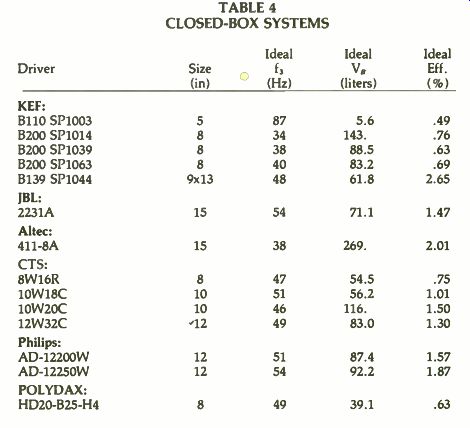
Some of the drivers turn out to re quire very large cabinets, with a very low bass cutoff (the KEF B200 SP1014, for example). While they make very fine subwoofers, the intended use of these high-Q drivers is in closed-box systems. For this purpose, I have prepared Table 4, listing box volume and cutoff frequency for a maximally flat closed-box system. Again, find a driver whose ideal box size falls between .7 x and 1.4x your cabinet volume. Within these limits, the bass cutoff should vary no more than 1.5Hz, with no more than ,33dB of ripple. Once the driver is chosen, no further calculations are necessary--closed-box systems are inherently simpler to design than vented box ones.
Incidentally, the eagle-eyed may spot some differences in data between my table and Hoge's. My data were obtained, for the most part, from manufacturers' data sheets, while his are the result of his own tests. At press time, we are in correspondence to try to resolve the discrepancy. Of the drivers listed only one besides the KEF units is made with Bextrene - the Polydax HD-20-B25-H4. 1 am currently attempting to collect data on other Bextrene drivers, notably Dalesford and Celestion, and will report them as soon as possible.
You have probably noticed a certain partiality on my part towards KEF drivers. I derived this from many sources, including: their fine performance in many high-accuracy commercial systems; the cooperativeness of the company in supplying crossover designs for a particular driver's actual characteristics; their relatively low price; their suitability for the bookshelf-type systems so many of us ...
TABLE 4 CLOSED-BOX SYSTEMS
... are blessed/cursed with from earlier times; and a certain rather overt Anglophilia. Be advised that the drivers are not worth buying from Falcon: the shipping charges are so high, due to the drivers' high density, that you wind up paying the same price you would here and waiting a lot longer. 1 bought mine from Victor's Stereo, 5701 W. Dempster, Morton Grove, IL 60053; you can locate other dealers by writing to KEF for their dealer list (KEF, Intratec, Dept. E, PO Box 17414, Dulles Int. Airport, Washington DC 20041) or through the classified ads in SB, TAA or Audio.
My drivers cost $127, plus $1.85 U.P.S. charges; the wood cost $15, and the fiberglass was about $3.00. CONCLUSION Upgrading a pair of not-so-hot speakers is not a particularly daunting task; I finished the main part of the design and construction work over one long weekend, and I'm not by any means an experienced woodworker.
Although the speakers are not perfect, nor are they state-of-the-art, I do feel they are state-of-the-$140-art and a vast improvement over what I had.
To those folks who feel intimidated by the math involved in the design pro cess, I offer my sympathy and the following cautionary tale. Be not discouraged!
MUSES AND MUSIC
Since the music moves you-the muse is almost surely able to do so as well. The writer's muse, that is.
Put pen to paper or better yet, typewriter ribbon to paper with a clear, orderly account of your adventure in speaker construction, or any related field of endeavor leading to good listening. Send it along with a stamped, return envelope. We pay modestly for articles, so if your muse moves you, write us about it and we'll answer promptly with suggestions and saying whether or not we have such an article, whether one is already in preparation, or whether we are interested. Some of our best articles come from people who have never before written for periodicals. And if your muse is as silent as a tomb, don't let that stop you. Write anyway and let's see what develops. We have a nice sheet of suggestions for authors which we will send to nearly anybody who asks for it.
A CAUTIONARY TALE
In the beginning the Lord created the heavens and the earth, and the moon and the stars, and the land and the sea, and the fish that swim and the birds that fly, and he told all of the animals to go forth, and be fruitful, and multiply.
After a time the Lord decided it was appropriate to inspect his handiwork, so he went down to Eden to look around.
All seemed to be well: the beavers frolicked in the water, with little beavers playing in the shallow places; the birds fluttered about their nest, while the little birds cheeped merrily away; even the elephants lumbered proudly along with a baby elephant tagging behind. The only discordant note was sounded by two forlorn snakes who sat pathetically alone in a deserted clearing. The Lord was moved and concerned, so he quietly walked into the clearing and asked, "Is anything the matter? Everything! moaned one of the snakes. There s nothing we d like better than to follow your directive, and be fruitful and multiply and all that, but we can t-because you made us adders! (Note: those of you who are already groaning had best bear up-there is far, far worse to come.) Well, the Lord admitted he had made a terrible mistake and he couldn’t come up with any obvious way to correct it.
'However, " he said, "I promise I'll think as hard as I can about it. In the mean time, you might consult with some of the other animals; one of them might have a solution. " So the Lord went back to Heaven, and thought and thought until tears came to his eyes; but try as he might he could not think of a way out. Reluctantly, he journeyed back to Eden to admit defeat.
When he got to Eden, however, things seemed somehow different. The beavers winked and grinned as he went by and when he arrived in the clearing he found a huge fallen tree. From the tooth-marks at the base he could tell it was the beavers work, but this was the least of his interests. For sitting on the side of the tree, smiling and beaming like any proud parents, were the two snakes-with fully a dozen snakelings wriggling happily around them.
"Well!" exclaimed the Lord. "I had come down here to confess that I couldn't solve your problem, but you seem to have done quite well without me. Tell me, how did you do it? Being adders, how could you possibly succeed in multiplying like this?" "Ah, " said the mother snake. "Even adders can multiply-on a log table!"
Also see:
An Ambience Reproduction Speaker System
Tools, Tips & Techniques-- Fred Gloeckler's simple, practical, speaker stands