Sage advice on the end result we seek using loudspeakers--and some simple tests for knowing when we have--or haven't --arrived
by Alan G. Watling
Some 35 years ago I was standing in a room in a German telephone exchange, looking at some of the line amplifiers which relayed Berlin studio programs to other centers. A German voice said something behind me, and I turned to see-nobody. There instead was the monitor loudspeaker on its short pillar, a 12" cone unit with a chamois leather surround mounted in a plain baffle board about three feet square. Behind it was an enormous DC energized magnet.
There it stood, talking at me with a positively uncanny naturalness. It started a trail for me that still intermittently fades out, restarts in another direction, gives a glimpse of a repeat performance which tantalizes or for all the wrong reasons improves on my memory of that brief glimpse of natural sound reproduction. Such is the fascination of hi-fi. It is instructive to recall some of the technical facts behind that event, if only to compare them ludicrously with the current parameters considered essential to any approach to reality.
The source was almost certainly a moving-coil mike, although just possibly an early capacitor type was pressed into service. The line from the studio was, I can guarantee, 3dB down at 50Hz and 8kHz with a few dB bumps in between. The noise was a little better than 45dB down. After the monitoring tap off the line amplifier transformer (rather loose laminations and a nasty peak at 12kHz) the signal went to a valve amplifier that would have made a useful trailer heater. Six watts triode output at 5% distortion-and that's about all the available measurement of its shortcomings.
It was well supplied with wirewound resistors and paper capacitors and had fixed bias. It did boast a splendid out put transformer (and one on the input too!), and it was beautifully bolted together in the fashion of the day. Lots of grey and silver paint and a smell of hot shellac. I have no doubt that on music it would have revealed a few aberrations, but that source was not available then. After all this time, I am still convinced a modern loudspeaker of comparable sensitivity could not have worked the miracle under those conditions.
MORE IS LESS
A modern transducer would certainly have shown up the line noise, the distortion on peaks, and some coloration on mid-bass (maybe even added some), and would have made me aware, by its obtrusive nature, that I was in its presence before I had even turned round. And the frustrating thing is it will still do it today with a super-quiet distortionless amplifier and undreamed of source equipment.
If you're wondering what I'm getting at, my point is that an unobtrusive loudspeaker that does not come be tween you and reality is very, very rare -and when you find it, it will change with the source material. That, is your Holy Grail, somewhere through the paths of chipboard and trees of long-fiber wool, hidden perhaps in the labyrinth, or a mirage in the shimmer of electrostatic diaphragms. Certainly nothing can make the adrenalin flow like the first sound from that magic box -especially if the box is still warm from the sand paper held in your own hands.
NATURALNESS RECIPE
What did the German monitor speaker have that was so good? Well, first of all, it did one thing we now do electronically, if we are sensible: its response favored the signal band width and ignored the hash. Then it was working well within its power capabilities. Next, the added coloration due to an open baffle was negligible. The damping on the voice coil was very good due to the enormous magnet, and the amplifier, though not a negative feedback design, helped along this road with a low triode impedance and a well-matched output transformer. The cone material was probably quite linear over the speech bandwidth, and the soft surround did not set off too many break-up resonances. Finally, the whole thing was well away from reflecting walls and a couple of feet off the floor.
If we built this speaker today, and kept to the same rules, the result would be the same. There's nothing really magic about pushing the air about with an electro-mechanical-acoustical transducer-it's a matter of knowing the physical laws that govern the pro cess and establishing their relevance to the particular sounds you intend to produce. I don't say it's easy, but it is a predictable exercise and the results, emotional as they may be, respond to good engineering and intelligent analysis.
AMATEUR VS. MANUFACTURER
The problems of making good speakers are different for the manufacturer and the amateur. Apart from a large capital investment in machinery, staff, and test gear, the manufacturer has an enormous quality control task. Practically everything he puts into his pro duct affects the sound: cone material, wire, chassis, damping material -even the finish on the cabinet. Consistent results over a long period become a major occupation. Manufacturers like KEF try to factor out the variables by using more stable materials for diaphragms and complex testing techniques to check the final response against a standard. At the other end of the scale Peter Walker of Quad relies on a electrostatic design which is more predictable than the moving coil, but faces a completely new set of problems in sensitivity and power bandwidth.
Good and consistent results don't come cheaply in the top brands.
The amateur has only to put together two or, at the most, four assemblies, and he has time on his side.
Usually lacking the complex testing equipment, he nevertheless can do wonders with reliable source material and a good pair of ears. The debatable quality of the source probably causes the most heartache. If you lack access to master tapes or discs which have not been equalized out of sight, you could do a lot worse than make a home recording with as good a microphone as you can lay your hands on.
TAPING A TEST
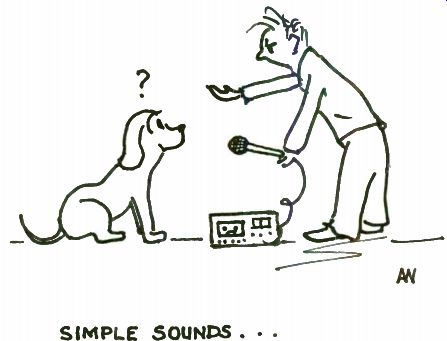
Taking the greatest possible care not to over-record, tape a series of simple sounds which can be repeated live for comparison when you test the speaker.
Notes on a musical instrument are fine, but sounds like two bits of sandpaper rubbed together, knocking on a plank of wood, and of course speech are all revealing tests. Record out of doors if you can, to avoid the additive effect of room acoustics. If this is impossible, make an absorbent studio by draping a comforter over a couple of chairs and do a bit of close miking. You will probably be appalled at the first results, but they'll teach you a lot about live and reproduced sound levels. Ignore the background noise for the moment and concentrate on the absolute quality.
Your first tests are best done in mono with one speaker. Then use two in double mono, which is a severe test of matching equality. Your ears are a little bit more critical of small colorations when they are not busy sorting out clues for stereo. Some so-called linear phase designs give peculiar results in double mono, and all but a very few of the best do not give a central image when the listener stands off the central line. More of this later.
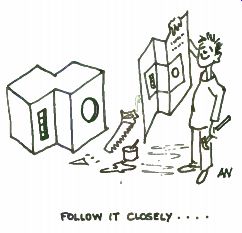
If you are going to follow someone else's design, then do him the courtesy of following it closely. In particular, use the model and make of unit he specifies. It doesn't matter if you have heard a superb tweeter in some other speaker-that may have resulted from a host of unrelated conditions. The designer must at least have taken the sensitivity of his chosen unit into consideration when he burnt the midnight oil. If he has done his job properly, he has also matched the natural cut-off frequency of his unit to that of the crossover network and to the units above or below the bandwidth it covers. You may think he's a bit nuts to have mounted the tweeter in the middle of the baffle with the mid-range on top; it will take you two weekends and a lot of sawdust to prove him wrong.
JUDGEMENT DAY
Perhaps you are a real beginner, with no recorder and little theoretical knowledge; this is your first effort at providing a worthy outlet for the ex pensive record player and amplifier which have made you a poor man before your time. OK, you will have to judge your efforts by the degree of satisfaction you get from your records, which will be your kind of music and your kind of sounds. Don't be put off by unimpressive results: that's perhaps the best indication you could have that you are on the right path.
By all means play a familiar disc, but remember your brain will be comparing it with images laid down over many repetitions through different equipment. "I heard things I have never heard from my discs before"--but are they worth hearing? Are they some new resonance that will take you the next two years to program out of your memory banks? That's what the ads don't tell you. Also your design was put together by some fallible human being with his own favorite source material. It is absolutely shattering to discover what some reputable manufacturers use as reference material. Wherever possible, go for the most natural recordings without synthesizers or amplified instruments.
Direct-to-disc issues are one way of avoiding the studio alterations, but check a few reviews before you go raving mad.
All my previous observations apply even more stringently to final testing on stereo characteristics. If you read the current articles on image positioning you will realize much more is still to be learnt on producing an illusion which is stable over a wide listening area. In many ways the design which produces the best power bandwidth and off-axis response is not the best for that subtle quality of depth in a stereo image. In fact, I have not yet found the best combination, despite bashing holes in walls (see TAA 1/74, p. 16) and eliminating the worst faults in small speakers. Again, the most reliable tests result from using the simplest microphone arrangements; Blumlein coincident-mike technique may not suit all the hi-fi ears, but it does produce consistent and reproducible image positioning.
BEFORE SMASHING
At about this point in the proceedings you will be feeling a bit dispirited. The nearly-finished design (minus its feet, grille, and a good deal of cosmetics) sounds just like a lot of other loud speakers, only more so. For the fiftieth time you put on the bass drum in Limehouse Blues and feel you are missing something.
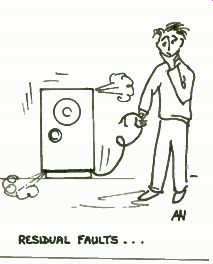
Pack up the tools, light a pipe, talk to your wife (will she be surprised!), have a drink -do whatever makes you forget about loudspeakers. Put the whole thing aside for a couple of days and allow your ears to recover from listening fatigue. More loudspeakers have been smashed to bits just when they were near the end of the road than at any other time. Even if you think you have reached the ultimate, sleep on it and have a crafty listen before breakfast the next morning. The residual faults will shine out like beacons.
What you then do about them will set you off on the best thing that can happen: a reading and learning session that in my experience lasts years and years. Whom to read? The old school first, because there's nothing so new as the oldest you can find. Perhaps the editor can help here, as I don't know what is easily available in the U.S.A. Olson, Rayleigh, Meyer, Briggs, Moir are all cheek-by-jowl on my bookshelf, with a good fat selection of technical magazine articles over the last 20 years from engineers who have made their reputations in the development of this most elusive of devices.
YOUR OWN STAGE
Back to the title, if I may. The Unobtrusive Stage is the one on which your private hi-fi fantasy is performed. If you are sensitive enough to respond to that dB of unwanted sound, don't you want the visual aspect to be satisfying too? I personally can't understand the trend for full frontal nudity in speakers. To see all the works flapping away in plastic and aluminum trim is, to me, psychologically devastating.
In my last home I was able to use white net curtains for special occasions like the performance of a complete opera for a group of friends; they made sound reproduction into an experience.
While you needn't go to those lengths, the finish and placing of speaker cabinets are worth a bit of consideration. When they combine with reproduction that detaches itself from all that hardware and floats Bach, Tippett, or Pink Floyd into your personal space you have a contact with the source nearly-but never exactly-as good as the original sound.
REFERENCES
Crabbe, John, Hi-Fi News & Record Review June, July, Sept 1979 Jordan, E. J. Wireless World February 1971 Jordan, E. J. Hi-Fi News & Record Review April 1979 pp. 71-79.
About the author: Alan Watling is a confirmed devotee of most of the craft disciplines of audio including building speaker housings. With pen and camera he is equally adept. He lives with his wife in a countryside John Constable made famous, near Colchester, England.
Cartoons
------------ FOLLOW IT
------

---------- To The Books .. ..
Also see: