by WILLIAM LIVINGSTONE
SAMPLING THE MET
A Beverly Sills points out in her radio appeals for the Young Audiences organization, there is nothing special about people who enjoy music, theater, and ballet except that they have been lucky enough to be exposed to the performing arts and have developed a taste for them. The Met still has its glamour, but since moving to Lincoln Center in 1966 the company has done a lot to remove the snobbery and class consciousness from opera.
For example, the clothing code in the house has been abandoned, and people are no longer turned away from the Met because of the way they are dressed. The free summer performances in the parks have done a lot to reduce the-element of social intimidation, and they have also shown large audiences that it is exciting entertainment. When Renata Scotto sang Madama Butterfly in Central Park last July, the crowd was estimated at 100,000 people.
In an effort to expose more young people to the lyric theater, the Lincoln Center Student Program takes a variety of short operatic entertainments into New York schools. And through the Metropolitan Opera Guild's youth programs, this season 40,000 students will at tend live performances at the Met at little or no cost. In the student "rush" plan any tickets still at the box office thirty minutes before performance time are sold to students for only $4.
This season a new audience-expansion pro gram, the Met Sampler, was introduced for young adults (under thirty-five) who do not qualify as students. A Sampler is a "mini-subscription" which costs $30 and includes orchestra seats for three operas, a libretto for each, a backstage tour of the opera house, and a trial subscription to Opera News.
According to the Met's advertising and pro motion coordinator Patrick Veitch, who originated the Sampler program, its components, if bought separately, would cost between $55 and $75. The $30 price was made possible by support from the New York State Council on the Arts. Eight of the ten Sampler series originally offered included at least-one of the sea son's new productions. The first ten sold out so quickly that six more were offered and were immediately snapped up.
A series that particularly appealed to me included the season's three "anniversary" op eras: The Barber of Seville, Carmen, and La Gioconda. All three were included in the Met's first season, 1883-1884, and they have been sung there frequently ever since. Rossini's Barber of Seville represented 150 years of Italian opera in New York. (Performed here in 1825 by a company that included the Spanish tenor Manuel del Popolo Vicente
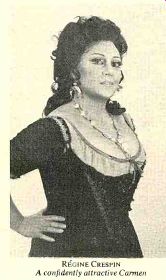
------------ REGINE CRESPIN, A confidently attractive Carmen Garcia and
his daughter Maria Malibran, it was the first Italian opera sung in the
original language in this city.) And the hundredth anniversaries of Carmen
and La Gioconda were observed during the 1975-1976 season.
Wondering what a young adult might see on his Met Sampler, I went to these three, and I'm pleased to report that even had he paid the full price, I think he would have gotten his money's worth.. In the performance of The Barber of Seville I saw he would have gotten the well seasoned comic characterizations of Fernando Corena as Dr. Bartolo and Jerome Hines as Don Basilio plus a youthful, high spirited trio as Rosina, Count Almaviva, and Figaro.
John Nelson conducted with obvious affection for the score, and although the production is old, the comic business was fresh and spontaneous. When Figaro was shaving Dr. Bartolo, Greek baritone Kostas Paskalis put so much lather onto Corena's face that some of it got into his mouth and he was briefly un able to sing. Though about to break up him self, Paskalis managed to sing Bartolo's lines until Corena recovered. The audience laughed a lot and left the theater happy.
A more somber view of life in Seville was presented in Bizet's Carmen with Regine Crespin. She sings the title role in the centennial recording issued by Erato and imported by RCA (it is reviewed in this issue), but it was recorded before she had performed the role on stage, and it gives only hints of how effective she now is in the theater. She is the best Carmen I have ever seen.
Most singers make Carmen hyperactive and desperate for attention, but Crespin plays the role with the confidence of an attractive woman who knows her power over men and doesn't have to do anything strenuous to intrigue them. She looked wonderful, handled the language like a great actress, and was in splendid voice. She developed the character with sensitivity, intelligence, and subtlety over the span of four acts. I found her especially compelling in the Card Scene, and by the last act she had built enough tension that when Jose stabbed her, several people around me were so stunned they gasped.
THE same kind of subtlety and vocal acting that distinguished Crespin's Carmen made Matteo Manuguerra's villainous Barnaba in La Gioconda a completely believable, three dimensional character. The performance was also notable for the idiomatic conducting of Giuseppe Patane (another new acquisition at the Met). But the big surprise for me was Martina Arroyo as Gioconda.
Usually rather placid and uninvolved dramatically, Miss Arroyo has obviously worked very hard on this opera and has devised an original interpretation suited to her own temperament. She emphasized the youthfulness of Gioconda the street singer, striving constantly to clarify the intricate plot. Though she did not convey maximum passion in some of the climaxes, she was always winning in her sincerity and touching in her vulnerability. In the last act Manuguerra for a few moments actually made one feel sympathy for the villain, and Arroyo moved me to such pity that I had to blink hard to keep back the tears.
La Gioconda and Carmen may be a hundred, but they haven't lost their seductive powers, and after 150 years The Barber of Seville is still among the top ten operas in this country (110 performances here in the 1974-1975 season). All three are available on records for anyone who cannot easily go to the Met or the country's other major opera companies. Although these operas were not in Maria Callas' Metropolitan repertoire, she re corded them for Angel, and I am partial to her interpretations. For those who do not respond to the Callas magic or would prefer actual Met casts I recommend London's Gioconda with Renata Tebaldi, Deutsche Grammophon's Carmen with Marilyn Horne, and RCA's.

Barber of Seville with Roberta Peters, Cesare Valletti, and Robert Merrill. With these sets you can sample the Met at home.
Also see:
Source: Stereo Review (USA magazine)