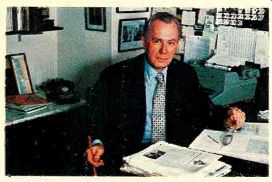
by WILLIAM ANDERSON
THEY'RE ALL SINGING OUR SONGS You might think that someone working every day with anything as prose-packed as the average issue of STEREO REVIEW would find something to do with his spare time other than reading-particularly reading about music. Let me, however, observe in passing that a reader is a reader, that an editor has as much right to a busman's holiday as any other poor toiler-and then get on with recommending a fascinating book on an American musical subject any observer will agree has more often been kicked under the rug than given a serious treatment. The book is William W. Austin's "Susanna," "Jeanie," and "The Old Folks at Home" (subtitled The Songs of Stephen C. Foster), and it has given me more to think about than any two books I have read this year. London Editor Henry Pleasants, who agrees with me on the book's importance, re views it on page 18, and I feel strongly enough about it to add my thumb to the scales.
If you are one of those who read magazines from front to back (rather than vice versa) you will have reached this page via the double metaphor of our cover and the splash of patriotic color on the Table of Contents and will al ready know that this is our American Music issue, a salute to the Republic on its two-hundredth birthday. You will also have noticed that it is somewhat smaller than the average telephone directory and may therefore be wondering how we managed to fit so large a subject into so small a package. We didn't, of course; anybody who knows anything at all about the subject knows that would be impossible. Henry R. Cleveland, for example, knew it. Writing in North American magazine in 1840, he observed (I quote from Austin): " ... American music, if it ever exists in the true sense of the word, must be as various, as copious, and as comprehensive, as the character of the people growing up under such widely differing influences... ' Things certainly haven't gotten any less various or copious since then, and so, secure in the knowledge that we have for some time been celebrating American music through our perseverant championing of Billings, Joplin, Gottschalk, and a whole slew of other native voices, we have contented ourselves with offering a group of articles intended to symbolize American music's variety and copious ness. James Goodfriend's comprehensive (but not complete) "Calendar of American Music" can be taken as the centerpiece of this effort; even a quick glance at its contents should be enough to convince an iconoclast that if he is proud of nothing else this year he can at least be proud of American music. Bernard Jacobson's "Basic Library of American Music" translates this general statement into particulars: a choice handful of recordings which should be as impressive to the ear as the Calendar is to the eye. Then there. is Chris Albertson's "A Word About Jazz"-and surely a word will suffice, for who in the world does not know that jazz is one of our principal--and most popular--exports? The world has, indeed, always valued our popular music, often higher than we have ourselves, and to symbolize that fact we have chosen Elvis Presley (this year marks his second decade of pop stardom), without whom there would likely have been no rock-and-roll, no Beatles, no Stones, no Jones-one wonders sometimes what might possibly have taken their place. Those disposed to groan at that alternative will appreciate this continuation of the Cleveland quotation begun above:
" ... In America, music must be in a considerable degree popular ... [it] must be surrendered to the people, must be domiciled among them, must grow up among them, or it cannot exist at all ... Music must be made popular, not. by debasing the art, but by elevating the people." [Italics mine.] Cleveland, you see, was kidding all along, and, Lord help us, such kidders are with us yet. It may be that even two hundred years is not enough time to grow up in, but Mr. Aus tin's book on Foster is to me a little light of hope on the far side of the birthday cake. It is heartening not only that an American musicologist has had the temerity to approach such a debased subject, that he knows they have all been singing our songs from Tokyo to Santiago and from Helsinki to Sydney for years, but that it's nothing to be ashamed of.
Introducing the Staff ...
When a personal opinion, particularly a publicly expressed one, grates on our nerves, one of the commoner responses is to ask, either under or at the top of our voices, just who that so and-so thinks he or she is. The question is asked of STEREO REVIEW with respect to our regular contributors and staff many times each month, and in this column we endeavor to supply the answers.
-Ed.
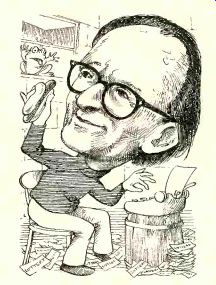
Contributing Editor, Richard Freed
WHEN I was a kid in Tulsa," Richard Freed recalls, "I contrived to work in the school office so I could be excused from music class, but before I left for the University of Chicago I had persuaded my high school English teacher to let me mix record reports with my book re ports. What got me hooked was, first, The Lone Ranger, and then Disney's Fantasia.
I liked the Lone Ranger's impeccable speech habits (I can't say as much for Tonto's), and I was intrigued by the music played between the scenes-a good deal more than just William Tell at the beginning and end and Les Preludes around the intermission commercial (someone ought to package a Lone Ranger Suite). I expected Fantasia to be two hours of Mickey Mouse, but the music I heard prompted me, at age twelve, to ask for a phono graph, and from then on whenever I had any money it went into records. Most of my reading then was about music and records, too, and my bible was the 1941 Vic tor catalog, a six-hundred-page encyclopedia for twenty-five cents!" While still an undergraduate, Freed began a bizarre sequence of newspaper jobs, then found. himself managing a travel agency. That is what he was doing when he began writing for Saturday Review in 1959, and the job enabled him to report on musical events in Budapest, Tokyo, and other exotic locales in addition to turning out his frequent record pieces. In 1962, Irving Kolodin invited him to join the staff at Saturday Review, where he helped edit the program magazine for Philharmonic Hall (now Avery Fisher Hall) at Lincoln Center. Freed subsequently worked as a critic for the New York Times and put in four years on the administrative staff of the University of Rochester's Eastman School of Music before he settled on full time free-lancing.
While he is more interested in the phenomenon of music than in the individuals who make it, Freed treasures his brief but close acquaintance, mostly through correspondence, with the late Karl Ristenpart.
"He was a luminously beautiful man who, despite his chamber-orchestra associations, based so much of his life on what he found in the music of Mahler. I'm grateful, too," Freed says, "for the opportunity to get to know Walter Susskind during the months I served as consultant to the Saint Louis Symphony Orchestra: I learned so much from him about the meaning of professionalism-which (in his case, anyway) has a lot to do with commitment and selflessness and simply nothing at all to do with self-aggrandizement or stuffiness." In addition to writing and broadcasting about music on records, annotator for the Philadelphia and Saint Louis Symphony orchestras, a consultant to various organizations, and executive secretary of the Music Critics Association, the professional society of critics in the U.S. and Canada. He recently began a series of nationally circulated broadcasts of Saint Louis Symphony Orchestra concerts. His annotative activity includes liner notes, too-about two hundred of them so far. He works in a subterranean chamber in one of Washington's Maryland suburbs, where a frog trapped in a window-well has been his only full-time companion, and he buys a lot of lottery tickets in hopes of having real windows some day.
ASIDE from music and records, Freed likes hot dogs (of the robust kosher variety he says are virtually impossible to find now), English film comedies of the early Fifties, and Putney Swope. "My wife and thirteen-year-old daughter think my passion for hot dogs is 'gross,' but that's be cause the really good ones have vanished.
I'd go as far as El Paso to introduce them to Laughter in Paradise (Alastair Sim, Joyce Grenfell, et al.), which I've seen more than thirty times." His literary ambitions were more or less abandoned when he learned that all the novels he wanted to write had already been written by Aldous Huxley, but he still cherishes the dream of writing an opera libretto entirely in limericks in collaboration with Alec Wilder, who has kept him supplied with waffle-type ice cream cones for years.
-Priam Clay
Also see:
POPULAR DISCS and TAPES (Jul. 1976)
Source: Stereo Review (USA magazine)