Accuphase T-100 AM/FM Stereo Tuner
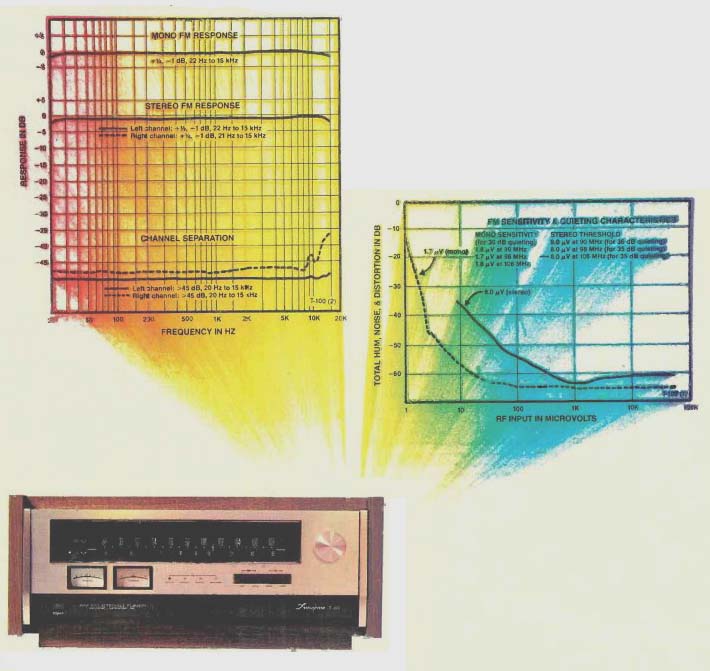
Spending more won't buy a better tuner.
The uncompromising quality of Accuphase makes the T-100 AM/FM Stereo Tuner one of the finest available. At any price. No qualifications.
From its unprecedented excellence in performance to its unusually effective multipath meter, the T-100 is truly superb.
Prove it yourself. We've assembled a free 36-page booklet of independent laboratory reports attesting to the superior performance of Accuphase. It's very convincing. But the best way to be convinced is to audition the T-100 yourself. Then you'll understand why the critical acclaim has been as impressive as the product itself.
Accuphase
Hirsch-Houck Laboratories Equipment Test Report, Stereo Review, Jan.1976.
"The ultimate distortion of the T-100's FM section was unevocally the lowest we have ever measured. To this can be added a really first-rate AM tuner section, the likes of which we have never before encountered in a product of this type."
"There is no doubt that its stereo channel separation and distortion characteristics surpass anything in our previous experience. Its AM frequency response was not only, by far, the flattest and widest we have ever measured on an AM tuner, it is sufficiently free of distortion and noise to make it a truly useful program source even for high fidelity listening."
write: TEAC Corporation of America, 7733 Telegraph Road, Montebello, CA 90640, USA.
Empire 2000Z phono cartridge
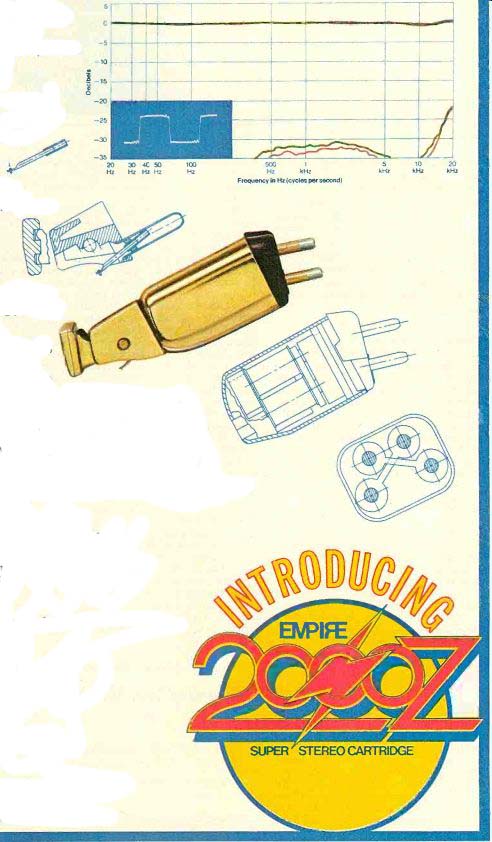
Blueprint for Flat Frequency Response.
In the graph below, frequency response was measured using the CBS 100 Test Record, which sweeps from 20-20.000 Hz. The vertical tracking force was set at one gram. Nominal system capacitance was calibrated to be 300 picofarads and the standard 47K ohm resistance was maintained throughout testing. The upper cures represent the frequency response of the right (red) and left (green) channels. The distance between the upper and lower curves represents separation between the charnels in decibels. The inset oscilloscope photo exhibits the cartridge's response to a recorded 1000 Hz square wave indicating its resonant and transient response.
Smooth, flat response from 20-20,000 Hz is the most distinct advantage of Empire's new stereo cartridge, the 2000Z.
The extreme accuracy of its reproduction allows you the luxury of fine-tuning your audio system exactly the way you want it. With the 2000Z, you can exaggerate highs, accentuate lows or leave it flat. You can make your own adjustments without being tied to the dips and peaks characteristic of most other cartridges.
For a great many people, this alone is reason for owning the Z. However, we engineered this cartridge to give you more.
And it does. Tight channel balance, wide separation, low tracking force and excellent tracking ability combine to give you total performance.
See for yourself in the specifications below, then go to your audio dealer for a demonstration won't soon forget.
The Empire 2000Z.
Already your system sounds better.
Frequency Response- 20 to 20K Hz ± 1 db using CBS 100 test record
Recommended Tracking Force-z4 to 1 3/4 grams (specification given using 1 gram VTF) Separation- 20 db 20 Hz to 500 Hz 30 db 500 Hz to 15K Hz 25 db 15K Hz to 20K Hz LM.
Distortion--(RCA 12-5-105) less than .08% .2K Hz to 20K Hz to 3.54 cm/sec
Stylus: 0.2 x 0.7 mil diamond
Effective Tip Mass: 0.2 mg.
Compliance--lateral 30 X10^-6 cm/dyne vertical 30 X10^-6 cm/dyne
Tracking Ability--0.9 grams for 38 cm per sec , 1000 Hz .
0.8 grams for 30 cm per sec , 400 Hz
Channel Balance--within 14 db 1 4-Iz Tracking Angle-20°
Recommended Load--47 K Ohms
Nominal Total System Capacitance required 300 pF
Output--3mv , 3.5 cm per sec using CBS 100 test record
D.C. Resistance- 1100 Ohms
Inductance- 675 mH
Number and Type of Poles--16 Laminations in a 4 pole configuration
Number of Coils-4 (1 pair/channel-hum cancelling)
Number of Magnets-3 positioned to eliminate microphonics
Type of Cartridge--Fully shielded, moving iron
For a free "How to Get the Most Out of Your Records" brochure writes Empire Scientific Corp., Garden City, N.Y. 11530.
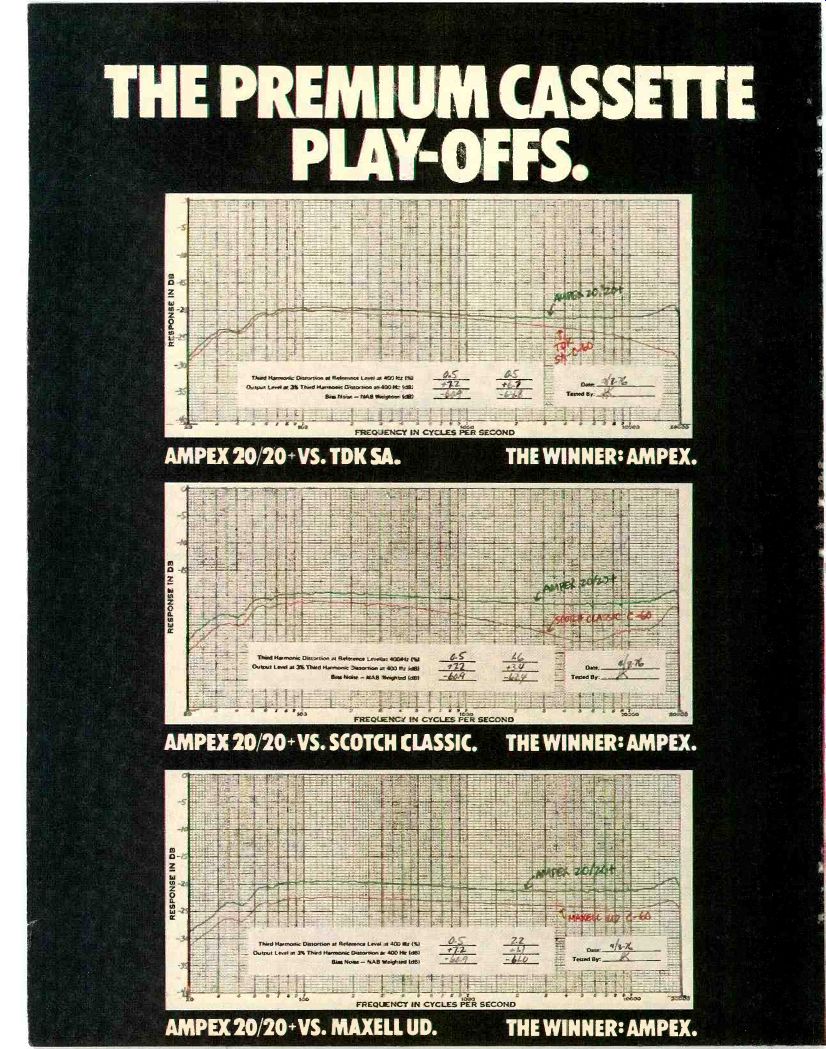
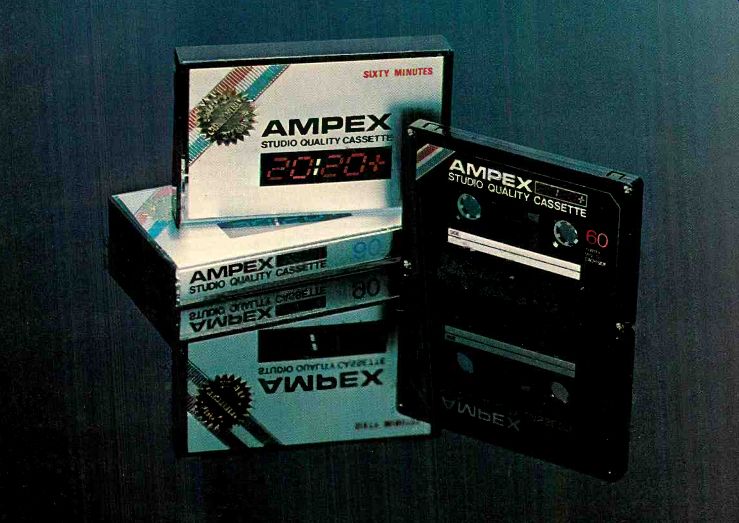
AMPEX--The best cassette yet.
Pickering
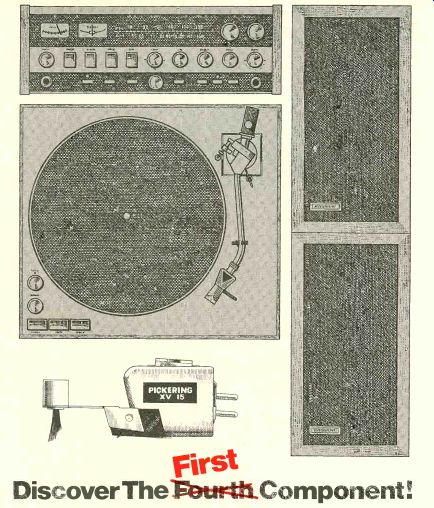
Discover The 4th.Component!
What is your First component?
Is it your receiver?
Your turntable?
Your speakers?
Or is it your phono cartridge?
We have become convinced that it really is your phono cartridge, even though we have been modestly advertising it for the past few years as your Fourth.
Let's face it, the cartridge is that important first point where the music begins, and if the stylus cannot follow its path accurately, no amount of expensive equipment . . . speakers, turntable or receiver . .. can make up the distortion it can produce. That is why you need a cartridge you can depend on. One that's the best your money can buy.
Specifically, a Pickering:
Because a Pickering cartridge has the superior ability to "move in the groove", from side to side and up and down, without shattering the sound of your music on your records.
Because a Pickering cartridge possesses low frequency tracking ability and high frequency tracing ability (which Pickering calls Trace-Ability). It picks up the highest highs and the lowest lows of musical tones to reveal the distinctive quality of each instrument.
Because Pickering offers a broad range of cartridges to meet any application whether you have an automatic record changer, or a high quality manual turntable, a stereo, or a 4-channel sound system. Your Hi-Fi dealer will be able to recommend a Pickering cartridge that is just right for your system.
Your stereo cartridge is the First part of your music system. It is too important to overlook, and so is a Pickering.
For further information, write to Pickering & Co., Inc.
Dept. SR, 101 Sunnyside Blvd., Plainview, N.Y. 11803
PICKERING -- Tor those who can hear the difference"
Yamaha
PART TWO: THE END OF THE DOUBLE STANDARD.
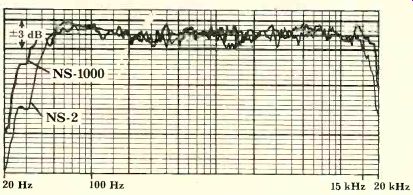
In the frequency range where you find most music, our least expensive speaker offers virtually the same flat frequency response and freedom from distortion as our most expensive speaker.
Until recently, you could consider the selection of speakers an act of faith.
Because of the lack of industry standards and the resulting confusion in the marketplace, the speaker buyer had to depend almost totally on personal taste and subjective evaluation.
But no longer.
At Yamaha, before we de signed a new line of speakers that would equal the revolutionary standard of our electronic components, we first defined our goal:
High accuracy across the musical spectrum. One of the few objective criteria for rating speaker performance.
Then we proceeded to make all Yamaha speakers to a sin gle revolutionary standard of accuracy:
A frequency response curve that varies by no more than ±3dB from 100 Hz to 15,000 Hz.
With typically no more than 1% harmonic distortion.
But since the frequency range of all our speakers extends well below 60 Hz to beyond 15,000 Hz, why do we even bother mentioning this figure? Because, with the exception of the very deepest rumblings of a pipe organ, all music is produced within this range.
In fact, few if any commercially available stereo pressings .have frequencies below 100 Hz and above 15,000 Hz.
Yamaha's success in achieving a single standard of accuracy in all our speakers is confirmed in the chart above.
Unlike the frequency response curves of other speaker manufacturers which indicate unnatural booming in the bass, added sparkle in the treble, and extreme loudness level variations of as much as 10 dB, Yamaha's frequency response curves show a relatively straight line, which indicates uncolored, natural sound.
Yamaha's musical heritage.
Yet, in spite of Yamaha's objectivity in design, the perception of sound remains subjective.
That's why Yamaha speakers aren't designed to meet objective standards alone, but to meet a higher standard: the ears of the people who make Yamaha's world-famous musical instruments.
-----
Yamaha brings you an extremely high degree of accuracy in all models throughout
the line. The above curves, comparing the NS1000 with the NS-2, were recorded
under the following conditions: 1. Equipment used--Bruell & Kjaer
(MK) 4133 microphone. 1022 oscillator, 2113 spectrometer, and 2306 recorder.
2. Input--A "pink" noise source was used with an input level of
3 watts (significantly higher, frv(re rigorous. and more closely corresponding
to actual home listening levels than the commonly used industry standard
of 1 watt). 3. Measurement--Each loudspeaker was placed in a "free
field" (off
the floor and no closer than 5 feet to any wall boundary in an average
size listening room). A multiplicity of curves were taken at various points
in the listening room and averaged, to produce the total energy curves pictured.
Since 1887, Yamaha has been making some of the finest musical instruments in the world.
Pianos, organs, woodwinds, guitars, and brass.
With our musical instruments, we've defined the standard in the production of fine sound. And now, with our entire line of speakers and electronic components, we've utilized not only our studio engineers, but also our musical instrument designers to de fine the standard of music reproduction.
It's called Natural Sound.
And it's totally unique to Yamaha.
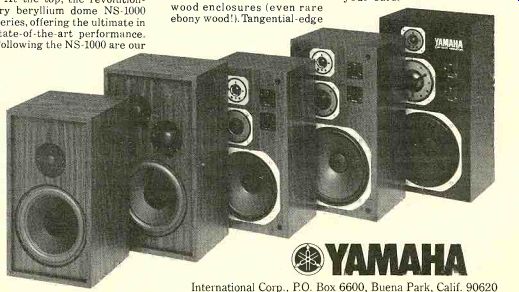
Five different speakers, built to one standard.
Yamaha offers five different speaker models, ranging in price from $1,350 a pair down to $200 a pair.
At the top, the revolutionary beryllium dome NS-1000 Series, offering the ultimate in state-of-the-art performance.
Following the NS-1000 are our other three-way types: the NS-690,NS-670, and NS-3. Our least expensive, but still highly accurate, is the two-way NS-2.
Since each is built to the same high quality standard, you're probably wondering what those extra dollars are buying.
It's very simple.
To satisfy the most demanding audiophiles, those extra dollars buy extended response at the frequency extremes.
Higher sound levels with equal or lower distortion. More power handling capacity. More tone controls to contour the tonal balance of the speakers with the characteristics of the room.
More specifically, on our model NS-670 and above, Yamaha offers die-cast speaker frame baskets to eliminate potential resonance. Luxurious wood enclosures (even rare ebony wood!). Tangential-edge suspension for midrange and tweeter domes to provide smooth response. Acoustic equalizers on tweeters to flat ten frequency response and enhance dispersion. Diagonally edge-wound voice coils for greater diaphragm control and increased transient response. Plus thick felt lining inside the cabinetry to isolate rear sound waves for distortion-free bass response.
But regardless of how much you pay, every Yamaha speaker is built to the same essential construction criteria and tonal accuracy.
Proven acoustic suspension design. Dome drivers for better high frequency dispersion.
Carefully matched crossover networks. And heavily reinforced, extremely rigid en closures.
The End of the Double Standard.
The single standard of performance found throughout the entire line of Yamaha speakers is a demonstration of product integrity that no other manufacturer can claim.
But in the final analysis, only your ears can be the judge.
That's why we invite you to visit your Yamaha audio dealer soon. His knowledgeable sales men and extensive demonstration facilities can save you time and trouble in selecting the speaker that's right for your budget. And right for your ears.
Yamaha International Corp., P.O. Box 6600, Buena Park, Calif. 90620
Also see:
Misc. ads collected (Oct. 1981)
Source: Stereo Review (USA magazine)