by IRA MAYER
WE wanted to put out the records the other companies wouldn't put out. When we found out how cheaply we could start, we just went ahead and did it." That was six years ago. The amount of money involved was $1,000. With that cash, Ken Irwin and Bill Nowlin founded Rounder Records. At this writing, Rounder has released nearly one hundred albums.
Much the same story could be told about any of hundreds of small record companies. Someone who was not satisfied with what was otherwise being made available took it upon himself or herself to do the job, and another label was born.
Folkways is in many ways the grand daddy of the "small" labels. Certainly it is the company most mentioned by those who run the newer labels as the example they followed. Folkways has issued more than 1,500 titles since its founding just after World War II, and all of them remain indefinitely in print.
Its catalog has remained a model of taste, quality, and diversity.
Founder Moses Asch is today in his early seventies, but he is still actively releasing records of every conceivable type: ethnic, spoken-word, jazz, sounds of nature, and folk music from virtually every part of the world. And Asch's attitude is very much one that has been adopted by those who followed in his footsteps: "I'm dedicated to keep on issuing. My competitors concentrate on what moves best. I can't do that." Asch readily admits that it is the Seeger, Guthrie, and Leadbelly albums that sell the best year in, year out. But that has not kept him from making available discs he feels are musically or socially valid or of historical significance, despite the probability of small sales.
This is not to say that Asch, or any of the other people operating small labels, is not a businessman. Some Folkways releases, for example, are geared primarily to the needs of libraries and educational institutions on a standing-order basis, a special but dependable source of income. Others are more likely to be "commercial," in the Seeger-Guthrie-Leadbelly vein, and these Asch will quite sensibly do his best to direct to stores around the country by companies which buy at wholesale from Folkways.
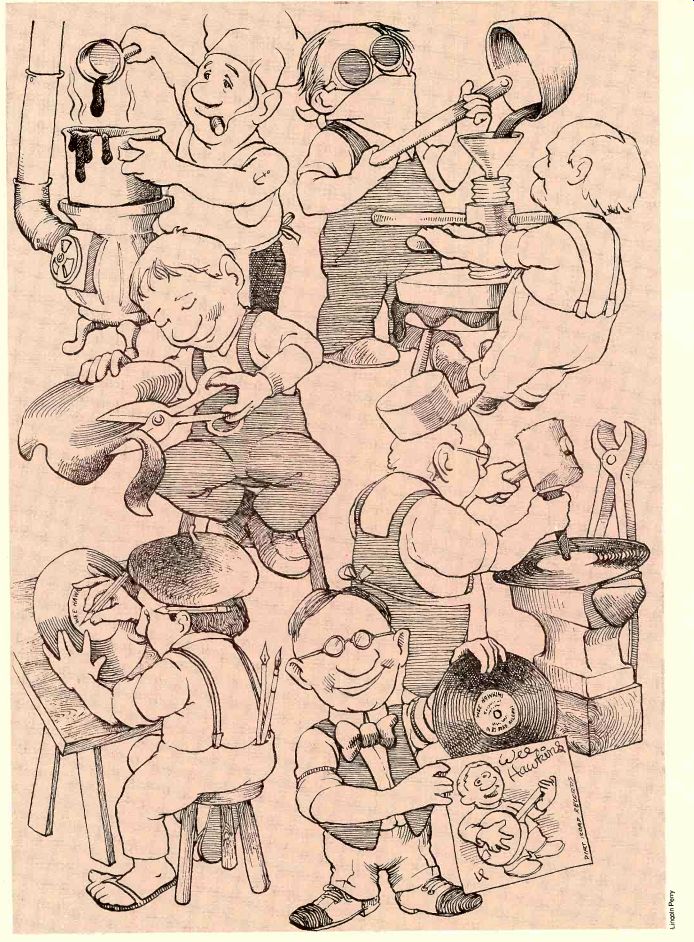
It should also be kept in mind that production costs for the kinds of records we are talking about are relatively low. The small labels either own and operate their own usually unprepossessing recording studios or they lease time from other small labels that domaintain their own facilities. And most of the music is recorded "live," which is to say that musicians and vocalists perform as they would in concert and the mikes take it down all at once.
(Commercial pop music, in contrast, has become a studio art in many in stances, with instruments and voices added one at a time to a master tape, followed by hours and hours of mixing and editing.) Other expenses are minimized too.
Little is spent on advertising or promotion. A few free copies are mailed to re viewers who are known to be interested in a particular field, copies are sent to sympathetic radio stations, and an occasional ad is placed in a specialized newspaper, magazine, or festival book.
Word-of-mouth and, frequently, mailings to past customers tend to be the most significant factors in spreading the news of new releases.
But one area in which production costs are greater for the small labels and here again Asch was the pioneer is in packaging, for while most of these companies stick to two-color covers, many include elaborate booklets with lyrics, background information, photos, and other pertinent data with their albums. Nearly every Folkways album comes four pages on one sheet or sixteen pages enclosed in its own pocket inside the record jacket, and many of the newer labels emulate that example.

IN view of this background, and of the attitude that has brought about the development of ever-increasing numbers of new small labels in the first place, it is plain to see that artistic control is of prominent concern. For instance, most Philo records of North American folk music bear the inscription "Philo Records encourages the artist to assume full creative control of his or her al bum. This record is as conceived by the artist." This policy is typical of most of the small labels. There are those at the major record companies who might object at this point that their artists have total control too. But the degree of involvement is different. At most of these small companies the "staff" is the owner and a spouse or one or two friends, and they all deal with the artist personally at every level of production.
Also, while some of the owners of the smaller labels might enjoy earning a gold or platinum record (signifying sales of 500,000 or a million albums, respectively), few will be disappointed at the fact that they never reach that point, for that is simply not why they are in business. (overleaf)
There will also be a few disgruntled artists who, because of situations that didn't work out for them, will insist that the "total control" so frequently spoken about doesn't really exist. In looking through the records that have been made available by these small companies, though, an unbiased ob server will find few of which an artist might be ashamed and an enormous number of which an artist might well be proud. Contrast that with the number of LP's released by major companies that it would be best to recycle immediately upon release.
TRULY, these little labels do have something to offer. But how does the prospective buyer get to it? Just listening to the radio or even browsing through the majority of "full line" record shops around the country, one might never discover the wealth of folk, jazz, blues, and traditional country material that has been put on record. The Schwann Catalog lists many small independent labels, but that source is not definitive even for the major labels. Nor can it help you track down a particular item in an offbeat area. If you are looking for a selection of Cajun music, for example, or should you want to find out what is the latest on the avant-garde jazz front, you're going to have some trouble unless you know where to begin to look. And the salesman at your local record store is not likely to be of much help these days. Therefore, in the interest of providing the reader with a little introduction to the whole field, of turning over, so to speak, the first spade in this garden of recorded delights, an examination of some of the more interesting, more important labels follows. But please remember that it is an introduction only, that a complete listing, even if it were possible in these cramped quarters (it is not), is the very furthest thing from our minds.
Catalog Sources
While descriptions of some individual specialty labels appear below, the bulk of information on small record companies can be found in several well-organized and extensive catalogs.
Most of the labels have their own catalogs, and most sell their records by mail and at concerts and festivals as well as through selected stores. But there are also three mail-order houses which publish general catalogs. These are in dispensable to the serious enthusiast of folk, jazz, blues, and traditional country music.
New Music Distribution Service, 6 West 95th Street, New York, N.Y. 10025. A division of the Jazz Composers Orchestra Association, NMDS is a nonprofit organization made up predominantly of avant-garde jazz and classical musicians who perform, issue records of their own, and run the mail-order service. It is the latter that supports many of JCOA's-own projects. The catalog-free for the asking-lists approximately one hundred labels and more than four times that number of records. Some are what would be referred to in publishing terms as "vanity press" items. Others are individual listings from companies that release records of other than avant-garde music.
171 Roundup, 186 Willow Avenue, Somerville, Mass. 02144. Irwin and Nowlin, who started Rounder Records, did so with political as well as musical motives. Rounder was set up as a collective, and anyone who worked with Irwin, Nowlin, or Marion Leighton (who joined early on) was a member. And everything was done by the members. "When we started we barely knew what an invoice was," Nowlin has stated on several occasions. Irwin, a political scientist, taught for the first few years in order to pay the rent, while the others-activists themselves-handled Rounder. The mail order business for other labels--Round house, in its first incarnation--was founded in the hopes of generating income to support Rounder's efforts. It has become more of a service, though; than a money maker.
Roundup became the name in the fall of 1975 when the operation was moved from Irwin, Nowlin, and Leighton's living room to a warehouse. Outside employees were hired for the first time about a year later.
"We don't emphasize the collective aspect nearly as much as we used to," Nowlin explains. "We run things today 99.9 percent the way any other record company or distributor would." The current Roundup catalog includes two hundred labels and several thousand discs. The concentration is on North American folk music, but Roundup carries the entire catalogs of some companies whose own reaches extend beyond that boundary. Of late it has also added a number of jazz labels.
J & F Southern Record Sales, 42 North Lake Avenue, Pasadena, Calif. 91101. In this case there is a store behind the catalogs, but owners John Harmer and Frank Scott, avid record collectors themselves, are dedicated to serving the needs of the mail-order customer. There are four separate catalogs, a bimonthly magazine, and periodic mailings about special purchases and auctions. The catalogs: blues, gospel, and rhythm-and blues; bluegrass, old-timey, American folk, and western swing; folk music of the British Isles; and 45's and EP's. Each includes domestic and imported records, and there is frequently a one- or two-line blurb describing the selection. The magazine, J & F Record Special, is taken up mostly by intelligent reviews of recent releases with some news and auction information. (In the matter of auctions, special mailings and the magazine are sent to foreign addresses earlier than to American addresses so that everyone interested in limited-availability items has an equal chance at acquiring them.) The J & F catalogs, because they are organized ac cording to category and then subdivided by label, are tremendously informative and useful.
Individual Labels
The label descriptions that follow, in alphabetical order, are an arbitrary grouping of folk- and jazz-oriented companies. The emphasis is on folk partly because there are more labels devoted to that genre and partly because many of the jazz labels consist of one or two LP's by a given artist. Also, there is much avant-garde and contemporary jazz being issued on labels distributed by major companies-ECM (Keith Jarrett, Gary Burton, Jan Garbarek) via Polydor, and Freedom (Cecil Taylor, Roswell Rudd, Dewey Red-man) through Arista. Interestingly, both of these are European labels which have been more successful in the United States than most American-based companies.

Arhoolie, 10341 San Pablo Avenue, El Cerrito, Calif. 94530. The catalog offers contemporary and traditional blues from the likes of Mance Lipscomb, Mississippi Fred McDowell, Clifton Chenier, and Bukka White, as well as several fine anthologies organized along geographical lines. It is run by blues lover Chris Strachwitz. Biograph, P.O. Box 109, Canaan, N.Y. 12029.
Arnold Caplin's label has amassed a considerable amount of historically important blues and early jazz material, some culled from the Columbia vaults, some from various out-of-print catalogs. Blind Lemon Jefferson, Ma Rainey, Ethel Waters, Reverend Gary Davis, and Leadbelly are among those represented, along with contemporary bluesman Johnny Shines and progressive blue-grassers Bottle Hill. There are also about a dozen LP's of piano-roll recordings by or of Fats Waller, Scott Joplin, and Eu bie Blake, among others.
Choice Records, 245 Tilley Place, Sea Cliff, N.Y. 11579. Gerry Macdonald's Choice label specializes in what used to be called modern jazz. Among the many fine artists on the Choice roster are Zoot Sims, Toots Thielemans ("Captured Alive," Choice CRS 1007), and Jimmy Giuffre. County, P.O. Box 191, Floyd, Va. 24091.
String-band music as it developed during the Twenties and Thirties is the mainstay of this label, with the Delmore Brothers, Wade Mainer and the Sons of the Mountaineers, and Charlie Poole leading the way. Contemporary recordings of traditional bluegrass and old-timey artists are also released on County, with Red Allen and the Kentuckians, the Lilly Brothers, the Stanley Brothers, and long-time Bill Monroe fiddler Kenny Baker heading the list.
Delmark, 4243 North Lincoln Avenue, Chicago, Ill. 60618. The Chicago blues as played by Roosevelt Sykes, Junior Wells, T-Bone Walker, and Mighty Joe Young are all that concern this most respectable outfit.
Additional classics come from Sleepy John Estes and Arthur "Big Boy" Crudup, the latter being the man from whom Elvis Presley learned Hound Dog.
Eubie Blake Music (EBM), 284-A Stuyvesant Avenue, Brooklyn, N.Y. 11221. At the age of ninety-three Blake continues to perform and record the ragtime songs associated with him since just after the turn of the century. The man who, with Noble Sissle, wrote I'm Just Wild About Harry and other classics has his own label dedicated to the preservation of his music. John Arpin, a fine Canadian ragtime pianist and jazz historian, has also recorded for EBM.
Ili Famous Door, 40-08 155th Street, Flushing, N.Y. 11354. Harry Lim's Famous Door label is dedicated, in the company's own words, to producing "jazz records of the finest quality, using the most up-to-date re cording techniques and equipment and the best pressings obtainable.- Famous Door's specialty is mainstream jazz; a representative recent release features John Bunch, Urbie Green, and Milt Hinton ("John's Bunch," Famous Door HL-107). Like all the label's releases, it is available by mail for $7.50.
Flying Fish, 3320 North Halstead, Chicago, Ill. 60657. Begun by Bruce Kaplan, who spent a brief period with the Rounder collective, Flying Fish features the talents of John Hartford, Norman Blake, and Tut Taylor in solo outings. There is also an outstanding double-record set titled "Hillbilly Jazz," a latter-day country-swing effort with Vassar Clements, David Bromberg, and some of their friends, which is something of an underground classic.
Folk-Legacy, Sharon, Conn. 06069. Sandy and Caroline Paton, performers themselves, concentrate their recording activities on contemporary interpreters of traditional music, though the early part of their catalog does include a few field recordings. Rosalie Sorrels was at her finest when she made her Folk-Legacy album (she has since recorded for several other labels), and Gordon Bok's recordings of Maine sea lore are excellent additions to any folk library. "The New Golden Ring," in two volumes, is a collection of songs performed by the Patons and such friends as Bok, Michael Cooney, Joe Hickerson, and Ed Trickett; it serves as an excellent introduction to their respective talents. Trickett, a hammered-dulcimer player and singer, is heard to beautiful advantage on his own LP, "The Telling Takes Me Home." A few of Folk-Legacy's albums include songs by the early American composer William Billings among the folk songs.
Folkways, 43 West 61st Street, New York, N.Y. 10023. The company's catalog is an education in and of itself, and no one else stocks the whole thing. There are records on handwriting analysis, hypnotism, and Senator Joseph McCarthy, along with the most extensive collection of Americana available on record. Of special note are the six-record "Anthology of American Folk Music," spanning the full spectrum of traditional country and blues with such artists as the Carter Family, Mississippi John Hurt, Charlie Poole, Bascom Lamar Lunsford, Blind Lemon Jefferson, and Uncle Dave Macon; Pete Seeger's four-volume "American Favorite Ballads"; "Berkeley Farms," a collection of old-timey string-band music;
and any of the black music anthologies, many recorded at the height of the civil rights movement and reflecting the crossing of traditional forms with contemporary needs and consciousness. Too, there are dozens of LP's of international folk music and a good variety of early-jazz anthologies.

Halcyon, 302 Clinton Street, Bellmore, N.Y. 11710. Founded in the late Sixties, Halcyon is the brainchild of jazz pianist Marian McPartland. Not surprisingly, the bulk of the label's catalog consists of jazz piano recordings, many featuring Ms. McPartland either on her own ("Solo Concert at Haverford," Halcyon 1 1 1) or teamed with such venerable artists as Teddy Wilson, Joe Venuti, and her ex-husband, cornetist Jimmy McPartland.
Improvising Artists, 26 Jane Street, New York, N.Y. 10014. Improvising Artists is run by avant-garde jazzman Paul Bley, who has worked with Ornette Coleman, Charles Mingus, and the Jazz Composers Orchestra Association, among others. In aim, it is somewhat similar to the more widely distributed ECM label. Among the artists represented in the Improvising Artists catalog are such major contemporary jazz figures as Sam Rivers, Ran Blake, Charlie Haden, and, of course, Bley himself. "Qui et Song," Improvising Artists 373839, on which he is joined by Bill Connors and Jim my Giuffre, is particularly recommended.
Jazzology, P.O. Box 748, Columbia, S.C. 29202. Jazzology is one of the oldest of the small independents, founded in 1949 by George Buck, Sr., and now run by his son George Jr. As the name implies, it is primarily dedicated to traditional, classic jazz, and the company has an enormous catalog of new releases and reissues. Jazzology has done a superb job of documenting on records the work of older but still functioning jazzmen, survivors of the ,great tradition; their numerous recordings of the great New Orleans clarinetist George Lewis (1900 1969) are a splendid case in point. Jazzology puts out a nice, folksy little publication, a 1966 issue of which was dedicated to the memory of their late "faithful and beloved Cocker spaniel dog Bootsie." The loss was undoubtedly felt, but it apparently hasn't adversely affected the label.
JCOA, 6 West 95th Street, New York, N.Y. 10025. Founders Michael Mantler and Carla Bley got the JCOA label off to a brilliant start with two critically acclaimed sets:
Mantler's "Jazz Composer's Orchestra," with Cecil Taylor, and Bley's three-record opus "Escalator over the Hill." (Mantler and Bley now record for their own Watt la bel.) The thin line between classical and jazz in the realm of the avant-garde makes it most difficult to categorize either work, and, as with Don Cherry, Roswell Rudd, or any of the other JCOA artists, a high level of sophistication must be brought to the music by the listener.
Master Jazz, Box 579, Lenox Hill Station, New York, N.Y. 10021. Master Jazz, founded and run by jazz buff William Weilbacher, has an extensive catalog of jazz releases, some new (produced for the label) and some old. Most notable among the latter is a reissue series comprising all the Mainstream sessions produced for English Decca in the Fifties by Stanley Dance, featuring, among others, albums by Rex Stewart and Bud Johnson. There is also a nifty series called "Master Jazz Piano," Volume I of which earned a STEREO REVIEW Record of the Year Award for 1970, and there are some fine Earl Hines discs among many others:
Paredon, P.O. Box 889, Brooklyn, N.Y 11202. Political activist and singer Barbara Dane is the force behind Paredon, a distinctly political label. The catalog includes such titles as "Che Guevara Speaks," the three-record "The Second Declaration of Havana" (the 1962 speech by Fidel Castro with printed text in Spanish and English), and "FTA: Songs of the GI Resistance," sung by Dane.
People's Music, 220-10 Hempstead Boulevard, Queens Village, N.Y. 11429. Though I've avoided those labels limited to one or two releases, People's Music is included be cause of the number of people represented on its two People's Victory Orchestra and Chorus LP's, "Weltschmerzen" and "The School." As with Bley's "Escalator over the Hill," a wide variety of jazz and rock personalities participate, and the results are strikingly original, if not to everyone's taste.
Philo, The Barn, North Ferrisburg, Vt. 05473. Philo is one of the most interesting of the folk labels because of the scope of its endeavors. Located in Vermont, the company feels the Canadian influence heavily, and there are excellent French-Canadian recordings by Montreal accordionist Phillipe Bruneau and fiddler Louis Beaudoin. Bruce "Utah" Phillips and Mary McCaslin have put out two excellent albums each; Phillips, a Wobbly organizer and train lover, and McCaslin, a sweet-voiced country singer/ writer, both bring things a little closer to home. Many of the other Northeast folk la bels use the facilities of the Earth Audio Techniques Studio run by Philo for recording their own artists.
Rebel, Route 12, Asbury, W.Va. 24916. Similar to County, but limited to the con temporary vein, Rebel is open to modem developments in the basic bluegrass form.
The Country Gentlemen and the Seldom Scene, generally considered progressive bluegrass bands, are probably Rebel's most popular groups. Both County and Rebel can usually be found on sale at booths at blue grass and folk festivals.
Rounder, 186 Willow Avenue, Somerville, Mass. 02144. Though it is relatively young, Rounder has done an impressive job of reissuing some Library of Congress recordings (an excellent set from labor-activist singer Aunt Molly Jackson) and some rare country blues (Blind Alfred Reed's Depression songs under the title "How Can a Poor Man Stand Such Times and Live?").
Rounder, however, is also active with con temporary folk idioms and artists from the bluegrass-jazz-country swing fusion of Tony Trischka and Breakfast Special to the thirteen-year-old 1975 fiddle and guitar champion Mark O'Connor. The latter is assisted by John Hartford, Norman Blake, and others. Recording quality and packaging care are above the average, and the taste is impeccable.
----
THERE are hundreds of other labels, far more than can be listed here. Most of them are highly specialized and cater to a select clientele, and finding out about them is a matter of meeting other people with similar interests, subscribing to special-interest magazines, and getting your name on mailing lists. With catalogs from NMDS, Roundup, and J & F for starters, or those available through writing to any of the above-mentioned companies, you may find yourself in the midst of a whole new world of recorded music that would have interested you long ago had you only known it was there or where to find it.
---
Spivey Records, 65 Grand Avenue, Brooklyn, N.Y. 11205. Spivey was founded by the late Victoria Spivey, a well-known blues singer who recorded for Okeh in the Twenties and was featured in the Warner Brothers film Hallelujah. Spivey was one of the first to record the young Bob Dylan (she appears on the cover of Dylan's "New Morning"), and two cuts that predate his signing with Columbia (Dylan providing harmonica accompaniment for Big Joe Williams) are available on "Three Kings and a Queen" (Spivey 1004). Other albums in the label's small catalog include performances by Roosevelt Sykes and Lonnie Johnson as well as a reissue of some of Miss Spivey's best Okeh work.
Strata East, 156 Fifth Avenue, New York, N.Y. 10010. This is the label responsible for establishing Gil Scott-Heron and Brian Jackson as major forces in contemporary black musical poetry. Their "Winter in America" sold very well and continues to be the duo's strongest work. (They now record for Arista.) Additional Strata albums come from Clifford Jordan, Pharoah Sanders, Cecil Payne, Stanley Cowell, and Sonny For tune, among others, and the emphasis is clearly on the jazz end of the spectrum. Takoma, P.O. Box 5369, Santa Monica, Calif. 90405.
Guitarist John Fahey, who crosses traditional folk guitar idioms with classical technique, records his own music along with that of his protégé Leo Kottke, dobro player Mike Auldridge, and other friends. Fahey's own "The New Possibility," featuring solo guitar renditions of traditional Christmas songs, is a masterpiece.
Yazoo/Blue Goose, 245 Waverly Place, New York, N.Y. 10014. Yazoo releases are devoted primarily to reissues of old blues, country, and novelty 78's in LP form; Blue Goose takes on contemporary blues and old timey artists. In the former category one is as likely to come across Blind Willie McTell or Charlie Paton as Cliff Edwards, better known as "Ukulele Ike" and the voice be hind Jiminy Cricket. The Blue Goose catalog is highlighted by LP's from Larry John son, an exceptional blues interpreter, and Roy Bookbinder, a combination bluesman and novelty writer. Much of the cover art is done by underground cartoonist R. Crumb, whose own Cheap Suit Serenaders have re leased two LP's and a 78 (yes!) on Blue Goose. Both labels were developed by Nick Perls.
ABOUT THE AUTHOR: Ira Mayer, who has written on music for the New York Times and the Village Voice, is the reviews editor for Record World, a prominent recording-industry trade publication.
-------------------
Also see:
BEST RECORDINGS OF THE MONTH: Instrumental: Vivaldi's Seasons, Cherubini's String Quartets; Blues: "The Nighthawks Liver"; Contemporary Folk (?): Ry Cooder's "Chicken Skin Music"; Opera: Massenet's Esclarmonde; Jazz: Fraser MacPherson Trio
Source: Stereo Review (USA magazine)