SELECTION OF RECORDINGS OF SPECIAL MERIT--BEST OF THE MONTH
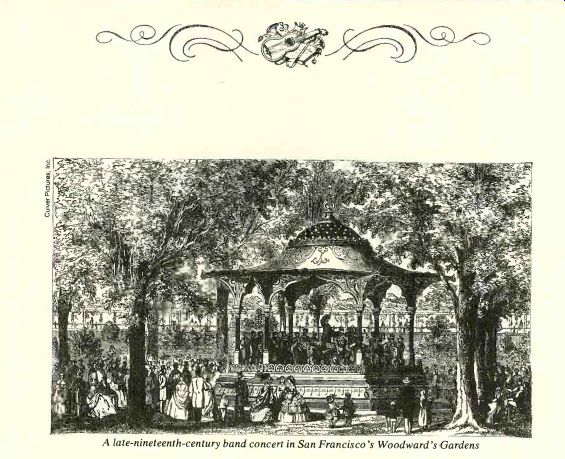
--- A late-nineteenth-century band concert in San Francisco's Woodward's
Gardens
"His execution ... killed the gold fishes and stunned the canaries all the way out to the packing plant ... "
THE sort of exultant, unabashed virtuosity exhibited on a new None such disc called "Cousins-Polkas, Waltzes, and other Entertainments for Cornet and Trombone" is always a de light in itself, but it is doubly delightful to have it lavished on such a surprising and altogether irresistible souvenir of a vanished era. Where, today, does one come across these gems-or, coming across them, can one hear them played with such spectacular aplomb? That they should be taken up with obvious affection by principals of the New York Philharmonic (trumpeter Gerard Schwarz) and the Boston Symphony (trombonist Ronald Barron) is only fitting, for they are for the most part challenging display pieces written by the most celebrated performers of their time-the brilliant Herbert L. Clarke, the immortal Arthur Pryor.
Robert Offergeld's characteristically thorough annotation, easily worth the price of admission in its own right, identifies the composers, some of whom did not play these instruments (one of them was even a music critic), but the good-natured brilliance of the music is something that really cannot be described. (Not that some have not tried. The notes quote an Omaha news paper review of boy-wonder Pryor in the 1880's: "His execution set the prairies afire; his vibrating pedal tones rattled the windows of the Theater and killed the gold fishes and stunned the canaries all the way out to the packing plant. . . . ") The rapid-fire triple-tonguing and swells of pure golden tone, the cantabile sections, the sassy "smears" in Henry Fillmore's outrageous Trombone Family, the feeling of exuberant comradeship in the duets and trios-these are enough to enchant the heart of anyone who might have thought his allegiance was only to Dufay, Dvorak, or Dallapiccola.
Sensational as the brass players are, Kenneth Cooper's stylish keyboard accompaniment identifies him as a full and splendid partner, and the extremely lifelike sound is the final touch in making this happy package so extraordinarily effective: it is ideally focused, comfortably "open," and, combined with the unusually silent surfaces, presents an all but visible image of the burnished brass. In short, this disc is a knockout.
-Richard Freed
COUSINS--POLKAS, WALTZES, AND OTHER ENTERTAINMENTS FOR CORNET AND TROMBONE.
Clarke: Cousins; The Maid of the Mist, Polka; Twilight Dreams, Waltz Intermezzo. Pryor: Blue Bells of Scotland; Polka, Exposition Echoes; Thoughts of Love, Valse de Concert. Hanaeberg: Triplets of the Finest, Concert Polka. Fillmore: Trombone Family. Gumbert: Cheerfulness. Buchtel: Polka Dots.
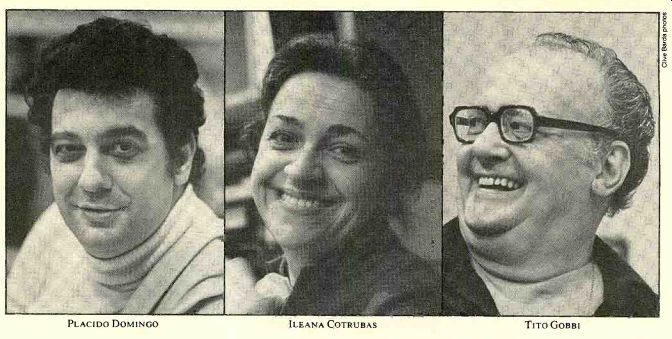
-----98 PLACIDO DOMINGO, ILEANA COTRUBAS, TITO GOBBI
Smith: The Cascades, Polka Brilliant. Gerard Schwarz, Allan Dean, and Mark Gould (cornets); Ronald Barron, Norman Bolter, and Douglas Edelman (trombones); Kenneth Cooper (piano). NONESUCH H-71341 $3.96.
Tito Gobbi as Puccini's Gianni Schicchi: First Choice Artistically And Technically THE second installment in Columbia's proposed complete re cording of Puccini's /I Trittico is a near-perfect triumph. In the preceding Suor Angelica there was too much reliance on star names and not enough on atmospheric authenticity. For the new Gianni Schicchi, however, which is even more of an ensemble opera (and a tricky one at that), a whole troupe of seasoned Italian veterans was brought to the London studio to impersonate the rapacious crowd of Buoso's rela tives with the right flavor and gestures.
Above all, the production has to its credit in the title role the baritone Tito Gobbi. It is a delight to see that, at six ty-two, almost twenty years after his original recorded impersonation of the comic rogue (Angel S-35473), he can still outshine all contenders. His Schicchi has plainly become a somewhat old er man, even a shade angrier one, but the passing of time is barely noticeable in Gobbi's singing. There is a certain loss of smoothness in his "Addio Firenze," but elsewhere his remarkably expressive resources conquer all challenges-singing, squeaking, or thundering-with a marvelous sense of comedy and with compelling overall authority.
Placido Domingo is unquestionably the best Rinuccio on records-fervent, secure, really youthful in sound. Ileana Cotrubas shares this welcome youthful quality, but she sounds fragile and at times unsteady. She is an adequate Lauretta, but I had expected better.
The Buoso relatives are all strongly and colorfully in the picture, particularly Giancarlo Luccardi, an unctuous, son orous Simone.
Except for the Nella-Ciesca-Zita trio, which he takes much too slowly, I found conductor Loren Maazel's tem pos convincing throughout. His grasp of the opera's busy musical strands and quicksilver action is impressive, and the orchestra plays beautifully for him.
Technically, the production is conscientious. Though some of the chaotic scenes and certain vocal gestures are not ideally highlighted, and though its superiority over London 1153 (a 1962 production) is marginal, this is technically the best Gianni Schicchi so far. In overall artistic merit it is also my first choice-but of course no one owning the Angel set could bring himself to part with the Lauretta of Victoria de los Angeles. ( II Tabarro, the final installment in Columbia's survey of the trilogy, is scheduled for 1978 release.)
-George Jellinek
PUCCINI: Gianni Schicchi. Tito Gobbi (baritone), Gianni Schicchi; Ileana Cotrubas (so prano), Lauretta; Anna di Stasio (contralto), Zita; Placido Domingo (tenor), Rinuccio; Florindo Andreoli (tenor), Gherardo; Scilly Fortunato (soprano), Nella; Alfredo Mariotti (baritone), Betto; Giancarlo Luccardi (bass), Simone; Stefania Malagu (mezzo soprano), La Ciesca; Leo Pudis (baritone), Spinelloccio; Guido Mazzini (baritone), Notary; others. London Symphony Orchestra, Lorin Maazel cond. COLUMBIA M 34534 $7.98.
Benjamin Luxon: Rocked in the Cradle Of the Deep and Other Maligned Old Favorites
BENJAMIN LUXON is a baritone whose striking vocal and dramatic gifts have been heard in English-made recordings of operas and art songs from Delius to Moussorgsky. In a new two-record set from Argo called "Give Me a Ticket to Heaven" he applies his marvelous voice and exceptional talent for interpretation to a program made up largely of forgotten ballads whose com posers were destined to remain less famous than the poets (Kipling, Tennyson, and others) who supplied the texts. Even those songs that have not been completely forgotten, hardy perennials from a more sentimental age, have never sounded so good-Rasbach's setting of Joyce Kilmer's Trees, for example; Huhn's of W. E. Henley's bloody, unbowed, and still impressively stoical Invictus; or the two-hundred-proof Irish of Clover's Rose of Tralee.
Luzon sings all these warhorses, long since put out to pasture, with a power and a conviction that are simply overwhelming. He does the same for Mascagni's Ave Maria, for the anonymous but utterly charming children's ballad Mr. Shadowman (where he sup plies a jauntily whistled chorus), and for a number of other songs, both secular and religious, which once brought tears to the eyes of nineteenth-century recital audiences on both sides of the Atlantic.
It may be argued that some of these items richly deserve forgetting; I will merely point out that it is a proposition impossible to entertain while Mr. Luxon, superbly accompanied by pianist David Willison, is singing them. It is, as far as subject matter goes, a rather melancholy concert, but it is a splendid one nonetheless, entirely free of arch kidding or of camp. And remember that if we judge our forebears solely by the music they listened to, someone is bound, one day, to do as much for us.
-Paul Kresh
BENJAMIN LUXON: Give Me a Ticket to Heaven. Harrison/Elton: Give Me a Ticket to Heaven. Tosti/Weatherly: Parted. Huhn/ Henley: Invictus. Sanderson/Weatherly:
Friend o' Mine. Quilter/Tennyson: Now Sleeps the Crimson Petal. Moss: The Floral Dance. Murray/Lockton: I'll Walk Beside You. Pepper: Over the Rolling Sea. Knight/ Willard: Rocked in the Cradle of the Deep. Lohr/Weatherly: When Jack and I Were Children. Gould/Tobin: The Curfew. Stern dale-Bennett/Hayes: The Carol Singers. Rasbach/Kilmer: Trees. Watson/Cowan: Anchored. Anon. (arr. Kaye): Mr. Shadowman. Tours/Kipling: Mother o' Mine.
Adams/Weatherly: The Holy City. Jacobs-Bond: A Perfect Day. Clover/Spencer: Rose of Tralee. Lamb: The Volunteer Organist.
Mascagni/Weatherly: Ave Maria. Clarke/ Radclyffe-Hall: The Blind Ploughman.
Brahe/Taylor: Bless This House. Davis: God Will Watch Over You. Benjamin Luxon (baritone); David Willison (piano). ARGO ZFB 95-6 two discs $15.96.
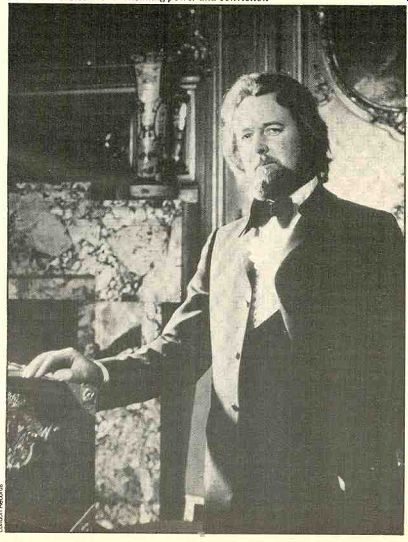
-------- BENJAMIN LUXON: overwhelming power and conviction.
Cleo Laine with an Audience: More Color, More Drama, More Feeling "iv last high note knocked my earring off," Cleo Laine announces to her cheering audience just after she's finished a performance of Noel Coward's London Pride that the master himself would have loved. That moment is preserved on her new RCA album "Return to Carnegie" along with a collection of songs that will knock your head off and permanently dispel any reservations you may still have about her being only a cult artist revered by musicians but Just-Too-Damned-Much for everyday listening.
I will here confess that this was exactly my opinion for a long time. It began to change only recently, most particularly after hearing her spectacular work as Bess in the jazz version of Gershwin’s Porgy and Bess RCA re leased last year (CPSZ-1831). Mostly, though, I've had to deal with my grudging admiration for the technical ability she has displayed in her recordings even as I wished she'd stop fiddling around with lyric meaning whenever it got in the way of showing off her vocal range. No such trouble on the present "Return to Carnegie," however-just an extraordinarily gifted actress-singer radiating first-class musicianship, enormous intelligence, and wit.
The presence of an audience seems to ignite Laine in a way that I've never heard in her other recordings. She takes command from the moment of her entrance with Blues in the Night and doesn't let go of our attention until the final chord of her closing song, Be a Child. In between she sings such things as Streets of London and the aforementioned London Pride with all the show stopping excitement of a Thames-side Judy Garland. She also busses Sigmund Romberg's slumbering One Alone into living, breathing pop life and weaves two extended medleys in each of which she manages to make a long neglected piece of the musical past un forgettable (Gershwin's By Strauss for one, and a little bit of nonsense called Broadway Baby for another-it is an exquisite send-up of all those singers of dread memory who are given to on stage attacks of the Pouting Cutes).
Through it all, there is the glory of Laine's voice, big, flexible, and gloriously secure as always-except that this time out I notice many more mood filled colorings, more levels of dramatic meaning, and more nuances of feeling.
So okay, Cleo, you've got me. Now just what do you intend to do with me?
-Peter Reilly
CLEO LAINE: Return to Carnegie. Cleo LaMe (vocals); orchestra. Blues in the Night; How Long; Streets of London; Lon don Pride; Direction; Medley-Company/ Miller's Son/Broadway Baby; Being Alive;
Born on a Friday; One Alone; Medley-I Got the Music in Me/Fascinating Rhythm/ Jazzman/By Strauss/I Gotta Right to Sing the Blues/Don't Mean a Thing If It Ain't Got That Swing/Playoff; Be a Child. RCA APL I-2407 $6.98. APSI-2407 $7.95, APKI-2407 $7.95.
George Jones: The New King of Country Music Wants to Sing
Is that Roy Acuff I hear, making a move to turn in his yo-yo? Those who've already taken to calling George Jones the king of country music are going to do it even louder when they hear Jones' new "I Wanta Sing" for Epic.
This may not be the album we've been waiting for Jones to make, but it's an album we've been waiting for, one in which several good things about Jones' talent and about country music coalesce, and it comes at the crest of a new excitement about Jones. A few more efforts like this and he will have bent the future of Nashville.
Every now and then country music "discovers" someone who has been around for years (in some cases selling a lot of records for those same years) and gets all in a dither about how underrated this great artist has been in the past. It happened to Charlie Rich not too long ago, you'll recall. It's happening to George Jones now, and he is (has been) every bit the talent they say he is and-more portentous for the immediate future of the genre, copy cats thriving in it as they do-he will influence the music back toward hard country, the opposite direction, roughly, from that taken by jazz singer Rich. Jones is, produced by Billy Sherrill these days, and Billy likes to layer on globs of orchestrated Nashville Sound-but he hasn't this time. Here he has gone with George's instinct for traditional country, and the result is a sad and funny al bum of some integrity.
Jones comes about as close as any singer I've heard to actually bleeding for his art. The way he sings, back to back, Please Don't Sell Me Anymore
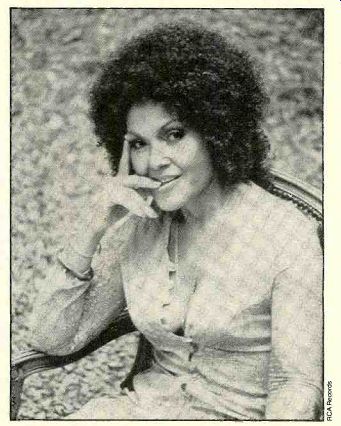
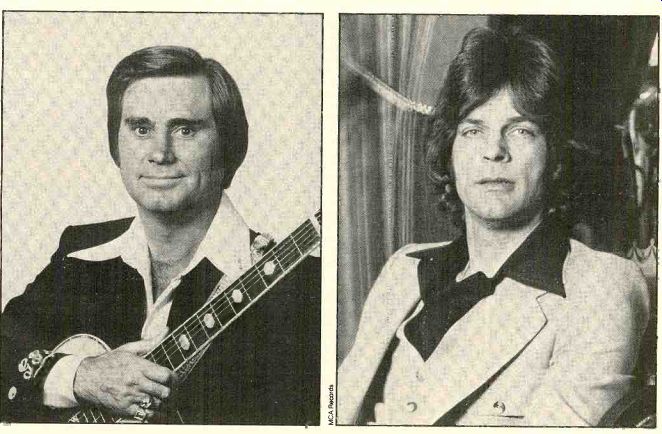
------ Left to right, three voices: Cleo Laine's (big, flexible,
and gloriously secure), George Jones' (sad and funny honky-tonk pathos),
and B. J. Thomas' (perhaps our most artistically important pop baritone).
Whiskey Tonight and They've Got Millions in Milwaukee (" . . . thanks to guys like me") creates some of the keenest pathos one could get from any Toast of Nashville. Here's Jones, with a real drinking problem that may yet become as well publicized as Farrah Fawcett-Majors' chevelure, and here are these two would-be "fun" songs on that same subject, one a sort of set piece for a melodrama on the order of Please Daddy Don't Get Drunk This Christmas, and the other a standard country novelty tune, honky-tonk division, turning mainly on a wry and (the writers surely hope) catchy phrase.
You wouldn't dream of taking either seriously with 99 percent of the singers singing them, but Jones is going to make your response a lot more complicated, a lacy pattern of contradictions, for he manages to get all the meaning out of them.
So you get that Old King Kong as well, the sort of country joke he and Buck Owens used to try to top each other doing. There's also a song that touches bases with both CB radio and Jesus, some good, solid, three-chord country songs in between, and the most impressive singing anybody's recorded in years. If you're willing to cut up the back of the jacket ("It's OK, it's yours," the instructions say-I love that), you also get a cardboard model of George Jones' bus.-Noel Coppage
GEORGE JONES: I Wanta Sing. George Jones (vocals, guitar); instrumental accompaniment. I Wanta Sing; Please Don't Sell Me Anymore Whiskey Tonight; They've Got Millions in Milwaukee; If I Could Put Them All Together; I Love You So Much It Hurts; Rest in Peace; Bull Mountain Lad; Old King Kong; You've Got the Best of Me Again; It's a 10-33 (Get Jesus on the Line). EPIC PE 34717 $6.98, PEA-34717 $6.98, PZT-34717 $6.98.
B. J. Thomas Delivers Some of the Best Pop Vocals to Be Heard on This Planet
GIVE a cheer, ladies and gents, for a pro. On his eponymously titled latest recording, B. J. Thomas delivers some of the best pop vocals to be heard on this planet. He has been doing this for quite some few years now, and with the recent loss of Elvis Presley it is probable that Thomas can be ranked as the most artistically important pop baritone in this country.
The comparison between Thomas and Presley is not whimsical: Presley had a unique feel for the pop song, which he used as a showcase for his voice and as a challenge for his interpretive artistry. In pop-rock, both Presley and Thomas (Sinatra and Crosby do the same in straight pop) emphasize lyrical content, and this requires that the singer concentrate on the text, that he know and feel the emotions of the song. This means he must size up the character doing the singing, imagine the other character(s) he is singing to, and create a credible dramatic situation. The tools he uses are phrasing, vocal color, rhythm, ornament, and dramatic intensity, and in expert hands these are not wasted even when applied to the simplest materials.
Presley seldom gave a bad performance of a song no matter what its merits. The same holds true for Thomas.
When a singer with Thomas' skill and insight continues to practice his art so well for so many years, there is a tendency to take him for granted. He shouldn't be: these days we need all the superior pop singers we can get. Starting in the very early Sixties (when he recorded I'm So Lonesome I Could Cry at a small Texas studio), on through the middle and late years of that decade (when he hit with Hooked on a Feeling and Raindrops Keep Fallin' on My Head), and now into the Seventies (with Somebody Done Somebody Wrong Song), Thomas' mellow and agile baritone has graced whatever material he sang. It is not only that he often had good, sturdy tunes to sing, but that he sang them so well.
His current album is a case in point.
The featured song, Don't Worry Baby, is a fine Sixties Beach Boys tune. Most of the rest of the material, contributed by various writers including Mac Davis, Barry Mann and Cynthia Weil, Troy Seals, Dennis Linde, Donny Fritts, and others, is also of A-1 quality. There are only two dog tunes on the whole album, but even with them Thomas pulls off convincing performances. The album does not pretend to be a work of art; it is straight-ahead, top-forty pop meant for an adult audience, with a few uncompromising references to The Kids tossed in as freebies. But it is so well constructed as a program and so perfectly tailored to Thomas' gifts that it can stand as a definitive example of first-class production and of first-class pop singing.
-Joel Vance
B. J. THOMAS. B. J. Thomas (vocals); vocal and instrumental accompaniment. Don't Worry Baby; Here You Come Again; Play Me a Little Traveling Music; Even a Fool Would Let Go; Our Love Goes Marching On; Still the Lovin' Is Fun; Plastic Words;
It's Sad to Belong; Impressions; We Had It All; My Love. MCA-2286 $6.98, MCAT-2286 $7.98, MCAC-2286 $7.98.
-----------
++++++++++++++
Also see: ROOTS OF JAZZ--Amazingly, some of the artists who started it all are still around. CHIRIS ALBERTSON
Source: Stereo Review (USA magazine)