CLASSICAL DISCS and TAPES: A Little
X-mas Music, WILLIAM KIMMEL, Gustav Leonhardt's Brandenburgs, STODDARD LINCOLN,
Jean -Baptiste Lully's Alceste, ERIC SALZMAN, Kreisleriana, GEORGE JELLINEK,
Giuseppe Verdi's II Trovatore, GEORGE JELLINEK
Reviewed by RICHARD FREED, DAVID HALL, GEORGE JET LINEK, PAUL KRESH, STODDARD LINCOLN, ERIC SALZMAN
J. S. BACH: Sonata in B Minor for Flute and Harpsichord (BWV 1030); Sonata in A Major for Flute and Harpsichord (BWV 1032); Trio Sonata in G Major for Flute, Violin, and Continuo (BWV 1038); Sonata in E Minor for Flute and Continuo (BWV 1034); Sonata in E Major for Flute and Continuo (BWV 1035); Trio Sonata in G Major for Two Flutes and Continuo (BWV 1039). Leopold Stastny, Frans Bruggen (flutes); Alice Harnoncourt (violin); Nikolaus Harnoncourt (cello); Herbert Tachezi (harpsichord). TELEFUNKEN 6.35339 two discs $15.94.
Performance: Echt!
Recording: Excellent
As we have come to expect from this Telefunken Bach series, the presentation is exquisite: the box is strong and handsome; the historical notes are detailed, copious, and trilingual (German, English, and French); scores are included; and the manuscript of Herbert Tachezi's excellent reconstruction of the first movement of the A Major Sonata is reproduced. The music is performed on original instruments, and articulation and ornaments are executed with the utmost historical accuracy.
All of this is, of course, admirable. But there are some serious musical problems. In the two sonatas with harpsichord obbligato, for example, the performers seem to be at odds about rhythmic alterations. Although both articulate clearly, Tachezi favors rhythmic alterations that conflict with Leopold Explanation of symbols:
= reel-to-reel stereo tape
= eight-track stereo cartridge
= stereo cassette
= quadraphonic disc
= reel-to-reel quadraphonic tape
= eight-track quadraphonic tape
Monophonic recordings are indicated by the symbol The first listing is the one reviewed; other formats, if available, follow it.
Stastny's even flow of notes. Also, some of the tempos are misjudged. In the B Minor Sonata, the first movement sounds nervous be cause of a too-quick tempo, and the slow movement lacks grace and repose because of a pushed andante rather than the largo Bach calls for.
Alice Harnoncourt joins in for the G Major Trio Sonata with a sound that is so deliberately devoid of vibrato and warmth that the result is overwhelmingly disappointing. Musically the two continuo sonatas come off better, especially the one in E Major. Here Stastny, as soloist, apparently feels free to make music the way he likes without worrying about what his peers are up to. The finest reading in the collection is of the G Major Trio Sonata for two flutes and continuo.
Stastny and Bruggen think alike, and the continuo players have no choice but to accompany them without interference.
The album as a whole, then, is for the music history buff only. Presence, projection, and individual interpretation are often completely lacking. The hoops, wigs, and lace have been donned, but the wearers have not yet learned to move naturally in them.
S.L.
BEACH: Sonata in A Minor for Piano and Violin, Op. 34.
FOOTE: Sonata in G Minor for Piano and Violin, Op. 20. Joseph Silverstein (violin); Gilbert Kalish (piano). NEW WORLD NW 268 $6.98.
Performance: Excellent
Recording: Clean but a mite constricted
These sonatas by Amy Marcy Cheney (Mrs. H.H.A.) Beach (1867-1944) and Arthur Foote (1853-1937) are thoroughly representative examples of what the pre-World War I group of American composers centered around Boston was turning out. Within a stylistic framework bounded essentially by Schumann and Brahms, both works display a high level of craftsmanship and by no means lack innate vitality. My own preference between the two is for the Foote. His 1890 sonata dates from his forty-seventh year; regardless of the Brahmsian elements, there are terseness and rhythmic virility in the opening movement and ingenuity in the siciliana scherzo. Brahms is much to the fore throughout the adagio, but Foote the organist-choirmaster emerges triumphantly in the finale, which builds up around a fugato texture and concludes in a splendid blaze of Victorian hymnody.
Mrs. Beach's 1896 work is notable for its predominantly lyrical first movement, a charming lightweight scherzo, and, most especially, the eloquent closing pages of the slow movement. Like Foote, she included a healthy dose of fugal writing to spur the pace of her finale. However, I do find the level of her thematic material occasionally undistinguished compared with Foote's.
In the performances here, Boston Symphony concertmaster Joseph Silverstein displays a small but well-focused tone, ample rhythmic vigor, and right-on-target intonation. Gilbert Kalish negotiates in sterling fashion the highly elaborate piano writing in both sonatas (they are billed as for piano and violin, in the Ger man Classical manner). The recording, done at Columbia's New York studios, is very clean, but I do wish there had been a bit more audible acoustic space. This kind of music can use it. D.H.
RECORDING OF SPECIAL MERIT
BEETHOVEN: Lieder. Maigesang; Marmotte; Neue Liebe, Neues Leben; Wonne der Wehmut; Sehnsucht; Mit einem Gemalten Band; Freudvoll and Leidvoll; Ich Denke Dein; Aus "Faust" (Flohlied); Urians Reise um die Welt; Die Liebe; Gellert-Lieder, Op. 48, Nos. 1-6; Opferlied; Des Kriegers Ab schied; Das Blumchen Wunderhold; Die Laute Klage. Peter Schreier (tenor); Walter Olbertz (piano). TELEFUNKEN 6.41997 $7.98.
Performance: Excellent
Recording: Excellent
Beethoven wrote nearly a hundred songs, but, except for the An die Ferne Geliebte cycle and a handful of others, few singers seem to favor them. A notable exception is Dietrich Fisch er-Dieskau , whose collection on Deutsche Grammophon 139 197 includes some of the better-known individual songs in addition to the cycle. This new release by tenor Peter.
Schreier duplicates none of Fischer-Dieskau's choices, which means that lieder aficionados who own both discs have about half of Beethoven's total output. Schreier's choices for this disc, labeled Volume 1, are mainly early songs, from the period of about 1793 to 1811, and nine of them are settings of Goethe texts.
I find this a virtually flawless recital. Schreier's tone is not particularly sensuous, but he can achieve exquisite effects through means that are tasteful and unfailingly musical. Very properly, he does not over-romanticize these songs, which are closer in spirit to Mozart than to Schubert. They call for a Mozartian command of tonal purity and sensitive control of dynamics, which the singer supplies in abundance. He also rises with virtuosic ease to certain technical challenges, such as the delicate transitions from full voice to head tone in Neue Liebe, Neues Leben. I would prefer the solid weight of a baritone voice for the solemn utterances of the six Gellert songs (among them the reasonably familiar Die Ehre Gottes aus der Natur), but Schreier surely de livers them as effectively as any tenor can.
Pianist Walter Olbertz, who excelled in the singer's recent Mendelssohn collection, again provides distinguished support, and the engineering is splendid. Texts are provided in German only and there are no notes. Just the same, bring on Volume 2!
G.J.
RECORDING OF SPECIAL MERIT
BEETHOVEN: Piano Sonata No. 1, in F Mi nor, Op. 2, No. 1; Piano Sonata No. 7, in D Major, Op. 10, No. 3. Sviatoslav Richter (piano). ANGEL 0 S-37266 $7.98.
Performance: Superbly fluent
Recording: Good
Word had it some years ago that Russia's Sviatoslav Richter was not happy recording under studio conditions and that those who wished to document his interpretations for public issue would have to take their chances with his concert performances. But to judge from the production/engineering credits on the jacket of this Angel disc, it appears that he was lured into EMI's Paris studios in the course of a European tour, and the result is as lovely a pair of readings of early Beethoven sonatas as you'll ever hear.
Typically, Richter enjoys making the most of the potential for contrast inherent in the works, so he chooses a very deliberate tempo for the minuetto of Op. 2, No. 1, which enhances the stunning brilliance and dazzlingly smooth passagework he brings to the final prestissimo. In Op. 10, No. 3, the high point is the great largo e mesto slow movement, the first of Beethoven's many profound essays in this vein, and Richter plays it wonderfully.
EMI's Paris recording team has managed the body and presence of the piano tone nice ly, with just enough room coloring to provide a necessary aura of warmth. The slightly hard middle-register tone in forte passages I am inclined to ascribe to the instrument rather than to the performer or producers. A touch of equalization adjustment may help, especially if your listening room happens to be on the live side, as mine is. D.H.
-----------------
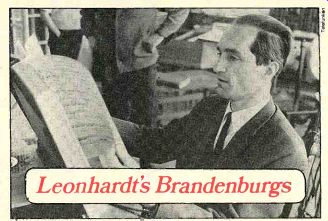
Leonhardt Brandenburg Concertos
THE first time I played continuo in Bach's Brandenburg Concertos was an extreme ly startling experience. The orchestra started out bravely, and then, suddenly, the horns went wild; a veritable fox hunt seemed to be going on at their end of the stage. A glance at the score revealed that that was how it was supposed to be; the notated hunting calls and tattoos were right there, even though in all the times I had heard these wonderful concertos I had never really heard the horns sound that way. I never heard them sound that way again until I listened to the superb new ABC/SEON recording of the concertos conducted by Gus tav Leonhardt. It is the clarity of the inner parts that characterizes these discs, and it is, of course, Bach's uncanny treatment of the inner parts that gives these works their very life.
This inner clarity stems both from the use of original instruments and the carefully executed Baroque articulation. In the First Con certo, Bach set up opposing choirs of strings, oboes, and horns. Modern instruments used according to the precepts of modern orchestral blending produce a smooth, homogenized sound. Bach's ideal, however, was not homogeneity but colorful contrast, which can be achieved only with raw-sounding natural horns, cutting oboes, and vibrato-less strings.
Performed by such forces, as it is here, the concerto becomes a lively trialogue. In the Third Concerto the contrast between the choirs is more difficult to bring out, since all three choirs are made up of strings, but in Leonhardt's reading the contrast is as clear as I have ever heard it.
With the various solo instruments in the concertos the problem is not contrast, but blending and balancing the different timbres.
Rarely, for instance, do the recorder and the trumpet of the Second Concerto come off as equal partners, and one often wonders if Bach was not asking for the impossible when he placed them side by side. It is not impossible, however, for this recording accomplishes it.
Perhaps the most ravishing sonority of the entire set is to be found in the Fifth Concerto.
Bach himself was surely aware of this, for there are many passages in the first movement where the harmony and figuration become static and only the sonority carries the music forward. Such moments of limpid clarity are beautifully presented in this performance, and the recording by the German SEON company has caught them perfectly.
Research and experience have taught us that intricate Baroque figuration can be heard best when it is highly articulated. But when the articulated units become too small and detached, because there is too much diminuendo on each unit and too much space between units, the phrase is lost and the result is in compatible with today's tastes. Many con temporary groups that play original instruments fall into this trap; the Leonhardt ensemble does not. Just the right balance is achieved: detail is underlined by articulation, and a long line is produced by a controlling overall sense of phrasing.
In a delightfully whimsical essay included in the notes, Leonhardt modestly points out that we will never know exactly how music was performed in Bach's time and that there fore no performance-including this one can ever be definitive. It is this sort of modesty that makes these records so wonderful.
Nothing is pushed for effect or brilliance; the music expands in its own world unhampered by any pressure from without. The result is a completely believable performance.
Obviously, this new set of the Brandenburgs must be seriously considered no matter how many other fine recordings of the works one already has. And, as a special enticement, there is included a full-size reproduction of Bach's complete autograph score as it was exquisitely copied out and presented to the "Marggraf de Brandenbourg." It is a thrill to follow this music, superbly performed, from the master's own score.
-Stoddard Lincoln
J. S. BACH: The Brandenburg Concertos (BWV 1046-1051). Amsterdam Ensemble, Gustav Leonhardt cond. ABC/SEON AB-67020/2 two discs $19.95.
"a veritable fox hunt seemed to be going on .”
------------------
RECORDING OF SPECIAL MERIT
BERLIOZ: L'Enfance du Christ, Op. 25. Janet Baker (mezzo-soprano); Thomas Allen ( bari tone); Eric Tappy (tenor); Jules Bastin (bass); Joseph Rouleau (bass); Philip Langridge (tenor); Raimund Herincx (bass); John Alldis Choir; London Symphony Orchestra, Colin Davis cond. PHILIPS 6700 106 two discs; $17.90, 7699 058 $17.90.
Performance: Polished
Recording: Excellent
Since its release in 1961, I have regarded Col in Davis' L'Oiseau-Lyre recording of L'Enfance du Christ as the classic realization of Berlioz's delectable masterpiece--even compared with the distinguished readings by Munch, Martinon, and Cluytens (whose An gel album with De los Angeles and Gedda is no longer listed in Schwann). The new Philips recording of the work, part of that label's admirable Berlioz series, puts the mature Davis in competition with his younger self, albeit with largely different performers under his direction. (Joseph Rouleau, who doubled in the roles of Herod and the Ishmaelite Householder in the earlier recording, sings the latter part in the new one.) Comparing the 1961 Colin Davis performance with that of 1977, I find that the latter offers decidedly more refined orchestral playing (the London Symphony winds are truly wonderful), more polished choral work, and a more dramatically effective balance between the chorus and the rest of the ensemble-particularly in the offstage angelic warnings, hosannas, and alleluias, which sound as seraphically disembodied as anyone could wish. The recording quality too is audibly superior, in overall sonic richness and stereo depth perspective, to that of the 1961 set.
Nevertheless, I am not about to dispose of the earlier L'Oiseau-Lyre album, for not only is it more sharply focused dramatically, but the team of soloists-Peter Pears (in top form), Elsie Morison, John Cameron, and the young Joseph Rouleau-wins hands down over the new Philips team, even though the latter includes the formidable Janet Baker. On the new set Jules Bastin sings Herod's monologue in a beautifully classic manner, but with not a trace of the Moussorgsky-like brooding that Rouleau brought to the 1961 recording.
Eric Tappy represents the classic type of high Gallic tenor, but his voice is too light in texture to elicit the tenderness called for in the "Holy Family by the Wayside" solo, let alone the pathos of the footsore arrival at Sais.
Even if he strained a bit at the top, Pears in the same passages managed to sustain the Gluckian melodic line and also to convey the gripping drama in the subsequent narrative.
For all the beauty of her delivery, Baker sounds like a fully mature woman rather than the frightened young mother depicted so vividly by Morison in the arioso-recitative dialogue between Mary and Joseph as they seek refuge in Sais. Similarly, Thomas Allen seems totally unable to convey Joseph's desperation the way Cameron did in the earlier recording.
To sum up, then, I sense a far greater degree of interaction both among the soloists and between soloists and conductor in the 1961 performance than in the new Philips effort, and it is just this element of interaction that makes the L'Oiseau-Lyre realization truly involving instead of merely enjoyable.
D.H.
BERLIOZ: Te Deum, Op. 22. Jean Dupouy (tenor); Choeur de l'Orchestre de Paris; Choeur d'Enfants de Paris; Maitrise de la Resurrection; Jean Guillou (organ); Orchestre de Paris, Daniel Barenboim cond. COLUMBIA M 34536 $7.98, MT 34536 $7.98.
Performance: Radiant
Recording: Mushy
Sir Thomas Beecham's premiere recording of this work is still in circulation (Odyssey 32 16 0206), and that performance still carries unique power and conviction. But the recording, now in artificial stereo, was made nearly twenty-five years ago, and sonic considerations are especially meaningful in this case.
Indeed, it may be that sonic differences, al most as much as actual interpretive ones, ac count for the different effects made by Colin Davis' 1%9 Philips recording (839 790LY) and the new Barenboim one. For the sake of brevity, it might be said that Davis emphasizes the work's dignity and grandeur and Barenboim its radiance. Both are intense, well organized, obviously committed performances. The new Columbia recording was made in the Eglise de Saint Eustache, the site of the Te Deum's 1855 premiere, and the somewhat over-reverberant acoustics tend to blur some of the lines, frequently making the words sung by the sopranos and the boys' choir all but unintelligible, rendering the orchestral punches a little mushy, and even swallowing up some of the instrumental solos (I found more or less the same effect in SQ playback as in two-channel stereo). The site of the Philips sessions, presumably one of the town halls or large churches regularly used for recording in London, made for a cleaner sonic frame in which every syllable is understandable and the orchestral wallops are not diffused. There are some clear musical advantages in Davis' majestic presentation, too: the London Symphony is a more precise ensemble, than the Orchestre de Paris, Franco Tagliavini's fervor is more appealing than Jean Dupouy's stylish but very cool singing of the solo part, and at the very end Davis leaves the listener with a feeling of noble uplift, while Barenboim's handling of the final bars leaves one wondering if they ought to sound quite so much like the end of Ives' Second Symphony. The Te Deum is a work that deserves far wider circulation than it has so far enjoyed; those who have not made its acquaintance are urged to remedy that oversight-via the Davis recording on Philips.
BRAHMS: A German Requiem, Op. 45; Variations on a Theme by Haydn, Op. 56a; Tragic Overture, Op. 81. Anna Tomowa-Sintow (soprano); Jose van Dam (baritone); Vienna Singverein; Berlin Philharmonic Orchestra, Herbert von Karajan cond. ANGEL SB-3838 two discs $15.96.
Performance: Orchestrally superior
Recording: Good except for overture
Karajan's third go at the German Requiem (his earlier essays were in 1948 and 1965) is superior to the others in point of orchestral balance, particularly in the timpani department, but comparison with Klemperer's monumental 1962 reading for Angel finds the Vienna chorus hopelessly weak next to the magnificently trained Philharmonia group.
Only in the evocation of the Last Judgment do the Viennese work up a real head of steam and bring to Brahms' music the elemental power it deserves. As for the soloists, Anna Tomowa-Sintow is no match for Gundula Ja nowitz (in Karajan's earlier DG recording) when it comes to floating the ethereally lovely lines of "Ihr habt nun Traurigkeit," nor does Jose van Dam command the magisterial quality of Dietrich Fischer-Dieskau (in Klemperer's version) in "Herr, lehre doch On the other hand, Karajan's orchestra plays magnificently throughout, and the recording, particularly in the lower end of the frequency spectrum, is absolutely stunning in power and body-which shows up all the more the weakness of the Vienna Singverein.
Karajan's tempos differ only marginally from those of his 1965 DG recording, and recording date, when the Karajan sessions were still being favored with rather church)/acoustics. D.H.
RECORDING OF SPECIAL MERIT
BRAHMS: Symphony No. 1, in C Minor, Op. 68; Symphony No. 2, in D Major, Op. 73; symphony No. 3, in F Major, Op. 90; Symphony No. 4, in E Minor, Op. 98; Academic Festival Overture, Op. 80; Tragic Overture, Op. 81; ...
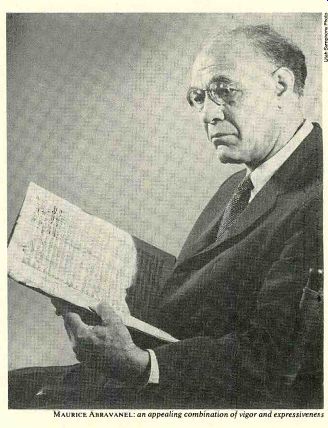
------------- MAURICE ABRAVANEL: an appealing combination of vigor and
expressiveness
...there is somewhat more spontaneity in the handling of dynamics, though the opening "Selig sind" is all but inaudible in my copy.
Oddly enough, Klemperer, usually associated with slow and ponderous pacing, is no slow poke in his handling of this score, being slightly faster than Karajan in all but "Wielieblich sind deine Wohnungen." Indeed, I find far more dramatic urgency throughout the whole of Klemperer's reading, which remains the one I prefer.
Karajan's treatment of the Haydn Variations is as elegant as ever, but I'd like a bit more starkly granitic approach to the Tragic Overture. The two orchestral tracks were evidently recorded in different locales. The rather obtrusive reverberation characteristics in the Tragic Overture indicate an early 1970's Variations on a Theme by Haydn, Op. 56a. Utah Symphony Orchestra, Maurice Abravanel cond. VANGUARD CARDINAL VCS 10117/20 four discs $15.92.
Performance: Spirited
Recording: Excellent
The four symphonies, the two overtures, and the Haydn Variations are, except for the two serenades, all the purely orchestral music that Brahms ever wrote (and even the variations are really the composer's own arrangement of a two-piano work). But what a lot of music to be packed into a set of only four discs! Mau rice Abravanel, his Utah Symphony, and Vanguard pack most of it in very well indeed.
The performances give the feeling of Brahms as a poet, as the last optimist. The orchestra is a bit short of first-rate, but, in compensation, Abravanel has been directing it for so long that they make a real team.
There's no heavy, long-beard stuff here; Abravanel's Brahms is "up." It is also rather sensitively worked for both detail and broad shaping. When Abravanel wants to shade the tempo-which he does often and nearly al ways to good effect-the musicians are right there with him. This combination of vigor and expressiveness is appealing, and something of a bargain at the price. A very musical essay by Bernard Jacobson, giving a remarkably succinct explanation of how Brahms' musical mentality actually functioned, is a valuable extra. E.S.
BRAHMS: Violin Sonata No. 1, in G Major, Op. 78; Violin Sonata No. 2, in A Major, Op. 100; Violin Sonata No. 3, in D Minor, Op. 108. Georg Kulenkampff (violin); Georg Solti (piano). RICHMOND 0 R 23213 $3.98.
Performance: Refined
Recording: Variable late-Forties mono
These Brahms sonatas, together with Bruch's G Minor Concerto done with the Zurich Tonhalle Orchestra under Carl Schuricht, were the last recorded performances by Georg Kulenkampff before his death in 1948 at the age of fifty. Kulenkampff had previously enjoyed a distinguished career as soloist and teacher and recorded a goodly portion of the classic violin solo and concerto repertoire, chiefly for Telefunken.
Young Georg Solti had just been appointed conductor of the Munich Opera--a first major step toward his present superstar status. The original English Decca 78's of the Brahms sonatas were transferred to long-play format in 1965 and issued in England when Solti was at the peak of his Covent Garden career.
Kulenkampff plays Op. 78 and Op. 100 in a warm but somewhat over-refined fashion, striking sparks of genuine passion only in the great D Minor Sonata. Solti is an able and, for the most part, sensitive keyboard partner, but he is relegated to the background in the Op. 78 recording. Balances in the other two works are more just. In any event, none of these performances effaces for me the rugged pre-LP versions of Opp. 78 and 100 by Busch and Serkin, or of Op. 108 by Szigeti and Petri, not to mention such more contemporary recordings as those by Suk and Katchen. The re corded sound varies from dim in Op. 78 to relatively good in Op. 108. D.H.
BRUCKNER: Symphony No. 7, in E Major; Symphony No. 8, in C Minor. Vienna Philharmonic Orchestra, Karl Bohm cond. DEUTSCHE GRAMMOPHON 2709 068 three discs, $26.94.
Performance: Forthright
Recording: Very good
Karl Bohm's Dresden recordings of the Fourth and Fifth were among the few complete Bruckner symphonies to appear on 78's; his Vienna Philharmonic concert take of the Seventh (now in Vox set VSPS-14) was one of the first to appear on LP. More than twenty five years went by before he began what was announced as a complete Bruckner cycle with the Vienna Philharmonic for London/Decca, but it got only as far as Nos. 3 and 4. Now, with the same orchestra, Bohm's Bruckner is continuing on Deutsche Grammophon. What is more surprising than the change in affiliation is DG's issuing these particular symphonies only a few months after Karajan's re make of the Eighth appeared on the same la bel (2707 085) and virtually on the eve of the release of that conductor's new DG recording of the Seventh. There is some justification for this duplication of repertoire, in that Karajan recorded the 1887 version of No. 8 while Bohm has done the now virtually standard Nowak edition of the version of 1890. There is also a great deal of pleasure in Bohm's handling of this material and in hearing Bruckner played by the Vienna Philharmonic, whose brass--whether by tradition, instinct, or a combination of both-brings a unique glory to the big proclamative gestures. The very opening of the Seventh Symphony here radiates such unpretentious security, such effortless grandeur, together with a striking vitality, that the listener at once feels a safe and satisfying journey is under way. By and large, that impression has been justified by the end of the Eighth, but one may also have a feeling that the journey has been rather uneventful.
The word that best suits these performances is probably "forthright." There is un questionable integrity and a gratifying absence of interpretive clutter in Bohm's approach, and the playing itself is glorious, set off in a lambent, clear acoustic frame. What is missing is the sense of exaltation one expects from this music. This is not the same thing at all as grandeur of execution and glory of sound (which can be, and here are, exhilarating in themselves). Rather, it is the mystery of what Bruckner is all about, and it requires a bit of indulgence in the way of dramatic shaping, of softer playing here and there than Bohm apparently asks from his orchestra, and of greater subtlety in building to so crucial a climax as that of the great adagio of the Seventh Symphony. Better by far Bohm's noble forthrightness (which is far from bland, and which some will find purifying) than the sort of "Brucknerism" characterized by abrupt gear-shifting and dynamic excesses; but better still the passion that illumines the recorded readings of Haitink, Horenstein, Jochum, and Karajan. R.F.
CARPENTER: Adventures in a Perambulator.
MOORE: The Pageant of P. T. Barnum.
NELSON: Savannah River Holiday. Eastman-Rochester Orchestra, Howard Hanson cond.
MERCURY SRI 75095 $7.98.
Performance: Ingratiating Recording: Excellent This reissue of material from the Mercury archives features American symphonic music at its most winning and agreeable. The stunning Hanson/Eastman-Rochester performance of John Alden Carpenter's Adventures in a Perambulator was out of the catalog for a while.
Now it is back on two labels: the ERA label, backed by Burrill Phillips' Selections from McGuffey's Readers, and this Mercury Gold en Imports release.
Carpenter's contribution is by far the most interesting of the three pieces here. The Harvard graduate who wrote it lived from 1876 to 1951, and when he wasn't managing his father's mill, railway, and shipping supplies business he composed some of the most inventive scores ever produced in this country.
It is a pity that his songs, his orchestral suite Krazy Kat, and his elaborate, high-voltage ballet score Skyscrapers (represented only by a thin, abridged performance on Desto) are not more readily available on records today.
It is certainly good at least to have Adventures in a Perambulator back. Written in 1914, this suite of sketches depicting a baby's day in his carriage is impressionism translated from the French into a distinctly American idiom.
Douglas Moore's The Pageant of P. T. Bar num, the first work still extant by the composer of The Ballad of Baby Doe, evokes episodes in the life of Barnum: here are the country fiddles of his boyhood, a flute solo suggesting the coloratura of Jenny Lind, a mock-military allegro depicting General and Mrs. Tom Thumb, and a full-fledged circus parade, with an out-of-tune clarinet caricaturing the calliope. It is delightful stuff, as is Ron Nel son's Savannah River Holiday, an eight-minute revel replete with the spirit of sum mer. The performances all have that incisive excellence Hanson drew from the Eastman-
Rochester Orchestra, and technically they reflect the high quality of recording achieved by Mercury way back there in the Fifties. The surfaces are flawless. P.K.
RECORDING OF SPECIAL MERIT
DVORAK: Piano Concerto in G Minor, Op. 33. Sviatoslav Richter (piano); Bavarian State Orchestra, Carlos Kleiber cond. ANGEL S-37239 $7.98.
Performance: Grand
Recording: Quite good
Presumably on the premise that everyone knows who Richter is by now, Angel has printed a jacket blurb about the conductor but
---------------
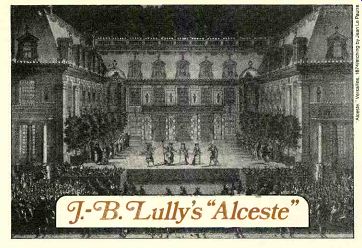
LULLY--Alceste
JEAN-BAPTISTE LULLY. What a name to conjure with! Born in Florence in 1632, he came to Paris at the age of eleven and had careers as a dancer, violinist, and music director for the king before he turned to opera in 1672.
Louis XIV promptly took the Theatre de "Op era and gave it, lock, stock, and barrel, to Lully. No one else in the history of opera, not even Wagner, ever held such power. The king's patent granted Lully a virtual monopoly on opera in France for the rest of his life.
Working with the poet Philippe Quinault, the designer-engineer Vigarani, and the re sources of the grandest court in Europe, Lully ran the most magnificent show-business establishment of all time. Nothing was left out: there were arias, recitatives, and choruses, huge casts and big orchestras (including the largest string section in Europe, plus ample winds and percussion), extensive dances and ballets, magnificent scenery and costumes, and spectacular stage effects (storms, gods descending, a maritime festival, the seige of a fortress, and the fires of hell all appear in Lully's Alceste). Hollywood at its most "epic" was crude compared to the French opera of le grand siecle.
Lully's musical style derives from the Venetian opera of Monteverdi and Cavalli, which he adapted to the French language and taste. His works were genuine music-dramas: long before Gluck and Wagner, Lully created a total theater in which melody, recitative, poetry, stage action, dance, the visual arts, solo virtuosity, orchestral and choral effects, comedy, and tragedy are intertwined on a grand scale. For three-quarters of a century his operas reigned supreme, only to disappear finally in favor of the works of Rameau and Gluck. They have never come back. Only their reputation-a certain perfume of a distant, heroic time-remains. After his death Lully was violently attacked by the supporters of Italian music, and they succeeded in establishing an image of him as merely the com poser of endless boring recitatives. But the reality-as we hear it on the new, complete Columbia recording of Alceste-turns out to be something quite surprisingly different.
Alceste was one of the earliest, grandest, most successful, and longest-lived of Lully's operas. It was the only one that he based on Greek tragedy, and even then the plot was severely modified to suit the French Baroque taste. Its subject, a favorite of the French, is love in its various shapes and forms. The main plot goes like this: Alceste is about to marry Admetus when she is abducted by Lycomedes . Admetus and his friend Alcides give chase and rescue her, but Admetus is mortally wounded. The god Apollo appears to announce that Admetus must leave this life unless someone else can be found to take his place in death. No one is willing except Alceste, who sacrifices herself. Alcides then boldly descends to the underworld, rescues Alceste, and-though he also loves her restores her in the end to Admetus. Mixed in with this more or less serious plot is a comic subplot involving a young lady whose enthusiastic principle in love is fickleness.
No one else in the history of opera ever held such power
One's first surprise, given Lully's reputation, is the popular character of Alceste's libretto. Like Shakespeare, Lully and his librettists were not afraid to mix the learned and the contemporary, the formal and the emotional, the tragic and the comic, the courtly and the popular-and the mix is pleasing.
Similarly, Lully's music blends the formal and the free, the declamatory and the melodic in a particularly satisfying way.
Of the opera's fall from grace, one can only suppose that the old court tradition seriously deteriorated after Lully's death and every thing began to seem terribly old-fashioned.
The very continuity of the vocal lines, gliding so smoothly from recitative to heightened speech-song to a truly Baroque melodic flowering, must have contrasted sharply with the simplicity and clarity of the new Italian style, in which everything was arranged in neat, easy-to-grasp tunes. To make matters worse, French singing had declined in quality (some say it has never recovered), and performances had become encrusted with layers of fossilized tradition.
To recover Lully's original from under the grime of centuries was certainly no easy task, but it has been admirably accomplished by Jean-Claude Malgoire and an excellent cast.
As is often the case in old vocal music, the men make a stronger impression than the women, particularly the two tenors-John Elwes, an Englishman, and Bruce Brewer, an American-and the versatile Dutch baritone Max von Egmond. The English soprano Felicity Palmer is effective in the (surprisingly small) title role, and the coquette Cephise is charmingly sung by Anne-Marie Rodde. The key element in the success of the recording is Malgoire's direction, for he has recaptured the exquisite flow of vocal and instrumental music with an unerring sense of tempo, phrase, and color. The results are impressive. Lully is not, as we thought, grand and cold. Quite the contrary: he is grand and warm.
-Eric Salzman
LULLY: Alceste. Renee Auphan (mezzo soprano), Nymph of the Seine, Thetis, Diane, grieving woman; Anne-Marie Rodde (soprano), Gloire, Cephise; John Elwes (tenor) Lychas, Apollon, Alecton; Max von Egmond (baritone), Alcide, Eole; Marc Vento (bass), Straton; Francois Loup (bass), Licomede, Cleante, Charon; Pierre-Yves Le Maigat (bar itone), Pheres, grieving man, Pluton; Felicity Palmer (soprano), Alceste; Bruce Brewer (tenor), Admete; others. La Grande Ecurie et la Chambre du Roy, Jean-Claude Malgoire cond. COLUMBIA M3 34580 three discs, $20.98.
--------------------
... not about the soloist. That's an unusual ges ture for a concerto recording, but Carlos Klei ber's contribution here is certainly a major one. The performance is symphonically con ceived and thoroughly integrated between so loist and orchestra from first note to last. It is on a very grand scale, and may strike some listeners as a little larger than life, but its in tegrity and sweep easily sustain the expansive proportions. My one disappointment is the reticent quality of the horn solo that opens the second movement, and even this is almost forgivable in view of the excellent playing by the winds in their exposed passages.
The annotation states that this is the "first time the solo score is played without the sty listic changes subsequently introduced by Vilem Kurz," but Rudolf Firkusny, in his third recording of the concerto (with Walter Susskind conducting, in Vox QSVBX-5135, CT-2145), also went back to Dvotak's original version. Angel's annotator goes to great lengths to find a connection between the performers and the Czech milieu, whereas a much happier point to be made about the con certo is its adoption at last into the repertoire of musicians who are not Czechs. That Fir kusny (who has done more than anyone else to keep this work alive) and Susskind both grew up in Prague and studied with musicians who had known Dvorak doesn't hurt, of course, and if I were compelled to choose a single recording of the concerto, the greater intimacy and straightforwardness of their au thoritative approach would appeal to me a little more than the more expansive, grander-scaled one of Richter and Kleiber. Both recordings are quite good technically-the Vox a little crisper, the Angel a little warmer-and I would not willingly part with either. R.F.
RECORDING OF SPECIAL MERIT
DVORAK: The Water Goblin, Op. 107; The Noonday Witch, Op. 108; Symphonic Variations, Op. 78. Bavarian Radio Symphony Orchestra, Rafael Kubelik cond. DEUTSCHE GRAMMOPHON 2530 712 $8.98.
Performance: Very dramatic
Recording. Very good
With this disc Rafael Kubelik completes his traversal for Deutsche Grammophon of the four Dvorak symphonic poems based on folk ballads of Karel J. Erben, the others being The Golden Spinning Wheel, Op. 109, and The Wood Dove, Op. 110. Dvorak's mastery of his musical material for the symphonic poems, particularly in terms of thematic metamorphosis and harmonic coloring, was absolute.
A singularly striking aspect of The Noonday Witch is the composer's use of speech rhythms and dissonance in a way that looks forward to the late works of Leo's Jandeek.
Kubelik has the Bavarian Radio Orchestra performing in a manner reminiscent of the Czech Philharmonic in the palmy days of Va clay Talich. His readings are extraordinarily dramatic, making the London Symphony recordings by the late Istvan Kertesz seem tame indeed in comparison. Dynamic and dramatic contrast also characterizes the Kubelik treatment of the colorful Symphonic Variations, composed nearly twenty years earlier than the symphonic poems. Whether one prefers the dance emphasis in Kubelik's reading or the marvelous flow of the 1969 Colin Davis performance with the London Symphony for Philips (for the moment out of print) is a matter of taste.
The DG sound has both richness and bril liance, though the deepish stereo perspective may offer just a shade less immediate detail than the Kertesz London discs of the symphonic poems. But for performance of these works, Kubelik is tops. D.H.
FALLA: The Three-Cornered Hat. Teresa Berganza (mezzo-soprano); Boston Symphony Orchestra, Seiji Ozawa cond.
DEUTSCHE GRAMMOPHON 2530 823 $8.98, 3300 823, $8.98.
Performance: More brilliant than authentic
Recording: Orchestrally excellent
Ozawa and the Bostonians have some hot competition in recordings of Falla's fascinating and witty ballet score about the ups and downs of young love and the discomfiture of middle-aged lust. Ansermet, whose 1962 Lon don recording also has Teresa Berganza as vocal soloist, conducted the world premiere in 1919. In Angel's Fruhbeck de Burgos and Everest's Enrique Jorda, we have Spanish conductors born and bred to the Falla idiom. And then there is the Columbia recording with the New York Philharmonic led by the formidable Pierre Boulez, who in his ballet recordings has displayed a striking feel for the theater along with remarkable musicianship.
I had only the Everest disc on hand for de tailed comparison, but I remember the others, and I would sum up the Ozawa performance as long on orchestral virtuosity and somewhat short on authenticity of feeling. The opening shouts of "Ole!" and the handclapping that set the atmosphere come off rather tamely, as does Mme. Berganza's following solo. The first dance of the miller and his wife is decidedly fast for my taste, the later fandango for the miller's wife alone lacks the nuances of phrasing specifically called for by Falla in his score, the seguidilla for the neighbors' festivities is rather on the languid side-and so on.
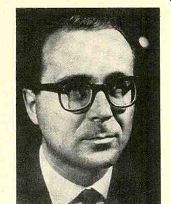
JINDRICH FELD--An eclectic, dramatic First Symphony
So, while the orchestral playing is superb and the recording is up to the best Deutsche Grammophon standard, if I were to choose a recording of The Three-Cornered Hat it would be-on the basis of the best combination of sound, vitality of performance, and style Fruhbeck de Burgos' version by a very narrow margin over Boulez. D. H.
FELD: Symphony No. 1. Czech Philharmonic Orchestra, Antonio de Almeida cond. Flute Concerto. Jean-Pierre Rampal (flute); Czech Philharmonic Orchestra, Vaclav Jirae'ek cond. SERENUS SRS 12074 $6.98.
Performance: Fine
Recording: Symphony good, concerto suspect
This record is my first exposure to the music of Jindfich Feld (born 1925), a Czechoslovak composer noted in Baker's Biographical Dictionary of Musicians for his "chamber music in a neo-Baroque manner." On the evidence offered here, he is a brilliant craftsman, and imaginative too, though not particularly original. Throughout his First Symphony (1970) one is constantly imagining oneself in the domain of some other composer or work, the Shostakovich First Symphony intruding with special prominence among echoes of Bartok, Honegger, Stravinsky, Ravel, and others. It is nevertheless (or perhaps because of these elements) a most attractive work-taut, balletic, a symphony in name only whose five movements (Prologue, Scherzo, Passacaglia, Interludio, Epilogue) have a dramatic thrust suggesting incidental music for a play. Antonio de Almeida, who conducted the premiere in 1972, makes a strong case for the work, and the sound is as fine as the performance.
Jean-Pierre Rampal has spoken with enthusiasm of Feld's Flute Concerto of 1954, and it is likely that this recording dates from the time he played the premiere. It sounds like artificial stereo to me, though it is not so labeled, but it is well managed for all that, with ample smoothness and detail. Actually, the work is not given in its entirety; this extraordinary note appears on the jacket:
"We have included only the first and third movement [sic] of the work because 1.) the total length of the work would demand more record space than Serenus can provide; 2.) the movement is so reminiscent of the symphony of another great earlier composer that, as capably as it is written, it might be subject to critical misinterpretation, something we believe Feld does not deserve; and 3.) the work has enough slow, moving [sic] parts in the two present movements that a slow movement might actually seem redundant; plus the fact that parts of the second movement are repeated in the third." Again, though, it is a really attractive work, with no dead weight (at least in the two longish movements offered here), but with an abundance of echoes and "reminiscences." The writing for the flute is sinuous and silky, and it is effectively contrasted with the generally driving orchestral material in the first movement (where the spirit of Honegger seems ever-present) and the more cantabile tuttis and greater rhythmic and color variety in the third (where Poulenc seems to peep through). The flute has hardly any rests and is called upon for the sort of endurance and big gestures one hardly associates with the instrument-no wonder Rampal loves the work! ( Continued on page 150)
--------------
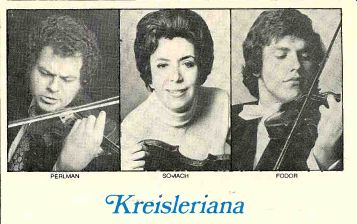
Kreisleriana
THE simultaneous appearance of three generous helpings of "Kreisleriana" (a fourth, an Elman reissue, is pending from Vanguard) points up once again the enduring appeal of Fritz Kreisler's violin miniatures, virtuoso pieces that dazzle while they delight.
Unlike Paganini, Kreisler never sets up a bravura challenge that cannot be met without sacrificing beautiful sound. No one ever wrote for the instrument more lovingly.
It is part of the virtuosic challenge of the Kreisler repertoire that the pieces be performed with seeming effortlessness-the debonair charm of Kreisler's own recordings shows the way. This is easier said than done, for the violin writing harbors treacherous reefs under its smooth surface. Mendels sohn's May Breezes is a good case in point. Its basic songfulness would seem to make the ar ranger's lot relatively easy, but Kreisler wrote virtually the entire piece for the violin's D and G strings. To achieve the required cello-like sonorities, the fiddler must constantly play in the highest and most exposed positions-and sound effortless, of course.
Itzhak Perlman in his second Kreisler al bum manages all this and more with stunning ease. He plays not only elegantly but also in the Kreisler spirit of romantic abandon, caressing his phrases and fearlessly using Kreisler's brand of old-fashioned portamento. But his innate taste allows for no exaggerations: no jondo emotionalism in Albeniz, no bearing down on the G string in Mendelssohn, not even an excess of Viennese schmaltz.
Technically, he could not be more impressive, right down to the treacherous Devil's Trill cadenza.
Eugene Fodor has a flashier style. His technique may be as formidable as Perlman's, but he does not round off his phrases with the latter's elegance and caressing touch (a rather over-assertive Old Refrain here is a good case in point). There is plenty of dazzle and even sweetness of tone, but the spiritual identification with the Kreisler world is missing.
That elusive quality is decidedly present in the playing of Beverly Somach, the erstwhile prodigy who with her "Homage to Fritz Kreisler" returns to concertizing after several years' absence. I enjoy the affecting lyricism FODOR she brings to the music, and she meets the technical challenges too, but not quite with the triumphant ease of her two colleagues.
There are surprisingly few duplications among the three discs (though Perlman's first Kreisler album, Angel S-37171, duplicates many of Fodor's choices). The accompaniments are good in all three collections, and all are well engineered, though Angel's exemplary balance gives the Perlman recording a slight edge.
-George Jellinek
ITZHAK PERLMAN PLAYS FRITZ KREISLER, ALBUM 2. Tartini/Kreisler: Sonata in G Minor ("The Devil's Trill"). Poldini/ Kreisler: Dancing Doll. Wieniawski/Kreisler: Caprice in A Minor.
Trad. (arr. Kreisler): Londonderry Air. Mozart/Kreisler: Rondo from the "Haffner" Serenade. Corelli/Kreisler: Sarabande and Allegretto. Albeniz/Kreis ler: Malagueria. Heuberger/Kreisler: Midnight Bells. Brahms/Kreisler: Hungarian Dance in F Minor. Mendelssohn/Kreisler: Song Without Words, Op. 62, No. 1 ("May Breezes"). Itz hak Perlman (violin); Samuel Sanders (piano). ANGEL 0 S-37254 $7.98.
EUGENE FODOR PLAYS FRITZ KREISLER. Kreisler: Praeludium and Allegro (in the Style of Pugnani); Sicilienne and Rigaudon (in the Style of Francoeur); Menuet (in the Style of Porpora); La Chasse (in the Style of Car tier); Recitativo and Scherzo; The Old Re frain; Caprice Viennois; Tambourin Chinois; Schtin Rosmarin; Liebesfreud; Liebesleid; La Gitana. Eugene Fodor (violin); Stephen Swedish (piano). RCA ARL1-2365 $7.98.
BEVERLY SOMACH: Homage to Fritz Kreisler. Tartini/Kreisler: Sonata in G Minor ("The Devil's Trill"); Variations on a Theme of Corelli. Gluck/Kreisler: Melodie from Orfeo_ed Eurydice. Mendelssohn/Kreisler: Song With out Words, Op. 62, No. 1 ("May Breezes"). Kreisler: Praeludium and Allegro (in the Style of Pugnani); Andantino (in the Style, of Padre Martini); Liebesfreud; Liebesleid. Beverly Somach (violin); Fritz Jahoda (piano). MUSICAL HERITAGE SOCIETY MHS 3612 $4.95 (plus $1.25 handling charge from Musical Heritage Society, 14 Park Road, Tinton Falls, N.J. 07724).
-----------------
Now I'm really curious about that omitted slow movement, and (bearing in mind that one man's "eclectic" is another's "derivative") I'd like to hear more of Feld's music-which Serenus will be offering, apparently, since this disc is labeled "Volume 1." R . F.
FOOTE: Sonata in G Minor for Piano and Violin, Op. 20 (see BEACH) GOUNOD: Faust. Montserrat Caballe (so prano), Marguerite; Giacomo Aragall (tenor), Faust; Paul Plishka (bass), Mephistopheles; Philippe Huttenlocher (baritone), Valentin;
Anita Terzian (mezzo-soprano), Siebel; Joce lyne Taillon (mezzo-soprano), Marthe; Jean Brun (baritone), Wagner. Chorus of the Rhine Opera; Strasbourg Philharmonic Orchestra, Alain Lombard cond. RCA FRL4-2493 four discs $31.98.
Performance: Vocally compelling
Recording: Very good
In "Essentials of an Opera Library" (October 1977 STEREO REVIEW), George Jellinek said that this new Faust (he had heard the advance pressings) would not replace the old De los, Angeles/Gedda/Christoff/Cluytens Angel re cording as his favorite. Well, I would agree, but there are more than a few things to be said for the new RCA recording nevertheless.
Montserrat Caballe's Marguerite is special: sweet, gentle, exquisite. There's no passion, but then there's not much real depth in the role to start with. Her portrayal is close to a certain kind of perfection; almost the only jar-ring note comes at the very end, when Marguerite suddenly and astonishingly throws Faust out so she can be suitably saved. Nothing in Caballe's performance prepares us for this sudden transformation of Marguerite from virgin to avenging angel.
Paul Plishka is a classic Mephistopheles with a dark, firm bass. Giacomo Aragall, a big, new talent, has a magnificent tenor voice that is a bit unpolished musically (compared with Gedda's, at any rate) but is certainly compelling. The weakness of the cast is the Siebel; Anita Terzian is not on a level vocally with the rest.
The orchestral forces are not first-rate, and Alain Lombard is not a great genius of the po dium, but these faint damns are not far from praise. Lombard is a fluent and highly compe tent practitioner, and he gets highly compe tent results out of the Strasbourg musicians.
This is, after all, Gounod. Faust is a work with a strong opening and much striking and beautiful music to follow. But there is also a steady and inexorable slide into sentiment, and Lombard's own enthusiasm seems to rise and decline on that same curve. He is a supple, sure-handed, but somewhat slippery craftsman who threads his way through Gou nod's pious sexiness (or is it sexy piety?) with ease, but never lifts us up beyond it. E.S.
RECORDING OF SPECIAL MERIT
GRIFFES: Piano Sonata; Three Tone-Pictures, Op. 5. RAVEL: Le Tombeau de Couperin. Susan Starr (piano). ORION ORS 77270 $7.98.
Performance: Superb
Recording: Very good
Susan Starr, trained at the Curtis Institute in Philadelphia, is yet another of the crop of younger-generation pianists to be reckoned with-and not just on the basis of virtuoso equipment but of innate musicality as well. I especially enjoyed Starr's handling of the Ravel masterpiece, inasmuch as she gives its poetic essence fully as much attention as its neo-Classic aspects. The music gains enormously thereby. And if it's sheer brilliance you're after, her playing of the final toccata will stand up against any other performance available on discs.
But the Griffes side of the disc gives me even more pleasure. I have been a strong par tisan of the fierce and power-packed sonata ever since I heard Harrison Potter play and record the piece back in the 1930's. There was a spate of early LP recordings of the work in the 1950's, but no stereo version appeared un til 1976, when the enterprising British pianist Clive Lythgoe recorded it for Philips as some thing of a Bicentennial tribute. Miss Starr's performance of the sonata is dynamic and brilliant, and an added attraction of her disc is the first stereo recording of the Op. 5 Tone Pictures-The Lake at Evening, The Vale of Dreams, and The Night Winds-in their original piano version (the woodwind-piano-harp arrangement was issued in 1976 by New World Records). In contrast to the Scriabin influenced style of the sonata, the Tone-Pictures are delicate and masterly impressionist essays. Miss Starr's playing is for me beyond criticism throughout, and the recording quality is altogether first-rate. D.H.
RECORDING OF SPECIAL MERIT
HANDEL: Sonatas for Oboe and Continuo in G Minor, Op. 1, No. 6, and in C Minor, Op. 1, No. 8; Trio Sonatas for Two Oboes and Continuo No. 2, in D Minor, and No. 3, in E-Hat Major. Ronald Roseman and Virginia Brewer (oboes); Donald MacCourt (bassoon); Timothy Eddy (cello); Edward Brewer (harpsichord). NONESUCH H-71339 $3.96.
Performance: Sensual
Recording: Clear
Ronald Roseman brings to these sonatas of the youthful Handel the kind of Italianate exuberance that went into their composition.
Treating them more as sketches for controlled improvisation than as specific notations for exact readings, Roseman spins garland after garland of sensuously ornate phrases, espe cially. in the slow movements. Performed in a seamless legato with a rich tone, the music emerges with the effect of inspired rhapsody Although the amount of ornamentation is nec essarily curtailed in the trio sonatas, Virginia Brewer is an excellent foil and expertly tosses back whatever challenges come her way.
The balance of the ensemble is excellent, and the use of a cello continuo for the solo so natas and a bassoon for the trio sonatas is an admirable notion. Edward Brewer's harpsi chord realizations are beautifully wrought and discreetly performed, the hallmark of good continuo playing. Although the trio sonata is to Baroque chamber music what the string quartet is to Classical chamber music, there are very few really good recordings derived from this vast and rich repertoire. This disc is a valuable addition to the catalog. S.L.
RECORDING OF SPECIAL MERIT
JANACEK: Katya Kabanovi. Nadeida Kni plova (mezzo-soprano), Marfa Kabanova; Vladimir Kregik (tenor), Tichon; Elisabeth Soderstrom (soprano), Katya Kabanova; Dalibor JedHata (bass), Dikoj; Petr Dvorskyt (ten or), Boris; Libi)se Marova (soprano), Var vara; Zdenel Svhla (tenor), Villa; others. Vienna State Opera Chorus; Vienna Philharmonic Orchestra, Charles Mackerras cond. LONDON OSA 12109 two discs $15.96, 5-12109 $15.96.
Performance: Very good
Recording: Excellent
By the time Leo's Janieek began Katya Kaba nova, his sixth opera, in 1917, his style was fully formed; it is characterized by brief, fragmentary vocal melodies growing out of speech patterns, a combination of parlando devices and folkloric elements, and a frequent use of motivic reiteration. The sparse orchestration occasionally takes on an unexpected brilliance, which, combined with biting and slashing sonorities, can result in unforgettably striking effects. The curious thing about Jana Zek is that what may initially seem like a primitive device will often turn out to be cunningly sophisticated.
Katya Kabanovd is based on Alexander Ostrovsky's play The Storm. (Tchaikovsky, who often turned to Ostrovsky's writings for inspiration, had written a programmatic con cert overture on the very same subject.) The plot: caught in an unhappy marriage and sadistically hounded by an evil mother-in-law, Katya seeks solace in a love affair, but she cannot live with her guilt and destroys herself.
Unquestionably, this makes for powerful theater despite the highly condensed and not very skillful libretto (Janadek's own).The river Volga and the gathering storm are used with great tone-painting art to provide a frame for the catastrophe. There is a sense of inevitability to the drama, and though the libretto does not allow for enough character development, the conflicts are real and full of impact.
In this performance the impassioned con ducting of Charles Mackerras (pupil of the great Vaclav Talich and an authority on this music) must be singled out for special praise.
He communicates the tenderness as well as the power of Jangek's quirky writing with a sure hand, drawing magnificent sounds from the Vienna Philharmonic. In the title role, Elisabeth Soderstrom, that exceptional singing actress, seizes our sympathy with Katya's yearning first-act aria and never lets go. More over, as the only non-Slav among the principals, she has mastered the Czech sounds remarkably well.
The other members of the cast appear thoroughly at home with the idiom. They form a very strong ensemble with certain standouts:
Nadelee Kniplova as the monstrous mother in-law is formidable yet laudably short of overdrawing the part, Petr DvorskY is convincing as the decent and not too bright lover caught in the triangle, and Dalibor Jedliela is colorful and sonorous as Boris' uncle.
Like all of Janadek's operas, Katya Kaba nova cannot be related to any Italian, French, or German models. Its closest frame of reference is the same composer's earlier Jenufa.
Of the two I find Katya Kabanovci mere successful. It may not instantly conquer you, but it will grow on you. G.J.
+++++++++
-------------------
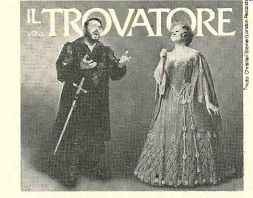
I CANNOT say that the new London recording of Verdi's Il Trovatore conducted by Richard Bonynge lives up to the promise of its blockbuster cast-it includes not only Joan Sutherland but also Luciano Pavarotti, Marilyn Home, Nicolai Ghiaurov, and Norma Burrowes. And yet, like the flawed but irresistible opera itself, it will undoubtedly have many partisans despite some few justifiable critical reservations.
Things begin-disappointingly-with a lifelessly conducted first scene in which Nicolai Ghiaurov sings the part of Ferrando well enough but not with the commanding authority he has displayed on past occasions (when, for moments, he could make us believe we were listening to operas named Ramfis or Timer). Bonynge has some fine moments later, such as the "Mal reggendo" duet and the difficult ensemble at the end of Act II, which he holds together admirably. But his overall leadership is inconsistent: the Anvil Chorus starts out too fast and settles into an effective pace only in the repetition, the Miserere is too languid, and the final scene, though somewhat better, still lacks the right urgency.
I find Luciano Pavarotti's Manrico virtually flawless. Except for "Di quella pira," this is really a lyric role, and from the very opening off-stage serenade Pavarotti imparts the prop er melancholy coloration to his music. In all his big moments, and there are many, he sings meltingly, with elegantly turned phrases. The single martial outburst is also delivered in a manner that silences criticism; let us hope that such vocal escapades do not damage the tenor's invaluable equipment.
Joan Sutherland's Leonora is more debat able. It is a pleasure to hear the part sung with note-perfect accuracy, neatly executed trills, and no compromise whatever in the florid requirements. Temperamentally, though, Sutherland cannot manage the transition from the aloof and dignified Leonora of the early scenes to the courageous and determined woman of Act IV. This, combined with her improved but still indistinct pronunciation, creates merely admirable instances of vocal display where involved dramatic singing is called for. But that vocal display is consistently beautiful in tone, a quality that simply cannot be dismissed.
If Verdi intended to make Azucena the central character in this opera, he must have had a mezzo with Marilyn Horne's extraordinary gifts in mind. She offers singing of all-out intensity and discriminating intelligence: her reverie-like approach to "Stride la vampa" and "Ai nostri monti" is not only right but also beautifully brought off. At forte levels, however, her vibrato sometimes takes the tone off the indicated pitch, to the detriment of an otherwise vital portrayal. Ingvar Wixell, a splendidly resonant, vigorous, and stylistically assured Verdi baritone, also lacks the smooth flow of consistently centered tone that would make his Count di Luna truly distinguished. Norma Burrowes presents an exceptionally good Ines, the other comprimarios are adequate, and, except for occasional im-precisions, the chorus does its work well.
This is the most complete Il Trovatore on records. The ballet sequence Verdi inserted for the opera's 1857 Paris premiere is dramatically irrelevant and disproportionately long, but in its own terms it is very good, and Bonynge conducts it well. There are also various restored cuts and usually omitted second verses to which Sutherland, for her part, adds tasteful embellishments. (The appropriate ness of the latter is debatable but certainly defensible. It would be interesting to read Bonynge' s thoughts on the matter.) The engineering is especially praiseworthy for its clear reproduction of the vocal ensembles. I recommend this set not as the "best" Trovatore but, in the absence of a uniformly superior stereo version, one of the most valid alternatives.
-George Jellinek
VERDI: Il Trovatore. Luciano Pavarotti (tenor), Manrico; Joan Sutherland (soprano), Leonora; Marilyn Horne (mezzo-soprano), Azucena; Ingvar Wixell (baritone), Count de Luna; Nicolai Ghiaurov (bass), Ferrando; Norma Burrowes (soprano), Ines; Graham Clark (tenor), Ruiz; others. London Opera Chorus; National Philharmonic Orchestra, Richard Bonynge cond. LONDON OSA 13124 three discs $23.94. "I find Pavarotti's Manrico virtually flawless. ."
-------------------
RECORDING OF SPECIAL MERIT
KALINNIKOV: Symphony No. 1, in G Minor. State Academic Orchestra, Yevgeny Svet lanov cond. COLUMBIANELODIYA M 34523 $7.98.
Performance: Enchanting
Recording: All right
Svetlanov came surprisingly close to the standard set by Sir Thomas Beecham in his recent recording of one of Beecham's special ties, the Balakirev Symphony No. 1 (Melodiya/Angel SR-40272), and this enchanting realization of the Kalinnikov First strikes me as the finest thing he has done on records so far.
There is a firm but subtle hand in control here, encouraging the various wind soloists in particular to shape phrases freely and alluringly and infusing the proceedings with an altogether captivating air of spontaneity. The Borodinish second theme in the first movement has a fine spring to it, and the andante, with the tasteful caressing of Kalinnikov's imaginative writing for harp, solo oboe, English horn, and clarinet (in that sequence), is sheer poetry. But the entire performance may be so described. The final movement is taken at a lick that will strike some listeners as excessively fast for the allegro moderato marking, but it works beautifully, generating a sweeping excitement that is ever so much more winning than the deliberately paced monumentalism usually visited on this dazzling piece. The recording could be richer, and the orchestra (probably the same one usually billed as the USSR Symphony Orchestra) shows some rough spots, but the shortcomings are easily overlooked amid the overall persuasiveness of the performance=which stands up splen didly in repeated hearings. R.F.
RECORDING OF SPECIAL MERIT
LISZT: Piano Sonata in B Minor; Mephisto Waltz; Transcendental Etudes No. 5 ("Feux Follets") and No. 12 ("Chasse-neige"). Janina Fialkowska (piano). RCA FRL1-0142 $7.98.
Performance: Remarkable
Recording: Good
On this French-recorded debut disc we have a brilliantly gifted young artist (with her share of competition laurels, too) whose musicality fully matches her seemingly limitless technical brilliance. Her Mephisto Waltz and Chasse-neige are fine performances indeed, but it is the gigantic B Minor Sonata that provides pretty much the ultimate test of virtuosity, endurance, and musicality. I can well un derstand the enthusiasm of Artur Rubinstein for Miss Fialkowska's performance of this work in the 1974 Israel competition bearing his name. Without question, the most impres sive aspect of her reading is an unerring sense of proportion, a feeling for the larger drama, that allows her to achieve a wonderfully satisfying sense of climax in the famous grandioso chorale-like episode. And yet she slights no detail of ornamentation and passagework. Everything falls into place musically and dramatically from beginning to end of this performance, which for me takes its place among the half-dozen or so really distinguished interpretations currently in the catalog. To hear Liszt with the poetry as well as the glitter is a fairly uncommon experience. Here is one disc that truly fills the bill. The recorded sound is full bodied and brilliant, if now and then just a mite confined. D.H.
MOLIQUE: Concerto in B Minor for Flute and Orchestra, Op. 69.
ROMBERG: Concerto in B Minor for Flute and Orchestra, Op. 30. John Wion (flute); orchestra, Arthur Bloom cond.
MUSICAL HERITAGE SOCIETY MHS 3551, $4.95 (plus $1.25 handling charge from Musical Heritage Society, Inc., 14 Park Road, Tinton Falls, N.J. 07724).
Performance: Scruffy
Recording: Thin
These two mid-nineteenth-century flute con certos are musically akin to the Hummel piano concertos and the Spohr clarinet concertos. Their gesture is pompous and serious, their form overblown, and their idiom padded with endless figuration and embroidery. But despite their old-fashionedness, they offer a fine flutist great moments of virtuosic revelry.
John Wion is a good flutist who employs a seamless legato appropriate to the style and, for the most part, gets around easily. There are, however, times when his pitch goes awry or his breath runs out and rhythmic smooth ness vanishes in the interest of simply getting through long and difficult passages.
The orchestral sound is far thinner than that required in music of this bombastic period, and I wonder if this obvious pick-up group had sufficient rehearsals to give a confident reading and full support. Nonetheless, the concertos make a welcome addition to the early Romantic recorded repertoire, and John Wion deserves some credit for digging them up and having the patience to learn them.
S.L.
MOORE: The Pageant of P. T. Barnum (see CARPENTER) RECORDING OF SPECIAL MERIT MOZART: Piano Concerto No. 14, in E-flat Major (K. 449); Piano Concerto No. 23, in A Major (K. 488). Ivan Moravec (piano); Czech Chamber Orchestra, Josef Vlach cond. SuPRAPHON 1 10 1768 $7.98 (from Qualiton Rec ords Ltd., 65-37 Austin Street, Rego Park, N.Y. 11374).
Performance: Poetic
Recording: Good
The stunning recording Moravec and Vlach made of the Concerto No. 25 with the Czech Philharmonic (Vanguard SU-11, reviewed here in February 1976) encouraged me to hope for more Mozart from the same team, and this pair of performances is every bit as distinguished as that earlier one. The K. 449 concerto lends itself especially well to the chamber-music approach it receives here exquisitely balanced, marvelously integrated, giving one the feeling that Moravec and every member of the orchestra are actually listening to each other and playing as beautifully as they can for each other's pleasure. Moravec and Vlach take the adagio of K. 488 very slowly indeed; it is by no means heavy or thickened, though, but is tempered by the same aristocratic restraint as the arias of the Countess in Figaro, to whose music this con certo, its slow movement in particular, is so intimately related. The outer movements, too, are somewhat restrained, but never at the expense of their innate vitality. Both of the Ser kins have given us similarly distinguished (and more imaginatively coupled) versions of K. 449, and Brendel and Pollini are equally persuasive in K. 488. But those to whom this particular coupling appeals, or whose enthusiasm for exceptional Mozart playing is not dimmed by the prospect of a duplication or two, may regard purchase of this well- recorded disc as one of the safest investments they are likely to make. R . F.
RECORDING OF SPECIAL MERIT
MOZART: Violin Concerto No. 3, in G Major (K. 216); Violin Concerto No. 5, in A Major (K. 219, "Turkish"). Jose Luis Garcia (vi olin); English Chamber Orchestra, Jose Luis Garcia cond. HNH 4030 $7.98 (from HNH Distributors, Ltd., P.O. Box 222, Evanston, III. 60204).
Performance: Superb
Recording: Flawless
These two Mozart violin concertos have had more than their share of outstanding recorded performances. But Jose Luis Garcia, long associated with the English Chamber Orchestra, especially in Baroque repertoire, doubles as soloist and conductor and comes up here with as fine a realization of these delectable works as I have heard anywhere. His tone has sweetness and warmth without ever becoming cloying, and it is quite clear throughout the orchestral tuttis and ritornellos that conductorially he can keep things moving in an effortless ebb and flow. Especially in the slow movements, he melds the solo and orchestral dialogue into a truly organic whole. Superb recorded sound and noiseless playing surfaces add to a production that gives unalloyed pleasure from start to finish. D. H .
NELSON: Savannah River Holiday (see CARPENTER) PETROV: Songs of Our Days, Symphonic Cycle; Poem for Strings, Organ, Four Trumpets, and Percussion. Leningrad Philharmonic, Arvid Yansons cond. COLUMBIA/MELODIYA M 34526 $7.98.
Performance: Heavy going
Recording: Very good
Andrei Petrov, born in Leningrad in 1930, is one of the younger composers in the Soviet Union seeking recognition in the face of the dominance of the modern big six: Prokofiev, Shostakovich, Khatchaturian, Kabalevsky, Miaskovsky, and Gliere. In 1968, Petrov wrote a letter to a Soviet newspaper suggesting that it was time some attention was paid to works by younger men. Well, this Soviet re cording introduces us to Petrov's own work.
He is a skilled orchestrator and an unabashed melodist and colorist deeply influenced by the work of the generation he is hoping to sup plant in the concert hall, but there is some thing essentially banal and mechanical in the musical episodes that make up Songs of Our Days-though the charm of the pipings and the toy march in the section called "Child hood" indicates what he might achieve in an unpretentious way if he were to take himself less seriously. Yet there is real strength and power in the Poem for Strings, Organ, Four Trumpets, and Percussion dedicated "to the memory of those who died during the blockade of Leningrad." This is restless, belliger ent music of impressive formal dimensions, and it makes me think that Petrov might yet be a worthy heir to Shostakovich himself who, however, lived to outgrow this type of rhetoric in the subtler scores of his later years. Perhaps it is not too late for Petrov, not yet fifty, to outgrow it as well. The performances by the Leningrad Philharmonic under Arvid Yansons are hard-driving and heavy handed, but given the leaden weightiness of these scores it is hard to imagine how they could have been otherwise. P. K .
PUCCINI: Gianni Schicchi (see Best of the Month, page 94)
PURCELL: Funeral Music for Queen Mary.
Anthems: Hear My Prayer, O Lord; Remem ber Not, Lord, Our Offences; Rejoice in the Lord Alway; My Beloved Spake; Blessed Are They That Fear the Lord. Choir of King's College, Cambridge; Philip Jones Brass Ensemble; Academy of St. Martin-in-the-Fields, Philip Ledger cond. ANGEL 0 S-37282 $7.98.
Performance: Churchy
Recording: Resonant
If the first side of this album plunges you into a fit of depression with its unmitigated gloom, ...
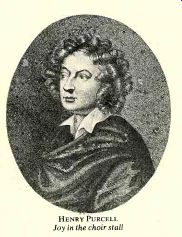
HENRY PURCELL Joy in the choir stall
... the second side will return you to a normal state of cheerfulness with its joyous verse anthems that so pleased the restored monarch Charles II. As one expects from the Choir of King's College, the choral sound is clear, but it is rather on the subdued side. Though the blend is particularly rewarding in the homo phonic passages, the sound loses its richness in many of the contrapuntally conceived sections. In an effort to bring out various points of imitation and interesting individual lines, Ledger allows the sound to fall apart and be come scruffy at times. The solo work by the countertenor, tenor, and bass is fine, but the various boy sopranos seem inadequate.
Perhaps the most frustrating aspect of this performance is the churchy approach to the music. Purcell was a full-blooded, lusty com poser equally at home in chamber, church, or theater. He used much the same style for each, underscoring the meaning of the words with his music. Joy is joy whether it is in the choir stall or on the boards, and it must not be played down just because the text is biblical; Solomon's amorous expressions are just as sensuous as any uttered by rakes and shepherds. The King's College Choir seems to for get this, and as a result Purcell's passionate musical language suffers from unnatural restraint and understatement. S.L.
RAVEL: Le Tombeau de Couperin (see GRIPPES)
RIETI: Conundrum, Ballet Suite. Harkness Ballet Orchestra, Jorge Mester cond. Sestetto pro Gemini. Gemini Ensemble. Second Avenue Waltzes. Elda Beretta, Maria Madini Moretti (pianos). SERENUS SRS 12073 $6.98.
Performance: Fluent
Recording: Good
It brought me up short to see "The Music of Vittorio Rieti, Vol. VI," printed across the top of the jacket, but this is indeed the sixth generously filled disc of Rieti's works in various forms to be offered by Serenus in the last few years. The three works here are as ingratiating and solidly wrought as the better known Harpsichord Partita (Sylvia Marlowe's remake of this is now preserved on CRI 312SD, together with the Harpsichord Con certo). Gold and Fizdale's recording of the Second Avenue Waltzes (1941) on an early Columbia LP (ML 2147) has become a collector's item, so this new recording of the work, delightfully played by two Italian pianists, is especially welcome. The Sestetto pro Gemini (for flute, oboe, two violins doubling viola, one cello, and piano) was written only a few years ago for a Dutch chamber group whose personnel includes two sets of twins from the same family; of its four brief movements, the vivacious second and lyrical third are especially intriguing, but all four are graced with real tunes and lovely, fresh colors. These would seem to be the most prominent qualities of Rieti's music, as they are again in the Conundrum ballet suite of 1964, whose dramatic episodes and propulsive momentum seem to contradict the information that it was composed without a specific scenario. All three performances are fluent, involved, and of a quality to delight any composer's heart, and the recording itself is quite good. Altogether a handsome and enjoyable package.
R.F.
ROMBERG: Concerto in B Minor for Flute and Orchestra, Op. 30 (see MOLIQUE) SCHUBERT: Lieder (see Collections-Ian Partridge)
RECORDING OF SPECIAL MERIT
R. STRAUSS: Don Juan, Op. 20; Macbeth, Op. 23. Dresden State Orchestra, Rudolf Kempe cond. SERAPHIM 0 S-60288 $4.98.
Performance: Splendid Recording: Vivid This would appear to be the first recording of Macbeth since Henry Swoboda's 1950 version for Westminster, which means it is only the second ever; it is curious that the work could have been neglected for so long, but then Strauss himself seems not to have bothered with it much either in conducting his music. It is an early work, as the opus number indicates, antedating Don Juan by a year in its original form, and even the revision made two years later shows more Lisztian characteris tics than one finds in Strauss' other tone poems. Both historically and for its own worth, it is too valuable a piece to be abandoned, and it could not be in better hands than it is here.
The Dresden orchestra, Strauss' own favorite, is justifiably proud of its unique tradition in performing his music, and Kempe too was more closely associated with the works of
Strauss than with those of any other composer. His magnificent cyclic of all Strauss' orchestral works, from which these two splendid performances are drawn, is surely his finest memorial, and Angel is more than generous in making portions of it available on the low-price Seraphim label. Both sides shine with authority, conviction, and commitment, and the sound has a burnished glow more mellow than brilliant, but agreeably rich and well defined. In view of the uniqueness of the coupling, this Don Juan might head the list of the versions now available. R.F.
TCHAIKOVSKY: Piano Music Humoresque, Op. 10, No. 2; By the Hearth, Op. 37a, No. 1; Impromptu, Op. 72, No. 1; Valse, Op. 40, No. 8; Nocturne, Op. 19, No. 4: Chanson Triste, Op. 40, No. 2; Christmas, Op. 37a, No. 12; In the Troika, Op. 37a, No. 11; Barcarolle, Op. 37a, No. 6; Durnka, Op. 59; Russian Dance, Op. 40, No. 10; Scherzo, Op. 40, No. 11; Song Without Words, Op. 2, No. 3; Harvest, Op. 37a, No. 8; Song of the Lark, Op. 37a, No. 3. Danielle Laval (piano). SERAPHIM S-60250, $4.98.
Performance: Pretty
Recording. Good
There was a big demand for do-it-yourself piano music in the nineteenth century, and Tchaikovsky composed quite assiduously and successfully for this market. His own style and inclinations made him the perfect master of the lytical small form. His innumerable salon and genre piano pieces combine the poet-is/meditative style of the early Romantics with the picturesque genre piece of the late nineteenth century. Silent-film pianists ripped off this music and almost killed it; no one has taken it seriously for a very long time.
Nevertheless, its appeal can be as strong as ever; a comeback was inevitable. Danielle Laval, a young French pianist, plays this music without affectation and with real charm.
She is not brilliant or flashy, but there is warmth and just the right touch of sentiment in her performance. Not only is this disc en gaging to listen to but it should send those home pianists still left among us rushing back to the keyboard, Tchaikovsky scores in hand.
E.S.
RECORDING OF SPECIAL MERIT VIVALDI: Flute Concertos, Op. 10, Nos. 1-6.
Stephen Preston (flute); Academy of Ancient Music. L'OISEAU-LYRE DSLO 519 $7.98.
Performance: Suave Recording: Smooth In his ingenious liner notes for this record, Christopher Hogwood argues that these concertos were designed to be played as chamber music, with one instrument per part. And so they are performed here with excellent results. Moreover, these performers play original instruments and obviously feel at home with them. Vivaldi knew exactly how to get the effects he wanted with the instruments he had. His music, therefore, is best presented by using the instruments he had. Only the original instruments can produce the flat, eerie sound that was obviously what he wanted in the slow movement of the Second Concerto (La Notte) or the bird calls of the Third Concerto (Il Gardinello). But all is not imitative effect here. There is a great deal of art involved in both composition and performance, and, while the music is admittedly lightweight Vivaldi, the Academy of Ancient Music elevates it to the level of edifying amusement.
S.L.
COLLECTIONS
COUSINS: POLKAS, WALTZES, AND OTHER ENTERTAINMENTS FOR CORNET AND TROMBONE (see Best of the Month, page 93) DICRAN JAMGOCHIAN: Aria and Song Re cital. Vivaldi: La Fida Ninfa. J. S. Bach: Coffee Cantata. Handel (attrib.): Dank Sei Dir, Herr. Mozart: Don Giovanni: Madamina; Finch'han dal vino. Borodin: Prince Igor: Igor's Aria. Bizet: Carmen: Toreador Song.
Verdi: La Traviata: Di Provenza it mar. Chou hajian: Garineh: Horhor's Aria. Spendiarian:
Oh, Rose! Muradian: Drunken with Love. Di cran Jamgochian (baritone); Armenian symphony, Rafael Mangasarian cond. GOLDEN AGE g GAR 1001 $6.25 (from Golden Age Records, 5347 28th Street, N.W., Washing ton, D.C. 20015).
Performance: Fairly good
Recording: Acceptable mono
Thinking of such fabulous Armenian singers as contralto Zara Dolukhanova and baritone Pavel Lisitsian, I approached this disc with keen anticipation. Well, I did not find their equal in Dicran Jamgochian, but I did find him to be an experienced and versatile artist with a bright and resonant sound and forthright de livery. There is quite a wide range of repertoire covered here, with results ranging from mediocre to almost first-class. A not fully developed top range is the baritone's main draw back. His clear diction discloses a good command of Italian and a less idiomatic way with German and French texts. Of special interest to Armenian listeners (a very musical group) are three attractive and expertly sung Armenian selections. G.J.
A LITTLE NIGHT MUSIC. Mozart: Serenade in G Major (K. 525, "Eine Kleine Nacht musik"). Gluck: Orfeo_ed Euridice: Dance of the Blessed Spirits. L. Mozart: Toy Symphony. Schubert: Rosamunde: Entr'acte in B-fiat Major. Handel: Xerxes: Largo. J. S. Bach (arr. Connah): Jesu, Joy of Man's Desiring. Academy of St. Martin-in-the-Fields, Neville Marriner cond. ANGEL 0 S-37443 $6.98.
Performance: Bright and burnished
Recording: Excellent
By now there are enough Eine Kleine Nacht musik performances on discs to cover the needs of at least twenty-eight nights, yet this latest addition sounds as fresh as though the ink had not yet dried on Mozart's "little serenade" of 1787. As usual, Neville Marriner's Academy of St. Martin-in-the-Fields intones every movement with a fine mixture of silken gloss and muted delicacy. Moreover, the pro gram is a generous one, including the Toy Symphony (which was attributed to Haydn until they found the music in a manuscript by Mozart's father Leopold), played crisply and light-handedly on toy instruments whose quaint sounds pop out jack-in-the-box style from all directions in quadraphonic play back, and Bach's imperishable Jesu, Joy of Man's Desiring-with the solo oboe of this arrangement beautifully placed against an orchestral tapestry of sound. P.K.
BENJAMIN LUXON: Give Me a Ticket to Heaven (see Best of the Month, page 94)
IAN PARTRIDGE: Schubert Lieder. Liebes botschaft; Standchen; Fischerweise; An Sylvia; Auflosung; Der Wanderer an den Mond; Die Sterne; Wanderers Nachtlied; Bei Dir Alleine; Die Forelle; Ganymed; An die Musik; Uber Wildemann; An die Laute; Der Einsame; Dass Sie Hier Gewesen; Der Schiffer. Ian Partridge (tenor); Jennifer Partridge (piano). ENIGMA VAR 1019 $7.98 (from HNH Distributors, Ltd., P.O. Box 222, Evanston, Ill. 60204).
Performance: Sensitive and idiomatic
Recording: Good
I have encountered Ian Partridge previously on records, but only in Baroque music. He must be very well known in England because this imported disc has dispensed with all bio graphical material. In any case, he is a well-schooled and experienced artist who appears quite comfortable with this group of irresist ible Schubert songs. His voice is agreeable in tone but rather small in size and somewhat limited in its upper extension. It is used with excellent control, without undue forcing, so that the tone never fails to please, though tur bulent passages in a song like Auflosung seem a bit stretched. There is in this case a certain problem in balancing voice and piano: the singer is at times blanketed by the pianist.
Nevertheless, I am quite impressed by this team. The tempos are just, and Mr. Partridge laudably refrains from rushing those marvel ous songs about speedy brooks and playful fishes, paying careful attention to Schubert's delicate ornamentations along the way. There aren't as many Schubert recital discs in the current catalog as one might think, and surely not many that contain such an abundance of "hits." With its full texts, translations, and excellent surfaces, this one therefore has my recommendation. G.J.
JEAN-PIERRE RAMPAL: Carnival de Rampal. Doppler: Fantaisie Pastorale Hongroise.
Kreisler: Liebesfreud; Liebesleid. Chopin: Nocturne in F-sharp Major, Op. 15, No. 2; Minute Waltz. Ravel: Habanera. Gluck: Orfeo_ed Eurydice, Minuet. Yoshida (trans.): Variations on a Theme of "Sakura." Genin: Carnival of Venice.
Debussy: Clair de Lune. Bizet/ Borne: Carmen Fantasy. Jean-Pierre Rampal (flute); Futaba Inoue (piano). RCA JRLI-2315, $7.98.
Performance: Pleasant
Recording: Excellent
Looking over the list of nearly a dozen al bums that Jean-Pierre Rampal has recorded in the past few years, one might suspect that this gentleman is determined to transcribe the en tire classical repertoire for flute. Where is the line to be drawn? Certainly the flute's allure is evident in the languorous Ravel Habanera, the Chopin Nocturne and Minute Waltz, De bussy's opalescent Clair de Lune, and the variations on a Japanese theme so adroitly transcribed by Masao Yoshida. Yet even so versatile and songful an instrument has limitations that even the supple skill of Rampal cartnot entirely conceal. It cannot, for example, compete with the violin in seductiveness, as becomes obvious in the transcriptions of Kreisler's Liebesfreud and Liebesleid and in the Carmen Fantasy. When it comes to Carnival of Venice, on the other hand, the banalities are built right into the score. In all, though, Rampal's elegant playing makes for pleasant listening throughout, especially with the alert piano accompaniments of Futaba Inoue. P.K.
LEOPOLD STOKOWSKI: Transcriptions for Orchestra.
Rimsky-Korsakov: Flight of the Bumblebee; Ivan the Terrible. Debussy: Claire de Lune; La Soiree dans Grenade. Chopin: Mazurka in B-fiat Minor; Prelude in D Minor.
NovaCek: Perpetuum Mobile.
Tchaikovsky: Humoresque, Albeniz: Fete Dieu a Seville.
Shostakovich: Prelude in E-flat Minor. Nation al Philharmonic Orchestra, Leopold Stokowski cond. COLUMBIA M 34543 $7.98.
Performance: Overdressed but lovely
Recording: Superb
Over the years-and there certainly were many of them-the late Leopold Stokowski occasionally took time out from the podium to apply a felicitous if florid hand to transcribing for orchestra some of his favorite non-orchestral works. Purists have held their ears in horror. Most of the rest of us have rather enjoyed the odd experience, especially when the white maned maestro himself coaxed some giant orchestra to draw sensuous floods of sound from the page. This time around, with the National Philharmonic at his disposal, Stokowski for once gave the Bach Toccata and Fugue in D Minor a well-earned rest, turning his attention to the Romantic literature instead.
Most of the transcriptions here are based on piano solos. In every instance we are drenched in gorgeous washes of instrumental color that is in some cases more appropriate to the original material than in others. The tints and rhythms, the pulsing excitement, of Albeniz's Festival in Seville are dazzling. For Debussy's La Soiree dans Grenade, Stokowski seems to have turned for clues to that composer's own Iberia, and the effect is alluring-although the town has certainly been painted red for the occasion. On the other hand, there is a diffident Chopin prelude blown up to Wagnerian proportions, and Rimsky-Korsakov's buzzing bumblebee pro liferates into an entire swarm. Even Nova Cek's Perpetuum Mobile, originally scored for violin and piano, glitters like a revolving Christmas tree in a shop window, for in this version Stokowski festooned his original transcription for violas and percussion with additional parts for woodwinds, brass, and harp.
In some cases he toned down earlier conceptions: I recall an old recording he did of the Chopin Mazurka in B-flat Minor that swooned like a thousand sighing Victorian maidens; on this one, it only pants a bit. No matter. We al ways have the originals to turn to if we want to recall the composers' real intentions.
Meanwhile, this colorful program-from the Tchaikovsky Humoresque, based on a pretty tune the composer once heard in Nice, to the "symphonic intermezzo" based on material from Rimsky-Korsakov's opera Ivan the Terrible-makes for luscious listening. The great conductor was never in better form, the National Philharmonic Orchestra responded to his whims with gusto, and the recorded sound is topnotch.
P.K.
The Opera File
MARIA CALLAS (1923-1977)
WHEN the startling news that Maria Callas had died was broadcast in New York, several friends called me to commiserate as though I were a member of the bereaved family. But, although I admired Callas enormously, I didn't know her personally and had never so much as written her a letter. On the few occasions in the Fifties and Sixties when someone offered to introduce me to La Divina, out of shyness I always declined. I was afraid that confronted with such a great artist who had moved me so deeply I would lose all dignity and self-control and say some thing dumb like-Gee, Mme. Callas, I think you're grand!" I heard her at every stage of her international career, beginning in Mexico City in 1951 before her name was a household word.
She sang Aida and La Traviata there, and al though I enjoyed her performances, I blush to confess that I did not foresee the great career that lay before her. I was young and hadn't been to the opera very much. Pretty voices, that's what I liked, and Callas' voice sounded strange to my inexperienced ears. I simply was not sensitive enough to appreciate her musicality, the purity of her diction, her genius for phrasing. Now when I listen to pirated discs or tapes of her Mexico City performances, I think I must have been not only young, but deaf.
My hearing improved greatly as her Angel recordings came out-Lucia, Puritani,Tosca, Forza, and Norma-and they sharpened my perceptions a great deal. Through them I found the beauty in her voice and realized that for me the most significant of her many gifts was an unparalleled ability to act with the voice and communicate feeling through music.
By the time I got to La Scala in Milan for the first time in 1955, I was an avowed Callas fan, and the first performance I attended in that historic theater was Bellini's Norma with Mario del Monaco, Giulietta Simionato, Nico la Rossi-Lemeni-and Callas in her prime. It took me several days to recover, and then I went back to see them do it all over again.
So much has been written about Callas the actress, and there is so much drama in her singing on records, that many people who never saw her think she must have caromed about the stage and clawed the scenery a lot.
Nothing could be further from the truth. Her acting was marked by delicacy, vulnerability, and taste. She always knew when a small gesture would make a greater effect than a large one, and she could command more attention by standing still and listening to a colleague than most singers get by rending their garments and tearing their hair.
Over the next decade, although I bought her records as they were issued, I saw her only intermittently in the opera house, but I was present at her last performance at the Met in Tosca on March 25, 1965. Some vocal decline was undeniable, but the magic was still there. In his memoirs, the Met's general manager Rudolf Bing wrote of that last evening: "She did not sing well, but it made no difference whatever-never had there been such a Tosca." After years of inactivity Callas returned to New York to give a series of master classes at the Juilliard School in the season of 1971-1972, and they were also unforgettable performances. It gave me goose flesh to see her walk across the stage or hear her sing a few lines to illustrate a musical point. I don't know how much her young students profited from her coaching, but fortunately Callas' great career began simultaneously with the introduction of the long-playing record, and a large body of her work is permanently documented not only for the pleasure of future record collectors but for the instruction of fu ture students of singing as well.
My list of essential Callas recordings includes her Lucia (Seraphim 1B-6032), Norma (Seraphim 1C-6037), and Tosca (Angel 3508).
I prefer these mono versions because here she is vocally more secure than in the later stereo remakes. Recorded in the early years of the bel canto revival, the Norma and Lucia make clear how Callas helped to bring that revival about. The Tosco- with Giuseppe di Stefano and Tito Gobbi is generally regarded as the most nearly perfect operatic recording ever made. A vocal collector should have at least one of her Verdi operas, perhaps Rigoletto (Angel 3537), for her dramatic yet girlish Gilda, or Ballo in Maschera (Seraphim IC -6087), for the intensity of her more mature Amelia.
Among the many recital discs, I would choose "Art of Maria Callas, Volume 3, Col oratura/Lyric" (Angel 35233) for its display of her versatility. One must also have "Verdi Heroines" (Angel S-35763) for her Sleepwalking Scene from Macbeth and "Mad Scenes" (Angel S-35764) for the excerpts from Bel lint's Il Pirata and Thomas' Hamlet. "Great Arias from French Operas" (Angel S-35882) is uneven, but the two Carmen arias are splendid examples of her feeling for rhythm and musical line, and "Printemps qui commence" from Saint-Saens' Samson et Dalila is quintessential Callas.
To list and analyze what Callas has left us on records would take a book. That book has been written. Published on September 12, only four days before her death, it bears the unintentionally apt title The Callas Legacy (Scribner's, 224 pages, $12.50). It was written by John Ardoin, music editor of the Dallas Morning News,a critic who has admired Callas and studied her work for years. In his new book Ardoin examines every available bit of her singing that has survived, whether on pi rate discs and tapes or commercial recordings. He points out faults as well as virtues, and I recommend the book not just for Ardoin's special insights into the artistry of Callas, but for his sensitive approach to operatic singing in general.
As I read The Callas Legacy, I realized that every time I saw her was such an important event in my life that I can still remember who attended each performance with me. And it occurred to me that just as a lot of my con temporaries conducted the love affairs and close friendships of their youth and early manhood to the musical accompaniment of Frank Sinatra or Mabel Mercer, I spent countless pleasant hours with the people I have loved most in the world listening to Cal las records. Then it dawned on me that I was indeed a member of a large bereaved family, her public.
In the epilogue to his book Ardoin quotes Richard Dyer's review iri The Nation of Cal las' appearance in Boston on her disastrous final concert tour with Di Stefano in 1974: "Now in her struggle and in her exhaustion she asks and earns . . . what she has never before seemed to need, our love." It made me bitterly regret that I had never touched her hand, looked into her eyes, and said, "Gee, Mme. Callas, I think you're grand!"
++++++++++++++++++++++++++++++
Xmas Music
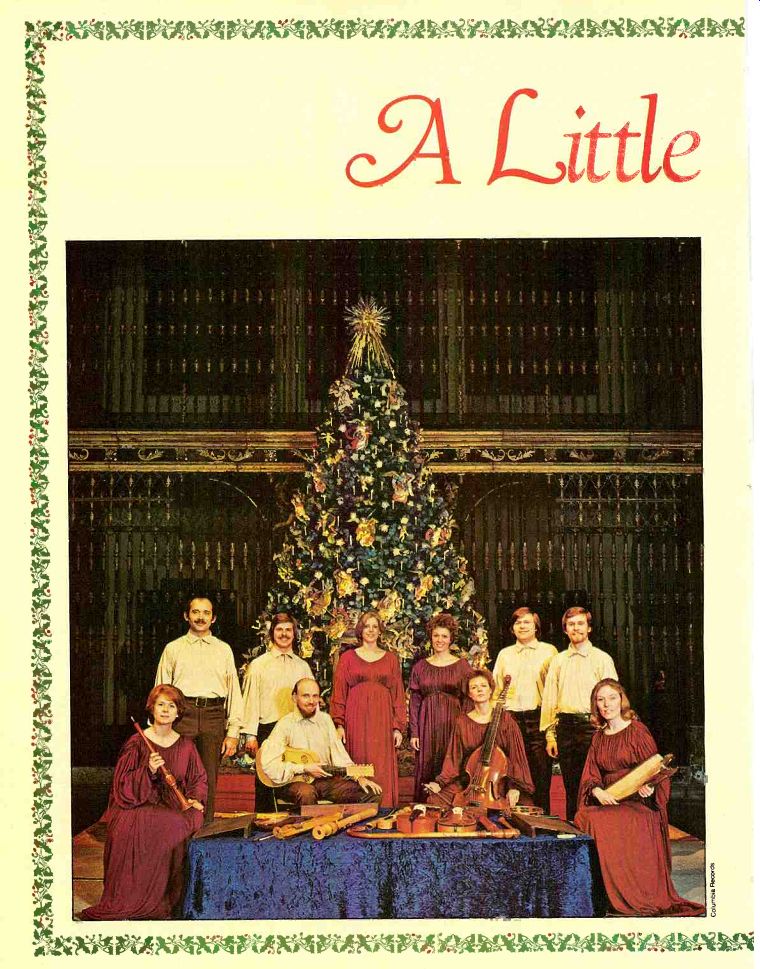
DURING Christmas week the post man often delivers a package out of which tumble a number of smaller, gaily wrapped pack ages of various sizes-assorted gifts chosen to appeal to the various ages and tastes of the entire family. They may range from simple "stocking stuffers"-fun and games-to impressive and finely wrought objets d'art. It is just such a package that has recently arrived from Columbia Records. Called "A Renaissance Christmas Celebration with the Waverly Consort," its dozen varied carols, chorales, dances, and motets were selected and most elegantly "wrapped" in the multicolored timbres of Renaissance instruments by director Michael Jaffee and his excellent group of singers and instrumentalists. The Waverly Consort (six singers and four instrumentalists, here augmented by seven additional performers) specializes in medieval, Renaissance, and Baroque music and has acquired an international reputation for the beauty, vitality, and authenticity of its performances.
Much of the music making of the Renaissance sprang from the art of skillful arrangers working with old, familiar melodies-liturgical chants, dance tunes, popular songs, and traditional carol or chorale melodies. And even when a composer had completed a new score, its performance again became an arranger's art, a matter of "orchestration," for the choice and disposition of voices and instruments for the various parts were left to the imagination and taste of leader, conductor, or chapel master. "Definitive" performances of these works are therefore no more possible than they would be for contemporary popular songs.
This art of arranging was described in detail in the writings of Michael Praetorius (1571-1621), prolific composer and musical scholar, eight of whose works are included in this Columbia program. His flair for the possibilities of vocal and instrumental color, varieties of sonority, contrasts of weight and texture, plus sheer sensuous pleasure-all characteristic of the musical taste of his time-parallels Berlioz's gift Members of the Waverly Consort pose with their instruments before the tree erected each Xmas season in the Medieval Sculpture Hall of the Metropolitan Museum, for orchestration two centuries later. The possibilities of combining solo voices with the instruments included in this recording (viola da gamba, organ, harp, shawm, recorder, dulcian, lute, sackbut, cornetto, Baroque trumpet, bells, tambour de Basque) are literally inexhaustible-if not all equally successful.
Two of the Praetorius arrangements included here are lively and sometimes rhythmically intricate dances. The other six are arrangements of some of the most familiar old Christmas melodies, varying from the simple, eloquent harmonization of Es 1st eM Ros' Entsprungen to the large scale, elaborate, one might almost say "concertato-fantasia" treatment of In Dulci Jubilo, where a succession of quickly changing textures and styles-now two or three voices, now seventeen; now poly phonic imitation, now homophonic sonority; now melodically simple and syllabic, now more elaborately ornamental-builds a sonorous architecture of multi-spaced and multicolored jubilation.
The program begins with three anonymous Spanish vitlancicos-popular, rustic dance songs with irresistibly "catchy" hemiola rhythms (three beats against two, or vice versa), breezy refrains alternating with solo verses. Simple strophic harmonizations of the melody acquire a new luster and beauty through the changes of instrumentation from stanza to stanza.
Side one includes the impressive eight-voice motet O Magnum Mysterium of Giovanni Gabrieli, the Venetian master of musical chiaroscuro, and the program concludes with Josquin's motet Ave Maria, a most eminent model of classical Renaissance serenity, poise, equilibrium, and unruffled eloquence of expression. In this performance the voices are unobtrusively reinforced by instrumental color that adds clarity to the individual vocal lines, and this in turn gives a new and exciting dimension to the word "counterpoint." Not only does one hear the familiar simultaneous unfolding of four separate melodic strands, but one also hears their "fitting together"-intervals of various sizes slip ping easily into place as blocks of stone do when a mason fashions an intricate and varied pattern in a building facade. Here is "musical architecture" that is no longer a mere metaphor, a structure made possible as much by the singers' vibratoless tone production and faultless intonation as it is by Mr. Jaffee's fine understanding of the compositional style and craft of the early sixteenth century. This is an album that deserves a permanent place of honor in anyone's collection of Christmas-music perennials.
ANOTHER of the record business' major contributions to the Christmas season this year is Angel's stunning new recording of Bach's Christmas Oratorio performed by the Choir of King's College, Cambridge, the Academy of St. Martin-in-the-Fields, and four super-star soloists and conducted by Philip Ledger, director of music at King's College.
The Christmas Oratorio was conceived as a set of six cantatas to be performed successively on the six feast days and Sundays of the Christmas season in the two major Leipzig churches in 1734. The Biblical story was thus narrated in six episodes: the Nativity, the Annunciation to the shepherds, the Adoration of the shepherds, the Circumcision and naming of Jesus, Herod's search for the child, and the Adoration of the Magi. Though it appears to be a succession of six independent and self-contained pieces, it is everywhere obvious that Bach conceived it as a single, unified, and thoroughly integrated large scale work similar to the Passions.
Much of the music consists of the re working of movements from previously composed cantatas, especially those for the birthdays of the Elector and the Electress-Queen of Saxony of the previous year. Because of this fact, it has been assumed that the music is therefore less "inspired," that Bach was taking the easy way out. But this was always a part of Bach's compositional procedure and, in deed, of Baroque composers in general.
Further, with respect to this work, there is evidence that the music of the birthday cantatas was originally conceived with an eye toward subsequent use in the oratorio.
In all, the Christmas Oratorio is no secondary work and stands only slightly be low the B Minor Mass and the St. John and St. Matthew Passions as crowning achievements of Bach's liturgical music.
Though the episodes of the story are not as dramatic as those of the Passions, the music is nowhere inferior, it is no less varied, nor is it less probing of the infinite
Xmas egusic... subtleties and ambivalences of the Christian faith.
There are at least two traditions of oratorio and oratorio performance. The first, that established by Handel out of Italian models, might be called the heroic-epic type. Based on Old Testament stories re counting the great deeds of heroic characters and intended for concert performance, it demanded large choruses and the great vo cal art of renowned virtuoso singers, both male and female-those super-mortals who rise in august solemnity before the foot lights, full-chested, with book in hand, fully conscious of their almost oracular responsibility. It is typically Baroque in that its aim is the marshaling of artistic effect to over whelm the beholder.
The second tradition, established in Germany by Schutz from liturgical drama origins and continuing through Bach, might be called the liturgical-hermeneutic type. Since it was intended for performance as part of the liturgical service, its performing forces were relatively small and its soloists were generally choir regulars (all men and boys).
The adventures of its non-heroic characters are told and immediately transposed and interpreted to become moments in the inner experience of the worshiper and the congregation. It contains, therefore, much that is more intimate, more personal and immediate, even homely in character.
Most of the recorded performances of the Christmas Oratorio currently available are hybrids from these two traditions-that is, the chorus of men and boys is relatively small while the solo arias and recitatives are performed by eminent virtuosos of the operatic stage. Unfortunately, not all of these soloists are able to shed the heroics of the Italian style or to forget themselves as exemplars of great singing art in order to portray the often simple, un-heroic, troubled conscience of the child of faith.
No, one recording, that of Nikolaus Harnoncourt and his group of Bach scholars for Telefunken (3635022), can be called purist in its attempt to reproduce Bach's works as they would have been heard in Bach's day the same size forces, Baroque instruments, falsettist and boy treble and alto, the pitch of that time (a half-tone lower), and articulations and rhythms based on the most recent investigation of Baroque performance practices. The result is highly unusual and un typical-for some, exciting and fascinating, for others, disturbing and even unmusical. It is therefore difficult to compare it with the others. Of those recordings with which I am familiar, almost all are of exceedingly high quality, so that it is almost impossible to single out one as unquestionably superior. The new Angel recording is in almost all respects a splendid and satisfying performance, both brilliant and moving-brilliant in sound as well as in the virtuoso performance of the choir, soloists, and instrumentalists, and moving in the eloquence of the accompanied recitatives and arias and in the compelling momentum of the chorus.
Choruses and chorales provide the architectural pillars of the oratorio. Each of its six parts, excepting the second, opens with a large-scale, elaborately developed chorus which establishes the character, mood, atmosphere, and color of what follows. The dramatic episode is then developed through solo recitative, arioso, aria, and an occasional chorale. A strong, traditional, congregational chorale concludes each part as a kind of collective affirmation. The excellence of the choir of King's College in the area of English polyphonic music has been demonstrated in their several recordings.
Their brilliant performance of the choruses of this work further attests to their superlative musicianship and to their ability to compete for honors with the seasoned German choirs whose very flesh and blood seem permeated with the Bach style (not to mention the German language). Though their tone quality is perhaps purer than the more open diapasoned directness of German choristers, it is nowhere lacking in power, vitality, or character, and their enthusiastic approach to the work contributes to the overall freshness and élan that characterizes this performance. The clarity and ease with which they negotiate the rapid ornamental figures in the opening chorus is breath-taking. So also is the whole of the chorus "Ehre sei Gott" whose jubilant shouts and antiphonal responses issue into a fugue of irresistible momentum and cumulative drive.
The trebles achieve an almost clarion brilliance and power, and these are matched by the strength and clarity of the altos.
ALL of the recording companies have en listed first-rank singers for the solo arias.
Those of Angel (Elly Ameling, Janet Baker, Robert Tear, and Dietrich Fischer-Dieskau) are artists of enormous stature and unquestioned artistry. If I have some reservations with respect to Mr. Tear and Miss Baker, it is not because their singing is not brilliant (it is), but because they were miscast. Both have voices of heroic size suited to the heroes of Handel and of Italian opera. Their virtuoso presence keeps them in the fore ground, and one loses sight of the story, the inwardness of the sentiment, and the earnestness of each character's stance. My preference is for Christa Ludwig (DG Archive 2710004), who has achieved a remarkable warmth, intimacy, and simplicity appropriate to the characters she portrays. And I also prefer Fritz Wunderlich (Archive as well) with his much more lyrical and flexible approach to the predominantly bravura ten or arias. Tear's performance seems much too robust, aggressive, even violent, not only in the two arias of part six, where there is some justification, but also in others where there is not. Admittedly, this is a bravura role, but there are many qualities of bravura besides rage and vengeance.
Miss Ameling and Fischer-Dieskau both give superlative performances throughout the new Angel recording. Ameling's almost childlike fascination and play with her double echo (oboe and treble) in the dialogue aria of part four is sheer delight, and Fischer-Dieskau's ability to turn mere words into living beings, each with a character, shape, and life of its own, is again apparent here.
He too subordinates his voice and artistry to the spirit and intimacy of the texts. Too word conscious? Not, I think, for Bach.
Special comments must be directed to the brilliant performance by the instrumental ists of the Academy of St. Martin-in-the-Fields. Not only are they not suppressed by the engineers in order to give prominence to the voices, they are everywhere co-partners, equal in virtuosity, eloquence, and beauty of sound. Special honors must go to oboists Tess Miller and Celia Nicklin. No where have I heard Bach's poignant oboe d'amore melodies played with greater beauty of sound, subtlety of articulation, and gracious expression. It is worth the price of the album for these movements alone. No less rewarding are the contributions of the other soloists, especially on trumpet and horn, from whom Bach demanded the al most impossible. But it is the perfection of the ensemble (especially in the concerto-style movements) that gives this oratorio of joy and praise the radiance appropriate to the Christmas story.
A FINAL word about the ambiance of the performance. It was recorded in the King's College Chapel, where there is a very lively reverberation which is sometimes exciting in the afterglow of the brilliant choruses but slightly disturbing elsewhere. At the opening, the timpani generate an almost too voluminous volume of sound, and occasionally--but only occasionally-the reverberation intrudes during the course of a movement, especially as a third and unwanted echo in the soprano aria of part four. otherwise it contributes to the very live quality of the recording.
All in all, and in spite of the few reservations voiced above, I find this a highly satisfying version of the oratorio, sometimes breath-taking and electrifying, sometimes tremendously moving, and almost always sensuously beautiful. The package includes the usual text with translation and two pages of useful notes.
---------------
THE WAVERLY CONSORT: A Renaissance Christmas Celebration. Spanish Villancicos (Anon.): Dadme Al bricias; Riu, Riu, Chiu; E la Don, Don, Verges Maria. G. Gabrieli: O Magnum Mysterium. Josquin des Pres: Ave Maria. Praetorius: Courante; Philov-Volte-Philov; In Dulci Jubilo; Ein Kind Geborn zu Bethlehem; Nun Komm, der Heiden Rei land; Psallite Unigenito Christo; Jo seph, Lieber Joseph Mein; Es Ist ein Rea' Entsprungen. Waverly Consort, Michael Jaffee dir. COLUMBIA M 34554 $7.98.
J. S. BACH: Christmas Oratorio (BWV 248). Elly Ameling (soprano); Janet Baker (alto); Robert Tear (ten or); Dietrich Fischer-Dieskau (bass); Choir of King's College, Cambridge; Academy of St. Martin-in-the-Fields, Philip Ledger cond. ANGEL 0 SC 3840 three discs $23.94.
--------------------
++++++++++++++++++++++++++++++
Ballet Disco
A BASIC LIBRARY OF SELECTED RECORDINGS
COMPILED BY WILLIAM LIVINGSTONE
BACKGROUND
BY the 1960's and early 1970's the growth of ballet in the United States had become truly phenomenal. An article in the Wall Street Journal of March 14, 1968, bore the headline "The Dance: Signs of a Boom Market." In 1972 the New York Times published statistics showing that attendance at ballet and modern-dance events had increased 500 percent since 1965. New York no longer contained the majority of the dance audience-73 percent of it was spread across the country. The young were especially prominent in this larger audience, and a survey made by the Association of College and University Concert Managers yielded the incredible bit of information that, on the 140 campuses included in the study, more ballet performances were sold out than rock concerts.
In the years since the Thirties the sissy image that once plagued ballet has almost disappeared, probably be cause of the emergence of such virile dancers as Jacques d'Amboise and Ed ward Villella, who were capable of performing feats of strength and endurance that few professional athletes could duplicate. The elitist label persisted a bit longer.
In its origins and for much of its history ballet was indeed elitist. It was a court entertainment, whether the dancers were the ladies and gentlemen of the court of Louis XIV of France or professionals hired to dance for the imperial court of czarist Russia. But the governments that have replaced those royal courts have since used ballet companies as cultural ambassadors to friendly nations-not to dance for audiences made up only of heads of state and cabinet members, but to convey to the public at large the message that "our country is cultivated, our men are strong, and our women are beautiful." As for the performers, such gifted dancers as Mikhail Baryshnikov and Gelsey Kirkland may belong to an elite, but it is the same elite that includes soccer players Shep Messing and Pete, tennis players Virginia Wade and Jimmy Connors, football's O. J. Simpson, baseball's Tom Seaver. God, the supreme elitist, has endowed these lucky few with physical and mental skills that enable them to do certain things better than the rest of us. The "Our country is cultivated, our men are strong, and our women are beautiful." public, always fascinated by excellence, is willing to pay for the excitement of seeing that excellence demonstrated, whether in arena or theater.
It is not unusual at dance events in New York and Washington to spot such diverse public figures and Beautiful People as Jacqueline Onassis, Woody Allen, Betty Ford, Katharine Hepburn, Paul Newman, and Joanne Woodward. Neither is it unusual to see a sprinkling of such celebrities at a ten nis match. But the majority of the audience for ballet, as it is for sports, is made up of the rest of us plain clumsy folks.
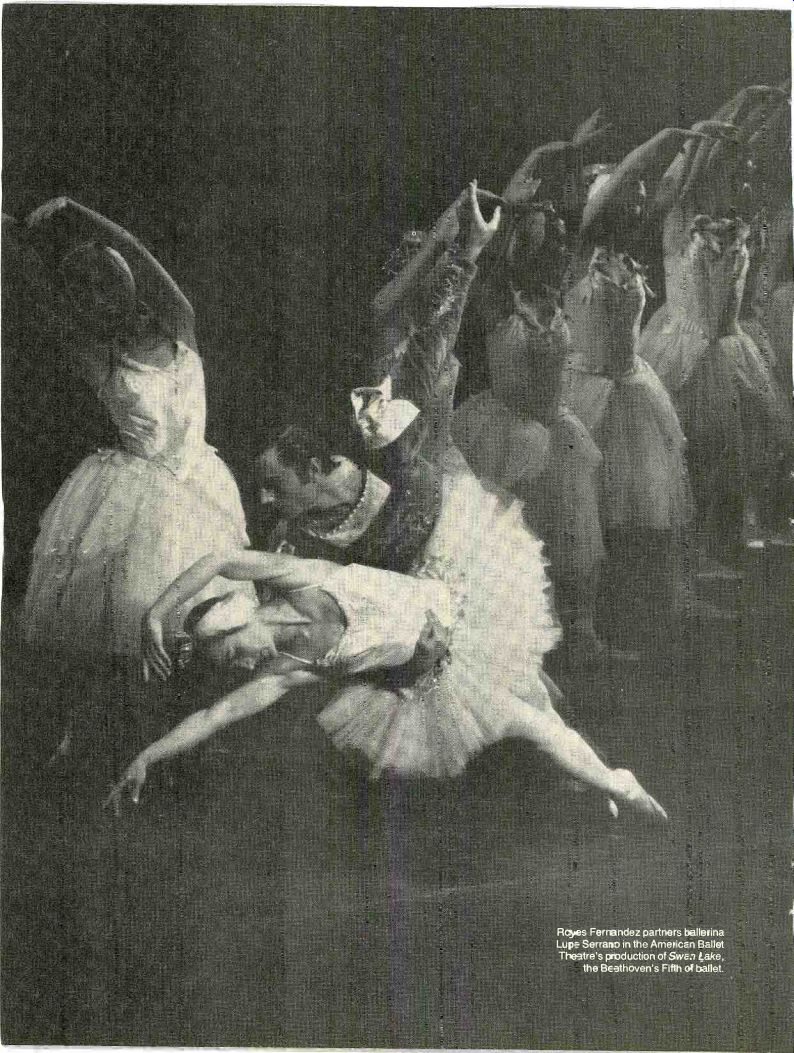
Happily, television, the Medium of the Common Man, is now taking the best the dance world has to offer into the homes of those who lack the funds, transportation, or energy to attend live performances. There have been some fabulous programs in Exxon's distinguished Dance in America series, and the American Ballet Theatre's performances of Swan Lake and Giselle in the Live from Lincoln Center series (also sponsored by Exxon) got ratings among the highest recorded for any "cultural" program disseminated by the Public Broadcasting Service. Swan Lake even won an Emmy this summer.
Happily, too, the greater part of the music for the "classical" dance repertoire is available on discs, and the record companies are responding to the increase in the size of the audience by bringing out more ballet on records.
----------------
Disco dancing has become so much a part of American life in the last few years that churches new advertise Saturday-night disco parties for senior citizens. But when news magazines speak of the United States as the world's leading dance power, they are not referring to the billion-dollar disco industry, but to the enormous increase in the popularity of ballet and related forms of theatrical dance that has taken place in this country since World War II.
Much as I love ballet, it strikes me as incongruous that such a traditional art form should flourish and appeal to wide audiences at just this time. Ballet re quires rigorous training, extreme discipline, and great virtuosity, yet its significant expansion has come during the last three decades, a period when practitioners of other arts rejected traditional forms and techniques in favor of "self-expression" and "getting loose," creating meter-less poetry, non objective art, and junk-yard sculpture.
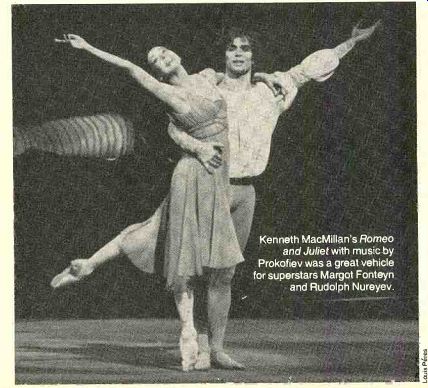
-------- Kenneth MacMillan's Romeo and Juliet with music by Prokofiev was a great vehicle for superstars Margot Fonteyn and Rudolph Nureyev.
One explanation of this paradox was offered by Lincoln Kirstein, general director of the New York City Ballet, in an article in the Schwann record catalog of May 1974. Kirstein said that, in a world rendered anxious by random absurdity and disorder, "the ballet represents humane order, or at least a metaphor, on an active plane of an ordered and civilized practice." I agree, but I think the appeal of bal let is more basic than that. Dance, like song, is one of the elemental forces that animate all music, and just as sculpture is a more primitive art than painting, dance is more primitive than song. Ballet dancers communicate with their audiences in a heightened form of body language that is curiously satisfying on some primitive, nonverbal level.
Similarly, I find that music for the bal let stimulates not only the mind and the heart, but the very muscles and sinews of the listener. It's exhilarating. While listening to records to compile the basic library of ballet music that follows, I found it very difficult to sit still and had to get up periodically and leap over the coffee table.
Choreographers today do not limit themselves to music written specifically for ballet, but choose as their scores anything from Bach to the Beach Boys.
The dividing line between ballet and modern dance has become very fuzzy as ballet dancers have become so versatile that the same companies that perform Giselle, Coppelia, and Swan Lake can also perform works by such modern-dance choreographers as Jose Limon, Alvin Ailey, Paul Taylor, and Twyla Tharp. I have limited this basic library to works composed or specially arranged for ballet, and this eliminates the scores for such popular ballets as Balanchine's Symphony in C and Concerto Barocco and all those works commissioned by Martha Graham and other modern dancers.
The list below is nearly the same as the one Clive Barnes and I prepared for a similar article in STEREO REVIEW ten years ago. The works included are perennial favorites representative of major periods from the eighteenth century to the present, and with few exceptions they are still danced regularly by major companies. Where possible, I have avoided suites of excerpts and have looked for complete performances.
The choices reflect my own tastes, of course. When several recorded versions of a given work were available, I've tried to select those that suggested the theater rather than the concert hall, recordings that made me want to get up and dance.
In the last ten years there have been many first recordings of unusual ballet scores. Richard Bonynge has been especially active in recording nineteenth- and early twentieth-century works for London, and Angel and Columbia have released some fascinating items from the Russian Melodiya catalog. A selection of my preferences among these less usual works is appended for those who wish to go a little beyond the basics. All these records have given me immense pleasure, and I hope they will do the same for you. But move some of the furniture out of the way before you start listening.
HEROLD: La File Mal Gardee (excerpts). Orchestra of the Royal Opera House, Covent Garden, John Lanchbery cond. LONDON CS 6252.
The only ballets of the eighteenth century still performed are the comedies Whims of Cupid and the Ballet Master (preserved by the Royal Danish Ballet) and La Fille Ma! Gardee, which has been danced in recent years by American Ballet Theatre, the Joffrey Ballet Company, and the Royal Bal let of Britain. Dating from 1789, La Fille Ma! Gardee is the oldest ballet in the inter national repertoire. Its story about a vivacious peasant girl who circumvents her mother's plans to marry her off to a rich suitor still amuses audiences.
The score for the first production in Bordeaux was the work of various hands.
Louis-Joseph-Ferdinand Herold provided a new score in 1828, and Peter Ludwig Hertel composed yet another in 1864. This recording derives from the Herold score as arranged by conductor Lanchbery for Frederick Ashton's new version of the ballet premiered in 1960 in London. It includes a clog dance from the Hertel version and some melodies borrowed from Donizetti operas and interpolated for Fanny Elssler in 1837.
It's a witty, melodious score conducted authoritatively by Lanchbery. Be careful going over the coffee table.
ADAM: Giselle. London Symphony Orchestra, Anatole Fistoulari cond. MERCURY SRI 2-77003 two discs.
In discussing ballet, the terms "Romantic" and "Classic" do not conform to the periods to which they refer in music history. In ballet the Romantic period occurred in the middle of the nineteenth century when Paris was the dance center of the world. The Classic period came later in the century and reached its culmination in Russia. But the music composed for ballets in both periods is Romantic.
Giselle, premiered in 1841, was not the first Romantic ballet, but it has been the most enduring one. Sometimes described as the Hamlet of the ballet repertoire, it has a mythic quality that goes beyond its rather simple story of a peasant girl betrayed by her aristocratic lover. Dancers who have specialized in the roles of Giselle and her lover Albrecht have been among the most famous in history, and balletomanes argue endlessly about Carla Fracci's Giselle as compared with Natalia Makarova's, about Igor Youskevitch's Albrecht as compared with Erik Bruhn's.
No ballet season is complete for me un less I get a few more performances of Giselle under my belt. I love Adolphe Adam's charming, theatrically effective score, and I love Fistoulari's recording of it. He toured with Ballet Russe de Monte Carlo, and his experience conducting for dancers is evident in this very idiomatic, "dancey" performance. It is the same one recommended in our 1967 basic library, but it has since been subjected to a sensational remastering job and is now available in excellent sound on European pressings in the Mercury Golden Imports series.
My only quibble with this recording has to do with the edition Fistoulari conducts. It observes most of the cuts that are standard in performances in the theater-and then some. Where for example, is the repeat of Giselle's first dance when she emerges from the grave in Act Two? A more scholarly version, which includes some music I'd never heard before, is conducted by Richard Bonynge on London 2226, and some listeners might prefer that one-but mostly for its completeness.
DELIBES: Coppelia. Minneapolis symphony Orchestra, Antal Dorati cond.
MERCURY SRI 2-77004 two discs.
Like Giselle, Swanilda, the heroine of Coppelia, is a peasant girl in love, but she is a great deal more practical than Giselle, and after a suitable amount of intrigue and dancing around, she gets her man. Giselle is the great tragedy of ballet's Romantic period; Coppelia is the period's great comedy.
Musically, Coppelia is considered a land mark in ballet history because of the high quality of its score, which is more sophisticated than most of the ballet music that preceded it. In Coppelia the music was integrated with the story as never before in a narrative ballet. The melodies that seem hackneyed when played as salon music in Muzak-like arrangements are still fresh and sparkling in a good performance of the complete score, and Delibes is ranked with Tchaikovsky and Stravinsky in the triumvirate of great ballet composers.
In 1967, Mr. Barnes and I lamented the deletion from the catalog of the Mercury re cording of Coppelia conducted by Antal Dorati, who, like Fistoulari, paid his dues as a ballet conductor in the pit of the Ballet Russe de Monte Carlo. I am happy to report that this performance has been restored in Mercury's Golden Imports series. The re-mastering, though less impressive than that of Fistoulari's Giselle, is satisfactory.
My second choice would be Yuri Fayer's performance on Melodiya/Angel SRB 4111, which has a good bit of theatrical snap and brilliance. The brand new recording by Jean-Baptiste Mari (Angel SB 3843) has a great deal of silken Gallic elegance to rec but there is insufficient brio for my taste. Ernest Ansermet's somewhat genteel performance is a good buy on London's budget-price Stereo Treasury series (STS 15371/2).
TCHAIKOVSKY: Swan Lake. Nether lands Radio Philharmonic Orchestra, Anatole Fistoulari cond. LONDON PHASE FOUR 21101/2/3 three discs.
TCHAIKOVSKY: The Sleeping Beauty. London Symphony Orchestra, Andre Previn cond. ANGEL. SCLX 3812 three discs.
TCHAIKOVSKY: The Nutcracker. Amsterdam Concertgebouw Orchestra, Antal Dorati cond. PHILIPS 6747 257 two discs.
It sometimes seems that everything Tchaikovsky ever wrote, except his letters to Mme. von Meck, has been used at one time or another for a ballet score-symphonies, piano concertos, fantasy overtures, tone poems, orchestral suites, and piano pieces.
But these three monumental works of bal let's Classical period suffice to give Tchaikovsky the status in the dance world that Verdi and Wagner have in opera. Swan Lake, Sleeping Beauty, and The Nutcracker, all three with fairy-tale librettos, simply are ballet to many dance fans, and they would cheerfully go to see one or the other every night. Swan Lake and Sleeping Beauty made the international reputation of England's Royal Ballet, and they have sustained it. All three of these works are now in the repertoire of American Ballet Theatre. The New York City Ballet's Nutcracker has become for children in New York what the Christmas pantomimes are in London, and other American cities, such as San Francisco and Seattle, have followed suit with their own productions. These scores are indispensable to any collection of ballet music.
So far as I know, Andre Previn does not have Dorati's and Fistoulari's experience in working with a ballet company, but he has shown a commendable aptitude for conducting great ballet scores, and his recording of Sleeping Beauty replaces George Weldon's, which was our choice in 1967.
Richard Reed, who prepares STEREO REVIEW'S discography The Basic Repertoire, chooses Previn's recording of The Nut cracker over all others, and I do not argue with that choice. But when Dorati conducts ballet music, it makes me think of taking down the dancing shoes I have hung up for ever and trying to see if a daily barre might not do something for this waistline. Dorati has recorded The Nutcracker, perhaps the most classic of Tchaikovsky's ballet scores, three times. Mr. Barnes and I chose his re cording with the London Symphony Orchestra in 1967, and I choose the one with the Concertgebouw now. When I listen to it, I remember what Music Editor James Goodfriend once wrote of the opera Hansel and Gretel (another Christmas treat for kids):
"This music is too good for children." And what can I say of Swan Lake? With audiences it ranks in popularity with Giselle, and for me these two dance dramas are not just two of my favorite ballets, but two of my favorite works of all the performing arts.
Swan Lake is, of course, a greater score than Giselle, and of all the works in this list it is probably the best seller on records. I am told that at repertoire planning sessions for classical labels some sales manager usually pipes up and asks wistfully, "Can we have a new recording of Swan Lake?" It is the Beethoven's Fifth of ballet music.
New in this listing is Fistoulari's Swan Lake, and I react to it as I did to Carlos Klei ber's recording of Beethoven's Fifth. It's the aural equivalent of seeing a familiar painting cleaned of years of accumulated grime. It sparkles, it glistens, and best of all it dances. A lot of scholarship has gone into reconstructing the score of Swan Lake as it was initially presented (unsuccessfully) in 1877. I am not a purist about this score and would actually prefer to have the music from the end of Act One (beginning on side Iwo of Fistoulari's recording) placed where it is customarily performed as the music for the Black Swan pas de deux in Act Three.
But the music is all there somewhere on the records., the original Act Three music on side five is quite beautiful, and Ruggiero Ricci's solo violin playing is glorious. If you buy only one recording from this list, I suggest that you celebrate the centenary of Swan Lake by acquiring this one.
CHOPIN: Les Sylphides, Philharmonia Orchestra, Charles Mackerras cond. ANGEL 5-35833.
Chopin never composed ballet music, but a group of his piano pieces was orchestrated to form the score of Michel Fokine's plot less evocation of the Romantic ballet. The first work ever performed by the American Ballet Theatre (in 1940), Les Sylphides is a repertoire staple in that company and many others. I have seen so many bad performances of it that I feel about Les Sylphides the way I do when confronted with Puccini's Tosca in the opera house-oh, not that damned thing again! But a good performance of Sylphides, like a good Tosca, grabs me every time. Mackerras has theater sense acquired as a conductor of the Sadler's Wells Theatre Ballet, and, as you must have figured out, I give extra points for that.
His recording of Sylphides, though not new, has proved to be very durable. Its inclusion of Ponchielli's Dance of the Hours and the Meyerbeer-Lambert score for Frederick Ashton's Les Patineurs makes it a very good buy.
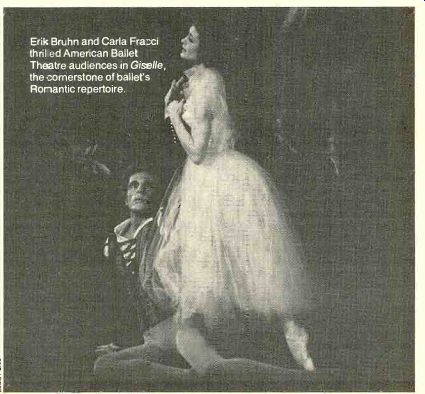
------ Erik Bruhn and Carla Frarczi thrilled American Ballet
Theatre audiences in Giselle, the cornerstone of ballet's Romantic repertoire.
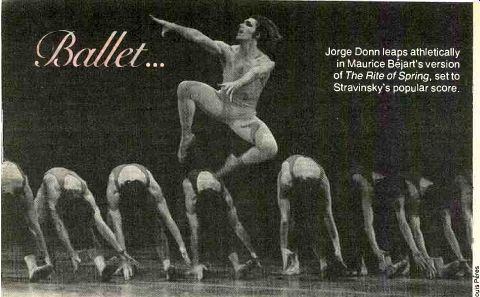
------- Jorge Donn leaps athletically in Maurice Beiart's version
of The Rite of Spring, set to Stravinsky's popular score.
Les Sylphides was first performed in St. Petersburg in 1908 as Chopiniana, orches trated by Alexander Glazounov. Among the many who have re-orchestrated the score are Anatole Liadov, Igor Stravinsky, Leroy Anderson, and Sir Malcolm Sargent. (Mackerras performs the version by Gordon Jacob.) Glazounov's orchestration, revised by Maurice Keller, is now available under the original title Chopiniana on Melodiya/Angel SR-40231, conducted by Algis Zuraitis. Fascinatingly different from what we hear in Western theaters today, it occupies both sides of a whole LP.
STRAVINSKY: The Firebird. New York Philharmonic Orchestra, Pierre Boulez cond. COLUMBIA M 33508, MQ 33508.
STRAVINSKY: Petrouchka. London Symphony Orchestra, Chas. Mackerras cond. VANGUARD 10113, VSZ 30021.
STRAVINSKY: The Rite of Spring. Chicago Symphony Orchestra, Georg Solti cond. LONDON CS 6885.
STRAVINSKY: Apollo (Apolion Musagite). Columbia Symphony Orchestra. Orpheus. Chicago Symphony Orchestra, Igor Stravinsky cond. COLUMBIA MS 6646.
Stravinsky is to twentieth-century ballet what Tchaikovsky was to the Classic period and more besides. He was a member of the illustrious group of composers, choreographers, dancers, and painters that Sergei Diaghilev (1872-1929) gathered together in Paris to create and perform some of the greatest ballets of all time. Stravinsky later continued to serve ballet in a great collaboration with another alumnus of Diaghilev's Ballets Russes, George Balanchine of the New York City Ballet. Agon, my favorite of Stravinsky's later ballets, was included in our 1967 basic library, but since no recordings of it are currently available, I have substituted the earlier Rite of Spring (Le Sacre du Printemps). With choreography by Vaslav Nijinsky (1913) and later by Leonide Massine, Rite of Spring did not succeed as a ballet, but it quickly became a concert-hall favorite. Later versions by choreographers Maurice Mart (1959), Kenneth MacMillan (1962), and others have restored it to the bal let stage.
It is difficult to select recordings of Stravinsky's scores because there have been so many good ones. I agree with Richard Freed on his first choices for Petrouchka, Rite of Spring, and the complete Firebird and with his view that Dorati's Firebird (Mercury SRI 75058) is a magical reading of the score de spite its age. Pierre Monteux conducted the first performance of Petrouchka, and his polished recording with the Boston symphony (RCA Gold Seal AGL1-1272) has authority as well as historical value. Similar virtues can be attributed to all the performances of Stravinsky's ballets by Ernest Ansermet on the London label. Ansermet was a friend of the composer, who introduced him into the circle of creative geniuses surrounding Diaghilev. In the same way that London has repackaged, in various combinations, Ansermet's recordings of Stravinsky bal lets, Columbia has repackaged those con ducted by Stravinsky himself. To my mind the latter are not always the most satisfying performances, but they do have the composer's own insights.
FALLA: The Three Cornered Hat. Victoria de los Angeles (soprano); Philharmonia Orchestra, Rafael Fruhbeck de Burgos cond. ANGEL S-36235.
Diaghilev never composed a score, choreographed a ballet, or designed a set, but he had a gift for drawing the best from those who could do what he could not. Falla's Three Cornered Hat is one of the finest scores Diaghilev commissioned, a really gorgeous work. The ballet is not currently danced, but I hope it will soon be revived.
The Angel recording by Fruhbeck de Burgos from the middle Sixties used to be a demonstration disc to show the uninitiated what hi-fi really sounded like (those castanets!).
The performance is still the most idiomatic reading of this music, and the sound holds up remarkably well. There is a new recording (reviewed in this issue) on Deutsche Grammophon with Seiji Ozawa conducting the Boston Symphony and Teresa Berganza singing the brief vocal solo.
ROSSIN I / RESPIGHI: La Boutique Fantasque. Israel Philharmonic Orchestra, Georg Solti cond. LONDON STS 15005.
Rossini wrote a great deal of ballet music to be included with his operas, and a good re cording of it is available on Philips 6780 027, a two-disc set with Antonio de Almeida con ducting the Orchestre National de l'Opera de Monte Carlo. But La Boutique Fantasque with a score of Rossini melodies arranged by Ottorino Respighi was among the great ballets Boris Lermontov (Anton Walbrook) promised to revive for Victoria Page (Moira Shearer) in the movie The Red Shoes. Was it such a great ballet? I don't know; I've never seen it. Like The Three Cornered Hat, it was premiered in 1919 by Diaghilev's Ballets Russes and is not often performed today. But its lively score endures on records, and Solti's is the most durable performance.
J. STRAUSS II: Le Beau Danube. National Philharmonic Orchestra, Richard Bonynge cond. LONDON CS 6896.
J. STRAUSS IL Graduation Ball. Vienna Philharmonic Orchestra, Willi Boskovsky cond. LONDON STS 15070.
Since a strong feeling for dance animated so much of the music of the entire Strauss family, it is hardly surprising that pastiches of their work have resulted in two such popular, waltzy ballets as Le Beau Danube (1924) and Graduation Ball (1940), the former orchestrated by Roger Desormiere, the latter by Antal Dorati. Bonynge's performance of Beau Danube (filled out with orchestral excerpts from Die Fledermaus) is among his best ballet recordings. I've chosen the re cording of Graduation Ball by Strauss specialist Willi Boskovsky, which also contains Weber's Invitation to the Dance (the music for Fokine's ballet Le Spectre de la Rose).
Dorati's own recording of Graduation Ball (backed by Offenbach's Gatti Parisienne) is still available on Mercury 75014.
OFFENBACH: Gala Parisienne. Monte Carlo Opera Orchestra, Manuel Rosenthal cond. ANGEL S-37209.
During the economic depression of the 1930's the successors to Diaghilev's Ballets Russes-Colonel de Basil's Original Ballet Russe and the Ballet Russe de Monte Car lo-cheered audiences up with good humored, chic (even chi-chi) ballets such as Le Beau Danube. None of these succeeded more than Gatti Parisienne, whose score of Offenbach melodies was skillfully arranged by Manuel Rosenthal for the premiere in Monte Carlo in 1938. No one of the many available versions has more good humor or good cheer than Rosenthal's own new re cording made last year in Monte Carlo.
COPLAND: Billy the Kid; Rodeo. New York Philharmonic Orchestra, Leonard Bernstein cond. COLUMBIA MS 6175.
BERNSTEIN: Fancy Free. New York Philharmonic Orchestra, Leonard Bern stein cond. COLUMBIA MS 6677.
Ballet Theatre (now American Ballet Theatre) announced its first season in 1940 as being staged by the "greatest collaboration in ballet history." Among the eleven choreographers represented in that debut season were two Americans, Eugene Loring and Agnes de Mille, both relatively young and unknown. Their first works for the company disappeared quickly, but his Billy the Kid and her Rodeo, both created (for other companies) to scores by Aaron Copland, be came among ABT's greatest hits. Just as Copland's music incorporated American folk elements, their choreography included American dance forms and movements then thought to be more appropriate to modern dance than classical ballet. Ballet in America has never been the same since. They opened a door, and Jerome Robbins was quick to come through it in 1944 with Fancy Free, a ballet about three sailors on shore leave, set to a jazzy score by Bernstein. The public loved it so much that Bernstein and Robbins expanded it into the Broadway musical On the Town. Both Miss De Mille and Robbins had great success choreographing musical comedies, but they did not turn their backs on ballet. Their artistic progeny, who have continued to narrow the gap between modern dance and ballet and to widen ballet's range of subject matter and style, are too numerous to mention.
PROKOFIEV: Romeo and Juliet. Lon don Symphony Orchestra, Andre Previn cond. ANGEL SC-3802 three discs.
Giselle, Coppelia, and the three Tchaikovsky blockbusters are thought of as the Big Five of Ballet. If I could nominate a Big Sixth, it would be Prokofiev's Romeo and Juliet. I was present at the first performance of this ballet in a version by a Western choreographer (Frederick Ashton) at the Royal Theater in Copenhagen in 1955, and I have never tired of the music. In versions by different choreographers Romeo and Juliet has been a great vehicle for ballet's most famous stars, such as Margot Fonteyn and Rudolf Nureyev. The score continues to in spire new choreographic treatments, and the Joffrey Ballet is offering one this season.
In 1967, Mr. Barnes and I complained that Prokofiev was poorly treated by record companies because there was no complete recording of Romeo and Juliet. Now there are two. I have chosen Previn's on Angel because I think it has a slight edge in theatricality, but Lorin Maazel's somewhat more symphonic performance on London CSA 2312 with the Cleveland Orchestra is also a splendid recording.
RICHARD BONYNGE: Homage to Pavlova. Luigini: Ballet Egyptian. Saint Saens: The Swan. Massenet: Thai's Meditation. Tchaikovsky: The Seasons: December. Melody, Op.42, No. 3. Rubin stein: Feramors: Danses des Fiancees de Cachemir. Czibulka: Love's Dream After the Ball. Kreisler: Schott Rosmarin. Dri go: Le Reveil de Flore. Assafieff: Papil Ions. Lineke: Glow Worm Idyll. Delibes:
Nada: Intermezzo. Catalani: Danza delle Ondine. Krupinski: Polish Wedding Mazurka. John Georgiadis (violin); Jascha Silberstem (cello); Osian Ellis, Marie Goossens (harps); London Symphony Orchestra, Richard Bonynge cond. LONDON CSA 2232 two discs.
RICHARD BONYNGE: The Art of the Prima Ballerina. Minkus: La Bayadere: Grand Pas de Deux. Don Quixote: Grand Pas de Deux. Drigo: Harlequin's Millions: Pas de Trois. Rossini: William Tell: La Tyrolienne. Adam: Giselle: Danse des Vignerons; Pas Seul; Peasant Pas de Deux; Grand Adage and Variations. Lt venskjold: La Sylphide: Scene de la Sylphide. Tchaikovsky: Swan Lake: Grand Pas de Deux (The Black Swan). The Sleeping Beauty: Bluebird Pas de Deux.
The Nutcracker: Grand Pas de Deux.
Donizetti: La Favorita: Ballet Music. Trad. (arr. O'Turner): Bolero 1830. Pugni: Pas de Quatre. London Symphony Orchestra, Richard Bonynge cond. LONDON CSA 2213 two discs.
RICHARD BONYNGE: Pas de Deux.
Minkus: Paquita: Pas de Deux. Pugni/ Drigo: Esmeralda: Pas de Deux. Auber: Grand Pas Classique, Heisted: Flower Festival in Genzano: Pas de Deux. Drigo: Le Corsaire: Pas de Deux. London Symphony Orchestra, Richard Bonynge cond. LONDON CS 6418.
Richard Bonynge has been tireless in searching out and recording the big solos
------------------
NOT SO BASIC
GLUCK: Don Juan. Academy of St. Martin-in-the-Fields, Neville Marriner cond. LONDON STS 15169.
ADAM: Le Diable a Quatre. London Symphony Orchestra, Richard Bonynge cond. LONDON CS 6454.
BURGMULLER: La Peri. London Symphony Orchestra, Richard Bonynge cond. LONDON CS 6627.
OFFENBACH: Le Papillon. London Symphony Orchestra, Richard Bonynge cond. LONDON CS 6812.
DELIBES: Sylvia. London Symphony Orchestra, Anatole Fistoulari cond. MERCURY SRI 2-77005 two discs.
MINICUS: Don Quixote, Elizabethan Trust Melbourne Orchestra, John Lanchbery cond. ANGEL S-37008.
GLAZOUNOV: The Seasons. Mos cow Radio Symphony Orchestra, Bo ris Khaikin cond. MELODIYA/ANGEL SR 40088.
RAVEL: Daphnis and Chloe. Orches tre de Paris, Chorus of the Paris Op era, Jean Martinon cond. ANGEL S-37148.
DEBUSSY: Jeux. DUKAS: La Peri. Orehestre de la Suisse Romande, Er nest Ansermet cond. LONDON STS 15022
BARTOK: The Miraculous Mandarin. New York Philharmonic Orchestra, Pierre Boulez cond. COLUMBIA M-31368.
PROKOFIEV: The Stone Flower. Bolshoi Theater Orchestra, Gennady Rozhdestvensky cond. MELODIYA/ COLUMBIA M3 33215 three discs.
KHACHATURIAN: Layne, Suites 1, 2, and 3. National Philharmonic Orchestra, Loris Tjeknavorian cond. RCA CRL2-2263 two discs.
-----
-----
ABT's-erry Orr and Rebecca Wright square dance to Aaron Copland's music in the American classic Rodeo by Agnes de Mille.
and pas de deux with which great dancers have thrilled their audiences, and many of these star turns are recorded here for the first (and only) time. Anna Pavlova, one of the greatest ballet dancers in history, was very astute in selecting what would show her work off to best advantage, but her choices were often hard to defend on purely musical grounds. Dame Alicia Markova worked with Bonynge on "The Art of the Prima Ballerina," and all three albums have a fine exhibitionistic authenticity. Compared with such a great score as Prokofiev's Romeo and Juliet, many of these excerpts and short pieces are ballet's equivalent of disco. Much of the music is trashy, but it's a lot of fun. If you are too inhibited to do plies and pirouettes in the family room, I think you will find that this very rhythmic music will speed up such chores as washing win dows and painting, and it's marvelous accompaniment if you go in for morning push-ups and sit-ups. After all, it helps keep dancers in great shape.
+++++++
Also see:
POPULAR DISCS and TAPES: Jazz Flowers: More Welcome Reissues, CHRIS ALBERTSON Pretty Linda Ronstadt, WILLIAM ANDERSON, Andy Pratt: Cheer Up-You're a Winner!, RICK MIT? Compelling Millie Jackson, PHYL GARLAND, Guitarist Mike Bloomfield JOEL VANCE Pianist Dick Wellstood CHRIS ALBERTSON Judy Collins' First Fifteen NOEL COPPAGE
Source: Stereo Review (USA magazine)