NEW PRODUCTS: Roundup of the latest audio equipment and accessories.
New Full-range Isolating Headphones From Superex
Superex is launching a new line of stereo headphones with the SM-700 "Studio Master," a dynamic headphone using 2 3/4-inch Mylar-diaphragm drivers in vented enclosures. The 10-ounce headphone has Leatherette-covered foam cushions that rest on the ear, isolating it from outside sounds. The met al headband is also covered with foam pad ding, and a 15-foot extended retractable cable with a clothing clip is provided.
The frequency response of the SM-700 is rated at 10 to 20,000 Hz ±3 dB. Distortion is rated at 0.25 percent for a 400-Hz signal at a sound-pressure level of 110 dB. A 0.6-volt (10-milliwatt) input is required to produce this acoustic output. Impedance is a nominal 35 ohms. Price: $65.
Sony is offering three new quartz-controlled direct-drive turntables, the PS-X7 (shown), PS-X6, and PS-X5. Each has a quartz-crystal oscillator that generates a stable reference signal; this is compared with a signal derived from the platter's speed, and speed fluctuations are then corrected by a ser vo system. All three turntables are semi automatic and have a safety clutch in the tone-arm return mechanism. Operating controls (other than speed and record-size selection) are located on the front panel of the base and can be manipulated with the dust cover closed. The turntable bases are made of an acoustically inert material and mounted on liquid-filled feet to prevent acoustic feedback.
The top-of-the-line PS-X7 features a car bon-fiber tone-arm shaft as well as a liquid-filled turntable mat. Both the PS-X7 and PS-X6 have an optical sensor- that triggers the tone-arm return mechanism as well as touch-sensitive front-panel switches for the start/ stop and repeat functions. Key specifications are identical for all three turntables and include 0.025 percent wow and flutter (wrms), better than 99.99 percent speed accuracy, and a rumble level of-73 dB (DIN B weighting). All three have approximate dimensions of 6 x 17 1/2 x 14 3/4 inches. Prices are $330 for the PS-X7, $275 for the PS-X6, and $230 for the PS-X5.
Osawa announces two additions to its Sat in M-18 series of moving-coil phono cartridges. The M-18E and M-18X are basically similar to the M-I8BX cartridge already on the market but are lower in cost and have different stylus assemblies. The M-18 series cartridges do not require a pre-preamplifier ("head" amp) since they have rated outputs of 2.5 millivolts, suitable for a standard magnetic phono input. The M-1 8E and M-18X use the Satin's fixed-point pivot in the stylus-cantilever mechanism for improved groove tracing and a specially formulated viscous fluid for damping.
The- M-18E, with a 0.2 x 0.8-mil elliptical diamond stylus, has a frequency response of 10 to 30,000 Hz. The M-18X is rated at 10 to 35,000 Hz and is intended for both stereo and CD-4 four-channel use; it has a 0.1 x 2.5-mil Shibata stylus. Compliance is 15 x 10-6 centi meters per dyne for each cartridge, and the recommended tracking-force range is 0.5 to 1.5 grams. Price of the M-18E is $195; of the M-18X, $250.
Koss has taken the plunge into the dynamic-speaker market with three new systems de signed according to Thiele's vented-box loud speaker theory and using Small's computer methods to optimize parameters. The new line consists of the CM 1010, a passive radiator system, and the CM 1020 and CM 1030 (shown) ported systems. The CM 1030 is a four-way system with a 10-inch woofer, two 4 1/2-inch mid-ranges, and two 1-inch high-frequency dome drivers for the lower- and upper-treble ranges. Crossover points are at 400, 2,500, and 6,000 Hz. The system has dual ports for supplementing bass output. The high-frequency drivers are loaded with different phase plugs, which increase their efficiencies but restrict their bandwidths, so that one covers the 2,500- to 6,000-Hz range and the other is active above 6,000 Hz. There are three level controls on the CM 1030, for mid range, treble, and high treble. Each is a three-position switch with settings of +3, 0, and-3 dB. Overall on-axis frequency response in the far field is 26 to 20,000 Hz ±3 dB. Far-field response is down 3 dB at 70 degrees off-axis and 6 dB at 80 degrees off-axis. A sound-pressure level of 96 dB is produced at a 1-meter distance on-axis with a 1-watt input; Koss recommends amplifiers delivering between 15 and 200 watts per channel continuous power into 8 ohms. The speaker is fused to prevent overload. Nominal impedance is 7 ohms. The cabinet, which measures 39 x 16 1/2 x 14 1/2 inches, is finished in pecan veneer and has brass lift handles on the sides.
The CM 1020 uses drivers similar to the CM 1030's but in a three-way configuration with one mid-range and one high-frequency driver.
The CM 1010 is a two-way system with an 8-inch woofer and a 1-inch dome tweeter; its 10-inch passive radiator can be adjusted for flat response to 35 Hz or for augmented output in the 50- to 80-Hz range (with the rolloff occur ring at 40 Hz) using a removable weight attached to the center of the diaphragm. Both of these units are finished in pecan veneer. Price of the CM 1030 is $395; of the CM 1020, $295; and of the CM 1010, $195.
IMP Teac's New Three-head Elcaset Deck
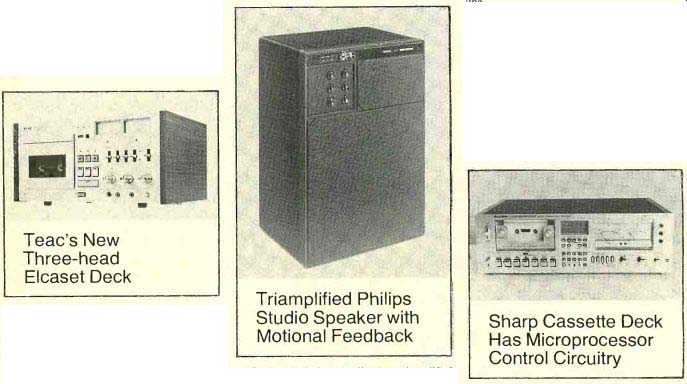
Teac's new elcaset deck, the AL-700, is a three-head, three-motor machine employing the new quarter-track, two-channel cassette format. The AL-700, like other elcaset machines, has a detector that automatically senses tape type (ferric, ferrichrome, or chromium-dioxide) according to coded notches on the elcaset shell, and it sets bias and equalization accordingly. The transport can be started automatically with a timer, and a photoelectric sensor detects the end of the tape and disengages the transport mechanism. A memory function for tape stop and replay is also included. The AL-700 has built-in Dolby noise-reduction circuitry; in addition, it will inter face with an external compander and has a front-panel switch for this (Teac offers a dbx unit as an option). The front panel of the AL-700 has touch-button transport controls, and lever switches for memory, timer, noise reduction, input source, and output. There are separate level controls for the two micro phone inputs, line level, and output. There are also indicator lamps for noise-reduction system, tape type, record, pause, and record mute (this last function can cut off any incoming signal from the recording head without switching out the record mode).
The AL-700 records at a tape speed of 3 3/4 inches per second with wow and flutter at 0.04 percent (NAB weighting). The frequency response is 25 to 20.000 Hz for ferric and 25 to 22,000 Hz for ferrichrome or chromium-dioxide tape. Signal-to-noise ratios are 59 dB with ferric and 62 dB with ferrichrome or chromium-dioxide tape. Improvements of up to 10 dB above 5,000 Hz can be realized with the Dolby circuitry. Input sensitivity is 0.25 millivolt for the microphone inputs and 60 millivolts for the line inputs. Output is 0.3 volt into 50,000 ohms. The AL-700 has approximate dimensions of 10 3/4 x 18 1/2 x 13 1/4 inches and weighs 45 pounds. Price: under $1,000.
Tri-amplified Philips Studio Speaker with Motional Feedback
The RH 545 from Philips is a tri-amplified motional-feedback loudspeaker system utilizing a 12-inch acoustic-suspension woofer, a 2-inch dome mid-range, and a 1-inch dome tweeter. The feedback system, which operates on the woofer only, consists of a piezo electric acceleration sensor on the woofer cone. The sensor generates a voltage proportional to the physical movement of the woofer cone, and this voltage is compared with the audio input signal. Any deviation is used to "correct" the signal that drives the woofer.
The RH 545 accepts the output from any preamplifier (input sensitivity can be adjusted between 1 and 23 volts into 10,000 ohms) and divides the signal into three bands: below 500 Hz, 500 to 3,000 Hz, and above 3,000 Hz. Adjustable low- and high-frequency filters are provided. The treble roll-off can be set to start at 7,000 or 10,000 Hz with the slope variable between 0 and 20 dB per octave (a pilot light indicates when the treble roll-off is in use).
The bass may be either boosted or attenuated below 350 Hz (by ±10 dB at 60 Hz).
After the signal is split up, each frequency band is directed to its specific power amplifier. The tweeter is driven by a 15-watt (continuous) amplifier, the mid-range by a 35-watt unit, and the woofer by a 50-watt unit. Maximum total harmonic distortion is 0.2 percent for each of the three amplifiers. In addition to the bass and treble controls, the RH 545 has response adjustments for room placement.
There are three adjustments--for "on floor," "back against the wall," and "side against the wall" placements. These are intended to provide uniform power response in an average listening room. The RH 545 can be driven by amplifiers with power stages (up to 100 watts output) as well as directly from preamplifiers. Power is drawn from a standard 117-volt a.c. line.
The rated frequency response range of the RH 545 is 20 to 20,000 Hz. At full power output it develops a maximum sound-pressure level of 108 dB at 1 meter. Standard phono jacks are provided for the audio inputs, as well as three-conductor DIN jacks for studio-type balanced inputs. The black-ash cabinet measures 25 1/2 x 17 x 12 1/2 inches, and the system weighs 67 pounds. Price: approximately $1,200.
Sharp Cassette Deck Has Microprocessor Control Circuitry
Sharp's new RT-3388 cassette deck is a two-head machine incorporating a micro processor circuit for a high degree of control over the tape-transport functions. The deck has a liquid-crystal display (LCD) panel that acts as a tape counter, timer, and indicator for the built-in Dolby system and the various memory functions. A built-in digital clock operates in either the 12- or 24-hour mode (with AM/PM indicators for the former). The LCD also serves as the clock display. The RT-3388 can be programmed to play any sequence of selections (up to a total of nineteen) on a cassette; it searches out particular selections by counting the blank sections of tape between recorded items. An "editor" function allows the user to insert these spaces in home-recorded tapes. There is a memory-rewind feature that permits the user to set the counter to read zero at any selected point on the tape and the rewind function will return the tape automatically to that point. A direct-memory function is used to address any point on the tape (whether between selections or not) and later recall that point for playback. The tape counter can be set to read tape footage or time (in the "time" mode, the readout is in minutes and seconds). The built-in clock can be used for timed switching of accessory devices plugged into the RT-3388's rear-panel a.c. outlet or to switch in a program source (such as a radio broadcast) for taping at a particular time. A built-in battery provides standby power for the clock if the a.c. source fails.
In addition to all its program-locating features, the RT-3388 has separate microphone- and line-level controls for each channel, plus an output-level control and adjustable bias and equalization for ferric, ferrichrome, and chromium-dioxide tapes. There is a peak-indicator light on the meter panel underneath the two level meters. Specifications include a frequency response of 30 to 15,000 Hz ±3 dB for chromium-dioxide tape and a signal-to noise ratio of 64 dB (for all tape types) with the Dolby circuitry engaged. Approximate dimensions are 5 1/2 x 17 1/2 x 13 inches; weight is 20 pounds. Price: under $300.
Ultrathin Speakers Added by Magnepan
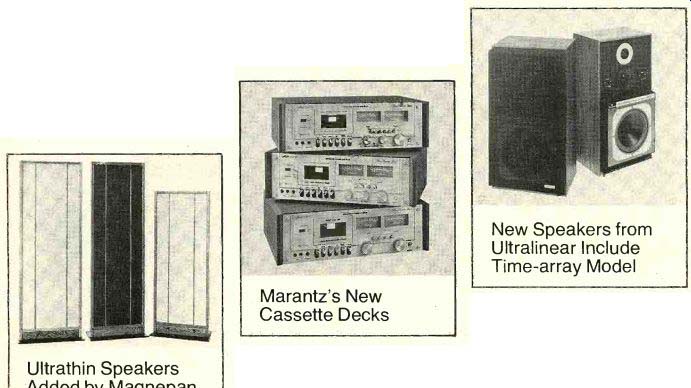
Magnepan Inc., manufacturers of the Magneplanar MG- II loudspeaker, has added two more Magneplanar speakers to its line, the MG-I and MG- III. These speakers use ultrathin film diaphragms (imprinted with a zig-zag conductor pattern) suspended in a planar magnetic field to produce their acoustic output. The MG-I (shown at right) has two Magneplanar drivers: a 428-square-inch diaphragm for bass and mid-range and a 68-square-inch diaphragm for the high frequencies. The crossover occurs at 2,400 Hz with a slope of 6 dB per octave. The MG-I has less dispersion in the vertical plane and lower acoustic output than the MG- II; these differences can be attributed to its smaller size. It shares all the other features of the larger Magneplanar speakers, including a bipolar radiation pattern, purely resistive impedance, and freedom from cabinet resonances.
The frequency response of the MG-1 is 50 to 16,000 Hz ±4 dB. The manufacturer recommends using an amplifier delivering between 40 and 80 watts continuous power per channel to drive the speaker; minimum input is 10 watts continuous, and the speaker can be safely operated with amplifiers of up to 200 watts output per channel if it is properly fused. A sound-pressure level of 82 dB at 3 feet is produced by a 1-watt input. Impedance is 5 ohms. The MG-1's flat base measures 24 x 14 inches and the 22 x 60-inch panel is only 2 inches thick. The frame is of solid oak, and either off-white or black acoustically trans parent grille fabrics are available. Price: $495.
The new MG- III speaker (shown at left with both off-white and black grille-cloths) is also similar in design to the MG- II but is a still larger and higher-performance model. Price: $895.
Marantz's New Cassette Decks
Marantz has three new front-loading cassette decks, each with Dolby circuitry, extended-range level meters, and a defeatable peak-limiter for attenuating sudden high-level inputs. The top-of-the-line Model 5030 is a three-head system with "full-process" Dolby: two Dolby circuits are provided so that inputs may be encoded for taping and instantaneously decoded for monitoring. Separate level controls are provided for micro phone and line inputs, which may be mixed, and there is a master level control. There are LED's for indicating peak inputs. The tape-transport system, driven by a d.c. motor, is servo-controlled. Key specifications for the 5030 include a wow and flutter figure of 0.08 percent and overall signal-to-noise ratios (S/N) of 52 dB (Dolby off) and 60 dB (Dolby on). The playback-only S/N is 54 dB. Frequency response is 40 to 13,500 Hz ±3 dB with ferric tape, 40 to 15,000 Hz ±3 dB with chromium-dioxide tape, and 35 to 16,000 Hz dB with ferrichrome tape. Approximate dimensions are 5 3/4 x 17 1/2 x 11 1/2 inches.
The Model 5025 is similar to the 5030, the major difference being that it is a two-head deck. Key specifications of the 5025 are identical to those of the 5030. The lowest-priced deck in the new Marantz line is the Model 5010, a two-head machine with a single record-level control for each channel. Wow and flutter are 0.1 percent, and overall S/N is 50 dB (Dolby off) or 58 dB (Dolby on). Playback S/N is 52 dB. The dimensions of the 5025 and the 5010 are identical to those of the 5030. Optional walnut-veneer cabinets are available for all three, as are optional rack-mounting adapters. Price of the 5030 is about $420, of the 5025 about $310, and of the 5010 about $250. A walnut cabinet is $35.
New Speakers from Ultralinear Include Time-array Model
Ultralinear has announced several new loudspeaker systems, including a three-way phase-corrected system, the ST-525 (shown).
The ST-525 employs a 10-inch woofer, 2-inch dome mid-range, and 1-inch dome tweeter, with the woofer installed several inches for ward of the other two drivers. Level controls are provided for all three drivers; the woofer output is adjusted by varying the mechanical impedance of a passive radiator mounted on the back of the cabinet. This passive radiator is actually a dynamic speaker that is not connected to the amplifier outputs; however, a variable resistance can be switched in across its terminals to increase the electromagnetic damping that acts on the passive radiator cone. The drivers are crossed over at 700 and 4,300 Hz, and the system impedance is a nominal 8 ohms. The stated frequency response of the ST-525 is 30 to 22,000 Hz. The minimum recommended continuous power input is 20 watts per channel, and the maximum continuous input is 75 watts (a circuit breaker is included for overload protection). The cabinet is available in walnut, oak, or Melamine finishes; approximate dimensions are 27 3/4 x 14 x 12 1/2 inches. Price: about $390 in walnut or oak, $350 in Melamine finish.
NOTICE: All product descriptions and specifications quoted in these columns are based on materials sup plied by the manufacturer.
Recent fluctuations in the value of the dollar will have an effect on the price of merchandise imported into this country. Please be aware that the prices quoted in this issue may be subject to change.
++++++++++++++
++++++++++++++
Also see:
TAPE TALK: Theoretical and practical tape problems solved, CRAIG STARK
A BEGINNER'S GUIDE TO HI-FI---Selecting equipment intelligently is something anyone can do ROBERT N. GREENE
Technical Talk, Julian D. Hirsch
I Remember Mono--An Audiobiography
Source: Stereo Review (USA magazine)