Total Energy Response:
The reason why Jensen Lifestyle speakers sound better than any comparable speaker.
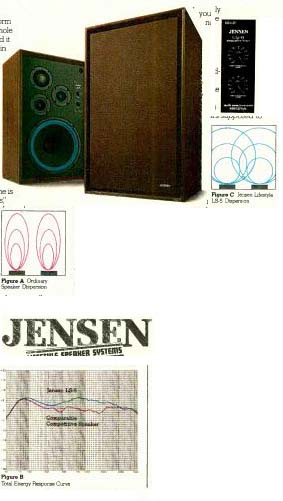
Just what is Total Energy Response? Total Energy Response is the uniform radiation of sound throughout the whole listening area-at all frequencies. And it makes an unquestionable difference in the stereo sounds you hear.
Most speakers are to one degree or another directional. That is, part of the room in front of the speaker gets the full sound. Bass, treble and midrange. While parts of the room to the sides of the speaker get just a fragment of the sound. (See Fig. A) It's precisely this fault we set out to correct. Because others may tell only part of the story. Often with just one response curve measured from just one position-their optimum position.
However their results don't look so favorable when the test microphone is moved "off-axis',' that is, to the side instead of directly in front of these speakers.
Figure B illustrates this. It is a Total Energy Response curve, taken with test micro phones in all positions. When comparing the Jensen (blue line) with a comparably priced "flat" speaker (red line), you can see how deficient the other speaker is in total radiated energy in the mid and mid-high frequencies. This midrange deficiency is unfortunately very common amongst speakers, and gives many so-called' flat"
Figure A Ordinary Speaker Dispersion
Figure B Total Energy Response Curve 400 700 1000 response speakers a very "thin" sound.
The Jensen Lifestyle speaker, on the other hand, demonstrates true Total Energy Response. Uniform radiated power-at all frequencies-throughout the whole room.
These speakers were conceived, de signed and tested for this. Tested from every spot in anechoic "dead" rooms, reverberation "live" rooms, and simulated living rooms.
Our finished products: remarkable dispersion for the hard-to-disperse high frequencies...160° or 170° wide, depending on the model. Also expanded dispersion of the critical midrange response. And full, rich bass that still perfectly matches the other frequencies for accurate sound re production. The way it's supposed to be heard.
You can see how the sound from a Jensen is distributed much more evenly throughout a room. And when you're in your own listening room ...you can hear it.
Figure C
Jensen Lifestyle LS-5 Dispersion What does all this mean to you?
1. It means that with Jensen Lifestyle speakers, you'll be able to hear all of the frequencies, all of the time, in almost any part of the room. Not just the bass if you're to the side of the speakers. And not just the treble if you're in front of them.
2. Excellent stereo imaging. You hear everything that both speakers are putting out. Almost anywhere in the room. Unlike listeners of other speakers, who can fall victim to gaps in the response characteristics, or "hole-in-the-middle" stereo.
3. Excellent balance. Many other speakers are hot on treble, or bass, or both. But all that really means is that the midrange is often neglect ed. Jensen sends the all-important midrange throughout a room every bit as much as the highs and lows.
4. Total Energy Response is achieved in Jensen speakers with out any loss of efficiency. Which means a moderate output amp or receiver is still all you need for great performance. Not a big super-amp.
What gives Jensen Total Energy Response? A number of features. First, the extremely wide dispersion of the Lifestyle Tuned Isolation Chamber- midranges.
Especially important are Jensen's two tweeters: a 160° dispersion cone direct radiator, and the 170° dispersion Mylar Sonodome tweeter. The sound input to each of these drivers is precisely monitored by Jensen's exclusive Comtrac crossover network, which insures uniform energy transfer between the woofer, midrange, and tweeter.
For final command of the Jensen Lifestyle's sound, behind-the-grille controls are featured.
These controls let you adjust the treble, and in some cases, the midrange, to the characteristics of your individual room.
And with Total Energy Response...there's more music to control.
Hear the difference yourself...
Stop by your local Jensen dealer and hear for yourself the difference Total Energy Response makes. It's the reason why Jensen Lifestyle speakers sound better than any comparable speaker.
For the name and location of your nearest Jensen dealer, write:
Jensen Sound Laboratories, Division of Pemcor, Inc., 4136 N. United Parkway, Schiller Park, IL 60176.
Used loudspeakers
Every Allison speaker system you buy as new has actually been "used" for 20 minutes to a half hour. Spending this much time on our test program gives us the confidence to publish a most complete set of specifications for our products, and to provide a full warranty that every one will meet those specifications within ±2 dB for at least five years.
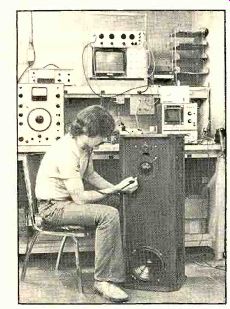
To that end, we manufacture all our drivers and crossover networks our selves. (Most of our competitors do not.) We test every driver and every crossover board (not just a random sample) to a set of close-tolerance standards. Only those that meet the standards are installed in cabinets.
Then every completed system must pass another long series of performance tests, before the cabinet gets its final coat of oil finish, a careful visual inspection, and is packed for shipment.
We don't have to guess what's inside our shipping cartons. We know. If you too would like to know, we'll be glad to send you our free 10-page catalog on request. It includes complete specifications and a statement of Full Warranty for Five Years.
ALLISON ACOUSTICS, 7 Tech Circle, Natick, Massachusetts 01760
How to identify the world's finest tonearm.
When one tonearm-among all those available-is described as "the world's finest," some controversy may be anticipated. Fine, we welcome that possibility. There is far too little discussion about tonearms-considering the critical difference they make in how records sound and how long they last.
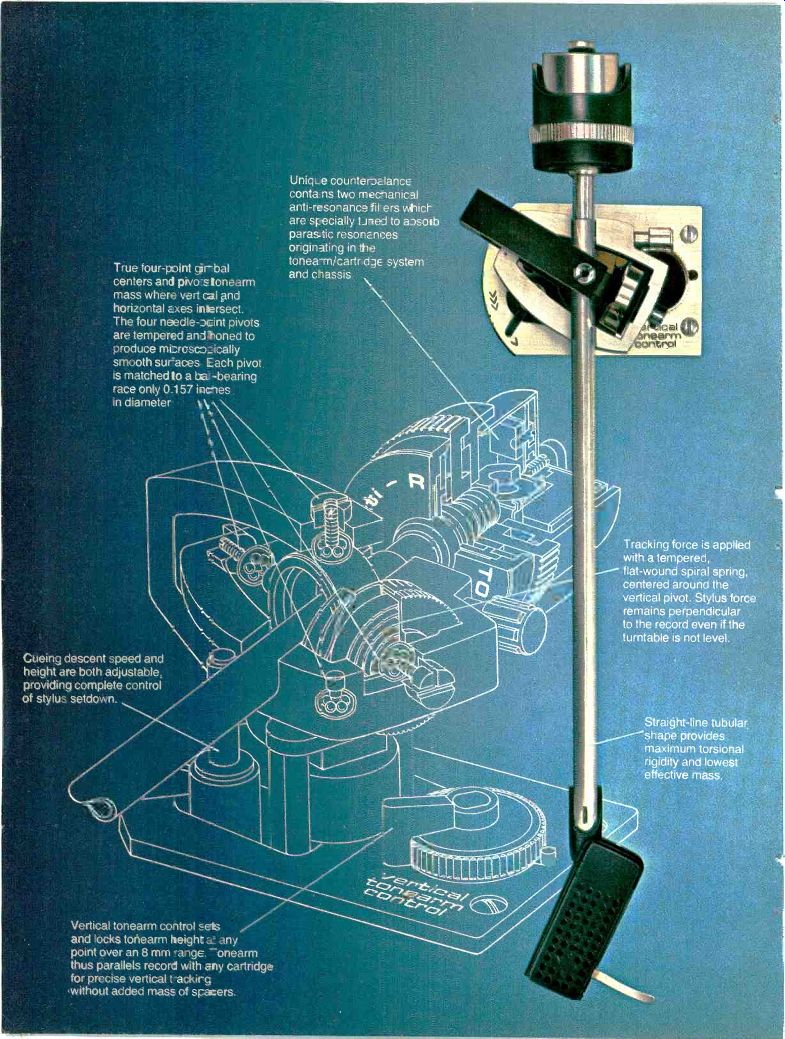
Simply stated, the tonearm's function is to provide the correct cartridge-to-groove geometry and to allow the stylus to trace the groove contours freely, precisely, and with the lowest practical tracking force.
Dual's engineering approach to tonearm performance makes us feel confident of the outcome of any comparisons.
The basic geometry.
The shape of the Dual tonearm is a straight line from pivot area to tonearm head, the shortest distance between those two important points.
Curved tonearms may look sexier, but contribute extra mass, less rigidity and a tendency to lateral imbalance. That's hardly consistent with good engineering.
Every Dual tonearm is mounted in a true, four-point gimbal. The tonearm mass is centered, balanced and pivots precisely where the vertical and horizontal axes intersect.
Identical pairs of low-friction needle-point pivots and miniature ball bearings are used in both axes.
The precision and quality control standards applied to their manufacture and assembly are usually found only in aerospace and allied technologies.
Settings for your cartridge.
The vernier-adjustable counterbalance lets you set zero-balance with micrometer-like precision so that tracking force can then be set accurately. A tempered, flat-wound spring applies tracking force directly at the vertical pivot, and this force remains perpendicular to the record even if the turntable chassis is not level. Anti-skating is applied around the horizontal pivot, directly counter to the skating force, and it adjusts automatically to the varying skating force encountered by the tonearm as it moves across the record.
Another Dual refinement, not available on any other integrated tonearm, is the Vertical Tonearm Control. A vernier height adjustment over an 8mm range allows paralleling the tonearm to the record without cartridge spacers. Tonearm mass remains as low as possible, and mounting and changing cartridges are simplified.
Another Dual exclusive: tuned anti-resonance filters.
The counterbalance contains two specially tuned mechanical filters that absorb parasitic resonances originating in the tonearm/cartridge system and chassis. The result: flawless tracking stability maintained even in the presence of external shock and vibration whether caused by acoustic feedback, record warps or dancing feet.
About all! Dual tonearms.
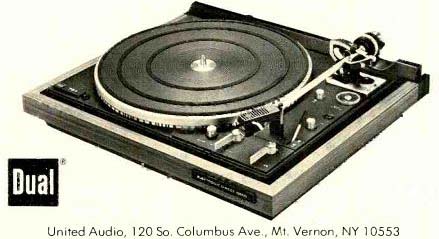
The tonearm shown and described here is part of our higher-priced turntables. But many of its features are found in our lowest-priced model: the four-point gimbal, the straight-line design, and the precise mechanisms for balance, tracking force and anti-skating adjustment.
In fact, we'd be willing to match the performance of our lowest-priced tonearm against anyone else's highest-priced tonearm. But one argument at a time is enough.
Now that you've been "armed" with the facts, we invite you to visit your audio dealer to examine the tonearms you find there-separate and built in-and decide for yourself which one is indeed the finest.
No one can argue with that suggestion.
Dual, dist. in USA by United Audio, 120 So. Columbus Ave., Mt. Vernon, NY 10553, USA.
New ... 1000 3-Way Curvilinear Enclosure System
THE DYNAMIC DOME RTR interpolates a significant midrange Within this striking, acoustically transparent enclosure, lies an exceptional 3-way speaker system.
Entirely new. Totally RTR.

The 100D was conceived and executed to display the new, technologically advanced RTR midrange system. Vast midrange capabilities are yielded by a low mass 1.5" soft dome driver, single layer voice coil and 3.4 lb. magnetic assembly. This is the first dome system to successfully integrate smooth response and broad dispersion with outstanding dynamic range and transient response. The key to reproducing music convincingly! This multi-faceted midrange crosses over at 1.25 KHz to an RTR 12" woofer which is so technically excellent that it will neither destruct nor delaminate.
The deep, authoritative bass response is uncolored and precisely defined.
Crossing in at 10 KHz, the solid state supertweeter imparts extended crystalline high end reproduction.
All walnut enclosure, and low priced.
RTR Industries. For dealer list, write RTR, Dept. SR, 8116 Deering Avenue Canoga Park, CA 91304
Separates or an integrated unit? Don't you owe it to yourself to seriously consider the alternatives? A complete home stereo system built around a Phase Linear power amplifier and a Phase Linear preamplifier, is now within the reach of every serious listener. The development of the new Phase Linear 200B power amplifier makes this possible. In combination with the 2000 preamplifier, the 200B provides the nucleus for an awesome, medium-powered stereo system. The increased dynamic range, faster transient response, lower distortion and greater flexibility make the Phase Linear System 200B a serious alternative to comparably priced systems built around integrated components. For those who are serious about acquiring state of-the-art performance from a medium powered high fidelity system, we present the Phase Linear System 200B. The serious alternative.
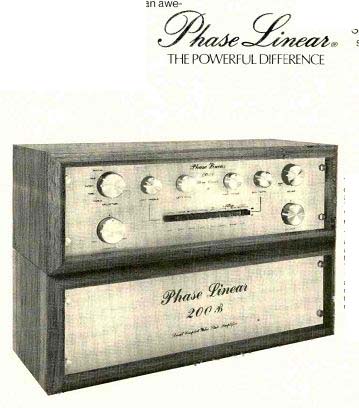
THE POWERFUL DIFFERENCE
The Phase Linear 2000 preamplifier is one of the quietest preamps ever made.
Signal to noise ratio: 74 dB below 10mV.
Total Harmonic Distortion: 0.1%.
Variable ambience injection circuit recovers music lost with most preamps.
The new Phase Linear 2008 power amplifier is a handcrafted, reliable amplifier with outstanding sonic performance in the tradition of the famous 700B and 400 models. Power output: 105 watts per channel, minimum R.M.S. at 8 ohms from 20Hz to 20kHz with no more than 0.25%total harmonic distortion. Hum and noise: 100dB below rated power.
Introducing a speaker system with a sound so fantastic that it took a whole new theory of loudspeaker design to produce it . . . the Koss CM 1010 loudspeaker. It's the ultimate in 2 bandpass speakers, with an extended bandwidth response, high efficiency and incredibly low distortion that's unmatched by any other 2 bandpass speaker at any price.
To achieve such remarkable performance, Koss engineers set critical parameters for cabinet size, frequency response and efficiency. Then the computer-programmed Koss Theory furnished not only construction specifications for the woofer, tweeter, passive radiator and crossover network, but also the optimum position in the cabinet for each component to create maximum structural rigidity and optimum dispersion and phase coherency.
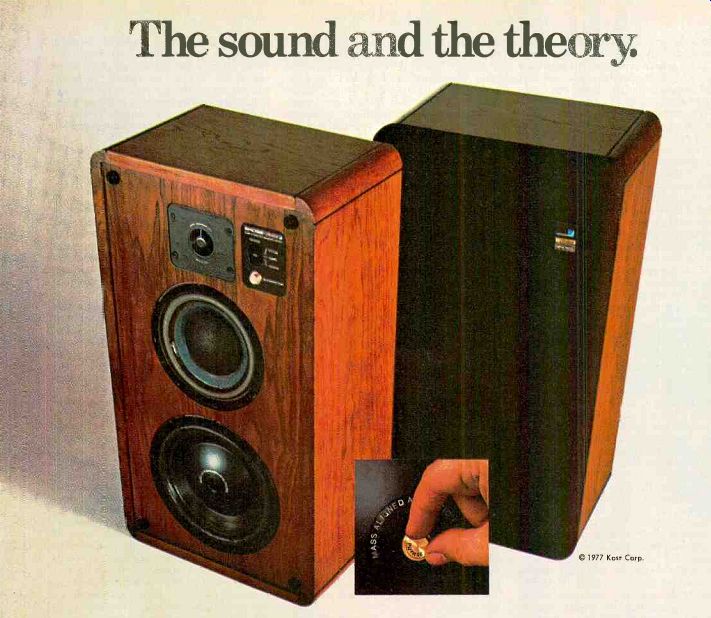
The result is an all-embracing quality of sound. The 10-inch passive radiator reinforces the lower 2 octaves KOSS' CM while the special 8-inch woofer also handles midrange to 3500 Hz. With the radiator's unique alignment mass in place, the CM 1010 reproduces a maximally flat response from an f3 of 35 Hz on outward. However, for more acoustic energy in the 50 to 80 Hz range, the alignment mass can be removed to create an f3 of 42 Hz and a low bass ripple of 1% dB centering on 60 Hz.
The CM 1010's high-energy, 1-inch dome tweeter linked to an acoustic transformer increases the high bandpass headroom by an incredible 6 dB. With performance so superior, the CM 1010 is clearly the ultimate speaker in its price range.
For a free, color brochure of Koss CM loudspeakers, write to Fred Forbes, c/o the Koss Corporation. Or ask your Audio Dealer for a live demonstration of the Sound of Koss, and hear the Koss Theory in action.
Once you've listened to the revolutionary CM 1010, you'll agree: hearing is believing.
1010 SPEAKER SYSTEM hearing is believing, KOSS CORPORATION, 4129 N. Port Washington Ave. Milwaukee, Wisconsin 53212 Koss International London. Dublin, Paris. Frankfurt Amsterdam Koss Limited Ontario- Koss K.K./Tokyo
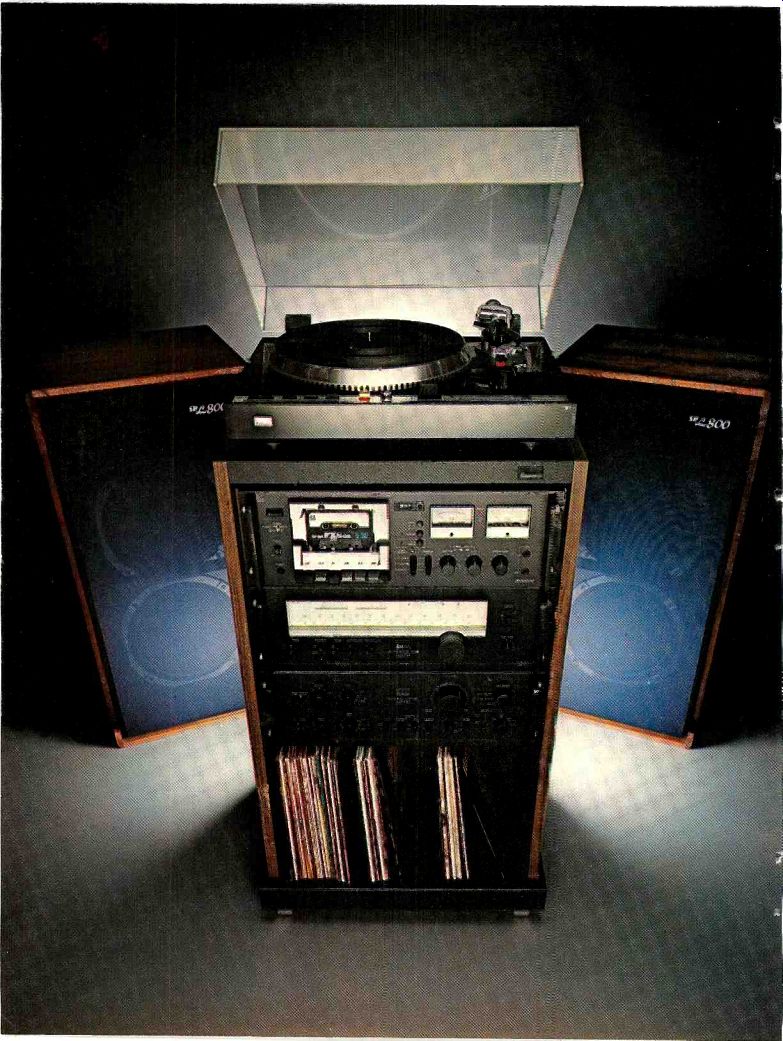
Nikko Audio Puts It All Together for Your Professional Component System
Nikko builds more than outstanding professional components and separates. And for good reason.
Firstly, we don't think stereo gear of any sort should be spread willy-nilly over the studio.
Secondly, we've created these designer-crafted hand-rubbed walnut veneer equipment racks.
And in keeping with our professional attitude, two of the hard wood cabinets are 19-inch standard width.
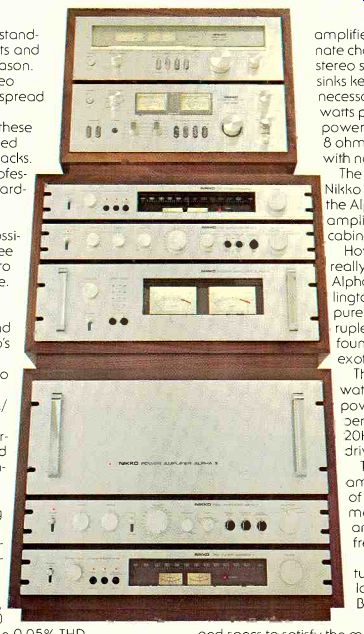
Thirdly, we've made it possible for you to assemble three fantastic custom packages to fit the cabinet of your choice.
End of commercial on cabinets.
We now invite you to read about a few of Nikko Audio's newest electronic products.
As with every Nikko Audio product features abound in the NT-850 (far top), an AM/ FM stereo tuner.
A switchable (normal/narrow) IF band and advanced circuitry are employed to in sure low distortion, signal stability, maximum stereo separation and outstanding reception.
Below the tuner is the NA-850 integrated stereo amplifier. It delivers 60 watts, continuous power output, minimum RMS per channel, driven into 8 ohms from 20 to 20kHz, with no more than 0.05% THD.
Take a hard look at the cabinet below with the Gamma I stereo FM broadcast monitoring tuner. A simply remarkable product.
It has a switchable wide and narrow IF stage for low distortion, high sensitivity (1.807) and the ability to pull in distant stations with clarity.
Nikko Audio's ultra-slim stereo preamp, the Beta II, has both an input equalizer and amp circuit powered by independently regulated voltage supply to help eliminate interference distortion. There is no end to its professional features.
Each dual power supply on the Alpha II power I amplifier has dual filters to eliminate channel crosstalk and improve stereo separation. Exterior heat sinks keep the amp running cool, necessary when it delivers 110 watts per channel, continuous power output, minimum RMS into 8 ohms, from 20Hz to 20kHz, with no more than 0.03% THD.
The heavyweight of the new Nikko Audio professional gear is the Alpha I basic stereo power amplifier, shown in the bottom cabinet.
However, there is nothing really basic internally about the Alpha I. It uses a 3-stage Darlington direct-coupled OCL, pure-complementary quadruple push-pull circuit, rarely found on anything less than exotic amp circuits.
The Alpha I delivers 220 watts per channel, continuous power output minimum RMS Der channel into 8 ohms from 20Hz to 20kHz, both channels driven. THD is 0.08% .
The revolutionary Beta I pre amp's circuitry consists entirely of high-voltage FET's. It's a mate to the Alpha I and is DC and non-coupling for better frequency response.
The Gamma I stereo FM tuner also appears in the lower cabinet below the Beta I stereo preamplifier.
Now, that's enough product and specs to satisfy the most discerning audiophile and professional.
Ask your Nikko Audio dealer for a definitive tour of the new Nikko product line.
Nikko Audio For those who take their stereo seriously Nikko Electric Corp. of America 16270 Raymer St., Van Nuys, Calif. 91406 (213) 988-0105 ©Nikko Audio 1977 In Canada: Superior Electronics, Montreal, Quebec
The English publication Hi-Fi News & Record Review and the prestigious German magazine Stereo are baldly known for their effusiveness. ("Acceptable" is tantamount to a rave review.) But reviewers in both publications adjudged PMB Stereo Headphones "Best" among those tested (included in the tests were Audio-Technica, Yamaha, Koss, Pioneer, Beyer and practically every other important name in the business). And Hi-Fi Stereophonie, perhaps the most important high fidelity journal in Europe, in an uncharacteristic display of enthusiasm described the PMB 8 and the PMB 6 as "Outstanding:' (Burwen Research markets two Orthodynamic Stereo Headphones, the PMB 8 and the PMB 6, and three Dynamic Stereo Headphones, the PMB 4, the PMB 40, and the FMB 20.) The line, styled and developed by Burwen Research, is manufactured in Germany. The combination of talents and techniques on both sides of-the Atlantic has produced stereo headphones that are not only very beautiful, but, indeed, outstanding within every important performance parameter. Burwen Research PMB Headphones are now available at a select number of audio dealers. Listen to a pair soon. We think you'll agree that they are worthy of your most critical attention.

For technical information and excerpts of reviews, write to Burwen Research, University Avenue, Westwood, Mass. 0209 In Canada: the Pringle Group, Don Mills, Ontario, Canada.
Audio humor via cartoons ...

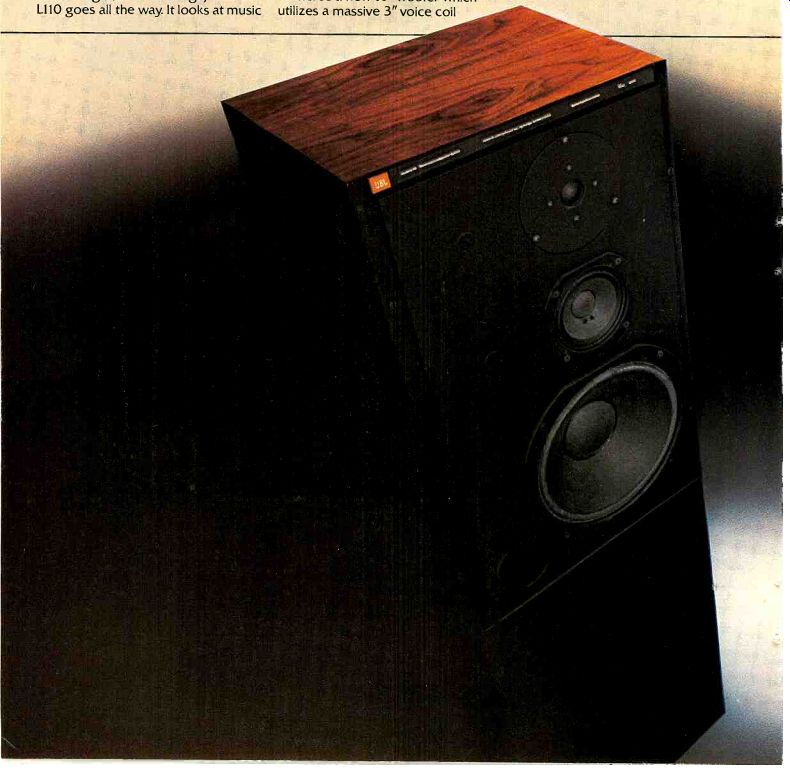
THE LOUDSPEAKERTHAT LOOKS AT MUSIC THE WAY YOU DO JBL's L110.
You're at a concert. The sound surrounds you. There's a guitar. A piano.
Some horns. You hear all of it.
But more than that, you hear each part of it. Each sound. Every sound. All the sound.
Most loudspeakers can't do that.
They only meet you half way. Only left and right, all or nothing. JBI2s new L110 goes all the way. It looks at music the way you do. Left. Right. Front. Back.
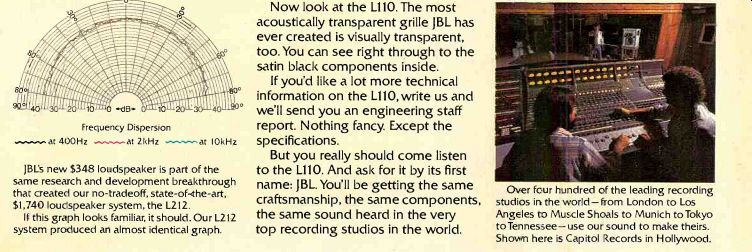
The L110 has almost perfect stereo imaging-a result of precise, uniform dispersion at every frequency.
Inside the L110, there's a brand new, super-sophisticated crossover net work designed specifically to match the brand new components.
There's a new 10" woofer which utilizes a massive 3" voice coil and 7 1/2 pound magnetic assembly normally found in 12" woofers. The result is smooth, accurate bass, plus an amazing level of efficiency and power handling capability throughout the entire system. (One more nice: You get more headroom for your amplifier. Less clipping.)
Frequency Dispersion at 400Hz at 2kHz at 10 kHz JBLs new $348 loudspeaker is part of the same research and development breakthrough that created our no-tradeoff, state-of-the-art, $1,740 loudspeaker system, the L212.
If this graph looks familiar, it should. Our L212 system produced an almost identical graph.
Now look at the L110. The most acoustically transparent grille JBL has ever created is visually transparent, too. You can see right through to the satin black components inside.
If you'd like a lot more technical information on the L110, write us and we'll send you an engineering staff report. Nothing fancy. Except the specifications.
But you really should come listen to the L110. And ask for it by its first name: JBL. You'll be getting the same craftsmanship, the same components, the same sound heard in the very top recording studios in the world.
Over four hundred of the leading recording studios in the world-from London to Los Angeles to Muscle Shoals to Munich to Tokyo to Tennessee-use our sound to make theirs.
Shown here is Capitol Records in Hollywood.
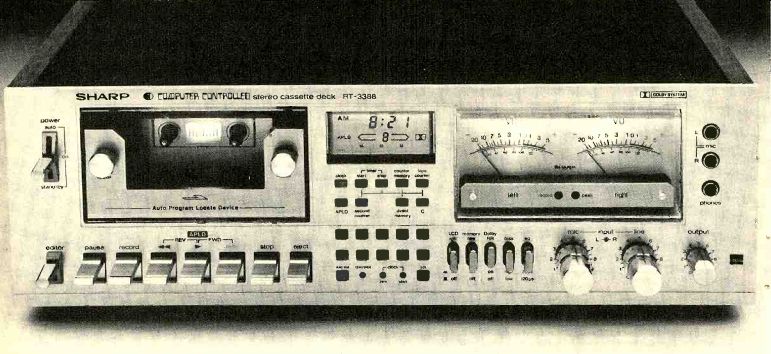
IT-3388.THE WORLD'S FIRST COMPUTER-CONTROLLED CASSETTE DECK.
Thanks to Sharp, the age of the computer has finally caught up to the age of music.
It's all come together in the RT-3388, the first stereo cassette deck that's actually con trolled by a microprocessor with no less than five memories. And the remarkable quantity of the functions it can perform is matched only by the quality of its sound reproduction.
First of all, the Auto Program Locate Device another Sharp exclusive and just one function of the "brain"--can skip ahead, or backward, up to 19 songs on a tape. And automatically play just the one you want.
The Counter Memory can find a specific number on the tape counter and stop there or start playback automatically. The Memory Rewind can rewind to any pre-selected point automatically and play it if desired.
You can even mark off a section of a song or speech and commit it to the machine's memory for immediate recall later by using the Direct Memory Function.
For pinpoint accuracy, it features Electronic Tape Counting as well as Second Counting. Which also can be used to deter mine how much time is left on the tape when recording.
A Liquid Crystal Display indicates what tape function is in operation, while the built in digital quartz clock is tied in to the timed-programming operations. For example, you can program the machine to turn itself on at a selected time, record a program from a radio or TV, then turn itself off.
We've even programmed the "brain" to switch to battery power in case of a power shortage. Thereby maintaining the correct time and keeping the memory intact.
Now if all that sounds impressive, you can be sure we didn't waste it on a machine that didn't have an impressive sound.
So the RT-3388 also features:
Dolby Noise Reduction System.
Bias and Equalization Selectors for optimum performance from any kind of tape.
Editor Function.
Ultra-hard Permalloy Re cording/Playback Head.
Friction-Damped Cassette Holder.
Output Level Control.
Spectacular Specifications: Wow and Flutter runs a minimal 0.06% WRMS. Frequency response covers the 30-15,000 Hz (± 3dB) range for CrO2 tapes. Signal-to noise ratio of 64 dB (Dolby On).
The price for such an incomparable piece of equipment? Only $349.95
Which is about what you'd expect to pay for a deck of comparable quality without any of Sharp's exclusive features.
But you'll own something so advanced it'll be ahead of its time years from now.
See your Sharp Dealer for a mind-boggling demonstration.
Sharp Electronics Corp.
10 Keystone Place SHARP Paramus, N.J. 07652
counter tape memory counter; direct memory clock ; zero start
Dolby is a registered trademark of Dolby Laboratories.
Manufacturer's Suggested Retail Price. Optional with Dealer.
fact: a stylus tip does not a cartridge make.
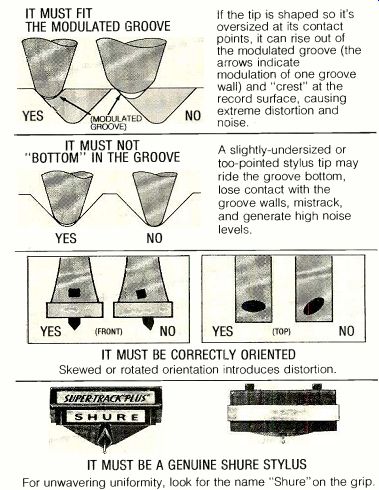
So why all the fuss? The stylus tip is only part of the complex stylus and cartridge structure, and performs a single function--it positions the entire stylus assembly so that all groove undulations are traced without damaging the record. The production of a top-quality tip calls for exquisite micro-craftsmanship, precision polishing, unwavering uniformity, and exact orientation. (However, important as it is, an exotic diamond stylus tip configuration simply isn't a cure-all for what might ail an otherwise deficient cartridge, regardless of high-flying claims you may have heard or read.) Here are the basic criteria a top-quality stylus tip must meet:
IT MUST FIT THE MODULATED GROOVE YES (MODULATE D NO GROOVE) IT MUST NOT "BOTTOM" IN THE GROOVE
If the tip is shaped so it's oversized at its contact points, it can rise out of the modulated groove (the arrows indicate modulation of one groove wall) and "crest" at the record surface, causing extreme distortion and noise.
YES NO A slightly-undersized or too-pointed stylus tip may ride the groove bottom, lose contact with the groove walls, mistrack, and generate high noise levels.
IT MUST BE CORRECTLY ORIENTED
Skewed or rotated orientation introduces distortion.
IT MUST BE A GENUINE SHURE STYLUS
For unwavering uniformity, look for the name "Shure" on the grip.
Please send for our "Scientific Study of Competitive Styli" booklet (AL548) explaining the important specifications all Shure styli are required to meet.
High Fidelity Cartridges & Replacement Styli Shure Brothers Inc., 222 Hartrey Avenue, Evanston, IL 60204, In Canada: A. C. Simmonds & Sons Limited Manufacturers of high fidelity components, microphones, sound systems and related circuitry.
SCIENCE
The simplicity of the Discwasher system belies the extensive research and instrumentation that has produced the world's leading record cleaner. Pain staking development using gas-liquid chromatography, thermal-sensing instruments, precision weighing equipment, friction-measuring instruments and electron microscopy have all contributed to the evolution of the Discwasher Record Care System.
This rigorous application of science has produced an integrated, patented system of brush and fluid which lifts both fingerprints and micro-dust from the record grooves (without smudging them deeper); which allows all contamination and fluid to be removed from the record surface; which preserves the chemical integrity of the vinyl (unlike many liquids and dry cleaning systems) and which offers long-term protection against biological and physical contamination.
EXPERIENCE
Any gadget can be made to "perform" by using simplistic test criteria instead of long term use.

Experience, on the other hand, responds to the valid questions of science and has proven that the best, most convenient, and most effective record cleaning system is the patented Discwasher.
"Experience" involves consumer intelligence, proper use-and proper evaluation of results. That's why Experience has made the Discwasher system the Leader in record care. Beyond any doubt.
AESTHETICS AND VALUE
What is the proper price for milled, hand rubbed walnut that will last long after the "plastic wonders" are cracked and broken? What is the net evaluation of an incredibly complex cleaning fluid which is lower in dry weight residue and yet more "active" and "safe" in the removal of standard record contamination than any other cleaner? What is the value of your record collection as compared to the protection of approximately 200 cleanings from each small bottle of D3 fluid? You can be ripped off by cheaper attempts, and fooled by more expensive "followers" of the Leader. But only Discwasher has the Clean Logic of Leadership.
discwasher inc. Columbia, Missouri 65201
The Black Widow Tone Arm.
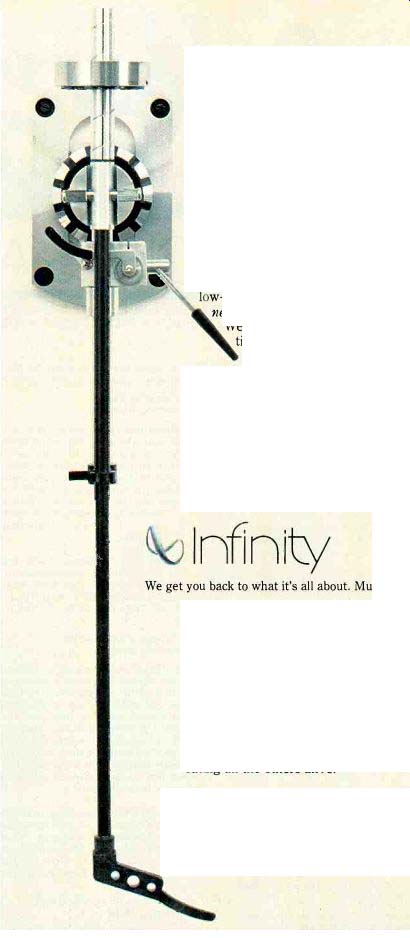
$200 and it does practically nothing.
The ideal tone arm/cartridge system in theory, would be a cartridge suspended from an infinitely rigid nothing.
. Infinity's Black Widow is, in fact, an exceptionally rigid, extremely low-mass, ingeniously engineered next-to-nothing.
We've eliminated the conventional head-shell, resulting in a barely-there-at-all effective mass of three grams.
Of course, low mass in itself is no guarantee of superior performance unless matched with a carefully engineered design, precise construction, and minute attention to details.
These goals have been beautifully achieved in the Black Widow Tone Arm.
In its year and a half of life, it has been widely acknowledged as the State of the Art.
The low mass of this arm permits any high-compliance cartridge to operate at its optimum; reducing mistracking and distortion and improving the accuracy of the stereo image.
Your records will reveal a musicality and cleanliness of sound you never knew was there.
If you want to even hear more, drop us a line. Or call us toll-free at (800) 423-5244. (In California: (800) 382-3372.) Better yet, drop in on any Infinity dealer. You'll find out why the Black Widow Tone Arm is eating all the others alive.
We get you back to what it's all about. Music.
C1977 by Infinity Systems, Inc., 7930 Deering Ave., Canoga Park, CA 91304. (213) 883-4800. TWX (910) 494-4919.
Manufacturer's suggested retail price, optional with dealer.
WE WANT YOU TO BE AS DEMANDING OF OUR SOUND AS WE ARE.
The most important feature in Setton equipment is the sound you hear. Every idea we've perfected over the years has that objective in mind. We think you'll be interested in reading about some of them.
Accurate adjustment of sound Superimposed on the circle of each knob is an elongated elliptical shape that helps your fingers accurately adjust the controls. That fine adjustment is aided by detents on volume and tone controls so you can set them precisely. The bass, treble and mid-range controls provide 1331 different settings. The mid-range control is valuable in correcting the dip in response in at least one well-known speaker.
Music--be it Bach, bop or rock-will sound truer. And the human voice, from an aria to an oratorio, will sound smoother.
Our pushbuttons are a pleasure to push. They're mounted in nylon bushings so they slide silkily and silently. They quickly switch bass and treble turn-over points, FM muting, loudness, tape monitoring and transfer.
The lights do a sparkling job of providing meaningful information.
You know instantly what mode of operation your system is in. And the lights on the security panel give you a visual warning of over-heating, distortion or over load, while a clicking relay also alerts you. Failing all else, the unit will shut down by itself before any damage is done.
Security Panel
New ideas to solve old problems We think about details, but we also think big, new ideas. For example, on our new TS-11 Automatic Front Loading turntable the dust cover slides forward instead of lifting up.
The TS-11 requires only about six TS-11 Automatic Front Loading Turntable inches of height, so you can place it wherever you wish. With the controls on the front, you needn't reach into the unit to start, stop, change speeds or cue. And their vertical action cuts down on vibration. Wow and flutter are remarkably low and the rumble level is -60dB.
We haven't told you about our new RCS-X-1000 Remote Control Center. Or about the dual-gate MOS-FET transistors in our receivers and tuners for greater selectivity. And our Power Boosters and Car Speakers that make great sound a moving sensation.
As you might expect, the highest fidelity doesn't come with the lowest prices. Setton equipment is ex pensive, but for its price it offers uncommon value. We believe there are relatively few people able to fully appreciate this highest fidelity equipment.
If you would like to learn more about the line that starts with perfection, simply write to Barbara Beachy, Setton International Ltd., 60 Remington Boulevard, Ronkonkoma, New York 11779.
SETTON Perfection. The best place to start.

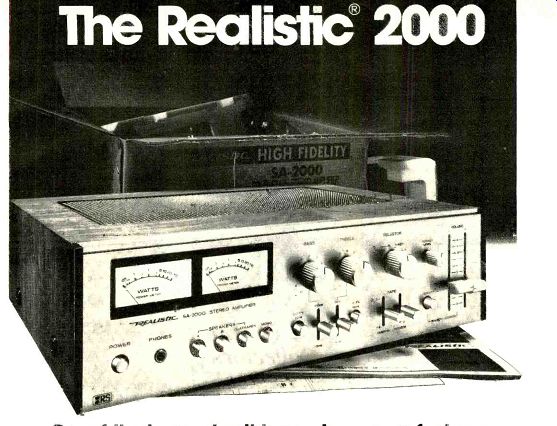
Proof that you don't have to pay a fortune for a first-class, high-power stereo amplifier What more proof do you need than rave reviews by a major audio magazine? Stereo Review (April 1977) says "The SA-2000 can deliver as much power, with as lithe distortion, as will ever be required by the vast majority of its users:' 55 watts per channel, minimum RMS at 8 ohms from 20-20,000 Hz, with no more than 0.3% total harmonic distortion. Our tone controls "are among the better ones we have seen:' says Stereo Review. They give you a choice, by boosting or cutting bass at 125 or 400 Hz and treble at 3 kHz or 7 kHz. It's almost like These two credit cards honored at most Radio Shacks.
Prices may vary at individual stores and dealers.
having four separate tone controls. Stereo Review also says ours is "one of the very few loudness compensation systems that really works:' That's because exclusive Perfect Level makes our Perfect Loudness system adjustable to any listening level so that the "boominess" so often heard with ordinary loudness systems is eliminated. Among many other features, the SA-2000 has two magnetic phono inputs, dubbing and monitoring circuits for two tape decks, and a walnut veneer case. Only $269.95 -- even less if you buy it in a complete system.
SOLD ONLY WHERE YOU SEE THE Radio Shack SIGN. Radio Shack -- A DIVISION OF TANDY CORPORATION, FORT WORTH, TEXAS, 76102
OVER 6000 LOCATIONS IN NINE COUNTRIES
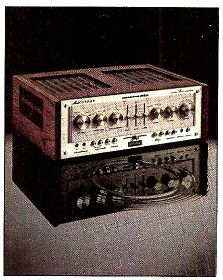
Ultimately, It's Marantz.
Go For It.
Marantz goes beyond THD to lower TIM (transient intermodulation distortion).
Because TIM doesn't show up on conventional amplifier testing equipment, most manufacturers and their engineers aren't even aware that it exists in their amplifiers. Even if they were, they probably wouldn't know what to do about it.
But because Marantz builds for the music and not just the specs we know how destructive TIM can be to pure sound reproduction. And we've developed a revolutionary new circuit design to eliminate it.
The reduction of TIM can be the single most important element in making an amplifier sound better. For instance, two amplifiers with identical total harmonic distortion (THD) specifications should sound the same when compared ... but the one with low TIM will sound audibly better! That's because TIM adds an unnatural harshness to the music. It's not only detrimental to pure sound reproduction, but it can have an emotional effect that you experience as "listening fatigue!' TIM is caused by an improper design of "negative feedback circuitry," by other manufacturers. Every modern amplifier uses it to lower THD. But excessive negative feedback coupled with an insufficient slew rate* can lead to gross internal overloads under the constantly changing transient and sound levels of music. That distortion is TIM.
The gentle slopes of continuous sine wave test signals normally used to test an amplifier simply cannot detect TIM distortion. It requires the type of extremely sophisticated spectrum analysis equipment developed by the space industry to analyze radio frequencies.
Our answer to TIM is a circuit design that ensures the widest band width and the lowest obtainable THD before negative feedback is applied. The Marantz 170DC Stereo Power Amplifier (the 1152DC and 1180DC also use this circuitry), for instance, needs only 1/100th (- 40 dB) the amount of negative feedback commonly required by other amplifiers to yield the same low THD figures.
Incredibly, Marantz amplifiers with low TIM design can deliver flat frequency response from 0 Hz to 20 kHz without the use of negative feedback. And this same circuit design provides the optimum slew rate for minimum TIM and maximum reliability.
Result: Marantz reduces TIM to an inaudible level, which means you get clear, clean sound from all your records and tapes. Think of Marantz with low TIM as a window to the original performance.
If you truly want the best reproduction of musical sound available anywhere-and are willing to spend a little more to get it-then go for it.
Go for Marantz. We sound better.
*The maximum change of voltage per unit time. 1978 Marantz Co., Inc., a subsidiary of Superscope, Inc., 20525 Nordhoff St. Chatsworth, CA 91311. Prices and models subject to change without notice. Your Marantz dealer has the full line of Marantz amplifiers. Look for him in the Yellow Pages.
Misc. ADs:




========
Also see:
Source: Stereo Review (USA magazine)