Reviewed by RICHARD FREED DAVID HALL GEORGE JELLINEK PAUL KRESH STODDARD
LINCOLN ERIC SALZMAN
RECORDING OF SPECIAL MERIT
ARNE: Symphonies Nos. 1-4. WESLEY: symphony in D Major. Bournemouth Sinfonietta, Kenneth Montgomery cond. HNH 4041 $7.98 (from HNH Distributors, Ltd., P. 0. Box 222, Evanston, III. 60204).
Performance: Excellent
Recording: Excellent
This is a recording of special merit not only because of the wonderful performance by the Bournemouth Sinfonietta under the sure direction of Kenneth Montgomery, but also be cause of the fabulous symphonies of Thomas Arne. When thinking of Handel's English contemporaries we are too apt to classify all of them as lesser imitators of the master. But there was also an important post-Handelian Classical school ushered in by the arrival in England of Johann Christian Bach in 1762.
The four Arne symphonies on this disc belong to that school and dramatically demonstrate that this talented composer was well aware of what was going on in Mannheim and what Sturm and Drang was all about. The music is full of drama and contrast and is detailed in its orchestration, which is filled with passages for the woodwinds and horns. The various effects are well structured; above all, one hears Arne's ingratiating sense of melody English to the core but with one ear tuned to Italy.
----------------
Explanation of symbols:
= reel-to-reel stereo tape
= eight-track stereo cartridge
= stereo cassette
= quadraphonic disc
= reel-to-reel quadraphonic tape
= eight-track quadraphonic tape
Monophonic recordings are indicated by the symbol
The first listing is the one reviewed; other formats, if available, follow it.
--------
Arne's extraordinary talent is emphasized by comparing his music with the youthful symphony of Samuel Wesley. Though fine in its workmanship, it lacks the sweep and dimension of the Arne works.
Kenneth Montgomery treats these works with the same respect one would pay to Haydn or Mozart, thus avoiding the usual "musical curiosity"-type reading so often given to lesser-known composers. I strongly recommend that every collector make a point of acquiring this album for a thrilling surprise.
S.L.
J. S. BACH: Sonata in B Minor for Flute and Harpsichord (BWV 1030); Sonata in E Major for Flute and Basso Continuo (BWV 1035); Sonata in A Major for Flute and Harpsichord (BWV 1032); Sonata in E Minor for Flute and Basso Continuo (BWV 1034); Partita in A Minor for Solo Flute (BWV 1013), plus alternative instrumentations; Concerto in D Minor (fragment after the first movement of the Sonata in B Minor, BWV 1030). Frans Briiggen (flute); Gustav Leonhardt (harpsichord); other musicians. ABC/SEON AB-67015 two discs, $13.96.
Performance: Authentic
Recording: Crisp
The producers of this disc, which is billed as containing the complete sonatas and partitas for transverse flute of J. S. Bach, take a hard line on what is really by Johann Sebastian and what is spurious. They have rigorously eliminated the Sonata in E-flat Major and the Sonata in G Minor (BWV 1031 and 1020, respectively) and the C Major Sonata for Flute and Continuo (BWV 1033), maintaining that the first two are probably the work of C. P. E.
Bach and the third the closely supervised work of one of J. S. Bach's students. On stylistic grounds there is certainly no quarreling with this stance, but I hope these three beautiful works will not be eliminated from the repertoire simply because they lack a proper pedigree. The alternative instrumentations provided for the Partita in A Minor are based on the speculation that because of the difficulty of the work it might have been written originally for some instrument other than the flute.
Thus, the movements have been variously as signed to the viola, harpsichord, violoncello piccolo, recorder, and violin. The result merely proves what we already know: that Bach is indestructible regardless of what instrument his music is performed on. The construction of a concerto from a fragment of the B Minor Sonata is even more speculative; what it really amounts to is a pleasant arrangement for strings, which leaves the listener frustrated because it stops halfway through.
The technically perfect performances here are in an "authentic" style derived from re search in various and sundry old documents that suggest a maximum of articulation was normal Baroque performance practice. While this may be historically correct, I feel that the complete lack of projection and a long line and the suppression of any individual interpretation by the performers render the product lifeless and inhuman. S.L.
BEETHOVEN: Fugues in A Minor, B-flat Major, and C Major; Choral Fugues in G Major and F Major; Fugues alla Duodecimo in D Mi nor and C Major; Double Fugues in F Major and D Minor; Preludes and Fugues in F Major, C Major, and E Minor. Canadian Broadcasting Corporation Festival Orchestra, Alex Brott cond. EVEREST 3419 $5.98.
Performance: Devoted
Recording: Fine
This album is entitled "The Young Prometheus." Once one gets through the name dropping liner notes and the notion that the music has anything to do with Beethoven's ballet score The Creatures of Prometheus, it turns out to be a delightfully dignified experience. The music is an arrangement of selections from contrapuntal studies written by Beethoven during his student years in Vienna (1791 to 1795). That he learned fugal techniques well is immediately obvious from the masterly handling of inversions, strettos, and the like. That these are only studies is immediately obvious from the absence of the characteristic Beethoven sound. Alex Brott has selected the studies and orchestrated them in the finest Stokowski tradition; the result makes good listening. The performances are excellent, and the disc is well worth acquiring at least as a curiosity. S.L.
BRAHMS: Ein Deutsches Requiem, Op. 45. Ileana Cotrubas (soprano); Hermann Prey (baritone); New Philharmonia Chorus and Orchestra, Lorin Maazel cond. Alto Rhapsody, Op. 53. Yvonne Minton (mezzo-soprano); Ambrosian Singers; New Philharmonia Or chestra, Lorin Maazel cond. COLUMBIA M2 34583 two discs $15.98.
Performance: Lyrical
Recording: Good
Lorin Maazel's view of the German Requiem is decidedly different in spirit from Otto Klemperer's darkly apocalyptic and supremely eloquent 1962 reading on Angel. Maazel stresses the lyrical and consolatory aspects of the score throughout, with most effective results in the "Wie lieblich sind deine Wohnun gen" and the two final movements. The New Philharmonia Chorus tenors give an especially fine account of themselves in the "Herr, du bist wurdig" fugue, and after a tremulous start Ileana Cotrubas is sweetly affecting in the famous "Ihr habt nun Traurigkeit" solo.
Hermann Prey's musicianship and dramatic sense are beyond reproach in "Herr, lehre doch mich," but his voice is a bit light in weight for my taste. And I can't say that I cared much for Maazel's rallentando treatment of endings and transitional half-cadences.
The real prize in this album turns out to be Yvonne Minton with the Ambrosian Singers (male contingent) in the Alto Rhapsody. This is as gripping and dramatic a realization of Brahms' Goethe setting on misanthropy and redeeming grace as I ever hope to hear, a performance that is right up there with the very best of its several distinguished predecessors on disc. And if Columbia's recording of the Requiem is good, that of the Rhapsody notably the excellent balance of the male choir-is definitely superior. I can only hope that this Alto Rhapsody will become available as part of a single-disc issue.
-D.H.
BRAHMS: Violin Concerto in D Major, Op. 77 (see Best of the Month, page 76) RECORDING OF SPECIAL MERIT CHOPIN: Twenty-four Preludes, Op. 28; Prelude in C-sharp Minor, Op. 45; Prelude in A-flat, Op. Posth. Martha Argerich (piano). DEUTSCHE GRAMMOPHON 2530 721 $8.98, 3300 721 $8.98.
Performance: Superb
Recording: Excellent
It is not for me to say that Martha Argerich's reading of the Chopin preludes is manifestly superior or inferior to those of such formidable rivals as De Larrocha, Moravec, Orozco, Perahia, or Pollini. There are too many elements of personal taste involved here. So I will say only that I found Argerich's reading of the preludes very much to my taste. Hers is an almost perfect compromise between a stern classicist approach and a heady roman tic one. The classicist is in control in No. 1, while the romantic is in full sway throughout the fiercely turbulent No. 22. I was most relieved not to hear the famous "Raindrop" be come falling boulders, yet it retains a full measure of its inherent drama here.
----------------
Mendelssohn's Octet
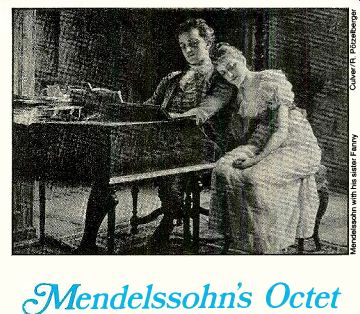
LIKE a full-size egg laid by a baby ostrich, Mendelssohn's Octet in E-flat Major was an unexpected marvel of nature whose production was anxiously watched over and whose completion was duly reported. Not that the sixteen-year-old composer's Opus 20 should have been a complete surprise, of course, for during travels in Italy and France his prodigious musical talents had evoked praise from, among others, Rossini, Meyerbeer, and Cherubini.
At the end of November 1825, Mendelssohn's teacher Carl Friedrich Zelter proudly announced to a privileged mutual friend, Johann Wolfgang von Goethe, that "Felix is working hard and is making progress. He has just completed an octet that is very cleverly written." The work "hat Hand and Fuss," Zelter told Goethe, meaning that it was fittingly accomplished top to bottom. We may well ask whether such distinctly restrained enthusiasm-expressed in terms more appropriate to a series of finger exercises for euphonium or a two-part invention for tuba and trombone-was the best that Zelter could summon up for a masterpiece that still remains unique one hundred and fifty-two years later.
BUT let us not be too hard on old Zelter. Could even the most doting foster parent tell from a barely dry manuscript that the work he held in his hand had a first movement with a momentum and dash worthy of Beethoven, an andante that could have been signed "F. Schubert" without arousing any suspicion of fraud? Not to mention that he might have found it difficult even to name a predecessor who had ever achieved anything comparable to the fleet-footed scherzo. It took the com poser's sister Fanny to disclose the secret of that movement's origin-"He told what he had in mind only to me," she said-in a reference to the marriage of Titania and Oberon in the Walpurgisnacht section of Goethe's Faust. When the scherzo's theme whizzes back into hearing in the contrapuntal whirl wind of the finale, an earlier Wolfgang namely Mozart, who originated this sort of movement-might well have joined Goethe in applause.
Mendelssohn's marvelous "egg," full of potential nourishment and enjoyment, is a great challenge to the skill of those who would serve it up. To help insure that it would be appropriately prepared, Mendelssohn included in the score such instructions as these: "to be played in symphonic style by all the instruments," and "pianos and fortes must be strictly observed." Among the excellent versions currently available, the choices have ranged from the Western omelette proffered by Jascha Heifetz and His Corral Seven (RCA LSC-2738) to the oeufs-a-la-Russe treatment by the Smetana and Jangek Quartets (Van guard SU-4).
Now, however, musical gourmets may savor an extraordinary presentation of the octet by the combined forces of the Cleveland and Tokyo Quartets, respectively led by Donald Weilerstein and Koichini Harada. Thoroughly blended and cooked to perfection, their inter continental omelette has an exceptionally pleasing texture (just firm enough) and a flavor that is simply not to be found in European servings of Mendelssohn's prodigious creation (even by I Musici). The teamwork is so selfless, the ensemble playing so effortless, that one viola is indistinguishable from the other, nor can one determine which cellist is playing when. This one unquestionably gets my cordon bleu.
As a bonus, the recording includes the Variations and Scherzo, Op. 81, that Mendelssohn wrote in the aftermath of his sister's death and only weeks before his own-in 1847. The work is a sober summation of Mendelssohn's life in music, and the performance is a manifold exhibition of the artistic excellence of the Cleveland players. The sound quality is fine both in this and in the octet.
-Irving Kolodin
MENDELSSOHN: Octet in E-flat Major, Op. 20. Cleveland Quartet; Tokyo String Quartet. Variations and Scherzo, Op. 81. Cleveland Quartet. RCA ARLI-2532 $7.98, ARKI 2532 $7.98.
-------------------------
The art less simplicity Argerich brings to the all-too-frequently sentimentalized A Major Prelude matches for me the achievement of the wonderful Horowitz record of the Mendelssohn Spring Song. Still another plus in this recording is the use of an instrument that gives the final note of No. 24 its full tonal effect, a far cry from the dull thud that occurs on too many other recordings.
-D.H.
DONIZETTI: Lucia di Lammermoor. Montserrat Caballe (soprano), Lucia; Jose Carreras (tenor), Edgardo; Claes H. Ahnsjo (tenor), Arturo; Vicente Sardinero (baritone), Enrico; Samuel Ramey (bass), Raimondo; Ann Mur ray (mezzo-soprano), Alisa; Vincenzo Bello (tenor), Normanno. Ambrosian Opera Chorus; New Philharmonia Orchestra, Jesus Lopez Cobos cond.
PHILIPS 6703 080 three discs $26.94, 7699 056 $17.96.
Performance: Good
Recording: Excellent
This appears to be an "authentic" Lucia, and, since its approach to the title role is so different from traditional interpretations, it is bound to raise controversy. According to conductor Jesus Lopez Cobos, Donizetti's auto graph clearly indicates the composer's preference for a lirico-spinto soprano as Lucia. The tradition of using lighter, "coloratura" voices (Patti, Melba, Tetrazzini, and their musical heirs down to Sutherland and Sills) was established only after the composer's death and presumably against his wishes. To make the part a coloratura "vehicle," Lucia's music was transposed downward (a full tone or a semitone) so that the added embellishments could be better accommodated. The performance captured in this Philips set returns to the Donizetti original, with Lucia's range rising no higher than a single C-sharp and a few high C's and with relatively modest cadential resolutions in the two long arias. To quote Maestro Lopez-Cobos: "Only a soprano with coloratura and at the same time a central range sufficiently consistent and dramatic can interpret the part of Lucia . . . the role should be restored to the lirico-spinto soprano for whom it was intended." The fact that Montserrat Caballe happens to fit the above description may be more than a coincidence, but that need not diminish the validity of the conductor's assertion. It is the performance that gives rise to doubts. Quite apart from the cadenzas, the soprano part abounds in coloratura passages that call for extraordinary agility. I cannot say that Montserrat Caballe can toss off "Quando rapito in estasi" or the Mad Scene with the sovereign ease Joan Sutherland exhibits in her two recordings. And while she supplies a wealth of finely sculptured phrases and meltingly lovely tones, in flights above the staff she often turns strident. So, at best, we have here an interesting challenge that is not fully met.
Jose Carreras, in fine form, imbues his music with an appropriately melancholy coloration. He manages the high E-flat Donizetti asks for in the first-act duet. It is no doubt a falsetto, but it is so skillfully blended with the soprano that we hear only the note without having to worry about its quality. Samuel Ramey is a bass-baritone rather than the true bass one would prefer for Raimondo, but his singing is smooth, stylish, and altogether admirable. Raising the Enrico-Lucia duet up a tone moves the baritone's music into a fairly uncomfortable tessitura. Vicente Sardinero handles it well, but not without effort, and the unusually fast tempo allows for little dramatic characterization.
I have mixed feelings about the conductor's work. It shows a great deal of thoughtfulness and dedication, but there is less than total precision between pit and stage, and there are several not-too-convincing tempo choices: too fast for the choral allegros, too slow for the Mad Scene and the final scene.
After years of highly decorated Lucias I really do not mind the reverse swing of the pendulum, and I intend to enjoy witnessing what is sure to be a lively controversy between upholders of the "Urtext" and sanctifiers of the "performance traditions." The truth, as always, is somewhere in between.
- G.J.
RECORDING OF SPECIAL MERIT
DVORAK: Slavonic Dances, Opp. 46 and 72. Michel Beroff, Jean-Philippe Collard (piano, four hands). CONNOISSEUR SOCIETY CSQ 2146 $7.98.
Performance: Joyous
Recording: First-rate
The overriding point of virtually all piano du ets (music played by two pianists on a single keyboard) is that the performers enjoy themselves. Alfred Brendel and Walter Klien seemed to be having a marvelous time in their classic recording of the complete Slavonic Dances in their original form. That version (Turnabout TVS 134060) has seen nearly two full decades of service now and must yield pride of place at last to this scintillating new one. The young Frenchmen's response to the dances is no less joyous than that of their Austrian predecessors, and they benefit from up-to-date recording that offers really first rate reproduction of the piano. The record benefits further from Irving Kolodin's affectionate notes on the music. (His suggestion that some of the tunes were created by an "anonymous folk fiddler" is at odds with most sources, which identify all the melodies as Dvorak's own, but since one or two of them are more or less identical with themes used earlier by Smetana, perhaps the question is worth re-exploring.) Highly recommended as a companion disc to the popular orchestral versions of the Slavonic Dances conducted by Neumann, Szell, or Kubelik.
-R.F.
DVORAK: Stabat Mater. Edith Mathis (soprano); Anna Reynolds (contralto); Wieslaw Ochman (tenor); John Shirley-Quirk (bass); Chorus and Orchestra of the Bavarian Radio, Rafael Kubelik cond. DEUTSCHE GRAMMOPHON 2707 099 two discs $17.96.
Performance:Draggy
Recording: Soloists prominent
Dvorak's Stabat Mater, one of the most remarkable and original productions of late Romanticism, is a mystical, deeply felt work of great intensity. And, contrary to what is said in the liner notes for this new recording, it is not all that obscure. It seems to have had a tremendously successful premiere in Eng land, and it has always had something of a place in the Anglo-American choral-orchestral repertoire.
The notes also say that the alto aria is "one of the few examples of archaic tendencies in Dvorak's music," but extraordinary evocations of antiquity pervade the rest of the work as well. It is, in fact, a remarkable synthesis of traditions stemming from Renaissance and Baroque polyphony. Even the ultra-chromaticism-extreme melodic and harmonic thrusts and changes-harks back to the old masters' use of chromatics and key changes to express feelings, religious and secular, of great depth and intensity. Other elements from the past include such things as the relatively rare 3/2 meter, the modal writing, the tight motivic construction, and the use of a chorus for this text at all. Central Europe in the late nineteenth century was the birthplace of musicology, and the study of the musical past influenced many composers, including Max Reger and Dvorak's idol, Brahms. But Dvorak's Stabat Mater still stands out for its uniquely powerful fusion of antique and modern elements. His own later symphonies seem almost Classical in comparison.
I have talked mostly about the work itself because I think it is a very great composition that is not given its due in this recording. The music is bold, intense, full of incident-but it takes a lot of listening through an introspective, slow-paced performance to realize it.
Kubelik's reading is too draggy, too murky, and, except for the solo singing, too feature less. The solo quartet is outstanding-even literally, for the engineering throws their parts into high relief-but that only serves to emphasize that the chorus, the orchestra, and most of the work's strong feeling have been left behind.
E.S.
ELGAR: The Music Makers, Op. 69.
PARRY: Blest Pair of Sirens. Janet Baker (mezzo soprano); London Philharmonic Choir and Orchestra, Sir Adrian Boult cond. VAN GUARD VSD-71225 $7.98.
Performance: First-rate
Recording: Quite good
The Music Makers, which had never been re corded in its entirety before this EMI production of 1967, is one of Elgar's last major works. Composed in 1912, much later than his other big choral pieces (by that time, only Falstaff and the Cello Concerto, among his major offerings, remained in the future), it is not only shorter, but generally more tightly organized and less given to mawkish sentimentality than such a work as The Dream of Gerontius. Musically, it is intriguing for the masterly handling of the big orchestra and the several quotations from Elgar's earlier works (also citations of La Marseillaise and Rule Brittania). But what does one say about a poem that includes such lines as "With wonderful deathless ditties/We build up the world's great cities"? Arthur O'Shaughnessy's fanciful verses about dreamers of dreams, "World losers and world forsakers, etc., the sort of thing only a Walt Whitman could really bring off, are hard to take seriously, and Elgar's grand setting only seems to emphasize the poverty of the text. That said, it must be acknowledged that Boult here gives a powerful performance, drawing the best from his various vocal and instrumental associates, including most especially Janet Baker, who gave of her formidable best in this curious enterprise. Sir Hubert Parry's concise setting of Milton's At a Solemn Musick (re-titled after its first line) strikes me as an altogether more creditable endeavor and an interesting introduction to a composer whose music is unknown to most Americans. There may be an echo or two from Brahms' Schicksalslied, but in general this is one of the happier products of England's nineteenth-century choral activity, a setting appropriate to its text in both texture and proportions. Again, the ...
---------------
Robert White: Return of the Irish Tenor
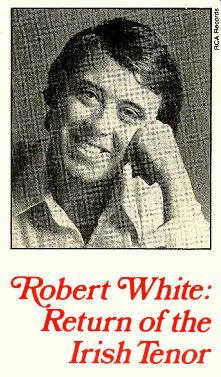
ROBERT WHITE, who started his singing career at the age of five, made something of a sensation among record collectors last year with "When You and I Were Young, Maggie," his first album of aged-in-the-wood Americana. The success of that album led to many a concert appearance, a second White House invitation (the first was from the Kennedys), and a sequel-"l Hear You Calling Me"-issued by RCA. Unlike most sequels, this one surely measures up to its predecessor in terms of performance. In fact, this time White seems openly out to claim the mantle of the great John McCormack. The title song was McCormack's trademark, and the rest of the program is made up largely of those hardy Irish perennials he recorded so breathtakingly in the 78-rpm era. Here are Danny Boy, Kathleen Mavoumeen, Roses of Picardy, Molly Brannigan, and 'Tis the Last Rose of Summer sung in a voice of purest gold and with an artistry that nearly makes one forget how dog eared and dusty these sentimental favorites have become.
BEFORE the concert is over, though, one be gins to wish that White had been a bit more adventurous in choosing his repertoire. True, he does give us a passage from the Rubdiydt as set by Liza Lehmann (whom I thought Beatrice Lillie had taken care of for all time with her version of Lehmann's There Are Fairies at the Bottom of My .Garden), but this can scarcely be considered breaking new ground; old Omar's hedonistic verses never sounded so much like stanzas from a Presbyterian hymnal. Ah well, i' faith, there will always be an audience for Molly Malone, and there isn't anybody else around at the moment who can hawk those cockles and mussels more persuasively than Robert White. His regular accompanist, Samuel Sanders (they met as students at New York's Hunter College), acquits him self on the new release as skillfully as on the earlier one.
-Paul Kresh
ROBERT WHITE: I Hear You Calling Me. Danny Boy; Kathleen Mavourneen; Come to the Fair; Ah, Moon of My Delight; A Bally nure Ballad; 'Tis the Last Rose of Summer; The Bells of St. Mary's; Roses of Picardy; The Lord Is My Light; Tommy, Lad; Molly Brannigan; Molly Malone; Mavis; I Hear You Calling Me. Robert White (tenor); Samuel Sanders (piano). RCA ARL1-2450 $7.98, ARS1-2450 $7.98, ARK1-2450 $7.98.
------------------
... performance rings with conviction, and the sound is very good indeed in terms of richness and balance, if not brightness.
-R.F.
GANNE: Les Saltimbanques (see Best of the Month )
RECORDING OF SPECIAL MERIT
GERSHWIN: An American in Paris.
RUSSO: Street Music, Op. 65. Corky Siegel (harmonica); William Russo (piano); San Francis co Symphony Orchestra, Seiji Ozawa cond. DEUTSCHE GRAMMOPHON 2530 788 $8.98, 3300 788 $8.98.
Performance: Sturdy
Recording: Superb
In the notes for an earlier Deutsche Grammophon recording, of William Russo's Three Pieces for Blues Band and Symphony Orchestra, David Noble tells how Seiji Ozawa discovered Corky Siegel and Jim Schwall and their band in a San Francisco bat, and how this meeting led to a commission for William Russo to write the pieces Ozawa recorded with the Siegel-Schwall Band and the San Francisco Symphony. That was interesting music, and the association has led to still another work by Russo, this time in a blues idiom, with Corky Siegel as harmonica soloist for the occasion and with the composer him self at the piano. The new work, called Street Music and subtitled "A Blues Concerto," is an intriguing piece, living up to its title with passages that exult in broad vulgarity in the best and lustiest sense, together with free-flowing flights of adventuresome writing that attest at once to Russo's fresh musical imagination and fluency. There are four movements-the first featuring a bluesy harmonica solo against a rather exalted Germanic symphonic background, the second a "shuffle" for piano in dialogue with the brasses and woodwinds, the third a "blues canon," and a finale that leads from a hoedown to a waltz to a dizzily rhapsodic orchestral wind-up. The piece is just chock full of bright ideas. Indeed, if Street Music suffers at all, it is from that very fluency which leads this composer down certain curious improvisational byways which at times tend to blur the formal structure. It certainly is played brilliantly under Ozawa's exuberant direction, and the solo work on both harmonica and piano is splendid.
Backing the rather long concerto (over thirty minutes) is a spectacularly elegant, energetic, and crystal-clear recording of the 1928 symphonic-jazz classic An American in Paris. Flinching at neither the impressionistic nor the cacophonic elements in this entertaining score, and making especially contagious the dance-band blues beat of the famous "homesick American" episode, Ozawa and his wide-awake forces bring off one of the best recordings of this piece yet committed to discs. In all, an inspiriting concert. P.K.
RECORDING OF SPECIAL MERIT
HANDEL: Music for the Royal Fireworks; Concerto a Due Cori in F Major; Concerto in F Major; Concerto in D Major. London Symphony Orchestra, Charles Mackerras cond. ANGEL S-37404 $7.98, 4XS-37404 $7.98.
Performance: Vigorous
Recording: Resonant
Perhaps the most sublime French overture in English is Handel's Music for the Royal Fire works. Choosing here the original version for wind band, Charles Mackerras gives it a spacious reading filled with vigor and drive. One factor (among many) that makes this performance remarkable is the clear differentiation between the usual barking, fanfare style and Handel's wind adaptation of the smooth string style he wanted but was unable to use in an outdoor piece. The oboes snarl and snap in the Bourree and play a melting legato in the Largo alla Siciliana titled "La Paix," and the horns and trumpets are similarly adapted.
Such differentiation, of course, heightens the existing contrasts of timbres and brings a new dimension to this music. Those who still work (released here on Vanguard and now out of print) should be more than satisfied with this new one.
The F Major Concerto "a due cori" (for two choirs) is fairly well known, being a set of arrangements of familiar items. The other two concertos on the disc, however, are more surprising, for both contain early versions of the Royal Fireworks overture movement. But they are not mere sketches of greater glories to come; rather, they are full-blooded works in their own right, again demonstrating that Handel could recycle his material into many widely varying but all first-rate products. Exhilarating performances make this a particularly fine release.
-S.L.
D'INDY: Trio in B-flat Major, Op. 29. RAMEAU: Cinquieme Concert de Pieces. Montagnana Trio. DELOS DEL 25431 $7.98.
Performance: Smooth
Recording: Likewise
Eager as I have been for more recordings of Vincent D'Indy's music, a half-dozen ses sions with his sprawling, forty-five-minute trio for piano, clarinet, and cello left me with the feeling that nothing much happens in the work until the finale, where it comes to life agreeably but hardly compellingly. I'm sure this impression is not the fault of the perform ers in this recording, whose proficiency and commitment are never in question; it is simply a dullish work. The charming little set of pieces by Rameau-usually played on flute, cello, and harpsichord when offered in its trio form (this cycle of suites arranged by Rameau from his harpsichord works exists in versions for larger ensembles as well)-is easy to take in the instrumentation offered here, and both smooth performances are smoothly recorded.
But if someone wants to do a service to D'Indy and his public, it is surely time for a new recording of the magnificent Second Symphony, which has not been available since RCA deleted its poor microgroove transfer of Pierre Monteux's glorious 1942 performance, and even Istar has not been available for several years, to say nothing of the Sinfonia Brevis and other still less familiar works. R.F.
MOZART: Mass in C Major (K. 317, " Coro nation"); Vesperae Solennes de Confessore in C Major (K. 339). Edda Moser (soprano); Julia Hamari (alto); Nicolai Gedda (tenor); Dietrich Fischer-Dieskau (baritone); Bavarian Radio Chorus and Symphony Orchestra, Eugen Jochum cond. ANGEL S-37283 $7.98.
Performance: Solid
Recording: Fair
Although the Bavarian Radio Chorus is a large one with a basically gluey sound that is difficult to move around, Eugen Jochum has managed to imbue these two festive works with a great deal of vitality and excitement.
The tempos are brisk, and not a touch of sentimentality mars the slow movements. The balance is excellent, allowing Mozart's joyous string writing to be heard dancing above the massed choral sound. The soloists are confident, and Edda Moser in particular offers some lovely lines in both works. The result of all this is a thoroughly professional and enjoy able performance.
-S.L.
MOZART: Piano Concerto No. 5, in D Major 382); Piano Concerto No. 27, in B-flat Major (K. 595). Karl Engel (piano); Salzburg Mozarteum Orchestra, Leopold Hager cond. TELEFUNKEN 6.41962 $7.98.
Performance: Out of the running
Recording: Very good
MOZART: Piano Concerto No. 25, in C Major (K. 503); Piano Concerto No. 27, in B-flat Major (K. 595). Friedrich Gulda (piano); Vienna Philharmonic Orchestra, Claudio Abbado cond.
DEUTSCHE GRAMMOPHON 2530 642 $8.98, 3300 642 $8.98.
Performance: Fluid/rigid
Recording: Very good
Karl Engel, widely admired for his Schubert and Schumann, and Leopold Hager, a fine young Mozart conductor, are together recording all the Mozart piano concertos under the auspices of the International Mozart Foundation. The performances are based on the latest Mozart scholarship, which, in the case of the disc listed above, restores seven bars to the first movement of the B-flat Concerto.
The programming also is attractive: Mozart's first original concerto for the piano and his very last, along with the Rondo composed in 1782 as an alternative finale for K. 175. Both the orchestra and Engel's Bosendorfer instrument are captured with realistic sound. After this list of virtues, it is dismaying to have to report that the performances themselves are simply out of the running. The K. 382 Rondo may not be a masterwork, but it can sound a good deal more alive than it does here-and it usually does. The big B-flat Concerto suffers from an apparent attempt to invest it with even more weight, more profundity-as if Mozart's point would otherwise be missed.
The slow movement in particular, very slow here, is stripped of its nobility and sags un comfortably, and the effect lingers in the finale. The D Major Concerto goes well enough, but it hardly justifies purchase of the record on its own.
Gulda and Abbado give us a far more winning account of K. 595, one that is, in fact, competitive with the best previous versions.
The performance has integrity, a not unattractive dash of individuality, and a polish that is more than patina-deep. The drawback in this case is the over-side performance of K. 503, which is as distressing in its own way as Engel's B-flat. Where Gulda is knowing and fluid in K. 595, he is here rigid and self-conscious; instead of the fresh light of day, this side ...
--------
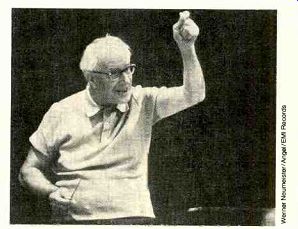
EUGEN JOCHUM: vital performances of Mozart's festive music
...seems illumined only by a dim lamp in a musty scholar's cell. The orchestra plays beautifully, the sound is even better than Telefunken's, but neither element helps vivify the performance of K. 503, which is so much better served by Ivan Moravec on Van guard, Barenboim in his self-conducted re make on Angel, and Stephen Bishop on Phil ips, among others.
R.F.
MOZART: Thamos, King of Egypt: Entr'actes and Choruses (K. 345). Charlotte Lehmann (soprano); Rose Scheible (alto); Oly Pfaff (tenor); Bruce Abel (bass); Heilbronn Vocal Ensemble; Wurttemburg Chamber Orchestra, Heilbronn, Jorg Faeber cond. TURNABOUT QTV-S 34679 $3.98.
Performance: Effective
Recording: Good
Mozart's incidental music for Thamos, King of Egypt had its beginnings in two choruses written in 1773 for Tobias Gebler's now obscure drama. The newly composed Symphony No. 26, in E-flat, evidently served as overture. Then a well-known company elicited from Mozart five entr'actes and a final chorus for a 1779 performance in Salzburg. Perhaps because of its Eastern aspect, some commentators have seen in the Thamos music anticipations of The Magic Flute, but I find the music more akin to the grander moments of Idomeneo, which was composed only a year after the later version of the Thamos score. In any event, Thamos is far from negligible Mozart.
The dramatic Act IV entr'acte and the final chorus with its imposing bass solo, excellently rendered here by Bruce Abel, are particularly fine, and at $3.98 this recording represents good value. For those who want a some what more polished version that includes the symphony-overture, I recommend the full-price Philips disc with Berlin vocalists and orchestra under Bernhard Klee.
-D.H.
RECORDING OF SPECIAL MERIT
OFFENBACH: La Perichole. Regine Crespin (soprano), La Perichole; Alain Vanzo (tenor), Piquillo; Jules Bastin (bass), Viceroy of Peru; Gerard Friedmann (tenor), Count Panatellas; Jacques Trigeau (baritone), Don Pedro; Re becca Roberts (soprano), Guadalena; Eva Saurova (soprano), Berginella; Genevieve Baudoz (mezzo-soprano), Mastrilla; others. Strasbourg Philharmonic Orchestra; Chorus of the Opera du Rhin, Alain Lombard cond. RCA FRL2-5994 two discs $15.98, FRK2-5994 $15.98.
Performance: Good
Recording: Very good
Thanks mainly to Maggie Teyte and Jennie Tourel, the vocal highlights from Offenbach's La Perichole have long been around in model interpretations. Now, at last, we have the en tire delectable score on records. This RCA re lease (licensed from the French Erato firm), which substitutes a spoken narrative for the dialogues, is not an ideal production, but it is smoothly professional and works up to a point. Musically, I have no real complaints.
Regine Crespin is a wise, saucy, sexy Perichole, and her mastery of the classic operetta style is absolute. Vocally, too, she is in good form, though not as free, relaxed, and tonally malleable as she would have been had this laudable project been undertaken ten years ago. Alain Vanzo is a near ideal Piquillo, and Jules Bastin, who interprets the Viceroy straight, without any buffo monkeyshines, is satisfactory. Supporting singers, chorus, and orchestra are shaped into a lively, zesty ensemble by conductor Lombard-the whole thing moves with spirit and charm.
I recommend the set, which comes with a good libretto and excellent annotations by Richard Traubner. But those fortunate enough to own a Pattie import of some twenty years ago, conducted by Igor Markevich, are urged not to surrender it, for it has strengths of its own and, in retaining some of the dialogue, offers more authentic continuity.
G.J.
-------------------
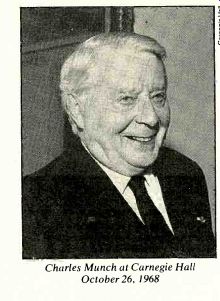
Charles Munch at Carnegie Hall October 26, 1968
A Munich's Bizet Symphony CHARLES MUNCH, who died a little less than ten years ago while touring this country with the Orchestre de Paris that was created for him, made as many as four recordings each of the Berlioz and Ravel works with which his name is most closely associated.
Some of his best work for the phonograph, however, is still unknown to many collectors, for it was neither Berlioz nor Ravel but the Bizet Symphony in C and the Tchaikovsky Francesca da Rimini that he did in London with the Royal Philharmonic Orchestra for the Reader's Digest mail-order series taped by RCA. These performances-most enthusiastically reviewed in these pages by Martin Bookspan in November 1965-have just been put into general circulation on a low-price Quintessence disc. It is high time, too, for they are simply stunning-outstanding in every respect.
This was the second of Munch's three recordings of the Bizet symphony (not his first, as stated in the review quoted on the liner), and it is by all odds the brightest, most effervescent, and most elegant account of the work yet committed to disc. The performance goes with a winged spontaneity that makes it downright irresistible-altogether more infectious than Munch's by no means unattractive subsequent version on Nonesuch H-71183.
The Royal Philharmonic here sounds more stylish than the Orchestre National on that disc, and the sound itself, for all its fifteen years, is at least as good as that of any other recording of the symphony.
THE delicious, youthful Bizet and Francesca da Rimini may seem to be an odd couple, but the Tchaikovsky performance is a similarly exceptional one measured not only against Munch's own earlier Boston version (Victrola VICS- I 187), but against the finest offered at any price. It is informed with breadth, grandeur, and even dignity, as well as the most compelling tension and excitement. Here again the orchestra is with Munch all the way, and not a single detail of the fine playing is lost in the crisp, full-bodied recording-said to have been made, by the way, in a single take without any splicing. Forget about duplication problems: this disc will spend as much time on the turntable as on the shelf.
-Richard Freed
BIZET: Symphony in C Major.
TCHAIKOVSKY: Francesca da Rimini, Op. 32. Royal Philharmonic Orchestra, Charles Munch cond. QUINTESSENCE PMC 7048 $3.98.
----------------
Horenstein cond. QUINTESSENCE PMC 7051, $3.98.
Performance: Ebullient
Recording: Excellent
Strauss waltzes are harder to bring off in performance than their airy melodies and straightforward style might lead one to think.
A band in a park might get away with a rigid, pounding run-through of the Blue Danube on a sunlit spring day, and a ballroom orchestra need only keep to the beat. But a symphony orchestra demanding an audience's full attention in a concert hall-or on records-cannot get by so easily. It takes a special combination of elegance, flexibility, and respect for the effervescent quality of this music to bring it off.
This recording by the late Jascha Horenstein is brisk and at times too brassy, but for the most part it displays a splendid lilt, and such things as the lovely pastoral introduction (complete with zither solo)' to Tales from the Vienna Woods have their full effect. The introduction to Wine, Women, and Song is for a change played complete, for which I am grateful, but it would have been still more re warding had that section been sung by a male choir-as it was originally intended to be and almost never is. The surfaces on my copy of the bargain Quintessence pressing, by the way, are absolutely flawless.
-P.K.
VIVALDI: Gloria; Magnificat (see Best of the Month, page 75) WESLEY: Symphony in D Major (see ARNE)
COLLECTIONS RECORDING OF SPECIAL MERIT
TOM BUCKNER AND JOSEPH BACON: Wandering in This Place. Dowland: I Saw My Lady Weep; Sorrow, Stay!; If My Complaints Could Passion Move; Flow Not So Fast, Ye Fountains; Awake Sweet Love; When Phoebus First Did Daphne Love; Can She Excuse My Wrongs; The Frog Gaillard; Tarleton's Resurrection; Lachrimae Pavan. Morley: Can I Forget What Reason's Force Imprinted in My Heart. Campion: Beauty, Since You So Much Desire. Cavendish: Wandering in This Place. Bartlet: Unto a Fly Transformed from Human Kind. Tom Buckner (voice); Joseph Bacon (lute). 1750 ARCH 1757 $6.98.(plus 750 handling charge from 1750 Arch Records, 1750 Arch Street, Berkeley, Calif. 94709).
Performance: Pleasant
Recording: Fine
The Elizabethan lute song is an art form that was intended mainly for the enjoyment of the performer and those few people who happened to be around to hear him. It suffers in the concert hall and other formal presentations, but it thrives in such intimate surroundings as private rooms, taverns, and shady lawns. Messrs. Buckner and Bacon have somehow managed to capture this atmosphere on their disc of songs and solo lute pieces. Buckner's voice (he refuses to call it by its range) is light and has limitations, but his simplicity of style and poetic sensibility more than make up for whatever is lacking.
The approach is perfect for this repertoire, which he projects far better than most highly trained operatic or 'leder singers could. We need this type of "amateur performance" (in the highest sense of that term) because it presents such music on its own terms, thereby solving problems of performance practice that to this day baffle musicologists and highly professional musicians alike.
S.L.
RECORDING OF SPECIAL MERIT
MARIA CHIARA: Verismo Arias. Cilia: Adriana Lecouvreur: Josono l'umile ancella; Poveri fiori. Giordano: Andrea Chinier: La mamma morta. Mascagni: L'Amico Fritz: Son pochi fiori; Non mi resta. Iris: Ho fatto un triste sogno; Un di ero piccina. Leoncaval lo: Pagliacci: Qual fiamma avea nel guardo.
Catalani: La Wally: Ebben? neandro lontana; Ne mai dunque avro pace. Loreley: Amor, celeste ebbrezza. Maria Chiara (soprano); National Philharmonic Orchestra, Kurt Herbert Adler cond. LONDON OS 26557 $7.98.
Performance: Warm and polished
Recording: Very good
"Verismo Arias" must be taken as a convenient catchall phrase in this instance. All seven operas represented here do date from the years (1891-1902) when verismo flourished, but neither Catalani nor Cilea were "veristic" composers, and L'Amico Fritz was, if any thing, a Romantic antidote to Mascagni's trailblazing Cavalleria Rusticana.
This bit of history aside, compliments are in order for the interesting sequence as well as for its winning execution. Maria Chiara's first record recital (London OS 26262), though auspicious, went largely unnoticed; now that the soprano has appeared successfully with both the Chicago Lyric and the Metropolitan, this one should attract more attention, and deservedly so. Chiara is obviously a finished artist with a solid technique that enables her to use an intrinsically warm and appealing voice artistically and expressively. Hers is a lyric sound: the Andrea Chinier aria, though exquisitely vocalized, lacks the required despair and intensity. Also, on a recital of this kind, involving a sequence of arias cast in a similar mold, a certain sameness becomes unavoidable. Still, she is a major vocalist, and she is undoubtedly capable of revealing more individuality in a theatrical context.
The orchestral backgrounds are discreet but well executed. The sound is plush, with some intruding pre-echoes.
-G.J.
---------
Disc and tape compared RCA's Opera Cassettes
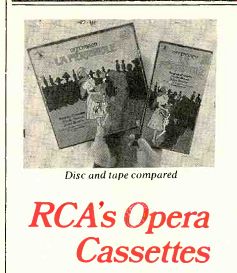
WE keep reading that Philips' mono baby, the cassette, "is coming of stereo age," but I think the time has already come when everyone must agree that the cassette is unmistakably a hi-fi medium. The last holdout of the major manufacturers, RCA Red Seal (they finally "went Dolby" only last year), also says so with the release of eight (more to come) complete operatic works in splendidly packaged, Dolby-processed cassette sets that include full librettos. Some are from the latest release sheets and at least one goes back al most two decades.
That one. Puccini's Turandot with Nilsson, Tebaldi, Bjoerling, and Tozzi, would have to be on my list of the greatest recordings of all time. It is a performance that's difficult to equal. The sound was always ahead of its time, and it still holds up as a great achievement. In fact, I have for years used the RCA open-reel version of this recording to demonstrate my sound system. For the cassette/disc comparison I had only an original pressing, which was not, even after twenty years of loving care, in the best condition. But I can not see how even a brand-new pressing could better the excellent sound that comes from this cassette set.
Another oldie-but-goodie is the Madama Butterfly with Price, Elias, Tucker, Maero, and Leinsdorf, recorded, like the Turandot, with the RCA Italiana Orchestra. The review cassettes are a great improvement over the original Dynagroove pressing despite the.
(very) slight flutter on the first cassette. And, of course, the singing of the Leontyne Price of the early Sixties is ravishing.
The recording of La Traviata with Moffo, Tucker, Merrill, and Previtali conducting the Rome Opera House Orchestra was for years my favorite stereo version. I came to it years ago as a reel-to-reel recording and was troubled by some overloading in the tape. RCA in formed me that the master tape was thus marred, and there was nothing to do about it.
Well, it's still true-but it still doesn't matter, and it's still my favorite stereo Traviata. The cassette version is bright, but it seems to have a slight low-frequency-noise content. Tosca with Price, Domingo, Milnes, and Mehta con ducting the New Philharmonia Orchestra is a toss-up. Both disc and cassette have a slight hiss, which makes me think that perhaps the trouble is in the master tape. The voices on the cassette seem more forward, but the brasses on the disc had better bite. La Boheme is an excellently engineered cassette set, clean and very quiet (thank heaven for Dolby).
The last three cassette sets are among RCA's latest releases, and all are simply extraordinary. Perhaps the fact that the original tapes were Dolby-processed had something to do with it. Andrea Chenier (Domingo, Scotto, Milnes, and Levine conducting the National Philharmonic Orchestra) is a wonderful opera full of big moments. The cassette version seemed cleaner to me than the records, and it handled all the climaxes well. And what climaxes! (Try the final ten minutes of this opera for an Italian Liebestod.) Recorded climaxes are not wanting in Verdi's Requiem either. Here Solti leads his Chicago Symphony Orchestra, Price, Baker, Luchetti, and Van Dam in the muscular reading of the music we have learned to expect from him. RCA has captured the sound with a realistic, thrilling ambiance. The cassette format with its Dolby processing was happily without hiss in the ever-so-quiet soft parts, and it held up extremely well in a direct comparison to the disc version during the cataclysm of the Dies Irae. The bass drum is especially well re corded. Let me put it baldly: this set represents the current state of the art of the commercial cassette.
I did not have the disc version of La Perichole (Crespin, Vanzo, Bastin, and Lombard conducting the Strasbourg Philharmonic Orchestra) at hand to compare, but I can say that the cassette set sounded. very clean, very bright, very French, and very right.
-Edward Buxbaum
PUCCINI: Turandot. Nilsson, Tebaldi, Bjoerling, Tozzi; Rome Opera House Orchestra, Leinsdorf cond. RCA ARK3-2537 three cassettes $23.94.
PUCCINI: Madama Butterfly. Price, Elias, Tucker, Maero; RCA Italiana Orchestra, Leinsdorf cond. RCA ARK3-2540 three cassettes $23.94.
VERDI: La Traviata. Moffo, Tucker, Merrill; Rome Opera Orchestra, Previtali cond. RCA ARK3-2538 three cassettes $23.94.
PUCCINI: Tosca. Price, Domingo, Milnes; New Philharmonia Orchestra, Mehta cond. RCA ARK2-0105 two cassettes $15.96.
PUCCINI: La Boheme. Caballe, Blegen, Domingo, Milnes; London Philharmonic Orchestra, Solti cond. RCA ARK2-0371 two cassettes $15.96.
GIORDANO: Andrea Chenier. Domingo, Scotto, Milnes; National Philharmonic Orchestra, Levine cond. RCA ARK3-2046 three cassettes $23.94.
VERDI: Requiem. Price, Baker, Luchetti, Van Dam; Chicago Symphony Orchestra, Solti cond. RCA ARK2-2476 two cassettes $15.96.
OFFENBACH: La Perichole. Crespin, Vanzo, Bastin; Strasbourg Philharmonic Orchestra, Lombard cond. RCA FRK2-5994 two cassettes $15.96 (reviewed on page 91).
-----
Also see: POPULAR DISCS and TAPES
Source: Stereo Review (USA magazine)