Reviewed by: RICHARD FREED DAVID HALL GEORGE JELLINEK PAUL KRESH STODDARD LINCOLN ERIC SALZMAN
ANTHEIL: Ballet Micanique; A Jazz Symphony; Violin Sonata No. 1, Finale; Violin Sonata No. 2. Vera Beths (violin); Reinbert de Leeuw (piano); Netherlands Wind Ensemble, Reinbert de Leeuw cond. TELEFUNKEN AW 6.42196 $7.98.
Performance: Lively
Recording: Good location job
The music of George Antheil's "radical chic" period has acquired a decidedly new element of interest today, not only in the light of what has been going on in contemporary music for the past twenty years, but more especially in the light of what we now know of the work of Charles Ives. For in the Second Violin Sonata and the Jazz Symphony, elements of Ivesian collage technique and populist parody are very much present-though there is no reason to believe that Antheil had any significant contact with Ives' work. If one must speak of influences in the early Antheil works, they are clearly those of Stravinsky and of pop mu sic-jazz, cabaret, and carnival (as in the use of the "hootchy-kootchy" dance motif in the Second Violin Sonata, where the populist elements are most prominent). Stravinskian gesture and motoric aspects dominate the finale of the Violin Sonata No. 1 and the one-time notorious Ballet Mecanique composed for Fernand Leger's abstract film.
The Jazz Symphony and chamber duos come off brilliantly in both sound and performance in this recording, which was apparently (to judge from the audience applause) taped live at the 1976 Holland Festival. I am less impressed by the Ballet Mecanique here, which is taken at a fast clip that loses detail and dam ages musical coherence-at least when com pared with the still excellent (and available from Columbia Special Products) 1955 mono recording conducted by Carlos Surinach, which had the composer's blessing. It also is worth noting that all three of the Antheil violin sonatas are available in their entirety on the Orion label. D.H .
-------------
Explanation of symbols:
= reel-to-reel stereo tape
= eight-track stereo cartridge
= stereo cassette
= quadraphonic disc
= reel-to-reel quadraphonic tape
= eight-track quadraphonic tape
Monophonic recordings are indicated by the symbol
The first listing is the one reviewed; other formats, if available, follow it.
-------------
J. S. BACH: Sonatas and Partitas for Unaccompanied Violin (see Best of the Month, page 86) BEETHOVEN: Soprano Arias (see Collections-Janet Baker) BOITO: Mefistofele: Prologo (see Best of the Month, page 85) BRAHMS: Piano Concerto No. 2, in B-flat Major, Op. 83. Maurizio Pollini (piano); Vienna Philharmonic Orchestra, Claudio Abbado cond. DEUTSCHE GRAMMOPHON 2530 790 $8.98, 3300 790 $8.98.
Performance: Brilliant but cool
Recording: Excellent
I get the feeling from this reading of the mighty Brahms B-flat that the performers were attempting an amalgam of Horowitz/ Toscanini brilliance and Curzon/Szell monumentality. Certainly the musical texture achieved both in Pollini's limpid pianism and in Abbado's sharply etched treatment of the orchestral score has something in common with the Horowitz-Toscanini approach, but the broad tempos taken here make for a quite different end result. It is something that I can describe only as a cold, intense light without much of the romantic glow that I feel is inherent in the music. This is definitely one of the "different" readings of the B-fiat Concerto.
The recorded sound as such is fine, but it is unfortunately marred in my review copy by a great deal of surface noise-swishes, pops, and clicks-throughout the first couple of inches of each side. D.H.
RECORDING OF SPECIAL MERIT
BRIAN: Symphony No. 6 ("Sinfonia Tragica"); Symphony No. 16. London Philharmonic Orchestra, Myer Fredman cond. HNH 4029 $7.98 (available from HNH Distributors, Ltd., P.O. Box 222, Evanston, Ill. 60204).
Performance: Expert
Recording: Splendid
Quantitatively speaking, England's Havergal Brian out-produced even Nikolai Miaskovsky in the category of the symphony and outdid both Verdi and Jangek in terms of productive old age. An eruption of creative energy came over him as he entered his seventy-third year and drove him until his death in 1972 at the age of ninety-six: in those two dozen years he composed four operas and no fewer than twenty-seven symphonies-the last seven, which brought his total to thirty-two, after he turned ninety. Most of these symphonies, including the two on this disc (written at ages seventy-two and eighty-four, respectively), are in one movement. All are in a highly personal language-concentrated, intense, and to a greater or lesser degree tragic in character (in this respect Brian has been spoken of as "an English Shostakovich").
This music is not everyone's cup of tea, but those who respond at all are likely to take it to their hearts with special enthusiasm, as Myer Fredman has surely done to judge from the expert, thoroughly convincing performances he draws from the London Philharmonic.
These are the same performances (recorded by Lyrita) that were issued about a year ago by the Musical Heritage Society (MHS 3426), but they have greater impact here because of the more transparent quality of the sound another triumph for mastering engineer Robert Ludwig-and the absolutely silent surfaces HNH continues to offer with astonishing (but gratifying) consistency. Indeed, listeners who do not respond to the Brian idiom may enjoy using this splendid disc to show off their audio rigs. R.F.
BRUCKNER: Symphony No 9, in D Minor. Chicago Symphony Orchestra, Carlo Maria Giulini cond. ANGEL SQ-37287 $7.98.
Performance: Good-natured
Recording: Good
This is a warm, good-natured, and almost gentle performance of what seems nowadays to be Bruckner's most often performed (dare one say most popular?) work. The music, the great adagio in particular, has many charms in this reading, and it is beautifully played and well recorded. On the other hand, if you consider this epic music-a sort of offspring of Beethoven's Ninth and Das Rheingold (and Parsifal!)-then you may find the first movement a bit wanting. E .S .
CAGE: Sonatas and Interludes for Prepared Piano; A Book of Music for Two Prepared Pianos. Joshua Pierce and Maro Ajemian (pianos). TOMATO 2-1001 two discs $10.98.
Performance: Well prepared
Recording: Very pleasant
John Cage has been America's premier enfant terrible for so long-forty years at least-that it is hard to remember that he didn't appear out of nowhere. His background and early work are closely related to major involvements in percussion, in Oriental music, and in numerology that have characterized important aspects of American music since the 1930's. One of Cage's early and distinctive contributions to this repertoire was his invention and use of the so-called prepared piano.
The set of twenty Sonatas and Interludes, written between 1946 and 1948 and first played by Maro Ajemian, are the best-known prepared-piano music. Sometimes referred to as the "III-Tempered (or Well-Tampered) Clavichord," this music is actually gentle in sound with simple, exotic exteriors and a complicated rhythmic numerology underneath. The pieces are performed persuasively here by Joshua Pierce.
The hypnotic early percussion style of Cage, Henry Cowell, Lou Harrison, Harry Partch, and others has reappeared in the con temporary pulse-and-cycle music of such composers as Phil Glass, David Borden, and Steve Reich. This line of connection is apparent in A Book of Music, a still earlier work for two prepared pianos. Whereas the Sonatas and Interludes are rather quirky and modern-
music-sounding in a quiet Zen way, A Book of Music is much closer to Eastern sources and, at the same time, to those contemporary minimal musics now much in vogue. Most listeners, myself included, will prefer A Book of Music, less "original" though it may be, to the later set; it sounds better and it coheres better. Actually, if you can tune in to this miniature universe of pings, bongs, and blonks, any of it can exert a kind of spacy, mindless charm.
Joshua Pierce is a persuasive young musician; he joins Maro Ajemian, long identified with this music, in the Book. Tomato Records (a name new to me) wraps its discs in brown-bag paper marked "Quality Produce"! The outer sleeve and the recordings inside are more conventional and very well produced.
E.S.
RECORDING OF SPECIAL MERIT
CHARPENTIER: Louise. Beverly Sills (so-
Mignon Dunn (mezzo-soprano), Mother; Jose van Dam (bass), Father; Eliane Lublin (mezzo-soprano), Irma; Martyn Hill (tenor), Noctambulist and Pope of Fools; Jacques Mars (bass), Rag and Bone Man; others. Chorus and Orchestra of the Theatre National de l'Opera, Julius Rudel cond. ANGEL SCLX-3846 three discs $24.98.
Performance: Good
Recording: Good
As Andrew Porter observes in his excellent annotations for this release, Louise was a success from the start, and by 1856, the year of Charpentier's death, it reached its one-thousandth performance at the Opera Comique.
Unfortunately and mysteriously, relatively little has happened to Louise since then. With the close of the venerable Opera Comique, this operatic glorification of Paris seems to have disappeared from the city that inspired it. The Metropolitan dropped it from its repertoire after 1948. There was a San Francisco staging in 1968, and there have been several revivals by the New York City Opera, which undoubtedly provided the impetus for this new recording with Beverly Sills and Julius Rudel.
The appearance of two recorded versions of Louise within a year of each other (see re view in February 1977 of Columbia M3 34207 with Deana Cotrubas and Placido Domingo, conducted by Georges Pretre) stands in dramatic contrast to more than twenty years of neglect. Both versions are substantial and, in the main, enjoyable.
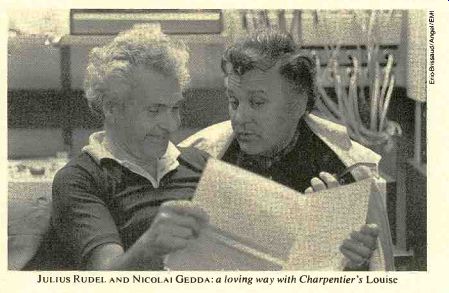
Louise is quite a singular French attempt at verismo with romantic touches. It juxtaposes romantic yearnings and domestic squabbles, combines melodic declamation with short but telling motivic reiterations and occasional arioso expansions, and mixes realistic and impressionistic gestures. It is not an easy opera to hold together effectively, but both conductors meet the challenge laudably. My preference for Rudel is dictated by his obviously loving way with this music, his unhurried savoring of its beauties. He is supported by a technical production that is more successful than Columbia's in achieving a good sonic balance between the diverse elements, though Columbia's sound per se is warmer.
------------------
Spanish Song: Teresa Berganza
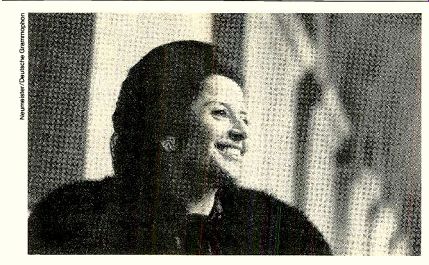
IT was only last month that I noted with de light the parallel releases of Manuel de Falla's Siete Canciones Populares Espanolas by Conchita Supervia and Victoria de los Angeles. Now comes Teresa Berganza with a third, this one with guitar accompaniment.
The combination is a natural one, since the original piano writing is full of guitar-like pat terns, though ears accustomed to the piano sound may find that some guitar figurations in the accompaniment sound awkward. Berganza sings with characteristic warmth and elegant phrasing, pouring out voluptuous tones in an irresistible flow and allowing the emotions of the clearly realized text to speak for themselves without excessive outbursts of passion.
The real find here, however, is the Garcia Lorca collection: thirteen songs obviously patterned on Falla's. Like Falla's, Garcia Lorca's songs are predominantly folk-based and artfully harmonized, taking on the characteristics of various Spanish regions. They include dance tunes, cradle songs, love songs, even a bullfight melodrama in which Narciso Yepes delivers a moving narration over his own subtle guitar accompaniment. The catchy La Tarara is identified as the source of El Corpus en Sevilla in the Iberia suite of Albeniz, but nothing is said in the flowery but uninformative notes about the obvious relation ship between Falla's Cancion and Garcia Lorca's Los Pelegrinitos.
This is a beautiful program, hauntingly per formed. There are some strophic songs which carry the threat of sameness despite their harmonic changes, so I recommend listening to all the songs in one sitting only if you have a natural fondness for the Spanish idiom. I was enthralled by it.
-George Jellinek
FALLA: Siete Canciones Populares Espmiolas.
GARCI A LORCA: Trece Canchines Espaiiolas Antiguas. Teresa Berganza (mezzo-soprano); Narciso Yepes (guitar). DEUTSCHE GRAMMOPHON 2530 875 $8.98, 3300 875 $8.98.
---------------------
In many ways, Beverly Sills and Nicolai Gedda are ideal interpreters of their parts, but they should have been given this opportunity years ago. Both effortlessly and convincingly offer individualized portrayals. Surely the Louise of Miss Sills is far more three-dimensional than the admittedly touching and neatly vocalized effort of Ileana Cotrubas. But the wide vibrato that afflicts Sills' tone these days is a serious detriment. For Nicolai Gedda, the tessitura of Julien's part presents no problems, but his tone has lost much of its erst while sensuous appeal. That Placido Domingo commands in abundance; what he lacks is Gedda's natural Gallic affinity and pointed pronunciation.
Jose van Dam is superb as the Father, convincing in rage as well as tenderness. His mellow, firmly centered tones embrace the range effortlessly and with moving expressiveness, undaunted by the high extension of his music.
This is the most successfully realized role in the two sets, and Van Dam is distinctly supe rior to his otherwise first-rate counterpart, Gabriel Bacquier. The two Mothers are about equal: Mignon Dunn is effective in her shrew ish scenes, but gives more listening pleasure in her quieter, cantabile moods.
Where the Angel set falls down (not that Columbia's is notably better) is in casting the many supporting parts that are suppposed to lend this opera its unique atmosphere. Un doubtedly we cannot expect star singers in bit parts, but such roles as the Noctambulist and the Pope of the Fools (usually doubled), the Rag and Bone Man, and Louise's seamstress companions make important contributions at certain moments--and in this instance I recall nothing that rises above mediocrity. There are no disasters, but neither is there any suggestion of magic.
This lengthy opera (more than three hours) is given here virtually complete, with a few insignificant cuts, on three discs encased in a beautifully produced album. I recommend it, though with the above reservations. G .J
RECORDING OF SPECIAL MERIT
CHOPIN: Waltzes, Op. 64, Nos. 1, 2, and 3; Polonaise-Fantaisie, Op. 61; Nocturnes, Op. 62, Nos. 1 and 2; Barcarolle in F-sharp Minor, Op. 60; Mazurkas, Op. 63, Nos. 1, 2, and 3; Mazurkas, Op. 67, Nos. 2 and 4; Mazurka, Op. 68, No. 3. Vladimir Ashkenazy (piano). LONDON CS 7022 $7.98.
Performance: Chopin at his best
Recording: Lush, unreal
All the music on this disc dates from the very end of Chopin's short life, and, not surprisingly, it is permeated with melancholy and brooding introspection. Ashkenazy may be the best Chopinist around these days-per haps it takes a Slav to know one. He has just enough of the old free style to make us feel the intensely personal quality of the expression, but not so much rhetoric as to make us disbelieve. The piano sound is lush, very seductive. and, I must say, a bit unreal. E.S.
-------- JULIUS RUDEL AND NICOLAI GEDDA: a loving way with Charpentier's Louise.
COPLAND: Passacaglia; Piano Variations; Piano Fantasy; Night Thoughts-Homage to Ives. Charles Fierro (piano). DELOS DEL-25436 $7.98.
Performance. Good
Recording: Good
Aaron Copland's quantitatively modest but musically impressive output for piano has fared well on disc over the years, beginning with his own 1931 Columbia discs of the Piano Variations and culminating in the 1960 William Masselos Columbia disc of the monumental Piano Fantasy. Since then, a younger generation has been essaying the Copland piano repertoire for discs, and, as evidenced by Robert Silverman's work on the Orion label and by Charles Fierro's on the present Delos release, with very considerable success.
Mr. Fierro offers a disc premiere of the 1973 Night Thoughts, which Copland com posed for the Van Cliburn Competition. As its "Homage to Ives" subtitle indicates, it contains elements of dissonance and bell-sonority strongly evocative of that New England master. yet it remains quintessentially Copland.
The early-Passacaglia sounds a mite ponderous for my taste in this performance, bu
---------------------
Archive Piano Recordings in Near Miracles of Restoration
----------- Josef Hofmann Sigismond Stojowski Percy Grainger.
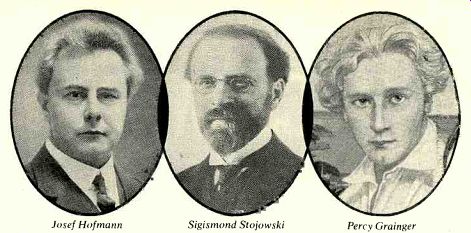
AVID collectors of piano recordings will undoubtedly experience the same pulse-quickening that I did in greeting the latest is sues, via Desmar, from that most important keyboard repository, the International Piano Archives. Hofmann, Grainger, Stojowski, Renard, and so on are no longer, of course, names in the public eye, but they do represent a past level and style of performance that many knowledgeable critics consider unsurpassed even by today's jet-fingered virtuosos.
In some cases the performers on these discs are linked with an even more distant past: Josef Hofmann was taught by Anton Rubin stein, Percy Grainger coached with Grieg, Sigismond Stojowski's teachers included Louis Diemer, Leo Delibes, and Paderewski, while his acquaintances included Franck, Brahms, and Tchaikovsky. Of course, the collector of such historical issues will already have steeled himself to reproduction that is a far cry from today's advanced technology. One must listen through a good deal of sonic cloudiness, scratch and swish, and attenuated highs and lows in order to penetrate to this older world. It must be said, however, that the IPA has worked some near miracles in making the best of its variable sources.
Regrettably, the worst-sounding item in Volume I of "Landmarks of Recorded Pian ism," a stupendous sampler containing one pianistic gem after another, is the only known recording by Johannes Brahms. Made in 1889 in Vienna on an Edison cylinder (as a greeting to the inventor), this nearly inaudible and abreviated Hungarian Dance No. 1 does, after repeated hearings (because one simply cannot catch it the first few times), display a certain gusto and panache. Also, rather more clearly than any of the music, one can hear the high pitched voice of the composer introducing himself. Fortunately, the remainder of this important collection contains some far better-
sounding selections: a Brahms pupil, Ilona Eibenschtitz, playing two of that composer's Op. 39 waltzes with charm and a refreshing lack of sentimentality; Grieg and Debussy playing their own works, the former the close of the Op. 7 sonata and the latter (with Mary Garden) in a tantalizingly brief Pelleas excerpt that conveys the veiled atmosphere of his playing style much more effectively than the deceptive piano rolls; a sixty-nine-year-old Saint-Saens dazzling the ear with an improvised cadenza for his "Africa" fantasy. Of famous pianists performing the works of others, there are five previously unissued items: Paderewski and De Pachmann in Chopin nocturnes, Godowsky in an extremely exciting Chopin Scherzo No. 2, Hofmann's tour de force La Campanella, and a superb Liszt Rakoczy March by Grainger. Together with a handful of other rarities, including four 1921 sides by Josef Lhevinne, these comprise a veritable feast, though one that has a few sonically indigestible moments.
Josef Hofmann's career had many supreme highlights, including a concert in the Metropolitan Opera House on November 28, 1937, celebrating the golden anniversary of the pianist's American debut at the age of ten.
It was, fortunately, recorded, first issued (but only in part) by Columbia in the early Fifties, and then released complete in 1971 by the International Piano Library (now Archives).
The complete concert has now been reissued in a version marginally superior sonically to its predecessor. I think it gives clearer evidence than any other recording of why many critics consider Hofmann the pianist of his age. There is, first of all, the Fourth Concerto by his teacher, Anton Rubinstein, in a performance that is quite simply magnificent. Then there are all the solo pieces, including a large Chopin group and a largesse of encores, all played with the pianist's blend of utter delicacy, heaven-storming fortissimos, and mercurial finger-work, and all seemingly effortless. If you want to know what all the fuss was about regarding Hofmann's pianism, this is the al bum to obtain.
The interpretive, rhythmic, and dynamic leeway that Hofmann allowed himself in actual concert was quite properly more restricted in the smaller confines of the recording studio; in the relatively few commercial recordings that he made, most of them pre-electrical, the performances are overall less indulgent and more tightly controlled. Those he made in 1923 for the Brunswick company are among the most important, and they include some marvelous examples of the pianist's art, such as a gorgeous Rubinstein Melody in F, some Rachmaninoff to rival that composer's own versions, and some stunning Chopin and Liszt. The reproduction is just a bit warmer in the bass than IPL's previous issue a few years ago; though the source was acoustic, it now sounds more than acceptable.
THE Rosita Renard Carnegie Hall recital of January 19, 1949, once available as an early privately issued LP, has been an underground item for some time now, and it is good to have the work of this little-known Chilean pianist (1894-1949) available for larger numbers to hear. Like her countryman Claudio Arrau, Renard was a student of Liszt's pupil Martin Krause. She began her career as a prodigy.
From the 1920's until the late Forties, how ever, that career suffered an eclipse, and it was not until a few years before she died (from a strain of sleeping sickness) that she was again establishing herself as one of the more important pianists of the first half of this century. Not everything on these four sides is extraordinary, but when Renard is at her best-as in the riveting Mozart sonata, the majority of the Chopin etudes, the Mendelssohn variations (which in excitement can stand comparison with the Horowitz and Larrocha recordings), and the charmingly playful
Ravel Valses Nobles et Sentimentales-her performances show commanding skill and dashing impetuosity.
Sigismond Stojowski (1870-1946), in his time well known as a composer before concluding his career as a highly respected teacher (his students included Arthur Loesser and Antonia Brico), made very few commercial discs. One of these was a rather dim 1916 Chopin waltz (Op. 34, No. 1); the remaining Chopin, Paderewski (Legende, Op. 16, No. 1), and Stojowski items included here derive from early 1940's broadcasts. They all reveal an excellent verve and a somewhat blustery and idiosyncratic way with the music that at times precludes delicacy (the four Chopin mazurkas. for example), but together they give a clear impression of this pianist's individuality. Luisa Stojowska, his widow, fills out the second side with affectionate readings (re corded recently in stereo) of six of his salon pieces.
FINALLY, there is the historically fascinating record of Grieg works played by Percy Grainger, including two different noncommercial recordings of the piano concerto, a 1908 recording of just the cadenza (made ten months after he had studied the work with Grieg), and three of the Norwegian Folk-songs, poorly recorded in 1950 on an out-of-tune piano. The concerto was, of course, a Grainger specialty, and it is incomprehensible that the pianist was never able to interest a company in recording it commercially. The present performances-the first recorded July IS, 1945, with Leopold Stokowski and the Hollywood Bowl Symphony, the second on October 27, 1956, with the very amateurish Southeast Iowa Symphony Orchestra direct ed by Richard A. Morse-both reveal Grainger's total identification with and ability to project this score. There is nothing shy about his playing, but in addition to the vitality there is also a wonderfully poetic streak. Neither performance is note perfect (the second is perhaps better in this respect), and yet a spirit emerges that one seldom hears in today's more polished readings. (I am still most thrilled by Grainger's 1957 Danish version of the concerto, but a recording of that live performance was never issued in any form precisely because of the plethora of errors.) Perhaps IPA would now do us all a favor by reissuing the Grainger electrical recordings from the late Twenties and early Thirties, especially the Schumann pieces, the Bach transcriptions, and the Brahms Op. 5 sonata. With these available, it would be even clearer what an extraordinary pianist Grainger really was!
-Igor Kipnis
LANDMARKS OF RECORDED PIANISM, VOLUME 1. Brahms: Hungarian Dance No. 1, in G Minor. Johannes Brahms. Waltz in E Major. Op. 39, No. 2; Waltz in A-flat Major, Op. 39, No. 15. Ilona Eibenschtitz. Grieg: Sonata in E Minor, Op. 7, Finale. Edvard Grieg. Saint-Saens: Improvised Cadenza for " Africa." Camille Saint-Saens. Debussy: Pelleas et Milisande: Mes longs cheveux. Claude Debussy (piano); Mary Garden (soprano). Liszt: Hungarian Rhapsody No. 2. Arthur Friedheim. Rakoczy March. Percy Grainger. Paganini/Liszt: La Campanella. Josef Hofmann. Chopin: Waltz in D-flat Major, Op. 64, No. 1 ("Minute"). Alexsander Michalowski. Nocturne in F Minor, Op. 55, No. 1. Vladimir de Pachmann. Nocturne in F Major, Op. 15, No. 1. Ignacy Jan Paderewski. Scherzo No. 2, in B-flat Minor, Op. 31. Leopold Goldowsky. Schumann/Tausig: El Contrabandista. Beethoven/Busoni: Ecossaises. Tchaikovsky: Tre pak, Op. 72, No. 18. Rachmaninoff: Prelude in G Minor, Op. 23, No. 5. Josef Lhevinne. DESMAR IPA 117 $7.98.
JOSEF HOFMANN: Golden Jubilee Concert. Brahms: Academic Festival Overture. Rubin stein: Piano Concerto No. 4. in D Minor, Op. 70. Chopin: Ballade No. 1, in G Minor, Op. 23; Nocturne in E-flat Major, Op. 9, No. 2; Waltz in A-flat Major. Op. 42; Andante Spianato and Grande Polonaise Britlante in E-flat Major. Op. 22; Nocturne in F-sharp Major, Op. 15, No. 2; Waltz in D-flat Major, Op. 64, No. 1; Etude in G-flat Major, Op. 25, No. 9; Berceuse in D-flat Major, Op. 57. Hofmann: Chromaticon for Piano and Orchestra. Mendelssohn: Spinning Song. Op, 67, No. 4. Rachmaninoff: Prelude in G Minor. Op. 23, No. 5. Beethoven/Rubinstein: Turkish March. Moszkowski: Caprice Espagnole, Op. 37. Josef Hofmann (piano); Curtis Student Orchestra, Fritz Reiner cond. DEsmAR PA 5001/2 two discs $15.96.
JOSEF HOFMANN: The Brunswick Recordings. Scarlatti/Tausig: Pastorale and Ca priccio. Gluck/Brahms: Gavotte. Beethoven/ Rubinstein: Turkish March. Rubinstein: Melody in F Major. Op. 3. No. 1. Hofmann: Mignonettes: Nocturne. Rachmaninoff: Prelude in C-sharp Minor, Op. 3, No. 2; Prelude in G Mi nor. Op. 23. No. 5. Wagner/Brassin: Magic Fire Music. Chopin: Scherzo No. 1. in B Mi nor. Op. 20; Nocturne in F-sharp Major, Op. 15, No. 2; Waltz in C-sharp Minor, Op. 64, No. 2; Polonaise. Op. 40, No. 1 ("Military"). Chopin/Liszt: My Joys. Liszt: Concert Etude No. 1 ("Walderauschen"); Hungarian Rhapsody No. 2. Josef Hofmann (piano). DESMAR IPA 103 $7.98.
ROSITA RENARD: At Carnegie Hall. J. S. Bach: Partita No. 1, in B-flat Major. Mozart: Sonata No. 15, in A Mawr (K. 310); Rondo in D Major (K. 485). Mendelssohn: Variations Serieuses, Op. 54; Prelude in B-flat Major, Op. 104. No. 1. Chopin: Etudes: E-flat Major, Op. 10. No. 11; E Minor, Op. 25. No. 5; E Major, Op. 10. No. 3; D-flat Major, Op. 25, No. 8; A Minor. Op. 25, No. 4 and Op. 10, No. 2; F Minor, Op. 25, No. 2; F Major, Op. 25, No. 3; C-sharp Minor, Op. 10, No. 4. Mazurkas: C-sharp Minor, Op. 30, No. 4; F-sharp Minor. Op. 59, No. 3. Ravel: Valses Nobles et Sentimentales. Debussy: Danse. Rosita Renard (piano). DESMAR IPA 120/I two discs $15.96.
SIGISMOND STOJOWSKI. Stojowski: Melo die, Op. 1, No. 1; Mazurka, Op. 19, No. 5; Variations on a Cracovienne Theme; Romance. Op. 43. No. 1. Chopin: Mazurkas: G Major, Op. 50, No. 1; A Minor, Op. 68, No. 2; A-flat Major, Op. 50, No. 2; C Major. Op. 56, No. 2. Polonaise in C Minor, Op. 40, No. 2; Waltz in A-flat Major, Op. 34, No. 1. Pade rewski: Legende, Op. 16, No. 1. Sigismond Stojowski (piano). Stojowski: Prelude, Op. 1, No. 2; Flowerette, Op. 36, No. 3; Confidante, Op. 25, No. 1; Solitude, Op. 24, No. 1; Ro mance, Op. 10, No. 1; Waltz, Op. 12, No. 2.
Luisa Stojowski (piano). DESMAR IPA 115 $7.98.
PERCY GRAINGER PLAYS GRIEG. Concerto in A Minor, Op. 16. Percy Grainger (piano); Hollywood Bowl Symphony Orchestra, Leopold Stokowski cond. Concerto in A Minor, Op. 16. Percy Grainger (piano); Southeast Iowa Symphony Orchestra, Richard A. Morse cond. Concerto in A Minor, Op. 16, Cadenza for First Movement; Three Norwegian Folksongs. from Op. 17. Percy Grainger (piano). DESMAR IPA 508 $7.98.
---------------------
... Fierro's realization of the Piano Variations has more than usually interesting in that he seeks out lyrical aspects of the music that are often passed over.
The Piano Fantasy, which ranks with Ives' Concord Sonata as one of the most musically substantial and technically demanding works in the American keyboard repertoire, is the main business of this disc. It is fascinating-as it is also with the Piano Variations to compare the present performance with that of William Masselos, who premiered the Fantasy. Sonic ambiance plays a major role here, inasmuch as the brighter acoustics of the room used for the Columbia recording tend to emphasize the nervously charged quality of the Masselos readings and, in the closing pages of the Fantasy, make for an almost ethereal transparency of texture. On the other hand, the more intimate acoustic surround of Fierro's recording helps bring into fascinating relief details of some of the scherzando music that don't quite come through on the earlier disc. The Piano Fantasy, with its sheer big ness, variety, and unifying motivic substance that serves as gravitational center for an apparently centrifugal whole, can stand a measure of diversity in interpretation. I hope that Mr. Fierro will be only one of many gift ed young pianists who have the courage to tackle the work. D.H.
COWELL: Quartet Euphometric (see HARRIS)
FRANCK: Sonata in A Major. PIERNE: Sonata, Op. 36. Jean-Pierre Rampal (flute); Pierre Barbizet (piano). ODYSSEY Y 34615 $3.98.
Performance: Excellent
Recording: Good
Cesar Franck's violin sonata is well known in its alternative version for cello and piano, much less familiar in the further alternative for flute. Gabriel Pierne's sonata, also originally for violin, is hardly familiar in either set ting, but it is an agreeable piece. Pierre Barbizet, I assume, performs here instead of Rampal's regular keyboard partner, Robert Veyron-Lacroix, because of his acquaintance with both works in their original form (as the longtime associate of violinist Christian Ferran). In any event, the two excellent performances sound no different here than on the still current Musical Heritage Society release (MHS 3175). James Galway and Martha Argerich are perhaps a bit more impassioned in their presentation of the Franck (RCA LRLI-5095), and their coupling choice, the Prokofiev flute sonata, is meatier stuff than the Pierne. But for the price of their disc the flute aficionado can buy the Rampal/Barbizet and another record with Rampal and Veyron Lacroix playing the Prokofiev plus works of Poulenc, Bartok, and Debussy (MHS 906 or Odyssey Y 33905). R.F.
RECORDING OF SPECIAL MERIT
GOLDMARK: Violin Concerto No. 1, in A Mi nor, Op. 28. SARASATE: Zigeunerweisen. Itzhak Perlman (violin); Pittsburgh Symphony Orchestra, Andre Previn cond. ANGEL S-37445 $7.98, 4XS-37445 $7.98.
Performance: Excellent
Recording: Very good
While I cannot quite agree with annotator Rory Guy's placing Karl Goldmark's Violin Concerto in A Minor on the level of the Bruch and Wieniawski concertos, I do feel it has been unjustly neglected much too long. The notes quote Itzhak Perlman's enthusiastic praise for the work; we can only applaud his joining its champions, following the lead of Nathan Milstein (Seraphim 60238).
Soaring lyricism and dramatic episodes as sure variety in the opening movement. After a serene andante, the concerto ends with a strongly rhythmic allegretto for which the composer wrote a fiendish and lengthy cadenza (wisely abbreviated by both Milstein and Perlman). Virtuosic challenges abound, but Perlman handles them with his customary brilliance while attending to the lyrical elements with a melting tone and polished elegance. For an encore, he tosses off the familiar Zigeunerweisen with an irresistible combination of abandon and refinement. Previn provides good support, and the recorded sound is clean and well balanced. G.J.
GOMBERT: Musae Jovis/Circumdederunt Me (see JOSQUIN)
RECORDING OF SPECIAL MERIT
GRAINGER: Country Gardens; Shepherd's Hey; Colonial Song; Children's March; Im movable Do; Mock Morris; Handel in the Strand; Irish Tune; Spoon River; My Robin Is to the Greenwood Gone; Molly on the Shore. Eastman- Rochester Pops Orchestra, Frederick Fennell cond. MERCURY GOLDEN IMPORTS SRI 75102 $6.98.
Performance: Sweet and lovely
Recording: Excellent
Percy Grainger, born in Australia in 1882, came to America in 1914 and died here in 1961, just two years after writing the liner notes for this recording of his music. The reissue of the record is welcome today, when real charm seems to be a commodity rarer than it was a quarter of a century ago, for Grainger's music is nothing if not charming. The Morris-dance tunes based on songs once popular in the English countryside, the quirky children's marches and jaunty melodies from Ireland, and winning miniatures such as Handel in the Strand radiate a pink-cheeked innocence and dispel the heavy air of the present with the disarming freshness of a May breeze. Early in his career, Grainger made friends with both Delius and Grieg; Grieg in particular encouraged him to hunt down and notate the folk songs of England, Denmark, the South Seas, and our own country, which he then transformed into the exquisite gems played here with sprightly finesse by the Eastman-Rochester Pops Orchestra under Frederick Fennell. The recorded sound, ahead of its time in the late Fifties, holds up splendidly on this noise-free Golden Imports pressing. P. K.
GRANADOS: Quintet in G Minor for Piano and Strings. Thomas Rajna (piano); Alberni Quartet. Danza Caracteristica; A la Cubana, Op. 36; Escenas Poeticas, Series II; Aparicion; Cartas de Amor ("Valses Intimos"), Op. 44. Thomas Rajna (piano). CRD 1035 $7.98 (available from HNH Distributors, Ltd., P.O. Box 222, Evanston, III. 60204).
Performance: Fluent
Recording: Very good
This disc, as far as I know, is our first recording of Granados' chamber music, and it has a surprising flavor. That is to say, the music does not sound particularly Spanish, as one would expect, but rather suggests that Grana dos may have taken Dvorak as his model in composing the agreeable fifteen-minute quintet in 1898. The first of the three movements is not only generally reminiscent of Dvorak's style, it opens with a phrase very like the final treatment of the theme in the Bohemian master's Symphonic Variations (Op. 78); the vigorous concluding movement is just as strongly, if less specifically, evocative of various Dvorak scherzos and the finales of his two best-known quintets. The lovely slow movement seems closer to home, with Moorish overtones. The quintet is really the piano's show for the most part, with the string contributions amounting to little more than ornamentation; it is all very easy to take, and the fluent performance here presents the work in the best light.
Hungarian-born Thomas Rajna has made four earlier discs of Granados' piano music for CRD. While Alicia de Larrocha's quite remarkable single-disc presentation of the Goyescas (London CS-7009) is in a class by it self, Rajna gives a most convincing demonstration of the principle, "You don't have to be Spanish . . ." The solo pieces on this disc are, like the quintet, among Granados' lesser-known works, and they are most agree able discoveries. If the four short works seem no more than extremely tasteful salon music, the second set of Escenas Poeticas is a good deal more than that. .Its four movements ("Recollection of Distant Lands," "The An gel of the Cloisters," "Song of Margarita," "Dreams of the Poet") reach a level of evocativeness that is frequently poetic. All of these are beautifully and knowingly projected, and the sound is quite good, though I suspect it would be better still, and surface noise less obtrusive, if HNH were to press the CRD material here, as it does for recordings from its other English and Swedish suppliers, in stead of importing the English discs. R.F.
RECORDING OF SPECIAL MERIT
HARRIS: Three Variations.on a Theme (String Quartet No. 2).
COWELL: Quartet Euphomet ric. SHEPHERD: Triptych for High Voice and String Quartet. Betsy Norden (soprano, in Shepherd); Emerson String Quartet. New WORLD NW 218 $8.98.
Performance: Excellent
Recording: Very good
The rise and decline of Roy Harris is a saga in the history of American music. Harris. who was born in Oklahoma in 1898, was a farmer who decided to become a composer in his mid-twenties. In the socialist-realist and nationalist atmosphere of the Thirties, he was acclaimed as the rising star of American mu sic. Nowadays, while his friend and colleague Aaron Copland remains a major figure in American music, Harris is neglected. We can understand the problem if we listen to his Second String Quartet. The style of this warm and earnest music has become so widely diffused through a couple of generations of symphonic and film composers that we hardly recognize the originality in it. Copland's style, although often imitated, has angles, harmonic and melodic turns, that mark it instantly as Coplandesque, but time has blunted the sharp edges of Harris' more even, flowing style. At any rate, this quartet is a beguiling work, and it is superbly played here by the young Emerson Quartet.
If Roy Harris is neglected, Arthur Shepherd is virtually forgotten. He was born in Idaho and trained in Boston; he taught and conducted in Salt Lake City, Boston, and Cleveland, where he composed an extensive list of sensitive, conservative works in all the major classical genres. The Triptych for High Voice and String Quartet is his best-known work (which isn't saying much). It is a setting of three poems by Rabindranath Tagore, and, in spite of its obviously derivative style, it evokes a genuine response to the life-affirming nature mysticism of the texts.
Henry Cowell's tiny Quartet Euphometric is an oddity. It was written between 1916 and 1919, which means that it took him three years to write two minutes of music. It em bodies an idea that can be said to have blossomed (if that is the right word) only half a century later: the relationship between the vibrations of musical tones and rhythm. This complex notion is set forth in such a small space of time that there is hardly a chance to catch on.
In all the works, the Emerson Quartet is first-rate. Betsy Norden sings the solo part in the Shepherd very beautifully, but, as is so of ten the case in these matters, not one word is comprehensible. Fortunately New World Records supplies the texts, along with what ...
-- CAROL ROSENBERGER: Thoroughly inside Hindemith's music can only be
described as more than you want to know about these composers and pieces.
E.S.
RECORDING OF SPECIAL MERIT
HINDEMITH: The Four Temperaments; Nobi lissima Visione. Carol Rosenberger (piano, in The Four Temperaments); Royal Philharmonic Orchestra, James De Preist cond. DELOS DEL-25440 $7.98.
Performance: Good to fine
Recording: Good
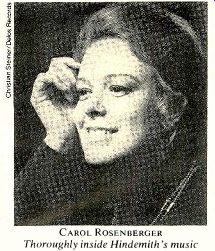
Neither of these titles has been listed in Schwann for some time, so this disc is as sured of at least the sort of welcome that is earned for the filling of gaps. Actually, it rates a much warmer welcome than that, for both performances are quite good and that of The Four Temperaments is just about all one could ask. It is easy to forget that this work, like Nobilissima Visione, was composed for a bal let. As Amelia S. Haygood reminds us in her very comprehensive annotation, The Four Temperaments did not receive an actual danced presentation until six years after its 1940 concert premiere in Boston, but it still turns up with some frequency as a concert work and was revived by the New York City Ballet two years ago. It is surprising that there has been no stereo predecessor to the new Delos release-which, however, fills the bill quite nicely in all respects. Carol Rosenberg er, in what seems to be her first recording with orchestra, is thoroughly inside the music, giving full but not excessive characterization to the respective sections. She has a very sym pathetic and able partner in James De Preist, who draws alert and sensitive playing from the Royal Philharmonic.
The overside Nobilissima Visione is less fine but still generally satisfying. The opening movement lacks the breadth that informed the noble versions under Otto Klemperer, Hindemith himself, and the late Jean Martinon (a stunning stereo recording with the Chicago Symphony Orchestra, which RCA has deleted along with all its other fine Martinon/Chicago material), but these are now gone, and one is grateful to have the music available at all. De Preist seems to adjust to a more suitable pulse and to pick up depth as his performance pro ceeds, and on this side too the orchestral playing is on a very high level. The sound is good on both sides. R.F.
HONEGGER: Jeanne d'Arc au Bticher (see Best of the Month, page 84) RECORDING OF SPECIAL MERIT JOSQUIN DES PRES: Missa L'Homme Arme; Hue Me Sydereo/Plangent Eum. GOMBERT: Musae Jovis/Circumdederunt Me.
VINDERS: O Mors Inevitabilis/Requiem Aeternam. Pro Cantione Antigua, London, Bruno Turner cond. DEUTSCHE GRAMMOPHON ARCHIV 2533 360 $8.98.
Performance: Particularly fine
Recording: Excellent
Despite its structural complexities and com positional detailing, Josquin's Mass based on the ubiquitous L'Homme Arme tune is so musically expressive and clear in its textures that it is an unstrained joy to hear. The Pro Cantione Antigua of London offers a particularly fine reading on this recording. The three countertenors, three tenors, and four basses of this excellent group produce a blend that comes very close to sounding like a consort of viols.
The purity of the individual voices renders each part with crystal clarity while giving an extraordinary voluptuousness to the sound of the whole. Bruno Turner's tempos are conservative and his general approach hushed and awestruck, but his sense of line and knowledge of where he is going carries the music to superb heights.
Fortunately, the same high standard of performance is accorded the other works on the record, a motet by Josquin and two lamentations on the occasion of his death by other masters of the period. O Mors Inevitabilis by the relatively obscure Hieronymus Vinders is especially striking. S.L.
KORNGOLD: Violanta: Prelude and Carnival (see WAGNER)
LISZT: A Faust Symphony (see Best of the Month, page 85)
MOZART: Piano Concerto No. 12, in A Major (see RACHMANINOFF) MOZART: String Quartets: No 1, in G Major (K. 80); No. 2, in D Major (K. 155); No. 3, in G Major (K. 156); No. 4, in C Major (K. 157); No. 5, in F Major (K. 158); No 6, in B-flat Ma jor (K. 159); No. 7, in E-flat Major (K. 160); No. 8, in F Major (K. 168); No. 9, in A Major (K. 169); No. 10, in C Major. K. 170); No. 11, in E-flat Major (K. 171); No. 12, in B-flat Major (K. 172); No. 13, in D Minor (K. 173); Di vertimento in D Major (K. 136); Divertimento in B-flat Major (K. 137); Divertimento in F Major (K. 138). Amadeus Quartet. DEUTSCHE GRAMMOPHON 2711 020 four discs $35.92.
Performance: Good
Recording: Well defined
The Amadeus Quartet's recordings of Mozart's ten mature quartets (Deutsche Grammophon 2720 055, also on individual discs) is one of the glories of the chamber-music discography, and it is likely to retain its position of supremacy for sometime. As in the case of that distinguished set, this new one of the early quartets must be evaluated against recordings of the same works by the only foursome that has been performing longer than the Amadeus without a change in personnel, the Quartetto Italiano, whose four Philips discs off these sixteen titles are available individually (6500 142, 6500 172, 6500 644, 6500 645). Here the competition is closer, and it is the Quartetto Italiano that comes out ahead.
It is hard to give precise reasons for this judgment, for both sets give a great deal of pleasure. The Amadeus' playing almost al ways shows the group's characteristic elegance and sensitivity (though there are occasional patches of uncharacteristic roughness), and the warm, well-defined sound is at least as much an asset as the fine sonics provided by Philips. One might say the Amadeus approach is more suave and expansive, the Italiano more crisp and incisive-but it is not at all hard to find movements or entire works in which this contrast is reversed. In general, I can only say that the Quartetto Italiano, which has perhaps played the early quartets more frequently than the Amadeus, seems to take to them more comfortably, offering more natural phrasing in place of the Amadeus' frequent overemphasis and occasional matter of-factness. The Italians have a more ingratiating way with the minuets, and they show greater assurance in the grander moments (such as the fugal finales of K. 168 and K. 173) and more unforced good humor in some of the cheery allegros (those of the three so-called divertimentos in particular).
There are, moreover, some advantages of the Philips series unrelated to the performances as such. The first is that it may be acquired one disc at a time, instead of in a complete set only. The next is that Philips 6500 142 includes the original slow movement for K. 156 as an appendix to the complete work with the superior adagio that replaced it. And finally, Philips has packaged K. 173 in D Mi nor not only with clearly superior performances of the three "divertimentos," but also with a magnificent version of the Adagio and Fugue in C Minor, K. 546, a work not included in the DG set; it is not an early work, to be sure, but it is a most welcome bonus.
Now that the early quartets have been so well attended to in two complete recordings, let us hope the Amadeus, the Quartetto Italiano, or the Tokyo Quartet will get around to giving us the four "Milanese" quartets listed as Nos. 210-213 in the old Koechel Appendix.
They may not be authentic Mozart, but, as the Barchet Quartet demonstrated in the last known recording of them (made some twenty six years ago, Vox PL 7480), they are far too attractive to be left in limbo. R.F.
RECORDING OF SPECIAL MERIT
MOZART: String Quartet No. 20, in D Major (K. 499); String Quartet No. 21, in D Major (K. 575). Alban Berg Quartet, Vienna. TELEFUNKEN 6.41999 $7.98.
Performance: Splendid
Recording: Rich
These are both splendid, very serious performances. The stature of these quartets is not diminished in allowing them a little more charm than they exude on this disc, but the solidity, firm rhythms, fine balance, and over all depth of the Alban Berg Quartet's playing add up to an unusually satisfying experience.
"Serious" need not be equated with "somber": both opening movements gain strength from the Viennese players' sinewy, taut approach, which allows for plenty of expansive ness and subtlety, and the inner movements disclose an unforced warmth of heart. The
undercurrent of melancholy in the two finales is superbly realized-again, effective but not overemphasized. The actual playing is no where less than impeccable, nowhere less than involved, and the recording itself is rich ly realistic-indeed, it is a model of how to record a string quartet, with each instrument firmly in focus in relation to its associates.
The Amadeus Quartet, showing even greater refinement and style, is still a bit more appealing in K. 499 (Deutsche Grammophon 139 355 or, as part of a set, 2720 055) and more enlivening in the finale of K. 575 (DG 139 437 or the aforementioned set). But there is no other single-disc coupling of these two works to compare with this new one, and chamber mu sic aficionados, I suspect, will always find room for Mozart playing of this quality regardless of duplications in their collections.
R.F.
MOZART: Symphony No. 40, in G Minor (K. 550); Symphony No. 41, in C Major (K. 551, "Jupiter"). Vienna Philharmonic Orchestra, Karl Bohm cond. DEUTSCHE GRAMMOPHON 2530 780 $8.98, 3300 780 $8.98.
Performance: Mellow
Recording: Rich
Karl Bohm has always had an especially persuasive way with the Jupiter, which he has re corded at least five times by now. His last previous version, made with the Berlin Philharmonic about fifteen years ago (Deutsche Grammophon 138 815), is more galvanic and fleet-footed than this new one; my impression is that this has less to do with a slowing down on his part than with his response to, or interaction with, the respective orchestras. It is a mellower Jupiter from Vienna, actually more like his last version with that orchestra (transferred from 78's to Bluebird LBC-1018 some twenty-five years ago) than the more re cent Berlin performance, and the extremely rich recording emphasizes this quality-as well as the golden sounds of the respective choirs and instrumental soloists.
The over-side G Minor, however, opens so expansively and with so little tautness that many listeners will be put off at first. If you stay with it, though, it becomes clear that Bohm's expansive-one might almost say Schubertian-approach is not at all short on tension or drama, but tends to put this frequently hotted-up work back into a convincing Classical perspective. His observance of the first-movement exposition repeat seems to support such a view. This G Minor will not be everyone's cup of tea, but it is solid, sensible, and very beautifully played. R.F.
PARRY: Songs (see STANFORD) HERNE: Sonata, Op 36 (see FRANCK)
PROKOFIEV: Symphony No. 5, ho B-flat Major, Op. 100. Philadelphia Orchestra, Eugene Ormandy cond. RCA ARL 1-1869 $7.98, ARSI-1869 $7.98, ARK 1-1869 $7.98.
Performance. Somewhat ponderous Recording- Superb While the opening movement and the adagio of Prokofiev's Fifth Symphony do place this score on a level of aspiration-and sometimes of achievement-comparable to that of Beethoven's Eroicu, overemphasis on this aspect of the music can make it seem something of a ponderous bore. Eugene Ormandy unhappily falls into this trap, and all of RCA's absolutely gorgeous sonics can do little to help. Artur Rodzinski's 1946 recording with the New York Philharmonic, Stokowski's USSR disc (despite coarse sound), Karajan's 1969 DG reading, and Rozhdestvensky's Melodiya/ Angel taping all come closer to the essence of the music, whose life-affirming aspect in the remarkable scherzo and fiercely defiant finale is not to be ignored.
D. H.
PUCCINI: Edgar. Carlo Bergonzi (tenor), Ed gar; Renata Scotto (soprano), Fidelia; Gwen dolyn Killebrew (mezzo-soprano), Tigrana; Vicente Sardinero (baritone), Frank; Mark Munkittrick (bass), Gualtiero. New York City Opera Children's Chorus; Schola Cantorum of New York; Opera Orchestra of New York, Eve Queler cond. COLUMBIA M2-34584 two discs $13.98, 0 MQ2-34584 two discs $13.98.
Performance: Good
Recording: Good
Giacomo Puccini's second opera, Edgar, is no neglected masterpiece, but rather the work of a prodigiously gifted young composer still in search of an individual style. Puccini himself never regarded Edgar as a first-class opera and took immediate steps to benefit from its less than auspicious reception. Unquestionably his most salutary action was to part company forever with Edgar's hopelessly inept librettist, Ferdinando Fontana. There is no point in detailing the ills of Fontana's insufficiently motivated plot and stilted language.
Once past a creaky first act, however, Puccini's soaring melodies rise above Fontana's folly. I suppose he was just too gifted a melodist and too resourceful an orchestrator to create a really inferior opera. But the difference between Edgar (1889) and Manon Les caut (1893) is greater than the interval of four years seems to suggest.
This first complete recording of Edgar, tak en from a live Carnegie Hall performance, has been accomplished as skillfully as Columbia's earlier similar venture involving Donizetti's Gemma di Vergy. The casting here is even more felicitous. Bergonzi sings the music of Edgar with such fervent passion that the character's cardboard identity hardly ever intrudes. Even at this late stage in his career, this unique artist can still phrase with an elegance and expressiveness all his own. The part of Fidelia is relatively slight, but Renata Scotto fills every moment of it with fervor and intensity. To Frank, another cardboard role, Vicente Sardinero brings the redeeming qualities of a vibrant personality and a manly sound. Evil though she may be, the villainess Tigrana is the only role in this opera that has some shape and purpose. Gwendolyn Kille brew provides appropriate sultriness and am ple vocal resource, but her enunciation is un clear and at times careless. Mark Munkittrick is adequate as the father, Gualtiero.
The mock-religious ceremony in Act III could perhaps be more impressive in a tauter and better-rehearsed performance. Aside from that, Eve Queler and her Opera Orches tra have done valuable service indeed in bringing this elusive opera to records. The set comes with the full text and translation, along with informative but verbose and carelessly edited annotations. G.J.
RACHMANINOFF: Piano Concerto No. 3, in D Minor, Op. 30. William Kapell (piano); Toronto Symphony Orchestra, Sir Ernest Mac Millan cond. MOZART: Piano Concerto No. 12, in A Major (K. 414), Andante and Allegretto. William Kapell (piano); Los Angeles Phil harmonic Orchestra, Pierre Monteux cond. DESMAR/INTERNATIONAL PIANO ARCHIVES IPA 507 $6.98.
Performance: Youthfully urgent
Recording: 1948-1950 acetates
Though the sleeve notes fail to give particu lars concerning these performances by William Kapell, whose career was tragically cut short in a 1953 plane crash, I would guess that both are broadcasts-one from the cavernous Massey Hall in Toronto, the other from the somewhat acoustically dead Philharmonic Auditorium in Los Angeles. Despite the thinned-out orchestral sound on the acetates (they sound like 78-rpm's) from the Canadian performance, Kapell's vital pianism is amply evident throughout the Rachmaninoff.
No reason is given for the lack of the first movement of the Mozart, but what we do hear are a slow movement played with loving care and a finale with wondrous lift and pa nache. Both the piano and the orchestra have a fuller-bodied sound here, and the mastering source-presumably a 16-inch acetate seems in somewhat better shape than that which served for the Rachmaninoff. Kapell's slim discography of commercial issues for RCA Victor included no Mozart concertos, which makes this souvenir of his art all the more valuable, and it is especially good to have this collaboration with Monteux, one of the great conductors of the day. D.H.
RAMEAU: Premier Livre (1706); Pikes de Clavecin (1724); Nouvelles Suites de Pikes de Clavecin (1728); Cinq Pikes (1741); La Dau phine (1747). Kenneth Gilbert (harpsichord). DEUTSCHE GRAMMOPHON ARCHIV 2710 020 three discs $26.94.
Performance: Impeccably historic
Recording: Superb
Kenneth Gilbert is a performing scholar in the best sense of the term. Not only has he produced the most definitive editions of the mu sic of such masters as Francois Couperin and Jean-Philippe Rameau, he has translated the authoritativeness of those printed scores into sound. Thus, in listening to this album devoted to the complete keyboard works of Rameau, one is confident that every ornament, every tempo, every rhythmic alteration is the result of thorough and careful research. The research has so entered into Gilbert's manner of performance that the two, research and performance, become as one. Gilbert is not only intent on an authentic performance style, he also insists on having a properly historic instrument on which to perform. For this album he has chosen three magnificent eighteenth-century French harpsichords: one built by Jean Claude Goujon ( Paris 1749), another by Jean Henry Hemsch ( Paris 1761), and the third by Dumont in 1697 (it was reworked by Taskin in 1789).
It is obvious that Gilbert's single aim here is to perform Rameau as he thinks Rameau was performed during the composer's own life time. On a purely subjective level, one may disagree with the musical results, but to voice such disagreements in a review would be pre sumptuous and unfair. Gilbert has chosen to present the music in as historic a light as possible, and he has carried through superbly.
S.L.
RESPIGHI: The Fountains of Rome; The Pines of Rome; Overture to Belfagor. London Sym phony Orchestra, Lamberto Gardelli cond.
ANGEL LI S-37402 $7.98.
Performance: Poetic
Recording: Atmospheric
RESPIGHI: The Pines of Rome; Feste Ro mane. Cleveland Orchestra, Lorin Maazel cond. LONDON CS 7043 $7.98.
Performance: Spectacular
Recording: Pointed
Respighi's Roman pieces have garnered a reputation through the years as primarily sonic blockbusters, but I for one insist on the poetic element as well-particularly in the final pages of the Fountains and in the quieter middle sections of the Feste Romane. Effective, too, is the use of the Clemens Rector Gregorian melody at the opening of The Pines Near a Catacomb. Because Lamberto Gardelli also insists on the poetic aspects of The Pines and Fountains, I like his way with the music bet ter than Maazel's, but I do not understand what happened to the taping of Gardelli's performance of The Pines of the Appian Way.
Not only is there an obvious ragged trombone entry as the dominant fanfare motive arrives at its third entry, but in the ensuing development, as the strings start up their slow scale, there is a big chunk missing, so that the climactic full-brass entry at the top of the string scale never arrives and we are suddenly de toured do' vn the scale. Since I can't believe this was ct.t in performance, I must assume it is a tape-editing error. Otherwise, this is an admirable disc, which, by the way, gains greatly in four-channel playback. The Belfa gor Overture which opens side two is the cur tain-raiser for a diabolic opera-comedy, its music sounding a bit like Wolf-Ferrari with sinister overtones.
The Maazel disc seems to be tailored for the sound buff, and, for the most part, very effectively so. The antiphonal trumpets at the opening of Circuses is a particularly nice touch, and the near-cinematic evocation of raucous popular clamor in the finale comes off with magnificent unbridled fury. London's re cording throughout has more immediacy and tonal body than Angel's. D.H.
SARASATE: Zigeunerweisen (see GOLDMARK) SCHUBERT: Soprano Arias (see Collections Janet Baker) SCHUBERT: Piano Sonata in A Major (D. 959); Piano Sonata in A-flat Major (D. 557). Radu Lupu (piano). LONDON CS 6996 $7.98.
Performance: Gentle
Recording: Pretty
This is a gentle, pastoral performance of the big A Major Sonata. The dramatic and epic qualities of the music-they are at least as important as the lyricism-are slighted here, a very decided shortcoming. The playing is likable, but the scale is too small. The A-flat Sonata-an early work, perhaps a fragment with two movements in A-fiat and an apparent finale in the "wrong" key of E-flat-is a charming novelty; this time the playing fits.
E.S.
SCHUBERT: String Quartet No. 13, in A Minor, Op. 29 (D. 804); String Quartet No. 10, in E-flat Major, Op. 125, No. 1(D. 87). Quartetto Italiano. PHILIPS 9500 078 $8.98.
Performance: Mixed
Recording: Very good
The Quartetto ltaliano, one of the most distinguished ensembles of its kind, has been playing with no change in personnel even longer than the Amadeus. It is hardly surprising, then, that this new recording of the beloved A Minor differs hardly at all from the one the same performers made some twenty-five years ago for London/Decca. The opening movement is not merely slow, but uncomfortably mannered, and in all four movements there are excesses in the form of over-accentuation and rhythmic inconsistencies quite out of keeping with the subtlety and refinement this group characteristically displays in repertoire ranging from early Mozart to Webern.
Those lofty standards are nobly upheld in the over-side performance of the earlier Quartet in E-flat, but it seems unlikely that many collectors would buy the disc for that work alone when a different version of the A Minor is indicated, even with the fine sonics as recommendation. When the earlier Quartetto Italiano version of Op. 29 was current on London, there was a splendid alternative in the form of the Vegh Quartet's recording on the same la bel. Now there is a most attractive complete Schubert cycle by the Melos Quartet of Stuttgart, based on the latest scholarship (Deutsche Grammophon set 2740 123, in which the scherzo of No. 10 follows the slow movement instead of preceding it as in the new Philips and all other recordings), and there is a similarly persuasive account of the A Minor, paired with No. 9 in G Minor (D. 173), by the Alban Berg Quartet of Vienna on Telefunken 6.41882. R.F.
RECORDING OF SPECIAL MERIT
SCHUBERT: Symphony No. 3, in D Major (D. 200): Symphony No. 5, in B- fiat Major (D. 485). Israel Philharmonic Orchestra, Zubin Mehta cond. LONDON CS 7020 $7.98.
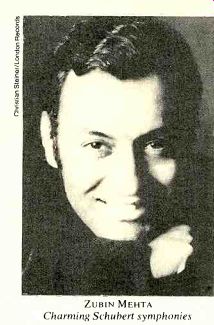
Performance Charming and natural
Recording. Beautiful
The early Schubert symphonies are just about irresistible, but for some reason they are still not encountered all that often. The Fifth is the best known and perhaps the best of them, but No. 3 is a real charmer-fresh, unpretentious, buoyant, intensely lyrical. Here we have clear. sturdy, beautifully recorded versions that call attention to the music, not the performance. 1 am very fond of the delicacy and precision that Mehta and the Israeli musicians achieve without any hint of patronization or prissiness. The music opens up, unfolds, and flows with the greatest ease, charm, and naturalness. E.S.
RECORDING OF SPECIAL MERIT
SCHUMANN: Kreisleriana, Op. 16; Wald scenen, Op. 82. Michel Beroff (piano). CONNOISSEUR SOCIETY CS 2138 $7.98.
Performance: Superb Kreisleriana
Recording: Excellent
This is a wonderful performance of the Kreisleriana, a reading that combines delicacy and nuance with real impetuosity. Beroff captures the poetic schizophrenia of this music, the youthful, breathless, headlong plunges that alternate with the most personal, expressive inwardness. The control and projection are never less than stunning. The Waldscenen best known for the strange and beautiful Prophet Bird-is a later work in a deceptively simple style. The nine movements alternate lyric and genre pieces, and a strong, German ic folk element is brought to the fore. This as pect is not Berpff's forte; the crisp, rhythmic movement of hunting songs and folk ballads needs to be more on top of the beat with the rest of the music woven around it. The lyrical pieces are enchanting, however, and on a level with the whole Kreisleriana-which must be accounted one of the most affecting interpretations of this great work on records.
E.S.
SHEPHERD: Triptych for High Voice and String Quartet (see HARRIS)
ZUBIN MEHTA Charming Schubert symphonies SHOSTAKOVICH: Sonata for Viola and Piano, Op. 147. Milan Teleck9 (viola); Lydia Majlingova (piano). AURORA AUR 5051 $7.98.
Performance: Committed
Recording: On the dry side
The Viola Sonata, Shostakovich's very last work, is not ingratiating, and the listener (as well as the performers) will need time to digest it. Its earnestness is apparent at once, though, as are its very personal nature and the spirit of melancholy fantasy that hovers over its three movements-the last of which, an adagio as long as its two predecessors combined, includes an amiably mysterious citation of the first-movement theme from Beethoven's Moonlight Sonata. There may be a double meaning in this: we are told Shostakovich had thought of writing a work in memory of Beethoven, and this elegiac-sounding sonata was in fact composed for Fyodor Druzhynin, the violist of the Beethoven Quartet, the Soviet ensemble that per formed Shostakovich's quartets and with whom he performed and recorded his Piano Quintet. (The Quartets Nos. 11-14 are dedicated to individual members of the Beethoven Quartet, No. 13 bearing an inscription to Druzynin's predecessor, the late Vadim Bonisovsky.) The opening movement is a characteristic Shostakovich moderato, the middle one a very substantial scherzo. Milan Teleck9 and Lydia Majlingova give an absorbing, obviously committed performance of the sonata, and the Czechoslovakian recording, beautifully pressed in England, is generally good, though a bit on the dry side. In all, this is an impressive introduction to an intriguing work.
(I understand, however, that there is an even better version, played by Druzhynin himself with pianist Mikhail Muntyan, which, with any luck, should be issued here before long by Angel or Columbia.) R .F.
SMETANA: The Kiss. Ludmila Cervinkova (soprano), Vendulka; Marta Krasova (mezzo soprano), Martinka; Stefa Petrova (soprano), BarCe; Beno Blachut (tenor), Lukas; Piemysl KoZi (baritone), Toma; Karel Kalai (bass), Father Palouck; others. Prague National Theatre Chorus and Orchestra, Zdenek Cha labala cond. HERITAGE HCNL 8006/7 two discs $15.96 (from Qualiton Records, 65-37 Austin Street, Rego Park, N.Y. 11374).
Performance: Zesty
Recording: Good mono
Written in 1876, shortly before its composer became deaf, The Kiss was the fifth of Smetana's seven operas. Like The Bartered Bride, it is rustic and comic, but its "folkishness" is less rollicking and its humor mellower. The Kiss has the slightest of plots, but its characters are engaging and the music overflows with warmth and exuberance. This is a skill fully through-composed opera, with arias, duets, and ensembles following one another in a natural flow-a seamless display of Smeta na's skills. Vendulka's first-act lullaby, one, of the melodic highlights, was the composer's special. favorite.
Ludmila Cervinkova and Beno Blachut are excellent as the quarreling lovers, and Pie mysl Kai is effective as the conciliatory brother-in-law. There are some weak singers in the cast, but on the whole the performance communicates the opera's beauties. Those who enjoy The Bartered Bride and My Coun try will find The Kiss delightful. The sound is acceptable Fifties mono. G.J.
STANFORD: Eight Unaccompanied Part Songs, Op. 119; The Haven, Op. 127, No. 4; Heraclitus, Op. 110, No. 4. PARRY: Six Modern Lyrics; 0 Love, They Wrong Thee Much;
Ye Thrilled Me Once. The Richard Hickox Singers, Richard Hickox cond. PRELUDE PRS 2506 $7.98.
Performance: Lovely, if somewhat bland
Recording: Flawed
Like the oratorio, the unaccompanied part-song is a genre associated particularly with Victorian England (no matter that Handel's oratorios were composed in an earlier era the performing traditions, for better or worse, were Victorian until recent years), and neither form has enjoyed similar popularity in other places and times. The eighteen songs on this disc are fairly representative of the genre's upper stratum, vintage 1890's. The one piece at all likely to be familiar on this side of the Atlantic is Parry's setting of Shelley's Music When Soft Voices Die, which concludes his Six Modern Lyrics. From the prominence giv en it on the jacket, I infer that Stanford's The Blue Bird is a special favorite in Britain; it alone in this collection has a prominent solo part, and, like all the Stanford songs but Heraclitus, it is a setting of words by Mary Cole ridge, great-niece of the celebrated poet.
Richard Hickox's twelve-voice ensemble per forms the various numbers with taste and feeling; if the overall effect is a little bland, it is probably because that is how the genre it self strikes many listeners. The recording is handsomely focused, but marred by a 60-Hz hum on the second half of each side; using a low-frequency filter helped a bit, but that didn't knock it out entirely. R . F.
TCHAIKOVSKY: The Seasons, Op. 37a. Michael Fardink (piano). ORION ORS 77274, $7.98.
Performance: Pleasant
Recording: A bit clangorous
Tchaikovsky's 1876 collection of twelve piano pieces, more properly titled The Months than The Seasons, was commissioned for month-by-month publication, and, for the most part, they fall into the category of what he described as "musical hlini"-the kind of salable music that furnished the wherewithal (together with Mme. von Meck's stipend) to permit him the luxury of working on sympho ny and opera. A few of the pieces have re tained deserved popularity over the years, such as the bitter-sweet Barcarolle (June), the plaintive Autumn Song (October), and the Troika (November). Those who want on a sin gle disc the whole set of these pleasant salon miniatures will find them decently, if not out standingly, served in these performances by Michael Fardink. The piano seems too close up. however, and can sound clattery without some tone-control adjustment. D.H.
RECORDING OF SPECIAL MERIT
TCHAIKOVSKY: Symphony No. 6, in B Mi nor, Op. 74 ("PatNtique"). Berlin Philharmonic Orchestra, Herbert von Karajan cond. DEUTSCHE GRAMMOPHON 2530 774 $8.98, 3300 774 $8.98.
Performance: Impassioned
Recording: Brilliant
TCHAIKOVSKY: Symphony No. 6, in B Mi nor, Op. 74 ("Pathetique"). Chicago Symphony Orchestra, Sir Georg Solti cond. LONDON CS 7034 $7.98, CO 8-7034 $7.95, 5-7034, $7.95.
Performance: Taut
Recording: Full-bodied
What looked to be a battle of conductorial giants in the Tchaikovsky Sixth turned out on hearing to be something of a one-sided affair.
Except for a rather heavy-footed second movement (marked allegro con grazia, in 5/4 time), it seems to me that Herbert von Karajan and his Berliners have it all the way. Sir Georg Solti does a beautiful job with his rhythmic pointing of this movement, but he takes the ensuing march at such a fast clip that it loses in cumulative impact. It is here that Karajan really excels--I don't expect ever to hear a more shattering performance of the march on or off records.
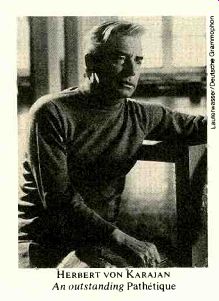
HERBERT VON KARAJAN--An outstanding Pathetique
In the first movement, Karajan makes the most of every dramatic point, but I'm not sure that I don't still prefer the more classically oriented, leaner texture of Claudio Abbado's Deutsche Grammophon recording with the Vienna Philharmonic. Nevertheless, this new Karajan disc of the Pathetique is outstanding on all counts-including the sound, which emerges from the speakers with enormous brilliance and body. Solti and his Chicago players are accorded even richer sound by the London production staff, and there is some what better presence in the bass register, but this cannot disguise his curiously passionless way with Tchaikovsky's passionate music.
D.H.
VERDI: Requiem. Leontyne Price (soprano); Janet Baker (mezzo-soprano); Veriano Luchetti (tenor); Jose van Dam (bass). Chicago Symphony Chorus and Orchestra, Sir Georg Solti cond. RCA ARL2-2476 two discs $13.96, OO ARS2-2476 $13.95, ARK2-2476 $13.95.
Performance: Good, not outstanding
Recording: Good
It is hard to succeed with a much-recorded work like the Verdi Requiem. Aside from the demands the work itself places on the per formers, there is also the challenge of matching standards established by the likes of Toscanini, Reiner, Giulini, and Karajan-and their stellar combinations of singers.
Perhaps RCA's optimism in launching a new Requiem against formidable competition (which includes Sir Georg Solti's own still fairly new London 1275 with Sutherland, Home, Pavarotti, and Talvela) will be justified commercially, but the results are artistically disappointing. The Chicago Symphony Chorus and Orchestra perform at peak level-the brasses in the "Tuba mirum" are thrilling-but in the quest for ensemble virtuosity Solti gives us a fairly unbending reading without sufficient warmth and flexibility.
The individualities of the four singers do not easily blend into a harmonious ensemble.
Leontyne Price delivers some beautiful phrases, but her low notes are harsh, especially in the crucial " Libera me." Janet Baker is considerably below form and not miked to her advantage. Veriano Luchetti is a thoroughly competent Italian tenor, but he is not to be compared to his recorded predecessors. Finally, Jose van Dam sings smoothly, elegantly, and with .perfect musicianship but sounds too much like a baritone in music that calls for the weight of a Pinza or a Ghiaurov. Ah, those standards! My recommendations remain: Giulini (An gel), Karajan (Deutsche Grammophon), and Reiner (RCA), in that order. The cassette version of Solti's performance, by the way, comes in a handsome book-style box too large for the two cassettes-but just the right size for the complete text booklet included. G.J.
VINDERS: O Mors Inevitabilis/Requiem Aeternam (see JOSQUIN)
WAGNER: The Flying Dutchman: Overture. Tannhauser: Venusberg Music. Siegfried Idyll.
KORNGOLD: Violanta: Prelude and Carnival. Royal Philharmonic Orchestra, Jascha Horenstein cond. QUINTESSENCE PMC 7047 $3.98.
Performance: Passionate
Recording: Holds up well
There's no yawning gap in the classical catalog aching to be filled by the overture to The Flying Dutchman or the Venusberg Music from Tannhduser, but if we must make room for still another performance of these popular winners in the Wagner sweepstakes, this one is at least a stimulating entry. Jascha Horenstein died in 1973, and his reputation is certain to be revived and enhanced by the current series of Quintessence reissues of his records.
There is a kind of moody passion in his readings of the tempestuous overture and the fevered bacchanale with which Wagner opened the 1861 production of Tannhauser in Paris.
By way of contrast, the Siegfried Idyll gets a hushed sotto voce performance which brings out in breathtaking whispers the pastoral beauty of this sublime work Completing the concert are a prelude and carnival episode from an opera called Violanta which Erich Wolfgang Korngold completed at the age of seventeen. The prelude, with its ominous atmosphere leading up to the stage action of a murder in sixteenth-century Venice, contains the seeds of the sort of atmospheric writing Korngold eventually would bring to his film scores. The carnival is an empty exercise in local color, but at least the hues are still clear and clean, not muddied and murky the way they would get when this com poser's skill as an orchestrator later out stripped his talent as an inventor of original music. The performance here is a vivid one, but this music is sadly overshadowed by the Wagner works that dominate the program.
The 1960's sound remains impressive. P. K.
WALTON: Belshazzar's Feast; Coronation Te Deum. Benjamin Luxon (baritone); London Philharmonic Choir; London Philharmonic Orchestra, Sir Georg Solti cond.
LONDON OS 26525 $7.98.
Performance: Resplendent
Recording: Not quite ideal
Belshazzar's Feast has been documented in a half-dozen or more recordings, none less than good and several of them truly remarkable.
This new one led by Sir Georg Solti almost falls in the "truly remarkable" category, thanks to the brilliantly disciplined singing of the London Philharmonic Choir and the razor-sharp orchestral performance. Only a hairline miscalculation of ideal presence for the chorus makes for some reservations. The impact-or lack of it-of the opening proclamation, "Thus spake Isaiah," can tell all: every word here must be clearly intelligible and the body of choral tone must have real weight. That is certainly the case in both recordings conducted by the composer, as well as in Previn's 1972 disc. In comparison with these, Solti's singers sound just a shade off-a problem that can be ameliorated to some extent by playing the stereo record through quadraphonic equipment as if it were a four-channel recording and cutting some bass in the signal to the rear speakers.
Solti's baritone, Benjamin Luxon, is not, for me, the equal of Dennis Noble (heard on both the first Walton-conducted recording and the Adrian Boult one of a decade later), who was a veritable incarnation of Nemesis in the handwriting-on-the-wall recitative. However, I do find Luxon better in the role than Donald Bell is in the Angel disc Walton conducted.
All in all, it is rather a photo finish among the three currently available versions-the Prey-in, the second Walton, and Solti's new one with all of them falling slightly short of perfection in one way or another. A major reason to favor the Solti disc is its inclusion, as an opening filler, of another Walton choral work, the sumptuous 1953 Coronation Te Deum.
There are no balance problems in this-every word of the English-language text is clear and the antiphonal effects among the organ, choir, orchestra, and brass come off splendidly. This is music of pomp and circumstance in the best sense. D.H .
RECORDING OF SPECIAL MERIT
WILLAERT: Benedicta Es, Celorum Regina; Magnum Hereditatis Misterium; Quem Terra, Ponthus, Ethera; Saluto Te, Sancta Virgo Maria; Pater Noster. Boston Camerata Motet Choir, Joshua Rifkin cond. NONESUCH H-71345 $3.96.
Performance: Fresh
Recording: Clear
Here, at last, is a representative sampling of the fine motets of Adrian Willaert (ca. 1490-1562), the Fleming who brought music to Venice and turned the tide of musical ascendancy from northern Europe to Italy. A first listening may give the impression that Willaert was just another typical mid-sixteenth-century composer standing somewhere be tween Josquin and Palestrina. But listen more closely and follow the texts; a very new fresh ness and passion are clearly evident.
The Boston Camerata Motet Choir brings its own fresh sound to the music, achieving a fine blend between female sopranos and countertenors-no small feat. The choir's diction is impeccable, and its clearly produced vowels both color and articulate the music. Joshua Rifkin, a rare blend of musicologist and all around performer, approaches the works with a single motto: be clear, be precise, and the music will speak for itself. And so it does;
Willaert's voice here is a strong and beautiful one. S .L.
COLLECTIONS
JANET BAKER SINGS BEETHOVEN AND SCHUBERT. Beethoven: Egmont, Op. 84: Die Trommel geriihret; Freudvoll und leidvoll. No, Non Turbarti (WoO 92a). Ah! Perfido, Op. 65. Schubert: Ziigernd Leise. Rosamunde: Der Vollmond strahlt. Lazarus: So schlurnmert auf Rosen. Alfonso und Estrella: Konnt' ich ewig hier verweilen. Janet Baker (mezzo soprano); Raymond Leppard (piano); English Chamber Orchestra and Choir, Raymond Leppard cond. PHILIPS 9500 307 $8.98.
Performance: Fair to good
Recording: Very good
This interesting sequence offers infrequently heard stage-oriented works by Beethoven and Schubert. The music of Egmont and Rosamunde is often recorded, but it is good to have the soprano arias so easily accessible apart from the orchestral context.
In performance, the Schubert side comes off better. Miss Baker sings the two arias charmingly, weaves a magic spell in the longish but irresistible Zogernd Leise (a Grillparzer setting for mezzo, female chorus, and piano), and makes a strong case for the lengthy aria from Lazarus, a semi-operatic oratorio Schubert left unfinished in 1820.
On the Beethoven side, the two songs from Egmont are done to a turn, but both concert arias are disappointing. Much of No, Non Turbarti, which appears to be new on records, lies in the E-G area that the singer finds uncomfortable; the rendition is tonally uneven and at times off-center. While the adagio section of Ah! Perfido is affectingly phrased, the concluding allegro lacks fire and determination. I am also disturbed by an increasing tendency on the part of Miss Baker to favor a "white" (vibrato-less) tone. Raymond Leppard should share the blame for that overcautious Ah! Perfido; otherwise his accompaniments are fine and warmly recorded. G.J.
CANTOR DORA KRAKOWER: Song and Chant Mosaic. Sounding of the Shofar. Janowski: Harninu. Trad. (arr. D. Krakower): Kol Nidre. Trad. Chassidic (arr. Pitesky): Psalm 23. Goldfarb: Shalom Aleichem. Pitesky: Blessing over the Sabbath Lights. Nathanson: Yihiyu L'Ratzon. Saint-Satins (arr. Michaels): Ana Dodi. Trad.: Hanukah Blessing over the Lights; V'Ohavtoh. D. Krakower: Va-ani Zoht B'riti. M. and D. Krakower: Birdsong; Talmud Berakhath; Parental Blessing; Avinu Shebashamayim-Prayer for the Government. Cantor Dora Krakower (soprano). AZURE CDK $5.98 (from Azure Music, P.O. Box 3723, Santa Monica, Calif. 90403).
Performance: Valorous
Recording: Very good
Cantor Dora Krakower, one of the first women to be accepted as a cantor, has been chanting the liturgy from the pulpits of Reform congregations in California and other Western states for some years under the sponsorship of the Union of American Hebrew Congregations, the central congregational body of Re form Judaism. Under the pseudonym of Doreen Michaels, she has also pursued a second career as a songwriter and singer in the movies and on West Coast television shows. This is her first album of liturgical music, and some of the settings are credited to her alter ego Doreen. No matter. The complaint often launched against the music of Reform Judaism-that it apes the Episcopalian hymnals and lacks emotional content-cannot be made here. Cantor Krakower applies her soprano to passages drawn from the nigunim, or ecstatic chants, of the Chassidic Jews of Eastern Europe, as well as a passage of Lithuanian cantillation; she sings a setting she helped com pose of a touching song about the freedom of birds written by a child who died-among 15,000 other Jewish children-in Terezin Concentration Camp; she offers in Hebrew her own adaptation off passages from the Song of Songs matched to the music of Saint-Saens' The Swan. There are several traditional prayers-including one for the government-and the program opens, just to show how well she can hold her own in what was until a short time ago exclusively a man's domain, with the cantor sounding the shofar, or ram's horn, as a prelude to passages that are sung in the synagogue on the eve of the Day of Atonement. A great operatic soprano she isn't, but her style is impressive and her voice true and sweet, and her singing wears well throughout an unusually interesting concert of Jewish religious music. P.K.
RECORDING OF SPECIAL MERIT
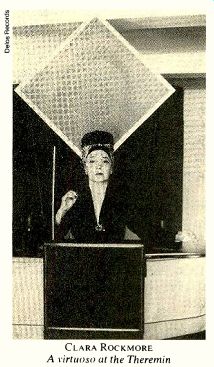
CLARA ROCKMORE--A virtuoso at the Theremin
CLARA ROCKMORE: Theremin Recital. Rachmaninoff; Vocalise; Song of Grusia. Saint-Satins: The Swan. Falla: Pantomime. Achron: Hebrew Melody. Wieniawski: Romance. Stravinsky: Berceuse. Ravel: Haban era. Tchaikovsky: Berceuse; Valse Sentimen tale; Serenade Melancolique. Glazounov: Chant du Menestrel. Clara Rockmore (Theremin); Nadia Reisenberg (piano). Det..os DEL 25437 $7.98.
Performance: Astonishing
Recording: Effective
1920, a twenty-one-year-old student at the University of Petrograd in Russia demon strated a working electronic musical instrument. This instrument-which eventually be came known by the last name of its inventor, Leon Theremin-was widely heard in Europe and America in the Twenties and Thirties. It attracted a great deal of notice and inspired several imitations and a number of composers. Unfortunately, the novelty waned, and a depression and a world war turned attention away from such exotic frivolities; Professor Theremin subsequently returned to Russia, where he now directs the Laboratory of Musical Acoustics at the School of Music of the University of Moscow.
During its heyday the Theremin attracted a number of performers, the most talented of whom was undoubtedly Clara Reisenberg Rockmore. The Theremin is played by standing stock still in front of the instrument and moving one's hands-very carefully!-in and around a pair of metal rods. The sight of the striking and sultry-looking Ms. Rockmore poised trance-like in front of a mysterious box, waving her hands in the air and evoking music directly out of the ether, must have been (is) extraordinary. Theremin could certainly have cooked up an easier way to play his instrument, but no keyboard could have been as evocative or, for that matter, have produced so particularly human a tone. Even without the vision of Ms. Rockmore in per son, we can hear in this remarkable recording a most vividly evocative sound-nothing like latter-day electronic music but something halfway between a human voice and a violin.
Not surprisingly, Rockmore was a musical prodigy and a violin virtuoso before she took up the Theremin, and every aspect of her playing is intensely musical. Out of this in credibly difficult instrument she manages to evoke the most affecting and personal sound imaginable.
Remarkably enough, this is the first recording of Rockmore's playing and one of the few examples of the Theremin on discs. A special feature is the rare appearance of her sister, Nadia Reisenberg, a famous pianist and teacher, and the recording was produced and engineered by Shirleish and Robert Moog of Moog synthesizer fanie. My only cavil is the repertoire, which consists entirely of small salon-type pieces-mostly romantic Russian voice-and-violin stuff. How curious: the starting place for electronic music turns out to be pure, soulful, psychic schmaltz of the old school. E.S.
THE TRIUMPHS OF ORIANA. East: Hence Stars! Norcome: With Angel's Face. Munday: Lightly She Whipped o'er the Dales. Gibbons: Long Live Fair Oriana. Bennett: All Creatures Now. Hilton: Fair Oriana, Beauty's Queen. Marson: The Nymphs and Shepherds Danced. Carlton: Calm Was the Air. Holmes: Thus Bonny-boots. Nicolson: Sing, Shepherds All. Tomkins: The Fauns and Satyrs Tripping. Cavendish: Come, Gentle Swains. Cobbold: With Wreaths of Rose and Laurel. Morley: Arise, Awake, Awake. Farmer: Fair Nymphs I Heard One Telling. Wilbye: The Lady Oriana. Hunt: Hark! Did Ye Ever Hear. Weelkes: As Vesta Was from Latmos Hill Descending. Milton: Fair Orion, in the Morn. Gibbons: Round About Her Charret. Kirbye: With An gel's Face. Jones: Fair Oriana, Seeming to Wink. Lisley: Fair Cytherea Presents Her Doves. Morley: Hard by a Crystal Fountain. Johnson: Come Blessed Bird. Pro Cantione Antigua, London, Ian Partridge cond. DEUTSCHE GRAMMOPHON ARCHIV 2533 347 $8.98.
Performance: Stultifying
Recording: Pure
Thomas Morley persuaded the best madrigal composers of the day to contribute to a cycle of madrigals in honor of Queen Elizabeth I, whose Arcadian name was Oriana. The only requirement was that each madrigal end with the couplet, "Then sang the shepherds and nymphs of Diana/Long live fair Oriana." The emotional scope of the collection is thus nec essarily limited, but to study the many ways in which the various composers set the final couplet is, in effect, to study the essence of the madrigal: word painting.
The Pro Cantione Antigua of London, an excellent ensemble of male singers, enlisted the aid of two female sopranos for this project; their voices are absolutely white and de void of all expression. When combined with the countertenors of the original ensemble and the somewhat muted natural-sounding tenors and basses, the result is otherworldly.
Everything is subdued and precious. One longs for a real forte or some point at which the singers simply let go, for although there are many beautiful moments the overall effect is emasculated and stultifying. Add to this some serious pitch problems and rhythmic fuzziness and it is clear that this disc is not a success. The group seems to be sight reading--and good readers they are-but this repertoire needs more than a reading to bring it across. S. L.
Also see:
Source: Stereo Review (USA magazine)