Editorially Speaking
By William Anderson
A MUSICAL EVENT, FIRST MAGNITUDE I HAVE a friend who is said to cry at card tricks. My own emotional threshold is set a little higher. but I know that in the presence of great art the hair on the back of my neck bristles, my eyes water, and my throat goes dry, developing a lump that makes it difficult to utter even a "bravo." I wanted very much to shout "bravo" as I watched and listened to the PBS TV broad cast of tenor Luciano Pavarotti's epochal recital from the stage of New York's Metropolitan Opera the afternoon of February 19, but my throat had already tightened up in response to what is best described as A Musical Event of the First Magnitude. The standing-room-only audience of 4,000 in the house was swelled by an estimated 387,000 viewers in the New York area alone, and the Lord only knows how many more watched across the nation (the whole thing was rebroadcast three days later for those careless enough to have missed it the first time and those clever enough to catch it for a second).
The occasion marked not only the first vo cal recital from the stage of the new opera house, but a kind of test by the broadcast's underwriters (the Exxon ',Live from Lincoln Center" series) to discover whether this kind of programming was, so to speak, "video viable." It could be argued that they hedged their bet outrageously by choosing for the experiment a man whose name is well on its way to becoming a household word, but no matter-a sensation is a sensation, however scored.
There was no hedging involved in choosing the music for the program, which was uncompromisingly high-minded-and I do not except the group of Paolo Tosti heart-throbbers at the close. It gave the soloist maximum opportunity to deploy across America's. living rooms, throughout almost two hours of merci less camera and microphone closeups, the vo cal gifts, the musicianship, the breath-catching ardor, and the spellbinding personal charm that are his in abundance. It is a kind of closeness that is not possible in the concert hall, of course, nor for those artists whose effortful grimaces and odd mouthings would obtrude unattractively. But with Pavarotti there is not an unaesthetic moment; the worst that can be said of him is that he sweats (he carries a security hanky), a reminder, for those who need it, that this kind of singing is hard work even for a skilled vocal athlete.
The tenor was accompanied by pianist John Wustman, his peer, heir apparent to the man tle of the great Gerald Moore, and for many years my own accompanist. (He can be yours too through the intervention of Music Minus One's albums of Italian art songs, Schubert, Brahms, and more besides; write MMO, 43 W. 61 St., New York 10023.) The resounding success of this first video-recital effort is almost bound to inspire more of the same. Perhaps, if we're lucky, it will also throw into relief the inadequacy of present-day TV sound. I have a good set, and I dutifully lowered my expectations, but the speaker nonetheless rang like a tambourine with overloading, and dynamic contrasts were merely simulated (they can be heard, naturally, on Pavarotti's many London recordings, which embrace perhaps half the contents of the broadcast program). The event was simulcast on FM (pirate tapes are already available through your usual sources), and Lincoln Center has also preserved a vault copy in impeccable stereo (and video) against the dawning of the video-cassette (or-disc) era.
During the program's intermission it was observed that we have not had a singer with Pavarotti's compelling magnetism since Caruso. Is he, then, "another Caruso"? No; great artists are one of a kind, and Pavarotti is . . . Pavarotti. The secret of his popular appeal can perhaps be found in his most typical gesture: those widespread arms are a token of a warm, openhearted, and vulnerable nature.
Only a mean-spirited Malvolio could resist.
LETTERS TO THE EDITOR
Best Recordings
In the spirit of the "two for the future" sections in February's "Best Recordings of the Past Twenty Years," I'd like to suggest as an ideal release a complete set of the thirteen symphonies by Allan Pettersson, performed by the Detroit Symphony conducted by Antal Dorati. Dorati's recordings of the Seventh (London CS 6740) and Tenth (EMI 061-35142) and of his own orchestrations of eight of the Barefoot Songs (HNH 4003/4) make him the perfect choice for the project, and his stay with the Detroit Symphony as music director (he is now in the middle of his first season there) should make it less difficult to bring that fine orchestra back into public view.
MARK S. SHANKS, Castle AFB, Calif.
Leave it to STEREO REVIEW to have its resident rock reactionary, Steve Simels, pick the "best recordings of the past twenty years." Predictably, he ignored some really classic albums, for instance (in my order of preference): "Led Zeppelin IV," the Who's "Who's Next," Pink Floyd's "Dark Side of the Moon," "Fragile" by Yes, Aerosmith's "Toys in the Attic," Black Sabbath's " Para noid," and Deep Purple's "Machine Head." Of course, these are pretty much all heavy metal albums, which Mr. Simels has made clear he doesn't like. He's entitled to his opinions, no matter how trashy. But to include Bruce Springsteen's "Born with the Runs" . . . he's got to be kidding.
BRYAN BORMANN Medford, Wis.
I enjoyed "Best Recordings of the Past Twenty Years," though I would have included Schnabel's long-ago Victor recordings of Beethoven's Sonatas Nos. 30 and 32. No indications were given about the availability of the records listed, so here's that information for the classical ones:
"Gabrieli and His Contemporaries" with the Schola Cantorum Basiliensis (was Deutsche Grammophon Archiv 73154) is no longer available, nor is Giuseppe di Stefano's Melodie Celebri (formerly Angel S-35837) or Richter's Columbia recording of Beethoven's Appassionata (in M2L 272). The Durufle Requiem disappeared from Schwann, along with the rest of the Epic classics, in the infamous Black Diamond Massacre, which also killed off CBS and Crossroads; however, the same recording is now available from Musical Heritage Society (MHS 1509).
All the others listed are still available under the catalog numbers given, but Schwann lists Nikolaus Harnoncourt as the conductor of the Telefunken Monteverdi Vespers, not Jurgen Jurgens. Their error? As for recordings for the future, I'll take anything Rudolf Serkin wants to record, and the sooner the better.
DAVID PIERCE, Vero Beach, Fla.
Nikolaus Harnoncourt is the director of the Vienna Concentus Musicus, the instrumental group that participated in the Telefunken Vespers. Jurgen Jurgens conducted.
Congratulations on an excellent twentieth-anniversary issue. As an avid rock-music fan I thoroughly enjoyed Steve Simels' choices of the past two decades' best recordings (per haps I'm a bit biased since I have all but one of them). I do have one small complaint, though. Where are the Who? If the Who haven't made an album or two as important or as good as the two Rolling Stones albums list ed, then I may lose my faith in rock and turn to disco. I suggest that Mr. Simels get out his copy of "Who's Next," put on Won't Get Fooled Again at top volume, and think about it for a while.
SANDY SHERRARD, Lewisburg, Pa.
Just a few of the "best recordings of the past twenty years" that STEREO REVIEW'S critics left out of their lists: Simon and Garfunkel, "Parsley, Sage, Rosemary, and Thyme"; Jefferson Airplane, "Surrealistic Pillow"; the Doors' debut album; Janis Joplin's "Pearl"; Sly and the Family Stone, "Stand"; Joni Mitchell, "Court and Spark"; Crosby, Stills, Nash, and Young, "Deja Vu"; the Beatles, "Sgt. Pepper's Lonely Hearts Club Band"; the original-Broadway-cast recording of Hair; the same of Jesus Christ Superstar; the Who's "Tommy"; Woodstock, the original soundtrack; Santana's first album; the Buffalo Springfield's first album; James Taylor's "Sweet Baby James"; Stevie Won der, "Innervisions"; Bob Dylan, "Highway 61 Revisited." JACK LORD Bethesda, Md.
Some comments on "Best Recordings of the Past Twenty Years": First, I was delight ed to see a Fritz Reiner/Chicago Symphony release listed (the Brahms Second Concerto, with Emil Gilels as pianist). Until recently I've felt that STEREO REVIEW'S critics were giving his recorded legacy short shrift in terms of preferences in recorded performances. Brahms Third Symphony, Tchaikovsky's Sixth, Scheherezade, the Pines and Fountains of Rome, Pictures at an Exhibition, the Rossini overtures . . . the list could go on and on. With Reiner's brilliant sense of style and clarity, the (almost always) superb playing of the CSO, and RCA's good job of capturing the sound of pre-renovation Orchestra Hall, the Reiner/Chicago pairing is unbeatable 50 percent of the time and at least very rewarding 40 percent of the time. If the other 10 percent of their recordings fail to come off for one reason or another, a 90 percent rate of success is still mighty impressive by any standard.
Two things in the section disappointed me.
One was Richard Freed's choices of chamber-music discs. All eight are of string quartets.
Why no woodwind pieces? Why no brass works? Why no mixed ensembles? Wind mu sic has been neglected long enough! (I am a professional bassoonist.) My other complaint is about David Hall's choice of Stravinsky's own recording of Le Sacre du Printemps. I have heard many other performances and recordings of the work that made it sound much more convincing, and the level of orchestral playing is absolutely inexcusable. Far be it from me to praise technical perfection above all else, but that record sounds like a second rehearsal. I recommend the Boulez/Cleveland Orchestra version in stead, which despite some odd ideas about tempo is about as good as they come. Too bad Reiner didn't record it!
WILLIAM B. SPENCER, Boston, Mass.
Stereo Generation
My thanks to Larry Klein for his informative and amusing "I Remember Mono" in the February issue. I don't remember mono, so I was somewhat shocked at the trials and tribulations Mr. Klein and other early audiophiles had to go through to achieve stereo sound.
We third-generation audiophiles owe them a great deal, for it was their consumer dollars that brought the audio industry to its present technological state. I'm looking forward to reading Larry Klein's "I Remember Stereo" in some future anniversary issue.
A.L. McCIANSEY, Galesburg, Ill.
On the Road
I don't mind when STEREO REVIEW'S pop-music critics don't know the name of a back-up band or artist on a record, but when they don't know rock-and-roll history it's a bit too much. Case in point: in his February review of Tom Waits' "Foreign Affairs," Joel Vance said that Jack and Neal is a song about two men and a woman driving cross-country. Ha! Jack and Neal are no ordinary Joes. They are definitely Jack Kerouac and Neal Cassady (see Jack's book On the Road).
RICH BOBKIN, Edison, N.J.
The Original Boris
Since the 1974 Metropolitan Opera production and the more recent release of the Angel recording of Moussorgsky's original version of Boris Godounov, I have read per haps two dozen critical opinions about its merits as opposed to the Rimsky-Korsakov version. Hooray for George Jellinek! He seems to be the only one in the bunch who brings ear and heart as well as eye and score to his criticism. Moussorgsky's orchestration is indeed effective in certain dramatic scenes, and these were least noticeably changed by Rimsky. But the original Polish scene is a disaster in the recording and a catastrophe in the theater (Mr. Jellinek used such kinder words as "inept" and "flat" in his February review of the Angel set), and the unrevised coronation scene sounds more like something got up for a Democratic or Republican national convention than a scene from the pen of a titan of Russian music.
Authenticity is all very well when the original is greater than its "enhancement," as is exemplified by the emergence of Bizet's original Carmen, which the public has accepted.
But most of the opera lovers I know (and Boris lovers in particular) are not very much taken with Moussorgsky's original now that they have heard it. Since we have it down on vinyl for posterity, let's consider going back to the Rimsky version so that we can continue to enjoy as well as appreciate this great opera.
From his review, I suspect Mr. Jellinek would very much agree.
JOSEPH R. PEARCE, New York, N.Y.
Sound Weather
I definitely agree with Eric Beckus ("Weather or Not" in February's "Audio Q. and A.") that loudspeaker sound changes with the weather. I wouldn't say, as he does, that my speakers ever sound "terrible" as a result, but I do hear a difference (especially with piano recordings). On a dry, sunny day the sound is clearer and more brilliant, more "alive" somehow, whereas in damp weather it is, well, slightly damped.
After all, musical instruments change tremendously in sound according to the tempera ture and humidity of the air around them and not just stringed ones but also some made of metal, such as a silver flute. So I'm sure that speakers too expand and contract as the weather changes, with some effect on their sound.
EDWARD J. SOWINSKI, Brooklyn, N.Y.
Music vs. Lyrics
Peter Reilly's January review of Billy Joel's "The Stranger" was kind of strange in its own way. In a full-page review Mr. Reilly devotes just a few lines to the musical quality of the album; the rest is concerned with the lyrics. What is he reviewing here, music or literature? The music and lyrics of "The Stranger" are both excellent, but nevertheless I am more concerned about the music. The lyrics are like the icing on the cake!
GREG TETA New York, N.Y.
Mr. Reilly replies: If Billy Joel's lyrics are "the icing on the cake," it's no wonder I like Doboshtorte so much. If Joel's reputation rested on his abilities as a melodist, he'd probably still be at home in Philadelphia, munching hoagies and dreaming wistfully of the Big Time. Aside from Piano Man and a few others, Joel's messages are principally in his lyrics which are as good as anything now being written in pop music.
Boone Booster
Thanks for Peter Riley's excellent February review of the Boones. I've been a fan of Pat's for twenty years and it's a pleasure to say that I'm now one of his daughter's as well. As a freeance record producer, I am glad that Mr. Riley did not attempt to analyze the musical components of Debby's hit, You Light Up My Life. The song isn't mixed that well, and instrumentally it suffers from sever al flaws; but, as they say, it sure does play!
JOHN O. YODER President, The King's Place Inc. New Providence, Pa.
Ear Checks
I enjoyed Ralph Hodges' essay on learning to listen (January "Audio Basics"), but a re cent experience leads me to suggest another basic step in becoming a critical listener that is almost routinely neglected. For the past eighteen months I have been plagued with an infection in my right ear. When I noticed a marked contrast between the sound from the right and left channels of my system-the left seemed mellower and the right thinner--I assumed the problem arose from the right-ear infection and fiddled for hours with the tone controls and room acoustics trying to compensate. Unsuccessful, I arranged for a hearing test by a certified audiologist. I was be mused to discover that the hearing in my left ear is significantly poorer than in the chronically inflamed right one.
Happily, the hearing loss is not much more than is usual in my age bracket (mid-forties), but the relevant point is that after I knew the facts a few minutes spent adjusting the tone controls in the reverse direction of my previous efforts enabled me to balance the sound from my system so as to complement the limitations of my ears. I therefore suggest a periodic reminder to STEREO REVIEW readers that hearing is as much an individually variable faculty as any other sense. Seeking an objective evaluation of one's auditory equipment is well worth the time and trouble of anyone concerned with the joys of listening.
DAVID M. DOLL Racine, Wis.
Rodgers Addenda
Since I feel that the music in some of Richard Rodgers' less popular shows and other scores is equal or superior to that in the well known ones, I was somewhat disturbed at James Goodfriend's list of recommended recordings on page 106 of the February issue.
I'd like to suggest some additions, even though all but the first is currently unavailable (perhaps the record companies will take the hint and return them to the catalog). With Lorenz Hart: On Your Toes ( Columbia Special Products CSP 2590); By Jupiter (RCA Victor LSO 1137). With Oscar Hammerstein II: Allegro (RCA Victor LSO 1099); Me and Juliet (RCA Victor LSO 1098); Pipe Dream (RCA Victor LSO 1097). Film: State Fair (Dot DLP 29011). Television: Winston Churchill: The Valiant Years (ABC/Paramount ABCS 387); Androcles and the Lion (RCA Victor LSO 1141).
HENRY E. SCHMIDT, Oakhurst, N.J.
Szell's Haydn
In his review of the Colin Davis recording of Haydn's Symphony No. 99 in the January issue, David Hall says that his disc preferences for this work are Bernstein and Szell. If I'm not mistaken, Szell never recorded No. 99, only Nos. 93-98. And it he did record it, Mr. Hall is mistaken in saying that it is still available.
ROBERT BALLENGER, New York, N.Y.
Music Editor James Goodfriend replies: Fifty-fifty, Mr. Ballenger. Szell did record No 99 (Epic LC 3455), but it is not now available.
James Taylor
I was very pleased to see the January cover story on James Taylor, long one of my favorite artists. His album "J.T." shows that he still has that mysterious "x" factor that holds his old fans while he keeps adding new ones.
Author Rick Mitz deserves praise for his perceptive approach, but even more for not trying to pick Taylor apart. Nearly everyone who writes about him has tried to draw parallels between his shifting life style and the advances in his music, but any fan with some intelligence will respect the man's right to privacy. I don't want to analyze what makes James Taylor great and some other artist an also-ran.
What's important is that he's got the pulse of contemporary music, and if he keeps his finger on it we're in for many more years of enjoyment.
RANDY HENN, Vernon, British Columbia
New Products--latest audio equipment and accessories
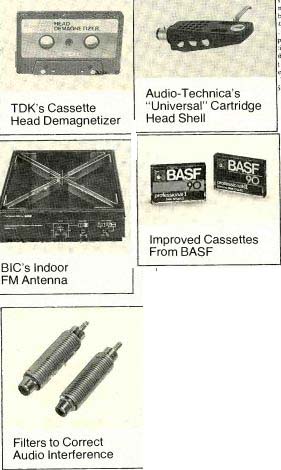
TDK has announced two new cassette-deck accessories, a head-cleaning kit and a head demagnetizer. The HD-1 demagnetizer (shown) is built into a standard compact-cassette case. It is inserted into the deck like a regular cassette and the deck is then set in the play mode; when a red LED on the demagnetizer lights up, the demagnetizing cycle is complete.
The HD-1 is powered by a miniature 1.5-volt cell. Price: about $20.
The head-cleaning kit includes a stiff brush, a cleaning-pad holder, and a dentist-type mirror, along with a bottle of cleaning fluid and a package of cleaning pads. It is packaged in a plastic case the same size as a compact cassette, so it can be stored in a regular cassette rack. Price: about $6.
Filters to Correct Audio Interference
For those with radio-frequency interference (RFI) problems or interference in their a.c. lines, Electronic Specialists offers various corrective filters. There are four basic types, designed for installation on the a.c. line cord or at the antenna inputs (both FM and television), phono inputs, or speaker out puts. The phono filter is essentially a RC circuit that serves as a low-pass filter (to remove RFI); it is said to have no effect on phono-cartridge response. The speaker filter is similar but is designed for higher current levels. The antenna filters come in 75- and 300-ohm versions. Besides the a.c.-line filters to be in stalled on the line cord of the equipment (this type is supplied with its own line cord), units are available for wiring onto the equipment chassis. Prices for the Electronic Specialists filters range from $7.95 for a pair of phono input filters to $17.95 for a three-prong plug-and-socket line filter with surge-suppression circuitry designed for a 350-watt load. Write Electronic Specialists, 171 South Main Street, Natick, Mass. 01760.
BIC is introducing a new indoor FM antenna for high-fidelity systems. Called the "Beam Box," it is shaped and sized like an electronic component (it's about the size of the average integrated amplifier) and contains several dipole antenna elements that afford the user a choice of antenna directionality plus passive-filter circuitry for selectively passing the desired FM frequency to the receiver or tuner. The antenna elements are four aluminum bars arranged in an "X." A switch electrically connects and disconnects them to provide, in effect, four different antenna orientations. For the passive circuitry there is a wide- and narrow-bandwidth switch that operates in conjunction with a tuning dial for fine-tuning the filter. In the "wide" mode the antenna's output contains all FM signal frequencies; the tuning dial sets the center frequency of a resonant LC filter circuit that is switched into the signal path when the bandwidth switch is set to "narrow." This limits the antenna output to a frequency band 3 MHz wide, centered on the desired FM-station channel. Gain in the narrow-band position is-5 dB referenced to a standard dipole.
The Beam Box has both 300- and 75-ohm outputs, and the standing-wave ratio in the narrow-band mode is 1.5 to 1. It measures 4 1/2 x 14 1/2 x 14 3/4 inches and weighs 8 1/2 pounds. A 44-inch length of 300-ohm antenna line with spade-lug connectors is provided. Price: about $90.
Audio-Technica's Model AT-N is a cartridge head shell designed to fit many Europe an and virtually all Japanese tone arms. It is intended for audiophiles who use more than one phono cartridge and interchange them frequently; users can mount all their cartridges on individual head shells and change cartridges simply by switching head shells.
The AT-N is a standard light-weight cut-away design with a finger lift on the side. Price: $5.95. Write Audio-Technica U.S., Inc., 33 Shiawassee Avenue, Fairlawn, Ohio 44313.
E7 BASF has announced the introduction of its new Professional I and II cassettes, the former utilizing a ferric and the latter a chrome tape. The Professional I tape is designed to operate optimally at the recording-bias level common in most Japanese cassette equipment. Thus, it is claimed to pro vide improved performance with the majority of popular cassette machines.
The Professional II chrome cassettes are claimed to offer advantages in noise level and high-frequency response over other chrome-biased formulations. Prices for the Professional I series are $3.29 (C-60), $4.79 (C-90), and $6.29 (C-120); Professional II cassettes list at $3.49 (C-60), $4.99 (C-90), and $6.49 (C-120).
-----------------------------------
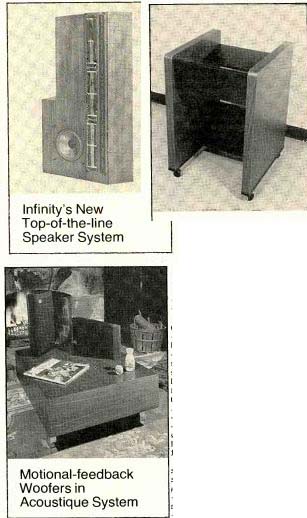
Infinity's New Top-of-the-line Speaker System
The Quantum Reference Standard is Infinity System's new top-of-the-line speaker system. It makes use of Infinity's "electro magnetic-induction" drivers for both the mid and high frequencies. The familiar electro magnetic induction tweeters (EMIT) are now joined by mid-range drivers, called EMIRM (electromagnetic-induction ribbon mid-range) of similar design. These mid-range units em ploy a low-mass Mylar diaphragm suspended in a magnetic field; the diaphragm has an aluminum ribbon bonded to it that serves in place of a voice coil. The QRS has three of these mid-range units arranged in a 5 1/2-foot vertical column; they radiate both front and rear. It uses twenty EMIT units, thirteen on the front baffle and seven on the rear of the enclosure.
The front-mounted tweeters are arranged vertically next to the mid-range units. The woofer is a 15-inch version of the Infinity/Watkins dual-voice-coil woofer mounted in a sealed enclosure. Crossover frequencies are 100 and 4,000 Hz.
The QRS cabinet is a modular design; the woofer enclosure is isolated from the baffle that supports the mid- and high-frequency units. This baffle-board is connected, with piano hinges, to two side panels that can be swiveled to the rear through as much as 90 degrees (they are not normally set this far back in use). These panels can be used to alter the stereo imaging, since their positioning changes the system's dispersion pattern at mid frequencies.
The frequency response of the QRS is rated at 18 to 32,000 Hz ±2 dB. Response drops 2 dB at 60 degrees off-axis on either side of the baffle...The system is meant to be bi-amplified;
suggested minimum inputs are 150 watts per channel for the woofer and 100 watts per channel for the mid- and high-frequency units. Infinity provides an active crossover to be used with the amplifiers. Nominal impedances of the woofer and mid- and high-frequency units are 4 ohms. The QRS has dimensions of 6 1/2 x 4 x 2 feet and weighs about 325 pounds. The speakers, sold in pairs, are hand made and must be specially ordered. Price: $6,500 per pair.
Motional-feedback Woofers in Acoustique System
Acoustique 3A International--or 3A for short--a loudspeaker manufacturer head quartered in Montreal, has introduced its Tri-phonic system: a bass module constructed to look (and serve) as a coffee table plus two small mid-range and high-frequency "satellites." The bass module consists primarily of four "acoustic-pressure-feedback" woofers and the associated feedback electronics, as well as a 150-watt mono power amplifier. The module accepts the output of the regular sys tem power amplifier and routes it through a two-way dividing network; frequencies above the bass crossover point (which is adjustable from 80 to 150 Hz) are directed to the two satellite speakers, while the bass portion of the signal goes to the woofer circuitry. The two bass channels are combined after the crossover and the resulting mono signal is amplified from its attenuated form by the Triphonic's power amplifier, the output of which drives the four 10-inch woofers. These drivers are governed by a motional-feedback system, employing circuits that sense the motion of the voice coils and use the result to develop a "correction signal" that is fed back to the amplifier inputs to improve the linearity of the bass-reproducing system. An analog computer in the feedback path alters the correction signal to make it representative of true acoustic-pressure response. The bass module has adjustments for the output level of the woofers as well as the input sensitivity of the mono amplifier. It also has a built-in microphone that can be used in conjunction with a pink-noise source to balance the acoustic outputs of the bass module and the satellites. Each satellite speaker is a three-way system with a 5-inch lower mid-range, 2-inch dome upper mid-range, and a cobalt-ribbon tweeter.
The frequency response of the complete Triphonic system is rated at 20 to 40,000 Hz ±3 dB. Bass distortion is under 1 percent for a sound-pressure level (SPL) of 92 dB at one meter. The woofers will develop between 86 and 100 dB SPL with a 1-watt input at 1 meter (their sensitivity is adjustable). The satellites produce a 94 dB SPL at 1 meter with a 1-watt input. Distortion of the satellites is rat ed at under 0.5 percent. The entire system can be driven by an external amplifier with as little as 15 watts per channel, since this power is used only to drive the satellite speakers.
The bass module measures 14 x 35 x 30 inches and is available in several finishes: black Chinese lacquer, walnut, and maple. The two satellites measure about 18 x 8 x 4 inches and are finished to match the bass module. Price of the complete system: about $1,300. Other small speaker systems can be substituted for the 3A satellites at the user's discretion.
Rack-It Industries' Equipment Cabinets
Rack-It Industries has introduced three new equipment cabinets, two for housing electronic components and one for tape machines. The two electronic-equipment cabinets are each about 46 3/4 inches high and 18 inches deep; one model has adjustable shelves for positioning non-rack-mounting equipment, the other has a standard 19-inch width and tapped screw holes for rack mounting. The shelving cabinet has three shelves (plus top and bottom panels) and can accommodate equipment up to 24 inches wide (its exterior width is 27 inches). The rack-style cabinet holds a stack of equipment up to 38 1/2 inches high (this corresponds to twenty-two standard 1-3/4-inch EIA rack spaces); exterior width is 22 inches.
The tape console (shown) will support any open-reel tape machine in a semi-horizontal position. Underneath the deck platform is an additional shelf for storage. Dimensions are 33 x 24 x 24 inches. All three cabinets have walnut-finish Formica side panels and are mounted on 2 1/2-inch ball-type casters.
Shelves are constructed of 3/4-inch birch ply wood. Price: $180 each.
AES Journal's Centennial Issue O The Centennial Issue of the Journal of the Audio Engineering Society, covering October/ November 1977, is being offered to the general public. The oversize 335-page issue contains a wide range of review articles on all aspects of audio. Articles are grouped into the general areas of Historical, Technology, Industry, Innovations, and Individuals in Audio. Each of these major sections of the issue includes from three to thirteen articles authored by such well-known industry figures as Harry F. Olson and Robert Moog. Illustrations, both photographs and drawings, are plentiful. A sampling of article titles includes: "Emile Berliner, Eldridge Johnson, and the Victor Talking Machine Company," "Record Manufacturing: Making the Sound for Every one," "Home Music Reproducing Equipment-Performance and Styling," "The Graphic Arts and the Record Industry," "The Audio Engineer-Circa 1977: What Does He (or She) Do?" and "Electronic Music." The issue also contains a listing of the recordings donated to the White House Record Library by the RIAA. It is available from Special Publications, Audio Engineering Society, 60 East 42 Street, New York, N.Y. 10017. Price: $20 hardcover, $8 soft-cover.
B&W Speaker Has Top-mounted Dome Tweeter
B&W's new DM-7 is a two-way loud speaker system utilizing a 2-inch hemispherical dome tweeter and an 8-inch active woofer with an 8-inch passive radiator. The tweeter is mounted on top of the enclosure on a special molded base intended to alleviate diffraction problems. Designed for high power handling and rapid transient response, it is a high-sensitivity driver with a resistive attenuator de signed to accept large inputs. The woofer and tweeter cross over at 3,000 Hz. The DM-7 has a control that allows the user to select one of several response contours provided by "weighting" circuits. The cabinet, construct ed of 1-inch laminated particle board, is mounted on an 8-inch pedestal; the speaker baffles are molded plastic.
The on-axis frequency response of the DM-7 is 50 to 20,000 Hz +2,-3 dB. Response is flat within 2 dB through a lateral angle of 40 degrees and a vertical angle of 10 degrees.
Harmonic distortion is under 1 percent from 40 to 20,000 Hz for a 95-dB sound-pressure-level output, which the speaker produces with a 10-volt input (equivalent to 12.5 watts into 8 ohms). Minimum recommended amplifier power is 50 watts per channel, and the speaker may be used with amplifiers rated as high as 200 watts per channel. Fuses are provided both for the system as a whole and the tweeter alone. The DM-7 measures about 35 1/2 x 10-3/4 x 14 1/2 inches and weighs about 66 pounds. Price: $49.
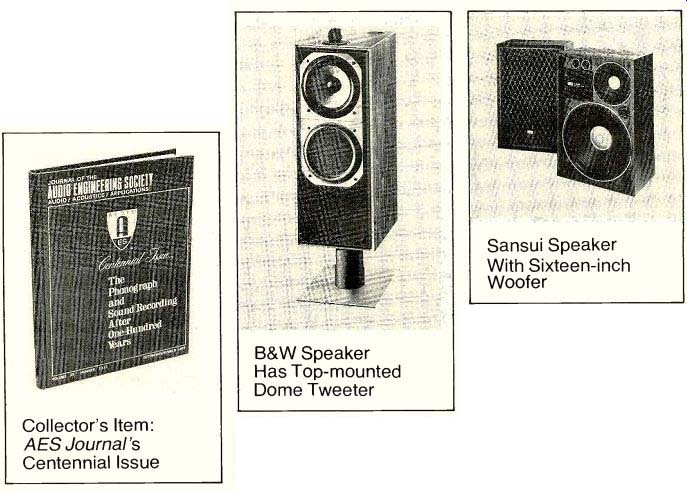
Sansui Speaker With Sixteen-inch Woofer
The SP-X9000 from Sansui is a new four way bookshelf-size speaker system employing a 16-inch woofer in a bass-reflex enclosure. Other drivers include an 8-inch mid range, two horn tweeters with 6 x 2-inch mouths, and two 1 3/4-inch horn-loaded "super tweeters" with Mylar diaphragms. Crossover frequencies are 1,000, 6,000, and 10,000 Hz.
The system has a three-position level control for the tweeters.
The SP-X9000 has a frequency response of 25 to 23,000 Hz +5,-7 dB. A 1-watt input produces a sound-pressure level of 100 dB at I meter (this is very high efficiency). Maximum program power input is 220 watts per channel, and the nominal impedance is 8 ohms. Approximate dimensions are 26 1/2 x 17 3/4 x 11 inches, and the speaker weighs about 47 pounds. The cabinet is finished in simulated-walnut veneer and has a hand-made grille. Price: $350.
NOTICE: All product descriptions and specifications quoted in these columns are based on materials sup plied by the manufacturer.
Recent fluctuations in the value of the dollar will have an effect on the price of merchandise imported into this country. Please be aware that the prices quoted in this issue may be subject to change.
Tape Talk

Demagnetizer Danger
Q. Will demagnetizing the heads in the tape part of an all-in-one compact system damage the other sections, such as the tuner, turntable, and phono cartridge? Most "power" demagnetizers warn about keeping other equipment at least 2 to 3 feet away while de magnetizing the tape heads. Does this mean I can't use one?
CINDY LEACH; Fryeburg, Maine
A. So long as you're careful and follow the correct procedure, I don't think you any fear about using a plug-in, a.c. powered head demagnetizer (also called a "degausser") on the tape heads in your com pact system. I've used the most powerful of the hand-held degaussers on all sorts of machines, even in rather close proximity to other equipment, with no ill effects. But care and correct procedure are necessary.
First, be sure your system is turned off so that no transistor in the area will be trying to amplify the intense 60-Hz "signal" being radiated by the demagnetizer. That could cause damage.
Second, remove any tapes to at least an arm's length away from any place the demagnetizer will be (especially as it is turned on or off-see below). The back end of my degausser is recommended as a bulk eraser for cassettes, and while not many models are that strong, this is an obvious precaution.
Third, if the tip(s) of your demagnetizer unit are not already covered by a rubber or plastic material, put some plastic electrical tape over them to prevent the possibility of scratching the faces of the tape heads.
Fourth, hold the demagnetizer about an arm's length away from the recorder (or any thing else susceptible to magnetic fields) when you turn it on (or off). At the moments of turn-on and turn-off the current surge is many times greater than when the demagnetizer is operating normally, and close proximity to a head, especially at turn-off, can impart a magnetic polarization far greater than the one you're trying to get rid of! When it's turned on, slowly bring the de gausses- up to the tape heads, guides, and capstan(s), then slowly move it up and down the exposed faces. Slowly withdraw it to arm's length before turning off its power. In the process, don't bring it near VU meters or pho no cartridges-you don't want them demagnetized. Be assured, however, that the field from the demagnetizer will be concentrated in the immediate vicinity of its pole tip(s), so if you're more than a few inches away from other components that you don't want to demagnetize, they won't be hurt. Just remember to get the demagnetizer physically well away from the deck before you turn it off.
The whole operation should take less than a minute. Professionals routinely "demag" their heads daily and also before starting any important mastering session. For the home user, about every 8 to 12 hours of running is enough-about as often, in other words, as you'd expect to clean flaked-off tape oxide from the heads. Don't neglect the routine demagnetizing chore, however, for a magnetized head will permanently erase the high frequencies on a treasured tape in a single pass.
Tape and Hum Fields
Q. Because of crowded conditions, I have to store my tapes quite close to my recorder. Will the electromagnetic fields from its motors harm my recordings?
VINCENT P. MANDAGLIO; North Plainfield, N.J.
A. I've received quite a few inquiries along these lines, often asking about dangerous hum fields around amplifier transformers, tape-deck motors, and, in one case, a furnace motor! Certainly a strong a.c. field will erase magnetic recordings-that's precisely how a bulk eraser works-and fields of lesser magnitude can effect partial erasure and an increase in print-through. But just where you can safely draw the line and forget about any danger may depend on the specific design of the motors, transformers, etc. in question. A toroidal power transformer, for example, creates much less of an external electromagnetic field than a conventional transformer much smaller in size.
You can draw some comfort from the fact that every time you double the distance be tween the source of an external field and your tapes, the field strength at that distance is one fourth its previous strength. Further, since external hum-inducing fields represent both a loss of efficiency and a potential source of consumer complaints, hi-fi equipment manufacturers usually make an effort to eliminate them.
Also, you can use a tape recorder as a rather reliable "hum sniffer." (You'd obviously need to borrow a second machine to check on your own recorder's motors, however.) Just put your deck's controls in "play" mode (using the "pause" control, if necessary) at a volume level that, if you were playing back a tape, would represent a rather loud but still endurable listening level. If your deck has re movable head shields, remove them. Then move the deck itself around in the vicinity of suspected sources of electromagnetic fields.
If you hear an increase in the hum level, you've found a field. You can establish the hum field's limits by moving the tape deck away again until the hum drops back to its minimum level. It would probably be wise to store your tapes at least that far away from the hum source (whether that turns out to be your own recorder or some other electronic or electrical device).
Headphone Mismatch
Q. I recently bought a pair of high-quality headphones, rated at 600 ohms, for tape monitoring. When I plug them into my recorder's headphone jack, however, they give me less than half the volume I get with my old 8-ohm phones. I wrote the tape-deck manufacturer, and he says I need a 600-ohm matching transformer. Is this true, and, if so, could you please explain?
PAUL BOUVIER; Blackwood, N.J.
A. Since my own tape deck has exactly the reverse problem of yours (it thrives on 600-ohm headphones but won't handle the normal 8-ohm audiophile variety), you certainly have my sympathy! Where you made your mistake, I fear, was in assuming that a "professional" 600-ohm impedance was automatically better than a "home" 8-ohm impedance. The impedance of a headphone, how ever, has nothing to do with its quality (some manufacturers make the same headphone in 8-ohm and 600-ohm models), but relates, in stead, to the kind of headphone circuit in the tape deck that is suitable for driving it. Since audiophiles almost universally use low-
impedance (8-ohm) headphones, the amplifier stage designed for them in a consumer deck will be built to deliver its maximum power only into a low-impedance load. Hence the loss in monitoring volume that you have experienced.
A small "audio-output" transformer de signed for transistor circuits and having an 8-ohm secondary and a 500- to 600-ohm primary could be connected in reverse to match the output of your tape deck's headphone jack to the higher impedance of your headphones.
Stancor, Triad, and UTC make such trans formers, but you'd most likely have to obtain them through an industrial electronics supply house or, alternatively, through a profession al audio dealer. The difficulty is that if you get a transformer good enough in quality to match the performance of the headphones, it's likely to cost nearly as much as a new pair of high-quality 8-ohm phones, and you'll need two transformers-one for each channel! You'll have to decide if it's worth the trouble.
Misleading Specs?
Q. I've noticed that equipment manufacturers seem to rate their products in what ever way is most convenient for them (but not necessarily for the prospective user). For ex ample, a manufacturer may measure the signal-to-noise ratio at +6 dB but the frequency response at-20 dB. Isn't this misleading? Why not record complete sets of data at both 0 and-20 dB?
ED HORST; Cleveland, Ohio
A. If you'll look at the graphs in STEREO REVIEW'S test reports on recorders, you'll find that Hirsch-Houck Labs does mea sure output vs. frequency ("frequency response") at both 0 and-20 dB. However, there ns substantial fall-off in treble response (especially with cassettes) at the higher output level (0 dB) because the tape, and not necessarily the tape deck, is being driven far beyond its capacity. At speeds less than 15 ips, therefore, it is standard practice to rate frequency response with a sufficiently low level signal to insure that the tape is still with in its linear range.
Whether or not this is "misleading" depends somewhat on how much information you expect a specification to convey. The frequency-response spec of a tape recorder is a little like the one-watt frequency-response rating of an amplifier-which is usually far wider than its bandwidth at full power output, but which nevertheless represents the typical performance of the device in practical use.
What I find more misleading is the almost universal practice of saying "±3 dB" when what in fact is meant is " +0,-6 dB."
Exercising Tapes
Q. I have a large collection of tapes. Should I make a point of playing them all through regularly? Will they deteriorate if played only once in a while? If you do suggest making sure to play them regularly, would put ting them through fast-forward serve the same purpose of prolonging tape life?
BEVERLY WESTMAN; Victoria, British Columbia
A. Playing your tapes through occasionally from end to end is a good idea, since the "exercise" involved will dissipate any tensions within the tape pack that may have developed over time (and reduce print-through). The need for occasional stress relief of this kind was much greater years ago when most tapes used an acetate-base film that expanded and contracted quite considerably with seasonal temperature and humidity changes. With modern tapes that use a poly ester base material, you really needn't exercise them any more often than you wish to hear them--so long as you keep your tapes at room temperature and moderate tension.
That warning about moderate tension is important, however, for one of the worst things you could do to your tapes would be to run them through on fast-forward (or rewind) and then store them for a long period of time. The fast-winding modes impose high and uneven stresses on the tape pack that, over time, can indeed ruin a tape. If you expect not to use a tape almost immediately, therefore, always leave it in a played, not rewound, condition.
Audio News, Views and Comment
AUDIO IN LAS VEGAS
THE Winter Consumer Electronics Show (WCES) was held this year in Las Vegas, Nevada, the first and second weeks of January. Traditionally, the trade-only winter show has been on a much smaller scale than the summer one held each June in Chicago, and it has featured a conspicuous diversity of non hi-fi products such as calculators, watches, electronic games, and portable radios (the summer show, on the other hand, looks more and more like a hi-fi exhibition every year).
However, the new site with its expanded facilities evidently inspired audio manufacturers to an unprecedented level of participation, and there were a number of significant new-product introductions.
Some highlights:
Receivers. At 270 watts per channel, the Pioneer SX-1980 is now the world's most powerful receiver. But since Pioneer representatives at the show predicted that its out put capability would be surpassed by some other manufacturer at almost any moment, it is evident that the power race is still on. Three other receivers, ranging from 185 to 80 watts per channel, were also introduced by Pioneer. The SX-1980 has a "nationally advertised value" of $1,250. The others are quoted at $900, $700, and $550.
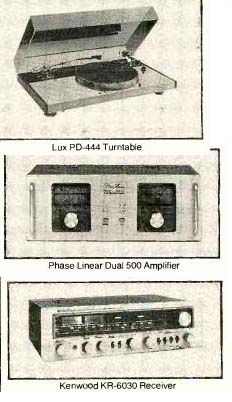
Sansui is up to 220 watts per channel with its latest addition to the G Series, the G22000, which has a power-amplifier section that detaches for installation convenience. Ken Kenwood KR-6030 Receiver wood's receiver introductions numbered three: the KR-6030, KR-5030, and KR-3090, at 80, 60, and 26 watts per channel, respectively. Prices are $500, $400, and $250. Sony's STR-7800SD (125 watts per channel) incorporates Dolby noise reduction for FM and a newly developed low-noise transistor in its phono section. Sherwood's two latest, the S 110CP (100 watts) and S-75CP (70 watts), come with credentials testifying to the performance of each individual unit. Sanyo now has receivers providing 120 (Model JCX2900K) and 85 (Model JCX2600K) watts per channel, priced at $570 and $470, respectively. And Philips is now providing black front panels for four existing models, all of which bear a "I" suffix to indicate the new look. The Class-G series of Hitachi receivers has been expanded by the addition of the SR 804, rated at 50 watts per channel continuous power (100 watts peak power) and priced at $400.
Amplifiers. The most provocative new amplifier at WCES was probably the Sony TA-N88, the pulse-width-modulation or "switching" amplifier the company has been promising for some time. Its 160-watt-per-channel rating in a package weighing a mere 24 pounds is good news, as is the low-silhouette rack-mountable exterior design of the device.
Phase Linear has reworked the appearance-and to some degree the electronics-of virtually all its products to stunning effect, as Phase Linear Dual 500 Amplifier well as adding to its line a 500-watt-per-channel power amplifier ($1,350), a $600 reverberation unit, and a new preamplifier. Marantz is making a vigorous attack on transient intermodulation distortion (presumably using the Ottala method of testing), and the result is the Model 300DC power amplifier, rated at 150 watts per channel. Hitachi has announced the introduction of two power amplifiers employing MOSFET output transistors. The HMA 7500 ($500) and HMA 9500 ($1,350) deliver 75 and 100 watts per channel, respectively.
Another MOSFET amplifier (a new trend?), exhibited by Nikko, was rated at 80 watts per channel. And Cerwin Vega announced the formation of its "Metron Group," a line of electronics initiated by a $500 preamplifier Lux PD-444 Turntable and a $550 amplifier.
A large number of integrated amplifiers also made debuts at WCES. Strangely enough, they are lower in output capability, on the average, than the amplifier sections of some of the new receivers.
(125 watts per channel) power
Record Players. The Harman Kardon Rabco ST-7 turntable has now become the ST-8, with a Hall-effect-controlled motor and a number of other modifications. Dual has a new direct-drive turntable, the 621 (under $300), that offers fully automatic operation in a single-play format. A new direct-drive turntable line from Lux is highlighted by the PD-444, which has an unusually wide base that accommodates up to two tone arms, one of which can be a 16-inch model. List price is
$795. The Marantz 6350Q is also a direct-drive machine, with phase-locked-loop speed control referenced to a quartz-crystal oscillator. A less elaborate machine, the 6110, em ploys belt drive. Elac appeared again with a novel drive system using an idler to bring the platter up to speed rapidly and a belt drive that takes over while the record is being played. The Models 830 and 870 both have the feature.
Tape Equipment. Sharp/Optonica continues to intrigue the cassette-deck market with its automated marvels. The company's latest, the RT-3388, not only counts selections on a cassette and cues in whatever program is desired; it also tells exactly what it's doing at all times via a liquid-crystal display that incorporates a 24-hour digital clock. Naturally, the clock is capable of functioning as a timer for recording. And all this, believe it or not, can be had for a mere $350.
Fisher presented a $250 cassette deck, the CR-4025, that can be operated by a hand-held wireless remote-control unit. Also showing new additions to their cassette-deck lines were Marantz, Sony, Sanyo, and Sankyo.
Accessories. The new ADS Model 10 all-digital Acoustic Dimension Synthesizer is a time-delay/reverberation device (approximately $1,000) that includes a built-in stereo amplifier (100 watts per channel) to drive the Model 10 Acoustic Dimension Synthesizer rear speakers plus the rear speakers them selves-a pair of ADS L10's.
It seems that equipment racks and cabinets are becoming an especially popular product category, with Harman Kardon, JVC, Marantz, Mitsubishi, and Sansui joining such al ready established suppliers as Pioneer and Nakamichi. In some cases the racks are being offered exclusively as retail displays at the moment, but it's certain that they will be watched carefully to determine how much consumer interest they attract.
Record- and tape-care accessories are flourishing, encouraging fresh product introductions from Bib, Discwasher, Nortronics, Rob ins, Sound Guard, Metrotec, and VOR Indus tries. as well as bringing new faces such as Memorex (a complete new line of record accessories) into the field. Audio-Technica made another strong commitment to head phones with the unveiling of five new designs, two of which employ the electret-condenser principle. And Sony announced a new configuration for electret-condenser microphones resulting in a diaphragm of exceedingly low mass.
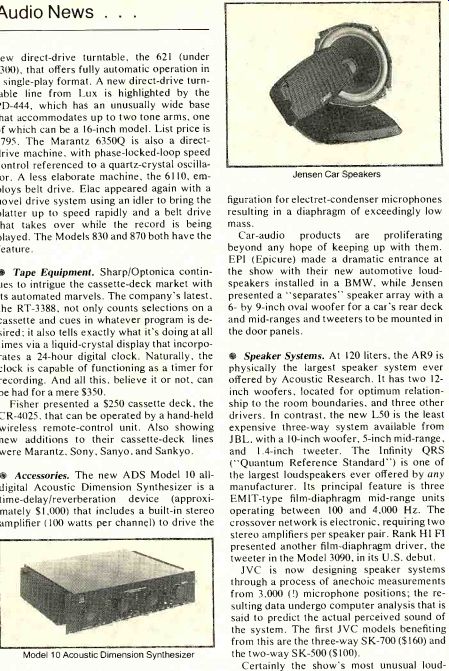
Car-audio products are proliferating beyond any hope of keeping up with them.
EPI (Epicure) made a dramatic entrance at the show with their new automotive loud speakers installed in a BMW, while Jensen presented a "separates" speaker array with a 6- by 9-inch oval woofer for a car's rear deck and mid-ranges and tweeters to be mounted in the door panels.
Speaker Systems. At 120 liters, the AR9 is physically the largest speaker system ever offered by Acoustic Research. It has two 12-inch woofers, located for optimum relation ship to the room boundaries, and three other drivers. In contrast, the new L50 is the least expensive three-way system available from JBL. with a 10-inch woofer, 5-inch mid-range, and I.4-inch tweeter. The Infinity QRS ("Quantum Reference Standard") is one of the largest loudspeakers ever offered by any manufacturer. Its principal feature is three EMIT-type film-diaphragm mid-range units operating between 100 and 4,000 Hz. The crossover network is electronic, requiring two stereo amplifiers per speaker pair. Rank HI FI presented another film-diaphragm driver, the tweeter in the Model 3090, in its U.S. debut.
JVC is now designing speaker systems through a process of anechoic measurements from 3,000 (!) microphone positions; the resulting data undergo computer analysis that is said to predict the actual perceived sound of the system. The first JVC models benefiting from this are the three-way SK-700 ($160) and the two-way SK-500 ($100).
Certainly the show's most unusual loud speaker was that demonstrated by a new company, Plasmatronics. A small quartz cell, open to the outside air through an aperture slightly larger than a postage stamp, is subjected to a high polarizing voltage that creates an environment of ionized (and incandescently hot!) gas. The application of an audio-signal voltage results in sound. The driver demonstrated operates at frequencies above 700 Hz and requires a constant stream of helium bled into the cell from a pressurized tank. The manufacturer says that the standard tank of helium is good for about 300 hours of listening time. And, as an added attraction, the driver glows while functioning with a lovely violet hue that many will find at least as interesting to watch as some standard TV fare. The woofer is a conventional cone driver installed in a large, sturdy enclosure.
This is just a slice of the first (and smaller) CES show. The summer monster will, as usual, be highlighted in these pages in the September issue.
-Ralph Hodges

Audio Basics
DISC EQUALIZATION
IN the earliest days of phono recording there I was no deliberately introduced frequency equalization. With the mechano-acoustical recorders and reproducers in use at the time, studio pioneers were generally satisfied if their results sounded acceptable to listeners on the players that were then available. There was little or no discussion of such niceties as frequency balances. Then electrical recording arrived, and frequency equalization, easily achieved with simple electronic networks, soon came to be universally--and chaotically--applied.
The first disc-equalization scheme to come into widespread use was a straightforward low-frequency attenuation applied during re cording. It was adopted for a very practical reason: by reducing the amplitude of the large side-to-side groove excursions that result from unattenuated low frequencies, it was possible to provide more grooves per radial inch of record surface, and hence longer playing time. Since the public was evidently more concerned with playing time than bass response, this compromise was accepted. And when electrical reproducers became common in homes, tone controls enabled listeners to restore at least some of the bass.
Well and good. But the next development in the recording arts was what might be called "creative equalization," a brand of sonic meddling that raises the hackles of music lovers even today. In other words, the men in the control room began to "adjust" the sound of the record in an effort to "enliven" it for more exciting reproduction on the majority of (usually mediocre) record players. Musical purists and owners of good sound equipment (these are not necessarily mutually exclusive) were understandably upset and began calling for fixed, standard equalization characteristics to be applied to all records worldwide. It took some time, but that is essentially what they got in the 1950's--about a dozen standards, as a matter of fact.
It seems that there were legitimate disagreements among the recording engineers working for the various companies as to the bass turnover and treble rolloff that would produce the best performance from the disc medium in respect to dynamic range, frequency response, noise level, and compatibility with the playback equipment of the day. During the early 1950's it was not uncommon for better equipment to have at least eight positions of record equalization available, and hi-fi magazines used to run charts showing what equalization characteristics were required for the proper playback of each manufacturer's product. In 1953 the recording industry was prevailed upon to accept a single universal standard for disc equalization. The one that applied to virtually all consumer re cords was known as the RIAA standard, and it is the same for 33 1/3-, 45-, and 78-rpm discs, whether mono or stereo. The RIAA characteristic actually defines only the equalization for the reproducer-that is, the machine in the home-on the assumption that the record companies would adjust their disc-cutting equipment to provide the inverse of that equalization, so that the frequency balance would come out "flat" in the end. This was not the safest of assumptions, but it at least enabled record-player manufacturers to begin providing some sort of standard equalization.
The frequency-response "curve" of RIAA standard equalization in reproduction comes close to being a straight line descending at a 6-dB-per-octave rate from 30 to 15,000 Hz. In effect, it provides for a bass boost and a treble rolloff. If the disc-cutting equipment is set up as specified, it will introduce a precisely complementary treble boost and bass rolloff. The bass rolloff is there for the old reason of yielding longer playing time per record side; the treble boost applied during cutting results in an improved signal-to-surface-noise ratio.
The subsequent treble rolloff when the record is played restores flat frequency response and drives the surface-noise level down.
The circuits for RIAA equalization in modern high-fidelity equipment act on the signal coming from the phono cartridge very early in the signal path-usually right in the first electronic stage after the phono-input jack of the receiver or amplifier. Equipment designers have become aware in recent years that the accuracy of the equalization and the way in which it is achieved by the circuit can be responsible for significant audible differences between two amplifiers or receivers that might otherwise be expected to sound identical. When a consumer compares equipment by ear, he will often perceive any audible difference (even a trivial one such as a slight and harmless variation in frequency response) as a qualitative distinction, and he will often make a buying decision on that basis. This poses a dilemma for manufacturers, for it is impossible for them to predict which way the consumer will decide under any given set of circumstances. As a result, much emphasis has been put of late on the "accuracy" of RIAA equalization, meaning that it must con form to the RIAA standard within a very small fraction of a decibel. If a consumer accepts the manufacturer's claim of accuracy, he will presumably interpret any difference he' hears as signifying that the competition's product is less accurate, although there is probably no way he can determine this for certain without test instruments.
Unfortunately, as it happens, it is not especially easy to design a phono-equalization circuit that will be unfailingly accurate with all cartridges. This is because the cartridge's electrical characteristics themselves tend to become part of the circuit, and, as you might expect, there is appreciable variation in these from cartridge to cartridge. In equipment test reports for STEREO REVIEW, Hirsch-Houck Labs checks the effect of several popular cartridges on the equalization accuracy of any phono preamplifier under test. Occasionally there is no change, but in the majority of cases the equalization is altered at the higher frequencies in a definitely measurable and sometimes, audible manner. Rarely is this any cause for great concern; a slight turn of the treble control will almost always eliminate it.
But it is further evidence of some of the trickier aspects of phono-preamplifier design, of which there are several more.
ANOTHER recent concern has been what to do with phono equalization beyond the range of frequencies (30 to 15,000 Hz) the RIAA standard specifies. It might at first seem logical merely to extend the equalization curve out along its existing 6-dB-per-octave slope indefinitely. However, although this is practical at the high-frequency end, it is not for the extreme low frequencies; the bass boost would become preposterous, ridiculously magnifying all the effects of turntable rumble and infrasonic record noise that we would actually like to be rid of entirely. So there is a real need for a bass-rolloff standard in play back equalization to be applied to frequencies below 20 or even 30 Hz. Such a standard has been proposed by a European industry organization (the IEC), but it has not yet been endorsed by the RIAA, despite reports to the contrary. As for STEREO REVIEW, we'd like to see a better standard than the present IEC characteristic, and we'll keep pushing for it.
We'll also keep you in touch.
Installation of the month
By Richard Sarbin
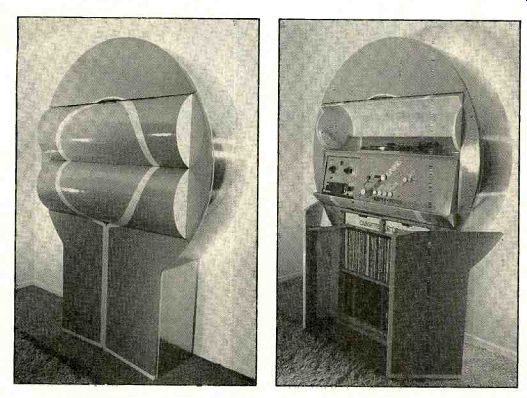
IN designing a visually extraordinary installation for his home in Houston, Tex as, Douglas Colin proved that plebeian equipment-storage problems can indeed find aesthetically noble solutions. Although it may seem whimsical, his unconventional cabinet design is both efficient and convenient. When not in use the unit serves as a striking piece of sculpture that is the focal point of the listening room.
Built of 3/4-inch plywood and finished with a high-gloss enamel, the console stands 7 feet high and measures 5 feet at its widest point.
The curved side panels are made of 1/43-inch Masonite covered with brushed-chrome-finish vinyl; the resulting distorted reflections enhance the overall sculptural effect. The horizontal revolving-drum doors in the center cut from 16-inch-diameter fiber tubing used for pouring concrete columns-are pivoted on ball bearings and balanced with counter weights to provide easy, finger-touch movement. The doors enclosing the record and cassette storage area at the base of the installation are double-hinged to swing out and back, clear of the cabinet edge. At the very top, the semicircular door to the open-reel tape storage compartment is similarly hinged and also spring-loaded so as to open and shut with ease. The overall front design includes curved, cutout areas in both the top and bottom sections that serve as convenient door pulls.
THE highly graphic control panel, labeled with rub-on artist's letters, masks a basic rack-mount system consisting of moderate price components. Appropriately shaped and sized openings were cut to accommodate the various dials and switches regulating program sources. Visible components are a Dual 1219 turntable, equipped with a Shure V-15 Type III cartridge, and a Sony TC 353-D open-reel tape deck. Mounted behind the control panel is a lineup of Dynaco equipment, assembled from kits, that includes a PAT preamplifier, an FM-3 tuner, and a four-channel synthesizer. The panel can easily be removed for ac cess to these components. Two Dynaco power amps, a Stereo 120 and a Stereo 80, are in stalled in the rear of the console, which rests on heavy-duty casters so that it can conveniently be moved or turned away from the wall to get at the amps or wiring.
The synthesized four-channel sound produced by Mr. Colin's setup is heard through a pair of KLH Five speakers (front) driven by the Stereo 180 and two KLH Thirty-two speakers (rear) driven by the Stereo 80. Pro gram sources besides FM include LP's and open-reel tapes recorded from FM broad casts, with a strong emphasis on opera. As the two center slide-out drawers indicate, Mr.
Colin is ready to begin collecting cassettes as soon as he carries through the planned purchase of a cassette deck (which he will install in a slot to the right of the turntable).
DOUG COLIN is a commercial artist, and he has here used his skills to create an outstandingly attractive, yet functional, home installation. Dimmer-control rim lighting outlines the console from the rear, and on the front is painted a perfect circle in school-bus yellow surrounded by white. The circle changes its apparent shape from different vantage points on the room-from 45 degrees off-axis it looks like a super-graphic mouth, leading Mr. Colin to deadpan that his installation, besides playing music, "makes a great conversation piece."
Audio Q. and A.
Stereo Separation
Q. The poor stereo separation in new discs that some readers have complained about is most likely the fault of their loud speakers. I own a pair of true omnidirectional speakers (Design Acoustics D-12's) and the stereo image is clearly defined even if I stand within a foot of one speaker with the other 12 feet away. Older discs were mixed according to the loudspeaker characteristics of the time, and similarly today. A speaker's interface with the listening room produces acoustic effects not necessarily recorded on the disc.
PHIL HARDWICK; Lowrey AFB, Colo.
Q. Stereo records are not losing separation! It is just that producers are more accurately re-creating true spatial effects instead of ping-ponging sound across listening rooms as in the late Fifties. Recent recordings have an even spread of sonic localization. Good ears and headphones may be required to experience it fully. but with them it is evident. What's the fuss? As the Doohie Brothers say, listen to the music (not the separation).
R.K. FORTSON Santa Clara, Ca.
Q. I have been grumbling about the new "wide-mono" LP's for quite a while. Years ago I accidentally hooked up a stereo cartridge with the hot and ground wires inter changed, which made no difference until I switched my amplifier to mono. Then any material that was at the same volume and phase in both channels cancelled and disappeared! I purposely left the wires wrong for a while because I found the results amusing: vocal discs became instrumentals, lead singers vanished, etc. I finally put them right because newer LP's often ended up with nothing left but reverb. Unlike the disc-quality problem, the record companies can't use "economics" as an excuse; it's just a matter of keeping their mixer controls in the right positions to ensure full stereo. Why don't they?
ALLEN DAVENPORT Ogdensburg, N.J.
A. The stylus/groove drawings shown be low will help explain what is happening. In (A), only the left-channel groove wall is modulated and the stylus is moved diagonally up and down. In (B), both the right and left groove walls are carrying information that has generally similar strength and phase. The resulting stylus movement is in the lateral plane and the amplitude of the side-to-side swing is determined by the strength and the frequency of the recorded signals. The louder the signal and the lower the frequency, the greater the groove swing. And the greater the groove swing, the less playing time there is on a disc. Since loss of loudness and playing time are always obvious, while lack of low bass may not be, engineers (who are frequently forced to juggle such factors) tend to sacrifice bass in favor of a louder, longer-playing disc.
Perhaps at this point, some of my readers are getting a clue as to where all this is leading. Drawings (C) and (D) illustrate what hap pens when you have simultaneous strong signals in both channels that are not ,in phase with each other (for example, a loud sax phone on one channel playing against a loud bass on the other). The groove walls then advance toward and retreat from each other.
The effect in playback of (C) is possible groove jumping or "sticking." However, for situation (D), the major problem is in the cutting of the master lacquer disc rather than in the playback of the pressing. When the vertical (out-of-phase) modulation of the signal on the master tape is too great as a result of excessive separation, it may cause the cutter to lift off the surface of the master lacquer or, on the other hand, to cut so deeply that it hits the lacquer's aluminum base material. Either would require recutting the lacquer.
The solution is either to limit the separation during mixdown or to reduce the signal level inscribed on the disc. In other words, there sometimes turns out to be an inverse relation ship between the allowable loudness on a disc and its separation between channels. So, in a sense, it does turn out to be, in Mr. Davenport's phrase, an "economic" matter, simply because in general producers believe that louder records sell better.
----------
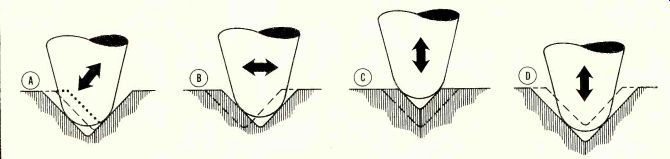
Playback (and cutting) stylus motions for three different types of audio signal. In each drawing the dashed line represents the position of the unmodulated (no signal) groove wall and the stylus is shown in one of its full-modulation positions. In (A) the left-channel signal has caused the stylus to move diagonally downward; on the next part of the audio-signal cycle the groove wall will probably be in the position indicated by the dotted line. In (B) the signal has caused the stylus to shift to the right without varying its depth. The shallowness of the cut shown in (C) and the depth in (D) are two results of strong, well-separated (that is, different or out of phase) stereo signals. To avoid excessive depth or shallowness in cutting the master lacquer disc for stereo records, engineers today often reduce the degree of separation between the left and right channels rather than cutting signal strength.
---------
Sound Taste
Q. Recently, I told a friend that I had built my own speakers from scratch. He immediately asked "How flat are they?" My question is this: are we getting so wrapped up in specs that we forget about our basic goal good sound the way we like it? I spent over fifty hours building my ported speakers so I could have a lot of bass the way I like it. Now, I know a lot of "sophisticated" audiophiles are out for fiat reproduction and take a dim view of coloring sound, but I like mine that way. Don't get me wrong; specs and test re ports are definitely helpful, but one should al ways bear in mind that you're putting out money to have sound the way you like to hear it-not as somebody says it "should be."
IVAN Dzombak; Latrobe, Pa.
A. If Mr. Dzombak wrote about choosing shades of paint for his living-room walls or selecting a blend of coffee--or a wife--I would not argue with the subjectivity of his approach-although my tastes would probably differ. Everyone has a right to his own tastes, and "good" in that context is properly defined as that which satisfies. But there is a vital difference between sound production (as with a musical instrument) and sound reproduction (as with a hi-fi system).
When the goal is to reproduce sound, then the reproducing elements must not add any special sonic characteristic of their own. If Mr. Dzombak prefers speakers that produce more bass than is in the original program material, that's his privilege. But I must point out that his speakers, by definition, are not providing high-fidelity reproduction. Fidelity to some original is what hi-fi is all about, and it apparently conflicts with Mr. Dzombak's taste.
For me, "good" reproduced sound, by and large, closely resembles sound that I might experience live. I prefer equipment that has flat frequency response because I find that such equipment is most likely to provide "good" sound the way I like to hear it.
Installation of the Month
I have noticed that STEREO REVIEW frequently runs an "Installation of the Month" feature showing the setups of audiophiles. I would like to know what you need in the way of photographs and information in or der to consider showing my own installation.
CHARLES CUMMINGS; Palo Alto, Calif.
A. To answer Mr. Cummings and others who have inquired: any snapshot (color, black and white, or Polaroid) will be sufficient for us to make a preliminary evaluation of your installation. If it is judged acceptable, you will then be asked to submit a glossy 8 x 10 black-and-white print (or a negative from which one can be made). As for accompanying information, any past "Installation of the Month" can serve as a guide. In particular, we need details on the construction and special features of the cabinets (or whatever you've used), a complete and accurate list of the components, and a few personal notes, such as your occupation, audio background, and interests-musical and other. We also need your address and a phone number where you can be reached during business hours (these, of course, will not be printed).
Although we appreciate systems with well chosen components, it is necessary to point out that "Installation of the Month" focuses on the installation-that is, the special approach taken to house the equipment-not the equipment itself. Address entries (with return postage) to Richard Sarbin, STEREO REVIEW, One Park Avenue, New York, N.Y. 10016.
Technical Talk
By Julian D. Hirsch
The Testing of Tone Arms
FOR purposes of listening or testing, phono cartridges and tone arms are inseparable. Neither can be used or evaluated without the other. At this time, separate tone arms are a relatively small part of the U.S. audio-component market, and almost all record players are sold with an integral tone arm. It seems logical to test them as a unit, and that is what we do whenever possible. In the rare in stances when a tone arm must be tested separately, we mount it on a suitable turntable base.
To measure the performance of a tone arm, a suitable phono cartridge must be installed in it. Generally, record players come supplied neither with cartridges nor with recommendations for suitable cartridge models, leaving the choice up to the user. In our case, the problem is simplified because we need not be concerned with how the cartridge sounds (since it is not being tested), just that it is of good quality and is compatible with the characteristics of the tone arm.
If no suitable cartridge is on hand for testing at the same time a record player is to be tested, I usually install a Shure M95ED, whose compliance and tracking-force requirements are compatible with most record-player arms. It is also relatively easy to install and not unduly fragile. Since I am not trying to establish the performance limits of the cartridge, I use it at or near its maximum force in this case 1.25 to 1.5 grams.
After unpacking the record player, I set it up according to the instructions furnished. In my opinion, the clarity and accuracy of setup instructions and the degree of ease in carrying them out are among the most vital characteristics of any product-especially a record player. An incorrectly mounted cartridge or an incorrectly adjusted tone arm can negate the most sophisticated engineering design. I assume that if I have difficulty understanding-or carrying out-the instructions, it is likely that the average consumer will also have problems.
One of the more critical arm/cartridge adjustments is the stylus overhang, which is the distance the stylus tip extends beyond the center point of the turntable platter. This is one of the key factors (together with the arm length and the cartridge offset angle) deter mining the tracking error of a pivoted tone arm. Since an overhang error of even 1/16 of an inch is excessive, some foolproof means should be provided for mounting the cartridge in the correct position for the specific arm.
A good mounting system might employ some sort of plastic gauge that fits on the shell and provides a positioning reference point.
Equally good is a reference post or mark on the motorboard that the stylus will contact when the adjustment is correct. A reference mark on the side of the head shell or cartridge-mounting slide can also serve, but it re quires more care to ensure proper alignment.
Less convenient is a simplified form of stylus protractor, which is usually a piece of card board, printed with a group of parallel lines and a reference mark, to be placed over the record spindle., If the stylus position is correct, the edge of the head shell will be parallel to the lines when the stylus is placed on the reference mark. (This is essentially what we do when measuring lateral tracking error, but it is not as convenient for setting up an arm initially.) If the only guide to the user of the tone arm is a statement that the stylus should overhang the center spindle by some given amount, the manufacturer has been derelict in his duty, for it is then impossible to make the adjustment with sufficient accuracy to ensure optimum results.
ONCE the arm has been adjusted according to instructions, its tracking error is measured for record radii between 2 and 6 inches. We use a special protractor designed for this purpose. The measurement requires that the arm headshell have a reference edge parallel to the cartridge that can be aligned with the parallel lines on the protractor. If there is no suitable reference, a visual "guesstimate" is required.
Usually the tracking error can be measured within half a degree or less. Dividing this number by the radius gives the tracking error in degrees per inch. Since the distortion resulting from a cartridge's deviation from perfect tangency to the record groove is directly proportional to this quantity rather than to the angular error itself, a simple specification of a tracking error in degrees, without specifying the radius, is meaningless.
NEXT, the vertical tracking force is measured and compared to what the tone arm's own scale says it is. We use a Shure balance for this purpose, since it is easy to use and can be read to within 0.05 gram with ease. In the case of an automatic record changer, this measurement (at a 1-gram setting) is repeated with the arm raised to the height of a full stack of records, in order to determine whether the force changes significantly in this position.
The change can be in either a positive or a negative direction, but if it does not result in a tracking force outside the correct operating range, it can be considered acceptable.
The electrical capacitance of the arm and signal-cable wiring (with the cartridge and shell removed) is measured with a Boonton Model 160-A "Q" meter. By measuring both the capacitance from each "hot" signal lead to ground (with the other channel shorted) and the combined capacitance of the two channels in parallel, it is possible to compute the actual capacitance to ground in each channel as well as the interchannel capacitance (which can affect the high-frequency channel separation of some cartridges).
The effective arm mass, referred to the stylus position, is measured with a special test fixture made for us by Shure Brothers. It is actually a small downward-facing cone loud speaker whose voice coil drives the tone arm through a calibrated spring. When the speaker unit is driven from an oscillator whose frequency is slowly varied between 5 and 20 Hz, the entire arm will begin to move up and down at a resonance frequency determined by the effective arm mass and the spring compliance.
The oscillator is tuned carefully to produce maximum amplitude of arm motion, and that frequency is noted. Given the known physical characteristics of the driver/spring, it is easy to compute the effective mass of the arm-and-cartridge combination.
Since the effective mass will be affected somewhat by the position of the counter weight, the measurement is best made (for comparison between arms) with a standard cartridge and vertical-force setting. This is another reason for our using the Shure M95ED and a force setting of 1 gram as references for arm-mass measurements. The 6-gram mass of the cartridge is subtracted from the computed mass to obtain the effective arm mass. If another cartridge is used, its mass is similarly subtracted (most cartridges have a mass between 5.5 and 6 grams). The probable error in the measurement is about 0.3 gram with a typical record-player arm mass be tween 17 and 20 grams.
THE accuracy and effectiveness of skating compensation can be measured in several ways, and there is no universal agreement on the best technique. I believe that antiskating should be set during the test procedure so that equal distortion is measured in both channels when playing a heavily modulated record.
However, this leaves open the questions of what tracking force to use (with many cartridges, the effect of antiskating compensation is difficult to see above a certain vertical force) and what test record to use for the adjustment (since the amount of compensation required is also a function of recorded level velocity-among other things).
One test disc we have used for some time has 1,000-Hz tones at the very high recorded level of 30 centimeters per second (cm/sec).
Examining the waveforms from the two channels of the cartridge on an oscilloscope, it is easy to see the waveform distortion in the right channel when no antiskating is used. As antiskating is increased, the distortion de creases and eventually begins to appear in the left channel. The correct setting for this velocity is the one that gives equal distortion in both channels. Sometimes it is necessary to reduce the tracking force (modern cartridges being much better than those of a decade ago when the record was made) in order to see distortion in both channels simultaneously.
It can be argued that 30 cm/sec is an unreasonably high velocity for such an adjustment.
For this reason, among others, we currently prefer to use a record (issued by the German Hi-Fi Institute), that has 300-Hz tones record ed with amplitudes ranging from 20 to 100 microns (millionths of a meter). These correspond to velocities of about 4 to 19 cm/sec. In addition to being an excellent test of a cartridge's tracking ability (see our discussion of cartridge testing in the February 1978 issue), the signals on this record provide a very convenient way to set the antiskating. With no antiskating in use, at some velocity a distinct distortion will be heard from the right-channel speaker. Adding some antiskating will cause it to disappear, usually to reappear at the next higher velocity level. By repeating the process, one soon arrives at the correct anti-skating setting for the particular tracking force in use, one that gives approximately equal distortion in both channels.
Either of the above methods will usually re quire a higher setting of the antiskating dial than the tone-arm manufacturer recommends (at least 1 gram higher than the tracking force). This does not necessarily mean that the arm manufacturer is in error, since there is no "right" or "wrong" in the matter of skating compensation. Some cartridge manufacturers, such as Shure, feel that the correct setting is that which gives equal wear on both sides of the stylus tip, and this requires less corrective torque than the equal-distortion condition. But the "wear" criterion is obviously one that is impossible to check quickly and nondestructively.
What about tonearm resonance? The low-frequency resonance (determined by the effective mass of the arm-plus-cartridge and the stylus static compliance) is measured with a Nippon Columbia XL-7001-A test record. A band on this disc has a constant-velocity signal sweeping from 4 to 100 Hz. The amplified but unequalized output of the cartridge is plotted on our chart recorder. If there were no resonance, the trace would be a straight line sloping upward 6 dB per octave as the frequency increases. However, resonances are unavoidable in mechanical systems. Depending on the cartridge and arm characteristics, the bass resonance may take the form of a single or a double peak in the response. The amplitude of the resonance peak(s) can be any where from 3 to 10 dB above the ideal 6-dB per-octave slope line and the frequency any where between 5 and 15 Hz.
To some extent, the resonance curve duplicates the information obtained from the arm-mass measurement (since either the arm mass or cartridge compliance can be inferred if one of these two quantities and the resonance frequency is known), but the measurement also shows the effectiveness of any damping or other anti-resonance measures.
There are other possible tone-arm resonances that are not so easily measured. Various torsional and flexural modes in the arm tube (shaft) can give rise to "glitches" in the measured response curve of a cartridge.
These are almost invariably the result of a very high-"Q" mechanical resonance, which means that they span a very narrow range of frequencies. In fact, unless the graphic recorder is able to draw a curve at a very high speed, it can easily fail to reveal these sharp, narrow-range resonances. Fortunately, they seem to be just as difficult to excite when playing records. Unless the program has appreciable energy in the vicinity of the resonance frequency, the system will ignore the whole matter. I have never heard or seen any evidence that these high-Q resonances pro duce any audible effects.
Certain tone-arm characteristics are best evaluated by actual use. The cueing device should raise the arm smoothly, with no bounce, and should lower it just as gently.
And, as the pickup descends, it should not move outward under the influence of the antiskating torque. The handling "feel" of an arm is very important, especially in a non automatic record player. The finger lift should be easy to hold, and the arm should not tend to "get away" from the operator.
By considering the measured and subjective qualities of a tone arm as a whole, we are usually able to decide whether it is just a reasonably competent arm (as most are), one so outstanding that we would like it in our own systems, or one that is so miserable that we cannot wait to ship it back. It is unlikely that any one measurement or characteristic will qualify an arm for membership in one of these three categories. Rather, it is the overall "feel" of the product that for me determines its value.
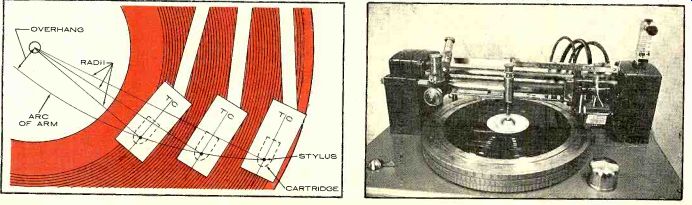
------------- The geometry of record playing is complicated by the use of a tone arm that pivots in an arc. But a properly designed arm can still manage to keep the cartridge's centerline (TC) nearly perpendicular to the radii.
As illustrated by the cutting lathe below, record making involves a scribing device (the cutter head) that moves radially across the disc with its centerline always exactly perpendicular to the disc radius.
NEXT month we will discuss the testing of turntables, another silent (we hope) member of the record-playing team.
The Pop Beat
By Paulette Weiss
FLYING DOWN TO RIO
---------Pop Music Editor Weiss (second from right) at STEREO REVIEW'S Record of the Year Awards party with Warner Bros.' Gary Kenton and Capitol's notorious publicity trio, Doreen () Agostino, Maureen O'Connor, and Kathy Schenker. For more party pictures, see below.
FRED ASTAIRE has sung its praises, Frank Sinatra has crooned of his yearning to re turn, and Peter Allen's exuberant musical portrait has undoubtedly convinced Aunt Myrts everywhere that they ought to pack their bags and head south. It convinced me.
Rio. Rio de Janeiro. The name conjures up exotic tropical images and a distinctive musical sound to go with them. It is a sound that has infiltrated our pop music in ways both subtle and obvious, and if you claim never to have heard any Brazilian-influenced music, I'll bet you one rare Carmen Miranda record that you're wrong.
Ever hear of Sergio Mendes and Brazil '66 (now Brasil '77)? If you're not familiar with the haunting film Black Orpheus, set in Rio at carnival time, or with its soundtrack (Fontana SRF 67520), you may still know its lovely main theme Manha de Carnaval in its English translation, A Day in the Life of a Fool. Per haps back in the early Sixties you heard The Girl from Ipanema in its most popular incarnation, Stan Getz's smooth sax and Joao Gilberto's delicate guitar barely keeping Astrud Gilberto's whisper-light vocals earthbound.
Or perhaps you've heard it more recently, routinely, and mundanely while going up (or down) in an elevator. But there are younger examples as well. Santana's "Festival" (Columbia PC34423),for instance, with its heady Brazilian flavor, or Charlie Rouse's "Cinnamon Flower" (Douglas NBLP 7044). Such artists as Jorge Ben, Airto Moreira, Flora Purim, and Milton Nascimento also contribute to a trickle of Brazilian influence, but it's a much quieter stream than the vigorous one the bossa nova rode northward in the Sixties.
Bossa nova, a refreshing distillation of samba rhythms and American jazz, originated in Rio in the late Fifties. Its creation is generally attributed to its current foremost. practitioners, Joao Gilberto and Antonio Carlos Jobim, but a number of less-publicized composers such as Carlos Lyra, Roberto Menescal, and Oscar Castro-Neves contributed greatly.
American jazz artists started mixing drinks with the zesty import, and Stan Getz, Charlie Byrd, Dizzy Gillespie, and others were soon dispensing the brew to a thirsty North American public.
I was just a little drunk on the stuff myself for a fair portion of the Sixties, and instead of going on the wagon when the supply dwindled in the following decade, I continued to search out a few stubborn suppliers. Despite the fading popularity of bossa nova here in the U.S., record-shop import bins continued to stock al bums bearing names both familiar and new composers Baden Powell and Dorival Caymmi, unheard-of singers Maria Bethania, To quinho, Maria Creuza, Chico Buarque. I was delighted to discover albums for which Vinici us de Moraes sang as well as wrote, and to unearth Tom Jobim. "Aha! a brother of Antonio Carlos," I thought, until a Rio resident
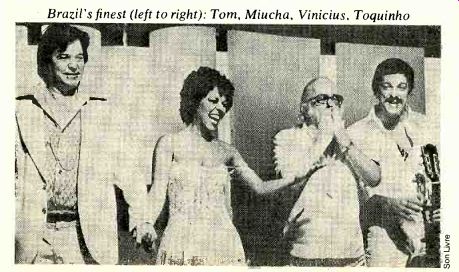
----- Brazil's finest (left to right): Tom, Miucha, Vinicius, Toquinho
set me straight: Tom and Antonio are one person. (Brazilians have deep affection for their musicians and know them by nicknames.) But, no matter how full they were, record bins were not quite the original source my samba-crazed heart required. And so, following Peter Allen's advice, when my baby next smiled at me, we flew to Rio. If the hills of Austria are alive with the sound of music, then every molecule of the air in Rio pulses with it. Children on the beach form impromptu combos and slap out sophisticated samba rhythms on whatever surface is at hand, and music drifts out of open windows. Many TV programs are simply lip-synched visual projections of a singer strolling through a breath taking Brazilian landscape.
It must be admitted that even in Rio, as in so many other parts of the world, American and British rock have bullied the national mu sic into a corner, but although 50 percent of both radio fare and albums in the numerous discos (record shops) are imported rock, there's still plenty of samba and bossa nova to feast on. And feast we did. The night we went to Canecao, a large Brazilian night club, I re called an ancient prayer that consists of the enumeration of a long list of miracles, each one followed by the chant, "It would have been sufficient." Had I not had all the other wonderful experiences that Rio provided, that one dazzling night would have been sufficient.
Picture a club of airplane-hangar proportions-with a stage to match-filled with small tables. I had hoped to see just one famous performer I had grown to love in the States; one would have been sufficient. But when the curtains parted, not only was there a full orchestra and a five-woman chorus visible on stage, but also, arm in arm, Toquinho, Miucha, Antonio Carlos Jobim, and, best of all, Vinicius in his first appearance in Rio in three years. For two and one-half all-too-short hours these most ingratiating of performers ran through a program of old favorites-Corcovado and Garota de Ipanema (Girl from) and instant new favorites--Sei La and Vai Levando--that had me enchanted. You needn't take the word of this starry-eyed observer, for there is a recording of the event, "Tom, Vinicius, Toquinho, Miucha Gravado Ao Vivo No Caneciio" (Son Livre 403.6142) available as an import. The spontaneity of these artists comes through clearly on disc.
FOR some reason, imported Brazilian discs are cheaper in the U.S. than they are at home, a discovery that caused some gnashing of teeth when I returned burdened with vinyl.
Most large record stores in major cities have good import sections. If they don't, import services such as Peters International ( 619 West 54th Street, New York, N.Y. 10019) will fill in the gaps by mail. The major shops in New York City-King Karol, Sam Goody, and others-have a surprisingly extensive coverage of import discs. According to Werner Gerichter of the Forty-second Street branch of King Karol, there are over 1,000 different titles in their Brazilian collection alone. And if Mr. Gerichter's sales figure of three hundred discs a week is accurate, bossa nova and samba are alive and well in New York, if living a bit more modestly than in the past. As if to underline that fact, rumor has it that Frank Sinatra has contracted for a series of concerts in Brazil with none other than Antonio Carlos Jobin. Now that's an event I'd consider returning to Rio for.
----------
Stereo Review throws a Party

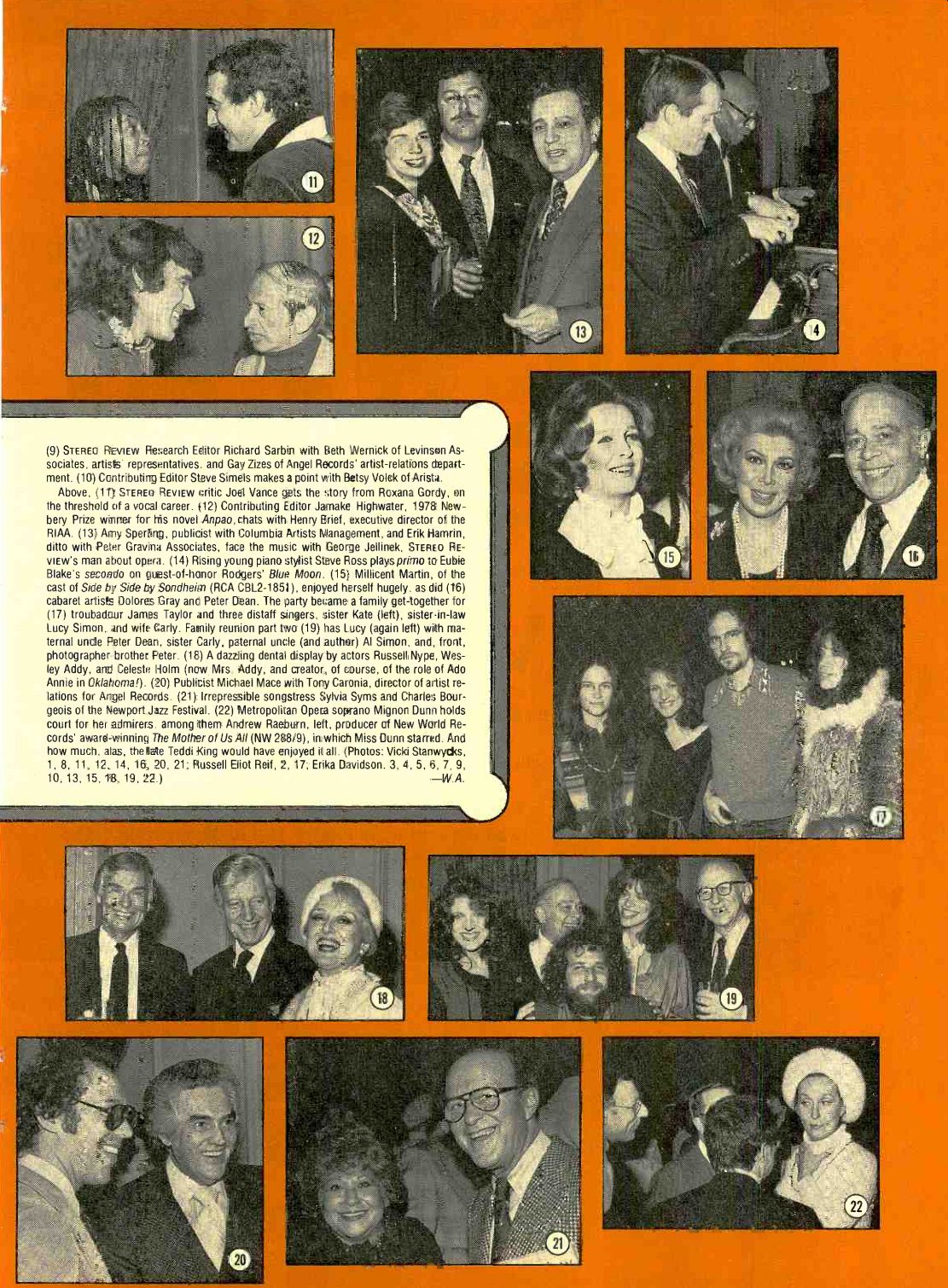
---------
Going on Record
TECHNOLOGY, A FABLE
WAY back when the tape recorder, which had just gotten over being "an invention," was growing out of its toy-contraption stage and about to be come a piece of serious audio equipment, I bought one. As a matter of fact, over the years I bought several--each, I hoped, an improvement on its forerunner. I did with those tape recorders precisely what you might have expected. In my amateur fashion, I ran frequency checks and A-B comparisons on them, tried some on-location re cording, recorded live concerts off the air (better fidelity than records), taped mint copies of my best new records (on tape they would always sound new), taped other people's records (well, I wasn't a millionaire), and so on. In short, I gloried in the technology of the tape recorder, in its ability to deliver to me consistently a sound truer to the original than any but the very best LP records, and those only on their first few plays.
I hesitate to make any general statement on that ability's being then largely theoretical, but in my case it was. Those frequency checks never turned out the way they should have. Of course, I didn't really know how to do them, but still . . . . And I could always tell the difference between A and B. Some times I even actually preferred B, and that bothered me. Those live recordings from FM on my tapes usually seemed to have some sort of an edge to them that shouldn't have been there. And the tape itself! Well, you know tape. What with dropouts and physical mutilations, tearing and stretching, it seemed to me only a marginally more dependable medium than vinyl.
Ultimately I got rid of all my feature-ridden tape recorders and bought a new one, a ma chine more elementary than any of its predecessors. It promised a great deal less and it cost a good deal more, but it worked. Strangely, now that I had a unit that consistently de livered what it was supposed to, I found myself far less interested in technological marvels. I forgot about frequency-response checks, made the requisite one or two live recordings, and still occasionally taped some thing off the air. But what I was really interested in doing was preserving, in easily playable form, the priceless musical performances in my collection (and others I had access to) of genuine low-fidelity 78-rpm records.
I worked like a demon over a period of years and accumulated bookshelves full of those conveniently storable 7-inch boxes with the reels inside containing miles of irreplaceable 78-rpm sound. Then I lent my faithful tape recorder to a friend for what seemed a morally dubious dubbing project, and, when I got it back. something was wrong. I had it fixed by the company and I had it fixed by a resident genius, but the machine had become erratic and undependable. Perhaps it had mo al scruples built into its circuits. It got shoved into a closet, and the last time I took it out and wavering (not to say fluttering and wowing) its way through a professional tape dub of a Brahms Second Concerto that I had to hear.
When cassettes came in, I waited for the dependable machines to appear and then got one. Cassettes were fun and easy to do every thing with but store in some conveniently eye catching way; they were too small for that.
They couldn't be conveniently edited, so I wasn't ashamed at not having spent hours editing them. I recorded what I wanted in hap hazard fashion and played it back the same way. I was happy. But I still had those shelves of 7-inch boxes with the tape reels inside and miles and miles of great music from 78's. And I was as effectively cut off from that music as if I had never spent the thousands of hours I did recording it, editing it, and cataloging it.
What to do? WHILE I was recovering from an illness recently, having no more strength and power of concentration than it might take to push a but ton, a friend happened to leave his new, neat, simple, and working reel-to-reel recorder at my house for a couple of days. My eyes were slow to light up, but when they did they stayed on for longer than they had in a week. I pulled down boxes and boxes of tapes, and then, making the final necessary connection, I pulled from a bag in the closet a dozen blank cassettes. I set to work.
By the time my friend returned to pick up his recorder (it was still warm) I had transferred to cassette (a new technological medium) from open-reel tape (a somewhat older technological medium) the following material drawn mostly from 78-rpm shellac discs (a comparatively ancient technological medium, and some of them recorded acoustically in the dark ages): thirty-six lieder, by such composers as Schubert, Schumann, Wolf, Brahms, and Liszt, sung by Karl Erb, a great German tenor whose elegant style has never been matched (as if any great musician's style could ever be matched); sixteen ballads of Karl Loewe, sung-by such master interpreters of the distant past as the basses Paul Bender and Paul Knupfer and the baritone Gerhard Hirsch (Fischer-Dieskau has not sung them nearly as well); three operas minutes (full op eras averaging about eight minutes apiece) by Darius Milhaud, plus the famous original re cording of his L'Orestie d'Eschyle, with all the exhorting voices and the boom-boom background (ah, those were the days of modern music); a half-dozen French medieval songs sung by a lady who went by the name of Chanterelle (which means either the highest string on a violin, a musical bottle, or a mush room) as if she were some kind of musical emanation from the medieval windows of Chartres; two folk songs sung and accompanied by the composer-conductor-singer-pianist Reynaldo Hahn with the sort of effortless artistic elegance that I think just doesn't exist today; a collection of Welsh songs sung by Thomas L. Thomas (that one came from an LP, but it too is long gone), backed with a much more obscure collection of Welsh songs and dances drawn from a variety of ephemeral 78's; ninety minutes' worth of English madrigals by the Cambridge University Madrigal Society (it was a single huge 78-rpm set); a performance of Mahler's Ninth Symphony by Dimitri Mitropoulos and the New York Phil harmonic, taken off the air, which Bruno Walter was quoted as saying was the most beautiful he had ever heard; Charles Koechlin's L'Abbaye for chorus and orchestra, recorded by the French Radio and once, long ago, broadcast in this country while I sat there pushing the necessary buttons; Georges Witkowski's fascinating 1930's answer to the Symphony on a French Mountain Air, titled Mon Lac, with the composer conducting and Robert Casadesus (no kidding) in the solo part; an hour and a half of assorted master works of the lied by such singers as Fiore Nielsen, Emmy Leisner, Heinrich Schlusnus, Fritz Soot, Michael Bohnen, Hans Hotter, Lotte Schone, Elena Gerhardt, Ria Ginster, and a very young Gerard Souzay; a collection of French melodies sung by Charles Panzera, Jane Bathori, Fanely Revoil, Irene Joachim, Jacques Jansen, and Renee Doria; and a few other things I've temporarily forgotten.
I Love very nearly every one of them, and every one is, in its own way, unique. I don't care what the current technological medium is, so long as it is one in which I can still listen to these performances. And now that I know what technology means to me, bring on your digital recording.
+++++++++++++++++++
Also see:
Source: Stereo Review (USA magazine)