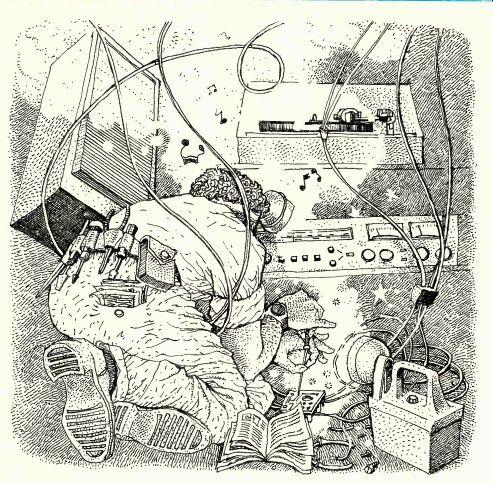
A few clues about what you can
do to keep him away from your door.
By Robed N. Greene
I'm an audio service technician-otherwise known as a hi-fi repairman. What's it like? It's a job like any other, with many ups and downs, a few frustrations, and now and then a laugh. Come along with me on some of my house calls and see for yourself. If you pick up some ideas about how you can avoid paying somebody like me to come to your house, you'll be just that much ahead of the game.
Hum Sweet Hum
One of the nastiest audio-equipment problems there is hum. When it's caused by a circuit malfunction, finding and replacing the offending part is a relatively straightforward process. But when everything appears to be working right it can be a real head-scratcher.
For newcomers to hi-fi, it's worth pointing out that speakers themselves don't hum; they simply let you hear the hum originating elsewhere in your sys tem. The number of ways in which hum can get into a system works out to a total I would prefer not to think about.
The magnetic field around some a.c. carrier, perhaps even the normal house wiring inside the walls, is usually the source, but there's nothing one can actually see or feel, so correcting the trouble is largely a process of trial and error. In one case I remember, the answer all but fell into my lap.
The exact nature of the customer's equipment was unimportant, except that its bass response was good enough to deliver hum in full measure. The hum was reported to be on phono only, a common enough situation since pho no cartridges can be hum sensitive, and preamplifiers have both high gain and equalization circuits that provide considerable bass boost. I half expected to find the record player too near the amplifier or other chassis, one of the common hum sources being the strong a.c. field surrounding power transformers. The cure in such a case requires very little engineering savvy; you just move the components away from each other. (Cassette-deck tape heads can also be sensitive to radiated hum.
Sometimes stacking a deck on top of some other component will introduce hum problems.) In this case, however, I found the record player sitting chastely on a shelf a good three feet from the nearest chassis. Nonetheless, I was able to spot the problem immediately, simply because this owner had made the same mistake I once had in my own system, and it had sat staring me in the face as unobserved as Poe's Purloined Letter. I walked over and switched on his sys tem; a conveniently placed lamp also went on to illuminate the turntable.
Very handy, but it was one of those compact, high-intensity lamps, the kind that uses a 12-volt bulb. And how do you work a 12-volt bulb on a 120-volt line? Right: with a step-down trans former hidden in the lamp base, a small but efficient electromagnetic-hum producer when operated near audio equipment. Enough said? Let's hope you've found this little tale illuminating . . . .
A Little Amp That Couldn't
"My amp doesn't like heavy-metal rock!" I've heard quite a variety of audio complaints, but this was a new one.
Suppressing an urge to observe that the caller's amplifier may have had better musical taste than its owner, I asked for a little clarification.
"Well, whenever I play my Aero smith or Led Zep records the sound just sort of keeps going on and off." From the slightly apologetic tone it was clear this guy expected me to think he was some kind of nut. At one time I might have, but I've learned that audio equipment sometimes does behave strangely under stress, and that even quite straightforward problems can sound a mite strange when described by a technically unsophisticated owner. "What about quieter kinds of mu sic?" I asked. "They seem to play okay; that's what I can't understand." I went through the catalog of standard questions trying to get some handle on this oddity, but the only additional information I got was that the problem occurred with the cassette machine as well, but seldom with the tuner. And the amplifier was an elderly model bought secondhand.
So we set up an appointment for a house call, and a few days later I got to meet this "no rock, please" amplifier in person. It was a name-brand integrated unit of respectable quality, on the low-power side but normally quite adequate for a small apartment. Every thing else was good, standard older equipment; the only items that didn't fit the picture were the new smallish 4-ohm acoustic-suspension speakers at one end of the little listening room. The owner proudly explained that he was upgrading his system and had started with these high-quality but, unknown to him, low-efficiency jobs.
I switched on the power and every thing lit up merrily. The tuner sounded okay, so I put on one of the reference records I carry with me--still good.
Since everything seemed to be working well, I asked the owner to demonstrate his rock problem (my reference discs are, as you may have guessed, not loud rock music). He put on one of his own records and cranked up the bass, treble, and volume so high that just the sound of the stylus in the lead-in groove made me cringe. When the music began it was painfully loud, but mercifully it stopped abruptly after the first few moments, just as the owner had said it would. And, just as abruptly, it came back on for a relatively quiet pas sage, then went off again as the decibel level began to rise once more.
During one of the quiet periods I turned the volume and bass down a bit and the sound returned with a little "click" at the amplifier. It was no longer ear-popping-at-the-Palladium time, but we had sound, and perfectly good sound at that. The customer was right; his amplifier didn't like rock-at least not the way he was trying to play it.
What he didn't realize was that in going to better speakers he had created a problem. His previous speakers had been a different design of much higher efficiency, and he had been able to get ear-shattering volume out of that amp-speaker combination with no trouble (except, perhaps, from his neighbors).
He thought that with better speakers he'd get "bigger" sound, but nobody told him he'd need more amplifier power to continue shaking the walls the way he wanted to. His demand for tremendous volume and bass from his new low-efficiency 4-ohm speakers overloaded his poor little amp, and it protested by triggering its protective) relays. When things calmed down a little and the output transistors were no longer in danger, the amplifier would kick back in until the next high-level onslaught came along and shut things down again.
It wasn't easy to convince the customer that anything approaching live-rock sound levels would require a considerably more powerful amplifier, a switch to higher-efficiency speakers, or both. Of course, he could also leave things as they were and listen at the more reasonable volume and bass levels his equipment could handle. I never heard the upshot of this situation, but I'd be willing to bet it wasn't long be fore our rock fan went out and bought ...
"What the 'experts' had done was to entomb the chassis, virtually guaranteeing that it would self destruct. . .
...the biggest damned amplifier he could afford-and promptly blew out his new speakers.
Hum Again Getting back to the subject of hum, let me tell you about another case that was particularly frustrating to the owner. This was an older gentleman who over the years had put a good amount of money into his system and spent a lot of time listening in his favorite chair. Shortly before the problem arose, he told me, some of the furniture, including that favorite chair, had been rearranged for reasons of decor.
He saw no connection between the furniture movement and his problem and mentioned it only in passing.
And here's the kicker: this poor soul seemed to be the only one who could hear the hum! He had had a few people in to inspect his system, but they claimed not to hear what he found so annoying. At first I suspected that I wouldn't be any more help than the others-I couldn't hear any abnormal hum level, either. There seemed to be nothing but normal system noise. But the man was obviously not a crackpot; if he said he heard something it seemed reasonable to assume he did even though I couldn't. So I left and re turned later with something I don't generally cart around-my oscilloscope.
Hooking it to the speaker leads, I found that there was indeed some extremely low-level 60-Hz hum present. Now that I could "see" the hum I could take steps to minimize it.
In this case it was not the cure that was interesting but the problem (as it happened, connecting an external ground-from the amplifier to a radiator-cut back the hum sufficiently so that it was no longer bothersome). The point is that the man was sensitive to low frequencies while his high-frequency hearing was diminished. The hum had probably been present right along, but it had gone unnoticed until that favorite chair had been moved-right into one of the peak-pressure areas of a 60-Hz standing wave in his listening room. So our customer suddenly had an accident of room acoustics com pounding his peculiar low-frequency sensitivity.
A somewhat related hum incident involves a well-known audio writer (he shall remain nameless) who spent hours one Saturday trying to eliminate a hum that was totally independent of the setting of the volume and bass controls. The problem was solved very late in the day when he noticed that the hum was also independent of whether his equipment was turned on or not. It seems that there was this old art-deco electric clock vibrating on the shelf by his speaker that made its own 60-Hz music without needing any other amplification than that provided by the sounding-board shelf.
Can You Breathe in There?
Our next case doesn't involve any cure but rather some prevention. Some years ago, when I was working for an audio-equipment manufacturer, I had a friend who had just "gone stereo" with a fancy new rig. He didn't do the set ting up himself but farmed it out to a cabinetmaker who supposedly "specialized" in high-fidelity installations.
He might better have done it himself.
The cabinetmaker took the physical dimensions of the various audio components and set about making the furniture based on these figures. Some weeks later they delivered the completed piece and "installed" the components. What I found on going to view this creation was a rather handsome bookshelf arrangement incorporating the receiver, record player, and tape deck, along with a little bar, a desk, and a few other fittings usual in such a piece. As I had suggested, the speakers had been left on long leads to allow for optimum positioning in the room.
The builders had been clever in their use of space; not an inch was wasted.
Decoratively this was fine, but it did create one very serious problem: each of the components had been allotted only the absolute minimum amount of space necessary. The turntable and tape deck were on rollers, so they were okay. But the hot spot-literally-was the receiver. It was slid into a space just barely large enough to house it, and no larger. This cubbyhole was sealed on top, sides, and front; the back was open-but the whole thing stood flush against a wall. What the "experts" had done was to entomb the chassis, virtually guaranteeing that it would self-destruct from its own heat, probably sooner than later.
I of course alerted my friend about it. He was far from happy, but relieved that it had been caught in time. He had run the unit for only a short while, but he had already noticed that the receiver's face-plate became alarmingly hot.
The receiver couldn't be moved to another shelf; it was mounted on a wood panel that couldn't be removed easily. Further, putting it anywhere else would have upset the visual design of the cabinet.
The only way out, short of returning the whole thing for rebuilding, was a piece of surgery that seemed at the time almost sacrilegious. I got out my electric drill and circular hole cutter, pulled the receiver chassis out, and
-------------
WHAT TO DO BEFORE SENDING FOR THE REPAIRMAN
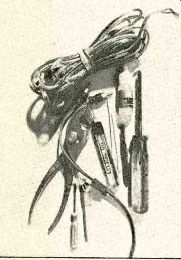
You should, first of all, have your own little troubleshooting kit handy for possible sonic emergencies. It ought to contain several spare sets of shielded audio cables long enough to substitute for the longest cable in your system. In addition, lay in a few spare fuses of each type and value used in your equipment (they will probably all have different amperage ratings and some will be special fast- or slow-blow types; get exact re placements). A length of speaker wire-usually No. 18 lamp cord long enough to reach any of your speakers easily will prove helpful at times too.
As for tools, there should be, at minimum, standard 1/4- and 1/4-inch plastic-handle screwdrivers, needle-nose and regular pliers, a magnifying glass, and a small flashlight.
You may not be able, in any given case, to solve the problem yourself, but you should at least be able to get an idea as to which piece of equipment is at fault and how serious the trouble is. Remember, it's always cheaper to take a part of your system to a repair station than to have a repairman come to you.
Now, as to procedure: step number one is a warning. In the body of the accompanying article you are direct ed to pull the a.c. plugs if you see smoke. That's not a joke. If you see smoke coming from any part of your system, if you smell anything burning or hear crackling or popping noises coming directly from a component, immediately unplug the a.c. leads.
Don't just turn things off-pull the plugs! Then, unless you know what you're doing technically, get professional help.
To zero in on the minor problems, start by determining if the trouble appears on all of the amplifier's input functions-tuner, phono, and so on.
If it doesn't, then the problem is probably in the signal-source component. If it's in one channel only, interchange that component's right and left shielded cables at the amplifier end (in a receiver, of course, there are no tuner-to-amplifier cables). If the trouble changes channels, try re placing the cable from the bad source channel. If that doesn't solve the problem, the source component itself is probably at fault.
If the problem is poor sound on phono, check first for a wad (or even a speck) of dirt on the stylus. Dirt is a prime troublemaker even in quantities too small to be visible. It can be removed with a soft camel's-hair brush and alcohol. Careful-styli are very delicate.
Also check the thin-wire connections to the phono-cartridge pins (these are also delicate). If the cartridge shell isn't easily removable, hold a small mirror under it and illuminate the area with a flashlight pointed into the mirror. Perhaps you'll see a broken lead or a clip that's worked loose.
Don't, however, try to repair or ad just a record player or changer mechanism unless the instruction book so advises. You'll probably aggravate whatever troubles you've got.
IF the troublesome signal source is a tape deck, remove the head cover (if possible) and clean the tape heads with a cotton swab and head-cleaning solution. Don't use the same solution on the rubber pinch-roller unless the instructions give you the okay to do so. The pinch roller (the black rubber puck) can safely be cleaned with isopropyl alcohol (drugstore variety) and another cotton swab. Without any tape in the machine (use a card, or whatever, to fool the automatic cutoff switch into believing some tape is loaded), put the controls in play. Hold the alcohol-dampened swab against the rotating rubber wheel until the black (or brown) stuff stops coming off.
If your tuner seems to be having troubles, check several stations. If most are okay, then you may have a problem with your antenna. Check the connections and the antenna's orientation. If antenna manipulation doesn't change anything, profession al help is probably needed. If only one station is bad, it's probably the broadcaster's fault. This is much more common than you might imagine, and if the trouble appeared abruptly it will probably be cleared up at the source and disappear just as abruptly. Listen to another station until the substandard one gets its act together. If your trouble is spread over half your FM dial but not the other, again, get professional help.
If the trouble appears on all functions, then the fault is probably in the amplifier (receiver) or perhaps one of the speakers. If you have noise, distortion, or silence in one speaker, switch the left speaker cable to the right speaker, and vice versa, at the speakers. If the problem does not move to the other loudspeaker, then the offending speaker is the cause.
Ask the manufacturer for the name of his local authorized repair station; do not call your local repairman.
If the trouble moves to the other speaker (it probably will), then you have either an amplifier or a speaker-cable problem. So, interchange the left and right speaker connections at the amplifier (you have now returned your speaker hookup to the original left-and-right configuration). If the trouble stays in the same speaker, re place the cable to that speaker. If it moves, the trouble is in the amplifier.
THIS should be enough to give you the general idea: it's all an orderly process of elimination. For a more detailed check, get a reprint copy of the article "Hi-ft .Troubleshooting" from the July 1975 issue of STEREO REVIEW. It includes an elaborate troubleshooting flow chart that covers just about everything the average audiophile can do for himself in the event of system trouble. And if you can't fix it yourself, the information provided can at least help you deter mine which component is at fault, and that's half the battle. The reprint is available for $1 from Stereo Re view Reprints, P.O. Box 278, Pratt Station, Brooklyn, N.Y. 11205. Ask for reprint No. 9.
And last, but by no means least, the manufacturer is the best source of advice about where and how to get your equipment repaired. It's usually worth investing in a long-distance phone call, if need be, to get the in formation directly, correctly, and especially-fast.
--------------

". . . just avoid panic and take the time to think things through." drilled a series of large air holes through the shelves above and below it.
This would permit the chassis to ventilate itself as it was meant to do. Fortunately, the holes were inconspicuous after the raw edges were stained. The patient recovered without the trauma of major surgery.
I've actually thrown you a bit of a curve with this story. The incident took place years ago, and the receiver involved was a tube unit. However, though transistorized equipment of a comparable size will be much cooler in operation, the same rules of ventilation apply. Most solid-state equipment develops some heat-the large amplifiers and receivers a great deal-and the transistors themselves, unlike tubes, are heat sensitive.
So don't you put yourself in the position of having to drill holes in a nice new piece of furniture. And even if the top of your solid-state unit doesn't seem to get very hot, don't use it as a convenient surface to stack magazines or-especially-records !
Got the Shakes?
As long as I'm on the subject of the potential interaction of audio equipment and furniture, I'll cite another ex ample. This time the complaint was about a blurring of sound when records were played at high level. Over the years, I've learned to distrust customers' descriptions of their problems somewhat, so I was prepared to en counter almost anything. It could have been, for example, that the so-called "blurring" was actually present all the time but not obvious except at high levels. In that case, the cause could be something along the lines of a worn stylus (or one with dirt stuck to it), poor tracking (for any of a variety of reasons), turntable flutter, or you name it.
* * A little aside here: in the previous case history, I spoke of the importance of having the speakers separate from the cabinet to avoid creating what would in effect be a console. Why the avoidance of consoles? For one thing, they don't permit proper placement of speakers for best performance in a given environment. Another is even more important: the engineers who de sign the equipment that goes into these pieces of furniture usually have a serious-and unavoidable-constraint placed on them: the system's bass response must be severely restricted. As the speaker goes lower in frequency, its vibrations become coupled to the cabinet, which in turn couples it to the record player. The only vibration that should be present in any record player is that of the stylus as driven by the record groove; anything else will be superimposed on the desired stylus vibration, causing signal distortion or noise.
Carried to an extreme, this extraneous vibration, as reproduced by the speakers, will be returned to the record-player stylus, then back to the speakers, and so on. In a mild case of such acoustic feedback, there may be a sort of "twanging" quality to the music; in severe cases there will be a loud howl whenever the volume is turned up. By restricting the bass, the designers can minimize the acoustic-coupling problem, but at the cost of sonic fidelity.
All turntables have some kind of built-in provision to help avoid acoustic feedback, a suspension system of one sort or another designed to isolate the turntable and tone arm from the vibrations taking place in the rest of the world. These suspension systems are effective to varying degrees. With some, virtually nothing short of an earthquake will get through; others can be triggered into vibration by a loud bass passage.
* * * But back to the case at hand. The owner's description had been accurate, and the problem was indeed acoustic feedback. Everything hadn't been built into one cabinet, but there was a connection, if a less obvious one, between the speakers and the turntable. The speakers, excellent bass reproducers, stood on shelves attached to a wall.
The turntable was some distance away, but on a cabinet attached to the same wall. That wall, then, was the connecting link and the transmission path for the vibration that was blurring the sound.
I ran a quick check of the equipment to be sure there was nothing else wrong (there wasn't) and then proceeded to try to eliminate the lack of clarity (the low frequencies, especially, were muddy). A problem of this kind can be at tacked from either one end of the sys tem or the other; either the speakers or the record player can be isolated sometimes both. As long as the feed back link is broken, how it's done usually comes down to a matter of convenience. In this case the record player was easier and more practical to move than the two fifty-pound speakers.
Foam-rubber padding under the turn table frequently does the trick, but this isn't something one carries around. I stole a flat foam cushion from a chair and put it under the player. It was a little wobbly, but it made the point-the lows were now hard and tight.
Another way of defeating acoustic feedback is with dead weight rather than padding; the heavier anything is, the less subject it will be to vibration. I ran extension cables from the turntable and placed it on a heavy chest standing nearby. This also worked.
As a final double check, I put every thing back the way it had been and gave it another try-the muddiness re turned. So the diagnosis had been made; the customer had been shown the problem and ways to correct it. He could now get something more appropriate in the way of an isolating mounting (Netronics and Audio-Technica have them) or relocate his record player. Since the end result would be the same either way, I left the choice to him.
So there you have a handful of examples of the kind of equipment malfunctions an audio service technician is likely to encounter. If you're thinking that in none of the cases cited was there anything seriously wrong, you're quite right. Not all equipment problems manifest themselves in smoke clouds, blowouts, and depleted bank accounts.
Many of them can be handled nicely by the owner if he'll just avoid panic and take the time to think things through. A reprint of STEREO REVIEW'S "Hi-fi Troubleshooting" and a modest tool kit (see the accompanying box) may be all you need to set things straight yourself.
If you do decide to try it, go slowly, use your head, and, as the old saying so wisely has it, "when all else fails, read the instructions."
+++++++++++++++++++
Also see:
Source: Stereo Review (USA magazine)