++++++++++++++++
By Hirsch-Houck Laboratories
Kenwood KA-7100 Integrated Amplifier
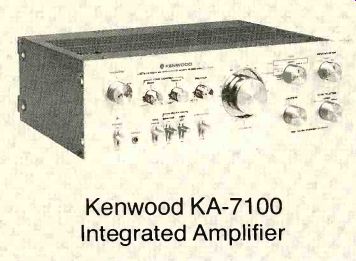
KENWOOD'S new KA-7100 integrated amplifier is a moderate-price product with outstandingly low distortion specifications and ample control flexibility for a well equipped hi-fi system. It is rated to deliver 60 watts per channel to 8-ohm loads from 20 to 20,000 Hz, with less than 0.02 percent total harmonic distortion. The KA-7100 has separate power supplies for its two channels, fed by a common power transformer. The power-amplifier sections of the KA-7100 are direct-coupled.
The dominant feature of the front panel is the large volume-control knob near its center.
It operates a thirty-two-position step attenuator whose detents are so light that one is hardly aware of their presence. The bass and treble tone controls are each eleven-position step controls, and the balance control is lightly detented at its center. Below these are level switches for TONE DEFEAT, SUBSONIC and HIGH filters, and a 20-dB audio ATTENUATOR.
To the right of the volume knob is the TAPE switch, with positions for dubbing from one tape deck to another (but not back the other way) while monitoring the playback output from either deck and for conventional tape playback from either tape deck or a selected program source. The input selector has positions marked PHONO, TUNER, and Mix. Below are the loudness switch, with three positions marked OFF, 1, and 2, and the mode selector, with REVERSE, STEREO, and MONO positions.
Completing the front-panel controls are the speakers switch at the upper left (for driving either, both, or neither of two pairs of speakers), the power switch, and a headphone jack.
In the rear of the amplifier are the various signal input and output jacks, plus a DIN socket duplicating one set of the tape-recorder connections. The speaker terminals are insulated binding posts. The two switched a.c. outlets will take no more than 100 watts of accessory equipment; there is one unswitched outlet. The Kenwood KA-7100 is approximately 17 inches wide, 15 inches deep, and 6 inches high. It weighs 25.4 pounds. Price: $300.
Laboratory Measurements. The FTC pre conditioning period made the amplifier only moderately warm. Afterward, its outputs clipped at 72 watts per channel (at 1,000 Hz) driving 8-ohm loads. The 4-ohm and 16-ohm clipping levels were 95 and 46 watts.
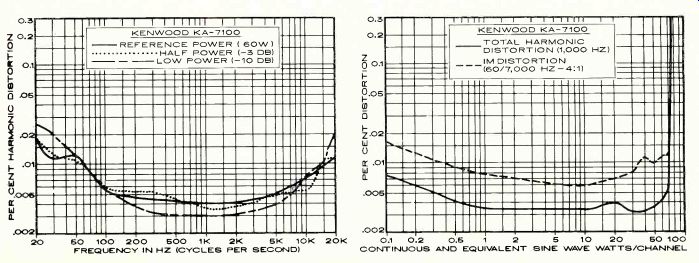
The claimed low distortion of the KA-7100 was confirmed by a considerable margin. At 1,000 Hz, total harmonic distortion was be tween 0.003 and 0.004 percent for all power levels from 1 to 60 watts, and it was only 0.0056 percent at 70 watts, just before clipping occurred. The distortion also rose slightly at very low power levels, to 0.008 percent at 0.1 watt. The intermodulation distortion (IM) was 0.006 to 0.008 percent over most of the power range, increasing to 0.017 percent at 0.1 watt and 0.012 percent at 70 watts.
This low distortion was not limited to middle frequencies. At the rated output and also at lower power levels, the distortion was about 0.005 percent or less from 100 to 5,000 Hz, increasing to 0.018 percent at 20 Hz and between 0.011 and 0.018 percent at 20,000 Hz. The distortion at 20 Hz and-10 dB (6 watts output) was 0.025 percent, but this included inaudible noise components that were comparable to the distortion at that low level.
The input required for a reference output of 10 watts was 61 millivolts at the high-level in puts and 0.95 millivolt at the phono inputs.
The corresponding unweighted signal-to noise ratios were 79 and 76.4 dB, both very good figures. The phono preamplifier over loaded at a very high 260 millivolts.
------------ FREQUENCY IN HZ (CYCLES PER SECOND) CONTINUOUS AND EQUIVALENT SINE WAVE WATTS/CHANNEL
The tone-control action was moderate but perfectly adequate, with a maximum range of ±8 dB at the low frequencies and ± 10 dB at the high frequencies. The filters had gradual 6-dB-per-octave slopes. The SUBSONIC filter reduced the 20-Hz output by 2.5 dB. The HIGH filter response was down 3 dB at 6,000 Hz, and its effect was not much different from that of a tone control.
The loudness compensation used on the KA-7100 is one of the better circuits of its type. Instead of providing for independent adjustment of overall gain and the compensation (the ideal system), it offers two degrees of bass boost at any given volume-control set ting (the highs are unaffected). With either switch setting, the bass boost is much less than is common with loudness circuits, and we found that it could be used without imparting excessive heaviness to the sound.
The RIAA phono equalization was literally ruler-flat, with less than ±0.25 dB variation from 30 to 20,000 Hz, and down only 0.5 dB at 20 Hz. The inductance of typical phono cartridges caused a slight high-frequency rise in phono response at a rate of about 0.7 dB per octave above 2,000 Hz. The rise time of the amplifier (including the preamplifier section) was 2 microseconds and its slew rate was 45 volts per microsecond, both figures representing very good performance for an integrated amplifier of this power rating and general price class.
Comment. We have been observing with interest during the past couple of years the appearance of amplifiers boasting almost un measurably low distortion levels (anything much under 0.02 percent certainly falls into that category). The phenomenon has so far been restricted principally to the higher power and price ranges. The technology responsible for this (we assume it to be the development of improved transistors) has now found its way down to the $300 class of amplifiers, as exemplified by the Kenwood KA-7100.
Although we doubt that there are any audible benefits to reducing distortion from 0.1 percent (or so) to the 0.02 percent or less of this amplifier, what is amazing is that it can be done at all, let alone in such a low-price amplifier. The really impressive thing about the KA-7100 is how effectively it does its job, with nary a sour note-mechanical or audible-to mar the performance of a beautifully engineered product. Someone with $300 to spend would have to look long and hard to find a better amplifier for the money.
++++++++++++++++++
Technics SU-9070 Stereo Preamplifier
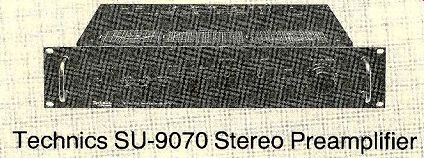
TECHNICS refers to their SU-9070 stereo preamplifier as a "flat" amplifier. This is a particularly apt description, since the SU-9070 is not only physically "flat" (built in the currently popular low-profile format) but is also as electrically flat as one could desire.
It is, in addition, a d.c. amplifier, with no capacitors whatever in the signal path from its high-level inputs to the outputs. However, a second set of output jacks is available with capacitive output coupling.
The SU-9070 is a control center, and an exceptionally versatile one, but it has none of the tone controls and other response-modifying circuits usually available to a user. That role is assigned to a companion graphic equalizer, the SH-9010, which matches the SU-9070 in size and styling. Both are finished in black, with gold panel markings that are surprisingly legible against the dark back ground. The toggle power switch at the left of the panel is followed by pushbutton switches for selecting mono or stereo modes, turning on a subsonic filter (for the phono inputs only), and inserting an external signal-processing accessory in the signal path. The last control is identified as EXT UNIT and the push button connects it either into the preamp's main signal path or into the tape-recording outputs. Although the EXT UNIT is intended to be the Technics SH-9010, it can also be any other type of equalizer, noise reducer, or dynamic-range enhancer. The ability to switch in such a device to modify the signals going to a tape recorder is a valuable one not found on many high-fidelity control units.
Three bar-knob switches select the program sources for listening and tape recording. The REC SELECTOR and INPUT SELECTOR operate completely independently, so any program can be recorded while one listens to any other. Both switches are equipped to handle the tuner and AUX inputs, a phono input, and up to three tape decks. The INPUT SELECTOR al lows one to listen to the playback from any of these decks, and the REC SELECTOR interconnects the machines for dubbing a tape from any one to either or both of the others. It also has an OFF position that removes all input signals from the recorders.
The third knob is the PHONO SELECTOR, which connects the input from one of three pairs of phono jacks in the rear of the SU-9070. One set can accommodate a low-output moving-coil (MC) phono cartridge (for which there is a separate low-level pre-pre amplifier) and the other two take moving-mag net (MM) cartridges. If a high-output MC cartridge is used, it must be plugged into one of the MM jacks.
The remaining controls are a MUTING switch for reducing output level by 20 dB and a concentric VOLUME and BALANCE control.
Balance is handled by a center-detented ring; volume is continuously adjustable. The rear panel of the SU-9070 is well filled with the many input and output jacks plus three a.c. outlets, one of them switched. The metal top cover carries a full set of performance graphs and a signal-flow block diagram of the preamplifier. It also identifies the various rear connectors so that cables can be inserted when the rear labeling cannot be seen.
The specifications of the Technics SU-9070 are both complete and impressive, even by to day's standards. Its salient features are extremely low distortion, typically about 0.003 percent, and art equally low noise level that is achieved by the use of special circuits and some newly developed low-noise transistors.
The Technics SU-9070 is 19 inches wide, 4 inches high, and 14 1/2 inches deep. It weighs 15.7 pounds. Price: $399.95.
Laboratory Measurements. Although the rated output of the Technics SU-9070 is 1 volt into a 600-ohm load, its maximum-output rating is 20 volts into 600 ohms. This corresponds to about 0.67 watt, which is rather un usual, since very few preamplifiers are de signed to deliver significant power output. In our tests, the 1,000-Hz output of the preamplifier clipped at just above 18 volts with a 600-ohm load. It is noteworthy that the distortion remained very low all the way to the clipping level, measuring less than 0.003 percent at any usable output, 0.01 percent at 6 volts, and less than 0.02 percent at 15 volts.
At 15,000 Hz, the distortion was actually slightly lower than at 1,000 Hz. These, and all other measurements, were made at the d.c. output jacks with a 600-ohm termination.
They can be expected to be somewhat better (!) when driving the much higher typical impedance of a power-amplifier input.
The "flat" nature of the preamplifier is illustrated by the frequency response through the AUX input. It was absolutely constant from 10 to 20,000 Hz and down 0.3 dB at 5 Hz (our lower measurement limit) and 0.2 dB at 50,000 Hz. The RIAA-equalized phono response (through a MM input) was very nearly as flat. It was within ±0.35 dB from 20 to 20,000 Hz. The effect of the subsonic filter could not be measured since it occurred principally below 5 Hz (the filter has a 12-dB-per-octave slope starting at 20 Hz). When we measured the phono equalization through the inductance of a typical phono cartridge, it was changed by less than ±-1 dB at any frequency up to 20,000 Hz.
The SU-9070 required 180 millivolts at its AUX input for a 1-volt reference output. The phono sensitivity was 3.1 millivolts (MM) and 0.11 millivolt (MC). The excellent corresponding phono-overload levels were 410 and 10 millivolts.
Measuring the noise level of the SU-9070 was not easy. In fact, we could not verify the ratings, since our meter will not indicate signals of less than 100 microvolts (80 dB below 1 volt). In our unweighted measurements, the signal-to-noise ratio (S/N) was something better than 80 dB at the high-level inputs, about 80 dB at the MM phono input, and 61 dB at the MC phono input. If these figures were "A" weighted to correspond to their audibility (and to the Technics rating system), the first two figures would be completely below our meter's reading range. Therefore, we had to do our noise-vs.-signal evaluation on a subjective basis.
Comment. Let us dispose of that noise question at the outset. With the SU-9070 connected to a 200-watt-per-channel amplifier (which required 1.5 volts input to develop full power) and playing through typical low-efficiency speakers, we could operate all gain controls at maximum, using the MM phono inputs (open-circuited), and, with an ear against the speaker grille, not hear a trace of hiss or any other sound. Through the MC in put, also open-circuited (although its internal resistance is a low 47 ohms), a faint hiss could be heard within a foot or two of the speakers in a very quiet room. In other words, under any practical listening conditions that we can imagine, the SU-9070 is totally noiseless.
Some noise may be heard when the preamplifier is used in a system, but at least there should Ile no doubt as to where the noise is not coming from.
The other performance specifications of the SU-9070 speak for themselves. Its ruler-flat frequency response and almost unmeasurable distortion could be considered a case of "overkill" if the amplifier sold for several times its price. As it is, the relatively moderate-price Technics SU-9070 is an excellent ex ample of what really first-rate design engineers can do with today's techniques and components.
We enjoyed the almost Spartan simplicity of the SU-9070 controls, which were nevertheless as versatile as any we have seen on a control amplifier. Although we never tried to connect three tape decks to it, it was nice to know that the capability was there. The same comment goes for the EXT UNIT facility. The modular design of the Technics "flat" series components makes it practical to incorporate as much or as little operating flexibility as one's preference or budget will allow, while maintaining a uniform (and very high) overall quality standard.
+++++++++++++++++
Visonik DD-8200 turntable
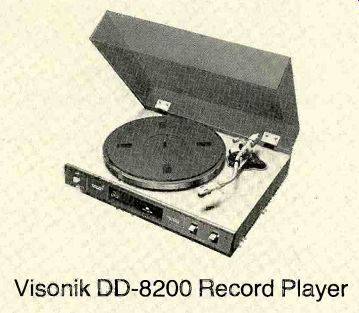
THE DD-8200 is a direct-drive, two-speed record player imported from Japan by Visonik of America, Inc. It is semi-automatic, with the motor coming on when the tone arm is lifted from its rest. At the end of play, the arm automatically returns to the rest and the motor shuts off. The cast platter and its rubber mat weigh 4 pounds. They are driven by a twenty-pole, thirty-slot brushless d.c. servo motor at 33 1/3 or 45 rpm. A vernier speed adjustment covers a ±3 percent range, and an illuminated stroboscope pattern is visible under the platter.
The tone arm is an S-shaped tube with an "outrigger" weight to supply lateral balance.
The tracking-force scale, calibrated from 0 to 2.5 grams at intervals of 0.5 gram, is on the rotating counterweight. An antiskating dial is built into the arm base. The cartridge shell is the familiar plug-in type, with a locking ring and a well-shaped finger lift. The player mechanism is on a black and gray base and has a hinged, clear-plastic dust cover that re mains open at any angle. The entire unit sits on four spring-supported mounting feet.
The DD-8200 has all its operating controls on the front edge of the base, so they are fully accessible even with the dust cover lowered.
A square pushbutton at the left of the panel selects the speed, which is indicated by one of two red signal lights nearby. A recessed window at the center of the control panel pro-vides a full view (by way of a mirror) of the illuminated strobe markings underneath the platter. A horizontal slide control fine-tunes the speed (it affects both speeds, so when one is set, the other is correct also).
Two levers at the right of the panel control the reject and cueing functions. With the CUEing lever up, the arm is raised from the record surface. Pressing it down until it latches causes the arm to descend slowly. To lift the arm, the CUEING lever is pressed down and re leased. Like the descent, the lift is smooth and well damped. At any time during the playing of a record, pressing the REJECT lever will lift the arm, return it to its rest, and shut off the motor. The Visonik DD-8200 is 18 inches wide, 13 inches deep, and 6 inches high with its cover. It weighs 22 pounds. Price: $249.
Laboratory Measurements. We tested the DD-8200 with a Shure M95ED cartridge in stalled; installation was simplified by a sup plied plastic stylus-position gauge. Maximum tracking error was only 0.5 degree per inch at a 6-inch radius, and it was considerably less elsewhere on the record. The tracking force was typically within 0.1 gram of the indicated value when initial arm balance was established on a horizontal plane and within 0.05 gram when it was balanced with the head shell slightly above horizontal.
The measured tone-arm mass was 18 grams, which is typical for most of today's record-player arms. It resonated with the compliance of the M95ED at 8 Hz, with a 5-dB amplitude. The total arm and cable capacitance to ground was 112 picofarads (pF) per channel, and the interchannel capacitance was 15 pF. The antiskating dial calibration was correct, giving equal distortion in both channels when the dial was set to match the tracking force. The cueing device worked smoothly, and there was no lateral arm drift during its operation.
With the strobe dots stationary, the turntable speeds were very slightly fast (about 0.5 percent at 33 1/3 rpm and 0.15 percent at 45 rpm). The vernier control range was ±4.5 percent at 33 1/32 and ±3.2 percent at 45 rpm.
The speeds were not affected by line-voltage changes.
The rumble was-35.5 dB in an unweighted rms measurement and-62 dB with ARLL weighting. The unweighted rms wow and flutter were 0.035 and 0.05 percent, respectively, with a combined reading of 0.06 percent.
Both the flutter and rumble spectra showed little energy above 10 Hz. This is very good performance, typical of the better direct-drive turntables. The base isolation from external vibration was about average for direct-drive record players.
Comment. As the test data show, the Visonik DD-8200 is in every way a fine record player. The same can be said of many others, of course, although many turntables lack such niceties as accurately calibrated antiskating dials and drift-free cueing systems. But the real convenience feature of this machine is the front-panel location of all its controls.
There are a number of other record players whose motors can be switched from the front, but to lift or lower their tone arms one must lift the dust covers.
True, one must still place the record on the DD-8200's platter manually, and one must cue the arm manually at the start. However, from that point on the cover can be closed, with no need to lift it either for a temporary playing interruption or for a complete shutdown of the system. We found the control setup of the DD-8200 decidedly superior, and it was a pleasure to encounter such a well-thought-out design on a fine-functioning player.
+++++++++++++++
Revox B77 Tape Recorder
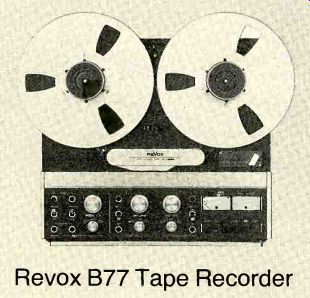
IN two decades on the American hi-fi scene, Revox tape recorders have earned an enviable reputation for quality. Having recently established a new U.S. distributorship, the Swiss-based manufacturer (Willi Studer) has chosen to add his own name to the brand name-hence, the latest Revox recorder is the Studer/Revox B77.
The 1377 might seem to be a logical successor to the long established A77, which it resembles in many respects. However, at least for the time being, both models will be carried in the product line. The B77 is a high-quality open-reel tape deck specifically designed for the discriminating home user. It operates at either 3 3/4 or 7 1/2 ips, selected by pushbutton switches, and the capstan has its own direct-drive, servo-controlled a.c. motor. Separate torque motors drive the take-up and supply reels, which can be up to 10 1/2 inches in diameter. The B77 is available in half-track and quarter-track versions. We tested a quarter-track model.
The upper portion of the dark-gray recorder (with contrasting accents in its aluminum knobs and trim) is devoted to the tape reels.
The hub shafts are 0.25 inch in diameter, so adapters are needed if 10 1/2-inch NAB reels are to be used. Between the reels is the push button-reset index counter, and below that is the head assembly with its snap-off cover. To the right of the heads is a built-in tape-splicing block, complete with pivoted cutting knife.
As an aid to editing, a "cueing" slide switch under the heads brings the tape into light con tact with the playback head so one can locate a specific point either by turning the reels by hand or with the machine in the fast-forward and rewind modes. When the cueing switch is operated, the fast-forward and rewind controls do not latch, so they can be used to shuttle the tape back and forth with considerable precision.
The operating controls of the B77 occupy the lower third of the panel area and are arranged in functional groups. At the left are the MONITOR Controls plus the speed selectors and the power switch. The concentric volume control affects only the level at the two near by headphone jacks (intended for 600-ohm or other medium-impedance phones). The line-
output levels can be set by small control shafts in the rear of the machine next to the line output jacks. The monitor switch channels either incoming signals or the playback-amplifier outputs to the line and phones out put jacks. A small playback-mode switch selects normal or reversed-channel stereo, mono, or left- or right-channel playback through both outputs (this control affects the line outputs as well as the headphone jacks).
The recording controls occupy the central portion of the panel. Each channel has its own level control plus an input-selector switch with positions for low- or high-level micro phones, AUX, and RADIO (for a DIN-level signal source), plus interchannel transfer positions (L to R and R to L) for making sound-with-sound recordings. Each channel also has its own recording safety-interlock switch and a red light that shows when it is in a recording condition. The two phone-jack microphone inputs are located near the switches. On each meter face is a peak-indicating LED that glows red for excessive recording levels.
Finally, the lower-right portion of the panel contains the transport operating controls.
They are light-touch momentary-contact pushbuttons which operate the machine through electrical solenoids and a logic sys tem that makes it possible to go from any mode to any other without first stopping the tape. Normally, the red RECORD button must be pressed simultaneously with the PLAY but ton to make a recording (and, of course, the corresponding recording safety switches must be on). In addition, the B77 can make "flying-start" or "punch-in" recordings while playing a tape, if one holds the PLAY button in and touches the RECORD button at the desired point during playback.
The fast-forward and rewind buttons can be operated sequentially to shuttle the tape back and forth smoothly, and with a little practice the STOP button can be used to halt it at exactly the desired point. The PAUSE button does not latch and must be held in for as long as the recording is to be halted. Thus, it offers little advantage (other than one-finger operation) over using STOP and restarting the tape with both the RECORD and PLAY buttons. However, an optional remote-control accessory is avail able on which PAUSE is a locking control.
The input and output connectors are set into the rear of the machine. They include a line-voltage selector (from 100 to 240 volts) and jacks for the tape-transport and capstan-speed remote-control accessories (the latter makes it possible to vary the tape speed continuously from 2.5 to 11 ips) as well as a slide-projector synchronizer (which requires an electronic module installed in the recorder).
The aux input and line-output jacks, line-level controls, and DIN socket for the RADIO input and output circuits complete the facilities available at the rear of the machine.
The B77 has a folding carrying handle, and it can be operated in a horizontal or a vertical position. However, if tape editing is planned, horizontal operation is preferable so that the playback-head gap can be seen.
The Studer/Revox B77 is 17 3/4 inches wide, 16 1/4 inches high, and 8 1/8 inches deep (slightly greater top and side clearance is required when 10 1/2-inch reels are used). It weighs 37 1/2 pounds. Price: $1,195.
Laboratory Measurements. The Studer/ Revox B77 is factory-adjusted for Scotch 207 tape (we used the very similar Scotch 206 for our tests). Studer believes that the bias controls found on some consumer recorders do not assure best results with different tapes, since the recording equalization is also likely to require adjustment. Thus, the company recommends that the machine be set up for one specific tape by a competent technician using appropriate laboratory instruments.
In our measurements of playback equalization, we used Ampex test tapes: 31321-04 for 71/2 ips and 31331-01 for 33/4 ips. The latter is a 120-microsecond tape, and the B77 has 90-microsecond playback equalization at its lower speed, so we would not expect to get a truly flat response from the Ampex tape. However, the 3 3/4-ips playback response was a smooth, downward-sloping line, varying only ±2.5 dB from 50 to 7,500 Hz (the frequency limits of the test tape). At 7 1/2 ips, the response was within +1,-1.5 dB from 50 to 15,000 Hz.
The record-playback frequency response with Scotch 206 tape was well within Studer's very fine specifications. At 7 1/2 ips, it was within +1, -1.5 dB from 20 to 20,000 Hz at a-10-dB recording level. At 0 dB, there was little evidence of tape saturation under 15,000 Hz, and the response was within +1,-1.5 dB from 20 to 15,000 Hz and down 7 dB at 20,000 Hz. One feature of the Revox frequency-response curve was distinctive-- it had none of the low-frequency "bumps" typical of most tape recorders. This is a function of head design, and Studer has evidently done a very effective job in that department.
The 33/4-ips response at -10 dB was within ± 1 dB from 28 to 15,000 Hz, down 3 dB at 20 Hz and 10 dB at 20,000 Hz. As expected, the 0-dB response at the slower speed showed the effects of tape saturation beginning at about 6,000 Hz. The response was ±1 dB from 30 to 7,000 Hz, down 3.5 dB at 20 Hz and 4.5 dB at 10,000 Hz.
For a 0-dB meter reading, the Aux recording input at maximum gain was only 17.5 millivolts (exceptionally high sensitivity for a high-level input). The microphone sensitivities were 0.053 and 1.35 millivolts, respectively, for to and HI inputs, with respective over load points of 20.5 and 350 millivolts. The playback output from a 0-dB recording level was 0.7 volt at 1,000 Hz. The meter calibration corresponded to the rated 257 nW/m flux level for a 0-dB reading. The peak overload lights flashed at a +5.5-dB level. The meters themselves were overdamped by VU standards, giving a reading that was about 55 percent of steady-state signal level on 0.3-second tone bursts.
The third-harmonic distortion during play back (from a 1,000-Hz, 0-dB signal) was 0.8 percent at 3 3/4 ips and 0.5 percent at 7 1/2 ips.
The reference distortion level of 3 percent was read at recording inputs of +6 and +8 dB, respectively. The signal-to-noise ratio (S/N) referred to these levels was 57 and 61 dB in unweighted measurements for the 3 3/4-and 7 1/2-ips speeds. With "A" weighting the S/N improved to 63.5 and 68 dB, and with CC IR/ARM weighting it was 60 and 64.2 dB.
At maximum gain through the microphone to input the noise level was 10 dB higher; with the HI input the increase was a negligible 1.5 dB.
The peak flutter reading in a DIN-weighted measurement was 0.05 percent at 3 3/4 ips and
0.045 percent at 7 1/2 ips. These were measured with the Ampex 31336-01 and 31326-01 test tapes. The principal flutter frequencies were 60 and 120 Hz. In fast forward, 1,800 feet of tape was wound in 76 seconds; some thing like 100 seconds was required for the same amount of tape in rewind.
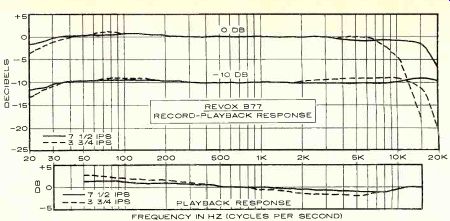
---------- Record-playback response curves for the Revox B77 are shown at levels of 0 and-10 dB, rather than the usual 0 and-20 dB. Note the wide response of the B77 (with Scotch 206 tape) at -10 dB and the absence of low-frequency "bumps" in the curves at either level.
Comment. The Studer/Revox B77 is obviously one of the better home tape recorders, which is no less than we would expect from Studer. Many of its individual performance ratings can be matched by somewhat less expensive machines, but we know of none at a significantly lower price that is the full equal of the B77. It excelled particularly in its very low flutter (it is rated with almost ridiculous conservatism at 0.1 and 0.08 percent for the two speeds) and the flatness of its frequency response, especially at low frequencies. We noted the same conservative approach to ratings throughout the extremely detailed specifications for the B77. It met and comfortably surpassed every spec but one--the previously mentioned VU-meter characteristic.
The B77 is a very easy machine to use, and as one becomes familiar with it the consider able flexibility of its operating controls be comes more apparent. Unlike most tape recorders, the B77 produced a very listenable volume through 200-ohm headphones.
As we see it, the B77 should appeal to the serious tape-recording hobbyist who would like to have many of the qualities of a true "pro" machine without paying the price in dollars, size, weight, and convenience that a real professional recorder would entail. Assuming that the traditional quality standards and ruggedness of Revox recorders have been carried forward into the B77, it should be a very good long-term value.
+++++++++++++++++++
Altec Model Fifteen Speaker System
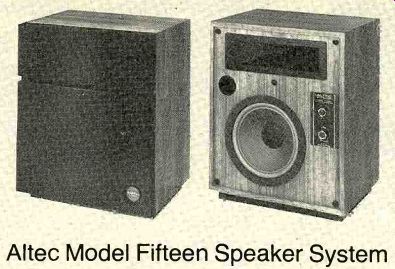
ALTEC'S two top-of-the-line speaker systems for the home, the Model Fifteen and the Model Nineteen, feature a newly developed high-frequency compression driver and horn assembly employing the company's unique "Tangerine" phasing plug. The phasing plug is placed between the driver's diaphragm and the throat of the high-frequency horn to equalize the acoustic-path lengths from all parts of the diaphragm and thus pre vent random acoustic cancellations and reinforcements. The new plug is said to be responsible for a flat output from below 2,000 to beyond 20,000 Hz. The horn itself is a mold ed-plastic curved radial unit in which the driver faces upward. The mouth dimensions of the horn are 14 1/4 by 3 1/2 inches. In the Model Fifteen, which was tested for this report, the new high-frequency unit is teamed with a 12-inch bass driver in a vented cabinet using a ducted port. The crossover from the tweeter to the woofer is at 1,700 Hz.
The cabinet of the Altec Fifteen is finished, in oiled walnut or oak veneers, on all visible surfaces (the input connection terminals are on the bottom, out of sight) including the driver mounting panel, which is exposed by un snapping the foam-plastic grille. The unit can be suspended upside down from wall or ceiling in studio-monitoring applications or mounted conventionally on the floor. A 1 ¾-inch-high wooden mounting base is furnished for optional use in floor mounting.
The system impedance is nominally 8 ohms, and the rated frequency-response range is 30 to 20,000 Hz. As might be expect ed from a system with an obvious studio-monitor heritage, it is very efficient, rated to deliver a 94-dB sound-pressure level (SPL) at a distance of 4 feet when driven by 1 watt of pink noise in the band from 500 to 3,000 Hz.
The wide dispersion of the new radial horn is illustrated by its rating of 120 degrees cover age, uniform within 6 dB, for frequencies be tween 500 and 8,000 Hz in both the lateral and vertical planes. The high efficiency is accompanied by high power-handling ability. The Model Fifteen is rated to handle a continuous 60-watt input of pink noise without damage.
This will produce an acoustic SPL of 111 dB at 4 feet. The speaker is recommended for use with amplifiers rated to deliver between 12 and 250 watts, which encompasses almost all amplifiers made today. Overall dimensions of the Altec Fifteen are 22 inches wide, 27 inches high, and 15 1/2 inches deep. It weighs about 80 pounds. Price: $429.
Laboratory Measurements. The composite frequency response, measured with both balance controls (mid-range and highs) set to their indicated OPTIMUM settings, showed some emphasis in the mid-bass and high frequencies. Alternatively, it could be considered as showing a reduced output in the mid range, since the output at both frequency extremes was about the same. Overall, how ever, the response was within ±5 dB from 25 to 11,000 Hz, rising slightly to about +8 dB at 14,000 Hz. Our microphone calibration does not extend beyond 15,000 Hz, but there was no sign of a falling of output between 15,000 and 20,000 Hz.
One of the most impressive aspects of the high-frequency performance of the Model Fifteen was the wide dispersion of its tweeter all the way to 15,000 Hz. When we plotted the response curves of the two speakers at angles of 0 and 45 degrees relative to the systems' axes, they were exactly coincident at all frequencies above 6,500 Hz. This is unusual, to say the least. In fact, we have never seen any thing approaching such ideal dispersion in a forward-facing speaker (and not always in so called "omnidirectional" speakers).
The mid-range level control had a range of about ±5 dB from its OPTIMUM setting, affecting frequencies between 1,500 and 6,000 Hz.
The high-frequency control range was a mere 2 dB (all reduction) at frequencies above 6,000 Hz. The tone-burst response was good though not outstanding. The close-miked woofer response curve showed that the port radiation was dominant below 40 Hz.
Our sensitivity measurements confirmed Altec's claims. When we drove the speaker with I watt of random noise in the octave centered at 1,000 Hz, the SPL at a 1-meter distance was 94 dB. Such high sensitivity is rarely associated with a speaker whose bass response extends to 30 Hz and below, but of course the Model Fifteen is considerably larger than many home speaker systems, and size is one of the basic trade-offs in establishing speaker bass-performance parameters. The system impedance hit a maximum of 40 ohms at 50 Hz, with the lowest points being 9 to 10 ohms at 22 Hz and between 100 and 250 Hz.
The bass distortion with a 1-watt input was exceptionally low-typically about 0.6 percent from 100 to 50 Hz, increasing very gradually to a mere 4.5 percent at 30 Hz. When the drive level-was adjusted to maintain a constant SPL of 90 dB (at I meter) regardless of frequency, the distortion was essentially the same. Even at a 10-watt input, which produced a very loud output, the distortion was between 1.5 and 2 percent down to 50 Hz, and only 7.8 percent at 30 Hz.
Comment. Our simulated live-vs.-recorded test disclosed a mid-bass warmth (sometimes audible on male voices) and a slightly hot top end. Both effects were consistent with our frequency-response measurements. The highs were excellent, and we found little difference when the high-frequency level control was varied through its full range. We tried to balance the lows and middles by raising the set ting of the mid-range control, but this gave the sound an excessively "forward" character.
On the whole, Altec's "optimum" settings give the best overall sound balance.
In the past, we have reacted negatively to a number of speakers designed for studio-monitor applications. Many of these did not meet the fidelity requirements of a home hi-fi sys tem. We are happy to say that the Altec Fifteen's smoothness, balance, clarity, and just plain good sound are fully compatible with the needs of the serious home listener.
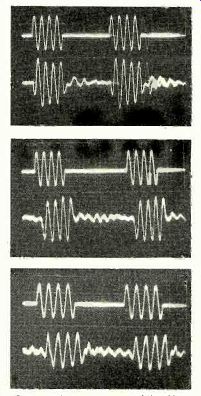
----------- The tone-burst response of the Altec Model 15 at frequencies of 100, 1,000, and 5,000 Hz (top to bottom); lower trace is loudspeaker output.
+++++++++++++++++++
TALES FROM AN AUDIO REPAIRMAN'S NOTEBOOK-- A few clues about what you can do to keep him away from your door
Source: Stereo Review (USA magazine)