BEST RECORDINGS OF THE MONTH: Dexter Gordon: "Great Encounters" Czech Violin/Piano Sonatas, Copland: Music for Solo Piano; Orchestral Suites 3 and 4 , The Pretenders: A Hot Little Group , The Emotions: "Come into Our World"
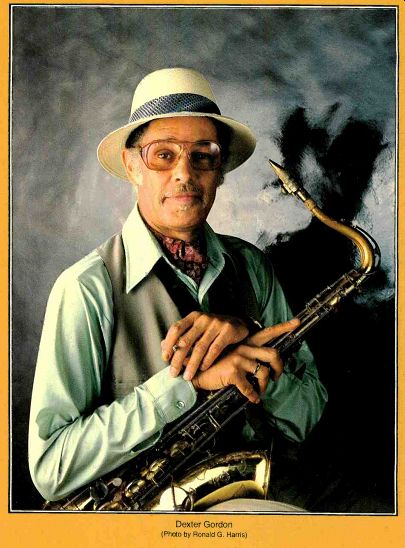
----------- Dexter Gordon (Photo by Ronald
G. Harris)
A Great Encounter with Hornist Dexter Gordon
A CERTAIN amount of jazz of the old, unfused, unadulterated, acoustical kind is always around, of course, but its dedicated players have for some time been seeing progressively fewer new faces in their audiences as the major record companies and the mass media either gave their music a back seat or ignored it altogether. One result of this neglect is that a generation of Americans has grown up believing a lot of second-rate funk to be a modern form of jazz; another has been the migration of some of our finest musicians to Europe, where jazz fans are still prepared to support players who deliver the genuine article.
High-ranking among the jazz men who crossed the Atlantic in search of proper appreciation is Dexter Gordon, now back living in the U.S. If young fans today are finally discovering that horn players who bypass printed circuits and electronic tone generators can lend their own individual, highly distinguishable (and distinguished) voices to music, it is in large measure owing to the push given Gordon by Columbia Records since his return to the States.
Though it is true that we have had some of his peers in our midst all along, any one not seeking out the pleasures of jazz with a single-minded passion could easily move about the country twiddling FM tuner knobs and clicking TV channel switches for a month or more without ever coming within hearing range of their music.
"Great Encounters" is Gordon's fourth Columbia release in as many years, and it captures the now fifty -seven -year -old tenor man in splendid form and in great company. Throughout side one that company is Johnny Griffin, another tenor man who moved to Europe in the Sixties and has recently found a new and responsive audience at home. Tenor duets (or duels, which is perhaps more descriptive of what actually goes on) have been "fought" by Messrs. Gordon and Griffin for many years. They occasionally engaged each other in these crowd -pleasing skirmishes while on the Continent, and both have taken on other formidable opponents in their American past. In fact, Gordon faced another tenor as far back as 1947, when he teamed up with the late Wardell Gray to make, among other marks, a Dial recording called "The Chase," a classic example of the genre. Subsequent Gordon challengers have included Teddy Edwards, Leo Parker, Don Byas, and Ben Webster; according to witnesses, and judging by the recordings that exist of some of these meetings, the score for all of them is just about even.
Griffin is best known for his long association with former Basie tenor player Eddie "Lockjaw" Davis.
It was ...
----
DEXTER GORDON: Great Encounters. Dexter Gordon (tenor saxophone); George Cables (piano); Rufus Reid (bass); Eddie Gladden (drums); Woody Shaw (trumpet); Curtis Fuller (trombone); Johnny Griffin (tenor saxophone); Eddie Jefferson (vocals). Blues Up and Down; Cake; Diggin' In; Ruby My Dear; It's Only a Paper Moon. COLUMBIA JC 35978 $7.98, OJCA 35978 $7.98, JCT 35978 $7.98. ----
... as co-leader with Davis of a foot-stomping, goosebump-producing quintet that Johnny Griffin first gained wide attention in 1960. The Griffin/Davis group lasted some two years, and it was immediately following its breakup that Griffin made his move to Europe.
The present Gordon/Griffin encounter was captured for posterity at New York's Carnegie Hall on September 23, 1978 (coincidentally, the date would have been John Coltrane's fifty second birthday), and it starts off with Blues Up and Down, a tune that was created and recorded (for Prestige) by tenorists Gene Ammons and Sonny Stitt in 1950 and has since become a warhorse of tenor battles. It gets a rousing reading as Gordon and Griffin trade bars in a fashion that makes their repeated quotes from Irving Berlin's Anything You Can Do (I Can Do Better) the most apt of interjections. Here, as on Cake, the Gordon tune that completes the first side of the album, the spotlight remains on the two tenors throughout for a surging display of proficiency, style, and acrobatic grace.
The other half of the album features the same rhythm section as side one pianist George Cables, bassist Rufus Reid, and drummer Eddie Gladden with Woody Shaw, Curtis Fuller, and singer Eddie Jefferson added on two selections, Gordon's Diggin' In and the 1933 standard It's Only a Paper Moon, both of which are heard with special Jefferson lyrics. Sandwiched in between these is the album's only slow selection, a beautiful quartet reading of Thelonious Monk's Ruby My Dear.
Eddie Jefferson was the first to take an improvised instrumental solo and turn it into a vocal vehicle; his special adaptation of a James Moody solo, Moody's Mood for Love, was written nearly thirty years ago, but it still sounds current. These tracks were re -
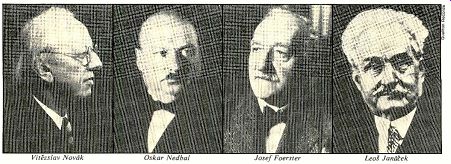
------------ Vithslav Novak Oskar Nedbal Josef Foerster Leos Janethek
corded last year, just six months before Jefferson was murdered in a Detroit incident yet to be fully explained. At the time, he was enjoying renewed popularity, having finally found a fresh audience for his highly personal delivery and lyrics. Here he gets wonderful sup port from the augmented quartet, and his vocal performances are laced with solos that are in themselves a joy.
"Great Encounters" was probably not conceived as a whole, but it works as one, giving us a portrait of the great Dexter Gordon in three eminently suit able frames. Jazz has not yet, it seems, been synthesized out of existence.
-Chris Albertson
-------------------
Violinist Josef Suk and Pianist Jan Panenka: Exquisite Partners in Czech Violin Sonatas
THE names Viterslav Novak (1870 1949), Oskar Nedbal (1874 1930), and Josef Bohuslav Foerster (1859-1951) will not ring many bells with American music lovers. The Czechs have a performing string quartet named for Novak, but many may have assumed the ensemble's name came from that of its leader, Antonin Novak. Composer Novak's De Profundis, a World War II piece for organ and orchestra, has circulated here on Supraphon import 50476. Nedbal's operetta Polenblut was available in the Fifties on Urania, and his Kavalier Waltzes, conducted by Anton Paulik, may still be heard on Vanguard Every man SRV-1505D. The long-lived Foerster, remembered as a friend of Mahler (especially at the time of the composition of Mahler's Second symphony), is the only one of these three composers listed in the current Schwann-recordings of a wind quintet (Orion ORS 76254) and his Fourth Symphony, called Easter (Nonesuch H-71267). These three unfamiliar names come up now because each of these composers wrote at least one large-scale sonata for violin and piano, which Josef Suk and his longtime associate (in the Suk Trio as well as in duo recitals) Jan Panenka have recorded, together with Leos Jandoek's three works for their instruments, in a two -disc Supraphon set labeled, reasonably enough, "Czech Violin Sonatas." They are all fascinating discoveries, and the impact of discovering them all together is therefore all the more striking.
Novak and Nedbal both composed their respective violin sonatas at about the time they turned twenty. Both were pupils of Dvorak, and Novak's sonata was his first major effort in that master's class. Foerster, like Saint-Satins, not only lived to a remarkable age but was active in several other fields besides music; he composed two violin sonatas in his twenties, but produced the Sonata Quasi Fantasia recorded in this set when he was eighty-four (only thirty seven years ago). The Novak and Ned bal sonatas, as one would expect from young composers in the 1890s, are both exuberantly romantic, charged with the most direct expressiveness and filled with astonishingly handsome tunes.
Each is in three substantial movements.
The finale of the Novak has an especially intriguing theme, rather in the shape of the Ride of the Valkyries, which alternates with fanciful folk-flavored material-the surprise being that the folk flavor sounds less like Novak's famous teacher, or anything we might recognize as Czech, than like the Norwegian pieces by Edvard Grieg. This unexpected likeness turns up in the Nedbal sonata as well, but in both cases it is only incidental to an effective out pouring of a nature more personal than nationalistic.
The more mature sonata of Foerster, as one might also expect, is more trim in its dimensions and more controlled in its expressiveness, but its nature, too, is highly romantic-in this case with an emphasis on sweetness and nostalgia rather than the sometimes impetuous drama of the two youthful works just discussed. The Jandeek sonata, of course, is a relatively familiar work, re corded most recently by Sergiu Luca and Paul Schoenfield in another collection of "Czech Music for Violin" (Nonesuch H-71350), together with works of Dvorak and Smetana, which was one of the highlights of Teresa Sterne's final year or two as Nonesuch's remarkably creative director.
Suk and Panenka give an incredibly eloquent and deeply felt performance of this work-and give us, in the bargain, Janazek's two shorter works for violin and piano, the Romance in E Major (which I don't recall encountering on a record before) and the Dumka in C Major (once available on an old Westminster mono recording by Walter Barylli and Franz Holetschek).
It is interesting to speculate on whose idea it was to record all these works.
Perhaps some Czech musical authorities felt it was time to unearth them and asked Suk to do it. From the sound of the performances, though, I would imagine the project came about on Suk's own initiative, born of long acquaintance with the material and genuine affection for all of it. No violinist active today has a sweeter tone than Suk, none can manifest more passion on behalf of music he really believes in, and the exquisite completeness of his partnership with Panenka is by now an old story. We are reminded of all these things in this set, but what stamps the music as fully worthy of such exalted musicianship is that the strongest impression of all is the one of shared discovery of so much enchanting music.
The recording itself, made in September 1975, is absolutely first-rate in terms of both richness and balance, and the disc surfaces are clean.
-Richard Freed
NOVAK: Sonata in D Minor for Violin and Piano. NEDBAL: Sonata in B Minor for Violin and Piano, Op. 9. FOERSTER: Sonata Quasi Fantasia for Violin and Piano, Op. 117. JANACEK: Romance in E Major for Violin and Piano; Sonata for Violin and Piano; Dumka in C Minor for Violin and Piano. Josef Suk (violin); Jan Panenka (piano). SUPRAPHON 1 I I 2341/2 two discs $17.96 (from Qualiton Records Ltd., 39-28 Crescent Street, Long Island City, N.Y. 11101).
----------------
Aaron Copland's Solo Piano Works in Illuminating
Performances By Leo Smit
ARON COPLAND'S solo -piano repertoire comprises three major works (the Variations, the Sonata, and the Fantasy), a couple of early pieces (not ably the Passacaglia), and several little known shorter works (notably the Four Piano Blues, which has been unaccountably neglected). If we rule out the two early works, the rest fall neatly into one of two categories: the shorter pieces are in a more or less popular mode, while the big works are in Copland's "serious" style.
The 1930 Variations sounds quite modern today, and the Fantasy is strongly influenced by serialism and twelve-tone music. In his serious moods Copland is not to be trifled with: these are big, heroic pieces, and the Variations, at least, is an unquestioned masterpiece. But the magnum opus-liter ally-is the Fantasy, a half-hour of tremendous musical seriousness and scope. When it came out in 1957, pundits wagged their tongues: Copland has given in to the serialists, they muttered.
Well ... yes and no. By now it is obvious that a big, dissonant, block-like harmonic style was an integral part of Copland's musical thinking much earlier. And so was hard-driving rhythmic music--it is very close to the Short Symphony and not so very far removed from the "popular" ballet scores. The Fantasy receives a very dynamic large scale performance in a new Columbia recording by Leo Smit--perhaps the most remarkable in a two-disc set of impressive performances.
Remarkable too, in its own way, is the pianist's reading of the early Passacaglia, a piece of a major Copland work through this solid performance. Smit is on less sure ground, however, with the occasional pieces. There are a surprising number of them, including several bits of obvious Gebrauchsmusik written for young pianists, a charming group of piano blues written over a period of more than twenty years, and, finally, a curious Night Thoughts (Homage to Ives). This most recent work--it was written in 1972 for the Van Cliburn piano competition--is a curious amalgam of popular style with serious, dissonant elements. Perhaps this reflective, somewhat melancholy piece really belongs with the big serious works--a fourth to be added to the Big Three. It is not as immediately impressive as the others, but it does seem to grow on you.
Copland's output in recent years has been very slight, so a work like this, full though it may be of sweat and gloom, is doubly precious.
Leo Smit, an important composer "in his own write" (to quote another, rather different, contemporary composer), is also a teacher, writer, conductor, birder (0, and, not least, an excellent pianist.
He first presented the piano works of Copland as a full-evening concert pro gram in 1977, and it has achieved an appropriate recorded form here.
This is such an important and (by and large) successful production that I hate to quibble, but the piano sound is only "all right"-close and often rather ugly. Also, it would have been useful to know more about the music. Columbia has chosen instead to print a transcript of a discussion between Copland and Smit that proves to be far less illuminating than the music and its performances are.
-Eric Salzman
COPLAND: Music for Solo Piano. Scherzo Humoristique-The Cat and Mouse; Passacaglia; Four Piano Blues; Piano Variations; The Young Pioneers; Sunday After noon Music; Piano Sonata; Midsummer Nocturne; Piano Fantasy; Down a Country Lane; In Evening Air; Night Thoughts (Homage to Ives). Leo Smit (piano). CoLUMBIA M2 35901 two discs $11.98.
George Malcolm Conducts the Bach Orchestral Suites For Modern Tastes
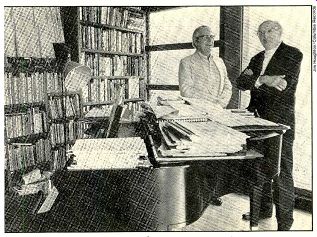
--------- Composer/pianist Leo Smit talks with composer Aaron Copland
AMONG the more than a dozen avail able recordings of the Bach orchestral suites (or overtures), a newly released Merlin album of the last two by George Malcolm and the New Chamber Soloists is outstanding. Malcolm is best known as a harpsichordist,
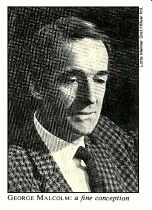
------- GEORGE MALCOLM: a fine conception in which capacity he still
plays an instrument of a type now much frowned upon by purists, one with
pedals to manipulate its colorful variety of stops, including a sixteen-footer.
Malcolm's instrumental background has acquainted him with historically authentic
performance practice, but personal preference has encouraged him to adapt
the old style to modern taste as well. As a conductor, he has done precisely
that in this Bach recording with a chamber orchestra of modern instruments.
The first movements of the suites the ouvertures proper--are particularly striking; double dotting is effectively employed, and the tempos, rather brisk ones, achieve a perfect compromise between vitality and dignity. Fortunately, this aura of "rightness" is true of the ensuing movements as well.
Moreover, it is a pleasure to hear Malcolm's fine conception of the music executed by a group of top-drawer performers. The articulation is clear but not exaggerated, and, most important, the grand line is preserved. The work of the trumpets is especially exciting; the players have cultivated two styles of playing, and they both add brilliance and blend unobtrusively into the delicate textures of the dances.
Merlin is a small British label and the album is an import. Though not quite as exceptional as the performances, the recording and pressing are excellent. Perhaps $16 might seem a lit tle high, but be assured this record is worth it. -Stoddard Lincoln J. S. BACH: Suites for Orchestra, Nos. 3 and 4 (BWV 1068-69). New Chamber Soloists, George Malcolm cond. MERLIN MRF 78901 $16 (from Merlin Records, 1827 General Beauregard, Baton Rouge, La. 70810).
Chrissie Hynde and The Pretenders: A Hot Little Group That Packs a Wallop
THE Pretenders are an English band, but they are fronted by an expatriate American named Chrissie Hynde who just happens to be one of the most physically striking rock-and-roll women in recent memory. More to the point, she also happens to have what I think is the finest white female rock singing voice in the history of the music. A fairly astonishing claim, I admit, but I think you'll agree after hearing about fifteen seconds of her band's debut.
She's a highly theatrical singer, to be sure--a vibrato so lush you could drown in it (if she didn't use it so sparingly) and heavy breathing that makes Donna Summer sound as chaste as the Singing Nun. None of this passion ever seems faked, however, and it is coupled with an uncanny ability to suggest the styles of more great rock and r -&-b singers, famous or obscure, than you can probably remember. At various times on this frequently brilliant record Chrissie conjures up the Shirelles' Shirley recalling what her Mama Said;
Claudine Clark heartbroken because she sees the Party Lights; Brenda Holloway coming to the depressing conclusion that Every Little Bit Hurts; Ronnie Spector Walking in the Rain and falling hopelessly in love; Sandi Shaw, blonde, barefoot, and oh-so-cool on Shindig, warning that the Girl Don't Come; the pre-women's-lib Dusty Springfield putting her hair in curlers as she sits Wishing and Hoping; Sandy Denny, regal and passionate, spitting out the tragic tale of Matty Groves; Joni Mitchell pining away in front of the radio in a Rainy Night House; and even Patti Smith curling your toes with the impossibly beautiful dream lust of Kimberly. So evocative is her sound that the list could go on and on. And yet, astonishingly, she always comes out sounding like herself, perhaps be cause, unlike most of the women listed above, Chrissie is not afraid to let you know that she knows how good she is.
For confirmation, just check out this al bum's Brass in Pocket, a sensational neo-disco thing in which she tells a prospective beau in no uncertain terms that she deserves his attention because she is, quite frankly, "special." From anybody else that would be obnoxious, but Chrissie has the goods to back up the claim; in fact, it seems so obvious you wonder why the guy is bothering to play hard to get. Who is this dummy daring to resist a Force of Nature?
The other Pretenders have the unenviable job of trying to keep up with Ms. Hynde, and the wonder is that they succeed at all, let alone practically all the time. Quite apart from Chrissie's heart-skips -a -beat vocals, this is one of the hottest little rock bands going, one capable of moving from the pop heaven of the utterly gorgeous Kid (those tom toms! that Duane Eddy guitar!) to the sizzling metallic hard rock of The Wait to the Phil Spectorish glories of their remodeling of Ray Davies' seldom-heard Stop Your Sobbing with equal kineticism and style. Which is to say that this is a group that packs quite a wallop. I'd go out on a limb and call them the first great band of the Eighties if it weren't for a few niggling little criticisms.
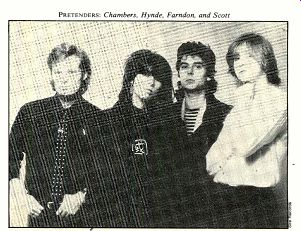
------ PRETENDERS: Chambers, Hynde, Farndon, and Scott
To begin with, the songs here that have already had exposure as English singles are a little too obviously superior to the rest of the material, which probably doesn't bode well for their writing in the future. Second, and more damningly, for all the trendiness of the package (this isn't New Wave or Power Pop exactly, but it's close enough), there is a lingering air of arena -act excess here. I suspect a lot of that comes from Chrissie, who as an American Midwesterner has probably seen enough gross heavy-metal pros to know the value of pandering to an audience.
In other words, there's a real schizophrenia at work here, as if the band hadn't sorted out whether they want to be the unique Sixties Brit/American r-&-b/pop-rock synthesis their better numbers suggest, or merely an Aero smith clone with a tough chick standing in for Steve Tyler. It's my hope, of course, that they'll opt for the former.
But none of this should dissuade you from getting this album immediately.
Even its low points are worth hearing if only for Chrissie's r- &-b authority, and as for the rest . . . well, be good to your self: let yourself fall in love with the most seductive voice you've ever heard riding effortlessly over a wall of loud guitars and drums.
-Steve Simels
PRETENDERS. Chrissie Hynde (guitar, vocals); Pete Farndon (bass, vocals); James Honeyman Scott (guitars, keyboards, vocals); Martin Chambers (drums). Precious; The Phone Call; Up the Neck; Tattooed Love Boys; Space Invader; The Wait; Stop Your Sobbing; Kid; Private Life; Brass in Pocket; Lovers of Today; Mystery Achievement. SIRE SRK 6083 $7.98, eM8S 6083 $7.98, miss 6083 $7.98.
The High-Flying Emotions: Technical Facility Applied to Quality Music
I THINK it likely that as long as the I Emotions continue to use Maurice White as their producer, they will re main among the top popular singing groups of the day. Their innate talent is attested to by a long professional career that dates practically from infancy (these three sisters from Chicago were once known as the Hutchinson Sun beams), but it is White who has pressed them to explore the outer limits of their vocal abilities. This is in keeping with a pattern he established long ago with his own vocal -instrumental group, Earth, Wind and Fire.
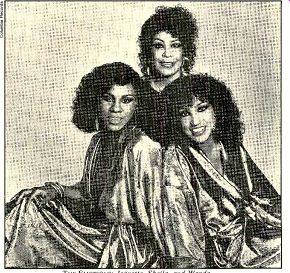
-------------- THE EMOTIONS: Jeanette, Sheila, and Wanda Not since the
days of the castrati have men attained such spectacular soprano heights as
the members of EW&F have, and the fact that White has been able to encourage
women to sing, without apparent strain, in even higher registers is more
remarkable than it might seem. Most popular artists simply cannot stretch
their voices in this way, but if there is the slightest hint that the ability
exists, White will have them reaching for the sky.
Employing another device he found effective with EW &F, White has taught the Emotions to sing percussively. They attack each of the notes swiftly and decisively, as if they were targets, punching them out with such precision that the music simply rings. These vo cal effects are echoed in the instrumentals, with their complementary emphasis on crisp, percussive rhythms.
None of this technical facility would mean much, of course, if the music it self were not quality stuff. That it definitely is in the group's new Columbia album "Come into Our World." It is made up of the sort of briskly invigorating and tuneful songs that reach right out and grab your ear. One characteristic of the song -album format, however, is that the merits of one or two tracks are usually so outstanding that every thing else in the set seems to be de signed principally as a setting or a build-up for them, and such is the case here. Although the title track, On & On, and Layed Back are good songs that wear well with repeated listenings, the peak is reached with Where Is Your Love?, clearly the best song the Emotions have recorded since Best of My Love, the number-one hit that firmly established the trio back in 1977 as something more formidable musically than "just another girl group." Ross Vanelli is the composer of this one, but it is the Maurice White touch that makes it such a knockout, with its al most pyrotechnical display of musical swoops and sweeps. Still, though White may well be the Svengali behind this trio of Trilbys, none of his magic would work if it were .not for the energy and polish supplied and applied by the Emotions.
-Phyl Garland
THE EMOTIONS: Come into Our World. The Emotions (vocals); instrumental accompaniment. What's the Name of Your Love?; Cause I Love You; Come into My World; On & On; I Should Be Dancing; Where Is Your Love?; The Movie; Layed Back; Yes, I Am. COLUMBIA JC 36149. $7.98, JCA 36149 $7.98, JCT 36149 $7.98.
---------------
Also see: POPULAR DISCS and TAPES: Soundtrack: 1941 , Natalie Cole and Peabo Bryson , Gail Davies: "The Game", Anita Ellis Returns
BULLETIN, WILLIAM LIVINGSTONE
Source: Stereo Review (USA magazine)