-------------
By Hirsch-Houck Laboratories
KLH 1, a compact, floor -standing three way speaker system
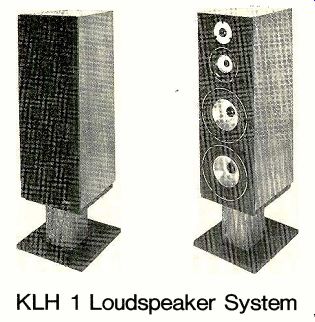
HEADING the new line of KLH "computer-controlled" loudspeakers is the KLH 1, a compact, floor -standing three way system whose modest size and unobtrusive appearance bely its acoustic performance. The KLH 1 is constructed in a columnar format, its walnut -veneered enclosure measuring 30 1/2 inches high, 101/4 inches wide, and 11 inches deep. It is furnished with a separate pedestal stand that places the top of the cabinet some 40 inches above the floor. The speaker system weighs about 50 pounds.
The four drivers are aligned vertically, with two identical woofers (nominally 8 inches in diameter) at the bottom and the 4 -inch cone midrange driver and 1 -inch dome tweeter above them. Each woofer is in its own isolated compartment, vented to the front through a duct about 1 1/4 inches in diameter and 4 inches long. The crossover to the midrange driver is at 500 Hz, and the second crossover to the tweeter takes place at 4,000 Hz. There are no external level or balancing adjustments on the speaker. The front panel of the speaker cabinet has a layer of acoustically absorbent foam plastic around the midrange and high -frequency drivers to reduce sonic-diffraction effects.
The two identical woofer sections are de signed as a sixth -order equalized system to give a response that is down only 3 dB at 30 Hz. The necessary equalization is supplied by an external module, which KLH calls an Analog Bass Computer, or ABC. Although one of the major functions of the ABC is to supply the low -frequency equalization needed to generate a bass output flat to 30 Hz, it has additional important duties. For one thing, the required bass boost could result in excessive drive-or even damage-to the woofers. To prevent such mishaps, KLH has designed the ABC to be connected into an amplifying system as part of an external feedback loop going from the amplifier's speaker outputs to an earlier stage of the amplifier, typically the tape -monitor input of the preamplifier section. The circuit in side the ABC contains variable -gain amplifiers (separate for each channel) whose gains are electrically controlled by the amplitude, frequency content, and duration of the audio signal.
Until a given low -frequency threshold level is reached, the ABC acts as a simple equalizer, boosting the response below about 150 Hz to a maximum of about +16 dB at 33 Hz and cutting off sharply at lower frequencies. As the threshold voltage is exceeded, the low -frequency response of the equalizer is progressively altered, reducing the amount of boost and shifting the frequency of maximum boost upward. Ultimately, the gain at 33 Hz can be reduced as ...
---- The KLH Analog Bass Computer protects the KLH woofers from damage
from being overdriven. It reduces the bass -boosting equalization be
fore the amplifier's output power exceeds the woofers' excursion limits.
...much as 30 dB and the equalizer response rolls off below 100 Hz instead of rising.
However, this condition is not reached until the amplifier output reaches 50 volts at 30 Hz, corresponding to an output of more than 300 watts into 8 ohms! At all times the response above 150 Hz is flat and not affected by signal level.
This woofer-excursion control is the major dynamic function of the ABC, serving to protect the woofers against damage from any conceivable drive signal. The controller action is rapid compared to the response time of the woofers to avoid possible over load on the leading edge of a bass transient, but its decay time is about 1 second.
There is also a separate, very -long -time -constant gain -control loop in the ABC, with a different threshold level that provides built-in long-term thermal protection for the woofers. Although the woofers cannot be damaged physically by sudden program -
level peaks, prolonged exposure to very high power levels would heat their voice coils, and the ABC responds to such a condition with a suitable reduction in gain (we assume this to be at all frequencies to preserve sonic balance, although it is not specifically so stated by KLH).
The operating time constants and thresh old levels of the ABC are established by the known properties of the drivers in the speaker system. KLH makes two smaller models that also use an ABC for controlling their operation, and each of those controllers has its own specific characteristics to match its companion speaker system. Al though the operation of the KLH ABC might seem similar in some respects to a motional -feedback system, it does not actually derive any information from the speakers themselves. Instead, it automatically adjusts the amplifier frequency response and output to conform to the needs and limitations of the KLH woofers.
The KLH 1 Analog Bass Computer is a small black and silver unit 10 1/2 inches wide, 6 inches deep, and 21/2 inches high. It is powered from a small external supply that plugs into an a.c. outlet (like the a.c. adapt ors of some electronic calculators). On the front panel are four buttons. The IN/OUT button turns on the ABC and bypasses its circuits in the our position (which might be needed if another type of speaker were to be used on occasion, since the KLH 1 must never be operated without the ABC and the ABC should never be used with any other type of speaker). There are two red LEDs, one of which serves as a pilot light when the ABC is turned on; at program levels that operate the controlling circuits, another light next to it comes on and the regular light goes off, a lateral flickering of the lights indicating that the computer is functioning properly. Next is a TAPE button; since the ABC is normally connected into the tape -monitoring loop of the amplifier, the monitoring function is duplicated on its panel. The POSITION button modifies the bass response to compensate for speaker placement against a wall (the preferred lo cation is at least 3 feet from a wall; any closer placement will enhance the bass output of the speaker, which must then be reduced by the IN setting of the POSITION but ton). The last button is an OVERLOAD indicator with two red LEDs above it. The AMP LED glows when the amplifier output exceeds a level (between 20 and 200 watts) set by a control in the rear of the ABC. Next to it is an H F light, indicating that the drive to the mid- and high -frequency drivers is approaching unsafe levels. With the button out, the overload lights are not functional.
When the black plastic grille is snapped off a KLH 1 speaker, it can be seen that the cones of the bass and midrange drivers are formed of a translucent plastic. This is poly propylene, chosen by KLH for its stability, freedom from internal resonances, and re producible physical and acoustic properties.
The drivers are assembled on heavy cast baskets and use unusually large magnet structures. The price of the complete KLH 1, consisting of two speaker systems, two pedestals, and the Analog Bass Computer, is $1,100.
Laboratory Measurements. All our acoustic tests of the KLH 1 speakers were made with the Analog Bass Computer in use; the input to the ABC was maintained at a constant level for each test. The woofer response was measured with a close -spaced microphone at the cone and at the port opening. The two curves were combined after adjustment for the relative areas of the cone and port, and the bass -response curve was spliced to the reverberant-field measurement of mid and high frequencies made in the back of the listening room.
The bass curve sloped upward with de creasing frequency from the 500 -Hz upper limit of the woofer's operating range to a maximum of about +12 dB (above the mid range level) at 35 Hz. Below that frequency the output dropped rapidly, but at 20 Hz it was still above the midrange level.
The mid- and high -frequency response also sloped upward from its minimum point in the 500- to 1,000 -Hz range, but much more gradually. At its maximum output ( +5 dB), the frequency was about 12,500 Hz, and the output fell off at higher frequencies to reach the midrange reference output at our 20,000 -Hz upper measurement limit.
Splicing the two curves was difficult be cause of their shapes in the region of over lap. In the end, we had to resort to listening to give us the necessary clues, and the final curve we obtained was reasonably representative of what the speaker sounded like in OUT room.
Our initial reaction to the sound of the KLH I was that it was exceedingly bass -heavy. Prolonged listening convinced us that, although the system was indeed some what overpowering in the bass, much of our initial shock was owing to the fact that we do not expect speakers of this size (or any size, for that matter) to develop a full strength output in the lowest audible register. Other speakers with a similar high -frequency response sounded bright compared with the KLH 1 because they did not have a similar bass output to balance their highs. It is hard to say which is "right," since the final result depends so much on the room and many other factors.
As we have pointed out frequently, the composite frequency -response curves we develop from our speaker measurements are just that-composite. They show an approximate reverberant (power) response in a typical room above several hundred hertz and the equivalent of an anechoic response below that frequency, making them, in a technical acoustic sense, neither fish nor fowl. They do, however, indicate quite well the sort of sonic balance one can expect from the speaker in some reasonable listening environment, and they make possible a fair comparison between speakers-at least in respect to their power output over the audio -frequency range.
In this case, the total variation in output was about 13 dB from 20 to 20,000 Hz, and it was quite smooth throughout, most of the change being in the form of almost linear slopes above and below the middle octave.
The raw response curves from the left and right speakers diverged above 9,000 Hz be cause of the directivity of their tweeters.
However, the differences were similar to those we have measured from most speakers using 1 -inch dome tweeters.
The woofer -distortion measurement presented us with a problem associated with any equalized speaker system. We established the reference woofer drive level at 100 Hz, where it was set at either 2.83 or 8.94 volts (1 and 10 watts, respectively, into an 8 -ohm load). Then the input signal to the amplifier was maintained at a fixed level so that the amplifier output to the speaker was free to follow the equalization supplied by the ABC. The low -frequency boost inevitably resulted in higher distortion readings than would have been obtained from similar speakers without equalization.
The distortion was measured separately at the cone and port, but when the response curves were combined it was evident that the major part of the output (above 40 Hz) was from the cone. The final distortion data therefore really reflect the performance of the cone radiation with no significant contribution from the port. At I watt, the distortion was only 0.21 percent at 100 Hz, rising to 1 percent at 70 Hz and 7.5 percent at 40 Hz. At a 10 -watt drive level, the distortion was typically two to three times as high as at I watt, and measurements were not practical below 50 Hz because of the very large low -frequency boost of the equalizer. These measurements were made with the "wall -mounting" setting of the PO SITION button on the ABC, since that gave about 7 dB less boost at 33 Hz than the "free-standing" setting.
The speaker sensitivity is rated at 87 dB sound -pressure level (SPL) measured at 1 meter for a 1-watt input at 1,000 Hz. Our measurements, using an octave of noise centered at that frequency, showed an output of 85 dB from one speaker and 87 dB from the other.
The speaker impedance reached a maximum of just over 40 ohms at 50 Hz (there was apparently another peak below 20 Hz, where it could not be measured). The impedance dropped to about 5 ohms over most of the frequency range above 120 Hz. Actually, it varied between 4.5 and 6 ohms except for a rise to 8 ohms at 20,000 Hz.

Comment. In recent times, there has been a "sameness" to the sound of all really good speakers. Some people view this as evidence of an overall mediocrity, but in our view it simply reflects the rather high general level of performance now available from the better products produced by the speaker industry. It does pose a problem, however, when we try to describe the various differences we usually hear between speakers, since they tend to be of a subtle character that may really be reflecting the effects of the listening environment as much as the inherent quality of the speaker.
As mentioned earlier, on first hearing the KLH 1 we felt that something must be wrong-where were the highs? Careful listening established that everything was there-and for the most part in the correct proportions-but the bass was undeniably overpowering. Even with the speakers located 3 feet from the wall, as recommended, they had a sole -tingling, gut -shaking deep -bass response that carried over into the middle and upper bass, giving male speech a heavy quality that we usually associate with speakers having an upper -bass emphasis to camouflage a lack of real bass response.
KLH, in a brochure about this new series of speakers, discusses their characteristics with admirable objectivity. They say the speakers are "good by any standard, and unique for their size." We agree. They will take a lot of power (emphasis theirs), being use with amplifiers delivering rated for from 40 to 200 watts per channel. KLH also states that "There may be minor audible side effects from the dynamic action of the ABC." This can be said about any dynamic signal processor, but we did not hear such effects in listening to the KLH I.
We drove the speakers with a 200 -watt -per -channel amplifier, and after we gained some confidence in the efficacy of the ABC as a power controller, we were fascinated to see and hear what happened when we played very deep, high-level organ pedal notes (or other high-level, low -bass material) as the amplifier gain was increased. After a while the output indicators of the amplifier reached a plateau, and no amount of further gain increase made any change in their readings. So, with a silent prayer, we cranked the gain to maximum and sat back to experience an amazing sonic massage.
The low -bass output of these speakers is difficult to believe, especially in view of their size and weight. Nothing else we had on hand (or have had, in recent memory) could even come close to matching the strength and depth of their bass performance.
This capability carries with it certain potential problems. There is an increased possibility of acoustic feedback to a record player, which will experience acoustic levels perhaps 15 to 30 dB higher in the deep bass than it would with other speakers. We did not have trouble from this source, but it certainly must be recognized as a possibility.
What we did find was that objects in the room buzzed and rattled at times as their mechanical resonances were excited. If you hear strange and unpleasant sounds when using the KLH I, it is not necessarily the amplifier or speaker crying "uncle," but more likely a resonance being excited by the prodigious bass output of these speakers.
An adjective such as "prodigious" should be used sparingly, but it seems like a rather mild description of what we heard and felt from the KLH I.
With the gain at maximum, our sound-level meter (at the back of the room some 15 feet from the speakers) read between 100 and 110 dB, which is a truly lease -breaking level and far louder than we would normally prefer to listen. However, we heard no signs of distress from either speakers or amplifier, nor did the amplifier blow a fuse. After a while, we came to accept the fact that although both the AMP and the HF warning lights on the ABC were glowing most of the time, neither the speaker system nor the amplifier was in any real danger of being damaged.
As we listened to the KLH 1 with various types of program material, we soon found ourselves accepting its bass output as the norm (which may present a problem for the next speaker we test!). It is, at least in our room, too heavy -sounding for male voices, but most other sounds are reproduced very pleasingly. The bass tone control on any good amplifier should be able to tame the bass very nicely (one of the few times when a tone control can really correct a speaker response). And even with the bass heavily rolled off in this manner, the KLH I will put out more deep bass (under 50 Hz) than most speakers.
Incidentally, for those who wonder if the bass dynamic compression of the ABC will audibly restrict the impact of deep bass, it should be pointed out that the compression does not even begin until the amplifier output exceeds about 15 watts in the low bass.
Under normal listening conditions there is no compression and the ABC serves merely as an equalizer.
Needless to say, the virtues of the KLH 1 are not limited to the low bass, although that is its most spectacular quality. As we write this, the KLH Is are generating a very satisfying string -orchestra sound with no obvious signs of an overactive woofer at work. It is an impressively smooth, easy-sounding speaker that we find as enjoyable at a listening level of 70 as at a level of 110 dB.
==============
Sonus Dimension 5 Phono Cartridge
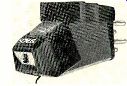
THE Sonus Dimension 5 phono cartridge T from Sonic Research differs from previous Sonus cartridges principally in the design of its moving system (the stylus, its cantilever, and the moving -iron armature).
A primary goal in the design of the Dimension 5 was to obtain the most accurate tracing of the record groove over the full audio -frequency range and beyond in order to extract the potential sonic qualities of the latest discs, whether recorded directly or from digital master tapes.
The special qualities of the Sonus Dimension 5 begin with its highly polished stylus jewel, which the manufacturer calls the "Lambda" stylus. Its contours resemble those of a cutting stylus as closely as possible so that it can trace high -frequency, high -velocity groove modulation accurately.
The cantilever is a very short, thin -walled aluminum tube with an opening at its free end into which the square shank of the stylus tip is cemented.
The design of the Dimension 5 is claimed to provide a single transmission path from stylus to armature and correspondingly more accurate phase response. Also, the short, stiff cantilever and its "micro -machined" armature resonate in the 35- to 40 -kHz region, well above the audible range.
Because there is little recorded energy at that high frequency, very little damping is used in the stylus system, permitting low frequencies to be tracked at low vertical forces. The armature is mounted in a ring-shaped elastomeric pivot that gives it equal freedom of motion through the full 360 degrees around the cantilever axis as well as supplying some damping.
The fixed coils of the Dimension 5 have fewer turns than those of most cartridges, resulting in lower than average inductance and resistance (respectively, 150 millihenries and 300 ohms per channel). A benefit of this feature is the relative independence of the cartridge frequency response from load -capacitance effects. A minor disadvantage is the relatively low output voltage (compared to many moving -iron cartridges) of about 3 millivolts.
Like other Sonus cartridges, the Dimension 5 is highly compliant (rated at 50 X 1^0-6 cm/dyne). It is designed to track at forces from 1 to 1 1/2 grams, and the cartridge weighs 5.5 grams. The vertical stylus angle is 20 degrees, and the frequency response is specified not only in the audio range, but up to 40 kHz (the cartridge can be used for playing CD-4 discrete four-channel records). Physically, the Dimension 5 resembles other Sonus cartridges, with a molded plastic body and a user-replaceable stylus. The suggested retail price is $250.
Laboratory Measurements. We installed the Sonus Dimension 5 in a medium -mass arm (effective mass of 14 grams). The recommended cartridge load is 47,000 ohms in parallel with not more than 400 picofarads (not more than 250 pF for CD-4 records).
In our test setup, the load capacitance was 275 picofarads, but we also checked the response of the cartridge with higher values of capacitance.
Preliminary tracking tests showed that the Dimension 5 could play the highest levels on our low -frequency test records at its rated minimum force of 1 gram, but that middle- and high-frequency tracking benefited from a higher force. We operated the cartridge at its rated maximum of 1.5 grams throughout our tests. At that force, the 300 -Hz test section of the German Hi Fi Institute test record could be played only to the 80 -micrometer level. The cartridge output was 2.5 millivolts per channel at a 3.54 cm/sec velocity with a 1 -dB level imbalance between channels. The measured vertical stylus angle was 24 degrees.
The frequency response of the Dimension 5 with the CBS STR 100 test record was flat within better than ± 1 dB from 40 to 13,000 Hz and rose smoothly at higher frequencies. Since the response was still rising at 20,000 Hz, we also measured it with the JVC TRS-1005, a record which sweeps from 1 to 50 kHz. This showed a relatively undamped resonance peak of some 7 dB at about 30 kHz and a rapid fall -off of output above that frequency. The channel separation (with the STR 100 disc) was a very good 25 to 32 dB in the midrange, 15 to 20 dB at 10,000 Hz, and 12 to 15 dB at 20,000 Hz. Tests with the JVC record showed a good 10 dB of separation all the way to the disc's 50 -kHz limit.
The immunity to capacitive -loading effects resulting from the low -impedance windings of the Dimension 5 was convincingly demonstrated by the identical frequency -response curves (up to 20,000 Hz) we measured with loads of 275 and 375 pF.
The low-frequency resonance in the test arm was at 8 Hz with a 6 -dB amplitude.
The tracking -distortion measurements with the Shure TTR-102 and 103 test records showed that the Sonus cartridge could track very high recorded velocities without significant distortion. This was particularly true in the case of the intermodulation-distortion test using the TTR-102 record. The distortion varied only slightly over the full range of velocities on the record (from 7 to 27 cm/sec) and remained between 1.5 and 3 percent at all levels (there was no mis tracking even at the maximum level, which few cartridges can track cleanly). The 1.0.8 -kHz tone bursts of the TTR-103 record were also tracked cleanly, and the distortion rose smoothly from 0.8 to 2.3 percent over the velocity range from 15 to 30 cm/sec.
The square -wave response from the CBS STR 112 record showed ringing, but this is mostly a property of the test record and is normally visible only in the output of a moving -coil cartridge whose frequency response is not limited by the interaction of its coil inductance and load capacitance. In this respect, and in its overall frequency response, the Sonus Dimension 5 behaved very much like a typical moving -coil cartridge.
Comment. Subjective tracing tests of the Sonus Dimension 5, using Shure's "Audio Obstacle Course" records, roughly con firmed our measurements. Although the Dimension 5 is unquestionably a very fine cartridge, it does not necessarily excel in every aspect of tracking ability. The older ERA III record could be played in its entirety without audible mistracking except for the beginnings of a "sandpaper" quality on the highest level of the sibilance section.
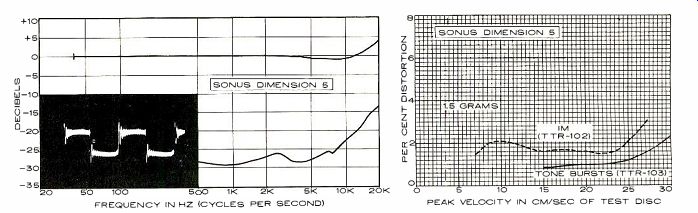
-------- In the graph at left, the upper curve represents the
smoothed, averaged frequency response of the cartridge's right and left
channels; the distance (calibrated in decibels) between it and the lower
curve represents the separation between the two channels. The inset oscilloscope
photo shows the cartridge's response to a recorded 1,000 -Hz square wave
(see text), which indicates resonances and overall frequency response.
At right is the cartridge's response to the intermodulation-distortion
(IM) and 10.8-kHz tone burst test bands of the TTR-102 and TTR-103 test
records. These high velocities provide a severe test of a phono cartridge's
performance. The intermodulation-distortion (IM) readings for any given
cartridge can vary widely, depending on the particular IM test record
used. The actual distortion figure measured is not as important as the
maximum recorded -signal groove velocity at which the cartridge is able
to track before a sudden and radical increase in distortion takes place.
There are very few commercial phono graph discs that embody musical audio
signals whose average velocities are much higher than about 15 centimeters
per second.
The ERA IV record, a more severe test of a cartridge's tracking ability, elicited sounds of distress from the Dimension 5 on the highest levels of most of its sections, al though these were usually heard as "strain" rather than obvious mistracking.
As might be expected, none of the music records we played taxed the tracking ability of the cartridge as severely as these specially made high-level recordings, and we never heard any of the telltale signs of mistracking in our listening tests. What we did hear was a crisply defined, occasionally slightly bright sound, particularly with speakers and records with exaggerated high-frequency characteristics. Many people prefer that type of high-end response, which imparts a sense of definition to the program material.
On the other hand, the strong high -frequency output of this cartridge is an ideal complement to the naturally rolled -off highs of many speakers and the high -frequency absorption in most listening rooms.
We found the total effect to be almost universally pleasing when we played various records through different speakers that were on hand in our listening room. The Dimension 5 does not exaggerate record hiss, because most of its output rise is above the audible range.
If one were to examine only the measured performance of this cartridge and then listen to it without knowledge of its construction, it would be easy to believe that it was a high -quality moving-coil cartridge. However, it has better tracking ability than most moving -coil cartridges, more output, and a replaceable stylus assembly. The Dimension 5 shares with most moving-coil cartridges a very high-frequency, undamped stylus resonance and immunity to external loading effects. It has the clarity and definition that have made moving-coil cartridges so popular in recent years among dedicated audiophiles.
As with most audio components, there are many facets to the total performance of a phono cartridge. It is deceptive to judge a cartridge by a few of its specific measured characteristics. These really tell only a part of the story; the proof of a good cartridge design is in the listening. In evaluating the Sonus Dimension 5, we first tried to listen for anything that would corroborate or en large upon our measurements or even contradict them in some way. Very soon, we found ourselves just listening for the pleasure of it. This might seem to be a dilution of the critical process, but it is really the essence of it. Listening to the Dimension 5 was an unadulterated pleasure.
================
Philips AH 180 AM / FM Stereo Tuner
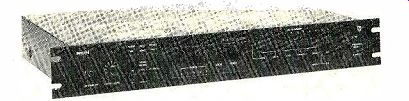
THE Philips AH 180 AM/FM stereo tuner is part of the new "Sound Series Eighty" line of rack -mounting deluxe audio components. It is a digitally synthesized tuner combining excellent basic performance with one of the most versatile control and tuning systems available to the audiophile. With the exception of a small knob for adjusting the audio-output level, all the controls of the Philips AH 180 are pushbuttons, most of them the very -light -touch, positive-action type similar in feel to those used on digital calculators.
The frequency display, behind a window in the center of the panel, shows the tuner frequency in half -inch red numerals. The selected band is identified by AM or FM, kHz or MHz appearing next to the numbers. Below the frequency readout is a row of five green LEDs that light up with in creasing signal strength to form a line. A red LOCAL legend appears to the right of the level display when a very strong local signal is received on FM. Simultaneously, there is an automatic attenuation of the signal entering the tuner to prevent overload of its r.f.-amplifier stage. Adjacent to the LOCAL light there is a green STEREO indicator light.
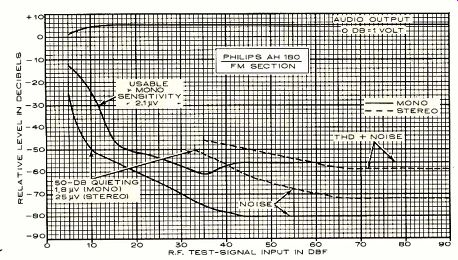
----------- PHILIPS AH 1130 FM SECTION
To the left of the display are pushbuttons that control the MPX filter (blending the two channels at high frequencies to reduce noise on weak stereo FM signals), select MONO or automatic STEREO operation or STEREO ONLY (which un-mutes the tuner only when a stereo signal is received), and control the MUTING functions. There are two buttons for the MUTING functions; one turns the muting on and off, the other selects either of two threshold signal levels at which an FM signal becomes un-muted. A sixth button, OF >50 kHz, is used to verify that an FM station is actually tuned on-center by the synthesizer -controlled tuning when it is set to 50-kHz spacing.
The actual tuning of the AH 180 is carried out principally with two flat, square momentary-contact buttons at the right of the panel. They are marked UP and DOWN to indicate the direction of the frequency shift that touching them will produce. The specific tuning mode is selected by a group of buttons along the bottom of the panel. One selects AM or FM on alternate touches, and next to it is a button that selects either a 50-kHz or a 100-kHz tuning interval for FM. The 50-kHz steps are needed in Europe, but in North America only the 100-kHz steps are used. When 50-kHz intervals are chosen, a smaller numeral 5 also appears in the digital frequency display.
If the SEARCH button is engaged, a touch on one of the tuning buttons will start an automatic scan in the indicated direction; this will continue until a signal with enough strength to overcome the muting threshold has been acquired. During the scan the audio is muted, regardless of the setting of the MUTING button, and the program is heard only after a station is tuned correctly. Next to SEARCH is a LOCK button; pressing it after a station is tuned in 'will prevent the tuner frequency from being changed by any operation of the front -panel controls.
If the SEARCH button is not pressed, the tuning keys will change the frequency by the selected interval (50 or 100 kHz) each time they are pressed momentarily. Holding a key down for about one second will cause the frequency to scan very rapidly until it is released. The entire FM band can be covered in about 9 seconds in this mode. A group of twelve small momentary-contact buttons forms a row above the tuning-mode buttons. They are numbered from 1 to 12, and above each a small red LED shows when it has been selected. These buttons operate the tuner's digital memory system, which can store the frequencies of up to twelve stations, either AM or FM, and re turn the tuner to any of them instantly at the touch of the corresponding button.
To store any frequency to which the tuner has been set, one touches a STORE button which lights a red LED light for a few seconds. While the light is on, a touch on any of the preset buttons transfers the tuner frequency data to that memory position, where it is available for recall at any time. The same preset buttons are used for still another tuning mode, operated by the KEY IN but ton below them. When this is touched, the frequency display changes to read 00.0.
Any frequency can be selected by touching the corresponding numbered preset buttons in sequence (using the "10" button for "0"). As each is touched, the selected digit appears on the display. When the selection is complete, a touch on STORE instantly transfers the tuner to that frequency and un-mutes it. If desired, the setting can be transferred to one of the preset memories or held with the LOCK button. If the selected frequency is outside the assigned band, the tuner goes to one of its limits (108 or 87.5 MHz for the FM band) and does not unmute. All of the described tuning functions apply equally to the AM band, except that there is no muting, the tuning increments are 1 kHz, and the band limits are 525 and 1,605 kHz. The AM band can be scanned in about 40 seconds by holding down the tuning key.
At the left of the panel is a pushbutton marked ON/STAND-BY. This is the power switch, and the absence of an "off" marking refers to the fact that the memory circuits are kept active as long as the tuner is plugged into an energized a.c. outlet. Even if power is lost temporarily or the unit is unplugged for any reason, the memory is held for about two days. The rear of the AH 180 contains the antenna terminals, a hinged AM ferrite-rod antenna, and two pairs of audio outputs. One is controlled by the front -panel level knob, and the other is at a fixed level.
The Philips AH 180 is manufactured in Japan to Philips' specifications and distributed in this country by Philips High Fidelity Laboratories. It is a surprisingly compact unit in view of its exceptional circuit sophistication and control versatility. Finished in flat black, it measures only 19 inches wide, 13 1/2 inches deep, and 21 3/4 inches high; it weighs about 12 1/2 pounds. The suggested retail price is $559.95.
Laboratory Measurements. The stereo performance of the Philips AH 180 was nearly ideal, with a frequency response flat within ±0.2 dB from 30 to 15,000 Hz and exceptionally uniform channel separation between 47 and 50 dB from 30 to 4,000 Hz, falling smoothly to 42 dB at 10,000 Hz and 35.5 dB at 15,000 Hz. The audio output (fixed or maximum variable level) was 1.8 volts.
The IHF usable sensitivity (mono) was 11.8 dBf (2.1 microvolts, or µV). The quieting curve of the tuner was so steep that the mono 50-dB quieting sensitivity was 10.3 dBf (1.8 pV). In stereo, the usable sensitivity was set by the stereo switching thresh old, which was between 35 and 29 dBf (30 and 15 µV). These figures represent the signal level needed to switch the tuner from mono to stereo and the level at which it would switch back to mono as the signal strength was reduced. The stereo 50-dB quieting sensitivity was 33 dBf (25 µV).
The selectable muting thresholds were and 38.3/29.8 dBf (45/16 AV). The signal -strength lights came on at levels from 20 to 78 dBf (5 to 4,000 µV). The LOCAL light was not activated by our maximum available signal input of 111 dBf (200,000 AN).
The ultimate signal-to-noise ratio of the Philips AH 180 at an input of 65 dBf (1,000
µV) was a very good 80 dB in mono and 71 dB in stereo. The distortion at that input level was 0.15 percent in mono and 0.135 percent in stereo. The capture ratio was about 2 dB, and AM rejection was 53 dB at an input of 45 dBf (100 µV) and a very good 68 dB at 65 dBf. The image rejection was a very high 100 dB, as rated. Alternate-channel and adjacent -channel selectivity measurements were, respectively, 71 and 5 dB.
The 19-kHz pilot carrier in the audio outputs was suppressed to a barely measurable -86 dB, reflecting the use of a highly effective pilot -signal canceler in the MPX de modulator instead of the more common low-pass filter. The tuner hum level was -66 dB. The AM frequency response was down 6 dB at 60 and 3,500 Hz, typical of most AM tuner sections.
Comment. The measured performance of the Philips AH 180 shows it to be very good or excellent in every respect, and out standing in such characteristics as pilot -carrier and image suppression and signal-to noise ratio.
In operation, the tuner worked exactly as it was supposed to, and no "bugs" or idiosyncrasies were encountered. The preset station memory held its information over weekends when power was completely removed from the tuner. All tuner control operations were both impressively silent and smooth.
The most positive and negative qualities of the Philips AH 180 are (in our opinion) one and the same-its almost overwhelming operating flexibility. Short of being inter faced with an external computer, it is hard to imagine any FM or AM tuning mode that this tuner cannot handle. For example, the last selected frequency remains in the memory when the tuner is shut off, so that it comes on at the same frequency next time power is applied (very convenient for making unattended tape recordings off the air with a timer switch). It can tune to any frequency, worldwide, that is used for FM or MW (broadcast band) AM transmission.
Even a possible future change to 9 -kHz AM channel spacing would not faze this synthesizer, which operates in 1-kHz steps instead of the 10-kHz steps used in some other synthesizing tuners. If FM channels should be changed to 150 -kHz spacing instead of the present 200 kHz (another-but slight possibility under consideration by the FCC), the AH 180 would still be completely usable.
One price of this freedom from obsolescence is a rather complicated operating procedure. With a few minutes' study of the instruction manual (a veritable Rosetta stone written in ten languages from English to Finnish), one would have no problem using the tuner. However, we can attest from personal experience that anyone encountering it for the first time, without access to the manual, would be very lucky to get the station of his choice, much less utilize all the versatility built into the tuner.
In spite of this complexity (or perhaps because of it) we found the Philips AH 180 to be a most fascinating tuner to use. Need less to say, it sounded just as good as the broadcast program permitted. We guarantee that any confirmed button pusher or knob twiddler will get his money's worth from this tuner just from playing with its controls (but he would be missing a lot if he neglected to listen to it as well).
================
Spectro Acoustics Model 200SR Power Amplifier
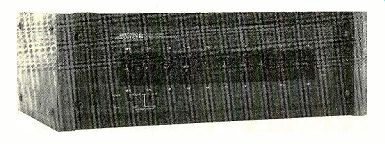
THE Spectro Acoustics Model 200SR power amplifier is described by its manufacturer as a "medium -power" model, based on its FTC power rating of 110 watts per channel into 8 -ohm loads from 20 to 20,000 Hz with no more than 0.08 percent total harmonic distortion. However, they also point out that it is effectively and audibly more powerful than its rating suggests because of its unusually large IHF dynamic -headroom rating of 3 dB. In other words, it can deliver short-term unclipped peaks of 220 watts to 8 -ohm loads, which makes it for most purposes almost the audible equivalent of a 200-watt-per-channel amplifier.
The Spectro Acoustics Model 200SR is a fairly large amplifier for its power rating, with a rack-mounting panel 19 inches wide by 7 inches high and a depth behind the panel of 12 inches. It weighs 26 pounds.
Solid -oak or walnut side panels are avail able for installations where the amplifier will not be mounted in a rack or a system cabinet.
The amplifier circuits are constructed in the form of two physically separate mono amplifier modules. Each is on a single plug in circuit board, from the differential op-amp input stage to the four output transistors mounted on a metal plate that transfers their heat to large finned radiators (also integral with the amplifier module) extending from the rear of the amplifier.
Although the output stages of the Model 200SR do not have the usual current-limiting protective circuits, they are thoroughly protected against overload or improper operation. On each amplifier module is a pair of fast-acting power-supply fuses as well as a load-line limiter that protects the output devices against unsafe operating loads. On the rear of the main amplifier are separate speaker-line fuses and a single a.c. power-line fuse. The speaker-output terminals are insulated binding posts on 3/4-inch centers that accept dual banana -plug assemblies, and the signal inputs are standard phono jacks.
The most obvious feature of the front panel of the Spectro Acoustics Model 200SR is a large display window which measures 13 1/2 inches wide and 2 inches high; it occupies most of the upper part of the panel. The power display consists of twenty pairs of LEDs that light sequentially at power outputs from 0.3 to 200 watts (into 8-ohm loads). The LEDs are recessed and easily visible only from about eye level.
Above and below the window cutout are output calibrations from - 25 to +3 dB (0 dB being the rated output of 110 watts). between the parallel rows of LEDs are calibrations in watts. From 0 to +3 dB the LEDs are green, while at lower levels they are red. The power display is capable of responding to signal peaks of a few milliseconds' duration.
Since most listening is done at relatively low power levels, two pushbuttons on the front panel increase the display sensitivity by 10 or 20 dB. A third button serves as the power switch. The Spectro Acoustics Model 200SR is priced at $600. The same amplifier less all the switches and the power display is called the Model 200S and is priced at $400.
Laboratory Measurements. The one-hour preconditioning period at one-third rated power left the heat sinks of the Model 200SR too hot to touch for more than a moment, but the rest of the amplifier was not unduly hot. Driving 8 -ohm loads at 1,000 Hz, the outputs clipped at 153 watts per channel for an IHF clipping headroom of 1.43 dB. The Model 200SR is not rated for operation at other load impedances, but into 4 and 16 ohms the clipping powers were, respectively, 203 and 105 watts per channel (the line fuse blew just at the 4 -ohm clipping point). The 5 -ampere speaker fuses would be expected to limit the continuous output to 100 watts into 4 ohms and 50 watts into 2 ohms regardless of the amplifier's ability to deliver current to those load impedances. It was probably coincidental that the line fuse blew in our tests before the speaker fuse had a chance to react to an excessive output into 4 ohms.
The absence of conventional current -limiting circuits in the 200SR accounted for its exceptional performance when driving low load impedances with the 20 -millisecond tone bursts used for the IHF dynamic power measurement. The 8 -ohm power at clip ping in this test was 215 watts, for a rating of 2.9 dB. With 4 -ohm loads, the dynamic power was 340 watts, and into 2. ohms it was a most impressive 472 watts (per channel in each case).
The Model 200SR would not be considered a "fast" amplifier by current standards, although it certainly handled audio and low ultrasonic frequencies with no difficulty. The IHF slew factor was 2 (the waveform suddenly changed to a triangle shape at 50,000 Hz when the amplifier was driven at the same level that produced rated output at 1,000 Hz). The slew rate was 14 volts per microsecond, and the rise time was 2 microseconds. The measured low-level frequency response was perfectly flat through the audio range and down no more than 0.4 dB at 5 and 50,000 Hz (the -3 -dB response frequency was 235 kHz). At 1,000 Hz, an input of 0.12 volt drove the amplifier to a reference output of 1 watt; A -weighted output noise was 89 dB below I watt.
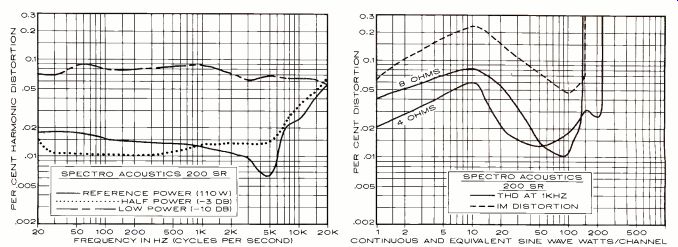
------------- FREQUENCY IN HZ (CYCLES PER SECOND) CONTINUOUS AND EQUIVALENT
SINE WAVE WATTS/CHANNEL
The distortion characteristics at 1,000 Hz were unusual in that maximum distortion (0.08 percent) was reached at about 10 watts output and the minimum (0.01 percent) at either 100 watts (8 ohms) or 50 watts (4 ohms) output. We did not make 2-ohm measurements because of the constant fuse replacement that would have been required. At low power levels, the distortion was in the 0.02 to 0.04 percent range. The IM distortion curve was similar in shape, with a maximum of 0.22 percent at 10 watts and a minimum of 0.05 percent at 100 watts.
The distortion was nearly constant with frequency, measuring typically 0.01 to 0.02 percent from 20 to 7,000 Hz at rated power and half power, and rising to about 0.06 percent at 20,000 Hz. At one -tenth power the distortion was an almost constant 0.06 to 0.09 percent from 20 to 20,000 Hz. The power-display lights responded very rap idly, so that on most program material they appeared as a set of dancing lights whose positions changed almost too rapidly to follow. However, on steady-state signals the calibrated indications were typically three to ten times the actual power output into 8 -ohm loads.
Comment. In actual use, the Spectro Acoustics Model 200SR worked exactly as we would expect a silent and essentially distortionless amplifier to work (none of the distortions we measured was sufficient to be audible with even the best program material). Also, there were no switching transients or thumps heard when the amplifier was turned on or off, making it a truly unobtrusive component.
Even if the power indicators had been ac curate and easily visible, we would question the utility of such an elaborate and expensive visual display. A simple overload indication or a warning of impending overload would have been more useful, in our opinion. The Spectro Acoustics Model 200SR is not an inexpensive amplifier, considering its FTC -rated power output, although in terms of true listening power it is essentially a "200 -watt" amplifier. In fact, it is one of the very few amplifiers that will drive even the lowest-impedance speaker load on musical material to very high levels without clip ping or serious distortion. Considered in that light, it is priced quite reasonably.
And, if one is willing to forgo the flashing lights, the basic version (Model 200S, with out lights and switches) is something of a bargain at $200 less.
============================
Eumig Cassette Deck
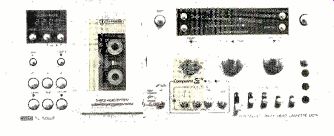
INTEGRATED -CIRCUIT (IC) microprocessor "chips" are increasingly being used to perform various switching and control -adjustment functions in high -quality audio equipment. In units we have tested previously, however, the role of these "chips" has been confined strictly to internal operations--as it is, for example, in a hand-held calculator. The Eumig FL -1000 is the first hi-fi component we have encountered whose internal microprocessor is also able to communicate directly with popular home microcomputers such as the Commodore Pet, the Apple, and the Radio Shack TRS-80.
Although one doesn't need a computer to operate the FL -1000, if you have one it opens up entirely new applications for the deck, some of which are discussed in a separate section of this report.
The Eumig FL-1000 is a front-loading deck with separate record and playback head elements contained in a single housing, and in addition to its computer inter face it incorporates a number of unique de sign features-a capstan -drive system, for example, which eliminates the need for heavy, speed -stabilizing flywheels. The FL -1000 uses an optical servo system to control a low -inertia, coreless d.c. capstan -drive motor. A second, similar motor is used to drive the reel hubs, shift the head assembly and pressure roller against the tape, and operate the brakes.
The front -panel pushbuttons used to activate the transport modes (REWIND, PLAY, FAST -FORWARD, PAUSE, STOP, and RECORD), select tape or source monitoring, and set the four -digit electronic tape counter display are additionally labeled with numerals 0 through 9, reflecting their dual purpose. A user can "punch in," as on a calculator key board, any four-digit tape location and, by pressing the co TO pushbutton, cause the machine to fast -forward or rewind to that precise location.
When the EJECT button is pressed, the lid of the cassette well swings open approximately 30 degrees; cassettes are inserted much in the way one would put a letter in an envelope. The cassette well is illuminated, and a transparent panel permits viewing the cassette label and the amount of tape remaining on a side. The lid itself is removable for periodic head cleaning and demagnetizing.
The FL -1000 utilizes an "equalized" peak-reading fluorescent display to indicate record levels. This means that, within the accuracy of the fourteen calibrated steps (from -20 to +8 dB) registered on the display, the recordist can monitor the exact signal level, including the effect of the re cord -equalization circuits, being sent to the tape. The level indicator also includes a two -position brightness switch, a peak -hold switch that retains the highest reading over a period of time, and an attenuator that lowers all meter readings by 6 dB (it may be useful with metal-particle tapes, which re quire a somewhat higher -than -normal drive level). Also located in the display section of the front panel is a switchable limiter that prevents distortion on peaks if the record-level controls should be set too high.
Though it is principally designed for voice recording, we found the limiter useful in background music as well.
Concentric controls for left and right channels provide mixing facilities for two stereo sources (two line -level inputs or a pair of microphones plus a high-level source). An additional pair of concentric knobs provide overall recording level control plus a cross fader that permits a gradual transition between the two inputs. A "Computest" facility provides test tones of 400 and 14,000 Hz for adjustment of the Dolby-sensitivity level and the bias current for optimum performance with different brands of ferric, chromium-dioxide (or equivalent high -bias), and metal -particle tapes. A rotary MICROPROCESSOR AUTO switch sets the deck for various rewind-and-repeat and timer-activated functions, and additional lever switches control the selection of tape type, transfer of reverberation from one channel to the other, microphone sensitivity, operation of the Dolby noise -reduction circuits, and the use of a multiplex filter for FM dubbing. An output -level control governs the signal level both for the front -panel headphone jack and for one pair of the two sets of output jacks.
The rear panel of the Eumig FL -1000 has two sets of line -level inputs and both fixed -level and variable -level recorder outputs. A DIN connector is provided for European -style equipment, as is a separate ground terminal. For computer connections a ten -pin DIN -type connector is provided.
The rack-mounting FL-1000 measures 7 x 13 x 19 inches, weighs 26.5 pounds, and is available with either a black or a silver panel. Price: $1,550.
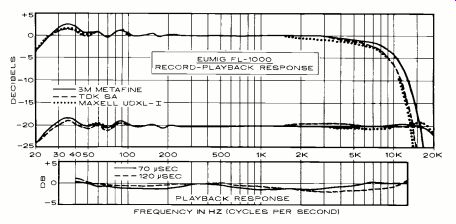
Laboratory Measurements. Eumig sup plied the specific cassettes used for factory adjustment of our sample of the FL -1000 (Maxell UD XL -I, TDK SA, and TDK MAR for the ferric, CrO2, and metal switch positions, respectively), but the built-in Computest facility enabled us to adjust the deck for equivalent responses with a very wide variety of tapes, including: 3M Master I, TDK OD, Memorex MRX3, and BASF Professional I (ferric); Maxell UD XL -II, 3M Master II, and Memorex High -Bias (Cr02 position); and 3M Metafine, Fuji metal, BASF metal, and Maxell metal. The metal -alloy tape category is particularly significant in this respect, as we have found that rather wide variations in required bias levels are needed in order to optimize their frequency response. As far as overall re cord -playback frequency response is concerned (taken at a record level of -20 dB), Maxell UD XL -I, TDK SA, and 3M Meta -fine performed essentially identically.
High -frequency response did not drop by more than 2 dB until approximately 18 kHz. The low -frequency response irregularities (head bumps) did not exceed 2.5 dB at their most prominent point (approximately 35 Hz) and are typical for the "sandwich"-type head construction used.
Playback-only response was checked with a TDK AC-337 test tape. Response was within ± 2 dB throughout the 40- to 12,500 -Hz range of the tape; the slight "sag" (1.6 dB) in the mid-frequency range was too small to be audible on any prerecorded materials we listened to.
Though it is not marked as such, the 0-dB point on the fluorescent record -level indicator corresponded exactly to a 200-nanoweber/meter Dolby-level test tone. Distortion at this level measured 0.22, 1.2, and 1.6 percent using 3M Metafine, TDK SA, and Maxell UD XL -I cassettes and a test frequency of 1 kHz. Increasing the record level to obtain 3 percent third -harmonic distortion (the traditional measuring point for signal-to-noise ratios) revealed a headroom margin of 3, 4.5, and 3 dB, respectively, for the three tapes. Relative to this level the unweighted signal-to-noise ratios (S/N) measured 53, 54.5, and 51.4 dB -or 59.8, 60, and 56.2 dB with IEC A-weighting.
With Dolby processing and CCIR/ARM weighting, the signal-to-noise ratios for the three tapes measured 68.6, 68, and 64.2 dB, respectively. Both the headroom and the S/N improved by 1.5 to 2 dB when using a more standard 315 -Hz tone instead of our customary 1 kHz.
Measured wow and flutter were exceptionally low -so much so that we had to use a combined record -playback measurement technique in place of test tapes. On the DIN peak -weighted flutter measurement we registered 0.048 percent, with even less (0.046 percent) on the Japanese weighted-rms scale. Dolby tracking was excellent: within ±0.5 dB up to 18,000 Hz at recording levels of -20, -30, and -40 dB. The multiplex filter was unusually sharp and did not affect frequencies below 16 kHz.
An input-signal level of 96 millivolts was required to produce a 0 -dB record level, and this sensitivity could be increased 6 dB by rotating the cross -fader control to its extreme position away from the center detent.
In the two microphone settings ("near" and "distant"), sensitivity was 2.2 and 0.24 mV, respectively. Microphone overload was not encountered until the signal level reached 24 and 180 mV in the two positions, and the microphone circuitry did not add any measurable or audible noise to the system. Output from the FL -1000 was 740 mV for a 0 -dB indication.
The limiter, which has a red LED indicator that glows during its operation, con trolled signals to within a -3- to -1-dB display indication over a 23 -dB range, and its attack and release time constants were well chosen so that its operation was inaudible. Headphone volume was more than adequate with either low- or medium -impedance headphones.
Comment. Listening tests confirmed what the excellent measurements implied: the Eumig FL -1000 is a superb performer.
Dubbing from FM or phono discs revealed no audible differences between the original and the copy, and even FM interstation noise -our most severe test -could be re corded and played flawlessly up to levels of approximately -5 dB. The Computest adjustment for different brands of tape was not only accurate but contains a built-in re wind mechanism that returns the tape to the precise point where you began your adjustment. The counter was the most accurate we have ever used. And for people who are "into" computers, the one -of -a -kind (so far) Eumig FL -1000 cassette deck opens up endless possibilities.
-----------------
Computer Operation
WE first encountered the Eumig FL -1000 at the fall meeting of the Audio Engineering Society, where, in a demonstration of fully automated radio broadcasting, some sixteen of the machines were being simultaneously con trolled through a standard Commodore Pet home microcomputer. While one deck was "on the air," others automatically cued themselves up to the proper starting points for various selections within their cassettes (complete with commercials and station breaks) to be played in any chosen sequence. When one selection ended, another deck was automatically switched "on air," while the first rewound and either stopped or cued itself up for another selection from its cassette. Other decks were busy dubbing updated news items or recording selections for later airing.
While such a setup is obviously well beyond the needs of the home recordist, it gives some idea of the operational flexibility that computer interfacing with the FL -1000 can achieve. According to Eumig, similar programs, with the variations required by other popular home microcomputers, will shortly be available, and complete technical data are already published for those enthusiasts who wish to make up their own specialized programs.
Using the Eumig-supplied program, we were able not only to control both machines from the computer key board-telling machine 01 to go to counter location 2504 and begin recording there while machine 00 was playing the third selection of a previously re corded tape, for example-but we were also able to call up on the computer's screen a complete index listing of all the selections on a prerecorded cassette, with starting and ending counter readings, performers, titles, running time, and any other comments we might want to recall later. This is because, when connected to a computer, the FL -1000 can read and write (that is, play and re cord) digital information, using the first few seconds of the cassette.
In addition, Eumig informs us that it now has a "sort" program (developed subsequent to our tests) which will permit codifying all the indices on all one's cassettes, then sort through them electronically by whatever category one chooses-performer, title, or what ever-so that one can instantly find precisely which cassette and which selection on that cassette the deck should be directed to play.
----------
------------ EUMIG FL -1000: RECORD -PLAYBACK RESPONSE
Also see:
Misc. ads collected (May 1978)
EQUALIZERS -- They are much more than just a fancier set of tone controls, DONALD SHEFFIELD
EQUIPMENT TEST REPORTS (Dec. 1979)
Source: Stereo Review (USA magazine)