Regulars (Letters, etc.) (Feb. 1981)
LETTERS TO THE EDITOR
Digital Exposure
I would like to compliment William Anderson on his terse and discerning editorial, "Necessary Noise," in the December STEREO REVIEW. I would only add a word in defense of the many honest and also discerning listeners who do hear differences be tween digitally mastered and analog mastered recordings. It is not only that they "miss the noise," but that the "noise" of conventionally mastered discs has masked defects in the recording-reproduction chain that digital mastering now exposes. At the record end, defects may exist in the digital processing, but they more likely exist in the associated analog equipment and recording techniques. The reduction of "defect masking" has always slowed acceptance of improvements in any part of the chain. Re member, for example, the public perception of many early high-fidelity recordings as "screechy and irritating."
DANIEL QUEEN
Daniel Queen Laboratories, Chicago, Il.
Cassette Dubbing
James Goodfriend's "Home Piracy" in December brought out some good points, but he did not explore the actual reasons so many people dub record albums. I am an audio mixer by profession, and I and most of my friends enjoy fairly decent cassette playback systems in our cars. All of us realize that most prerecorded cassettes are a joke. If we want to listen to anything that doesn't roll off at 8,000 Hz, we have to re cord it ourselves. I think most consumers are tired of paying $7.98 for a welded shell with cheap, commercial-grade tape inside and program material dubbed at high speeds, all of which results in a product that is devoid of high frequencies, noisy, and full of dropouts. Besides, if I like the selections enough to spend my time dubbing them, I have most likely purchased the album any way. And what about tape dubbing to pre serve one's own albums? Those of us who have spent mucho bucks on our cassette recorders (not to mention open-reel machines) with logic controls, adjustable bias and equalization, Dolby, d.c.-servo capstans, etc. want to get some use out of them-not just erode their heads playing tapes assembled on the cheap in Mexico.
ROBERT SORKIN
Chicago, Ill.
James Goodfriend's comments in December's "Going on Record" regarding home taping of classical record releases were certainly well taken. His indictment of the taping practices of certain classical enthusiasts was right on target; undoubtedly their activities are a contributing factor in the deplorable and unfortunate decline of the classical recording industry. I must count myself among the guilty in this respect. However, I have never purchased a record solely for the purpose of taping it and then returned it for credit under the false pretense that it was defective. Such an act is clearly an abuse of retailers' and manufacturers' good will in accepting returns of truly defective recordings. There are perhaps no adequate means, legal or otherwise, of limiting the borrowing of records among friends or acquaintances for the purpose of taping, but surely there must be something that the recording industry or record merchants can do to restrict the return of allegedly "defective" records that were, in fact, merely pirated.
JOSEPH R. SUTTON Alexandria, Va.
Superdiscs
In their contribution to "Superdiscs" in December, Tomlinson Holman and Danny Kumin question the ability of the neighbors to accommodate the wider dynamic ranges due on records sometime before the next world war. The solution seems obvious: let the bonus feature of the first all-digital 1812 Overture (inescapable!) be a bronze cannon-fired digitally, of course, and aimed at the neighbors.
E D. HOAGLAN Omaha, Neb.
The first digitally mastered 1812 cannon has already been fired, of course (Telarc DG-10041, reviewed in January 1980); the ending will, according to David Hall, "knock you out of your chair,- but we think the neighbors ducked.
Magazine's Third
Regarding Joel Vance's November re view of Magazine's "The Correct Use of Soap," allow me to set the record straight: it is hardly the group's debut album but, rather, their third; the preceding albums were "Real Life" and "Secondhand Daylight," also on Virgin Records. As for the lyrics, since when are "rock" lyrics totally clear? I've had to help my sister catch lyrics for songs she was learning, only to discover completely unintelligible lines. Magazine's--or, rather, Howard Devoto's--lyrics are, however, quite clear.
KARL BRASAEMLE, Minneapolis, Minn.
In Re Simels
Please keep Steve Simels on STEREO REVIEW'S staff. He lends just the right Oliver Hardy touch to an otherwise serious magazine. It has been known for generations that Shakespeare believed he was writing pot boilers and doing hackwork, which is an important part of the reason he is considered a genius. As for whether or not he was an art ist, we'll have to go to Greenwich Village and take a poll. Isaac Asimov's story "The Immortal Bard" is must reading for Steve. I realize that he would probably hold the book upside down, but he should still finish the five or six pages of the story before his Social Security checks start rolling in.
LYLE MCDOLE
Hawarden, Iowa
I'd like to thank STEREO REVIEW for bringing Steve Simels into my mailbox every month. I am an American GI in West Germany and look forward to my monthly issues to bring me news of a rock world that is more than just miles away. Most of the records I listen to are unavailable locally and have to be mail-ordered, and Steve lets me know which of them are worth the wait.
D. FRITZ, Ramstein, West Germany
Once again this month I hurriedly opened the new issue of STEREO REVIEW to "Letters to the Editor," only to find more of the standard, ever-present "Steve Simels doesn't know what he is talking about" letters. It is unfortunate that so many condemn Mr. Simels' style of reviewing simply because he holds opinions differing from their own. I think he does a splendid job even though I haven't agreed with the man once!
DEAN A. SMITH, Wellesley Hills, Mass.
==========
Audio/ Video news
By David Ranada
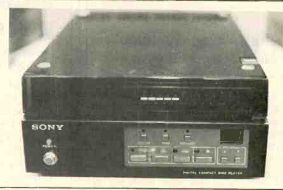
above: Shown at the Japan Audio Fair : Sony's digital Compact Disc player.
Note played-time indicator and program selector.
COMING: TRUE DIGITAL DISCS
BARRING an electronic or economic disaster, home digital-disc playback will be a reality by the end of next year. Sony and Philips plan to introduce their jointly developed Compact Disc system in the fall of 1982 with a player in the $400 to $1,000 range and with discs costing, in terms of playing time, about the same as analog LP records. These plans will go forward whether or not there is an international agreement on a digital-audio disc standard.
What, then, are the Compact Disc's basic specifications? The disc itself is 120 milli meters in diameter (about 4 3/4 inches) and 1.2 millimeters thick (about 1/20 inch-thinner than a conventional analog disc). On its single playing surface are impressed billions of microscopic pits carrying the digital-audio information. A laser "reads" the disc, so there is no disc wear. The disc is also relatively immune to handling damage thanks to a protective transparent plastic layer over the information-carrying surface. In addition to carrying audio signals, the disc can also provide text information for display on a TV screen, a feature that could be used for program notes, lyrics, and librettos. By doubling the rotation rate of the disc, four-channel sound is possible.
For those already attuned to the new computer vocabulary, the digital-audio signals are sixteen-bit linear quantized with a sampling rate of 44.1 kHz. That's rather complicated to explain in full, but what it means is that the audio specs are quite impressive. Frequency response is flat to with in a fraction of a decibel from 20 to 20,000 Hz. Signal-to-noise ratio is greater than 90 dB, as are both dynamic range and channel separation. Harmonic distortion is less than 0.05 per cent. Wow-and-flutter is almost unmeasurable and certainly inaudible.
Playing time of the one-sided stereo disc is typically I hour, but this can be extended.
Conspicuous by its absence in this catalog of technological achievements is any mention of compatibility with the various videodisc systems. There is none. Sony and Philips have sought to decouple the fate of home digital audio from that of the video disc because of the present instability of the videodisc market and the advantages of non-compatibility with video (smaller disc and player size, simplified electronics and optics, and higher reliability among them).
Dr. Toshi Doi, head of Sony's digital-audio project, pointed out at a recent SMPTE (Society of Motion Picture and Television Engineers) conference that IBM has defined world-wide standards for computer "peripherals" (computer tapes, magnetic discs, etc.) not through any cooperative standardization effort but simply through IBM's clout in the marketplace.
He told me later that Sony alone cannot do this with digital audio, but that the Sony/Philips alliance hopes to. It is indeed a powerful combination, with substantial in fluence on hardware (in this case, players and discs) and on software (the music on the discs). Sony has close ties to CBS, while Philips has even closer ties to Polygram, one of the world's largest record conglomerates (incorporating Philips, Deutsche Grammophon, London/Decca, and Polydor, among others). Both CBS/Sony and Polygram have announced that they will release material in the Compact Disc format.
FOLLOWERS of the videodisc market know that mass production of laser-read video discs has been hampered by low production "yields." Dr. Doi stated that the smaller audio-only disc is far easier to produce than the much larger 12-inch optical videodisc.
Apparently many of the defects in the videodisc come from uneven heating of the press "stampers." The smaller molds required by the Compact Disc can be more evenly heated. In addition, a very strong ("robust" in computer lingo) error-correction system also helps increase disc yield by making a defect which would be fatal to an optical videodisc correctable in a digital-audio system.
Design and manufacture of the player it self is also simplified in the audio-only format. The digital decoding and error-correcting circuits use large-scale integrated-circuit "chips," and the laser tracking-servo controls are also in integrated-circuit form. Even the sixteen-bit digital-to-
analog converter, one of the most crucial and costly components in a digital-audio system, is a one-chip (!) circuit and therefore ceases to be the primary factor in player price. That price is instead dominated by the cost of the lens-mirror-servo optical system and of the laser. Sony hopes to use a small, low-cost semiconductor laser (similar in some ways to a LED) instead of a gas-tube helium-neon unit (as used in optical videodisc players).
The Sony/Philips system seems well thought out and stands an excellent chance of becoming at least the de facto standard.
There are, however, at least three other digital-audio systems in the works. Telefunken's stylus-read fourteen-bit system was described in the June 1980 issue of STEREO REVIEW, and JVC's non-grooved capacitance stylus system was demonstrated at last November's Audio Engineering Society convention. Called AHD (audio high-density), the JVC system is compatible with the company's VHD (video high density) videodisc since the same playing mechanism and control electronics are used. As shown at the convention, a 10 1/2 inch AHD disc carries three (!) channels of sixteen-bit digital audio plus the capability of showing a series of still color-TV pictures, a new one appearing every 5 seconds.
It remains to be seen whether this last feature is truly useful, considering the high audio potential of real videodiscs.
THE third and most surprising entry in the race comes from the U.S. and is the only system so far in which the recording is stationary and only the player's parts move. Its developers hope that this fixed-record player will be the first major creation of DRC-Soundstream, a newly founded company formed by the acquisition of Utah's Soundstream (of digital master-tape fame) by Digital Recording Corp. of Connecticut.
In a stock prospectus issued last year the DRC record is described as an optical digital recording and playback system. DRC Soundstream claims that with their system 40 minutes of stereo digital audio can be fit ted into an area less than that of a 3 x 5-inch file card. In their system a photographically produced recording-even one with videodisc-like pits-is scanned by a laser operating through a series of rotating mirrors and lenses. The lens-and-mirror system moves across the face of the fixed record.
Some of the claimed advantages include less sensitivity to focusing errors, a sealed playing mechanism, inexpensive software duplication, and the possible ability to re cord. A 1983 debut is planned.
All the digital-audio home systems proposed so far seem to be capable of providing sound quality superior to that obtained with the most treasured audiophile analog disc or tape systems. But some of the digital systems appear to be more equal than others in versatility, features, player and disc reliability, and cost.
Standardization, de facto or negotiated, is a prerequisite for the survival (if not the arrival) of digital playback in the home. We can only hope that digital audio does not fall into a morass of incompatible systems, as videotape and the videodisc have done recently, as quadraphonics did lately. Digital audio now seems to offer two, three, or four information-carrying channels whose audio capabilities come very close to perfection. With such quality within reach it would be a tragedy to fumble.
================
Audio Q. and A.
By Larry Klein
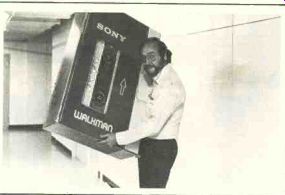
Technical Director Klein tries out a prototype 350-watt-per-channel open-reel portable player.
Noise Compression n I know that a noise-reduction device AC compresses an audio signal during recording and expands it during subsequent playback. What I don't understand is how such a device produces noise reduction when the compressed signal is expanded back to its original form.
JIM MASTRUIL, Bound Brook, N.J.
A The only noise that can be reduced by any compression/expansion type of noise-reduction system is the noise that intrudes after the audio signal is com pressed. The compression process consists of (1) making the loud-level signals softer and (2) making the soft signals louder. We will consider only the soft signals since they are the ones involved with (and that most need) noise-reduction processing. It is important to keep in mind that the signal is compressed before it is recorded. During the recording process the inevitable low level noise inherent in analog tape recording intrudes on the previously compressed signal for the same reasons-and in the same amount-that it would intrude on a normal (non-compressed) signal.
In playback, the compressed audio signal is expanded back to its original level, which means that the recorded loud signals are made louder and the soft signals are made softer. Since the low-level noise is riding in with the soft signals, it is reduced along with them during the restoration of the original signal levels.
Turntable Strobes
Q. Recently I purchased a strobe disc to check my turntable speed and it has different markings for 50 and 60 Hz. I know the record is going at the same speed whether it's run off a 50-Hz line or a 60-Hz one, so why the different markings?
TIM DRAUGHON, Montgomery, Ala.
A. As a matter of fact, the record (at least in the old days), did not turn at the same speed when a 60-Hz turntable was powered by a 50-Hz a.c. line frequency.
The speed of a synchronous motor depends on the line frequency, and different-size pulleys or bushings must therefore be used on the motor shaft in order to achieve 33 1/3 rpm at 50 or 60 Hz.
Today, many turntables, particularly the servo-controlled ones, operate on d.c., and the a.c. line frequency is no longer a speed-controlling factor. However, the neon lamp used with the stroboscopic markings on the turntable's platter almost always operates directly from the a.c. line and therefore flashes on and off at either 100 or 120 Hz, respectively, if the line frequency is 50 or 60 Hz. There are frequently two sets of strobe markings on the platter, each designed to synchronize properly with 50 or 60 Hz. The markings in each set are spaced so as to appear stationary when viewed by a light flashing at the appropriate rate.
When one uses an external strobe disc, the same factors are at work. If you don't have a neon lamp to view the strobe disc with, standard fluorescent lighting will also work. The strobe markings are not distinct when viewed under a standard incandescent bulb because the thermal lag of its filament prevents distinct on/off pulsations.
Adding Noise Specs
Q. Is there a simple technique for deriving the total signal-to-noise ratio (S/N) of a signal-processing chain from the specs of its individual components? I hope to be able to come up with ballpark figures without performing sophisticated tests, perhaps using a rule of thumb.
MARK HAMMER
Hamilton, Ontario
A. Julian Hirsch tells me that if you have a preamplifier and a power amplifier both of which have been rated in accordance with the current IHF standard, you can easily come up with a simple and reasonably valid combined S/N figure (valid, at least, for comparison purposes). That is because the measurements are made under standardized gain conditions (which are fairly close to real-world conditions), so that the reference preamplifier output is 0.5 volt and the power-amplifier output is 1 watt, with an implicit assumption that the power-amplifier gain can be set so that a 0.5-volt input gives a 1-watt output. If that condition is realizable, the S/N for each component represents its total contribution to the output-signal noise and the two can be added logarithmically.
For example, if the preamp S/N is 70 dB and the power-amplifier S/N is 75 dB, the combined value of the two is about 69 dB. If the difference between the two component S/N figures is greater than 6 dB, the poorer of the two will be degraded by less than 1 dB. Obviously, any changes in the gain settings of either will invalidate the use of IHF S/N ratings for this purpose.
In a more general case, the noise contributions of several components can be combined by referring each to a specific point in the signal path, preferably the input. This requires a knowledge of the noise at the output of each component, and its gain, so that the various noise contributions can be successively referred backward toward the input of the system. Sometimes the equivalent input noise is specified, but this is rare.
For a typical home music system, this would (or could) be a laborious process hardly worth the effort. Two factors militate against the use of such a cumbersome procedure: (1) audibility weighting factors must be taken into account for a meaningful total noise assessment, and (2) only listening will ultimately disclose how audible the noise really is (speaker efficiency, room characteristics, ambient noise, etc. can all have a powerful influence on what is really heard).
Ear Ringing
For no apparent reason. I sometimes hear a tone that seems to originate somewhere inside in my head. It appears, I hear it for several minutes, and then it disappears, not to be heard again for months. Can you explain what's happening and advise whether I should do anything about it? CHARLES PINKHAM Aurora, Ohio
A. What you've described is called tinnitus, and for some people it is not a minor annoyance as in your case but a severe affliction that makes life a torment.
Transient cases of ringing in the ears can be brought on by Blue Oyster Cult, Black Sabbath, or sinus congestion. (The last named is not a rock band, so please don't write asking where their act can be caught.) Various prescription drugs and allergies can also cause tinnitus. In severe cases of tinnitus, I'm told, the noise can approach in subjective volume the sound level of a jet-plane take-off. It is frequently caused by middle-ear disease or tumors of the auditory nerve.
Recent research has shown that masking white noise from an external source will sometimes help chronic tinnitus, at least symptomatically. Apparently the relatively high level of the rushing, hissy white noise obscures the tinnitus but can itself be ignored (or even sometimes enjoyed for its tranquilizing effect). For more information, write to the American Tinnitus Association, P.O. Box 5, Portland, Ore. 97207.
==============
Tape Talk
Craig Stark
New Superword
Q. I've been seeing the new superword "microprocessor" quite a bit lately in "Tape Talk" and elsewhere. For the layman, could you please explain this new technological giant? BARTON KING Citrus Heights, Calif.
AA microprocessor is simply the highly complex integrated circuit (or "chip," in the vernacular) that performs the computations in a computer or a hand calculator. There are literally thousands of switching transistors in such a chip, together with a certain amount of solid state "memory" that retains the numerical results.
For example, a typical microprocessor application in a cassette deck would be to optimize the recorder's bias current to eliminate brand-to-brand tape variations within the same basic tape type (ferric, CrO2, metal). To do this, the "computer" (micro processor) would be instructed to turn on a built-in test-tone generator (400 Hz or thereabouts) and to switch the bias successively to perhaps a dozen or more different settings, making a short recording at each level. It would then be instructed ("programmed") to rewind and replay the tape, noting the audio output obtained from each bias setting. It would then "remember" which bias setting corresponded to that specific audio output and would set the bias to that level. The same microprocessor could then go on to do the same kind of thing to optimize the Dolby-level sensitivity and the record equalization of the deck, and it could further be instructed, at the conclusion of all its adjustments, to rewind the tape to the beginning so all the test tones will automatically be erased when you begin recording. Typically, such a procedure takes between 25 and 40 seconds.
Microprocessors are also used to count the number of pauses (blank portions of tape) between selections so that even in high-speed fast-forward or rewind the deck can be "programmed" to play selections in any given order. And since microprocessors thrive on counting 1 + 1 + 1 + 1 . . . , digital tape counters are a natural application for them.
Actually, by computer standards, the microprocessor chips incorporated in to day's tape decks tend to be relatively simple devices that may already have become obsolete in their original applications. Never mind; that just makes them more economical to incorporate in audio components and no less awesome in what they can do for us.
Ticks and Pops on Dubs
Q. I want to transfer a number of my LPs to tape and, if possible, to eliminate the disc ticks and pops from the recordings.
The KLH-Burwen Transient Noise Eliminator seems suited for the purpose, but I note that one reviewer has said it will not be effective on sources played back on a tape deck because of high frequency losses in the deck. Is this true?
WILLIAM L. JONES, New York, N.Y.
A The kind of tick/pop suppressor you are considering is available from KLH-Burwen, Garrard, SAE, and perhaps others. One aspect of its operation involves detecting the difference between the wave form generated by a record "tick" and that generated by even the fastest kind of natural musical transient. The record tick appears as a "spike" that is much steeper than any musical attack. Having detected the difference, the suppressor can eliminate the excessively sharp attack waveforms (ticks and pops) without touching the musically generated signals.
What many audiophiles do not know is that what makes a sharp noise "spike" is the presence of frequencies far above the audible range. When you dub a record that has clicks and pops on it and compare the original signal with the tape copy, you may not hear any difference in the character of each "tick," but it's there all right, and it is detected by circuits in the tick/pop suppressor that have better high-frequency response than your ears do (or your tape recorder does).
A tick/pop suppressor, then, will work if you connect it before the signal to be treated reaches the tape recorder, but it will be largely ineffective on LP dubs that have already been recorded onto tape. The correct sequence of units in the "tape loop" of an amplifier is: (1) amplifier tape output into tick/pop suppressor input, (2) tick/pop suppressor output into tape-recorder input, and (3) tape-recorder output back into amplifier tape input. If the sequence is reversed, the tick/pop suppressor will lose the very ultrasonic information it needs in order to do its job.
Eight-track Repairs?
I have a number of eight-track cartridges that have jammed and a number more whose splices have come apart. Is there anywhere I can get them repaired?
JOHN J. POPSON JR.
Olyphant, Pa.
A. While I do not personally know of any such eight-track repair services, I seem to recall seeing, from time to time, brief ads for one or more of them in the "Classified" section of this magazine and corresponding sections of other audio publications. I suggest you keep an eye out for such ads, which appear sporadically.
Cassette Crosstalk
On a number of prerecorded cassettes I can hear the program from side two backwards on both channels when I'm trying to listen to side one. If my deck's head alignment were off surely I'd hear the problem only in the right channel, but it appears in both and with several different decks I have played these same tapes on.
What's wrong?
MICHAEL A. STEINBERG; Syracuse, N.Y.
A. In order to save time, it is customary in duplicating prerecorded cassettes to record all four tracks (left and right channels for both sides) simultaneously using a four-channel record head. (Similar heads are found in some home cassette decks that play or record bidirectionally-that is, without turning the cassette over.) If the shielding in the four-channel duplicating head is poor, some of the "backwards-recorded" material from side two can be induced into the head gaps intended for side one and so get recorded along with the intended side-one material, if at a some what lower level. You're quite right that the right channel is most prone to this phenomenon since, in the cassette format, the left channel occupies the edge tracks for both sides, with both right channels toward the center of the tape.
It is conceivable-though most improbable-that all the decks on which you have played the offending tapes are bi-direction al decks using four-channel heads and that the normal switching mechanism that is supposed to short out any pickup by the playback head gaps from the second side has failed. In such a case there could be a "bleed-through" traceable to your equipment. Since you have tried several decks, however, the odds against this are astronomical, and I can only suggest that you return the tapes as defective.
============
Technical Talk

By Julian D. Hirsch
Hi-Fi is Getting Better (Part 3)
LAST September and November, I discussed in this column some of the ways in which hi-fi has been improving over the years, trying to put in perspective some of the real improvements as compared with those that are illusory or of little significance. Although I dealt with most types of audio components used in the home, I did not cover loudspeakers, feeling that they de served separate treatment.
An incentive to talk about loudspeakers was recently provided by a reader who wrote to tell me that he bought a pair of loudspeakers about seven years ago on the basis of a review in these pages (plus his own listening judgment) to replace a pair of much older but still serviceable systems. At the time, he felt that the new ones represented a worthwhile improvement over the old speakers, and his opinion has not changed.
Even though my correspondent is not at all dissatisfied with his seven-year-old speakers, he wonders how they would com pare with some of the more recent speakers that have received highly favorable reviews from me. In other words, he wants to know if there have been advances in speaker technology comparable to those that have taken place with other types of components, and to what extent new test techniques have made it possible to refine speaker performance beyond that which was possible in the past.
First of all, to the best of my knowledge there have been no fundamental advances in loudspeaker design in the past twenty five years or more (1 would consider the development of the acoustic-suspension speaker by Edgar Villchur in 1954 to be the latest "basic" improvement in the field). Other wise, the fundamentals of every presently available speaker design were quite well understood many decades ago, and certainly the basic laws of physics have not changed! There have, of course, been many techno logical advances, but they have generally been in the development of new materials and manufacturing techniques, as well as some dramatic new measurement and analysis techniques made possible by the avail ability of computers and lasers.
Though perhaps not really fundamental, the definitive mathematical analysis of vented speaker systems by the Australian A. N. Thiele a decade ago has made it relatively easy to design woofers having almost any desired set of performance qualities, within certain constraints and trade-offs.
Prior to Thiele's work, the old bass-reflex enclosure and its variants had fallen into de served disfavor because of their bass performance, which often earned them the descriptive label "boom box." The acoustic-suspension speaker, properly executed, was far superior to the ported systems that had preceded it, but that is no longer necessarily the case today. There are a number of astonishingly good small ported systems (and some not so small) that owe their fine performance to the use of Thiele's low-frequency-design criteria.
Otherwise, the various versions of electrostatic speakers, plasma-discharge speakers, and other exotic types may be engineering advances over their predecessors, but they hardly constitute fundamental advances in the speaker art. The horn configuration will probably never be replaced as a high-efficiency acoustic transformer, and over the years there have been numerous improvements in horn materials and flare design that result in improved dispersion and less coloration from internal resonances. There can therefore be no doubt that many of today's horn drivers sound better than yesterday's, but their advantages are more likely to be appreciated in professional applications where high efficiency is often of prime importance. Incidentally, the quality of some of the horns I have heard recently would probably make them quite acceptable even to those critical listeners who still look down on horns as inherently low-fi devices.
I DO not mean to strike an uncompromisingly negative note in this short review of speaker progress. Quite the reverse, in fact:
today's speakers are, in general, far superior to most of their predecessors. This is due in part to the previously mentioned computer design and analysis techniques that provide insight into the dynamic events occurring in and around the drivers, their enclosures, and the room-thus making it possible to minimize many audible problems.
There has been no lack of exotic materials used in speaker construction, principally for cones and surrounds. At one time each manufacturer had his own secret formula for the slurry that was eventually formed into paper cones. Once a combination of elements had been found that met the designers' goals, it was likely to be guarded with the same dedication as (and perhaps with greater success than) the formula for Coca Cola or the internal structure of a nuclear weapon.
More recently there has been a movement away from paper as a cone material.
Various plastics (Bextrene, polypropylene, resin-impregnated cloth, and many others) share that function with an assortment of metal-sandwich and honeycomb structures.
Tweeter diaphragms are not necessarily the simple hemispheres they may seem to be; subtle changes in the shape of the dome and in its surround can have a profound effect on both response and dispersion.
With all these new developments, is it reasonable to expect that some sort of "breakthrough" will give us a speaker that will sound dramatically more "real" or "natural" than those which have preceded it? I'm afraid not. Certainly not unless there is a fundamental advance in our understanding of the hearing process and the complex inter-relationship of speaker characteristics, room environments, and recording techniques. Although there are still any number of different theories as to what particular properties of a speaker's acoustic output determine the subtle nuances of its sound character, sophisticated modern de sign methods enable competent engineers to create speakers that come very close to meeting their particular goals.
Nevertheless, anyone who really listens to speakers at all knows full well that every one sounds different in some way-including some of those whose reproduction "ac curacy" can be demonstrated in a number of ways. On the other hand, I am constantly impressed by how similar the better speakers--at all price levels--sound to each other. In their more subtle characteristics they do sound different, but these differences can only be heard when you listen very critically, and this often requires ignoring the musical content of the program. (As a matter of fact, they are likely to be heard when comparing left and right speakers of the same type simply because of the way the room affects each.) To many people, however, these very subtle differences are of overwhelming importance, and they are sometimes willing to pay a high price for speakers that have the particular sound they are seeking. Luckily for most of us, 99 per cent of that special subjective sound quality-whatever it is-is usually available at a small fraction of the price in some other model or brand.
My correspondent also asked whether it is valid to compare test reports on speakers reviewed years apart. That is, I think, a bit risky, both in respect to the measured performance and the reviewer's reactions to what he hears. A reviewer's subjective standards inevitably evolve along with the equipment he tests, and, in addition, the objective test standards have changed considerably in recent years. However, since the purely electronic components have at best a secondary effect on a system's sound quality, there is much less risk in assuming that an amplifier or a tuner that was judged good years ago is still good (you might keep this in mind when you have a chance to buy a used component in good working condition). I am aware that I risk inciting a furious response from those who feel that the amplifier is a major contributor to the final sound, but to that I can only reply non sense!-and reserve the subject for another day.
============
Going on Record

James Goodfriend
WIN, PLACE, AND SHOW
INSTRUMENTAL competitions-such as the Tchaikovsky, the Van Cliburn, the Leeds, the Queen Elizabeth-are generally felt to be necessary evils of the musical world. They are, of course, one way for highly talented musicians to get attention.
But some very fine artists do not win com petitions and others do not even enter them.
This, in part, has given rise to the theory that there is a certain kind of musician who does win competitions and that one winner-there are now almost too many different competitions to name them all-is very much like another. Portrait of a competition-winning pianist: big technique, solid basic musicianship, a fast study, big tone, careful, calculating, unwilling or unable to take chances, objective and impersonal, and ultimately a bore. How much truth is there in this? There happen to have been released recently, on the new Concours series from Deutsche Grammophon, three programs by competition winners who are all new to records. The discs are excellent showcases, and they offer a small research area for looking into this problem.
In fact, the three pianists here are very different from one another, although they are all young and all obviously talented. Boris Bloch, a Russian pianist apparently in his early thirties, began his studies in Odessa and continued them in Moscow with Tatiana Nicolaieva and Dimitri Bashkirov. He won first prize in the Busoni Piano Competition in September 1978. On his record (DG Concours 2535 006) he plays Beethoven's Op. 10, No. 2, as if driven by an improperly regulated spring motor. But he follows that with some wonderful and idiomatic Rachmaninoff (Vocalise, Lilacs, and three Etudes Tableaux) and an atmospheric Busoni Elegy No. 4 and conclude; with a spectacular demonstration of virtuosity in the Liszt/Busoni Fantasy on Two Themes from Mozart's Marriage of Figaro.
Bloch has truly astonishing ability to handle huge masses of musical sound, steering and directing the movement like a master pilot.
Still an uneven pianist, but impressive.
Steven de Groote was born in 1954 it South Africa and studied with Lamar Crowson, Eduardo del Pueyo, Rudolf Ser kin, Seymour Lipkin, and Mieczyslaw Horszowski. He won first prize in the Van Cliburn Competition in 1977 but lost out in public acclaim to the pianist who didn't win, Yuri Egorov. It would be unfair to subject him here to another comparison with Egorov. Suffice it to say that on this recording (DG Concours 2535 007) of the Beethoven Eroica Variations and Schumann Etudes Symphoniques he shows all the positive attributes of the hypothetical competition winner and some of the negative ones.
Certainly he is well schooled and knows exactly what he is about, and certainly he has the basic musicianship and seemingly limit less technique. But I find him calculating and artificial, a first-rate problem-solving mentality. Impressive but uninteresting.
David Lively (of whom, as opposed to the others, I had heard nothing before), is an Ohioan, born in 1953. He studied, on scholarship from the French government, at the Ecole Normale de Musique under Jules Gentil. He was an award winner in the Tchaikovsky Competition, the Queen Elizabeth, and the Marguerite Long, but he is billed on his record (DG Concours 2535 009) as first-prize winner of the Dino Ciani Competition in Milan. He plays Ravel's Le Tombeau de Couperin and Stravinsky's Tango, Piano Rag Music, and Three Scenes from "Petrouchka." To my perhaps prejudiced ears, he sounds like the sort of pianist who does not enter competitions. His musicianship is instinctive and individual rather than learned. Everything he plays (on this record at least) exhibits the greatest naturalness, and his technical proficiency, while equal to the music, seems never to be on display. He is obviously mu sic- rather than audience-oriented. His playing has a personal warmth that might seem to be beside the point with Ravel and Stravinsky, but it works quite well and leads me to believe that I would probably enjoy hearing him in almost anything. Un-startling perhaps, but satisfying.
So much for this small-scale investigation.
Should anyone care to draw generalities about contest winners from these specifics, he has my best wishes. I'm not planning to.
=============
ADs:
The moving coil replacement from Stanton Magnetics...
the revolutionary 980 LZS!

Now from the company to whom the professionals look for setting standards in audio equipment comes a spectacular new cartridge concept. A low impedance pickup that offers all the advantages of a moving magnet cartridge without the disadvantages of the moving coil pickup. At the same time it offers exceedingly fast rise time-less than 10 micro seconds-resulting in dramatic new crispness in sound reproduction -a new "openness" surpassing that of even the best of moving coil designs. The 980LZS incorporates very low dynamic tip mass (0.2 mg.) with extremely high compliance for superb tracking.
It tracks the most demanding of the new so called "test" digitally mastered and direct cut recordings with ease and smoothness at 1 gram ! .
The 980LZS features the famous Stereohedron stylus and a lightweight samarium cobalt super magnet. The output can be connected either into the moving coil input of a modern receiver's preamps or can be used with a pre-preamp, whose output is fed into the conventional phono input.
For "moving coil" audiophiles the 980LZS offers a new standard of consistency and reliability while maintaining all the sound characteristics even the most critical moving coil advocates demand. For moving magnet advocates the 980 LZS provides one more level of sound experience while maintaining all the great sound characteristics of cleanliness and frequency response long associated with fine moving magnet assemblies.
From Stanton ...The Choice of The Professionals.
For further information write to: Stanton Magnetics, Terminal Drive, Plainview, N.Y. 11803.

HORIZONTAL SCALE 10 MICRO SECONDS PER DIVISION
Actual un-retouched oscilloscope photograph showing rise time of 98OLZS using CBS ST13112 record.
Stanton---THE CHOICE OF THE PROFESSIONALS
--------------
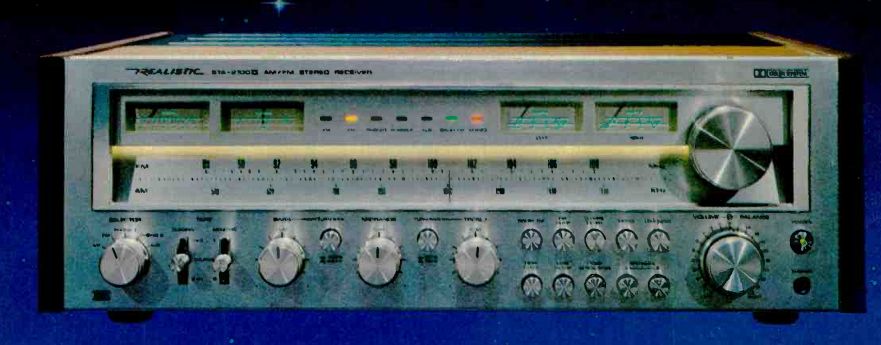
Save $200 on Realistic's Most Powerful Receiver Ever! From Now Until Feb 28th
The Power to Drive the Largest Speakers to Wall-Shaking Volume.
You get 120 watts per channel, minimum rms into 8 ohms from 20-20,000 Hz, with no more than 0.05% total harmonic distortion.
And that's enough to break your lease or reproduce superb full dynamic-range sound.
AM/FM Signal Strength and FM Center-Channel Tuning Meters Powerful Savings, Too! Until the end of February get the STA-2100D for only $499.95 that's $200 off the regular $699.95 price!
Brains and Beauty, as Well as Brawn. Top-of-the-line features and handsome styling in a genuine walnut veneer case make the STA 2100D an attractive addition to your home and music system.
Lighted Dual-Range Wattmeters Monitor Power Output Levels Radio Shack custom builds the STA-2100D in one of its own factories to meet the high standards of performance you want. It has power to spare to handle thunderous musical peaks as well as provide "detailed" response at quiet levels
Operating convenience and Versatility. Controls, inputs and out puts are provided to handle virtually any need. Two magnetic phono inputs (one with selectable sensitivity) plus both phono and DIN-type jacks for two tape decks let you make recordings like the "pros”.
And for Reliability.
Extensive circuitry protects against over heating, overloads and speaker wiring shorts.
Selectable Turnovers Plus Detented Bass, Midrange and Treble Controls Tailor Sound Hear Music, Not Noise.
A built-in Dolby decoder reduces noise and extends dynamic range on Dolbyized FM broadcasts. The low-noise preamplifier has a subsonic filter to prevent turntable rumble. There's even a special circuit that eliminates annoying "pops" and "thumps" when you change inputs.
Color-Coded Indicator Lamps Instantly Show Operating Mode Get Yours Now! Super power, super performance and super savings from Radio Shack.
Only till February 28th!
The Performance-Designed STA- 2100D AM/FM Stereo Receiver--on Sale Only at Radio Shack for $499.95.
Realistic Puts the "Real" In Sound
Retail prices may vary at individual stores and dealers.
--------------------
We don't charge extra for brilliant engineering.
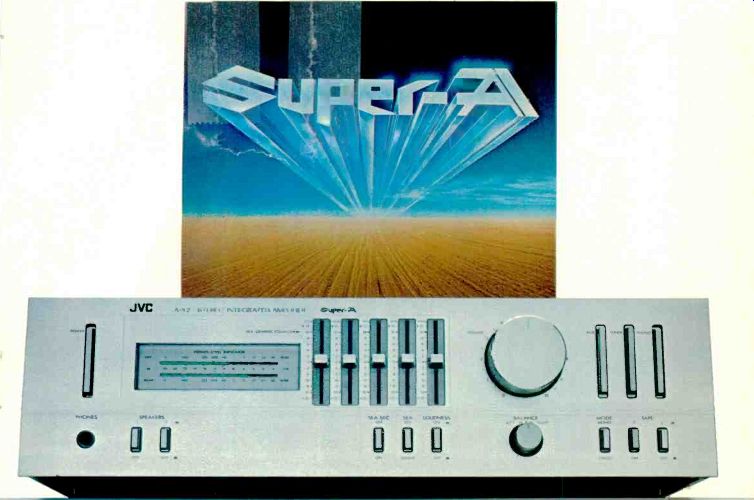
JVC Super-A.
Super-A, A-X2 Integrated Amplifier
For years, audiophiles have praised the purity, depth and naturalness of Class-A amplifiers.
But they haven't been wild about he heat, weight, power limitations and high cost that go hand-in-hand with Class-A's low efficiency and high idling currents. That's why Class-A has remained a rare, esoteric design chosen by The few who were willing to pay for its fidelity and put up with its limitations.
----------Class-AB Jagged center line indicates switching distortion.
JVC Super-A Min. distortion in output waveform.
JVC Super-A design brings together the purity of Class-A and the efficiency of "he more common Class-AB.
By eliminating most of the measurable switching and crossover distortion, Super-A achieves the kind of sound that has distinguished Class-A designs of the past.
At the same time, Super-A is as efficient as Class-AB, so there are no heat and weight problems which also drive up the cost of conventional Class-A.
And JVC :Super-A amplifiers have no transient intermodulation distortion (TIM) thanks to very wide bandwidth capabilities. What's more, the A-X2 Super-A amplifier shown here includes a 5-band graphic equalizer for both normal playback and recording EQ, LED power meters, "direct power supply" which yields high damping factor at all frequencies, and JVC's Triple Power Protection system.
All this comes with plenty of power behind it: 40 watts per channel continuous (RMS) power into 8 ohms, from 20-20,000 Hz, with no more than 0.007% total harmonic distortion.
When you put everything together, and compare our power and price with the competition, you'll discover you're get ting the benefits of Super-A and graphic equalization practically for nothing.
JVC. US JVC CORP. 58-75 Queens Midtown Expressway, Maspeth, New York 11378.
-----------------
audio-technica

Even after 100 plays your records will sound BETTER THAN NEW with Lifesaver! Introducing LIFESAVER , the multi purpose record treatment from Audio-Technica. It's a long-term antistatic agent which lasts 100 plays or more. And a record preservative which protects against environmental attack and improves the effectiveness of any wet or dry record cleaner.
LIFESAVER LS-1, with DiscProtec formula Treats 60 sides. $12.95
But LIFESAVER with DiscProtec formula is also a dry lubricant which sharply reduces record - stylus friction. Tests prove lower harmonic distortion from a disc treated with LIFESAVER after 100 plays than from the first play of an identical untreated record! Your records will sound cleaner and quieter from the very first play with LIFESAVER. And 50 or even 100 plays later they'll still sound better than new. Just one easy application protects your library for years.
Enjoy better sound today and tomorrow with LIFESAVER! See dramatic proof at your Audio-Technica dealer today. Audio-Technica U.S., Inc., 1221 Commerce Drive, Stow, Ohio 44224.
In Canada: Audio Specialists, Inc., Montreal, P.Q.
audio-technica
Tests: From independent lab tests reported by Len Feldman in Audio Magazine, February, 1980. Write for your free reprint.
====================
Also see:
Digital Mastering--A Progress Report (Jan. 1979)
Source: Stereo Review (USA magazine)