By C. Repka
THE year 1978 ended with digitally recorded phonograph records available in the U.S. on the Japanese Denon label (manufactured by Nippon Columbia, which has been producing digital discs since 1970!) and on the American Orinda and Telarc labels.
A brand-new company, Digital Sound Products, has also been formed, and it already has five discs' worth of digitally recorded material being prepared for release momentarily. Furthermore, Crystal Clear Records, one of the companies in the forefront of direct-to-disc production, has made no secret of the fact that it has often employed a digital recorder as a "back-up" machine at its recording sessions (presumably those digital tapes will be used to generate new digitally recorded molding parts once the existing d-to-d ones wear out), and its engineers were recently busy in London with more of the same, using the very musicians and conductor (the London Symphony Orchestra and Morton Gould) Digital Sound Products had just initiated into the digital mysteries.
Can you figure out what's happening here? Digital recording is making a big bid to become the standard method of music recording in the future, and al most everyone seriously involved in the recording industry is either climbing onto the bandwagon or cheering it on. The one point in question seems to be whether the transition from conventional "analog" mastering to the new digital techniques will be accomplished in five years or ten. However, given the tremendous energies fueling the activity just described above-and there is undoubtedly more we haven't even heard of yet-there is a good chance that the switch will come much faster than anyone has so far dared to predict.
How long the complete change over--to pressing of encoded discs, that is--will take is another question.
None of the products of the recording companies mentioned above are avail able to the public as digitally encoded discs. Instead, they are conventional analog LP discs that have been made from digitally recorded master tapes.
---------------------
SPECIFICATIONS
Typical specifications for the Soundstream and 3M machines would look something like this:
Frequency response 0 to 21 kHz ±0.2 dB
THD at maximum recording level less than 0.03%
THD at 0 VU less than 0.004%
S/N 90 dB unweighted
Dynamic range 90 dB
Wow and flutter unmeasurable
With performance specifications like these, the digitally recorded tapes being made today far exceed the capabilities of the standard disc format into which they must be converted.
The best discs today (even direct discs) have a signal-to-noise ratio that may get as high as 65 dB or so with luck, and available dynamic range decreases--and distortion increases as one approaches the center of the disc. Further, the wow and flutter figures of any LP can be no better than those for the typical home record player, and all are equally susceptible to dirt, dust, damage, and a host of manufacturing-related problems. All of which makes the eventual appearance of the digitally encoded disc (in one format or another ) inevitable.
---------------
True digital-disc recordings of music have been demonstrated, but the time table for their availability (and that of the special players they will require) has yet to be written. However, Hitachi, JVC, Panasonic, and Sony have all demonstrated tape equipment, based on video cassette machines, that will record and play back true digital recordings via special adapters. By the time you read this the Sony adapter, priced at about $4,000, should be avail able. Several of these same manufacturers have also demonstrated PCM (pulse-code-modulated) digitally encoded audio discs, based on video-disc technology, with just about the same noise immunity and dynamic-range capability as the digital-tape systems.
Such a tape system would include a video-tape machine of some sort (in most cases, a video-cassette recorder) and a special "PCM adapter." With such home equipment a recordist could challenge or surpass the performance of the finest professional analog tape machines, but he would still have to depend on his own live-recording efforts for program material. There are no pre recorded digital audio tapes available as yet.
But why the sudden rush into the dig ital future at this particular time? Part of the answer undoubtedly lies in the pressure that has been applied on the recording industry from without by the critical and market successes of direct-to-disc recordings. When the record-buying public embraced these limited-edition productions with a price-no-object fervor, the more farsighted of the large record companies realized that sooner or later they would have to offer a product of comparable quality but in quantities appropriate for the mass market.
Another part of the answer is pres sure from within the industry. When Dr. Thomas Stockham of Soundstream began applying the equipment used in the digital restoration of old Caruso recordings to recording new material, the handwriting began to appear on the wall. A few more words were added when 3M introduced a professional thirty-two-track digital recording sys tem for studio use (as of this writing, 3M has delivered the system appearing on this month's cover to four major U.S. recording studios: A&M Records, the Record Plant, Sound 80, and Warner Bros.), and more such systems can undoubtedly be expected from other suppliers.
So far, the one flaw in this apparently wonderful state of affairs is the usual one with any new technology: compatibility. The sad fact is that none of the existing or proposed digital recording or playback systems (tape or disc) en joys full compatibility with the others.
For example, Soundstream and 3M use 1-inch tape, sixteen-bit encoding, and a 50-kHz sampling rate, but each system...
---------------
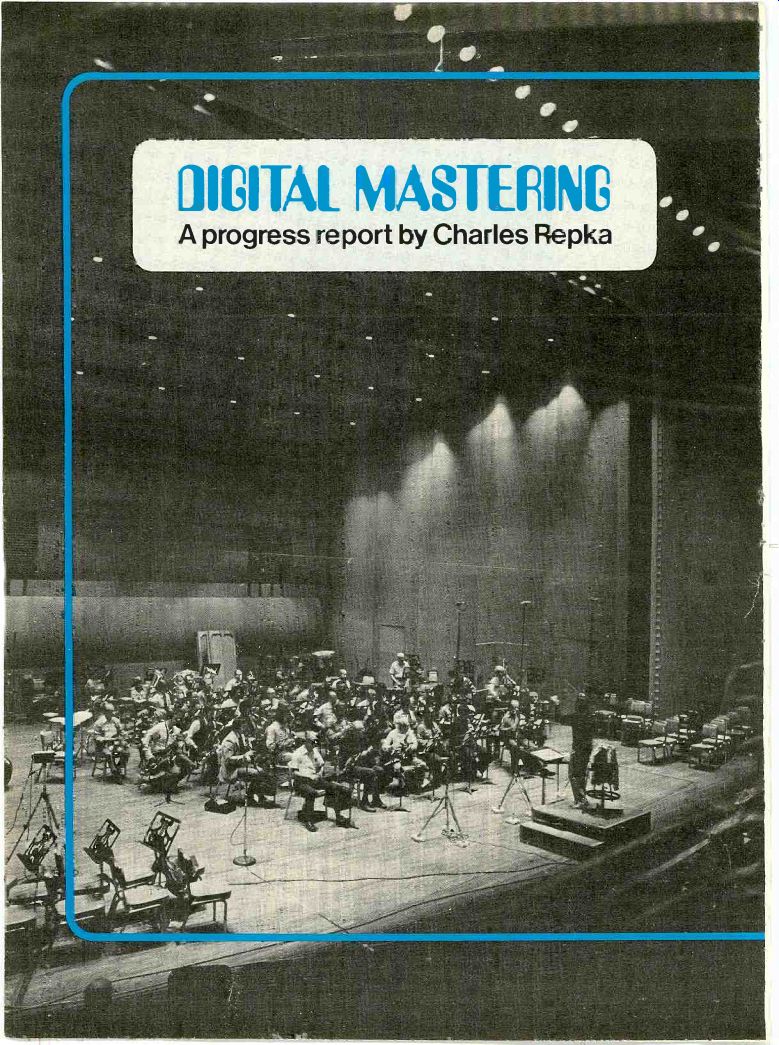
above: Frederick Fennell conducting the Cleveland Symphonic Winds in a program of Bach, Handel, and Holst for Telarc; see review . (Nat Silverman photo for Audio-Technica)
----------------
DIGITAL EDITING
ONE of the major advantages digitally mastered recordings have over direct -to-disc productions is that digital tapes can be edited. The editing process is much more complex than the "cut-and-paste" procedure used for conventional analog tapes, however, especially if one considers that there can be over a million bits recorded on a second's worth of tape. Finding the proper "bit" to splice into (and out of) is a task nearly impossible to do by hand (although I'm told the Japanese have developed such a technique), so the only practical editing method is via computer.
To date, both 3M and Soundstream: have editing systems. A simplified description of how the Soundstream system works can serve as an example. To join two takes of a musical passage at a particular spot, the first take is played back and listened to in analog form, and simultaneously it is transferred in digital form to a magnetic disc. When the joining point is reached, the editor taps a key that tells the computer to "remember" that, particular spot (the tape can actually be played at half speed to make the edit point easier to find). The second take is then played and the editor again taps the key at the proper point.
The computer then takes over and "views" the analog waveforms at the edit points and selects the correct points at which to join the two takes.
Next, the computer plays the two takes back in analog form, switching at the proper point to permit the editor to decide if the edit sounds okay.
If not, the editor can either tell the computer to shift the edit point slightly or, alternatively, he can have the analog waveforms displayed on an oscilloscope and manually select the correct edit point with a light-beam pencil. All the edits are made in this manner until the takes are all stored in digital form on the magnetic disc and the edit points are stored in the computer. The magnetic discs are then transferred to a new digital tape with the computer switching back and forth between the various takes to form the final edited version.
To do all this, Soundstream is using a $100,000 general-purpose computer-a tad more expensive than a box of razor blades and a roll of splicing tape, to say the least. However, my computer advisors tell me that this cost could be cut by a factor of four or even ten with currently avail able equipment. Probably by the time digital recording is in general use in the studio, the cost of a special-purpose editing system will be no more than the cost of an equalizer, a limiter, or any other piece of special-purpose studio electronics.
----------------
...employs a different error-detection scheme and a different track format (3M has thirty-two digital tracks for thirty-two audio channels; Soundstream has sixteen digital tracks for eight audio channels). Both 3M and Soundstream use instrumentation-type tape recorders with fixed heads, but Denon uses a video-tape recorder with rotating heads as well as different en coding schemes, sampling rate, and tape width. And, while it is possible to play back a (prototype) RCA PCM disc on a Panasonic player, it is not possible--at the moment-to play a Panasonic PCM disc on an RCA player.
The Audio Engineering Society has formed a digital-standards committee (with representatives from various manufacturers) to sort out this jumble and arrive at a standard format every one can build to. Unfortunately, these efforts have been blocked by a court injunction filed by one company that has declared that the promulgation of such a standard would constitute "restraint of trade." So, as of this writing, the problem of standards remains un resolved, but it may solve itself in the marketplace if one manufacturer can manage to preempt the field and his machines become the de facto standard.
This, indeed, would appear to be 3M's intention with its almost simultaneous delivery of four of its systems to major U.S. studios. In fact, the only company with equipment ready for delivery at this time appears to be 3M, although I suspect that the other major professional-level recorder manufacturers (Ampex, MCI, and Studer, to name a few) have been quietly perfecting their own ideas about digital recording.
AFTER all this discussion about specifications, what can we say about the sound of the new digital recordings-or at least the analog disc recordings that have been made from them? Certainly, all the recordings I've heard have impressive clarity and freedom from distortion, but there are some important points that should be made.
Denon has the largest selection of discs available, with over 160 in their catalog. Until recently these were available only in Japan, but many of them are now being imported into the U.S. by American Audioport and are available at selected audio stores (not record shops). I had the opportunity to sample some of the early Denon/PCM discs about two years ago. Although they were flawless from the standpoint of mechanical reproduction, I was not happy with the microphone placements chosen by the engineers, which result ed in some very unpleasant sounds perfectly reproduced! Listening to some of the more recent releases, how ever, I find a great improvement in this area, the best recordings being the re sult of joint efforts by Denon and the Czechoslovakian label Supraphon. The combination of Japanese engineering and Bohemian musical supervision seems to be nearly unbeatable.
All domestic digital recordings so far have been produced using the Soundstream system, but with quite uneven results. The Diahann Carroll tribute to Ethel Waters on Orinda [see review in December issue] somehow fails to impress me even though the record has no technical flaws. After several listening, I got the impression that the re cording engineer simply set the session up in the same old way (Soundstream provides only the digital recording ma chine and editing facilities; the record company provides the recording engineer), making no allowances for the improved technical capabilities of the Soundstream process.
The Cleveland Symphonic Winds re cording on Telarc, on the other hand, is digital recording at its finest. The record (recorded by Soundstream but pressed in Japan) is essentially noise-
free and has a dynamic range that runs from whisper to thunderclap. The bass-drum shots (in the Holst and Handel se lections) have an almost frightening impact, and they clearly dispel the notion that a half-speed cutting process re moves low bass. The Telarc disc shows that digital recordings are every bit the equal of the best direct-to-disc recordings, and with none of their production shortcomings [see facing page].
WHAT of the future?
Look for more digital releases by Denon, Orinda, and Telarc as well as new ones to come from Digital Sound Products and Sound 80. And since two major record labels (A&M and Warner Bros.) now have digital machines as well, we should soon see digital records being produced for the mass market and not just the audiophile trade. If one of those studios should happen to produce a digitally recorded hit record ... well, we might see every producer and every studio demanding a digital machine for the next session. With digital mastering universal, encoded pressings would soon follow, leading in time to the creation of a whole new category of home audio equipment. Maybe we could speed it up a little: do you think the Beatles could be talked into getting back together for a digital album?
-D. Charles Repka, a free-lance recording engineer and audio consultant, has been active in the audio field for almost twenty years.
----------
A Wind Band Spectacular
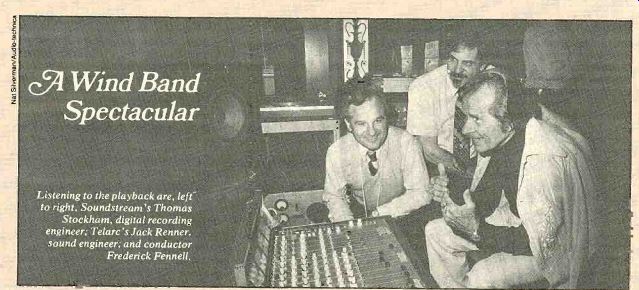
Below photo: Listening to the playback are, left to right, Soundstream's Thomas Stockham, digital recording engineer; Telarc's Jack Renner, sound engineer; and conductor Frederick Fennell.
“A GLORIOUS noise!" is the best description of a new Telarc digital-master disc of forty-two minutes of wind-band classics performed by sixty or so of the best wind and percussion players in Cleveland (half of them with the Cleveland Orchestra) under the direction of Frederick Fennell. The glory of what emerged from my speakers derives not only from the flawlessly polished and alert performances by superb musicians, but more especially from the use of a re cording technology that yields both the, clarity of the finest direct-to-disc recordings and the tape-editing options of the conventional analog medium. And how welcome it is to have such technology devoted, for a change, to such first-rate music as the two Gustav Hoist suites.
In a review last October in these pages of the Denon/PCM recording of Mendelssohn's Songs Without Words, I indicated my strong conviction that digital technology was the way to go for the ultimate in sound reproduction (that sound of a disembodied piano on the Japanese disc, free of any trace of tape hiss or back ground noise, has since been for me an unfailing party ploy). The Fennell album involved a collaboration be tween American (Thomas Stockham's Soundstream digital-recording system) and Japanese technology (the JVC Cutting Center's disc mastering and pressing by the Victor Company of Japan, Ltd.), and it certainly vindicates that view. As with the Denon/PCM digital recordings I have heard, what most immediately impressed me in the Telarc disc was the total cleanness of the sound, which is especially evident in the interlaced counterpoint of the first Hoist suite-whether in the quieter passages of the opening chaconne or in the densely textured conclusion of the march, when all the players are going full tilt with the two themes in combination reinforced by hefty percussion. There is not a trace of distortion at any point, and there are both rock-solid "presence" and complete openness in the sonic texture.
The most striking aspect of the record is the extraordinary dynamic range. Telarc's "unofficial" measurement is 64 dB, and by ear it seemed to me to match precisely the dynamics on a completely uncompressed experimental cutting I have of the 1953 Dorati/Minneapolis Symphony re cording of Respighi's Pines of Rome (the version actually released by Mercury incorporated the element of compression usual for conventionally recorded and marketed discs). Combine such dynamics with capture of the entire audible frequency range, and the result is mind-boggling in deed. The high-frequency overtones and transients are all there, and as for the low-frequency transients-well, the bass drum sounds super-spectacular; the conclusion of the Handel Royal Fireworks Music, with bass drum, cymbals, and three field drums, should shiver the timbers of the stoutest dwelling place. And if it's the organ-like sonorities of massed winds that you're after, then the handsome Bach transcription will be right up your alley.
There is a certain price, beyond the premium cost of the disc itself, that must be paid if you want to experience to the fullest degree what this recording has to offer. Only the finest playback equipment in tiptop operating order will reproduce fully what is recorded here; this is no record to play on "compact" systems (not only would it be a waste; it might overload and damage them). Moreover, to hear the quietest passages at all, since the recording, level has not been boosted to overcome background noise (there virtually isn't any), your listening room will have to be extremely quiet. To hear the opening of the Hoist Suite No. 1 at what we usually consider a "normal" listening level, the volume control must be set radically higher than usual-but then be prepared for tutti passages that will test to the utmost the tolerance of both your speakers and your ears.
The cleanness and dynamic range of the digital recording makes it all important that extra care be taken in the plating and pressing processes, for any swish in the finished disc be comes unbearable, and any ticks or pops sound like cannon shots. The eventual way out of this problem is the all-digital disc (whatever the particular method of encoding and play back) that is waiting in the wings. In the meantime, anyone who lays out $14.95 for this Telarc album will not only receive in return an extraordinarily satisfying sonic and musical experience but will also have documentation of the erection of a significant landmark in the art and science of sound recording. Musically, technically, this is for now the collector's item of the year.
-David Hall
------------
HOLST: Suites for Band, Op. 28: No. 1, in E-flat Major; No. 2, in F Major.
J. S. BACH (arr. Goldman/Leist): Fantasia in G Major (BWV 572): Gravement.
HANDEL (arr. Baines/ Mackerras): Music for the Royal Fire works. Cleveland Symphonic Winds, Frederick Fennell cond.
TELARC 5038, $14.95 (plus $1 handling charge from Audio-Technica U.S., Inc., 33 Shiawassee Avenue, Fairlawn, Ohio 44313).
-------
------
====================
Also see:
Digital Audio: A Primer (Feb. 1981)
Dear Record Company: Letters to your decision-makers
Source: Stereo Review (USA magazine)