A Masterpiece of Joseph Haydn's Old Age
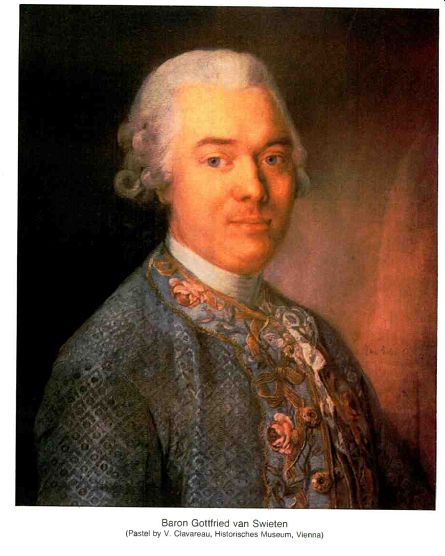
---------- Baron Gottfried van Swieten (Pastel by V. Clavreau, Historisches
Museum, Vienna)
BARON Gottfried van Swieten (1734 1803) is one of the most fascinating characters in the history of music. Of Dutch origin, he was a diplomat, court librarian in Vienna, a writer, a musician, and a consummate connoisseur and patron of the arts. They don't make 'em like that any more. At a time when Baroque music was almost completely unfashionable and neglected, Van Swieten collected manuscripts of Bach and Handel and had their music performed. It was in this way that Haydn, Mozart, and Beethoven came to know some of the music of their illustrious predecessors. The rediscovery of Baroque counterpoint and the revival of the oratorio were only two of the beneficial results.
Van Swieten was also the librettist of Haydn's The Creation, and the success of that work led to its sequel-a sequel that was at least as successful and popular as its predecessor. The Seasons superbly performed on a new Philips digital recording by star soloists and the Chorus and Academy of St. Martin-in-the-Fields conducted by Neville Marriner-is a product of Haydn's old age, and it cost him two years of work, a long time for a composer who turned out symphonies and quartets by the dozen and who virtually breathed music. Haydn had reservations about the text, which Van Swieten had adapted from the English poem by James Thomson, translating it into German and adding a new happy ending incorporating textual material by two other poets. What bothered the composer was not so much this heterogeneous mixture of literary material, but the necessity of his writing for it music imitative of natural sounds, a kind of music he referred to as "Frenchified trash." Whatever effort it may have cost the composer, there is not the slightest trace of it in The Seasons. It is a work that is rich and complex in the simplest possible way. If it is, in part, lyric, meditative, even autumnal, it is so with freshness and vitality-it has not aged a bit in more than a century and three quarters.
--- HAYDN: The Seasons. Edith Mathis (soprano), Hanne; Siegfried Jerusalem (tenor), Lucas; Dietrich Fischer-Dieskau (baritone), Simon; Chorus and Academy of St. Martin-in-the-Fields, Neville Marriner cond. PHILIPS 0 6769 068 three discs $38.94, 7654 068 $38.94. ---
Neville Marriner and his English musicians are perfect for this music. They make an elegant, effortless statement. They love what they are doing and express that love in a beautiful sound-beautiful in phrasing as well as sonority. Haydn was a sophisticated man who retained the naïve and straightforward nature of a peasant up bringing. How much harder for modern performers, far removed in time and, often, in place, to keep these qualities intact without losing sincerity and sensibility. Marriner and his forces have achieved this without compromise.
I have intentionally praised the conductors, chorus, and orchestra first al though the excellent soloists deserve no less credit for the success of this recording. Wisely, the soloists were chosen from the German-speaking world. I say wisely because it is probably true that even the best and most artistic singers can never quite achieve a level of sincerity and depth of expression in a language they have not thoroughly mastered. This kind of ease with the language is absolutely necessary for close identification with the feelings being expressed (something the chorus does not always achieve). All three singers Edith Mathis, Siegfried Jerusalem, and Dietrich Fischer-Dieskau-are out standing as individuals; they also make a tight and effective ensemble. (Parenthetically, I was struck by how much Jerusalem sounds like a younger, tenorish version of Fischer-Dieskau.) There are many felicitous details in this performance-the use of a forte piano to play continuo, for example.
Marriner's sense of tempo is, I think, unerring; liveliness comes not from external speed but from internal vitality.
Lyricism is achieved with tone, pulsation, infinite care with phrasing and articulation, and a natural way of speaking that is never studied or pushed. The sound is on the mellow side, but there is plenty of clarity and presence. Full texts and translation are furnished.
This is a beautiful recording and, if this music means anything to you at all, one not to be missed.
-Eric Salzman
----
The Thompsons and Friends Give Us the Most Immediately Gripping Pop Album of the Decade
ETs get the prejudices right up front: for me Richard and Linda Thompson's new Hannibal album, "Shoot Out the Lights," is the kind of record that makes most of those that cross my re viewer's desk seem like the work of artistic pygmies. In terms of intensity of feeling, craftsmanship, and originality of vision, the only record I've heard this year that's in the same league is Lou Reed's magnificent "The Blue Mask." Unfortunately, the Thompsons' album will probably fare even more poorly than that one did in the marketplace. It probably won't even sell well enough to become somebody's tax write-off (when was the last time you heard a hit album that featured the word "renege" in one of its song titles?). And that is why I refuse to feel embarrassed about gushing over Richard and Linda publicly for what seems like the umpteenth time.
The facts of the matter are these: Richard is one of the most interesting rock guitarists now working (he has in finitely more chops than either Neil Young or Tom Verlaine, by the way).
He is also a songwriter who, with his timeless-sounding amalgam of antique English balladry, American mountain music, early rock-and-roll, and his own considerable demons, should be recognized as one of the best alive. And finally, his wife Linda is the most moving folk-oriented vocalist out of England since the late Sandy Denny.
"Shoot Out the Lights" is the Thompsons' most consistently satisfying album since the near legendary "I Want to See the Bright Lights To night." It rocks harder (the title track could pass for heavy metal if Richard's soloing weren't so idiosyncratic), but it has the same Apollonian grace, it is just as easily elegant, rhythmically insinuating, and lyrically incisive. Did She Jump or Was She Pushed? may be the best suicide song anybody has ever written, and ditto for Back Street Slide on the topic of adultery.
The backing musicians, mostly long time colleagues from Richard's tenure in Fairport Convention, are uniformly splendid, and they provide accompaniment that is both spare and forceful.
Producer Joe Boyd, who has also worked with Richard since the old days, has framed the whole thing with a most becoming aural sheen that never once lapses into slickness. "Shoot Out the Lights" isn't exactly what I'd call escapist entertainment, and it probably won't be to everyone's taste, but if there has been a more immediately gripping pop album released since the dawn of the decade, I haven't heard it.
-Steve Simels
RICHARD AND LINDA THOMPSON: Shoot Out the Lights. Richard and Linda Thompson (guitar and vocals); Simon Nicol (guitar); Pete Zorn, Dave Pegg (bass); Dave Mattacks (drums); other musicians. Don't Renege on Our Love; Walking on a Wire; Man in Need; Just the Motion; Shoot Out the Lights; Back Street Slide; Did She Jump or Was She Pushed?: Wall of Death. HANNIBAL HNBL 1303 $8.98.
----
Previn and the Pittsburgh: Shimmering Ravel and Appealing Saint-Saens In Digital Sound
THE Pittsburgh Symphony Orchestra, under such illustrious conductors as Fritz Reiner, the late William Steinberg, and now Andre Previn, has always made a strong impression in its recordings, but I can't remember its ever having sounded so downright luscious--and so aptly so--as it does in Previn's new Philips digital recording of Ravel's Mother Goose (Ma Mire P. )t e` It k the full ballet version that is offered here is not just the orchestrate piano suite, and its shimmering opulence is a joy from first note to last. Pre yin keeps the music moving just briskly enough to avoid sentimentalizing it, while allowing every one of Ravel's magical touches to make its full effect in context. One feels the aural deliciousness comes from the very heart of the music, not merely its coating, and the marvelously transparent sound is nearly as important a contributor to the enchanting effect as the superb performance itself. This is not a matter of decibels on display, but of mostly delicate sounds and exquisite colors perceived in the clear, honest light of un contrived, beautifully balanced sound engineering.
The companion work is Saint-Sans' Carnival of the Animals, and it is brought off with similar distinction.
The bracketing of these two titles gave me a moment of apprehensiveness, be cause the only similar pairing I could recall was the old Columbia disc on which Andre Kostelanetz did the short er Mother Goose Suite and a Carnival of the Animals in which Noel Coward recited Ogden Nash's more-tiresome-than-clever verses. (That was in fact the premier recording of the Nash verses; it is still circulating on Odyssey Y 32359, with a different discmate.) Happily, Previn had better judgment than to clutter up a witty and original work with gratuitous verbiage, and he makes the most of the not inconsiderable musical substance in the Carnival.
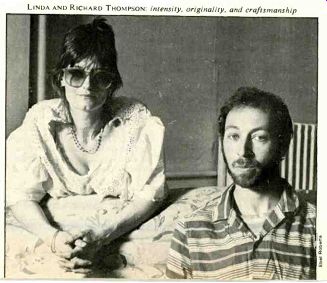
---------- LINDA AND RICHARD THOMPSON: intensity, originality, and
craftsmanship
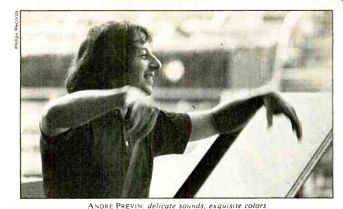
--------- ANDRE PREVIN: delicate sounds, exquisite colors
In fact, while Boulez, Martinon, Monteux, and, especially, Skrowaczewski all do nobly by Mother Goose in their recordings (in each case without the " aO recorded performance of the Carnival of the Animals, either in Saint-Saens' original chamber version or with the fuller strings in general favor now, that is quite as appealing as Previn's. The Pittsburgh cellist, Anne Martindale Williams, gives a dream performance of the battered old "Swan"-sensitive, dignified, alive-and the two pianists, Joseph Villa and Patricia Prattis Jennings, as well as the various other orchestral soloists, give a more satisfying account of the music than most of the "all-stars" in some recent recordings of the chamber version. In short, everyone involved in the making of this record can be very proud of it, and everyone who buys it can be very sure of a great deal of listening pleasure from it.
-Richard Freed
RAVEL: Mother Goose (complete ballet). SAINT-SAENS: Carnival of the Animals. Pittsburgh Symphony Orchestra, Andre Previn cond. PHILIPS 0 9500 973 $12.98, 7300 973 $12.98.
-----
Hank Williams Jr.: Good Pickings on the Border of Country Macho And Southern Rock
THROUGH several good albums in recent years, Hank Williams Jr. has been hanging out on the country side of the Southern rock frontier, but with his new "High Notes" for Elektra he steps right up to the border and finds good pickings in more ways than one. In fact, the difference between the sound of rhythm guitars in this program and those in the typical Nashville Sound al bum speaks volumes about the attitudes involved. Here they sound like real guitars played by real people (you can check this out easily in Norwegian Wood, in which they are, appropriately, recorded up front), not like those anemic, neutered-bass, round-back things played by robots.
There is more than a dash of Dixie chauvinism in this borderline mix, of course, and there is still ample evidence that Williams came from the macho school of country performing, but the man's respect for the music and its listeners overshadows all that. His material dares to make waves both verbally and melodically, and even though a staggering variety of instruments is played here (only a few at a time, of course), he has come up with a cohesive sound that may not be spanking new but does have a certain vernal freshness about it.
One of the most impressive cuts is Jessi Colter's Ain't Makin' No Head lines (Here Without You), which Williams does in full-blown Mexican style.
This treatment seems so right you won der why Colter didn't think of it in the first place-Williams has literally taken the song over. He works a similar improvement on the Ozark Mountain Daredevils' If You Wanna Get to Heaven ("you gotta raise a little hell") and even finds his own space in Norwegian Wood. What I particularly like about the last is how he remains himself throughout, delivering the song rather than letting it deliver him-that, and the way he tricks me into thinking he won't be able to hit the high notes, which he then hits with no strain at all.
Add a few interesting tunes he had a hand in writing (especially good is the blues-with-twist I've Been Down) and some of the best country-Southern rock-ensemble playing you can get on an album, and you have something worth your forty minutes. A couple of the songs could be stronger, I suppose, but I'm not sure they could be played any better.
-Noel Coppage
HANK WILLIAMS JR.: High Notes. Hank Williams Jr. (vocals, guitar, banjo); Steve Nathan (keyboards); Terry McMillan (harmonica); Roger Clark (drums); David Hungate (bass); other musicians. If Heaven Ain't a Lot Like Dixie; Whiskey on Ice; High and Pressurized; I Can't Change My Tune; I've Been Down; Honky Tonkin'; The South's Gonna Rattle Again: Ain't Makin' No Headlines; If You Wanna Get to Heaven; Norwegian Wood.
ELEKTRA E1-60100 $8.98, E4-60100 $8.98, E8-60100 $8.98.
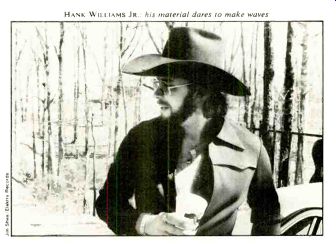
HANK Williams JR: his material dares to make waves.
-----------
ADs
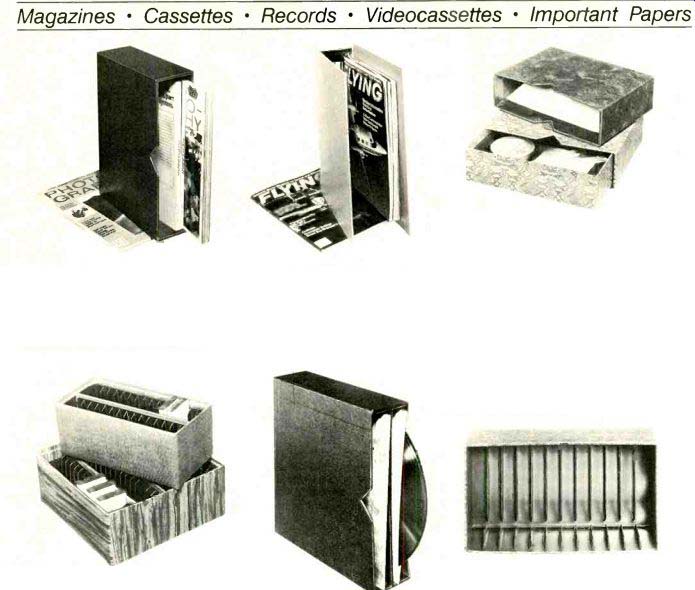
A case for getting organized Magazines, Cassettes, Records, Videocassettes, Important Papers
MAGAZINE CASES Store and protect your magazines the way libraries do! These open-back file cases keep your magazines neat and organized... and in order. Magazine title (almost 12,000 titles available!) is embossed on the spine. Specify titles on coupon. Colors selected by Publisher. Z-MC $6.95 each, 3 for $19.95, 6 for $37 50 D
CASSETTE CASES. Put your tapes in order with these handy cassette cases. Each cassette gets its own slot. Pressure-sensitive labels are included for easy identification. Available in a variety of colors,' for 30 or 60 cassettes. 30-Tape Cassette Case. JC-30 $14.95 each, 3 for $39.95 60-Tape Cassette Case. JC-60 $19.95 each, 2 for $37.95 p B
MAGAZINE BINDERS. Metal rods hold your magazines in their proper sequence. Binders available for almost 12,000 titles. Specify your choices. Colors selected by Publisher. = Z-MB $7.95 each, 3 for $22.50, 6 for $42.95
RECORD CASES. Protect your record collection with these deluxe record cases. Each one holds 20 12" LP albums. Center divider helps keep your records organized. Specify color' = J-R12 $8.95 each, 3 for $23.95
FILES FOR EVERYTHING. Now you can organize your important papers.. news letters... maps... receipts photographs...clippings...anything you like! Order these handsome files .n the sizes and colors you prefer. Available with or without drawer.
Storage Files With Drawers: (Add "D" after item number and specify color' and size.) $10.95 each. 3 for $29.95, 6 for $58.95
Storage Files Without Drawers: (Add-5" after item number and specify color and size.) $6.50 each, 3 for $17.95, 6 for $34.95
VIDEOCASSETTE CASES. No more pile of tapes on the TV set! These handy cases organize and protect your valuable videocassettes.
Holds twelve VHS or Beta cassettes. Designer colors only. = Z-VC $12.95 each, 3 for $34.95 DESIGNER COLORS (for all products except magazine binders and cases)
MAROON REPTILE ORANGE REPTILE GREEN REP TILE BROWN REPTILE BLACK REPTILE DENIM BURLAP WOODGRAIN ZIFF-DAVIS PUBLISHING CO.
Available in Black, Browr and Green Kidskin or designer colors.
-----------
Also see: POPULAR MUSIC (tape and record reviews)
Source: Stereo Review (USA magazine)