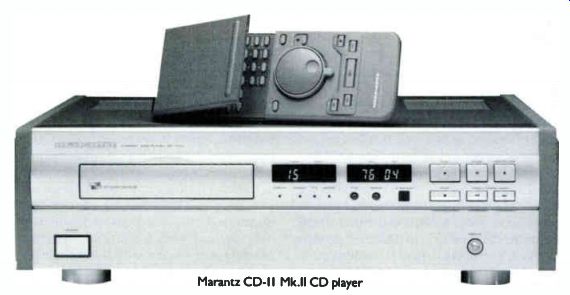
-----------Marantz CD-I1 Mk.II CD player
| Home | Audio mag. | Stereo Review mag. | High Fidelity mag. | AE/AA mag.
|
A goldern ear listens to high-end CD players from Kinergetics, Marantz, MSB, and Proceed.
MSB Technology Silver. Fixed level, unbalanced outputs. Frequency response: 20Hz-20kHz ±0.IdB. SIN ratio: 111dB (A weighted). THD: 0.001%. Dimensions: 19" W by 13.9" D by 5.25" H. Weight: 42 lbs. Serial number of unit auditioned: none provided. Price: $2795. Approximate number of dealers: 10. Manufacturer MSB Technology Corporation, P.O. Box 141, Moss Beach, CA 94038. Tel: (415) 728-5265. Fax: (415) 747-0405.
Marantz CD-11 Mk.11. Fixed level, balanced and unbalanced outputs. Frequency response: 20Hz-20kHz ±0.IdB (unbalanced outputs), 20Hz-20kHz ±0.2dB (balanced outputs). SIN ratio: 108dB. THD: 0.00135% (1-khz). Bitstream dual differential mode decoding, 1-bit/128x-oversampling. Dimensions: 18.9" W by 13.5" D by 4.75" H. Weight: 37 lbs. Serial number of unit auditioned: MZ 019202060286. Price: $2500. Approximate number of dealers: 250. US Distributor Marantz USA, 1150 Feehanville Drive, Mount Prospect, IL 60056. Tel: (708) 299-4000. Fax: (708) 299-4005.
Proceed PCD 3. Fixed level, balanced and unbalanced outputs. Frequency response: 10Hz-20kHz +0dB, -0.2dB. S/N ratio: 107dB (A-weighted). THD: 0.004% (1-khz, 0-dB). 20-bit/8x-oversampling. Dimensions: 8.4" W by 13.25" D by 8.9" H. Weight: 27 lbs (shipping). Serial number of unit auditioned: 6643. Price: $2995. Approximate number of dealers: 80. Manufacturer Madrigal Audio Laboratories, Inc., P.O. Box 781, Middletown, CT 06457. Tel: (203) 346-0896. Fax: (203) 346-1540.
Kinergetics KCD-40 Platinum. Fixed and variable level unbalanced outputs. Frequency response: 20Hz-20kHz ±1dB. SIN ratio: greater than 100dB. THD: 0.025% (1kHz). 18-bit/8x-oversampling. Dimensions: 17.25" W by 13.5" D by 3.75" H. Weight: 21 lbs. Serial number of unit auditioned: 40 081 326. Price: $2295. Approximate number of dealers: 60. Manufacturer Kinergetics Research, P.O. Box 4839, Chatsworth, CA 91313. Tel: (213) 582-9349. Fax: (213) 582-9434.
SO MANY CD PLAYERS (in March 1993) … so little time. CD players are all over the place these days. The CD-player section of Audio's annual directory is starting to compete with loudspeakers for pulp content. The major Japanese manufacturers, it seems, hardly get their newest models established before yet newer models take their places.
But try as they might, complete CD players just can't get any respect in the High End. Digital/analog processors are where the action is, and our coverage recently has reflected that fact. Maybe it has something to do with stability; processors usually come from smaller manufacturers who don't change their models every six months. Over the last couple of years the reviewers for Audio and Stereo Review have had full-time jobs reviewing the new top-of-the-line machines from Sony alone. Or so it seems.
But there is an undeniable attraction in the single-box player. Besides convenience, there's the theoretical cost advantage-less sheet metal, fewer power supplies, lower shipping costs, etc. The manufacturer of a single-box player also has more control over the total CD playback system and doesn't have to wonder what transport will be used with their D/A processor (or vice versa), and thus have to make design allowances for possible variations. And the buyer is spared concern about choosing, and paying for, a digital interconnect. With the average-priced CD tin-lizzy flying out the door of your nearest Audio/Video R Us for less than a middling cost pair of high-end interconnects, it takes guts to attempt to market a player for more than ten times that price. But here we have four of them, fighting their ways uphill against an avalanche of mass-market hype designed to convince the public that a CD player is a disposable item distinguishable from others of its ilk only by its features-if at all.
While we're on that subject, you'll see little or no discussion of bells and whistles in the individual reviews that follow. Though none of the present company of players may come with an automatic toothbrush, each provides any control and programming function you could possibly want in a single-play machine Those readers for whom random play is the most sought-after feature should really investigate multidisc players. Then you could experience, in scattershot order, Beethoven, Bon Jovi, Burt Bacharach, Bach, and the Beatles. The mind boggles. All of the players evaluated here are built around Philips trans port mechanisms and therefore use Philips style functional control and programming features.
ASSOCIATED EQUIPMENT
For most of the tests, the CD player under audition was connected to a Rowland Con summate preamplifier by means of TARA Labs RSC interconnects. (Unless otherwise noted, the players were auditioned using their unbalanced outputs. Only the Proceed and the Marantz were provided with balanced outputs.) The preamp to power amp link was Cardas Heidink (an appropriate length of the RSC was not available here at the time of the tests). A new Krell KSA-250 performed the amplifier chores. TARA Labs RSC loud speaker cable connected the latter to a pair of WATT 3s/Puppies, which were linked by their standard MIT Puppy Tail. A pair of Entec L2-F20 self-powered subwoofers filled in below 100Hz, with Entec's passive cross over rolling off the WATTs/Puppies below that point.
REFERENCES
To determine how these one-piece players might stack up against a recognized excel lent-value D/A processor and separate trans port, I teamed up the PS Audio Ultralink with the Pioneer PD-65 discussed by Sam Tellig in the January issue. The latter was used as a transport only. A Kimber KCAG dig ital interconnect linked the PD-65 and the Ultralink' This combination was not arrived at through any exhaustive process, but did turn out to be an attractive match. The price of the Pioneer/Kimber/PS Audio playback ...
--- ------
1. Unlike most manufacturers of comparably priced (and even much more expensive) Japanese-made players, who seem to feel that Toslink optical is all that anyone could possibly want. Pioneer has thoughtfully provided both Toslink and coaxial digital outputs on the PD-65.
----------
... system was roughly the same as that of the Proceed PCD 3, which was, by a small mar gin, the most expensive player of the group.
I did note one problem with this pairing of the Pioneer PD-65 with the Ultralink: a "tick" reproduced along with the music, occurring perhaps once or twice per hour of listening. I have not yet tracked down the rea son for this. The Pioneer proved a less adept tracker than any of the other players, judged by playing back the tracking and error correction bands on the Pierre Verany test disc; it mistracked several bands before any of the others, but still easily met the CD standard. It should also be mentioned that our sample of the Ultralink is a fairly early version. Later models have some minor upgrades, which we have not yet evaluated.
MSB SILVER: $2795
MSB Technology Corporation is a small California company founded in 1986 by Chief Engineer Mark S. Brasfield (MSB does not stand for Most Significant Bit). His first CD players were, in the fashion of the day, extensive re-workings of Philips/Magnavox stock units, one of which was reviewed by yours truly way back in Vol.11 No.3.
The latest MSB players still use a basic Philips chassis and some Philips internal parts, but are extensively remanufactured by MSB. Their uniqueness begins on the outside--a single thick piece of dark, not quite opaque plexiglass covers the top and sides, through which you can catch fleeting glimpses of the interior. (RL, on spying the MSB on the test bench, asked if it had a light inside It doesn't.) The front panel of the MSB is devoid of all but the necessary functions: drawer Open/Close, Play, Stop (the stop-sign shape used to mark this button is a neat idea), and Forward and Back track advance. That's it.
Everything else is on the remote. I like the layout; there's no searching around on the front panel for that small Play button concealed in a row of identical controls. But some will miss ready access to one or another of their favorite functions on the player itself LA, for example, strongly feels that a Pause button belongs on the front of any proper CD player or transport. There is also no power switch on the MSB Silver; it is de signed to be left on at all times.
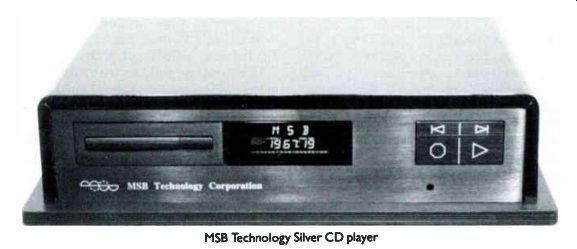
MSB Technology Silver CD player
The rear of the MSB is also about as basic as you can get: just unbalanced analog out puts, no digital output. While adding a digital output would require another board inside the player (which is why MSB does not pro vide one), I feel that any player today needs a digital output. There is just too much in the way of digital signal processing (Dsp) coming on-line in the next few years. But MSB can convert the Silver into a transport (resembling their dedicated transports) if desired; the charge is a nominal $100 plus shipping.
Perhaps this is a satisfactory alternative. Converting the Silver to a transport, however, eliminates the analog outputs. The reason for this is that one channel of the existing player is converted to a line driver in the conversion, to drive the digital output.
Four-times oversampling is used in the MSB Silver, along with a Philips Crown Select multi-bit DAC. MSB does not specify the number of bits (perhaps they consider the whole umpti-bit spec game clearly misleading, as I do), but for those who must know, the Crown Select is a 16-bit device. Philips, despite a corporate commitment to Bit stream, continues to manufacture their multi bit DACs and presumably will continue to do so as long as there is a demand.
A first-order analog filter is used at the output of the DAC. Passive de-emphasis is used for those (few) discs requiring it. High quality parts are incorporated, including tight-tolerance metal-film resistors and Cardas output jacks. All the chips in the circuit are individually shielded and all internal connections are soldered-no friction-fit connectors. A very high slew rate of 2000V/us and fast settling time of 100ns are claimed for the output stages, which consist of a direct coupled DC servo current-to-voltage converter and output buffer. The Silver is powered by a proprietary 200MHz low-impedance internal supply.
The internal appearance of the MSB is probably its least impressive aspect. The basic cast-plastic framework of a Philips player is still very much in evidence, and the general layout lacks the crisp, finished feel of the higher-production machines reviewed here.
The Philips CDM 4 transport mechanism has been carefully damped, however. Overall, the player inside looks very much more like a mod-albeit an extensive and carefully thought-out one-than the polished, distinctive, and classy exterior would lead you to believe.
Probably the most attention-getting, visible feature of the MSB Silver is the MSB Electromagnetic and Acoustic Isolation Plate attached to the bottom of the player, and which accounts for 32 of its hefty 42 lbs.
Identical in function to the plates MSB sells separately for use with other components, the alternating layers of iron and mechanical damping material which make up these plates is said to provide both a barrier to acoustic vibrations, and isolation from and containment of electromagnetic fields. MSB has recently released a White Paper on these plates and will provide one on request to any interested reader. MSB's own isolation feet, under the plate, complete the package? Sound: "A slight warmth, reducing clarity in the low frequencies to a small degree, and ...
--- 2. MSB owners should be aware that the sheer mass of the Silver causes these slightly tacky feet to adhere firmly to what ever smooth surface the player may be sitting on. I had occasion to place the Silver on a plaster-finished built-in banco (Santa Fe talk for bench) in the listening room for a few days when it was not in use; when I picked it up, a couple of square inches of plaster came along with it! ---
... a slight lack of top-end openness and air (having a similar effect), are neither immediately obvious nor, in the longer term, troubling?' So began my listening notes for the final stages of my auditioning of the MSB. I say final stages because the Silver had been in house for some months prior to formal reviewing, and had quickly worked itself into my reference system. What made it difficult to dislodge was an all-around listenability and ease, without the blandness that such a description often disguises. With a more immediate, palpable sound than the rest of the players on test here, the MSB provided a wealth of unforced detail. A trace of lower treble emphasis would occasionally intrude, but it was balanced out by a lack of leanness or any analytic, etched qualities.
I found the MSB less than first-rate in only two areas, both addressed in the lead-off quote. The first was that slight excess in the mid- to upper bass, this warmth somewhat restricting the ultimate clarity of the over all sound. The second was the restriction in subjective top-end extension. To a certain extent these qualities reinforced each other--together they were more apparent than either would have been alone.
But neither of these weaknesses could obscure the MSB's strengths. It passed two of my critical tests with ease: First, I often found myself listening to more of a recording than I had intended; I never tired of listening to it. Second, when listening to another player, I often found myself anxiously wondering how that player would compare to the MSB. The MSB's warmth did have a positive side. It provided a rich foundation for an open, three-dimensional midrange that even a digiphobe could love. Instruments were solid and rounded, voices were more than just unsupported vocal cords. Sara ICs voice on Closer Than They Appear (CheskyJD67) was glorious, with just the right amount of ambient space at the top and weight and sup port at the bottom. And while the low end of Jennifer Warnes's The Hunter (Private Music 1005-82089-2) definitely sounds hyped on the recording itself, her voice was liquidly rich and smooth. The MSB did have a more forward sound than any of the other players here-enough to give it a pleasing presence but not enough to put the sound in the listener's lap. This in no way restricted the overall front-to-back perspective of its soundstage. I had no difficulty deciphering the layering of details in Mokave, Volume 1 (AudioQuest AQ-CD1006) or in the terrific soundtrack from Edward Scissorhands (MCA MCAD-10133). (The latter is another first rate effort from engineer Shawn Murphy, who has probably added more top-quality soundtrack recordings to his credit over the last few years-including audiophile favorite Glory-than anyone else.) The MSB's bottom-end extension bettered that of all the other players in this group.
Whether reproducing the growl of the bottom-end organ pipes on Jean Guillou's controversial transcription of Mussorgsky's Pictures at an Exhibition (Dorian DOR-90117), the pop of the lower range of the bass line on Richard Thompson's Rumor and Sigh (Capitol CDP 7 95713 2), or the gutsy synthesizer grumble on the soundtrack from The Abyss (Varèse Sarabande VSD-5235), the MSB scored solidly. The fact that its LF was less crisp than I would have preferred was more a result of the slight fullness of its mid-to upper bass than of any lack in the extreme bottom.
When I was able to pry the Mark Levinson No30 away from JA, LA, and RH long enough to use in January's loudspeaker sur vey, I resolved to compare it with at least one of the players under test here. The honors fell to the MSB. The transport used with the Levinson was the new Proceed PUF 3, linked to the No30 with an AT&T optical connector. Balanced Lapis interconnects (one stage removed from the current generation) were used between the processor and the Rowland Consummate preamp. Unbalanced Lapis of the same generation was used to connect the MSB to the preamp. The rest of the system consisted of Cardas Hexlink interconnect between the preamp and a Krell KSA-250 (latest version), and Symo loudspeaker cable to a pair of Thiel CS3.6s. (The WATTs/Puppies/Entecs/TARA RSC cables had not yet appeared in my listening room when this comparison occurred.)
Not surprisingly, the Madrigal [3] combination ran away with the prize in this com parison. But it didn't run and hide, winning out by virtue of its greater see-through clarity and openness. It simply presented more detail and a more tightly focused soundstage. The MSB had a richer, warmer quality, was more forward in the midrange and lower treble, and was softer and less open and airy on top.
----------
3. Madrigal is the manufacturer of both Mark Levinson and Proceed products.
---------------
But I by no means felt deprived in any significant way when listening to it. In fact, I actually preferred it to the Proceed/Levinson on certain material, especially female vocals, where the MSB presented a more palpable, fully rounded, emotionally involving sound.
It had a certain "glow" to its sound which the cooler-sounding Proceed/Levinson lacked.
The MSB also seemed to delve deeper into the extreme bass. But the superior tightness and clarity of the Madrigals in the mid- and upper bass not only produced better over all bottom-end detailing, but subjectively opened up the midrange and treble as well.
With a bit more clarity in the mid- and upper bass and a shade more air at the very top, however, the MSB would have turned this comparison into a real horse race. Even as it stands, the one-box player had nothing to be ashamed of, especially considering the price gap between it and Madrigal's high end separates.
Compared with the Pioneer transport/PS Audio Ultralink D/A processor "reference," the MSB very nearly came out on top. I say very nearly because, as I sampled different recordings, the reference came out ahead in some face-offs, the MSB in others. The latter scored when it came to bottom-end extension and weight, and in its continuing lively, immediate presentation. The reference was a bit sweeter in the upper midrange/lower treble, and more open and transparent in general. The reference came out on top more often, but rarely by more than a narrow margin.
Take, for example, The Mighty Wurlitzer (New World NW 227-2), a wonderful selection of potboilers played on three different theater organs, all of them recorded in big, reverberant acoustics.4 This recording does not work at all unless the air and space around the instrument are captured properly. Both 4 Attending a movie at the Crest theater in Westwood, CA, near LA, last summer-a medium-sized, beautifully and recently restored theater with fine technical facilities including THX sound-I noted that they were playing recordings of old theater-organ music before the show. It was a revelation compared with the drivel usually played in theaters before movies, but it took visits to four Tower Records before I could locate any recordings of this instrument. This was the one I found; it was originally recorded in the late '70s on analog masters.
players did it justice. The verdict was close, but the MSB won by a nose. Its richer, fuller sound gave the proper body and weight to these magnificent instruments; it more fully captured the buzz of the high, reedy pipes, and in general gave more life to the sound. It also surged ahead in presenting a feeling of depth and space, though on other recordings its more forward sound didn't always make it the winner in those categories.
I was recently made aware of a two-CD album called lafabuleuse histoire de Mister Swing (WEA Music 2292-42338-2), featuring French singer Michel Jonasz [5]. I first heard a selection from this recording, "Le Temps Passé," played back on this system but using the above-mentioned Proceed PDT 3 transport and Levinson No.30 processor. It had a remarkable see-through quality, with a slight bite to the vocalist's voice and a striking over all clarity. It was also exceptional on the Pioneer/PS Audio "reference." The MSB reproduced this selection with even more presence than the Pioneer/PS Audio-a very solid, almost reach-out-and-touch-me sound. But the MSB had just a bit too much warmth; the reference ultimately won by virtue of its greater transparency and more "look-into" soundstaging. The MSB did continue to impress here, however, with its more extended and defined deep bass. While I preferred the reference overall on this recording, my vote could have gone either way. I didn't like having to make a choice.
The same was true on The Abyss sound track. Here the soundstaging was too close to call. The MSB had the more solid bottom end, from the stunning, percussive low frequency impacts on band 6, "The Fight," to the subterranean rumblings and LF punctuation on band 10, "Bud's Big Dive." But the reference almost matched this bottom end performance and continued to shine in top-end transparency. The latter barely edged out the MSB overall, but the win was by no means by a knockout.
The MSB made a very positive impression on this reviewer during its stay in my listening room. It won't be as easy to find as the other players here, but it's well worth seeking out for an audition.
Measurements: The MSB Silver put out 5 Unfortunately, you probably won't be able to find this recording in the US. At least not yet.
2.42V from the left channel and 2.41V from the right when decoding a 1-khz, 0-dB (full scale) sinewave. Its output impedance measured just over 54 ohms in both channels. DC offset was 14.1mV in the left channel, 0.6mV in the right. A positive-going impulse showed positive on a 'scope; the MSB is therefore non-inverting.
The MSB Silver's frequency response was flat (fig.1, top trace), with just a trace of innocuous rolloff at the top end. Note the small ripples in the response above 2kHz- typical of machines using the Philips 4x oversampling filter. They are audibly insignificant. The de-emphasis error also shown in fig.1 indicates only a gentle rolloff of tenths of a dB in the upper range. There may be a very slight softening of pre-emphasized discs (of which there are very few), but this will very likely be unnoticeable for most listeners and most systems. The crosstalk was sym metrical and around -90dB across the band, which is a bit higher than most comparable machines at the lower frequencies. It remains quite low up to above 10 kHz, however, and in any case is very low on any absolute scale.
Fig.2 shows the spectral analysis of the MSB's decoding of a track of "digital silence" (all data words zero). There are two items of interest here: first, the fairly high levels of power-supply-related noise at 120Hz (and a lesser amount at 60Hz). Though well below audible levels, this is unusual in a player at this price. Second, note the high levels of noise at frequencies above audibility. The latter strongly resemble those found in a 1-bit player, as we shall see in the case of the Marantz below. But here it is in a 16-bit machine.
MSB uses a very gentle, 1st-order analog filter in the Silver, as they consider this the best sonic approach. This is less effective in removing ultrasonic hash from the signal than the more common digital filters used in most players.
Using the same spectral analysis while the player was decoding of a -90dB, 1-khz dithered sinewave signal gave the result shown in fig.3. The power-supply noise is still evident (greater in the left channel than in the right), as is some linearity error in decoding the -90dB signal. Otherwise, visible artifacts are low.
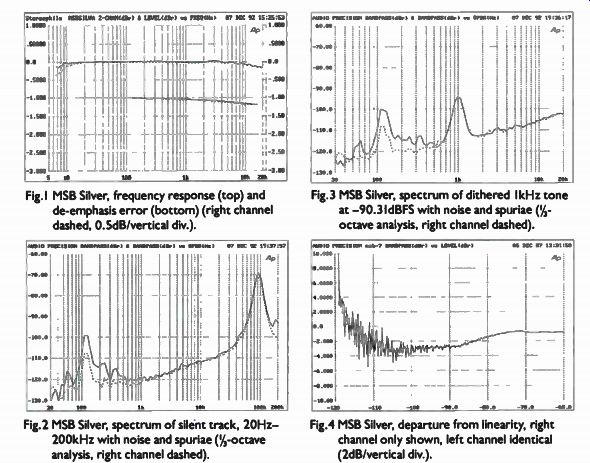
Fig. 1 MSB Silver, frequency response (top) and de-emphasis error (bottom) (right channel dashed, 0.5dB/vertical div.).
Fig.2 MSB Silver, spectrum of silent track, 20Hz 200kHz with noise and spuriae (1/3-octave analysis, right channel dashed).
Fig .3 MSB Silver, spectrum of dithered 'kHz tone at -90.31dBFS with noise and spuriae octave analysis, right channel dashed).
Fig.4 MSB Silver, departure from linearity, right channel only shown, left channel identical (2dB/vertical div.).
Looking at a broader analysis of the MSB's linearity (fig.4), we see some error beginning at -75dB, increasing to a maximum of less than -3cIB to below -110dB, allowing for interpolation within the low-level noise. This is acceptable but not exceptional performance for a current player at this price. The right channel is shown; the left channel was an exact match. The noise modulation as a function of signal level vs frequency is plotted in fig.5. (The test signal here was derived from Stereophile’s Test CD 2, track 29. A full description of this test is available in the booklet.) The plots show the noise spectra produced while the player decodes a low-frequency tone at six different, progressively decreasing signal levels, running from -50dB to -100dB. The more tightly clustered the results, the better. Above 4kHz, the MSB's grouping is reasonably close, but below that the spread is considerably worse; most of the error is with the curves for the two highest levels (-50dB and -60dB). All of the curves show some rise at the lowest frequencies, which may be at least partially an artifact of the dither used on the disc; it shows up to varying degrees on all of the players here. This is a comparatively new test; the audible significance of good or bad results is still to be determined, but the MSB did show the poorest clustering of all the players in this group.
Fig.6 shows the results of the MSB decoding a 1-khz, undithered sinewave at -90dB. Here the general periodic nature of the wave form can be seen, but the desirable stairstep response-see the Meitner IDAT review else where in this issue-is only vaguely apparent. Part of the problem is due to the power supply-related noise, the major component of which can be seen overlaying the higher frequency component of the wave. Using a full-scale (0-dB) 1-khz squarewave to drive the MSB results in the plot shown in fig.7.
The result is quite typical of players using linear-phase oversampling filters. Only a slightly smaller, better-damped ringing on the . flat tops and bottoms of the traces distinguishes this trace from the others in the group. (The overshoot and ringing in the Audio Precision's anti-aliasing filter have been subtracted from this and the other squarewave plots.) Finally, feeding the MSB with a full-scale combined 19kHz+20kHz signal and per forming an FFT analysis of the output resulted in the plot shown in fig.8. The artifacts are considerable; the result here is noticeably worse than we're used to seeing in even inexpensive players. But note the result care fully. Virtually all of the hash would appear to be noise, almost none of it related to any frequency which would logically result from intermodulation of a 19kHz+20kHz signal.
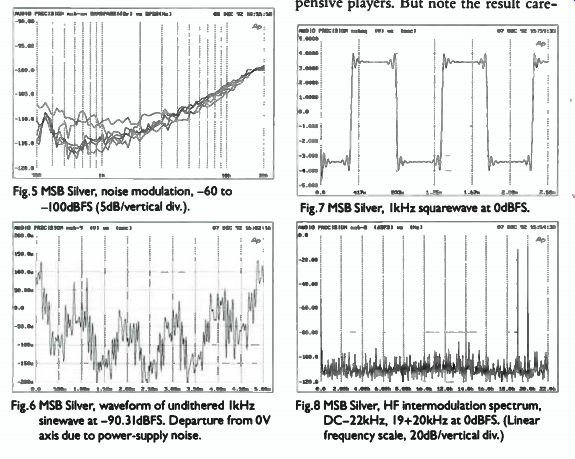
Fig. 5 MSB Silver, noise modulation, -60 to -100dBFS (5dB/vertical div.).
Fig.6 MSB Silver, waveform of undithered I kHz sinewave at -90.31dBFS. Departure from OV axis due to power-supply noise.
Fig.7 MSB Silver, I kHz squarewave at 0-dBFS. Fig.8 MSB Silver, HF intermodulation spectrum, DC-22kHz, 19+20kHz at 0-dBFS. (Linear frequency scale, 20dB/vertical div.)
The typical problem frequencies-1-khz and discrete frequencies at 1-khz intervals, especially just above and below the 19kHz and 20kHz fundamentals-are either low in level or displaced enough from the expected frequencies to make us suspect noise rather than IM. I suspect that most of the artifacts are low-level noise from the MSB's power sup ply. The worst of them is more than 76dB down (less than 0.015% in distortion percentages). CD players in general exhibit quite low distortion on this test; the MSB's results, while higher than is typical, are still low relative to the measurable distortions present in analog stages and, especially, analog transducers.
Checking the error-correction performance of the MSB with the Pierre Verany test disc revealed some small glitches beginning at track 34. The MSB tracked 34 through 36 with only a slight stumbling at the beginning of the band, continuous dropouts beginning at track 37. Though this was a bit below the performance of the other players in the group, it is still about average for the players and transports we've tested. Track 27 is the required CD minimum standard; any competent CD player should do better than that.
The measured performance of the MSB is adequate, though not in any way exceptional. It is below average in noise modulation, IM artifacts (noise or otherwise), linearity, and in the reproduction of a 1-khz, undithered sinewave, though not apparently to a degree which affects its audible performance. Perhaps it would sound even better than it does if its bench performance were better. Perhaps not.
MARANTZ CD-II MK.II: $2500
Aesthetics are certainly in the eye of the beholder, but the Marantz CD-11 Mk.II is, to these eyes, easily the most physically striking, and best laid-out, of the players in this group (though the MSB certainly takes the prize as the most unconventional-looking). The CD-11 has a full set of front-panel controls, with the exception of track scan (located on the remote with all of the lesser-used functions). The classic Marantz brushed-gold look is a pleasant change from the black and grey of the other players, though the decor conscious may find that it can only be cosmetically matched with other Marantz products. (Could this be intentional?) Heavy metal end-caps (which, like the MSB's baseplate, though not to quite the same extent, make up a significant part of the player's overall weight) complete the external design. On the rear panel both balanced (transformer coupled) and unbalanced output jacks, as well as optical (Toslink) and coaxial digital out puts, may be found. Remote-control input/ output jacks are also provided, which are only for use with a complete system of Marantz components, where they make possible complete remote-control facilities. And I will be forever grateful to whomever is responsible for placing holders on the rear panel for the CD-11's transport screws- items which are forever getting lost.
The CD-11 Mk.II is, cosmetically and functionally, the spitting image of the Philips LHH500 reviewed here in Vol.14 No.1 (January 1991). Not so surprising-Philips is Marantz's parent company. It is, therefore, also not surprising that the LHH500 and the CD-11 Mk.II both use Philips's Bitstream Pulse Density Modulation (PDM) decoding scheme. The LHH500 used a very early implementation of this process; the CD-11 Mk.II uses Philips's latest Bitstream technology. The internal processing begins with a 20-bit, 8x-oversampling digital filter. The resulting filtered digital signal is further massaged by a 3rd-order noise shaper, which also provides another 16x-oversampling (thus the 128x-oversampling in the specs). Noise shaping is no option in one-bit decoding techniques, but is required to shift the quantization noise generated by the process to frequencies well above the audible range. After leaving this noise-shaper, the digital data stream is input to dual DACs: Philips TDA 1547s (or DAC7s, as they're also known). Each DAC 7 has four individual D/A converters, two differential left, two right.
The CD-11 Mk.II uses a heavy-duty, die cast Philips CDM-4 Professional transport mechanism. A toroidal transformer and completely revised (from LHH500 days) power supply, heavy-duty, diecast, copper plated chassis, and excellent apparent overall build quality and parts complete the package.
Sound: When I reviewed that original Philips LHH500 two years ago, my reactions were not particularly favorable I found the sound two-dimensional at best, with a rather grainy overall character. I can happily report that the CD-11 retained neither of these qualities. It had a smooth, dimensional sound; nothing about its performance offended or irritated.
-----------Marantz CD-I1 Mk.II CD player
It combined a good soundstage (including depth) with a sweet, somewhat forgiving character. It was not unlike the MSB in broad outline, with a degree of softness at both frequency extremes and a slightly forward, rich, and tactile midrange. I don't want to stretch the comparison too far here-I'll get back to it further on in the review-but the CD-11 was never less than enjoyable, its sound easy to get comfortable with.
The CD-11 handled voices very well, with a good feeling sense of air, presence, and natural warmth. Instrumental detailing was never in-your-face, but pleasingly subtle The bottom end was reasonably extended and full, the top end airy, though not with a sense of limitless extension.
But there was something not quite there in the Marantz's sound that I didn't notice immediately. It would, in fact, be relatively easy to live comfortably with the CD-11 without ever being conscious of anything being missing. The Marantz is not dull or obviously veiled. Clannad's Magical Ring (RCA ND71473) didn't obviously lack for space or detail. There was a fine sense of air, with sweet, subtle shadings surrounding the instrumental accompaniment. Gordon Light foot's voice on If You Could Read My Mind (Reprise 6392-2) was sweet and warm, with a slight bloom, and no hint of a threadbare or unnaturally lean balance. Mary Black's Babes in the Wood (Gift Horse/Curb D2 77528)--not the smoothest recording throughout, though striking in places-had a lovely vocal glow and believable warmth.
But it was perhaps the CD-11's very ease and listenability which worked against it, even as it made it difficult to really dislike its overall sound. There was a lack of something which gives music its drive and, yes, its edge (not the same thing as edginess). MC might refer to it as pace RH would discuss the sense of blackness behind the notes. And JGH has, in the past, used the term "snap:" I might simply call it clarity. Whatever you call it, the CD-11 seems to shortchange it. There was a certain homogenization to its sound which became more pronounced as the music became more complex, and which prevented everything from popping sharply into focus.
I've observed this quality in a number of single-bit designs in the past; I hesitate to stereotype all such players, but the balance of my experience is pointing me at least tentatively in that direction.
My listening notes consistently point out this quality, even while commenting frequently on the easy, relaxed quality of the CD-11's sound. On Clannad I commented that there seemed to be a shortage of grip and forward drive. I wanted to turn up the level to give the music more punch. Mary Black's recording sounded just a bit dense, emerging from a "dark grey" rather than a "black" background. Guillou's organ transcription of Mussorgsky's Pictures involved me less than it had in the past; the silences between the notes were not as well defined as I've heard them. I felt the same way about Mokave, Volume 1. Here I wrote that the transparency was a bit lacking; the sound was good, though not really sit-up-and-take-notice or knock-your-socks-off. Images were a bit enlarged, with a rather overripe midbass and not less than the best inner detailing.
But again, the shortcomings didn't jump out. Every time I returned to the CD-11, I thought it would be an easy player to live with. Then, as I continued to compare it to other players in the test, it let me down. Mister Swing, with its inherently fine clarity and precise soundstage layering, was very clean through the CD-11 though slightly rich, somewhat forward, and smooth and sweet rather than highly detailed. There was a good sense of space, with the voice nicely focused, if a bit "big" and "cushy" overall. Had I not heard this recording through players offering better overall resolution, the result would have certainly been more than acceptable But I have, and it wasn't-or rather, it was less so. A lack of contrast in the sound made it difficult to "see into" into the soundstage to any great depth.
To make the comparison a bit more specific, I went back and listened to this and other recordings through the MSB Silver.
Now the images within the soundstage were better defined; the sound simply had more life, demanding more of the listener's attention. If it was less "relaxed," it was also more involving. The bottom end was also tighter and deeper. And if the MSB's bottom end is itself rather warmer and fuller than I might ultimately prefer, the CD-11's was clearly a step further removed from the ideal.
Finally, I compared the CD-11 with the Pioneer transport/PS Audio Ultralink combination. The latter was easily the more lucid.
Mister Swing had a more visceral, layered, see into quality with the transport/processor; the CD-11 simply homogenized and "prettied up" the sound too much. Mokave, which depends for its impact on the ability to separate inner details, simply worked better on the Pioneer/PS Audio.
A recently released compilation of music used in the TV series "Northern Exposure" (MCA MCAD-10685)6 can only be described 6 A recent record review-which I would gladly credit ill could recall where I read it-thought this album primarily lacking in that, unlike the series, you couldn't see Janine Turner. I can relate to that. At least the album has the moose theme.
as the oddest compilation album I've acquired in years. The recording quality ranges from enjoyable to execrable, the music from sub lime to hokey. Several cuts, however, were useful in this comparison. One in particular, "Don Quichotte," from an obscure rock group called Magazine 60, was most revealing. Overdubbed, multimiked, and apparently processed through a meat-grinder, it nevertheless opened up through the Pioneer/PS Audio reference. Inner threads were clearly revealed. The layering of the mix was laid bare-and was not unpleasant. Sup ported by a tight bassline, it had a drive and forward motion which were irresistible. On the Marantz it certainly didn't sound bad-it would take a curmudgeon to say that-but it was simply too smooth, too lacking in that subtle yet important quality of aliveness.
Through the reference, this selection came across as enjoyable and involving, even as a selection which might be useful in assessing the inner clarity of other components.
Through the Marantz, it was never less than interesting, but never much more, either.
All of the above listening was done through the Marantz's unbalanced outputs.
To compare these to the balanced, I switched over to AudioQuest Lapis interconnect, using identical-length balanced and unbalanced pairs. The differences were really subtle, and I would not want to have my feet held to the fire to choose the better of the two. If pressed, I'd have to say that the unbalanced connection was just a trace more detailed in the top end, a difference only evident with material having a lot of energy in the treble The Lapis cable did add a trace of sparkle to the Marantz's top end, much as it did with the Proceed (below), opening up the sound relative to that with the sweeter-sounding TARA Labs RSC. In the universe of CD players (and trans port/processors of comparable cost), I can certainly categorize the CD-11 as a solid, competent performer; capable, to be sure, of making a good first impression, and never hard to listen to except on CDs best suited for leprechaun frisbees. But it nevertheless left me with an "Okay, that's nice" feeling rather than the desire to listen on into the night. And to get really enthusiastic, the latter is what I need. The CD-11 Mk.II is certainly better than its parent, the Philips LHH500. But in today's digital technology race, you have to run hard just to keep up, while at the same time pausing long enough to look closely at the competition.
Measurements: From its unbalanced out puts, the Marantz CD-11 produced 2.24V/ 2.22V (left/right) when decoding a 1-khz, 0-dB (full-scale) sinewave. From its balanced outputs, it put out 2.71V/2:69V-significantly less than the 6dB increase expected.
Its unbalanced output impedance measured just under 99 ohms in the left channel, 100 ohms in the right. The balanced output impedance was virtually the same. DC offset was 2mV in the left channel, 5mV in the right.
A positive-going impulse indicated positive at the unbalanced output; the Marantz is non-inverting. The balanced output is con figured with pin 3 positive, pin 2 negative- the less commonly used arrangement, in our experience. Using the Marantz's balanced outputs into a preamp having balanced inputs using a 2+ arrangement will result in an absolute polarity reversal in the system.
The frequency response of the Marantz CD-11 Mk.II was extremely flat (fig.9, middle traces) from the unbalanced outputs, with a small rolloff at the frequency extremes (greater than specified, however) from the transformer-driven balanced outputs (top traces). (The remainder of the measurements shown are for the unbalanced outputs.) The de-emphasis error (shown at the bottom of fig.9) should not be called an error-it is virtually dead flat. The crosstalk was also extremely good, very well matched between channels at better than -115dB across most of the band, with only a small rise at the higher frequencies, most likely due to capacitive interchannel coupling.
Fig.10 shows the analysis of the Marantz's decoding of a track of "digital silence" (all data words zero). The main distinguishing feature is the rise in the noise at ultrasonic frequencies-an intentional result of the operation of the necessary noise shaping used in Bitstream decoding. The noise in the right channel is exceptionally low in the audible range, less so but still excellent in the left.
Using the same spectral analysis, fig.11 shows the result of decoding a -90dB, 1-khz dithered sinewave signal. The curve indicates good linearity, no significant artifacts, and only an insignificant blip of power-supply related noise at around 60Hz (still at nearly -120dB, however). Looking at the Marantz's linearity in a different way (fig.12), using a fade-to-noise with dither signal, we see virtually perfect decoding down to below -100dB. No comment is needed here; the result is typical of well-designed 1-bit decoders. The left channel is shown; the right is a virtual clone. The noise modulation as a function of signal level vs frequency is plotted in fig.13. (The test signal here was derived from Stereophile's Test CD 2. A full description of this test is avail able there.) A tightly clustered series of curves is the best result, and the Marantz is superb in this respect, with the noise modulation continuing to decrease at low frequencies in all but one curve. This comparatively new test is still open to interpretation regarding its audible significance, but the Marantz did exceptionally well with it.
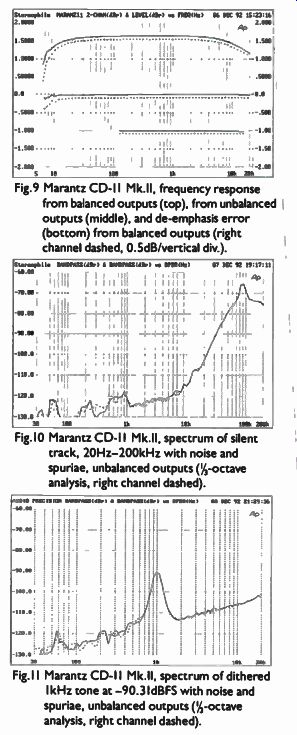
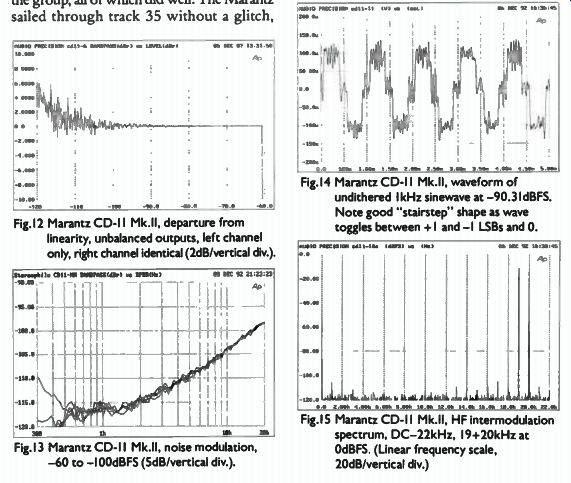
Fig. 9 Marantz CD-11 Mk.II, frequency response from balanced outputs (top), from unbalanced outputs (middle), and de-emphasis error (bottom) from balanced outputs (right channel dashed, 0.5dB/vertical div.).
Fig. 10 Marantz CD-11 Mk.II, spectrum of silent track, 20Hz-200kHz with noise and spuriae, unbalanced outputs ('-octave analysis, right channel dashed).
Fig. 11 Marantz CD-11 Mk.II, spectrum of dithered 'kHz tone at -90.31dBFS with noise and spuriae, unbalanced outputs (s-octave analysis, right channel dashed).
Fig.12 Marantz CD-11 Mk.II, departure from linearity, unbalanced outputs, left channel only, right channel identical (2dB/vertical div.)
Fig.13 Marantz CD-11 Mk.II, noise modulation, -60 to -100dBFS (5dB/vertical div.).
Fig.14 Marantz CD-11 Mk.II, waveform of undithered kHz sinewave at -90.3IdBFS. Note good "stairstep- shape as wave toggles between + 1 and -1 LSBs and 0.
Fig. 15 Marantz CD-11 Mk.11 1 -IF intermodulation spectrum, DC-22kHz, 19+20kHz at 0-dBFS. (Linear frequency scale, 20dB/vertical div.)
Fig. 14 shows the results of the Marantz decoding a 1-khz, undithered sinewave at -90dB. Here the desired stairstep configuration of the wave can be clearly seen; this is a very clean result. Using a full-scale (0-dB) 1-khz squarewave to drive the Marantz results in a waveshape similar to that of the MSB (fig.7). Feeding a full-scale combined 19kHz+20kHz signal into the Marantz and performing an FFT analysis of the output resulted in the plot shown in fig.15. Minor artifacts can be seen at 1-khz and at several higher frequencies, none worse than -93dB (just over 0.002%). The CD-11 Mk.II's error-correction capability, tested using the Pierre Verany test disc, tied the Kinergetics' for the best showing in the group, all of which did well. The Marantz sailed through track 35 without a glitch, stumbling just a bit at the beginnings of tracks 36 and 37, and exhibiting no continuous drop outs until track 38. The minimum CD standard is track 27, though it would take a very poor player indeed to do no better than that.
The bench test results for the CD-11 Mk.II are simply first-rate. Its measured performance is very much state-of-the-art.
PROCEED PCD 3: $2995
The Proceed PCD 3 is the latest in a series of one-piece CD players from Madrigal which began with the PCD (reviewed in Vol.13 No.2) and continued with the PCD 2 (Vol.14 No5). Externally, the PCD 3 is little changed from the PCD 2. The only visible alteration is in the new machined aluminum feet, which allow an option of pads or spikes (furnished). As in the case of the PCD 2, the PCD 3 has a shape totally unlike those of other CD players. It is not built this way for cosmetic reasons, but to allow for internal orientation of the various boards and components in a way which Madrigal engineers feel produces the minimum interference between them.
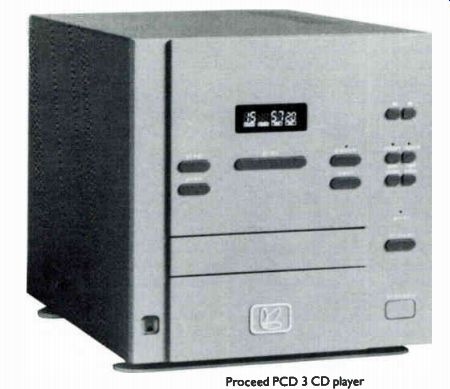
Proceed PCD 3 CD player
The rear panel of the PCD 3 provides both balanced and unbalanced analog outputs, a coaxial digital output, and the main power switch. The last is designed to be left on at all times (a warning in the manual cautions against turning it on with the rest of the sys tem powered-g». When the player is not in use, a standby switch on the front panel may be used to turn off the display while leaving the main circuits powered-up.
Madrigal makes much of their efforts to minimize timing errors in retrieving the signal from the CD. They begin with a rigid aluminum framework and the addition of lead mass at the base of the mechanism to minimize vibrations. The mass loading and generally heavier build quality are new to the PCD 3-as is a new decoder board (the bits are actually retrieved from the CD as an FM analog signal, which must be properly de coded), which further helps in reducing timing errors (jitter) in the digital data stream.
After digital filtration and 8x-oversampling-Madrigal believes that very high over sampling rates actually degrade the signal's noise and distortion characteristics-the signal goes to a new audio board (improved from the PCD 2) incorporating Burr Brown's latest 20-bit DACs, as well as a new filter from the top-of-the-line Levinson No.30 and new No.35. Separate electronic regulation is provided for the power supply to each rail of the converter circuitry. There have also been upgrades to the player's analog portions.
Opening up the PCD 3 reveals a neat, professional layout with quality parts and attention to detail. A toroidal transformer is used for the power supply, and particular mention should be made of Madrigal's new, proprietary, and very heavy duty RCA jacks used for the analog and digital outputs.
I have but a single nit to pick regarding the PCD 3's build and functioning: Its scanning mode accelerates far too fast. This was not a problem with the other players, but if you often use the scan mode to find a particular passage, you'll find the Proceed a frustration.
Several times I tried to stop three minutes into a selection and wound up zipping past the six-minute point before I knew it.
The price of the PCD 3 is considerably above that of the PCD 2, but there have been significant changes to justify the added cost.
Sound: Reviewing my impressions of the sound of the PCD 3, what was most striking was its balance of virtues. Nothing really jumped off the pages of my listening notes.
Like the Marantz CD-11, it had a sweet, very easy quality about it, but was more open, better focused, and had a tighter, better defined low end. It shared with the Proceed PDT 3/Levinson No.30 some of the latter's transparency and overall balance, though it never fooled me into thinking that I was listening to that stratospherically priced combination. Having developed the No30, Madrigal may be in the best position to close-in on the sound of that unit in its lower-cost products, but it was no surprise that they haven't done it here. No one expected them to.
What they have produced is an excellent one-piece player that, save for a tendency to be perhaps too forgiving at the top end- which can be mitigated somewhat by the choice of interconnect cable-sounds disarmingly neutral. Gordon Lightfoot's voice on If You Could Read My Mind was slightly sweet but not dense or obscured. It had a good if not striking degree of palpability, with no hard edge. If anything, it may have been a little too sweet. Michael Hedges's hard-driving guitar on Taproot (Windham Hill WD-1093) could have used a bit more air and bite at the top, but the attacks were handled well. Nothing seemed either missing or overdone.
Though I'd planned to listen to just isolated selections from the Edward Scissorhands soundtrack through the Proceed, I wound up listening to the entire album (with the exception of the execrable and totally out of-place Tom Jones song which brings it to a close). With the Proceed, its sound was superb-silky strings, open, spacious chorus, clear, detailed percussion, and a superior sense of space, expansiveness, and depth in the finely tuned soundstage. There was no hint of digital artifacts. The same was true of Clannad's Magical Ring. The sound was detailed without being in any way analytic or etched. It was never pushy or forward, and was refreshingly free of glare or excess brightness.
This wasn't invariably true, however. Mary Black's Babes in the Wood, though better sonically in my opinion than her earlier No Frontiers (Gift Horse/Curb D2-77308), is still marred on many of the songs by a hard, sibilant sheen. The Proceed doesn't hide this, but it was nonetheless forgiving enough that I found myself listening to the entire album.
A few of the selections on this album, despite what appears to be a rather heavy hand on the top EQ, are otherwise beautifully done.
The PCD 3 worked superbly here, with excellent top-end air, fine inner detailing, a good soundstage with focus, depth, and convincing sonic contrast, and a warmth which fleshed out the vocals naturally without going so far as to muddle the instrumental lines. Judged on its own, I found very little to complain of in the Proceed's sound. But I did find myself itching, throughout the auditioning, to compare its sound directly with that of the MSB. Absolute judgments of individual components are difficult to make through any real playback system, which invariably has colorations of its own.
It was obvious from the first listen that the MSB had a more forward, immediate sound than the Proceed. This could sometimes be a bit too much, particularly in the upper mid range and low treble, but I only found it to be an irritation on CDs which were hyped up in this region. Most of the time it resembled nothing so much as the aliveness of a good tube amplifier. At the bottom end, the MSB had the fuller, richer bass, with a some time over-ripeness to the mid- and upper bass, but a striking extension (which neither the Proceed nor any other player here could match) into the extreme bottom.
All of these qualities were evident in the Abyss soundtrack. Here the PCD 3 gave a fine accounting, producing a real feeling of depth, good high-frequency detailing, good bottom end extension and impact, and the ability to involve the listener in the eerie, sometimes creepy atmosphere evoked by the music. But the MSB carried this a step further. It was more open and expansive still, with its more extended bottom end creating a more ominous atmosphere. The sound was livelier, the details slightly more apparent. It was still sweet, but definitely less laid-back than the Proceed. The percussive whacks through out band 6, "The Fight:' had a degree less overall weight with the PCD 3, with not quite the definition in the depth plane of the MSB. Magical Ring was slightly brighter and more visceral with the MSB; perhaps less pleasant, but also, I felt, more suited to the music. Details were more evident, though not overdone, and voices were more sharply focused in space. The Proceed won out on Babes in the Wood, however, where the upper midrange/lower-treble hype of the recording did not mesh as well with the balance of the MSB. The latter did, however, do a better job of instilling a natural warmth into the bottom end of Mary Black's vocals.
Matched against the Pioneer transport/PS Audio Ultralink D/A processor, the Proceed was less open on top, with less see-through transparency and a subtle, dry grain in the treble which was not at all obvious except in the comparison. The Pioneer/PS Audio was less open in the mid- and upper bass, with a fuller quality in this region compared to the tighter, crisper sound of the Proceed. Male vocals on the Pioneer/PS Audio were liquid and grainless, with just enough clarity in the brightness region to give them a natural definition and reveal the subtle character and vocal inflections without becoming hard or etched. I noted some excess warmth in the upper bass, which bothered me initially but was easily ignored after a few minutes. The Proceed had none of this excess warmth. It was better balanced at the bottom, but the vocal quality was less fluid, less "there." This same difference was heard on Mister Swing, where the bass line, though it remained slightly warmer, was also richer and deeper on the Pioneer/PS Audio, and the latter revealed more inner detail and dimensionality. Both players had good ultimate LF extension, the differences between them being a close call. Ultimately I felt that the Pioneer/PS Audio dug a little deeper at the very bottom, while the Proceed was a bit leaner and more open in the mid- and upper bass. The latter quality helps to open up the sound in most cases, as it did here. But the natural openness of the Pioneer/Proceed's top end was compelling.
While most of the listening tests were done using the unbalanced outputs of the Proceed, I did listen to the balanced outputs toward the end of the evaluation period. Here I switched over to the latest AudioQuest Lapis interconnects because two equal-length pairs of these cables were available, balanced and unbalanced. The result was a shade better definition from the balanced outputs, not enough to swamp any of the differences discussed above, but enough to further open up the sound of the PCD 3 and help mitigate that rather laid-back politeness in its sound.
The Lapis cables themselves seemed to sound a bit more lively than the TARA Labs RSC, which seemed to better suit the Proceed. As a follow-on to this I also briefly compared the Proceed with the MSB, using Lapis cables for both-balanced for the Proceed, unbalanced for the MSB-to determine if this would change my impressions concerning the relative sound of the two. It did not.
Measurements: From its unbalanced out puts, the Proceed PCD 3 put out 2.13V/ 2.12V (left/right) when decoding a 1-khz, 0-dB (full-scale) sinewave. From its balanced outputs, it put out 4.25V/4.24V-the antic ipated 6dB gain for balanced vs unbalanced outputs, all else equal. The PCD 3's output impedance was extremely low, so low that it could not be measured accurately on the Audio Precision System One. It was effec tively at or below 1 ohm for both the bal anced and the unbalanced outputs. The DC offset was 0.1mV in the left channel, 1.2mV in the right. The Proceed is non-inverting from the unbalanced inputs-a positive going impulse indicated positive on the 'scope-and the balanced output is con figured with pin 2 positive, pin 3 negative.
The PCD 3's frequency response (fig.16, top traces) was flat, with only a minor and audibly insignificant drop above 10 kHz. The result shown is for the unbalanced outputs; the response for the balanced outputs was identical. (The remainder of the measure ments below were made from the unbalanced outputs.) The de-emphasis error also shown in fig.16 is virtually nonexistent. The cross talk was also superb at better than -120dB up to 8kHz, with left and right channels well matched and only a slight, and expected, rise at the higher frequencies due nearly always to interchannel capacitive coupling.
Fig.17 shows the spectral analysis of the Proceed's decoding of a track of "digital silence" (all data words zero). Note that, like most multi-bit players (the MSB being an exception that belies the rule), the noise does not rise dramatically at ultrasonic frequencies.
There's little worthy of comment here; the result is first-class. Fig.18 shows the result of using the same spectral analysis of the player now decoding a -90dB, 1-khz dithered sinewave. The curve indicates good linearity and shows no significant artifacts.
Looking at the Proceed's linearity curve (fig.19), we see virtually perfect decoding down to below -100dB. This is a result as linear as that found in good 1-bit decoders, proving (if proof were needed) that there is more than one way to properly do a bit of decoding. The left channel is shown; the right was no different. The noise modulation as a function of signal level vs frequency is plot ted in fig.20, taken from the second Stereophile Test CD, Track 29. A tightly clustered series of curves is the best result, and the Proceed is excellent in this respect, though with some deviation below 2kHz, primarily in the highest two signal levels.
The Proceed produced an excellent stair step waveform when decoding a 1-khz undithered sinewave at -90dB, with less ringing at the transitions than with any of the other players in the group. A full-scale (0-dB) 1-khz squarewave was reproduced with the sym metrical ringing typical of players using a linear-phase digital filter. Using a full-scale combined 1-khz+20kHz test signal to drive the Proceed and performing an FFT analysis of the output resulted in the plot shown in fig.21. This is a very good result, with all artifacts better than 88dB down (lower than about 0.004%). The PCD 3's error-correction capability was examined using the Pierre Verany test disc. The '3 had no difficulties through track 35, only occasional difficulties at the beginnings of tracks 36 and 37, and continuous dropouts starting only on track 37. The CD standard requires full error-correction through track 27, though we have not measured a player which could not considerably outperform this standard. The Proceed's performance on this test was first-rate.
The bench-test results for the Proceed PCD 3 are excellent all around, with virtually nothing worth criticizing-certainly nothing to stand in the way of superior sound.
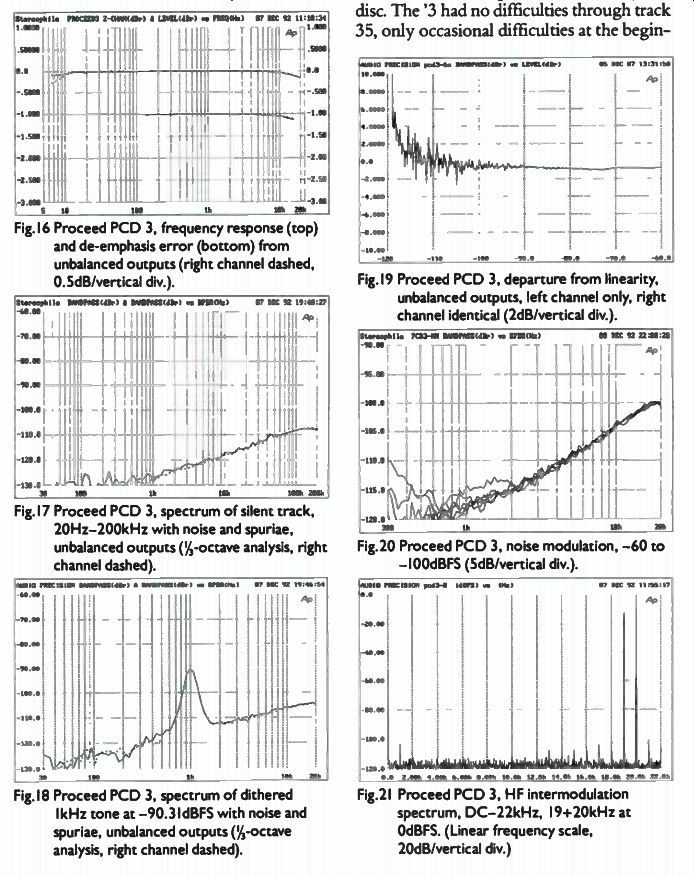
Fig.16 Proceed PCD 3, frequency response (top) and de-emphasis error (bottom) from unbalanced outputs (right channel dashed, 0.5dB/vertical div.).
Fig.17 Proceed PCD 3, spectrum of silent track, 20Hz-200kHz with noise and spuriae, unbalanced outputs (IA-octave analysis, right channel dashed).
Fig.18 Proceed PCD 3, spectrum of dithered 1-khz tone at -90.31dBFS with noise and spuriae, unbalanced outputs (s-octave analysis, right channel dashed).
Fig. 19 Proceed PCD 3, departure from linearity, unbalanced outputs, left channel only, right channel identical (2dB/vertical div.).
Fig. 20 Proceed PCD 3, noise modulation, -60 to -100dBFS (5dB/vertical div.).
Fig. 21 Proceed PCD 3, HF intermodulation spectrum, DC-22khz, 19+20 kHz at 0-dBFS. (Linear frequency scale, 20dB/vertical div.)
PROCEED PCD 2 VS. PCD 3
I also had the opportunity to briefly com pare the Proceed PCD 2 and PCD 3. The comparison was performed using the balanced outputs of each player with the Audio Quest Lapis balanced interconnect. The only other change in the system during this com parison was the absence of the Entec sub woofers; the WATTs/Puppies were used alone and full-range. The two CD players definitely sounded very similar; the differences were comparable in degree to those between two very good interconnects. As is often the case with such differences, they grew more significant, though no greater on an absolute scale, as the listening session continued.
I noted two principle improvements in the sound of the PCD 3 over that of the PCD 2.
First, the newer player had a slightly warmer, more full-bodied sound. Solo voices and instruments were a bit threadbare, in com parison, on the PCD 2. And second, the top end of the newest Proceed, though no more extended than the older player, was more open. The PCD 2 was drier, less liquidly sweet, less pristine-sounding than the PCD 3. That said, I'm not entirely happy with this description, which inevitably overstates the differences in order to convey the ideas. I would not even have attempted to characterize the differences between these two players had I not been able to hear them side-by-side (The outputs of the two players were identical to within 0.1dB, greatly simplifying the com parison.) I definitely preferred the PCD 3 to the PCD 2 overall. Upgrades arc available from Madrigal for converting a PCD 2 to a PCD 3 for $1295, and also to convert a PCD 1 to a PCD 3 (contact Madrigal for pricing). This upgrade will be worthwhile for some PCD 2 owners, but perhaps not for all. Because it is not an inexpensive modification, and be cause the differences in the players (at least between the 2 and 3 levels) are not shattering, I advise setting up a comparison of your PCD 1 or 2 to a PCD 3 at your local Proceed dealer before making any upgrade decision.
And for those who can't quite afford the PCD 3, I certainly recommend auditioning and considering a leftover PCD 2-a considerably less expensive player, and likely to be something of a bargain while stocks remain.
The Proceed is a player I could live with comfortably. Its shortcomings were few. In its third incarnation, the Proceed has reached a price range which leads to very high expectations, and where it must compete with some very good separate transports and D/A processors. Plus, it must sit in the shadow of its Madrigal stable-mate, the Levinson No30. While the buyer needs to consider all the alternatives when shopping for a one-piece player at this price, the PCD 3 can definitely hold its own.
KINERGETICS KCD-40 PLATINUM: $2295
The KCD-40 looks unique only in its use of lever switches instead of pushbuttons. I'm not certain that this is an advance; ergonomically I found them a little more fiddly than large, well-arranged buttons, but each buyer will have to make that determination for him or herself. The light lettering-common to the Kinergetics line-can also be a little difficult to read.
A ganged volume control on the front panel adjusts the level at a pair of variable output jacks on the rear. A second pair of fixed-level jacks is also provided (most of my listening was done using the latter). There is also a pre-cut opening on the rear for fitting a coaxial digital output--a $125 option.
Kinergetics does not install one at the factory; they feel it may slightly degrade the performance. There is no on-off switch on the player; it is designed to be left on at all times.
The KCD-40 operates in an 18-bit, 8x oversampling mode. Four matched Analog Devices DACs are used, two per channel in the same balanced topology used by Kinergetics in their separate D/A processors to minimize even-order distortions. Only un balanced outputs are standard, but balanced ones are a $125 option (installing them deletes the unbalanced connections). Kinergetics also ...
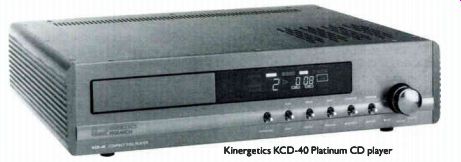
-----------Kinergetics KCD-40 Platinum CD player
... incorporates their patented hysteresis-canceling circuit, claimed to cancel any non linear distortions in the signal path due to wire and contacts.
The output stage of the KCD-40 is a hybrid of bipolar transistors and J-FETs. It is direct-coupled; a servo control is used to control DC offset. The output voltage avail able from the KCD-40 is considerably higher than that from any of the other players here, even in the balanced mode (where provided). This permits it to drive an amplifier directly through the variable outputs, or through a passive or other zero-gain control unit/ attenuator.
Internally, the KCD-40 shows good build quality, if slightly Tess "aah"-inspiring than that of the Proceed and Marantz. It has a solid aluminum chassis and high-quality parts. A toroidal transformer drives separated discrete voltage regulators for all stages.
Sound: As the least expensive player on test here, the Kinergetics KCD Platinum had everything to gain in this auditioning; even had it finished last, a strong showing would be nothing for it to be ashamed of. Well, it did make a strong showing, stronger than its relative price might indicate.
The Kinergetics is, however, still far from being an inexpensive player. A buyer has a right to expect a solid performance, and that is what he or she will get. The KCD-40 combines a rich, rounded, glowing midrange with an open, detailed top end and a full, warm, but well-defined and punchy bass. It has a slightly forward perspective which makes its depth less immediately obvious than that from the best players or trans port/processors, but over the long haul its front-to-back perspective is convincing. It never sounded etched or analytic with the TARA Labs cables I used (assuming some thing resembling a good-sounding CD). It could, however, be made to sound more up front and forward-including some tag along low-treble emphasis-with a judicious (or perhaps injudicious?) choice of cables.
There was a definite bloom to its sound which sometimes enlarged images-espe cially noticeable on male singing voices-but the soundstage was otherwise well-formed.
The KCD-40's performance is easier to describe in terms of particular recordings than generally. Jennifer Warnes's The Hunter was reproduced beautifully. Some excess of warmth is inevitable with this recording, and the Kinergetics did not conceal it. But the sound was big, open, and generous, with a finely shaded, detailed midrange and top end.
It was neither overly sweet nor veiled. Gordon Lightfoot's voice on If You Could Read My Mind did have a trace of excess warmth, but was otherwise full-bodied and open, with a clear, transparent midrange. With the more complex interplay of voice and instruments in Mister Swing, there was a good, though not exceptional, feeling of being able to hear into the soundstage and "feel" the layering of the recording. Again, the mid- and upper bass were perhaps a bit too warm here, with the lower bass present but somewhat soft. But the bass range did not obscure detailing fur ther up into the midrange and treble.
I did feel, however, that some recordings did not quite snap to life on the KCD-40. Case in point: Andreas Vollenweider's Book of Roses (Columbia CK 48601). Here there was a small lack of air at the top end and a lack of crispness to the sound. The latter term is one I do not like to use as something desirable-it is too often associated with treble exaggeration-but here I mean it only in the sense of the quality which makes subtle, overlaid transients stand out naturally from each other. The Kinergetics was certainly more than acceptable here, but it did not quite bring out the best in this recording, which, on the right player, can be striking for its subtle shadings and inner detail.
Compared with the MSB Silver, the KCD 40 sounded a little less punchy, with a less extended bottom end and less present mid range and lower treble. Both were a bit soft at the very top, but this was less obvious with the MSB because of its greater immediacy.
The MSB was more up-front, but at the same time its overall clarity gave it a more clearly focused soundstage and more obvious depth.
Both players had a tendency toward warmth, but the MSB won out by a hair in the bass and midbass because of its superior detailing. Overall, my preference was definitely for the MSB-which will, after all, set the buyer back an additional $500. The Pioneer transport/PS Audio Ultralink D/A processor opens up the price gap by another $200 or so, the additional cost being the price of the digital interconnect. And it opens up the sonic gap as well. The Pioneer/PS Audio outshines the KCD-40 in a number of ways. The most obvious is in overall openness and clarity-that "blacker" background. This, in turn, clarifies the overall soundstage; individual images have more "pop" to them, standing free of the surrounding sonic fabric. Vocalists were just a shade smaller and more appropriately sized.
While Kenny Rankin's &cause of You (Chesky JD63) certainly sounded fine on the Kinergetics, with warm, palpable vocals and solid instrumental accompaniment, it was that much "more" on the Pioneer/PS Audio.
Kenny Rankin's voice was better balanced on "Someone to Watch Over Me," though still somewhat warm in the midbass and more appropriately sized-read smaller-with the reedy sound of the accompanying saxophone more apparent. The depth and layering on Book of Roses was also more apparent on the Pioneer/PS Audio. Six seconds into "The Grand Ball of the Duljas," a dog bark is heard.
I noticed it for the first time on the Pioneer/PS Audio. While it is quite apparent on the KCD-40 now that I know where to listen for it, its spatial perspective is quite different on the two players. On the Kinergetics it has, arguably, the better presence with slightly more body. On the Pioneer/PS Audio, it's a bit smaller and set back further into the soundstage.
Still, the Kinergetics displayed strengths of its own in this comparison. On the sound track from The Abyss, it had a dynamic sock in the bass which initially impressed more than that from the Pioneer/PS Audio. While the latter proved ultimately to have the tighter overall LF definition, it was very much a matter of tradeoffs, with the KCD-40's fuller bass and midbass edging ahead at times, while at others it fell behind the tighter presentation of the Pioneer/PS Audio. Neither was hair-trigger tight at the bottom; the Pioneer/PS had a band of warmth of its own that occasionally intruded into its otherwise detailed, seamless presentation.
I did try using the variable outputs of the KCD-40 to drive a power amplifier directly, without using a preamp. Not surprisingly, it worked, with more than enough gain to generate levels capable of driving even metal maniacs screaming from the room. But my gut reaction, in an admittedly very brief listen in this mode, was that it was somewhat more congested and etched than with the fixed outputs. It's certainly worth trying if such an arrangement suits your listening situation--the fixed outputs remain available as a fall back in any case.
I noted above that, with a change of inter connects, the sound of the Kinergetics could be made to sound more up-front and brighter in the low treble. I found that switching from TARA RSC to new Audio Quest Lapis livened up the sound of the KCD-40 and removed some of the sensation of softness. This was a plus in some ways, but not in all. Following my comparison of balanced and unbalanced Lapis on the Proceed PCD 3 (see above), I compared the PCD 3 with the KCD-40, using balanced Lapis for the former and unbalanced Lapis for the lat ter. In general I preferred the sound of the Proceed in this comparison. It had a tighter bass and midbass (though on some recordings the warmth of the KCD-40 was welcome), a slightly airier top end, a more neutral midrange perspective (less forward), and a less bright low treble. The KCD-40 does better overall, I feel, with the TARA Labs cable than it does with the Lapis, but it does not, in either case, beat out the more expensive Proceed.
It was no embarrassment for the KCD-40 Platinum to be bettered by the more expensive MSB, Proceed, and the Pioneer/PS Audio combination. While it didn't stand out in any particular respect within this group, its solid overall performance, and more than competitive price, still get it a recommendation.
Measurements: From its fixed outputs, the KCD-40 produced 6.97V/6.96V (left/right) when decoding a 1 kHz, 0-dB (full-scale) sine wave. As anticipated, this was, by a consider able margin, the highest output from any player in this group (all of them put out more than the standard 2V output, the Proceed coming closest to that figure). As noted earlier, there should be no difficulty in using the KCD-40 to drive virtually any amplifier directly from either pair of outputs if desired (using an external attenuator with the fixed gain outputs). The output impedance was the highest in the group at 250 ohms (right channel, just slightly less in the left), though still low enough that there should be no loading problems encountered. Its DC offset was 19.1mV in the left channel, 15.5mV in the right. A positive-going impulse indicated positive at the unbalanced output; the KCD 40 is therefore non-inverting.
The frequency response of the KCD-40 was relatively flat (fig.22), with only a small rolloff at the top end. The de-emphasis error also shown in fig.22 indicates a small loss in the "brightness" region and a small rise above. At less than 0.25dB change from flat in either direction, the audibility of this is unlikely to be significant. The crosstalk shown in fig.23 is good, well-matched between channels and with that rather common rise at the higher frequencies, due most likely to interchannel capacitive coupling. If indicating separation less strikingly good than at least two other players in the group, this is still a result unlikely to compromise the player's performance.
Fig.24 shows the analysis of the KCD-40's decoding of a track of "digital silence" (all data words zero). As is typical in multi-bit players, the ultrasonic noise shows no unusual rise. Small blips of power-supply related noise, well down in level, are the only artifacts visible. Using the same spectral analysis, fig.25 shows the result of decoding a -90dB, 11cFlz dithered sinewave signal. The curve indicates some small nonlinearity, no significant artifacts, and the same innocuous low-frequency noise noted in fig.24.
Looking at the KCD-40's linearity in a more revealing way (fig.26), we see some nonlinearity beginning as low as -70dB, increasing at lower levels but leveling off to remain no worse than + 4dB down to -110dB. This is an acceptable but not exceptionally good result. The two channels are not quite identical, the left channel being the slightly better of the two. The noise modu lation as a function of signal level vs frequency is plotted in fig. 27. A tightly clustered series of curves is the best result, but the Kinergetics' performance is only fair here Its high frequency clustering is less good than the other players, but the clustering does remain fairly consistent down to low frequencies, with the exception of the low-frequency rise for the highest signal level of-50dB. A 1 kHz undithered sinewave at -90dB was reproduced with a good, clean stairstep shape, while a full-scale (0-dB) 1 khz squarewave was typical of players using linear-phase digital filtration.
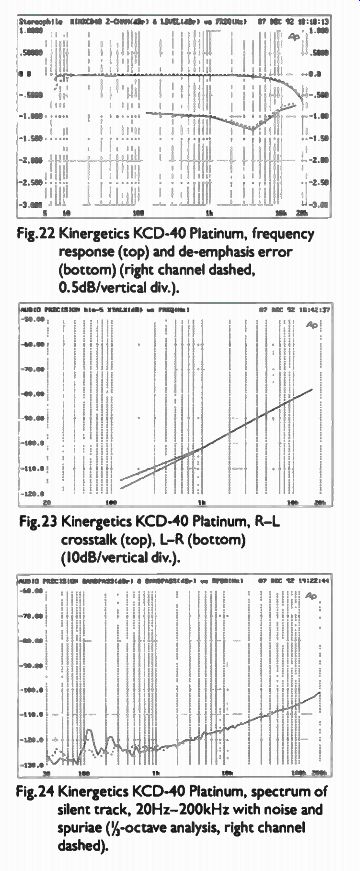
Fig. 22 Kinergetics KCD-40 Platinum, frequency response (top) and de-emphasis error (bottom) (right channel dashed, 0.5dB/vertical div.).
Fig. 23 Kinergetics KCD-40 Platinum, R-L crosstalk (top), L-R (bottom) (10-dB/vertical div.).
Fig.24 Kinergetics KCD-40 Platinum, spectrum of silent track, 20Hz-200kHz with noise and spuriae ('/ 3 -octave analysis, right channel dashed).
Driving the KCD-40 with a full-scale combined 19kHz+20kHz signal and per forming an FFT analysis of its output resulted in the plot shown in fig.28. Some artifacts are visible here, especially at 1-khz (though it's a rather high -65dB, this is still less than 0.06%), 18kHz, and 21kHz (about -78dB, or about 0.012%), though the response is quite clean over the rest of the range. (We become so accustomed to extremely low distortion figures from CD players that we tend to forget that even higher than normal readings are still very low on an absolute basis.) Using the Pierre Verany test disc to check the Kinergetics' error-correction capability revealed the player to have no problems up to track 35, minor glitches on tracks 36 and 37, and continuous dropouts on track 38; the required CD standard is track 27-a no brainer for any modern CD player. This tied the Marantz for the best performance in the group, all of which performed above aver age in any case.
The measurement results for the Kinergetics KCD-40 are generally good though not exceptional. Its linearity is only fair, and the 1-khz IM measurement is definitely higher than normal, though still moderately low as distortion percentages go. There is, however, nothing in the measurements which would obviously interfere with a good listening result.
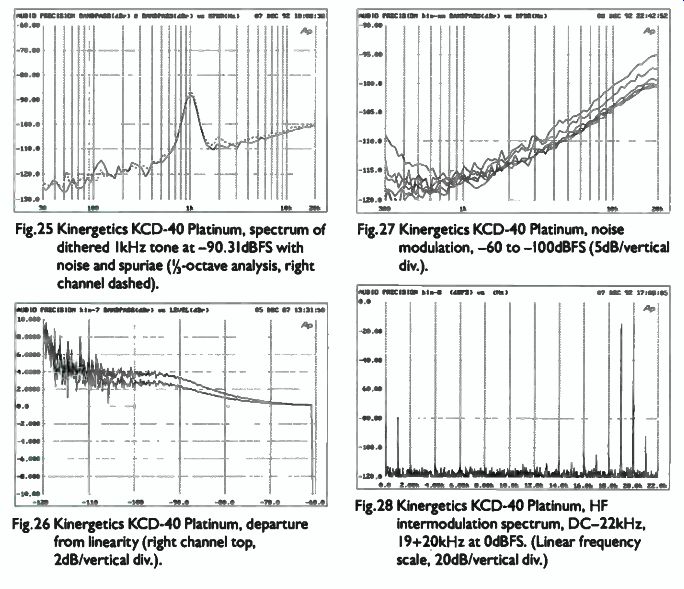
Fig.25 Kinergetics KCD-40 Platinum, spectrum of dithered 'kHz tone at -90.31dBFS with noise and spuriae (A-octave analysis, right channel dashed).
Fig.26 Kinergetics KCD-40 Platinum, departure from linearity (right channel top, 2dB/vertical div.). Fig.27 Kinergetics KCD-40 Platinum, noise modulation, -60 to -100dBFS (5dB/vertical div.).
Fig.28 Kinergetics KCD-40 Platinum, HF intermodulation spectrum, DC-22kHz, 19+20kHz at 0-dBFS. (Linear frequency scale, 20dB/vertical div.)
DOING THE JITTER
The jitter for the four CD players on test here was measured in the same fashion described in RH's article, "The Jitter Game," published in our January issue In brief, a Meitner LIM Detector was used to demodulate the clock signal (read at the input to the DAC chip in each player). Analyzing this result gives both an overall jitter measurement (read on an RMS voltmeter and converted to picoseconds of jitter) and a plot showing the jitter level as a function of frequency up to 20kHz (an FFT of the demodulated signal, calculated and plotted by the Audio Precision System 1). The data the CD player was being asked to decode was in all cases a 1-khz sine wave, at six different levels: 0-dB, -10dB, -30dB, -49.97dB, -70.31dB, and -90.31dB. The 0-dB reference for all these plots was 1% of the 44.1kHz CD system word-dock interval, or 226.7ns.
The discrete jitter measurements in pico seconds are shown in Table 1. The best jitter was exhibited by the CD-11, extremely low, the worst by the Proceed at and below -30dB. But levels for all of the players are good to excellent-as expected. Unlike the case with an outboard D/A processor, there is no need for a jitter-causing interconnect linking processor and transport. There is, of course, an analogous link inside the CD player, but it is generally short and under the complete control of the manufacturer.
-----------
Table 1
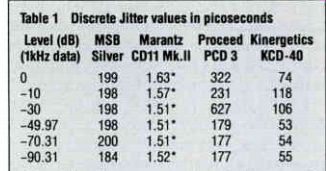
Discrete Jitter values In picoseconds Level «) MSB Marantz Proceed Kinergetics (1kHz data) Silver CD11 Mk.11 PCO 3 KCO-48 199 1.63' 322 74
-10 198 1.57* 231 118
-30 198 1.51* 627 106
-49.97 198 1.51* 179 53
-70.31 200 1.51' 177 54
-90.31 184 1.52' 177 55
*Though these figures are calculated using the appropriate scaling factor provided by Meitner for the 128x over sampling frequency, they seem astonishingly low. It is possible that we should be expressing these small time intervals as a percentage of the word clock, which, of course, in a high-oversampling DAC, will mean that it is more significant: ie, 1-ps as a percentage of an 8.82MHz word clock is as significant as 100ps of jitter with an 88.2kHz clock. We will investigate further, therefore.-JA
-----------------------
--------------
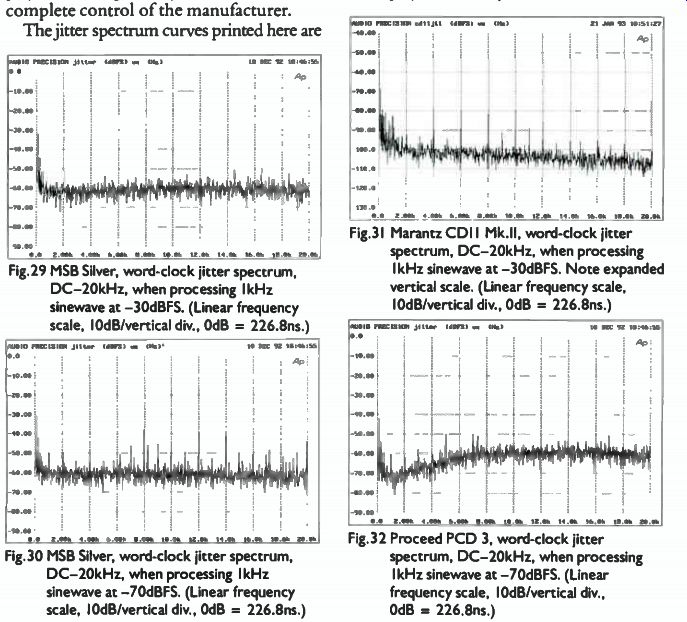
Fig. 29 MSB Silver, word-clock jitter spectrum, DC-20kHz, when processing 1-khz sinewave at -30dBFS. (Linear frequency scale, 10dB/vertical div., 0-dB = 226.8ns.)
Fig. 30 MSB Silver, word-clock jitter spectrum, DC-20kHz, when processing 'kHz sinewave at -70dBFS. (Linear frequency scale, 10dB/vertical div., 0-dB = 226.8ns.)
Fig.31 Marantz CDII Mk.II, word-clock jitter spectrum, DC-20kHz, when processing 1-khz sinewave at -30dBFS. Note expanded vertical scale. (Linear frequency scale, 10dB/vertical div., 0-dB = 226.8ns.)
Fig.32 Proceed PCD 3, word-clock jitter spectrum. DC-20kHz, when processing I kHz sinewave at -70dBFS. (Linear frequency scale, 10-dB/vertical div., 0-dB = 226.8ns.)
The jitter spectrum curves printed here are generally for the best and worst cases (judged primarily by the "spikiness" of the plots), with two exceptions. For both the MSB and the Marantz I've chosen to show the -300 data level which, though arguably not quite the level providing the best result for each of these players, is nearly so. Since this level was the worst (or one of the worst) for both the Kinergetics and the PCD 3, printing it for all of the players allows for some tentative comparisons at a level at which a great deal is usually going on, musically speaking.
Fig.29 shows the jitter spectrum for the MSB at the -30dB data level. The result here is very clean, with virtually no artifacts more than 10dB above the average except at the lowest frequencies. Dropping down to -70dB results in the worst case for the MSB (fig 30). Here some spikes-still rather low in level relative to the average-are evident at the signal frequency of 1-khz, with some harmonically related spikes (and a few some what lower-level, non-harmonic spikes as well) evident up to the 20kHz limit of the plot. This is still a rather clean result based on our still-limited collection of jitter measurements to date.
The jitter plots of the Marantz were consistently the lowest of this group of players.
The result shown in fig31 (-30dB data level) is representative of the results obtained at all levels. Note the gradually decreasing average at higher frequencies, not typical of the other players. Also note the shifted curve scale required to accommodate the very low aver age level. The only area in which the Marantz's jitter spectrum is arguably worse than those from the other machines is below 2kHz, where a number of closely spaced-though still very low-level-spikes are evident.
The -70dB data level for the PCD 3 is shown in fig 32. This was the best result for the Proceed. A few minor spikes are visible, most of them harmonically related to the 1-khz signal, but only one or two rise higher than 10dB above the average. The 0-dB and -30dB levels tied for the poorest result from the Proceed. The 0-dB is shown in fig. 33.
Note here that there are jitter spikes which are harmonically related to the 1-khz signal -interestingly, at odd harmonics only-and spikes at nearby frequencies above and below these harmonics At -30dB (fig34) the spikes at the harmonic frequencies become larger (and some even-order harmonics appear), but the spikes adjoining these harmonics largely disappear. Note that the Proceed's average jitter decreases at low frequencies down to about 1-khz before increasing again, unlike the other players.
The Kinergetics had its best result at a -50dB data level (fig. 35). The result is very clean, with only minor and isolated spikes.
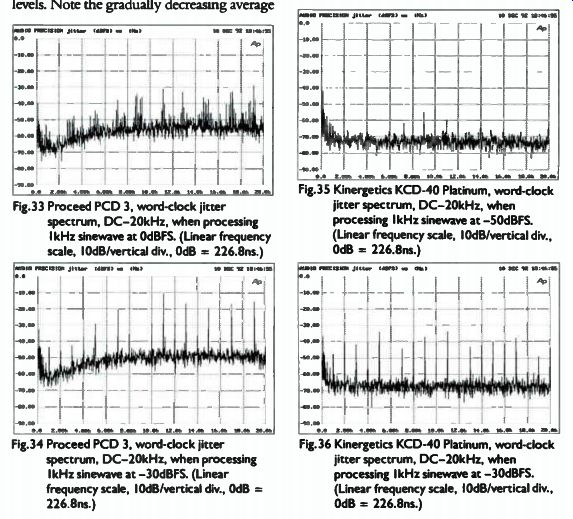
Fig.33 Proceed PCD 3, word-clock jitter spectrum, DC-20khz, when processing 1 kHz sinewave at 0-dBFS. (Linear frequency scale, 10dB/vertical div., 0-dB = 226.8ns.)
Fig. 34 Proceed PCD 3, word-clock jitter spectrum, DC-20kHz, when processing 1kHz sinewave at -30dBFS. (Linear frequency scale, 10dB/vertical div., 0-dB = 226.8ns.)
Fig.35 Kinergetics KCD-40 Platinum, word-clock jitter spectrum. DC-20kHz, when processing 1 kHz sinewave at -.50dBFS. (Linear frequency scale, 10dB/vertical div., 0-dB = 226.8ns.)
Fig.36 Kinergetics KCD-40 Platinum, word-clock jitter spectrum, DC-20kHz, when processing 1 kHz sinewave at -30dBFS. (Linear frequency scale, 10dB/vertical div., 0-dB = 226.8ns.)
At a slightly higher level (-30dB, fig.36) spikes harmonically related to the 1-khz signal become clearly evident (though interestingly absent at 6kHz, 12kHz, and 18kHz), and the 1 kHz jitter level itself is fairly prominent. But the average jitter level is very low.
The Kinergetics' slight tendency to be more forward and a bit brighter than the other machines may be reflected in its jitter spectrum. The lack of spikes in the Marantz and-to a lesser degree-in the MSB may possibly be reflected in their clean, liquid sounds. The jitter from all of these players, based on our limited collection of data to date, is relatively low. It's far too early to draw definitive conclusions about the absolute significance of these results. How the measured average jitter and its spectral content relate to the sound of a given player or processor is still a subject full of unanswered questions.
Is the jitter created at some signal levels more important than that at other levels? Is a consistent jitter value at varying signal levels more significant (assuming reasonably com parable values) than jitter which varies with level? Is 1-khz the "best" frequency at which to test for jitter, or is another frequency (or combination of frequencies) liable to be more revealing? And while it seems self-evident that less jitter is better, at what point do further reductions in jitter become audibly in consequential? Manufacturers should address jitter along with a multitude of other important considerations; at this stage of digital development, we certainly don't want or need a litter war."
CONCLUSIONS
Two machines were standouts in this com parison: the MSB and the Proceed. The MSB's bench-test results were the worst of the group, though still respectable, and its internal layout, while certainly functional and in some ways unique (i.e., the shielding of individual chips), definitely had a cottage industry look and feel. But the sound of the MSB was its calling-card, and it was my favorite of the group. If I remark again here that it combined a slightly warm, but not loose, bottom end with an immediate, "alive" midrange and lower treble and soft extreme top, you might be excused for thinking "tubelike" sound. And you wouldn't be far off, except that the MSB's extreme bottom end was the best of the four machines auditioned here-a very un-tubelike result.
The Proceed certainly runs off with the overall honors here if you weight everything equally-sound, construction, measurements. We don't do that. Form follows function, and the listening is, ultimately, the final arbiter. Still, the Proceed is right up there in the sonic sweepstakes. It is a little more "detached" than the MSB, a little cooler, a little more analytic without actually being analytic. It's tight, detailed, and open in the way that good solid-state products are tight, detailed, and open. It may very well lock into a wider range of systems than will the MSB; the latter's warmth may be a bit too much with rooms and/or loudspeakers having too much of their own-not an uncommon occurrence.
That leaves the Kinergetics and the Marantz. The Kinergetics is easy. We have long recommended the earlier, "non-Platinum" KCD-40, and I see no reason to change that recommendation for this latest version.
Choose your interconnects carefully (always good advice) and you'll have a first-rate player. If it doesn't quite reach the sonic accomplishments of the above players, your bank balance or credit statement will help compensate.
The Marantz is the toughest call. None of the players measure better, none are built better, none have better ergonomics or "feel." It's not a bad-sounding player; in fact it's quite competent. But if that word denotes a certain lack of enthusiasm, so be it. I didn't dislike it, and listening through it was almost always a pleasant experience, but it did suffer in small (but, I feel, important) ways in com parison with the best players in the group.
While we're still waiting to review that one-box CD player (of course, we haven't heard all of those available) that knocks the top competing D/A processors on their collective ear, the best of this group can more than hold their own in that company.
Also see:
AUDIO RESEARCH PH1 PHONO PREAMPLIFIER (review)
JVC's Akira Taguchi speaks! J. Skull talks with the producer of the JVC XRCD line of audiophile CDs.
Prev. | Next |