| Home | Audio mag. | Stereo Review mag. | High Fidelity mag. | AE/AA mag.
|
JVC's Akira Taguchi speaks! J. Scull talks with the producer of the JVC XRCD line of audiophile CDs.
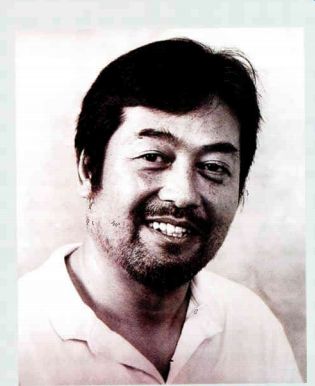
Whether remastering a jazz classic from the Fantasy catalog or producing a new recording by Bill Holman or Tiger Okoshi, Akira Taguchi is the very picture of a Los Angeles Music Man. His gestures and speech are staccato and explosive, his enthusiasm for jazz totally infectious. Taguchi produces those fine-sounding JVC XRCDs that everyone is talking about. I first met Taguchi-san - a fun guy and a dedicated audiophile - in his killer-sounding room at the 1998 Consumer Electronics Show. Kathleen and I enjoyed some quality time with him over dinner later that evening with Taguchi of Combak/Harmonix Corp. We enjoyed fab sushi at a small, hidden-away gem of a place. It seemed like all the top brass from JVC were there eyeing our table: lots of formal greetings and exchanges of business cards. I felt like a bug under a microscope! Kathleen and I caught up with Taguchi-san after he'd wrapped a recording session at the Clinton Studios here in New York City for a new Tiger Okoshi recording. We got him to sit still long enough to ask a few questions. I started by asking him how long he had lived in LA.
Akira Taguchi: I moved there five years ago from Japan.
Jonathan Scull: It's unusual to have a big Japanese company like JVC involved with something so audiophile as the XRCD. How did you manage that?
Taguchi: Maybe it's because I'm a crazy guy. But if you think about it, why does Honda do Formula 1? They don't sell any F1 cars!
Scull: True...
Taguchi: But they spend big money. And because of F1, Honda sells lots of Accords and Civics, right? So XRCD is like F1 to me. From a marketing standpoint, these CDs are great-sounding and make a nice image for JVC. Of course, it is double the price. But we spend a lot of money on it!
Scull: How did the XRCD project start for you?
Taguchi: Well, we'd ship a nice-sounding master tape to the plant. But I wasn't very satisfied with the result. [The CD] might not have enough top end or bottom end, or per haps it wouldn't sound punchy. Something was wrong, and I felt I had to do something about it.
Scull: Fighting City Hall?
Taguchi: Yeah! I had a few ideas and went to JVC's plant in Yokohama and talked with my old friend Nomiyama, the manager at the Disc Mastering Division. He knows what sounds right. And I said, "Hey, I don't like the way these CDs sound." So he agreed to help, and we started doing tests. Each small improvement made the sound better. In the end, we spent two years perfecting the entire XRCD process.
Scull: Tell us about it.
Taguchi: Well, first, it has to be recorded and mastered well.
Mostly record companies make nice-sounding CDs, but usually someone's taking a nap at the plant! Or the other way 'round. Mostly I think both sides are asleep!
Scull: So you take extreme measures in the recording, mastering, and production cycles?
Taguchi: Right. Most pressing plants don't take much care about the final results. XRCDs are made with lots of attention to both the mastering and manufacturing processes.
Normally, manufacturing is like a black box. You send a tape down - mostly U-matic 1630 format - and sometimes you're lucky, sometimes you're not. Oh shit! And then there's the release date. So normally, there's no way to redo it. Me, I don't care. I want it to sound right-change the release date! Also, the machines arc all customized.
Scull: For mastering or recording?
Taguchi: Both.
---------------------
Just What is an XRCD?
It's a beautiful product with first-class packaging. JVC exploits the format by offering a book-like presentation that works to best effect. The "book" can run to several pages of information and graphics. The CD itself is found at the rear in a bound-in paper holder with a flap.
The process starts at the mastering level. According to the documentation, "The analog signal is taken directly from the mastering console and digitized using JVCs 20 bit K2 process. K2 is a 20-bit, 128x-oversampling analog/digital converter, which provides a dynamic range of 108dB, -96dB THD, flat frequency response in the pass band to within +0.05dB, and a substantial reduction of harmonic distortion for low-level signals. The K2 super coding also provides a bit-down mode to convert 20 bits to 16 bits, and interface signal regenerating to eliminate time-base jitter in the digital datastream." As Taguchi explains in the interview, a Sony PCM 9000 magneto-optical disk is brought to the factory, where the 20-to-16-bit "down mode" is performed using SDIF-2 connections. "This stage resolves the high resolution 20-bit signal to 16 bits while retaining the integrity of the low-level information, which ensures a true 16-bit dynamic range without using noise-shaping.
The 16-bit signal is then EFM-encoded. Another K2 circuit, called the K2 laser, is used to regenerate the EFM signal right before going to the laser of the glass cutter.
This last stage is the same circuit used for the K2 inter face, which eliminates any time-based jitter that may be present in the datastream. Throughout this process, the word clock is amplified and distributed to the other stages to keep signal quality at a maximum. Similarly, all equipment is run off regulated AC power feeds to pro vide a pure base from which to work. A number of CD reflective coatings were also tested, including 24k gold and pure copper. Ultimately aluminum was picked after extensive listening tests, as providing the best audio representation.
"JVC has painstakingly gone through every step of the mastering and manufacturing process with the goal of retaining the highest sonic purity of the original music.
This was accomplished not by just measuring the results, but in extensive listening tests to determine the best con figuration. Every combination of equipment, connections, AC power regulation, word-clock distribution, mastering format, delivery system, and compact disc construction was tested. The result is the XRCD."
-Jonathan Scull
--------------------
Scull: Tubes or solid-state?
Taguchi: Both! And we're "customized" on the human side too, and that counts for a good 50% of the quality-good people who care about the sound. It's a little like a car. Say you have a nice engine, nice suspension, nice every/him; - but it drives bad, you lose. That's where the human part comes in. It's hard to describe, but it's a big part of it for me.
For example, take Jim Anderson - he's a great guy. He's engineered lots of jazz recordings for Verve and JVC. And he has good ears, too! In fact, he uses his own microphones and mike preamps.
Scull: So you choose the engineer and the equipment as a package?
Taguchi: Sure.
Scull: What kind of mikes do they use?
Taguchi: Maybe 80% of them use condensers and the rest use tubed microphones. Condensers are very open, more air. But tubed microphones have nice EQ sound. You have to know the microphone's nature and use that instead of doing too much EQ. One or two dB is okay, but if you push 3d13 you can get phase distortion. I prefer to change the microphones; that's a better method than hard EQ. Scull: Do you like to use a lot of mikes, or are you a minimalist in that way?
Taguchi: Well, I like to multimike. If you record a big band, like the Bill Holman recording, with a single-point stereo microphone, you get a loose, not very powerful sound. So on that recording we used 57 inputs!
Scull: Wow !!!
Taguchi: [smiles] Yeah, to two-track! You get real punch and lots of ambience that way. Two-track recording is much better than multitrack, especially for jazz. I hate overdubbing and punch-in. But with pop recordings you have to use multitrack.
Scull: How do you store the signal?
Taguchi: Analog, mostly half-inch, 30-ips, no noise reduction.
Scull: Ampex?
Taguchi: That's the best. Striders suck! Well, they record okay, but the playback is no good. [J-10 laughs] No, really. Ampex has better high frequencies and a better bottom end - more smooth, too.
Scull: Who does the mastering for XRCD?
Taguchi: Allan Yoshida at A&M Studios. Only this guy takes care of XRCDs. And for the Japanese releases, there's another nice guy in Japan, a mastering engineer named Tom Kotetsu. He did the 'Three Blind Mice re-releases over there, among others.
Scull: I gather you're not a Sonic Solutions kind of guy?
Taguchi: I don't think it sounds right. Once you transfer to Sonic ... damn, it sounds like a Sonic! Scull: Why is that?
Taguchi: Jitter. It's a hard-disk-system design for computers, not music. So CDs sound like zeros and ones, even with higher sampling rates - it may have more detail, but it'll still be more details of zeros and ones! [laughs] I don't know why, but I can always tell when something transfers through
Sonic Solutions. And cheap A/D converters just don't work either. Attention to the mastering is so important.
Everybody's spending big money at the major record companies on the recording budget, but spending very little on the actual mastering. This is wrong!
Scull: Do I understand that you ship 20-bit masters to the plant?
Taguchi: Yes. Most record companies send 16-bit 1630 masters. Normally, if you ship a 20-bit master, they just truncate the last four bits.
Scull: Not so good. So part of WC's proprietary K2 process is taking the 20-bit master down to 16 bits at the pressing plant?
Taguchi: Right. You can consider K2 a regeneration process rather than a noise-shaping or reclocking one.
Scull: The digital master is now on what media?
Taguchi: Magneto-optical disk.
Scull: Do you use the Genex unit from n the UK?
Taguchi: No. We use Sony PCM-9000. If you compare PCM-9000 to Genex, the PCM-9000 is way better. I work for JVC, but Sony did a good job with it. But the Genex is the only machine--for now - that accepts 96kHz/24-bit.
The Sony can only do 48kHz at 24 bits.
Scull: I suppose you don't use the Sony's A/Ds?
Taguchi: No! We use JVC 20-bit A/Ds.
Scull: With Sony's SDIF?
Taguchi: SDIF-2, actually. Three separate lines are much better. And that helps keep the jitter down, because you don't have to extract the clock from the data. And we have a more updated version of K2 [Digital K2] coining online soon. We have one prototype machine working now. It was designed by JVC's Toshiharu Kuwaoko.
Scull: A scoop!
Taguchi: Yeah, maybe at the June '98 Stereophile Show we will announce the new XRCD2. It will use the same interface we have now, but it will be more updated. Better power supplies, for example. [See "Industry Update" in this issue - Ed.]
Scull: When you re-master, do you work off the original master tape?
Taguchi: Well, I have to have the original analog master tape. That's a big one. If there's only a digital master, that's bad. Mono or stereo, I don't care. Sometimes "big" mono - like on Bags Groove-is better than stereo.
Scull: "Big mono? I think I know what you mean. Explain please...
Taguchi: The tape is mono, so the sound comes from between the speakers. But if it's recorded well, you can hear 3-D from mono! To me, that's "big" mono. Cheap stereo, like, uh …
Scull: Beatles stereo? Hard left, hard right, nothing in the middle?
Taguchi: Right, that has no air. And multi-mono sucks too.
Snare drums here, hi-hat there, tom-toms over there, guitar, trumpet -you can pinpoint the instrument but there's no ambience. To me, that sounds cheap.
Scull: Any particular problems with old analog masters?
Taguchi: Sure, like with Bags Groove: those old tapes don't have test tones up front; that became standard only around the mid-70s.
Scull: That makes things tough, I suppose.
Taguchi: Right, you have to get the EQ right. Yoshida does it by ear, and I help with that.
Scull: What do you consider important in a good recording?
Taguchi: First, I think the music has to be good. [laughs sharply] That's a big one. A wide and deep image is important.
Focus. And a natural frequency response.
Scull: Dynamics?
Taguchi: Yes, of course, dynamics.
Scull: Who from that era do you admire?
--------------
J-10's XRCD Favorites
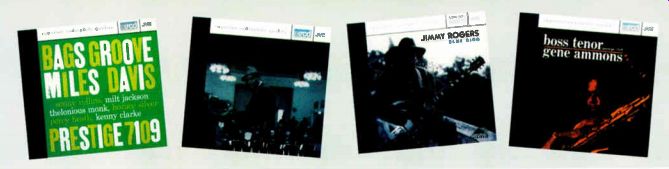
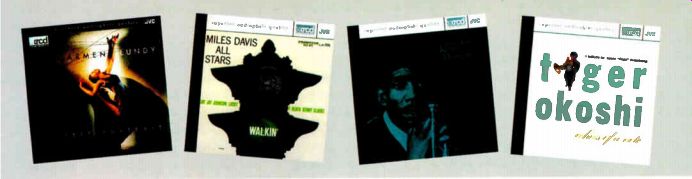
Don't miss Bags Groove ( JVCXR-0046-2), with Miles Davis, Sonny Rollins, Milt Jackson, Thelonious Monk, Horace Silver, Percy Heath, and Kenny Clarke.
This "Big Mono" recording is as classic as it gets, and definitely one of my all-time favorite albums. Miles fans will also pick up Walkin' with the Miles Davis All Stars (JVOCR-0047-2). The two Bill Evans recordings are ms I wouldn't be without: Everybody Digs Bill Evans (JVCXR-0020-2) and Bill Evans Trio at Shelly’s Manne-Hole (JVCXR-0036-2). Continuing in the classic jazz vein, try Gene Animons' Boss Tenor (JVOCR-0033-2), Coleman Hawkins' Good Old Broadway (JVOCR-0035-2), and Johnny Griffin's The Little Giant (JVCXR-0039-2). To hear what Taguchi can do when left entirely to his own devices, pick up one of his new recordings, where he's responsible for everything from microphone feed to pressing plant. Start with Bill Holman's Brilliant Corners: The Music of 'Thelonious Monk (JVCXR-0028-2): big-band Monk breathtakingly recorded, the sound wonderful beyond description. I’m also crazy for Echoes of a Note by Tiger Okoshi (JVOCR-0030-2). It's subtitled "A Tribute to Louis Tops' Armstrong" -you'll love it. And I heartily recommend the new Ernie Watts release, The Long Road Home (JVCXR-0045-2). A few other releases you may enjoy are Take Love Easy (JVCXR-0031-2) with Ella Fitzgerald and Joe Pass, and How Long Has This Been Going On? between Sarah Vaughan, Oscar Peterson, Joe Pass, Louie Benson, and Ray Brown (JVCXR-0031-2). With a lineup like that, how can you lose? Still unsatisfied? How about Art Tatum's Group Masterpieces ( JVOCR-0034-2), with Ben Webster, Red Callender, and Bill Douglass; Black Pearls by John Coltrane (JVCXR-0017-2); Duke's Big 4 (JVCXR-0022 2); or 88 Basie Street (JVCXR-0021-2), with the Count and his orchestra. While you're at it, you can grab another release of Jimmy Rogers' Blue Bird (JVCXR-0015-2), Tina Turner's Private Dancer (JVOCR-0044-2), or the sultry Carmen Lundy's Seortrait (JVCXR-0005-2).
-Jonathan Scull
-------------
Taguchi: Well, there's Rudy Van Gelder. He was good with woodwinds, horns, drums, but not so good with piano.
Scull: Sacrilege! Why?
Taguchi: Woom-poom-poom -no overtones. He was a good guy for ballad-type music. But with a typical jazz rhythm section his recordings sounded hard and had tape distortion.
Scull: Ah-HA! That’s what I hear on track 2 of the Bags Groove XRCD? It was Rudy, not you? Taguchi: Right-once you hit peak, it's over! But the tape was in very good condition. And one more thing: Rudy used spring reverb! You know, like karaoke reverb - buyungyungyuneung?
Scull: Ouch, that hurts.
Taguchi: Yeah. It's way cheap. And there's Val Valentine - he's a good engineer from the old days. Then there's producers Orrin Keep news at Riverside and Bob Weinstock at Prestige. Another producer who knows how to make good recordings is Lester Koenig at Contemporary.
Scull: Anything better about working with old master tapes?
Taguchi: Yeah, they didn't know from limiting!
Scull: Ah-ha ... no compression?
Taguchi: Right. So you have to make sure your VU meters don't brume -pop off the scale!
Scull: What do you think about 24-bit/96kliz recording?
Taguchi: It sucks.
Scull: [laughs] Would you mind elaborating?
Taguchi: Because maybe DVD will be good for audio, but no one knows for sure. And have you ever seen a true 24-bit A/D converter? Not yet you haven't. And the audio signal doesn't have information deep enough for 24 bits. 20 is enough.
Scull: What?!
Taguchi: I think so! And the recording head has to turn very fast, and that creates time-based jitter. You know, the DVD guys are looking at only the engine of the car.
Scull: Meaning... ?
Taguchi: For 44.1kHz/16-bit, let's say that's a 2000cc engine. For DVD audio at 24/96, it's a 5000cc engine. So which is better? For the measurements, maybe the bigger engine. But what happens if the smaller engine comes from Mercedes, and the bigger motor from Hyundai? Which is better? Hard to tell, right? And it's only the engine. You have to have a good engine, a good suspension, nice tires - the whole package.
Scull: I understand what you mean. They're only looking at the chip and not at mu/mat surrounds it: power supply, analog output stage...
Taguchi: Yes! We need it for the future, but for now, in my opinion, before you go DVD, you have to make regular CD sound right. Let's say you make a nice-sounding digital master tape and that rates 100% for you - the best sound possible. Even DVD cannot beat this guy. With a regular CD I think I can do 85 to 92% of 100%. If it's in that range, I think, "That's okay." Under 50%, "Do it again." But close to 90%, "Oh... that's good." You know, I always make a DAT reference copy from the original digital master -a one-to-one copy. Let's say this DAT is 97% on our scale. A regular CD never beats the reference DAT, but XRCD beats this guy. That means 98 or 99%, right? So do you think you need more than that?
Scull: Well, I guess not!
Taguchi: My position is, whatever you think is right, do it.
And then do an A/I3 test-with a blindfold! Whatever's best, that's what you use.
Scull: Obviously you're an analog kinda guy. What do you think about vinyl?
Taguchi: Vinyl.., is good.
Scull: [laughs]
Taguchi: Generally speaking, I like vinyl better than CD. But the problem is, there are no good vinyl-mastering engineers around now. Many studios don't even have a vinyl cutting machine! The mastering engineer is an artist -like a painter. Just because it's vinyl, Jonathan, it doesn't automatically mean it's good!
Scull: Does sounding "good" mean it sounds like analog, or does sounding "right" mean it sounds "accurate"?
Taguchi: Sounds like analog.
Scull: So the purpose of XRCD is to sound like...
Taguchi: Analog. As much as possible.
Scull: And you mean by that a sound that's as much like the master tape as possible.
Taguchi: Yes. You can say it that way. For me, it's all about the ambience.
Scull: So you'd say which: the purpose of a high-end system is to reproduce the master tape or to reproduce the live event?
Taguchi: Yes.
Scull: [laughs] Whaddaya mean, "Yes"? Which ...what!?
Taguchi: [laughs] Okay, let's see... if I record it right, and I listen to the master tape on the studio monitor...
Scull: The sound of the master tape on the monitor speaker in the mastering studio?
Taguchi: Yes.
Scull: Yeah, but a lot of recording studios use those nasty-sounding Yamaha NS10s.
Taguchi: Yes. [laughs ruefully] That's why I have to choose the studio and the engineer very carefully. And I'm speaking about the sound in the mastering studio - that's what it should sound like - not the sound in the recording studio.
But I have my own reference system at home. I bring a DAT home to check the sound of every recording we do. Do I have to push the EQ or whatever...
Scull: Ah-ha - what is your reference system?
Taguchi: I have Wilson WATT/Puppies.
Scull: That figures. The latest revision?
Taguchi: No, the one before that -WATT 3/Puppy 2.
And a Mark Levinson No31 transport and No35 DIA, a No26S preamp, and No23.5 stereo amp. I like the '26S better than the newer units.
Scull: What kind of wires do you use?
Taguchi: I like AudioQuest, the silver stuff. And I use Illuminati digital cable, and I also have a NASA-type cable. It looks weird, but it's very fast.
Scull: Who are your favorite jazz musicians?
Taguchi: If I had to pick one artist, it would be... Frank Sinatra! And then, Art Pepper and Bill Evans.
Scull: Who's your favorite female singer?
Taguchi: Carmen McRae, Peggy Lee, and my favorite, Ella Fitzgerald. She's the one who originally turned me on.
Doesn't matter what she looks like! [laughs] I love vocals!
Scull: And I'm sure a lot of audiophiles will love you too, Taguchi, now that they know what you're up to.
Taguchi: Oh! Thank you!
------------
Industry Update
UNITED STATES, John Atkinson
Abve, J. Scull talks to Akira Taguchi, the producer of JVC's superb-sounding and superbly presented Extended Resolution Compact Disc (XRCD) CDs. At HI-Fl '98 in June, Taguchi-san, together with A&M Mastering's Alan Yoshida, introduced the press to JVC's second generation XRCD2 discs. The essential difference between the two is the use of a Digital K2 Regenerator, designed by Toshiharu Kuwaoka, in both the mastering and manufacturing steps. (As only one Digital K2 machine exists, it had to be shipped back and forth between A&M Mastering in Los Angeles and the JVC disc plant in Japan.) The XRCD2 process starts with Yoshida converting the analog tape to digital with JVC's 20-bit ADC, reclocking the data with the Digital K2 before they are stored on a Sony PCM-9000 magneto-optical disk. This disk is sent to the CD plant, where the glass master is cut using the Digital K2 to minimize jitter, and reduce the 20-bit words to the CD Standard's 16 bits using JVC's K2 Super Encoding. Test pressings of the 16-bit CDs are then compared with the 20-bit original to ensure a minimal loss in quality.
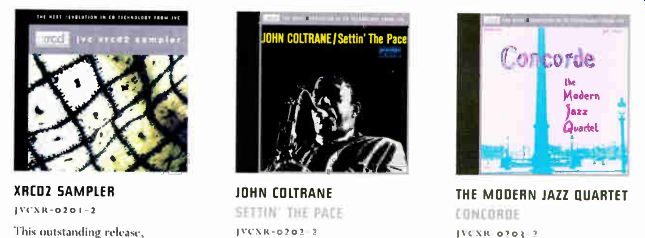
An XRCD2 sampler featuring Tiger Okoshi, Ernie Watts, the Bill Holman Band, and other JVC artists was launched at Hi-Fi '98, while JVC was quoting a street date of July 21 for the first two XRCD2 albums: John Coltrane's Settin' the Pace and the Modern Jazz Quartet's Oncorde. To follow in August are Sarah Vaughan's Crazy & Mixed Up, Gnint Basie Meets Oscar Peterson: The Titneketpers, and Tiger Okoshi's Gdor of Soil.
------------
JVC XRCD2 ADVERTISEMENT:
THE NEXT EVOLUTION IN CD TECHNOLOGY IS UNDERWAY
Since its introduction in 1996, Jvc's xrcd has received a glowing "thumbs up" from audio critics and consumers alike. Now jvc's international team of producers and engineers has taken another giant step into the future of technology with the release of xrcd2. Using the new DIGITAL K2 REGENERATING PROCESS for both mastering and manufacturing, xrcd2 boasts improved clocking accuracy and the total elimination of digital jitter. The resulting CD allows the listener to hear what the artists, producers and engineers intended ... the sound of the original master tape.
Experience the next [r]evolution in CD technology with these first three xrcd2 releases:
XRCD2 SAMPLER: JVCX11-020 1-2
This outstanding release, produced by Akira Taguchi, co-creator of the xrcd process, features tracks by live of jvc's critically acclaimed artists and includes the Bill Holman Band's 1998 Grammy award-winning track," No Chaser."
JOHN COLTRANE
Recorded in 1958, this classic session features Coltrane backed by the stellar trio of Red Garland, Paul Chambers and Art Taylor.
Among the tracks is a full' force workout of Jackie McClean's intriguing "Little Melonae."
THE MODERN JAll QUARTET--CONCORD JVCXR-020 3-2
Warmth, imagination, compositional freshness and musical integrity. This album, the first featuring all four members of the "classic" quartet, is notable for its fugue like title track, a relaxed "Softly, As in a Morning Sunrise," and Milt Jackson's "Ralph's New Blues."
LISTEN AND COMPARE!
Also see:
Creek 4330R integrated amplifier
AUDIO RESEARCH PH1 PHONO PREAMPLIFIER
(review)
Prev. | Next |