Departments: Letters; EDITORIAL: Mirror, Mirror; BOOK REVIEWS ; Showcase; JUST LOOKING
Intro:
Too seldom can we offer readers a new preamp design. With this and the next issue we take pleasure in sharing the results of extensive labor and care by a number of people. Bill Chater, now in leisurely retirement, put his MOS design together and built several prototypes, beginning here. This latest version is the result of a long series of samples, much listening and finally, extreme enthusiasm by the listening panel.
Modification of stock equipment has been part of our mandate from the first issue. Ben Poehland uses elegant imagery, hard-won experience and wise advice in showing us how to work reincarnation magic on blasted audio hulks. This and his next article are much more than a Tigersaurus mod--the advice will help you do upgrades for nearly any victim .
Andrew Stiller's remarkable article is the most thoughtful commentary on issues underlying our perception of music and its value to us. I consider it one of the most significant articles it has been our privilege to publish.
Bob Bullock reviews a book about car sound and Gary Galo reviews some picture books about music, starting below. We thank Richard Touzimsky for our first color cover and exquisitely crafted Borbely hardware pictured in Showcase.
Editorial:
Mirror, Mirror
Have you wondered what your fellow readers are like? We do, naturally, and from time to time we try to profile audio amateurs as a group. We recently sent questionnaires to 500 current readers.
Nearly two of every five surveyed returned answers to 26 questions, 181 in all; approximately one out of every thirty three readers.
How about audio systems! Half our readers have just one, one out of four has two and the rest have three or more.
Slightly fewer than half are very satisfied with their systems, the rest are only “somewhat ” satisfied with their current equipment. Systems range in value from 10% whose systems are worth a thousand or less; one-third have from $1,000-3,000 invested; one in five has laid out between $5,000-10,000; and 16% have $10,000 + in sound reproduction equipment.
What kind of annual investment do amateur's make in their systems! Sixty percent spend a thousand or less; one out of three expects to spend between $1,000-3,000 each year on upgrades or replace equipment; and a lucky 3% each are in two categories: one of $3,000-5,000 and the other over $10,000 per year.
We wanted to know how readers find out about us.
Nearly 40% answered an ad; 8% read an article about us; 27% learned of our existence from a dealer. But a whopping 27% discovered us by a friend's recommendation. We thank those of you who did the recommending.
Half of you describe as having a very high technical interest generally, and another third characterize their interest as high, Only a fourth of new subscribers consider themselves as having very high technical aptitudes when they subscribe, and another 31% describe their technical competence as high. An equal number regard their skills as moderate.
Over half of you have built four or more projects, about 8% have built three, 12% have done two and 9% constructed one. Some 16% have neither built nor modified equi A it came to matching material to interests, we fared better than we expected. Only 7% of you said our technical level was too high for your knowledge; another 18% thought our level was high, but 60% thought we were just right. Thirteen percent considered the material low com pared to their level of understanding.
Is what we publish of interest! Some 4% t our tech level was too for them; 14% thought it higher than it should be; while 9% thought the level too low. However, 70% believed the level was just right.
If readers built projects from scratch how did they evaluate them! Approx. 18% were extremely or 39% used 'very pleased' to describe their reaction; while 19% were only 1moderately happy and 1% had very little satisfaction with the results of their labor. When it came to modifications of stock equipment 18% were extremely happy; 29% in the “very"' category; 15% were only moderately enthusiastic and 1% weren't sure it was worth it. A mere 1% did not like the results at all.
How popular is "hands on ” work with equipment! We wanted to know whether readers were building, or just get ting mostly vicarious pleasure from watching others do construction and mods. Well 37% say they are very highly involved in building, another third are “very ” involved, while 20% are moderate builders and a remaining 8% thought their interest in building was “low." No one said he was not interested at all.
Not surprisingly, our group is 99.44% male; 63% of whom are married, 22% are single and 7% are divorced.
A few respondents were shy about telling us about such matters. In age, one out of four of us is between 18 and 34.
Half are between 35 and 49 and the rest are over fifty.
Household income for two groups of 5% each earn $10-15M and $16-25M annually. Slightly 1more than one in four earn between $25-50M annually. Over half are in a bracket above $50M per year. Nearly 75% own their own homes; 16% rent. The remainder thought that wasn't any of our business.
We are well educated. About 7% are high school graduates; 37% are college graduates and almost 30% also have graduate degrees. Twenty-one percent have some college credits. Nearly 70% of us own computers.
I was most interested in what we do for a living. A half to one percent of our readers are either broadcasters, lawyers, students, printers or architects. The occupations of physician or dentist, laborer, audio retailer, retired, or salesman each account for 3% of Audio Amateur's reader ship. Almost 5% are computer programmers, 8% are technicians, 13% are professionals and 7% didn't want to say what they do. The most surprising statistic in the entire survey:
45.4% of us are engineers, electronic being the largest group.
And our respondents gave us a report card: Our general articles earned 31 As, 52 Bs, 12 Cs, 1 D and an F. Our projects earned 28 As, 52 Bs, 13 Cs, 3 Ds and 1% flunked us.
You may be interested to know that Audio Amateur's renewal rate is better than 80% per year. Almost a third of you have subscribed to the magazine for over 12 years, 16% have been with us over nine years, 9% have been aboard for over six years, almost 20% are 3-5 year readers and one in four is new within the last two years.
I think we can look at ourselves as a group with a good deal of justified pride. We are better educated than average, are not all that satisfied with our systems and commit a great deal of energy and time to them. Seventeen percent of us spend twenty hours or more per month building or equipment while the majority, 43%, spend five en or less at the bench. 28% spend 6-10 hours and 9% work at audio projects from 10-20 hours per month.
Our musical interests range over the whole rich spectrum of offerings. We are still tabulating your listening hours and preferences, which we hope to report on later.
We thank all those who responded. Some arrived too late to be tallied. We are very pleased with the results. We aren't complacent however, we are studying your comments with great care and are paying particular attention to your suggestions which generally ask for more detailed information on just how to perform modifications in general techniques.
Looks to me as though Audio Amateur is a fairly healthy young adult, just turning 21 with this issue, which can continue to mature, be enjoyed and perhaps even flourish.
-E.T.D.
LETTERS
DALZELL CORRECTION
WE MADE AN ERROR in a letter from L. B.
Dalzell on page 56 in our 4/89 issue. In numbered paragraph 1, ''150pA'' should read ''150mA."" In numbered paragraph 3, ""9uA" should read '"9mA." C-QUAM SCHEMATIC WANTED
I am interested in obtaining a schematic or kit to construct a high-quality AM Stereo (C-QUAM) tuner. If you have any information on where I can obtain such information, please let me know. Thank you.
FRED CHABALA ,137 Pennsylvania Ave. Bridgeville, PA 15017
MAC ASSEMBLY LANGUAGE---I WANT YOU TO KNOW
I think the idea behind Audio Amateur is the same as that which keeps minds free and civilization progressing. Keep up the good work! Finally, I am learning Macintosh assembly language programming, and I'd appreciate articles, correspondence, and other opportunities to develop applications.
CARL L. NOE, II Cabin John, MD 20818
E-SERIES THOUGHTS I'M RESPONDING TO A QUERY from Reg Williamson (TAA 4/89, p. 51) about the E-series anomaly. I'm afraid I can't give a direct answer.
I am reminded of trying to solve a similar problem when writing a calculator program to design stepped attenuators.
I agonized over a way to calculate the nearest standard values of the resistors, but couldn't make sense out of the spacing. It definitely didn't fit any ''standard"' sort of log or other spacing. Since (at the time) memory was a limitation in the calculator, using a lookup table was out (aside from being inelegant). A friend told me of an Idea for Design that appeared in Electronic Design magazine, showing how to calculate the nearest n% value. It worked.
Since then, I've looked for a rational explanation of how the E-series values were picked...so far, no luck. If you ever find an explanation, I'd appreciate knowing about it.
RICK CHINN; Mountlake Terrace, WA 98043
Reg Williamson replies:
Many thanks for your interesting letter.
No one has come up with a convincing answer as to why the preferred range departs from the mathematical increment. I am beginning to think the explanation of one of my colleagues at the University is the right one, facetious though it may seem. His theory is that in the days when the range developed, the calculations were done on a slide rule and the value was read on the wrong side of the cursor. The error increases as
TXTSIZE13:CLS: PRINT: PRINTSPC(10)
"This 1s a program for listing both Calculated and" PRINTSPC(10) "near
Preferred values for the E Series of resistors.
":PRINT INPUTSPC(10) "Choose E6,E12,E24,E48 or E96...
INPUTSPC(10) "Percentage Tolerance VRE:
".1 INPUTSPC(10)*No. of decimal places for the pref. value *;D:D=ALOG(D) S=10*(1/E) :\
This is root E of ten (decade) the value increases towards the end of the decade-and on a log scale it is also more compressed and less detailed.
Calculating the actual value is easy and I enclose my own program (Fig. 1) written in one of the new BASICs (similar to Turbo-Basic). Originally written to help one of my students, it was this program that revealed the anomalies. I have three versions; this one simply shows the spread for a specific E range and tolerance. It then rounds to a specified decimal place and from that, you choose a real off-the-shelf value.
HICKOK HELP
MY SON ANDIARE TRYING to repair a Model 538A Hickok tube tester that I purchased at a surplus auction some years ago. The tester is in very good condition except that the Micromhos meter has an open coil in the D'Arsonval movement. After failing to repair the meter we sent it back to Hickok to see if they could restore it.
Unfortunately, they no longer service this type and do not have any spares.
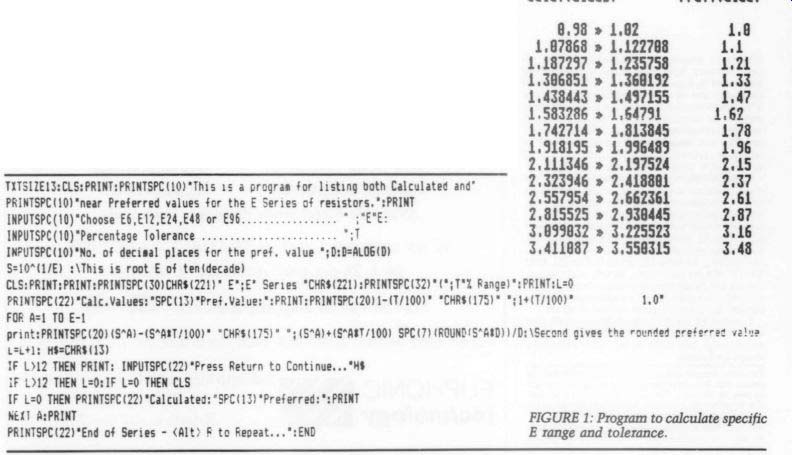
FIGURE 1: Program to calculate specific E range and tolerance.
Back in issue 3/86 you published an article by Alan S. Douglas in 'Classic Circuitry' called 'Classic Tube Testers.' It was a very informative and well written article, and Mr. Douglas appeared to have considerable knowledge and experience with tube testers from Hickok and others.
Perhaps, Mr. Douglas knows where to acquire a replacement meter or a suit able substitute. The schematic shows the meter to be a 0-50 uA 7,500 ohm ammeter.
We have searched various electronics and meter catalogs and nobody makes a 0-50uA at 7,500-ohm meter. Would a 0-50uA at 5,000 ohm with a 2,500 ohm resistor in series work? imagine the calibration would be a little off if we tried this; any ideas on how to calibrate it from u-A to u-Ohm?
Thank you for the fine article and your help on this matter.
And thanks for many years of enjoyment from The Audio Amateur. My son and are avid tube enthusiasts, and we applaud your new magazine Glass Audio.
We are currently restoring a Harman Kardon Citation II amplifier and are planning to build a monster tube amp using output transformers from a new Canadian firm advertised in Glass Audio; Perkins' Electro-Acoustic Research Labs, 275W from eight 6550s! That ought to be able to drive my Magnepans! (Now if I can figure out where to get a power transformer to drive the 6550s...)
ROBERT BLASCHKE; Lompoc, CA 93436
Alan S. Douglas replies:
Hickok incorporated a VOM into the model 538A (1951). While this apparently proved to be a poor sales feature, it's lucky for you, since you can get your meter working again without becoming involved in the tube-tester portion of the circuitry.
Your 50uA, 7,500 ohm meter movement can be replaced with anything more sensitive, or with less resistance. If the new movement is more sensitive (has a lower full-scale current), simply shunt it with a suitable resistor to bring it up to 50 uA.
If your new movement (plain or shunted) has a lower resistance than 7,500 ohm, add the necessary series resistor to make up the difference. There is no fudging or re calibration involved: The new substitute will behave exactly like the original, in every respect (except damping, which in this case does not matter).
There is probably already a resistor in the meter circuit somewhere, which was factory-adjusted to calibrate the meter Feel free to tweak it up or down to make the various VOM ranges average out correctly. Add a small carbon resistor in series, or shunt it with one of large value; these need not be any better than 5 or 10% tolerance because they make up only a small part of the total resistance.
And don't get carried away about accuracy. To paraphrase the old saying, ''The man with one watch (tube tester) knows what time it is; the man with two is never sure."' There is very little correlation between test conditions or numerical results obtained from different model tube testers, even of the same brand.
You might get a replacement meter from an old Hickok VOM (you would have to swap dial scales, of course). Any 20,000 ohm/V meter must (by Ohm's law) have a 50pA movement.
-----
MAGNAVOX MODS
I HAVE RECENTLY FINISHED the "most for least" modifications to my Magnavox CDB-650 CD player, and am currently preparing to implement the full modifications detailed in the POOGE-4 articles (TAA 1 and 2/88). Although I have no experience with electronic theory or construction, I found the information presented by Jung and Childress extremely clear and informative.
You can make additional modifications easily and inexpensively to many CD players to improve overall vibration damping ability of the drive mechanism and the chassis itself, and thus theoretically improve the sonic quality of the player.
1. Remove the top and front panels of the CD player.
2. Unbolt the tray mechanism and lift out the entire assembly.
3. Remove the disk clamping mechanism (CDB650 part #111) from its mount, and fill the underside cavities amply with latex bathroom caulk.
4. Scrape away the excess and smooth the surface with the edge of a putty knife or similar object (a credit card works well).
5. Clean up remaining unwanted caulk with a moistened cotton swab or cloth.
You can do the same to the many empty channels found in the transport mechanism, as well as those molded in to the bottom panel around the transport. Although this can get sloppy, you can clean latex caulk easily with water before it cures. The caulk will shrink somewhat after curing for several days, so you may need an additional layer.
While I cannot claim that these modifications have a dramatic sonic effect, they do damp vibration; just tap the clamp with your fingernail before you fill it, then after. As far as I can tell, latex bathroom caulk has no detrimental effect on the plastic, nor does the minimal weight addition seem to compromise the spring suspension.
I imagine you could lend additional mechanical stability to the CDB650 chassis by reinforcing the flimsy bottom panel, as some commercial modifiers do, but I have not yet encountered a suitable, inexpensive and easily machined panel.
I would be interested in hearing whether anyone has tried modifications similar to these, and particularly whether anyone has come across more complete methods for improving the mechanics of their player.
STEVE BODAYLA, 1314 N. Dunn, Apt. E, Bloomington, IN 47408
MORE MODS
I HAVE BEEN KEEPING TRACK of all the modifications performed on the Magnavox CD player. Some of the most elaborate were discussed in the POOGE-4 articles.
However, the articles do not mention the use of an outboard power supply. I speculate that a relatively huge op amp power supply would help, therefore, I built the Jung 1.5A op amp supply and connected the outboard supply to the AD712s, with a local bypass of 330uF.
The result is amazing. The original ma chine came to life. The soundstage is much wider and deeper, with especially warm and sweet highs. Bass, as expected, became well controlled. Most surprisingly, the CD player now reveals much more detail than before, the effect is like replacing a moving magnet cartridge with a moving coil cartridge.
Hence, I highly recommend an additional power supply for those who have invested a great deal in their Magnavox.
You're not getting your money's worth without the additional amps to kick out the potential of the audio circuits. Here is some relevant information:
1. The power supply uses an over rated toroidal transformer, with two 9,000uF output capacitors (Sprague, ESR type).
2. Power supply DC leads are connected to the player using Neglex Cable, terminated with Switchcraft Lockable DIN.
3. The CD player has the following mods:
a. Op amps replaced with AD712. I expect to change to the op amps mentioned in the POOGE-4 articles soon.
b. All capacitors changed to polystyrene types.
c. Electrolytic capacitors improved as mentioned in POOGE-4. However, the audio stage is taken care of by the 9,000xF in the external power supply.
d. 220pF caps replaced with 1uF around the D/A converter. I separately auditioned the effect; it is extremely beneficial. I simply removed the surface mounts and soldered all 1uF caps directly to the underside of the board.
e. Servo circuit is used in place of out put capacitors. I believe the use of any output capacitors would undermine all your other efforts. Imaging and airiness were the most severely affected areas.
f. 1 did not use a preamplifier between the CD player and the power amp. I used a passive preamp based on the PAS-01 mentioned in Stereophile.
g. CD-to-preamp interconnects are Neglex, while the interconnects be tween preamp and power amp are home brewed Solid-core. I used Alpha's silver-plated 22-gauge OFC, insulated by Teflon.
4. Bad CDs played on the modified unit are intolerable, while well recorded CDs are wonderful. Some observations:
a. Sheffield Lab CDs sound poor, with reduced dynamics.
b. Most Telarc CDs sound much better, with deep bass, wide soundstage, and awesome dynamics.
c. I had good luck with most London CDs. Some mid-priced CDs were excellent.
d. AAD or ADD discs played well on this machine. I tried Reference Recording, Angel's mid-priced, RCA's remastered, and Reiners, and they were great.
If anyone has made these further enhancements to the Magnavox player, please kindly share your experience. Has anyone:
1. Replaced the D/A converter with Burr-Brown's D/A converter that allows linearity trimming? Otherwise, does anyone know the price and availability of Philips' Select Grade D/A converter?
2. Used optical-isolation between the digital and the analog circuits?
3. Built an external D/A unit using the digital-out jack at the back of the player?
4. Connected an LED to the error signal?
This would allow monitoring of errors as they occur. The effect of using physical isolation such as tip-toes, CD damper, and so on would be observable.
The use of plastic parts in the laser assembly and transport prompted me to try some anti-electrostatic chemicals on these parts. I also tried eliminating static on CDs before playing them. So far, I do not have any conclusive results. Maybe with the installation of an Error LED, I would be able to detect the difference.
K. C. NG, West Lafayette, IN 47906
DUAL MONO GROUND
I WANT TO THANK YOU for your efforts in creating The Audio Amateur and for the unselfish sharing of ideas, designs, and technology by you and all of TAA's contributors. I think TAA has done more to advance the quality of audio equipment in recent years than all other publications combined. It is said that 'imitation is the sincerest form of flattery.' It should give us all a very warm feeling to see the many precepts first described and enunciated in TAA being adopted by high end audio manufacturers and designers, most often without attribution.
It has bothered me that so few readers use the “Letters ” column of TAA to comment on their experiences with de signs they have built from TAA. Many of these designs are not inexpensive to build and I am sure others have wondered, as I have, whether the cost and effort would be justified by the results.
Some time ago I built Erno Borbely's preamp (TAA 4/85 and 1/86) from the Old Colony kit. I could not resist my urge to “gild the lily." Accordingly, I built the preamp in DC coupled mode, using the MPSA06 and MPSAS56 output transistors (although } have also obtained a set of the Hitachi MOSFET out put transistors which I will one day in stall), and have removed the power supply decoupling resistors and lowered the rail voltage to + 22V as Mr. Borbely suggested.
I also replaced all the kit fractional value capacitors with polystyrenes (MIAL units built-up to the proper values). All wiring is six strands of 24 gauge Teflon insulated OFHC per conductor (a la the POOGE series) from Brigar Electronics. The volume control is my adaptation of the Hupp Solid-State Attenuator (TAA 5/82) which I built on a single 23-position 4-pole rotary switch.
I built the preamp and power supply in dual mono configuration, with 23,000uF of computer caps bypassed with 10uF of polypropylene and 0.1uF of polystyrene per rail, per channel; and modified Sulzer regulators (TAA 2/80) for phono and line stages in each channel.
Also, I replaced all electrolytic capacitors with Panasonic HF series (per POOGE-4) and bypassed 5uF polycarbonates. I also placed a 1uF polypropylene cap across the power rails at the input to each stage (phono and line) per Dick Marsh's comments in “Understanding Common-Mode Signals ” (Audio 2/88). As a final touch I built the unit using a separate, isolated central ground system for each channel, and strapped the two ground systems together temporarily, to produce a single central ground system, with the intention of separating the ground systems after I had become accustomed to the sonic qualities of the preamp.
Much has been written in the pages of TAA concerning the importance and proper execution of the grounding sys tem. I am convinced that ground is every bit as important as the “hot ” or signal portion of an audio device; it is, after all, the other half of the circuit.
We audiophiles realize the only way to build high resolution audio equipment is to use the dual mono configuration with separate power supplies for each channel. Indeed, high end commercial manufacturers have even adopted this concept. However, it did not seem to me to be carried to its logical conclusion: the use of a separate “dual mono"' grounding system, independent and separate for each channel.
My version of the Borbely preamp uses such a dual mono ground system, with a separate, isolated ground system using a single central ground point in each channel from power supply through to the phono and line stages. I isolated these ground systems from the chassis, with the chassis ground left floating. I intend to experiment further with this concept to determine whether it is best (sonically) to leave the chassis ground floating, ground it to one channel only, or ground it to the AC mains ground (the third prong on a three-prong plug).
After becoming familiar with the sonics of the “stock” Borbely (using the strapped single central ground point), I removed the straps to produce the dual mono ground system previously de scribed. I was not prepared for the sonic improvement I experienced. The sonics of the “stock ” Borbely preamp are, to understate matters, excellent and superb; by far the best I have yet experienced. I had been running a highly modified Leach FET wideband preamp, and immediately realized that the Borbely utterly and completely outclassed the Leach (a very good sounding preamp).
I realized I had been hearing some where between one-half and two-thirds of the detail and information present in the signal source. The Borbely not only resolves far greater detail, but also it has an open, effortless quality you must experience to understand. The transient attack and high end extension and definition is breath-taking, especially when fed by a POOGE-4 CD player using good source material (The Missing Linc, Lincoln Mayorga and Distinguished Col leagues, Sheffield CD-S10, has become my primary reference disc).
I then removed the ground straps, expecting a noticeable improvement in high end definition. I received the surprise of my life: The dual mono ground system resulted in a dramatic sonic improvement across the entire spectrum and a greatly expanded soundstage, in breadth as well as depth.
There now seems to be an individual space around each instrument with much greater individual ambience and three-dimensionality to each instrument and the ensemble as a whole. My speakers are modified SpeakerLab Ks, using all Electro-Voice drivers and horns, so they are positioned in the far corners of the listening room. While listening with my eyes closed I would point at an individual instrument and, upon opening my eyes, see that [ was pointing to an area outside of the room (beyond the wall).
I also noticed a great deal of information not previously heard on very familiar material. This is “the proof of the pudding ” of an equipment mod: Is the sonic quality not only enhanced after the mod, but does it allow you to hear information not heard prior to the mod? When the answer is “yes ” you can be sure you are not deluding yourself, nor hearing what you might want to hear, but is not really there.
In conclusion, I urge you to try the dual mono ground system in your own equipment. It is the logical conclusion of dual mono construction and is very easy to incorporate. It adds nothing to the cost or difficulty of construction, and the results will amaze and delight you. Good listening.
PAuL T. KELLY Fort Wayne, IN 46835
Erno Borbely replies:
Thanks for your letter. I fully agree with you that we need more feedback from readers concerning construction projects. Obviously, we evaluate our own designs before publishing them, but feedback from the readers would be a valuable tool in further improving the present designs as well as designing better ones in the future.
I also agree with your comment about dual mono configuration with separate power supply; however, I have some problems with your floating ground, isolated from the chassis. I believe the ground should be connected to the chassis to avoid noise pickup from the out side world. How and where to connect it to the chassis is a different question.
Much has been written about this (see for example Richard Marsh's comments in his preamp article in TAA 3, 4/80 and Walt Jung's POOGE articles), so I will not comment on it here. However, I hope you will continue with your experiments and report your results in the TAA Letters.
ADCOM GFA-555
TO BEGIN WITH let me say how much I enjoy your magazine. Having been an electronics hobbyist for 15 years with a bachelor's degree in voice performance I very much appreciate the subjective/ objective balance of your publication.
My first point is directed at Kit Ryan and the power supply regulator for the ADCOM GFA-555 (TAA 4/89). First, the regulator cards in their current guise will not fit in the post 1986 amps with the newer faceplate. I know Old Colony is considering a parts kit and should take this into consideration. Can the board be downsized? The power supply caps are only % inch from the output boards.
I would really like to build this, but it will not fit. Also, what about upgrading C4, C8 to a larger size and bypassing them with polypropylene caps? I have POOGE'd the rest of the amp in the following manner:
C3 to 47uF, 63V Panasonic HFS
C7 to 1uF Rel-Cap polypropylene
C1, 2, 4 to polystyrene
C6 to 0.1uF Rel-Cap polypropylene
Bypassed the rail fuses with 0.1uF, 425V Wonder-Caps to lower power supply impedance
All power supply leads are 14-gauge OFHC wire
Star connected the speaker + wires at the terminal post for lowered TIM
Bypassed the power supply caps with various smaller values. I'm currently using 10uF/0.68uF/0.01uF polypropylene combo
I noticed a great improvement in imaging when I replaced the stock power 2 cord with regular Monster cable and a heavy duty plug.
If using the regulators, do I still need all of the bypasses on the power supply caps or do they need to go after the regulators? Also, is the 3.9k/2W resistor on the power supply caps still needed if us ing the regulator? My next set of questions goes to Walt Jung or anyone who has modified a Sony 620 ESII CD player, a la POOGE-4.
I have already:
Replaced C926, 936, 906, 956 to 2,200uF/25V HFS
C924, 934 to 1,000uF/50V HFS C454, 455 to 2,200uF/25V HFS
All local decoupling to 330uF/16V HFS
All power supply caps bypassed with 0.1uF polypropylene
All local decoupling caps bypassed with 0.1uF metal film All resistors in the analog and power supply to 1% metal film All other caps in the analog and power supply to either polypropylene or polystyrene IC401, 501 to AD711BH op amps IC402-404/502-504 to AD712JN IC451 is a SIP package. I etched a small board with a SIP header to use an AD712AH All the above biased to Class A with 3.92k metal film pull-down resistors
Resistors 906, 916, 908, 958, 930, 931 jumpered to lower power supply impedance
Removed R920, C911, 910 and re placed with a 0.01uF film cap across the AC
Removed the headphone amp and R436, 536
Removed R422/522, C418/518
Removed C414/514, C413/513, R423/523 with 10xF polypropylene/ 0.01 uF polypropylene/100k combo Removed L201, C207, 206 (28-gauge wire on L201) and stock power cord.
Replaced with 14-gauge Esoteric audio speaker wire and plug.
My questions are:
1. Would it be worthwhile to increase 14V rails to 15V (or higher) and if so, how?
2. IC911, 912 deliver 5.8V to the DACs. Should this be 5V (using 705 regulators) and how will that affect the sound?
3. What is the purpose of IC450? Does it need upgrading?
4. believe the low-pass filter is some sort of Chebychev using FDNR. What is the cutoff frequency and does this need changing to some other type of alignment?
5. What value power transformers would I need to run the power supplies independently?
6. Are there any other things that I haven't covered that need POOGEing?
7. Are the pass transistors Q922, 932 adequate? Thank you for your help.
MICHAEL C. MORGAN, Wheaton, IL 60187
Kit Ryan replies:
I heartily thank Mr. Morgan for bringing the change of chassis size to my attention. To accommodate the newer models, I have redesigned the circuit board (available from Old Colony Sound) to be 0.5 inch narrower, which is only % inch wider than ADCOM's own output circuit boards and should provide sufficient clearance from the main capacitors on all models. A few notes on the new layout:
The external board connections have been moved inboard to reduce trace area.
They are in the same general positions as shown on the wiring pictorial in the article but will be more difficult to solder.
All the original components can still fit but check clearances carefully after soldering.
Some of the board traces are quite close together. Rather than use narrower traces (which I find more troublesome to etch on home-brew boards), I suggest you take extra care to avoid solder bridges.
Regarding the POOGEing modifications, they are very well taken. Since Musical Concepts made many of these during the initial upgrade of my amplifier, I felt it inappropriate for me to sug gest them in the article. While I was also pleased with the improvement in listen ability from these mods, the power sup ply regulator had a much more significant improvement on the sound. The two groups of changes certainly complement each other and are recommended.
[For a copy of the redesigned circuit board, write to Old Colony Sound, PO Box 243, Peterborough, NH 03458]
DIGITAL ALL THE WAY
OBVIOUSLY I AM EXAGGERATING when I say all analog recorded music sounds like mud. But when I hear digitally recorded music I hear it with pristine clarity. I know not everyone will agree
with me, but I cannot wait to go digitally all the way through the audio chain.
Therefore, I would like to suggest various projects such as a digital graphic equalizer (see Stereophile, Jan. '89, page 59) and amplifier, when building such items becomes feasible to the amateur.
P. BEST, Bridport, Dorset, U.K.
BODMER'S PS
I'VE BEEN HOPING to build Robert Bodmer's variable frequency power supply (TAA 4/88, p. 29); however, in going over the schematic and board (I hope the board will be made available, by the way), I've noticed a few discrepancies which I hope you can straighten out.
1. There is no C3 on the board layout.
I suggest a correction to the board- perhaps the C3 pads can be put between IC3 and the jumper.
2. In the schematic, D2 (LED) goes to ground. On the board, D2 goes to +V, which is correct? In addition, the stuffing guide does not indicate which way D2 should go.
3. A minor point-in the parts list, five 16-pin sockets are needed, not four.
JAMES LINN, New York, NY 10028
Robert Bodmer replies:
Thank you for your letter and observations. I shall answer in order.
1. You are right, there is no C3.
Despite several reviews it slipped through and I did not follow my own ad vice on bypass capacitors. You can in stall one as suggested although my board works fine without it.
2. The LED can be connected either way, observing the correct polarity. If wired as shown on the schematic, it will light when the loop is locked, indicating correct operation. If wired to 12V as shown on the board layout, it will light when out of lock. I prefer the latter and have wired my boards this way.
3. Change the quantity of 16-pin sockets from 4 to 5.
BOOK REVIEW
by Robert M. Bullock, III
-------------
Here's a hook about an upgrade that's so good and costs so little, high-end autosound dealers don't want to hear it-or even about it! Killer Car Stereo on a Budget Now you've got a simple choice when it comes to upgrading your car stereo. Instead of paying a few thousand to a good high-end dealer, you can pay only a few hundred.
With a good in-dash unit in place, you need only follow author Dan Ferguson's instructions for buying and replacing your front speaker, main speakers, and adding the killer-a subwoofer with enclosure, power amp and crossover.
Dan tells you where to buy all your high quality upgrades at low cost, including a choice of five-function crossover kit (parts less than $30) or completely assembled, tested and warranted for $70.
Your total cost for the upgrade can be less than $500-about a third-or even less-of what you'd expect to pay to have it done for you. This bi amped system has been tested and approved by audio club members, and owners of expensive hatchbacks, pickups and even custom vans.
Order Today. Only $19.95 Please add $1.75 shipping (first book); 50¢ each additional book.
( Canada: add $3.50 postage.) Remit in $ U.S. only.
----------------------------
Killer Car Stereo on a Budget is an excellent, concrete, hands-on treatment of the cost-effective design and installation of a high quality automobile sound sys tem. Ferguson concentrates on the loud speaker end of the system, contending that this is the weak link in automobile sound systems. High quality auto electronics are readily available at reason able cost, but high quality auto loud speakers are not.
I completely agree with this view and for years have used a conventional home speaker system in my car to obtain satisfying sound. The units sit in the back seat, where they are an invitation to theft, are a potential hazard in sudden stops, must frequently be removed to accommodate passengers, and make the vehicle resemble a loaded truck more than a passenger car. This book has convinced me I can trade these inconveniences for a custom auto system with out sacrificing sound quality.
The author starts by listing the deficiencies of standard auto loudspeakers and then describing a 'killer' auto sound system to correct these deficiencies. The rest of the book addresses the problems of implementing this killer system unobtrusively, given a car's space constraints.
Ferguson first discusses the problems of driver location and loading. He solves these in different ways for sedans, hatch backs and trucks, describing implementation details of several alternative loud speaker systems for each body type.
Along the way, he recommends drive units and relates the pros and cons of the proposed systems.
With sedans, the trunk can serve as a woofer enclosure, but with trucks and hatchbacks you need a box to provide satisfactory bass response. The author deals with this problem, giving plans for four box systems, each based on a particular woofer drive unit. Even if you design your own woofer system, this chapter offers some useful information specific to the vehicular environment.
The next chapter covers the construction of an active woofer crossover, an integral part of the author's overall design.
Ferguson's unit actually performs several functions, offering a versatility that can be extremely useful given the constraints of auto systems.
The last chapter contains information on electrical hookup and final system tuning. It also has a summary of steps to follow and the order in which they should be performed to build and install a 'killer' system.
With its excellent discussion of equipment, design, installation, and modification options, I have found the book a useful reference in planning a system for my car. I am sure it will be just as useful when I get to the construction and installation phase. I commend it to you if you are at all interested in building your own auto sound system.
HEATHKIT'S LATEST COURSES
Reviewed by Gary Galo
Electronic Fundamentals by Philip E. Wheeler. First edition, first printing, 1989, hardbound, 950pp., Cat. No. EB-200, $39.95.
Electronic Fundamentals Student Work book by Philip E. Wheeler, ed. by Greg V. Michalski, M.S. Spiral bound, 696pp., Cat. No. EB-200-40, $21.95.
Electronic Fundamentals Instructor's Guide. Unbound, punched for three-ring notebook (not included), 392pp., Cat. No. EB-200-50, $11.95. Heath Co., Benton Harbor, MI 49022, (800) 253-0570.
HEATHKIT HAS BEEN PUBLISHING COURSES in electronics since 1975. A consistent hall mark of the Heathkit courses has been the breaking down of mysterious concepts to an elemental level. Electronic Fundamentals continues in that tradition. Based on their multi-volume Basic Electronics Series, this new book synthesizes the material from that excellent course into a single volume. Electronic Fundamentals is Heathkit's first hardcover edition.
Thirty chapters are incorporated into four large subsections: DC Electronics, AC Electronics, Semiconductors and Electronic Circuits. Five appendices are also included. Each chapter begins with an introduction, which outlines the principal topics to be covered, followed by a list of chapter objectives. At the end of each chapter is a self test and a summary of the major points. Appendix D contains answers to all odd-numbered questions. I think this is a good approach, encouraging the student to go back and restudy points which need further clarification, rather than simply spoon-feeding all of the correct answers. Throughout each chapter, important terms are printed in blue boldface.
Section 1, DC Electronics, gets off on exactly the right track with a chapter on The Physics of Electronics. Author Wheeler explains the structure of the atom, the concept of electrical charge, the electron and the ion. With an understanding of the workings of the atom in hand, you are now prepared to learn exactly what constitutes current flow and electromotive force. Current and Voltage accomplishes just that. The concept of cur rent flow is explained in terms of our modern understanding of the atom. As Wheeler states, “the directed drift of free electrons is called current flow." The concept of conventional current flow does not exist, as far as Wheeler's text is concerned. As defined in the glossary, current flow is 'the movement of electrons from a more negative point to a more positive point across a resistive path. The symbol for current is I." This entire text is based on the premise that current flow and electron flow are synonymous and current flows from negative to positive.
Wheeler gives a complete survey of the principles of DC electronics, including series and parallel resistance, Ohm's Law, power, bridge circuits and magnetism.
Throughout these chapters, excellent illustrations complement the concepts discussed. He devotes a separate chapter to reactive components, again with illustrations and explanations that leave no doubt about how inductors and capacitors function. Wheeler's explanations of these topics more closely parallel the way I prefer to teach these concepts than any book I have seen.
Section II, AC Electronics, begins with an introduction to the workings of AC, with excellent explanations of peak, aver age and RMS values. I wish Wheeler had elaborated further on two items. First, an explanation of why the term “root mean square ” is used to describe effective value would be helpful. It can really be explained quite simply, but Wheeler believes the calculations are too lengthy and do not need to be demonstrated. Second, in discussing non-sinusoidal waveforms, an explanation of their harmonic content would aid the reader. In fact, he really does not explain the concept that the sine wave has no harmonics.
Wheeler offers methods for measuring alternating current, including an explanation of the oscilloscope. The scope section is particularly fine, with explanations on measuring voltage, period, frequency and phase. Resistance, capacitance, inductance and impedance are explained in relationship to AC. Understanding phase shift in reactive components requires a basic understanding of trigonometry. If you are a bit rusty in this area, Appendix B offers a refresher on Pythagoras, along with the sine, cosine and tangent. RLC circuits are covered in detail and he devotes a separate chapter to transformers.
Section III, Semiconductors, begins with a chapter on semiconductor physics, covering the basics of semiconductor atoms and crystals. An excellent explanation of doping follows, along with current flow within both N- and P-type materials.
The discussion of hole and electron movement is accompanied by helpful illustrations. One unique aspect of Wheeler's approach is unique in that he never loses sight of electron flow in the circuit, even when discussing P-type material. I am often disappointed with books that discuss only hole movement, ignoring electron movement in the device and the circuit, which is ultimately more important.
You'll find no better explanation of the semiconductor junction than Wheeler's.
Again, the illustrations are excellent and no mysteries remain. He also introduces common graphs to illustrate semiconductor characteristics, explaining the conventional diode and the zener as well. The chapter on bipolar transistors is one of the best explanations of these devices I've seen. As I mentioned above, he covers both hole movement and electron movement, but is consistent in explaining the electron current flow in the circuit for both NPN and PNP devices. This knowledge forms a solid foundation for under standing the principles of transistor amplification.
Other chapters are devoted to field effect and uni-junction transistors, silicon controlled rectifiers and triacs, in addition to light-sensitive and light-emitting de vices, including LEDs and liquid crystal displays.
Section IV, Electronic Circuits, occupies approximately one third of the text, and nearly half of this space is devoted to amplifiers. In the chapter on bipolar transistors, Wheeler introduces the concept of biasing a transistor with two batteries. He discusses the principles of biasing from a single voltage source and, once again, I concur with Wheeler's approach. He covers all the important concepts of amplification, in a completely de-mystifying manner.
A chapter on Amplifier Applications follows, which explains transistor use in basic, real-world circuits. Especially impressive is Wheeler's coverage of the push pull amplifier, including phase splitters and how they operate in amplifiers with full complementary output stages. I would have appreciated an explanation of the quasi-complementary output stage, as well, if only to provide a bit of historical perspective on the evolution of push-pull amplifiers. I realize the quasi-complementary output stage is now obsolete, but Wheeler does illustrate transformer coupled solid-state amplifiers, which are similarly outdated.
Only one area might require further explanation on the teacher's part. Although the author introduces classes of amplification in the chapter, Amplifier Basics, he does not discuss Class A, B and AB amplifiers in relation to push-pull output stages. I believe this is important and an explanation would be helpful, particularly for the audio amateur.
Tone and volume control circuits are explained, and the section on video amplifiers covers factors which affect frequency response, including the Miller Effect. The chapter concludes with a section on differential amplifiers, knowledge essential to the audio amateur. An entire chapter is devoted to the IC op amp.
Wheeler illustrates an operational amplifier in block diagram form, and then offers a schematic diagram of a typical de vice. From there, he covers all the basics of op-amp applications. This chapter pro vides an excellent foundation for the material covered by Walt Jung in his IC Op Amp Cookbook and Audio IC Op-Amp Applications.
Power Supplies begins with rectifier circuits and filter capacitors. From there, Wheeler proceeds to the basics of power supply regulation, including emitter follower regulators and feedback regulators.
The final chapters cover oscillators and waveshaping circuits. I've already made a brief mention of the appendices, including Right Triangles and Trigonometry, Answers to Odd-Numbered Questions and the Glossary. Wheeler also includes appendices on Scientific Notation and a Table of Trigonometric Functions. Vacuum tube theory is not covered in this text, being a virtually dead issue in nearly every field except audio.
Heathkit is obviously concerned about customer satisfaction. The last four pages of Electronic Fundamentals are a cutout questionnaire in which the student's and teacher's opinions are solicited. Despite the small points I cited above, Heathkit's Electronic Fundamentals is the best introduction I know of to the world of modem electronics. Given the high quality hard binding, the handsome printing and abundance of excellent illustrations, $39.95 is a bargain for a 950 page volume, especially when you consider today's typical prices for technical textbooks.
There's even more good news. For plement the text, Heathkit offers the Electronic Fundamentals Student Workbook.
It is designed to be used with their ET 3600 Analog Trainer ($119.95 as a kit; $199.95 as the ETW-3600 assembled unit) and the EB-200-30 Experiment Parts Package. 1 did not review the current trainer or parts package, but the work book does contain excellent laboratory experiments to enhance the knowledge gained from the main text. The novice will also find the tutorial on soldering, given in Appendix A, quite helpful. My experiences with their previous analog trainer and parts package, for their multi volume Basic Electronics Series, would lead me to recommend these also. In addition, the workbook provides four comprehensive examinations for each of the four sections of the course.
Teachers will find the Electronic Fundamentals Instructor's Guide extremely useful. Lesson plans are given for the en tire course, organized for both 15- and 30-week semesters. Answers to all of the end-of-chapter self tests are included, as well as answers to the section examinations. Heathkit also gives alternative exams for each section, presumably so the instructor can avoid giving the same exams two semesters in a row. A final examination as well as an alternative version are also included. Although a strict copyright notice is given at the S1.
of the Instructor's Guide, I would presume it is permissible to duplicate …, since it is not intended that the students purchase and have access to the en tire guide. Some clarification from Heath kit on this point would be welcome. The Heathkit catalog does not give any indication of the exams being sold separately.
Answers to all exams are also included in the guide, with a one-sentence explanation for each answer.
Finally, you will find answers for each of the experiments in the Student Work book. When you use all the pieces together, Heathkit's newest course in electronics provides an unsurpassed foundation in basic electronics. We owe a debt to the Heath Company for continuing their commitment to quality education in the field of electronics.
BOOK REVIEWS by Gary A. Galo
The Great Opera Stars in Historic Photographs, 343 Portraits from the 1850s to the 1940s, edited by James Camner; Dover, 1978; paperback, 199pp., $7.50.
The Great Conductors in Historic Photographs, 193 Portraits from 1860 to 1960, edited by James Camner; Dover, 1982; paperback, 89pp., $6.95.
The Great Composers in Historic Photographs, 244 Portraits from the 1860s to the 1960s, edited by James Camner; Dover, 1981; paperback, 125pp., $8.95.
THE DOVER ORGANIZATION publishes three books which will bring hours of enjoyment to any music lover. For years, Camner's The Great Opera Stars in Historic Photographs has been a source of enjoyment in my house. Many of the photos in this fascinating book are rare and valuable. It includes one of Francesco Tamagno, the chandelier-rattling Italian heroic tenor, chosen by Verdi to create the role of Otello, shown with full costume. No less than five photos of Enrico Caruso are included.
The Great Opera Stars is organized in chronological order, and each photo con tains a brief commentary on the singer in question. The first few pages glimpse some of the most legendary 19th century singers, including Italian tenor Enrico Tamberlick, who created the role of Don Alvaro in Verdi's La Forza del Destino in 1862, and Swedish soprano Jenny Lind, whose brilliant career was topped off with an American tour sponsored by P.T. Barnum. Many of these mid-19th century singers were not active long enough to make recordings. A few were, including Adelini Patti whose recordings made when she was in her 60s still pro vide a hint of why she was considered the greatest vocal technician of her generation.
Of course, those of us who treasure the wealth of vocal art preserved by recordings during the first half of this century will find dozens of familiar names in The Great Opera Stars. Bari tones such as Titta Ruffo, Pasquale Amato, Antonio Scotti and Giuseppe de Luca are among the many, along with sopranos like Geraldine Farrar, Francis Alda, Rosa Ponselle, Kirsten Flagstad and Emmy Destinn. You can see Destinn as Minnie in Puccini's La Fanciulla del West, an opera she premiered in 1910 with Caruso and Amato. One of the eternal tragedies in the history of operatic recording is the Victor Talking Machine Company's failure to record even one note from Fanciulla, despite having all three principals of the world premier under exclusive contract. Some evidence indicates that Italian publishing giant Giulio Ricordi actually prevented a recording, so perhaps Victor is not to be blamed.
What would a book of opera photos be without tenors? Here you'll find Giovanni Martinelli, Giacomo Lauri-Volpi, Aureliano Pertile, Giovanni Zenatello and Lauritz Melchior. Melchior possessed the finest Heldentenor voice in the history of recorded music and many of his Wagner recordings, including a magnificent Act I of Die Walkure from 1935 with Lotte Lehmann and con ducted by Bruno Walter, have never been equaled.
I've noted some serious omissions, including Dutch tenor Jacques Urlus and Danish tenor Helge Roswaenge. Urlus was probably the finest Heldentenor be fore Melchior. Caruso was among his admirers, and he is reported to have stood in the wings at the Old Met to hear Urlus sing Tristan one act at a time, on three consecutive performances.
Roswaenge was a brilliant dramatic tenor who sang Italian repertoire at the major German houses between the two World Wars. He excelled in German roles as well, including Florestan in Beethoven's Fidelio (I believe his 1938 recording of Florestan's aria is the finest on record), and the title roles in Wagner's Lohengrin and Parsifal.
Photos of fabled Polish tenor Jean de Reszke and Croatian soprano Milka Ternina are among the rarities. Neither of these legendary singers made commercial recordings, although you can hear both, albeit rather dimly, on 1901 Maple son cylinders recorded during live New York Metropolitan Opera Performances that year.
The book is quite complete, although another notable omission was that of Italian tenor Emilio de Marchi, who created the role of Cavaradossi in Puccini's Tosca. De Marchi never made commercial recordings either, but you can hear him well on a few of his Maple son cylinders, most notably a hair raising torture scene from the second act of Tosca recorded in a live performance on January 3, 1903.
The Mapleson cylinders, incidentally, were recorded by Metropolitan Opera librarian Lionel Mapleson. From 1901 until 1903 he recorded dozens of two minute excerpts from live Met performances on his Edison 'Home Model A" and 'Triumph Model A"' phonographs.
All surviving Maplesons are held by the Rodgers and Hammerstein Archives of Recorded Sound at the New York Public Library at Lincoln Center.
After years of painstaking restoration by Chief Engineer Tom Owen, the en tire collection was issued on six LPs by the Rodgers and Hammerstein Archives (R&H 100). These recordings are in poor fidelity even by contemporary 78 disc standards, but they remain an essential collection for serious vocal collectors.
The Great Opera Stars belongs on every opera lover's bookshelf.
What is a picture of Eugene Ormandy doing on the cover of The Great Conductors? Of all of the possible choices, why pick Ormandy? It has always amazed me that such a nondescript podium talent could have stood in front of one of the world's greatest orchestras for so many decades. Ormandy was a highly competent technician who maintained the technical standard set for him by his illustrious predecessor Leopold Stokowski. But beyond the superb technical skill of the Philadelphia Orchestra under his direction, how often did Ormandy produce performances of real depth or in sight? Once you get beyond the lush sound of his orchestra (a sound which was essentially the same no matter what composer's music he was performing), are you ever left with the feeling that the innermost meaning of the score has been revealed? Pick any work in the repertoire and chances are Ormandy's recording (or recordings) will not stand out as a definitive choice. I don't believe it's an exaggeration to say that you could compile a list of fifty of this century's greatest conductors and omit him. You'd include obscure names such as Gino Marinuzzi, Albert Coates, Leo Blech and Ettore Panizza, all strong and unique musical personalities.
Even if you did not agree with their point of view they could persuade you, for the duration of the performance, that their approach offered a unique and valid perspective on the music in question.
Something new would always be revealed. Ormandy always left me feeling bland and indifferent. A good friend of mine has often described Ormandy as a “taste-free ” conductor, and I can't think of a better description.
Contrary to what the author states, Ormandy did not develop “the sumptuous sound for which that orchestra was noted. ” Stokowski did, and I have dozens of Philadelphia 78s which attest to that.
Undoubtedly the best recorded examples of the Stokowski sound are on two LPs of the Bell Labs experimental high fidelity and stereo recordings (Bell Labs BTL-7901 and BTL-8001) made in the Academy of Music in 1931 and 1932.
These are fragments of live Stokowski concerts and rehearsals that belie their age. Just listen to the opening bars of Wotan's Farewell from his April 29, 1932, all Wagner concert. The intensity of this performance will rivet you to the back of your chair, and the beauty of the Philadelphia Orchestra's sound is captured admirably by this remarkable stereo recording.
Who should have been on the cover of this book? Perhaps Wilhelm Furtwangler or Arturo Toscanini are too obvious. Whenever I speak in favor of one of these giants, it is often assumed that I have no use whatsoever for the other.
Furtwangler and Toscanini advocates often separate themselves into two camps, each with little regard for the other. Such divisions can only be the result of ignorance; there's plenty of room for both of them. Two performers can be very different, and yet both can be right. Such is the case with Furtwangler and Toscanini.
Can any Furtwangler admirer (myself 50 The included) honestly deny the greatness of Toscanini's 1936 recording of Beethoven's Seventh Symphony with the New York Philharmonic Orchestra, or his 1941 Philadelphia Orchestra recording of Schubert's Ninth Symphony? By the same token, even the most die-hard advocates of Toscanini's NBC performances of the Verdi operas (I am among them) would be insensitive to dismiss Furtwangler's insightful interpretation of Otello as performed live at the Salzburg Festival in 1951. It is interesting to note that Toscanini and Furtwangler shared the same Otello, Chilean tenor Ramon Vinay. Vinay gives two quite different portrayals of the protagonist, arguably his greatest role, under these two conductors.
But, to get back to my original question, many indisputably great conductors could have occupied the cover of The Great Conductors. Leopold Stokowski (if familiarity were a criterion), Willem Mengelberg (if the author wished to be controversial), Sergiu Celibidache (if he wished to be even more controversial), and Gustav Mahler (whose legendary status unfortunately can't be confirmed via recordings) are all possibilities. And what about Fritz Reiner, Bruno Walter or Pierre Monteux? There's little controversy surrounding these three conductors, and no denying their greatness.
Just what makes a great conductor, anyway? A conductor should convince you, within a few minutes of music (sometimes it happens within a few measures) that he has a very definite point of view about the music at hand.
For this to happen, he must first convince a large body of musicians (often 100 or more) that his viewpoint on the score is valid, at least for the duration of the rehearsals and the concert. A performance must convey a sense of line and direction. Every phrase should grow out of what's come before and anticipate what's ahead.
Furtwangler's 1951 Bayreuth performance of Beethoven's Ninth, Toscanini's Verdi Opera Broadcasts with the NBC Symphony, Otto Klemperer's 1966 Philharmonia Orchestra recording of Mahler's Das Lied von der Erde, Serge Koussevitzky and the Boston Symphony in either of their recordings of Sibelius' Second Symphony are excellent examples of performances which convey exactly those virtues I mentioned above.
We've all heard performances that appear to have no sense of direction, causing us to be bored by great music. Just turn on any Saturday afternoon Metropolitan Opera Broadcast conducted by James Levine and you'll see what I mean.
Last Saturday was Verdi's Aida. The performance floundered from one episode to the next with no sense of unity. Sure, Levine can whip up some excitement in the large scenes, but the musical architecture remains incoherent.
Excitement is certainly part of a great performance, but a great conductor knows how to pace a performance so the climaxes occur in proper proportion to the rest of the work. Nothing is more frustrating than to hear a conductor drive relentlessly at a work, achieving a bombastic effect at every available opportunity, only to lose sight of the overall musical structure.
I know this won't be popular, but I see this problem in Leonard Bernstein's Mahler. Listen to the Mahler sym phonies under Jascha Horenstein, Klaus Tennstedt, Eliahu Inbal, Bruno Walter and Otto Klemperer, and you are left with a very different impression. Every thing is in proper proportion, with the entire composition leading naturally to and from the climaxes. Their performances illuminate the music's structure, yet still have a sense of spontaneity. They never sound overly calculated or academic.
A conductor should be a servant of the music, without drawing attention to himself. It is no surprise that the second rate conductors often demand the most attention. I dislike conductors who deliberately put on a choreographic display in front of an audience. Bernstein can't step onto the podium without making a spectacle of himself. In my opinion, the music-making is often a reflection of the personality.
A perceptive listener is never fooled by a conductor who considers himself more important than the music. Arturo Toscanini and Fritz Reiner can be seen in rehearsal photos making violent gestures to the orchestra in order to convey their ideas. There is one such photo of Reiner in this book. In performance, however, they were reserved (especially Reiner) so as to avoid drawing more attention to themselves than to the music.
You can see most of the conductors mentioned above in this thoroughly enjoyable book (the cutoff date is 1960), and dozens more are included. Many conductors from the past century, from which we have no recorded documentation, are shown including Hermann Levi, Hans von Bulow and Richard Wagner. Many more twentieth century giants are included, such as Herbert von Karajan, Karl Bohm, Hans Knappertsbusch, Victor de Sabata, Tullio Serafin and Felix Weingartner.
Some of the more interesting photos are of musicians who had more than one career and are not often thought of as conductors. A notable example is Sergei Rachmaninoff. In addition to being one of this century's truly great pianists, he had a major conducting career in Russia before the revolution. He was twice offered the post of principal conductor of the Boston Symphony Orchestra, and once offered a similar position with the Cincinnati Symphony. He declined both offers, deciding to concentrate on his career as a virtuoso pianist.
Siegfried Wagner, son of Richard, is also shown. Few contemporary listeners are aware of what an outstanding conductor he was. Fortunately, a set of two com pact discs has been issued by Trax Classique (TRXCD 112) of recordings he made in the late 1920s conducting his father's music. These are incredible performances, the most notable of which are the Good Friday Spell from Parsifal and the Prelude to Act I of Lohengrin. These discs are essential to anyone interested in conductors from the first half of the century.
Two notable omissions caught my attention. Jascha Horenstein is not to be found in this book. Although he became internationally known after 1960, his career began nearly 40 years earlier.
Horenstein is one of this century's most important interpreters of Mahler and Bruckner. His recordings for Unicorn of Mahler's First, Third and Sixth Sym phonies remain at the top of any list of performances of those works. A Berlin Philharmonic recording of Bruckner's Seventh Symphony, recorded in 1928, demonstrates his early mastery of that composer's music as well.
Eduard Van Beinum is also missing.
Van Beinum succeeded Willem Mengelberg as conductor of the Concertgebouw Orchestra of Amsterdam after World War II. Van Beinum made numerous recordings and it is difficult to find a second rate one among them. Back in the early 1970s Philips issued an eight-LP set en titled The Art of Eduard Van Beinum (6768 023), long since out of print.
This set is a fine testimony to his great ness and includes a wide repertoire with works by Bruckner, Bartok, Debussy, Mendelssohn, Schubert, Stravinsky and Rimsky-Korsakov, among others. Other LP reissues have demonstrated his affinity for Mahler and Beethoven. It is indeed a shame that he did not leave us with more Mahler recordings before his untimely death in 1959. Despite the two omissions and the cover photo, this book is thoroughly informative and enjoyable.
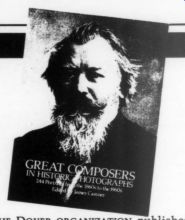
Johannes Brahms' portrait graces the cover of The Great Composers in Historic Photographs and you'll get no arguments from me on this choice. Brahms has always been one of the composers I admire most, and fifteen years ago I wrote my graduate thesis on his works in the theme and variations genre. With over 240 photos, every important com poser you can recall is included along with dozens of less famous names. As with the other two books, the captions are brief but often informative. Not surprisingly, many of the same names found in The Great Conductors also turn up in this volume, since many conductors were also composers. Some were equally famous in both roles (Gustav Mahler) and some barely recognized in the field of composition (Wilhelm Furtwangler).
When names overlap between the two books, the photos do not. You'll see different photos of Makler, Sergei Rachmaninoff, Richard Wagner, Siegfried Wagner and Richard Strauss than those in The Great Conductors. A number of the photos show composers accompanied by performers of their music. One of the best is a shot of Italian song com poser Paolo Tosti flanked by baritone Antonio Scotti and tenor Enrico Caruso, two noteworthy exponents of his music.
Giacomo Puccini is shown in a photo taken at the time of the world premiere of his opera La Fanciulla del West. Shown with him are David Belasco, who wrote the play Girl of The Golden West on which the opera is based, Giulio Gatti Casazza, general director of the Metropolitan Opera, and Arturo Toscanini.
Deems Taylor, composer of The King's Henchman, is photographed with American baritone Lawrence Tibbett, who per formed in the world premiere, and conductor Andre Kostelanetz.
A few composer-performers are not included, notably conductor Wilhelm Furtwangler, pianist Artur Schnabel and pianist Josef Hofmann. I was a little disturbed by Camner's dismissal of Charles Ives with a single sentence: 'American composer of nationalistic works of a highly complex nature.' With so many lesser figures given more extensive coverage, it is difficult to understand why he chose not to offer a bit more information. Ives was greatly misunderstood during his own time and gave up composition midway through his life, after an outstanding career, to pursue the insurance business. Only in the 1950s, as a result of performances conducted by Leonard Bernstein, did he finally begin to become recognized as one of America's greatest Composers.
As you read the captions, you'll see "student of Nadia Boulanger" time and time again. This celebrated French musician and teacher had an enormous in fluence on twentieth century music through her extraordinary teaching. As Virgil Thomson (also a Boulanger student) put it, every American town has two things-a Post Office and someone who studied with Nadia Boulanger. An other omission is Lili Boulanger, Nadia ”s sister who died prematurely.
The composer and conductor books are arranged alphabetically, whereas the opera volume is chronological. I prefer the chronological approach in such books, but the alphabetical arrangement eliminates the need for an index. All three of these are regularly circulated around the listening room during my Saturday night listening sessions.
As usual, Dover offers the highest quality paper, printing and binding for a fraction of what other publishers charge.
TAA readers who enjoy following scores while listening to music will find a wealth of excellent orchestral scores in the Dover catalog. They publish the complete Beethoven and Brahms sym phonies, as well as symphonies of Mahler, Mendelssohn and Schubert. Opera lovers will find superb scores of the Wagner and Verdi operas. Their complete offerings are far too numerous to list here, so write for a catalog: Dover Publications, Inc., 31 East 2nd St., Mineola, NY 11501.
SHOWCASE
DREAMS COME TRUE
by Richard Touzimsky
I would Like To show how my audiophile dreams came true when I built my own high quality equipment. After I became interested in high fidelity in 1970, I read many audio magazines and owned the best amplifiers by Sony, Marantz, McIntosh, and so on. But I was not really satisfied.
In 1981, I read my first issue of TAA, and since that time, I have built every part for my high-end equipment, except for the record player and CD player. In my spare time, (my profession is architecture and interior design) I learned much about audio, and the best teacher was always The Audio Amateur.
PHOTO 1: An inside look at Mr. Touzimsky's version of the Borbely Servo 100 mono amplifier.
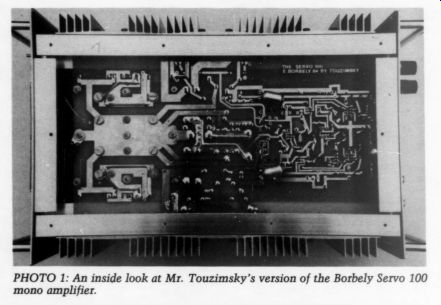
PHOTO 2: Internal view of two RIAA amplifier sections of Marsh's preamp.
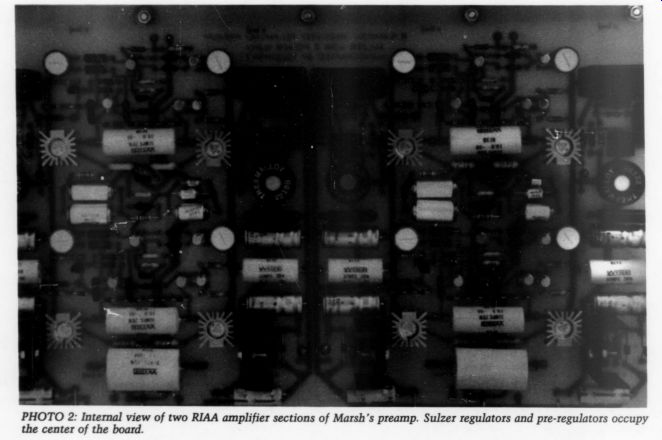
Sulzer regulators and pre-regulators occupy the center of the board.
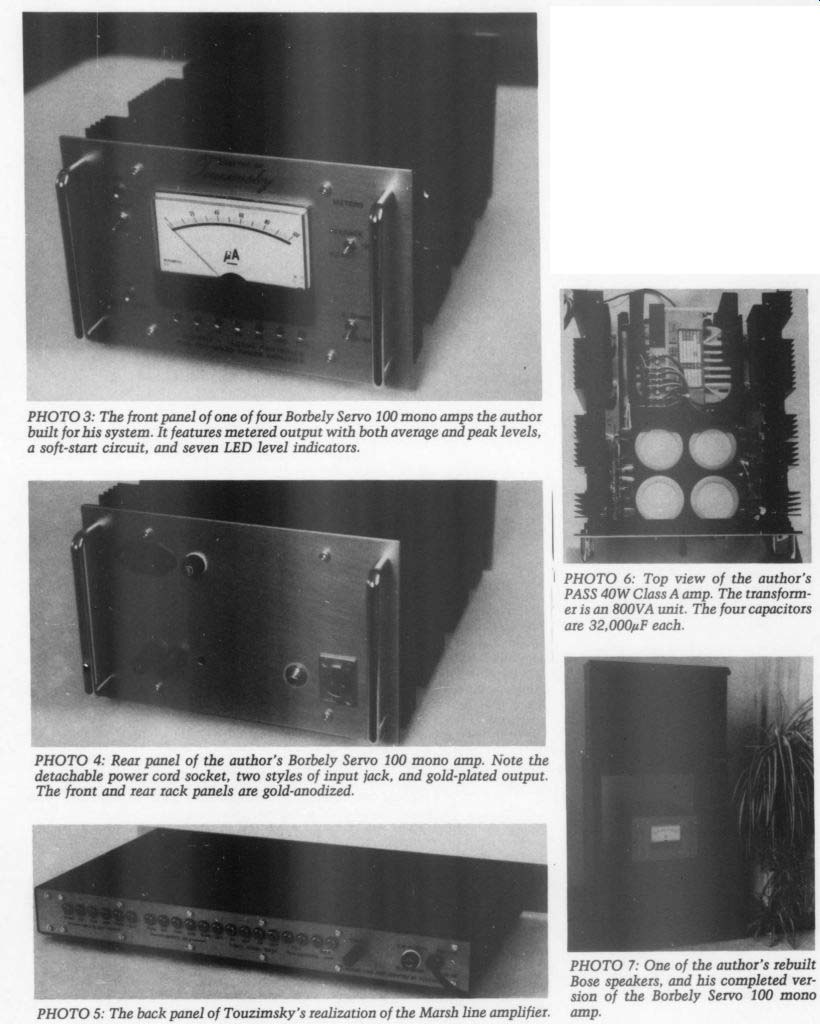
--------- PHOTO 3: The front panel of one of four Borbely Servo 100 mono amps the author built for his system. It features metered output with both average and peak levels, a soft-start circuit, and seven LED level indicators.
PHOTO 5: The back panel of Touzimsky's realization of the Marsh line amplifier.
My first project was the Nelson Pass 40W Class A (A40), and it works to this day without a problem. I made two amplifiers: one for me, and one for my son.
It was a big success, and so I decided to build other projects.
I completely rebuilt my Bose speaker system by making a new active equalizer complete with two separate Sulzer power supplies and pre-regulators. I then selected polystyrene and polypropylene capacitors, and made completely new speaker enclosures with struts and 1.25-inch plywood walls to avoid resonances. Both are finished in a beautiful rosewood veneer, and they sound great.
Another project was the R.N. Marsh
RIAA and line preamp with current sources. During the winter, I finished four units of Erno Borbely's Servo 100 mono amplifier. For all audio projects, I designed my own enclosures with gold anodized front panels.
I built all sections, screen printed letterings, and etched and screen printed the PC boards. I used only the finest components and materials I could find.
Overall, I am extremely pleased with the final work and performance. Sonically, they are the best products I have ever owned.
[Richard Touzimsky lives and works in Katsdorf, Austria]
PHOTO 6: Top view of the author's PASS 40W Class A amp. The transformer is an 800VA unit. The four capacitors are 32,000uF each.
PHOTO 7: One of the author's rebuilt Bose speakers, and his completed version of the Borbely Servo 100 mono amp.
JUST LOOKING
Audio Research Corporation has announced the LS1 hybrid line-stage amplifier which uses one vacuum tube (6DJ8/ECC88 dual triode) in its gain stage.
This unit has a frequency response of +0.5dB, 5Hz to 50kHz; -3dB points below 1Hz and above 200kHz. Distortion is less than 0.01% at 2V RMS out put. The LS1 measures 19 by 5.5 by 10.5 inches, weighs 12 pounds and is priced at $1,495. For more information, contact Audio Research Corp., 6801 Shingle Creek Pkwy., Minneapolis, MN 55430, (612) 566-7570.
The Isoplat, a low-profile platform for compact disc and laserdisc players, is now available from Mission Electronics.
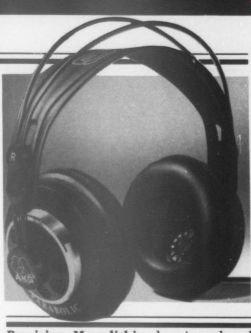
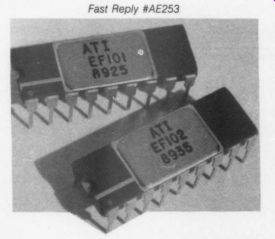
With its sorbothane feet, the product isolates the player from furniture vibrations. The platform also dissipates vibrations generated directly or indirectly by Audio Teknology, Inc., has announced the Electroformer Series IC balanced operation devices comprising the EF101 balanced output chip and the EF102 dual balanced input chip. Both typically have 100dB common mode rejection ratios and 120dB signal-to-noise ratios plus high slew rates. Each device is packaged in an 18-pin DIP. For more information contact ATI, 7556 SW Bridgeport Rd., Portland, OR 97224 USA, (503) 624-0405.
In an effort to reproduce the left-right concert hall perspective, AKG Acoustics has designed the K 280 Parabolic, a new headphone offering surround-sound style listening. The new dual-driver sys tem employs a CAD/CAM-designed parabolic reflector in each ear cup.
Power handling capacity is 200mW and rated impedance is 75%.
Suggested retail price for the K 280 is $195. For more information contact AKG Acoustics, Inc., 645 Bryant St., San Francisco, CA 94107, (415) 957-1067.
In order for serious music lovers to en joy the rich sound they are accustomed to while not at home, Henry Kloss of Cambridge Soundworks has designed the Model Eleven transportable component music system. The unit consists of a miniature three-channel amplifier, a pair of compact two-way satellite speakers and the unique BassCase--a woofer enclosure which doubles as the carrying case. Weighing just 23 pounds and measuring 16 1/2" x 19.5" x 6.5", it can easily be carried on an airplane, or toted to any destination.
Model Eleven's amplifier is switchable for use with any AC worldwide electrical system, as well as 12V DC. The satellite speakers (4.5 " x 5.5" x 3") and the 7" acoustic suspension woofer, which is built into the case, plug into the amplifier. The Model Eleven, retailing for $599, can be ordered using Cambridge SoundWorks' toll free number, (800) 252-4434.
Precision Monolithics has introduced the SSM-2220, a new low-cost dual PNP matched transistor for use in preamps, multiplier/divider circuits, current sources and mirrors, and logarithmic amplifiers. Features include ultra-low in put voltage noise and a 190Hz typical gain bandwidth product. To ensure long term stability of the matching parameters, internal protection diodes across the base-emitter junction are provided to clamp any reverse breakdown potentials.
The SSM-2220 is available in an 8-pin epoxy DIP covering the temperature range of --40° to +85°C. Price is $1.95/100.
The SSM-2210, a dual NPN matched transistor, is designed to meet the requirements of ultra low noise systems.
The SSM-2210 upgrades systems using the pin-compatible LM394BN/CN. Price is $1.50/100.
Also available from PMI is the SSM 2139, the newest member of its “next generation ” op amps. Features include ultra-low voltage noise, a slew rate of 11V/uS, 30MHz gain-bandwidth product and low power consumption. Conforming to the 8-pin dual op amp pinout standard, it is priced at $1.85/100.
For more information contact Precision Monolithics, 1500 Space Park Dr., Santa Clara, CA 95052, (408) 727-9222.
The second New York High End Hi-Fi Show, co-produced by Stereophile magazine and Nelson & Associates, will be held April 27-29 at the Penta Hotel.
More than 70 high fidelity, high tech equipment manufacturers and dealers will be present, including AudioQuest, B&W, Dahlquist, KEF, Vacuum Tube Logic and Vandersteen to name a few.
Manufacturers will demonstrate pre production and experimental products as well as units already on the market.
The show will feature live classical and jazz concerts at night and concert soloists performing during show hours. Seminars will be conducted by Stereophile audio critics and reviewers John Atkinson, J.
Gordon Holt, Sam Tellig, Lew Lipnick and others.
A $25 ticket is good for all three days, seminars and concerts. For ticket information contact Jerran Kingsley, (505) 986-1466.
Analog Dialogue 23-3, a 24-page technical journal on circuits, systems and soft ware for real-world signal processing, is available free from Analog Devices. As well as highlighting a monolithic DC to-120MHz logarithmic amplifier, this issue reviews Digital Signal Processing in VLSI by Richard J. Higgins. For more information contact Analog Devices Literature Center, 70 Shawmut Rd., Can ton, MA 02021.
A new dual BI-FET version of the AD744 precision op amp is also available from Analog Devices. The AD746 provides close matching of both AC and DC specifications between op amps, beneficial in differential and multi-channel systems. With 13MHz gain bandwidth, it settles in 500nS to 0.01% for a 10V step and has a 75V/uS slew rate. The AD746 is offered in three 8-pin types: plastic mini-DIP, hermetic cerdip, and surface mount. Price is $4.25/100 or $8.50 for the high accuracy grade with 0.5mV off set and 10uV/ °C offset drift. Contact Analog Devices, 181 Ballardvale St., Wilmington, MA 01887, (508) 658-9400.
Benchmark Media Systems announces the release of the CID-1, a two-input mixing interface mounted on a two-gang stainless steel wall plate. It is intended for permanent installations such as board rooms, conference rooms and so on, where the outputs of stereo-audio or video cassette decks must be mixed and sent to a mono sound system. The unit may be used with mono sources as well.
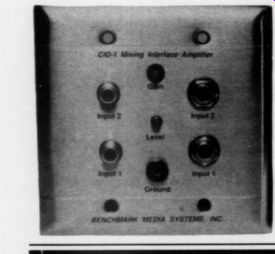
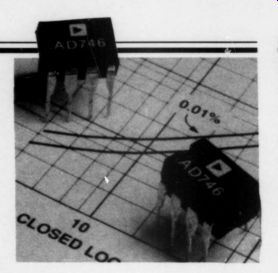
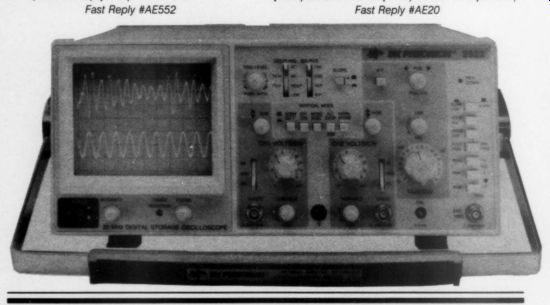
For further information, contact David May or Allen Burdick at Benchmark Media Systems, 3817 Brewerton Rd., North Syracuse, NY 13212, (315) 452-0400 or (800) 262-4675.
D. W. Electrochemicals Ltd. of Richmond Hill, Ontario, has announced that Stabilant 22, the world's first liquid semiconductor has received its US and Canadian patent. Its primary use is as a con tact enhancement material. A non-toxic liquid polymer, Stabilant 22 is initially nonconductive when applied to an electromechanical contact. Once inside individual contacts the material switches to a conductive state giving those contacts the reliability of a soldered connection. However, it remains nonconductive between adjacent isolated contacts. For more information contact D. W. Electrochemicals Ltd., 9005 Leslie St., Unit 106, Richmond Hill, ONT L4C 3G4, Canada, (416) 889-1522.
The new B&K Precision Model 2522 portable digital storage/analog oscilloscope is designed with the first-time user in mind. In digital mode, you can freeze a waveform for close examination of transients, one-shot events, low repetition rate signals or events which took place before or after the trigger signal.
Also included are several X100 time/ division ranges to extend sampling time to as much as 20 seconds per division (200 seconds per screen). Stored wave forms may be expanded X10 for closer examinations. Suggested user price is $1,495. For more information, contact B&K Precision, Maxtec International, 6470 W. Cortland St., Chicago, IL 60635. (312) 889-1448.
Madisound has introduced a new line of input cups to their Sledgehammer line. They will now be available with binding posts in either gold or chrome finish. Some of the advantages of these cups are non-flexibility, posts accept 10 gauge cable, gasketing for airtight seal, 25 " cutout, flange size of 3 square inches, and large solder lugs for multiple connections. Hardware is also in the same finish as the posts. Introductory dealer prices can be obtained by contacting Madisound, Box 4283, Madison, WI 53711, (608) 831 3433.
Sparkomatic has introduced the Model SR345 electronically tuned AM/FM auto stereo cassette. The unit incorporates a 27mm x 40mm display similar to that found in European DIN E radios. Features include 12 FM/6 AM programmable memory, full night lighting, auto seek and scan, LCD digital time, frequency, channel number, tape direction and band display, as well as separate balance, fader and loudness controls. Retail price is $129.99. For more information contact Sparkomatic Corp., Milford, PA 18337, (800) 233-8831 or (800) 592-8891 (in PA).

--------
++++++++++++++++
Also see: