From Switzerland, A Harmonious Blend of Elegant Styling and Advanced Technology
Only Revox can offer complete systems designed and engineered to please both the demanding audiophile and the discriminating, convenience-conscious homeowner. The front faceplates on Revox components do not trumpet unnecessary, "high tech" ostentation. Such gimmickry is not needed. A few moments of listening to a Revox system will let you know that, indeed, advanced technology is at work.
All Revox components may be operated via a single infrared remote control transmitter * The newest generation of microprocessor controlled units also have digital data ports which open the way to external computer control as well as multi-room remote control systems.
This leaflet gives a brief description of the Revox component line. Should you desire more information, please visit your Revox dealer and request a free copy of our 48-page full color catalog.
Revox B285 AM/FM Receiver A symphony of sophistication and simplicity, the full-featured B285 is surprisingly easy to operate. The secret lies in the B285's two on-board microprocessors. You program the B285 to respond to your listening habits and your room environment. Set it once and, from then on, the B285 remembers all the adjustments for you.
Features include: Programmable input sensitivity for all input signals 29 AM/FM station presets Programmable output levels for A & B speaker terminals Multimode LC display Advanced digital synthesizer tuner section Infrared remote control of 9 functions Bi-directional data port for multi-room remote capability Power amplifier section with class AB output stage Rise time of 3 and slew rate of 100 V/µs for superb transient response Exceptionally low noise for optimum CD reproduction.
B286 Tuner/Preamplifier No power amplifier stage; otherwise identical to the B285.
B215 Cassette Deck
Revox has designed a cassette deck to please the most performance-conscious audio enthusiast. Yet this same cassette deck also allows a non-technical music lover to make professional-quality recordings consistently and effortlessly.
A unique microprocessor controlled system, developed by Revox engineers, automatically calibrates the B215's internal bias and equalization for the best possible performance on any tape selected.
Other B215 features include: Automatic or manual input level setting 3 heads 4 direct drive motors Dual capstans driven by quartz-locked Hall effect motors Microprocessor spooling motor control for constant speed winding and jerk-free stops Azimuth stable pivoting headblock Dolby" B and C NR Dolby** FIX Pro headroom extension Elapsed time counter Address locate Automatic start-of record locate Loop function Automatic fade-in/fade-out Bi-directional serial data bus.
B225 Compact Disc Player Overwhelmingly acclaimed by audio critics as the reference standard CD player, the B225 makes no compromises in sonic performance or user convenience.
B225 features include: Oversampling (176.4 kHz) and digital filtering for superior sound resolution and optimum phase response Cueing time of less than 3 seconds to any point on the disc Pre-programming of nearly every conceivable combination of repeat, skip, pause, loop, and auto-stop functions Programming steps may use track (selection) or time as boundaries Dual mode LCD shows total tracks on disc, disc index, track playing, time of track, program step, as well as status of pause, loop, and auto-stop functions May be operated using same infrared remote transmitter as other Revox system components.
B791 Tangential Tracking Turntable
With its patented Linatrack tonearm, the B791 provides exceptional sonic performance while rendering record damage of any kind virtually impossible.
B791 features Include: Servo controlled linear tracking system Tonearm less than 1 3/4" long from pivot to stylus tip Hall commutated direct drive motor with quartz-locked speed control Variable speed control LED display shows nominal speed and percentage of deviation in variable speed mode.
Agora B Powered Speaker Systems
Digital sound recording challenges the limits of conventional loudspeaker design, and Revox meets this challenge with the new Agora B active speaker systems. Each Agora B enclosure contains three separate power amplifiers-one each for the bass, midrange, and high-frequency drivers. This tri-amplified design delivers deep, tight bass and breathtaking high frequency transparency.
Agora B speakers also feature: Active filter network instead of passive crossovers Two bass drivers, one mounted on top of the enclosure and facing inward to eliminate even-order harmonic distortion Feedback sensing circuit to compensate for back EMF from bass driver High rigidity titanium dome tweeter Bass, treble and bass blend adjustment controls.
B205 Remote Control
The lightweight B205 infrared remote control transmitter activates all normal operating functions of your Revox receiver, turntable, CD player, cassette deck, and open reel recorder.
Transmitter optional. Some units may require optional receiver module.
Dolby end Dolby HX Pro are trademarks of Colby Laboratories.
Our commitment to music begins here.
Producer/engineer Bob Gearmountain at the Power Station studios, New York. Clearmountain uses these 24-track Studer recorders in his work with Bruce Springsteen, Bryan Adams, Hall & Oates, and Huey Lewis and the News, among others.
It continues here.
On-air studio at WFMT, Chicago's classical music "superstation" And finishes here.
When you purchase Revox audio components, you are investing in more than buttons and lights in a box. Your Revox system is the culmination of a 30 year commitment to quality music reproduction that stretches across the entire spectrum of professional and consumer audio.
Our Studer professional recorders dominate the world-class recording studio market. And Studer engineers have been prime movers in development of digital audio systems.
Our recorders and mixing consoles carry this commitment into television and radio studios. From NBC in Washington to CBS in Hollywood to KUFM in Missoula, Montana, broadcasters count on Studer Revox for reliability and superior performance.
We apply the same strict standards of engineering excellence to every Revox home audio component.
Because we know what it takes for quality music reproduction. After all, we were there every step of the way.
Revox system with 8285 Receiver, B225 Compact Disc Player. 8215 Cassette Deck. Agora B Powered Speakers, B791 Turntable, and multi-room remote capability.
REVOX. Studer Revox America 1425 Elm Hill Pike/Nashville, TN 37212/(615) 254-5651

EPI
THE TIME/ENERGY SERIES--EPICURE PRODUCTS INCORPORATED
Computers have made something possible for hi-fi sound that wasn't possible before. Because of computers EPI engineers can analyze speaker performance to an extent that can't even be conceived of with conventional methods.
The new computer-tested EPI speakers will bring you sound with unheard-of detail.
They will "separate" the instruments so that you can hear the parts, as well as the sum.
They will give you a sound that is crystal clear, uncolored, and more natural than it has ever been.
For some of you it is enough to know what the Time/Energy Series will do for you. Others of you will also want to know how, and for you we have prepared the following discourse.
THE STEADY STATE SIGNAL AND THE SHORT SONIC EVENT.
From the beginning, improvements in speakers have come from testing, experimentation, and more testing. The bottom-line test has always been how well the speakers reproduce music. Sound comes to us through vibrations. We speak of these vibrations as signals, or sonic events. There are a variety of signals that we use to recognize sound, from short and explosive to long and steady. The limiting factor in conventional speaker testing techniques is that they evaluate only the performance of a speaker while it is reproducing a continuous, steady state test signal. This means that until very recently a great deal of the information that the ear uses to recognize sound, specifically the short sonic events, could not he evaluated. Enter the computer.
THE MISSING LINK.
Much of the research done with the computer in the engineering lab centered on the way a speaker component (driver) reproduces short sonic events. To do this the driver being tested is driven with a very short, electronically generated signal pulse. The sound produced by the driver in response to the signal pulse is picked up by a laboratory microphone, and sent on to an analog/digital converter. The converter converts the continuously varying voltage signal from the microphone into discreet digital bits of information, which are then stored in the computer's memory circuits. The key here is the computer's incredible speed. The speed wit] which it can accept and store the data allow it to provide enormously detailed information on how the driver responds to the very short test pulse. The next step is to take this new information and use it to evaluate existing drivers.
NEW SOURCE OF DISTORTION.
When we used a short pulse to test driver with high quality but conventional cone and diaphragm materials we found they would continue to produce sound long after the signal had stopped. The driver would add sound energy to the original signal: one of the basic definitions of distortion. Because the phenomenon has to do with the sound energy the driver produces and the time frame in which it is produced we refer to it as Time/Energy (T/E) response. We had found a new source of distortion and coloration. The next question was, why were the drivers responding this way?
JUST LIKE RINGING A BELL.
Ideally the cone or diaphragm of a driver should act only to transfer the motional energy generated by the voice coil to the air. If it does this and this alone it produces pure sound. But if it should (and until now it always has) flex upon receiving the motional energy it will produce distortion along with sound. An excellent analogy is the behavior of a ringing bell.
When a bell is struck, the energy from the impact is imparted to the body of the bell. This causes the sides of the bell to flex and store the energy. The energy is then released is the sides of the bell flex back and forth, generating sound. The cone or diaphragm of a driver can act in somewhat the same way.
The motional energy generated by the voice coil causes the cone or diaphragm to flex so hat some of the energy is stored in the cone diaphragm structure, and then released.
The cone, in other words, continues to "ring" after the driver should have stopped producing sound. This ringing is what we call Time/Energy distortion. It's proper in a bell, put in a speaker it produces distortion.
THE SEARCH FOR THE IDEAL MATERIAL.
The ideal cone/diaphragm material would be infinitely stiff so that it wouldn't flex and infinitely damped so that any potential ringing would be smothered. As you might imagine, there is no such material. So the EPI engineers began to experiment with combinations of materials that might together achieve the results one material alone couldn't. Rather quickly it became apparent that the ideal materials for a tweeter wouldn't be the same for a woofer. Whereas a relatively thin material with an applied layer of damping compound worked best for tweeters, woofers required a thicker material with a layer of solid damping material bonded to it for optimum results.
In the case of the tweeter, once the best combination of materials had been found it was discovered they wouldn't work with the existing tweeter shape. Although it had excellent Time/Energy characteristics it yielded' poor extreme high frequency response. After much experimentation a shape was found that gave excellent high frequency response and retained all of the performance benefits of both our original inverted dome tweeter and the new composite diaphragm material.
In the case of the woofer, it was found that a light layer of stiff plastic bonded to a layer of highly damped foam material was an ideal combination. To assure that the bond between the two layers would be uniform and permanent the EPI engineers developed a special bonding process and special tools and fixtures to perform the process.
CLOSER THAN EVER TO PURE SOUND.
All the drivers in the T/E Series speakers have Time/Energy response that is vastly superior to the older designs that were made with conventional cone and diaphragm materials. These new drivers stop producing sound almost immediately after the electrical signal from the amplifier ends. As a result they have more natural, less colored sound when reproducing solo instruments, and when reproducing a group they provide greater detail, definition, and sense of separation between the instruments. It is no exaggeration to say that this marks the most dramatic improvement in the fundamental fidelity of our speakers in the entire history of EPI. We haven't been able to produce sound this pure until now. And we don't think you have ever heard sound this pure until now.
---------------------------------
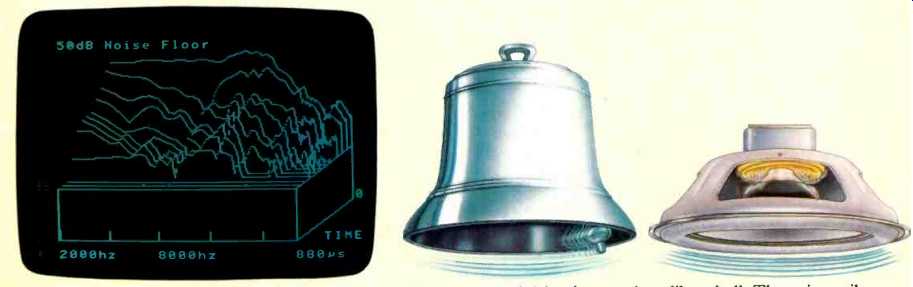
Computers provide information that conventional tests cannot.
The display above shows how the various frequencies the driver produces fade
away after the signal is cut off.
A conventional driver's cone rings like a bell. The voice coil motion makes the cone flex and store energy which is later released causing Time/Energy distortion.
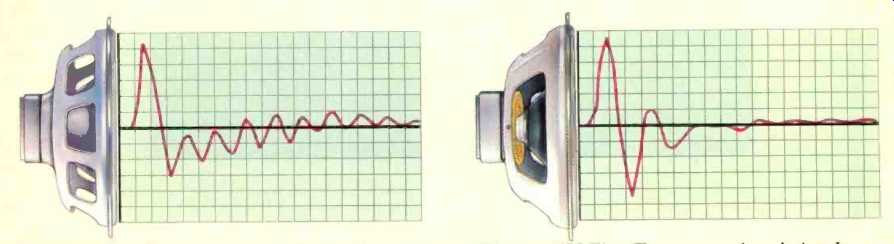
The illustration shows a conventional cone "ringing" long after
the electrical impulse from the amplifier has ended. It's known as Time/Energy
distortion.
The new EPI Time/Energy cone doesn't ring. It gives you pure, uncolored sound.
--------------------------------
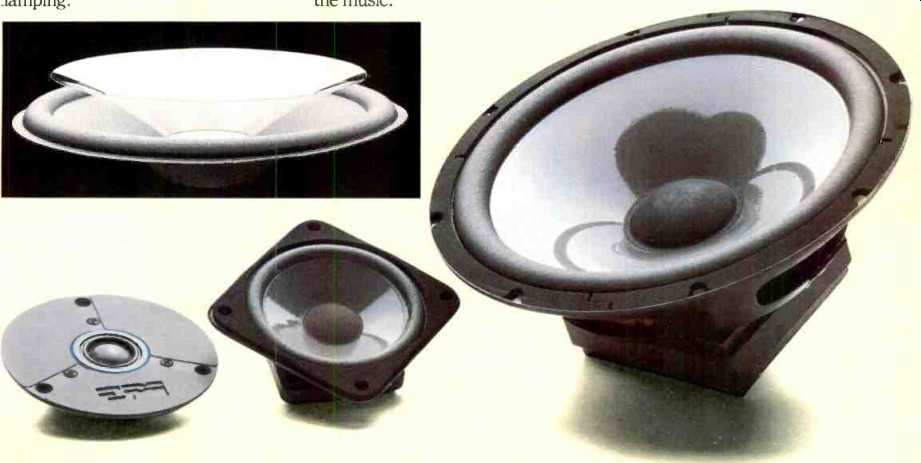
---- The cone layers are bonded together with a lamination process developed
by EPI. The composite cone material has an ideal combination of stiffness
and damping.
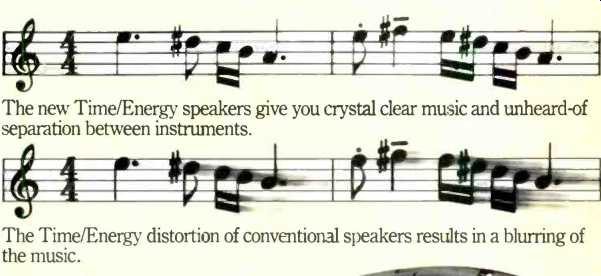
----- The new Time/Energy speakers give you crystal clear music and unheard-of
separation between instruments.
The Time/Energy distortion of conventional speakers results in a blurring of the music.
T/E 70 and T/E 100
The two loudspeakers that have brought more musical enjoyment to more people than any others have been elevated to a new level of performance with the Time/Energy driver technology. The sonic benefits of that technology ensure that the T/E 70 and T/E 100 will, like their predecessors, be given the highest performance ratings by stereo equipment reviewers.
From the new T/E tweeter to the bi-layer laminated woofer cone the T/E 70 incorporates the same Time/ Energy research technology that was applied to the largest models in the line. So the T/E 70 will produce a stereo image so large and so transparent that it is hard to believe it is being produced by such a compact speaker.
For more than a decade the EPI 100 has been used as the standard for comparison by knowledgeable stereo enthusiasts. The addition of the Time/Energy driver technology makes the T/E 100 the new standard. The increased dispersion of the T/E tweeter and the decreased distortion of all the drivers that resulted from the Time/Energy research ensures that the T/E 100 will continue to be regarded as the best speaker in its class.
T/E 100 PLUS and T/E 120
Any music fan will appreciate the clean, open sound of the two smallest models of the Time/ Energy speakers series. But for anyone who might want a speaker that is also a bit stronger in the extreme low frequency range EPI offers the T/E 100 Plus and T/E 120.
At first glance the most striking thing about the T/E 100 Plus is its modern oak-grain vinyl veneered cabinet. What is not obvious is the larger interior volume of the cabinet that allows the bilayer woofer cone to move freely and so produce better bass response. Not just more bass, but deeper fundamental bass response. The sparkling high frequency reproduction and midrange detail of the Time/Energy drivers is well complemented by the extended bass response of the T/E 100 Plus.
The T/E 120 is a two-way speaker with a 10" Time/Energy technology bilayer cone bass driver.
With its large cone area the woofer can effortlessly generate deep, powerful bass energy. The T/E 120 woofer was carefully engineered to match the efficiency of the T/E tweeter so the overall frequency response is smooth and balanced.
T/E 320
The compact, floor-standing TIE 320 produces the kind of sound that is typically associated with much larger, more expensive speaker systems.
The high tweeter crossover point of the three-way T/E 320 reduces the frequency range the tweeter must reproduce. So distortion is lower and power capacity is higher.
Of course the Time/Energy bi-layer cone technology was applied to the acoustically isolated midrange driver.
Critical midrange information is reproduced with exquisite detail.
Adding bilayer cones to EPI's most advanced woofer (which has a patented "Focused Field" magnet structure) ensures that it will continue to be noted for its low distortion and wide dynamic range.
T/E 360
With the superb sound reproduction capabilities of a Time/Energy technology three-driver system and a cabinet large enough to extend bass response to the deepest musical fundamentals the T/E 360 is the practical extreme of sound reproduction performance.
The drivers of the T/E 360 produce sound that is so clean and so dynamic that it is, at once, startling and thrilling. A unique "Passive Piston" bass radiator reinforces the patented "Focused Field" woofer to add a physical quality to the bass reproduction of the T/E 360. The light oak-grain vinyl veneered cabinet encloses all this high technology hardware in a way that makes the T/E 360 a visual as well as an aural triumph.
Epicure Products Incorporated
Epicure Products. Incorporated. Newburyport, Mass. 01950. USA
Harman International
TRIAD
harman / kardon
JBL
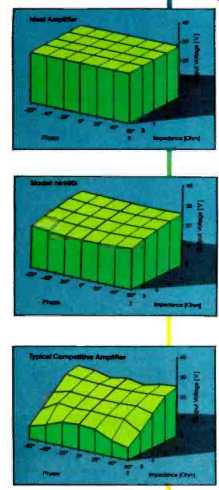
---------To demonstrate reactive load proficiency, Harman Kardon has developed
a 3-dimensional graphic technique that exhibits amplifier output voltage (Volts),
load impedance (Ohms) and current phase (Degrees).
HIGH CURRENT CAPABILITY... THE PROVEN POWER REQUIREMENT
While most manufacturers design their amplifiers to produce the best possible FTC power ratings, Harman Kardon designs equipment to produce the best possible sonic quality. FTC power ratings are determined by the continuous power an amplifier can drive into a resistor-typically 8 Ohms-which is supposed to represent a loudspeaker load. However, when actually playing music, a speaker does not react like a simple resistor. A low frequency transient can make a nominally rated 8 Ohm speaker instantaneously demand 6 times as much current as an 8 Ohm resistor.
For this reason every Harman Kardon amplifier and receiver incorporates High instantaneous Current Capability (HCC) to properly drive any loudspeaker system, regardless of its impedance.
REACTIVE LOAD PROFICIENCY
Recently, some manufacturers have tried to imitate Harman Kardon's HCC, and show improved power ratings in 4 and 2 Ohm resistive loads.
However, they are not providing a third, critical dimension of loudspeaker drive potential-the ability to drive reactive loads.
By only designing for resistive loads, the amplifier will only be able to drive loudspeakers under very specific conditions: When they draw current totally in phase with the music (voltage) signal. However, loudspeakers are nearly always drawing a current that is out-of-phase with the music (voltage) signal, which dissipates higher internal power. Amplifiers not capable of withstanding this dissipation must have output protection, usually in the form of current limiting. This ultimately results in significantly less power driven into the loudspeaker. As a result, peak music signals sound less powerful and the full potential of the loudspeaker is not realized.
NOT ALL COMPACT DISC PLAYERS ARE CREATED EQUAL
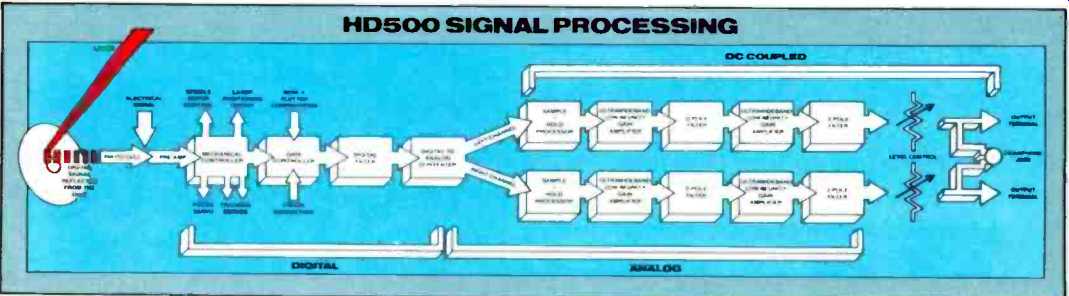
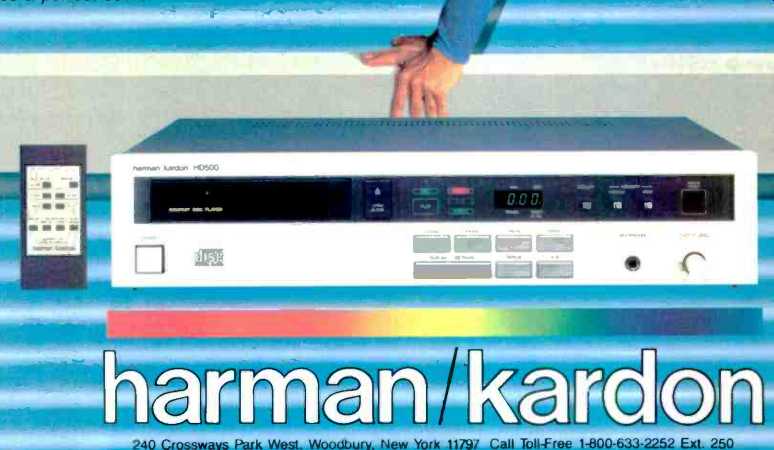
The compact disc medium is capable of elevating sonic standards to new levels. However, all compact disc players do not deliver the same quality of sound. Harman Kardon, renowned for superior quality audio/video components, applied their carefully developed design philosophies to the sonically superior HD500. The digital sections of compact disc players are all basically the same, comprised primarily of integrated circuits (ICs). To create a superior sounding product, Harman Kardon paid particular attention to the design of the analog output section.
The most significant problems inherent in the compact disc medium are ultrasonic signals, known as "alias error." Most digital-to analog converters employ a digital filter that suppresses these ultrasonic signals by 40dB. But, even at 40dB below the music, these signals cause the conventional analog sections to create highly audible intermodulation (IM) distortion.
To reduce this IM, conventional designs try to remove as much of the ultrasonic signals as is possible. Some manufacturers use digital filtering, but the result is a "processed" sound quality, lacking in detail. Others employ steep multi-stage 2-dimensional sounding analog filters with high negative feedback: This method produces severe phase shifts at mid-range and high audio frequencies, in addition to producing transient inter modulation distortion (TIM). In sharp contrast, Harman Kardon developed an analog output section with exceptionally low IM, so that audible effects from the signals are virtually eliminated. A simple analog filter was then added to gradually reduce these ultrasonic signals. In addition, this section utilizes no negative feedback, which also eliminates TIM, yielding 3-dimensional imaging and clear, crisp sound.
For ease of operation, the HD500 is equipped with a full-function infra-red wireless remote control, which duplicates all of the front panel functions. The HD500 has been carefully designed to complement the sound and look of all Harman Kardon audio/video components. The Harman Kardon HD500... Created better than the rest.
THE HARMAN KARDON HD500 COMPACT DISC PLAYER
THE PERFECT BALANCE BETWEEN ARTISTIC INTERPRETATION AND TECHNICAL ACCURACY
The gymnast, poised on the balance beam, knows that in order to achieve a perfect score, there has to be total attention given to detail in artistic interpretation as well as the mastering of technical accuracy.
While all gymnasts aspire to perform the most intricate of routines, not all have the ability. The same is true of compact disc players. The digital sections of most CD players are similar to compulsory exercises: They're all basically the same and all basically adequate. The analog sections are where the quality of the performance and the differences between competitors are determined.
The analog section of the Harman Kardon HD500 compact disc player has been designed with attention to subtle details, using only the most sophisticated circuitry and highest quality discrete components. The result is breathtaking dynamic range, startling realism and a-world class performance every time.
Visit your local Harman Kardon dealer and judge for yourself...The HD500 receives a perfect score.
AN OFFER THAT'S MUSIC TO YOUR EARS
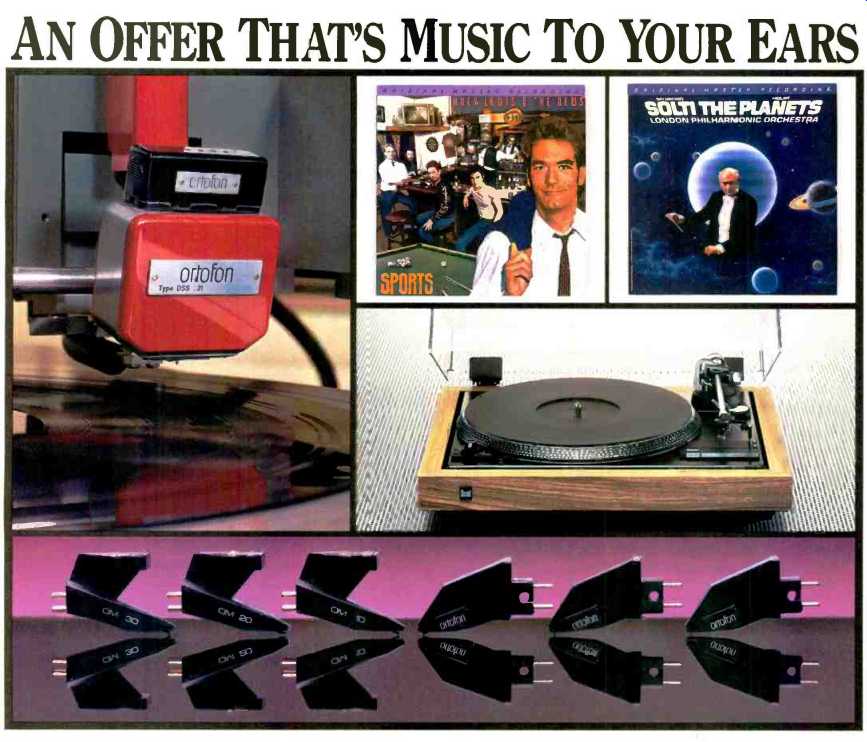
Buy a Dual turntable with an. Ortofon cartridge, and get up to 3 Original Master Recordings from Mobile Fidelity Sound Lab free! Mobile Fidelity Sound Lab has earned a reputation for producing some of the world's finest reproductions of recorded music. When it came to selecting a cutting system for their disc mastering they chose Ortofon.
And when Dual needed a phono cartridge manufacturer to aid in the design of the ultimate Low Mass Tonearm system for their new turntables, they too chose Ortofon.
Now these 3 industry leaders combine to make a unique, limited time offer. Simply purchase any new Dual turntable combined with a new Ortofon phono cartridge.
What you'll get is the finest reproduction of music for your money anywhere. Because of their legendary Black Forest craftsmanship and design, every Dual turntable offers superior performance in it's class. And when reproduced with the Dual/Ortofon U.L.M. tonearm/cartridge system, the sound from your records will astound you! And to he sure that you have the finest possible music source to listen to, just send us proof of purchase and we'll send you FREE up to 3 "Original Master Recordings" from the complete library of Mobile Fidelity Sound Lab.
Your participating Dual/Ortofon dealer has all the details. Ortofon Inc. 122 Dupont St., Plainview, NY 11803, USA. (516) 349-9180.
(Audio magazine, Jan. 1986)
Also see:
= = = =