Manufacturer's Specifications Gain: 40 dB, maximum.
Input Impedance: Equal to cartridge impedance.
Output Impedance: Less than 1 ohm.
Overload Margin (1 kHz, 0.008% THD): More than 100 mV.
THD (Referred to 50 mV Out, 1 kHz): 0.0001%.
Noise (Referred to 2 mV): -80 dB, unweighted.
Frequency Response: D.C. to 1 MHz,-3 dB.
Company Address: c/o Transparent Audio Marketing, P.O. Box 117, Hollis, Maine 04042.
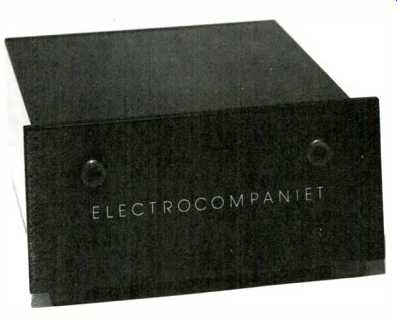
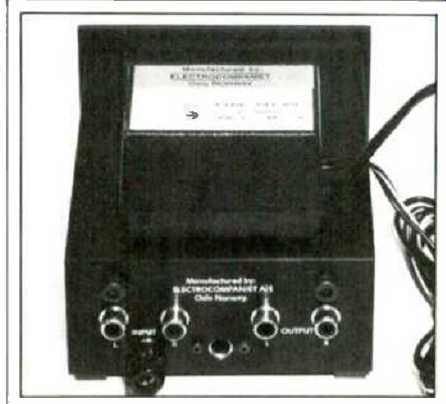
The moving-coil phono cartridge was commercially introduced by Ortofon in 1948. Since then, there has been a continuous search for the ideal device to amplify the cartridge's output signal, which is usually very low, to a usable level without introducing noise, coloration, distortion, high-frequency ringing, etc. Most often, an "audio" transformer has been used for this purpose, but such devices have been considered to be frequency restrictive, noisy, and distorting. Continued research has brought about major improvements in the moving-coil cartridge step-up transformer, e.g., oxygen-free copper wire, silver wire, better transformer laminations, toroidal windings, improved frequency response and phase linearity, and almost total elimination of noise.
During this period an audio revolution was started: Bell Laboratories introduced the transistor, and the world of audio was inundated with transistorized equipment. It was not long before a spate of devices loosely classed as high-gain, transistorized phono sections for preamplifiers and pre-preamps were made available to amplify the low-output signals from moving-coil cartridges. With such excellent step-up devices available, the moving coil cartridge was usually touted as being superior to the moving-magnet and moving-iron types. Finally, a cult developed that even today insists the moving-coil cartridge provides superior reproduction of recorded music.
Meanwhile, further research has brought forth superior transformers and pre-preamplifiers, but at prices ($1,000 and up) that few audiophiles can afford.
In my laboratory, the reference MC phono cartridge transformer is the Technics SH-305MC, and the reference pre-preamplifier is the Audio Standards MX-10A. Recently the MX 10A was bested by the relatively new Electrocompaniet MC-2 moving-coil pre-preamplifier, which has maximum gain of 40 dB and is priced at only $495. The Electrocompaniet is an outboard device with a separate power supply that plugs into a 110-V receptacle. The pre-preamplifier measures 5 3/4 in. by 4 in. by 2 in., and the power supply, which provides 24 V at 35 mA, measures 2 1/2 in. by 1 3/4 in. by 1% in. It is connected to the MC-2 power input by a long wire.
The MC-2 is usually sold for use with moving-coil cartridges that have an internal impedance ( d.c. resistance) of 10 ohms or less. It is generally agreed that the best moving-coil cartridges are those that have low internal impedance, but their low impedance makes them the most difficult cartridges to match to an amplification stage. Since other MC cartridges have internal resistance greater than 10 ohms, the MC-2 design has been made more flexible. It can now be used with almost any MC cartridge whose internal impedance does not exceed 50 ohms.
The MC-2 has more gain than any pre-preamplifier or transformer that I know of. It is not a step-up device in the usual sense of the term, but is more accurately described as a current sensing moving-coil interface and step-up device. The circuit is differential-symmetrical with floating ground, and is d.c.-coupled (see Fig. 1). To keep distortion to a minimum, the MC-2's current-sensing front-end actually adjusts its input impedance to match the fluctuating impedance of a moving-coil cartridge as it turns groove information into an electrical signal. To further reduce distortion, noise and high-frequency ringing, a very slight amount (about 1.5 dB) of closed-loop parallel feedback is employed, which is controlled by resistor R2 (Fig. 1). This feedback would normally reduce the input impedance nearly to zero ohms, so a series resistor (R1) is added to bring the impedance back to more useful values. In combination with capacitor C1, R1 also determines the open-loop cutoff frequency and the so-called input lag. The MC-2 is unsurpassed in its ability to reduce noise and distortion in the first amplification stage to levels that are nearly undetectable by common methods of laboratory measurement.
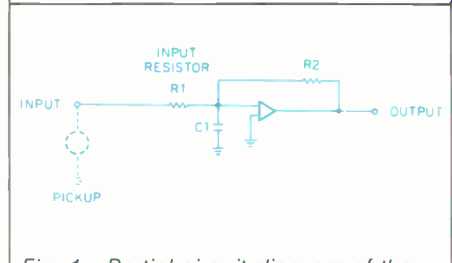
Fig. 1--Partial circuit diagram of the MC-2 pre-preamp.
The earlier version of the MC-2, which was designed for cartridges with impedances of 10 ohms or less, had a 16-position selector switch in place of R2 in the parallel feedback loop. Listening tests showed that this earlier MC-2 performed best in selector switch position 4. The newer version of the MC-2 does not have a selector switch. With this version, cartridge matching is optimized by changing R1 and R2, which are mounted in sockets for easy removal and replacement. The value of R1 is selected according to the phono cartridge's internal impedance. The value of R2, which controls the amount of parallel closed-loop feedback, should be approximately 20 times that of R1. The resistors must be changed in both channels at once, and only 1% metal-film resistors are to be used. (Transparent Audio Marketing, Electrocompaniet's importer, will retrofit this modification to the older model for a charge of $45.) In view of the sensitivity of the MC-2, I do not recommend that the audiophile perform any measurements on it unless special test equipment is used.
Measurements must be made with a generator that is able to drive a 10 ohm load without the slightest stress.
Noise can be measured at the output terminal by coupling a 5 to 10-ohm metal-film resistor between input and ground. I was unable to measure any noise at the output of the MC-2. (Discrete Technology's silver interconnects were used throughout my tests and listening evaluations.) A word of caution is in order: The MC-2 inverts absolute phase. If your system is in correct phase, hot and ground leads will have to be reversed at some point, either at the cartridge or at one end of each speaker-wire pair, so that the system will remain in phase when playing records via the MC-2.
Since there may be all sorts of audio equipment in the tape loop, it is preferable to correct the phase inversion at the cartridge. To accomplish this, invert the leads at the cartridge so that the red wire goes to the green pin and the green wire goes to the red pin.
Then perform the same operation on the left side-connect the white wire to the blue pin and the blue wire to the white pin. Wiring the phono cartridge in this manner permits any other audio equipment connected to the preamplifier to remain in phase all the time. If the MC-2 is ever replaced with a noninverting type, the original wiring at the cartridge will have to be restored.
I have used the Electrocompaniet MC-2 pre-preamplifier for over a year and found it to be superior to any transformer or pre-preamplifier with which I am familiar. It produced no noise, distortion, or coloration with any moving-coil phono cartridge, but it did improve the imaging more than I would have expected. Of all the virtues of the Model MC-2, the most important is that the price is right for what I consider to be the finest pre-preamplifier available today.
--B. V. Pisha
(adapted from Audio magazine, Jan. 1986)
Also see:
Electrocompaniet EC-1 Preamp (Nov. 1987)
ELECTRON KINETICS EAGLE 2 AMPLIFIER (Sept 1985)
MONSTER CABLE X-TERMINATOR SPEAKER PLUGS (Jan. 1986)
= = = =