 .
.
by Howard A. Roberson
In November 1987, Audio published "Mass Cassette Test: We Review 35 New rapes." This time, I am covering 88 tapes-that is, the great majority of formulations available in the United States, including those from mail-order firms. The tapes evaluated are 36 Type I, 36 Type II, and 16 Type IV cassettes. The brands are BASF, Certron, Chrome Master (from Master Hi-Tech Video), DAK, Denon, Fuji, Goldstar, Greencorp, JVC, Laser (Swire Magnetics), Maxell, Memorex (Memtek Products), Nakamichi, Realistic (Radio Shack), SKC, Sony, TDK, That's (That's America), and Visa (Interworld Electronics). I did not include tape formulations which were being updated or were about to be dropped at the time of the testing, nor did I include tapes from manufacturers who did not reply to my request for literature and test samples.
For example, because 3M was in the process of readying a new Black Watch tape line, these cassettes are not covered here. After the last survey, one reader asked that Teac be included next time. Alas, Teac is no longer distributing cassette tapes in this country.
The following brief descriptions of each formulation are based on statements in the manufacturers' spec sheets and catalogs. The tapes are grouped alphabetically by brand.
BASF Ferro Extra I is an updating of the previous LH Extra I. Ferro Super I is a new premium normal-bias tape with a high maximum output level (MOL) and extended sensitivity that are "ideal for recording loud rock and roll music." It is coated with a microscopically close-grained layer of ultrafine "megadium" oxide particles for outstanding uniform alignment. Ferro Maxima I, the newest BASF Type I formulation, uses a dual-layer micro-coating technology and proprietary megadium iron oxide.
The Type II Chrome Extra II is an updated version of Chromdioxid Extra II, offering the low noise floor typical of chrome tape "with extremely high frequency response and an S/N of 63 dB." Chrome Maxima II retains the double-layer chrome formulation of Chrome Maxima and uses a new wide window shell which features 12 rigid bracing struts in the critical magnetic head area. Metal Maxima IV (Type IV) is available only in C-120 cassettes, which can accommodate two 60-minute Compact Discs.
The Certron tapes are HD and UX, both Type I cassettes. I had also planned to include Certron LN, which I purchased locally, along with HD, in a discount department store. (Certron had supplied just UX, feeling it would best meet my basic criteria.) However, I dropped the LN formulation from the testing when the two samples failed criteria for minimum performance. The manufacturer refers to HD as the "performance and economy tape for music or voice" and to their UX formulation as the "quality music tape for all recording applications." Chrome Master LX-II (Type I), the single tape from Master Hi-Tech Video, is "engineered to perform a notch above the standard normal-bias tapes," and DAK promises satisfying performance from their MLX (Type I) and MLX2 (Type II) formulations.
Denon's tapes have Dynamic Balance (DB) hubs for smoother rotation and a more even tape wrap. One of their Type I tapes, DX1, utilizes a gamma-ferric-oxide formulation for wider dynamic range; their other Type I tape, DX4, uses a nonporous ferric oxide to "ensure a high MOL, exceeding the performance level for its class." In HD6 (Type II), a cobalt-doped ferric oxide has been used to ensure high MOL while offering a low noise level over the entire frequency range. A similar formulation has been used in HD7, with ultrafine particles for further improvements. An unusual Type II formulation, HD8 "combines pure-metal particles with cobalt-doped ferric oxide." Its extended frequency response, says Denon, approaches that of a Type IV tape. The pure-metal formulation of HD-M (Type IV) allows the "most accurate reproduction of the music possible." The Type II and IV cassettes have high-precision shell halves using a dual-window housing that "reduces resonance due to external interference, mechanism noises, and tape vibration." From Fuji come DR-I (Type I); DR-II, FR-11x, and FR-IIx PRO (Type II), and FR Metal (Type IV). The Pure Ferrix magnetic particles of DR-1 "provide the best balance of sensitivity, frequency response, MOL, and bias noise." The Type II tapes, DR-II, FR-11x, and FRIIx PRO, all use Super-Fine Beridox particles to secure high MOLs and low noise. The DR-II tape has a new large window cassette shell to ensure "stable tape transport and minimal distortion," while the new high-precision shell for FR-IIx "offers highly reliable transport stability and minimizes wow and flutter and modulation noise." Fuji's FR-IIx PRO, which has a new shell and tape mechanism, uses the company's "exclusive Double-Orientation technique to ensure minimum distortion at high output levels." The Type IV FR Metal tape has Super-Fine Metalix particles that are densely packed and uniformly aligned via Double-Orientation technology.
Goldstar offers HP and HR (Type I), CRX (Type II), and MT (Type IV). The HP and HR formulations use gamma hematite crystal particles to "ensure outstanding output and sensitivity through the full range of frequency responses." The HR tape's improved particles offer greater resistance to saturation "for the extra touch of detail and refinement." Goldstar's CRX uses sensitive, cobalt-doped iron-oxide particles to retain "all the energy and excitement of the original sound," and MT has very minute pure-metal particles said to be of high coercivity and unequalled uniformity to get "the ultimate in high-frequency response and the best dynamic range possible." Greencorp's Type I tapes, XDS and Music +, use gamma-ferric and super gamma-ferric particles, respectively.
Their Type II CR has premium-quality chromium dioxide, which performs "far better than so-called chrome-bias ferric-oxide tapes." The JVC GI (Type I), AFII (Type II), and AFIV (Type IV) tapes are in the manufacturer's Fidelity Series, offering attractive and well-performing shells.
The GI formulation provides "high cost performance with JVC quality," while AFII delivers "tight, well-dispersed sound with super-low noise." This tape has high MOL and reduced modulation noise. The AFIV tape has been upgraded and specially designed for digital sources, using ultrafine pure metal particles, a new binder system, and high-orientation technology. Its new, heat-resistant shell has many features, including precision molding and accurately shaped and positioned hubs, pins, and guides.
The single tape from Swire Magnetics is Laser XL Plus. This Type I tape has an "extra low-noise formulation for excellent music or voice recordings." The Maxell Type I tapes are Frill, URF, UDI, and XLI-S, and their Type II tapes are Capsule II, UDX-II, UDII, XLII, and XLII-S. The MX is Maxell's single Type IV formulation. Frill, UR-F, Capsule II, and UDX-II make up Max ell's Lifestyle cassette line. Pure crystal-oxide Frill tape, available in C-46 only, comes in various colors to appeal to 9to 12-year-olds, while UR-F cassettes are targeted more at teenage users. These UR-F cassettes' "micron sized particles are densely packed for uniform output over the entire frequency range." The Capsule II's special, rounded case facilitates carrying it in a pocket or bag; the tape's micron-sized particles are "Clear Epitaxial oxide for greater output, lower noise, and wide dynamic range." The Arrow cassette shell of UDX-II combines high precision with strength and stability, while the small, uniform particle size of the tape facilitates tight packing for "more sound. output, lower noise, and wide dynamic range." Maxell's newly developed Non-pore Epitaxial particles, used in UDI, deliver greater magnetic energy, and this tape's High Resonance proof (HR) cassette mechanism is said to offer a "high level of anti-resonance capability." Maxell's XLI-S is a normal position tape with new Super-Energy, fine Epitaxial magnetic particles which are oriented to expand the dynamic range while delivering ultralow noise.
This tape also features Absorption Control Treatment (ACT), a special surface treatment, and the Super Silent Phase Accuracy (SS-PA) cassette mechanism. Maxell's UDII uses newly developed ultrafine Clear Epitaxial magnetic particles and benefits from a new calendering process that smoothes its surface. The HR mechanism, described above, is used in both UDII and XLII. The latter tape has even finer particles, and both have the same High Endurance (HE) binder. The XLII S tape has improved sensitivity at mid and high frequencies, and improved MOLs are claimed in these areas.
Modulation noise is well suppressed with the use of the SS-PA mechanism.
The MX tape has further improved. Super Stabilized Pure (SSP) metal magnetic particles, which are ultra small and reportedly provide outstanding resistance to oxidation. High orientation and packing are achieved with a newly developed high-dispersion processing technology.
Memorex's tapes are dBS and MRX I (Type I) and HBS II and CDX II (Type II). The dBS tape's special formulation provides "clear, lifelike reproduction of rock, pop, jazz. or country music." A new shell and mechanism ensure smooth tape performance. The MRX I uses a "uniquely formulated ferric-oxide composition" for higher output and greater headroom. The company's HBS II has an "improved highly sensitive crystal-ferrite formulation" and a new calendering process; these combine to deliver "full sound and reduced tape noise." Memorex CDX II is a Type II metal formulation that offers "better than metal performance with high-bias convenience" and "makes distortion and saturation a thing of the past." Nakamichi has generally updated the formulations and shells of their EXII (Type I), SX and SXII (Type II), and ZX (Type IV) tapes.
The Realistic tapes, purchased at my local Radio Shack, are Supertape LN and XR (Type I), Supertape HD and MII (Type II), and Supertape MIV (Type IV). The LN has a high-flux-density oxide formula for high output and low noise, XR "delivers optimum performance at normal bias for greater musical detail," HD "captures loudest and softest passages while reducing noise," MII is a superb Type II metal tape with an "exceptionally wide dynamic range and superior signal-to-noise ratio," and MIV metal-particle tape is "highly recommended for recording from digital Compact Discs." SKC's tapes are GX and AX (Type I), OX and CD (Type II), and ZX (Type IV). The GX tape uses a special ferric oxide for high output and delivers "full dynamic range with excellent signal-to-noise ratio." It has a new crystal-clear, one-piece precision cassette shell. The company's AX tape uses a formulation for which it claims superior fidelity, and the "new wide-window, high-precision cassette shell assures perfect tape operation." The OX tape is also said to have a superior formulation and an ultra-high-density finish that provide extended high-frequency response. It features "outstanding dynamic range and sensitivity across the entire frequency spectrum." The advances pure-chrome formula of CD tape is said to deliver "extraordinary reproduction in all musical ranges." It combines ultra-high recording density and low background noise and "exceeds all requirements for high-fidelity Compact Disc recording." The ZX Type IV tape has specially treated, pure-iron particles to assure extended frequency response. It uses a "precision cassette shell for superior alignment and greater guidance accuracy." Sony HF (Type I) is good for "all-purpose recording-voice and music." Sony's other Type I offering, HF-S, has "Micro-fine Crystal Gamma particles for more accurate recording of music" plus Sony's High Polymer Binder Sys tern. Type II UX tape uses Micro-fine Uniaxial particles for excellent linearity and "dynamic reproduction in hi-fi tape decks and automobile stereos." The UX-S formulation's Super-fine Super Uniaxial particles reportedly provide "an extra measure of fidelity in music recording," while UX-ES utilizes Ultra fine High Power Uniaxial particles to make a "high-bias tape designed for impeccable fidelity for digital audio and live recording." The fourth Type II sample from Sony, UX-Pro, is a "professional reference tape that is unbeatable for digital audio and live music recording"; it features a ceramic tape guide that reduces noise and vibration.
A new, lower cost Type IV tape, Metal SR utilizes a recently developed Fine Dynametal formulation to obtain "outstanding magnetic performance and a dramatic reduction in bias noise and distortion." The Metal-ES has ultrafine Extralloy particles in a dual coating that secures reduced noise with improved high-frequency and midrange responses. Metal Master is very similar to Metal-ES magnetically but has a unique ceramic shell. The tape guide and outer one-piece rigid shell are made from "ceramic composite material specially designed to dampen external vibrations and reduce modulation noise." The TDK D (Type I) has new Pure Grained Ferric particles, a high-dispersion binder system, and advanced tape-coating technology. Improved MOL and high-frequency sensitivity result in a "fresher, clearer sound." The Pure Linear Ferric ultrafine particles in AD have uniform dispersion and high packing density. This tape is said to provide "superb performance and sound quality for use with digital sources." The ultrafine, nonporous ferric particles in AR are in a special new binder system. TDK claims that AR's "low-frequency MOL is equal to that of metal tape." In AR-X, a dual coating of "ultrafine, high recording density Avilyn particles" has been used: "Overall magnetic properties are extremely balanced, with very high, yet carefully controlled, values." Even finer Avilyn particles, with a more perfect needle shape, are used in the upgraded formulation of the SD Type II tape. Noise remains low, and "sensitivity and MOL are improved." The SA cassettes use "ultrafine high recording density Super Avilyn magnetic particles which have been further improved to achieve a higher packing density." Bias noise is low, while MOLs are higher. A dual, high-density coating of ultrafine Super Avilyn particles in SA-X result in "ultra low noise plus improved MOL over the entire frequency range." In one of their Type IV tapes, MA, TDK uses unique Finavinx particles that "have been further improved to give even higher performance than before." High packing density achieves unusually good magnetic performance. Ultrafine Finavinx particles, highly dispersed in a uniform dense packing, are found in MA-X. It has the "sound quality for the digital age's top-grade cassette." Although MA-XG is much like MA-X, it uses a shell assembly incorporating a center die-cast metal section. The shells of all TDK tapes are improved over previous versions.
The Type I That's CD tape, from That's America, uses a "highly dispersed and densely packed Flush Surface Cobalt formulation" to ensure a "crisp, clear sound and wide dynamic range across the entire audio spectrum." That's CD-II (Type II) is an "all new, high-bias-position tape with a dynamic range comparable to metal tape performance." The formulation has Submicro Cobalt Gamma particles.
With its Super Alloy formulation, CDMH "delivers the brightest, hottest highs and the most dynamic recording in the high-bias position." An Anti-Vibrational Resin (AVR) shell is also featured. That's CD-IV (Type IV) uses what the manufacturer calls a Nano Dynamic Tactoid formulation. In combination with the AVR shell, the maker claims this tape delivers "outstanding response from the most demanding digital sources." The Visa tapes from Interworld Electronics are High Performance I and High Tech Turbo Superferro UFX I (Type I) and Professional Chromdioxid CX II and High Tech Turbo Superchrom UCX II-S (Type II). From here on, these tapes will be referred to as High Performance I, Superferro UFX I, Chromdioxid CX II, and Superchrom UCX II-S, respectively. No literature was received on the Visa formulations.
TEST METHODS
With a few exceptions, manufacturers supplied three C-90 samples of each formulation evaluated. Maxell Frill comes only in a C-46 length; Certron HD, Chrome Master LX-II, and Goldstar MT were obtained in C-60 lengths, and BASF Metal Maxima IV is available only in the C-120 length. As most readers probably know, a number of formulations are now available in C-75 (or C74 or C-76) and/or C-100 or C-110 lengths. I asked each maker of such lengths to supply two samples of each formulation for cross-checks with their C-90s. I examined the packaging and unwrapped all samples of all lengths, noting any pull-tab instructions. Every sample was fast-wound once in each direction before any other tests.
I used a Nakamichi 582 deck for substantially all of the record/playback tests. I also used a Nakamichi CR-7A and Akai, Kenwood, Teac, and Technics recorders for some cross-checks.
Bias and sensitivity figures for both sides of every sample were measured relative to the standard IEC Type I, II, and IV reference tapes. A meter in relative-decibel mode measured bias at an internal point in the 582 deck.
Using the first side of the first sample, I adjusted the record head's azimuth for the best high-frequency response, compensating for any skew between it and the playback head. I set bias for the smoothest overall record/playback response at 20 dB below Dolby level, using a pink-noise source and a third-octave RTA for the playback display. Subsequently, I checked for skew and changes in bias requirements for the second side of the first sample and for both sides of other samples. I noted any other deviations from flat response for later reference.
The 582's 400-Hz calibration tone was the source for measuring sensitivity in relative decibels.
I made record/playback response plots for the 88 formulations at Dolby level (200 nWb/m at 400 Hz) using a function generator and an X-Y recorder. The-3 dB points at the high-frequency end are indicated in the accompanying Tables. I secured more exact data, however, with my Audio Precision System One test system, used for the majority of all other tests.
Let me emphasize that although there are references to Dolby level, no tests were run with any sort of noise reduction. I measured MOLs at 11 points from 20 Hz to 1 kHz with a distortion limit of 3%, and measured saturation output levels (SOLs) at nine points from 1 to 16 kHz. The data was used for obtaining limit curves on each frequency response plot.
The signal-to-noise ratio was the difference between the signal level which caused 3% distortion at 400 Hz and tape noise measured with IEC A-weighting. I recorded a 3-kHz tone and played it back to assess flutter. / remind the reader: The deck has a considerable effect on the exact flutter-for any tape. The same 3-kHz tone was used in testing for dropouts and to determine the degree of level stability at this moderately high frequency. I measured modulation noise after recording a high-level 1-kHz test tone.
The playback passed through a 500 to-1,500 Hz bandpass filter, and the tone was then notched out by using the THD + N filter of the Audio Precision System One. The playback level of the tone without the notch served as the reference for the measuring meter.
A bar graph displayed the noise levels; the modulation noise figure reported in the Tables is the average of the minimum and maximum indications. I noted in the discussions of the tapes whether the noise was smooth (steady in level) or varied noticeably with time.
USE TESTS
It was easy to remove the wrapping from most samples. I had some difficulty with cassettes from Chrome Master, Goldstar, and Laser, and less difficulty with ,,VC and Realistic tapes; the Denon, Sony, TDK, and That's samples were the easiest to unwrap. Many of the manufacturers include little arrows and "Open" to show which way to pull the tab Sony gives the specific, helpful suggestion, "Pull diag." Many cassettes co not unwrap well if the tab is pulled straight, perpendicular to the long edge of the box. Quite a few cassettes opened easiest with the box held so that "Open" appeared upside down.
Most of the cassettes come with pressure-sensitive labels. Some of the tapes from BASF, Certron, Denon (DX1 only), Goldstar, Greencorp, JVC, Realistic (all), and Visa are supplied with labels already affixed. Labels vary in size and surface, offering a wide range of writing area. I can't take the space to report the details of what I found, but be aware that some labels may be too small for needed notes and/or have a coated surface that is very hard to write on. In general, affixed labels are easier to write on.
Most of the supplied boxes are of good quality, much better than some provided several years ago. Certron and Greencorp had the poorest boxes; the quality of Realistic and Visa boxes was somewhat higher. In general, Fuji, Maxell, Nakamichi, Sony, TDK, and That's supplied the best boxes, with the Denon and JVC boxes very close in quality. I examined the shells very carefully for signs of distorted shape or poor assembly, rating BASF, Denon, Fuji, JVC, Maxell, Nakamichi, Sony, TDK, and That's as having the best shells. Of all the samples provided, I judged the Sony Metal Master and TDK MA-XG shells to be outstanding.
Most of the cassettes have tactile clues for picking out side A or B. This is very helpful for those with vision problems or when looking is undesirable, as when driving. A single raised dot to identify side A and a double raised cot for side B are used on all the Greencorp tapes as well as on most tapes from Denon, Maxell, and TDK and on one JVC tape. Raised or engraved letters are used on all the Goldstar, Nakamichi, and Realistic tapes; on most of the Fuji, SKC, and Sony tapes, and on one tape apiece from Certron, Maxell, and Memorex. I congratulate Fuji for including "A" and "B" in Braille on the shell halves of FR Metal; the dot pattern can also be decoded by the sighted. I hope more cassettes will include this information in the future. The triangular window of the That's cassettes also gives good tactile clues.
The great majority of the samples were quiet during fast-winding. The minor exceptions, still acceptably quiet, were some cassettes from Certron, Goldstar, Memorex, Realistic, SKC, and Visa.
MEASUREMENTS
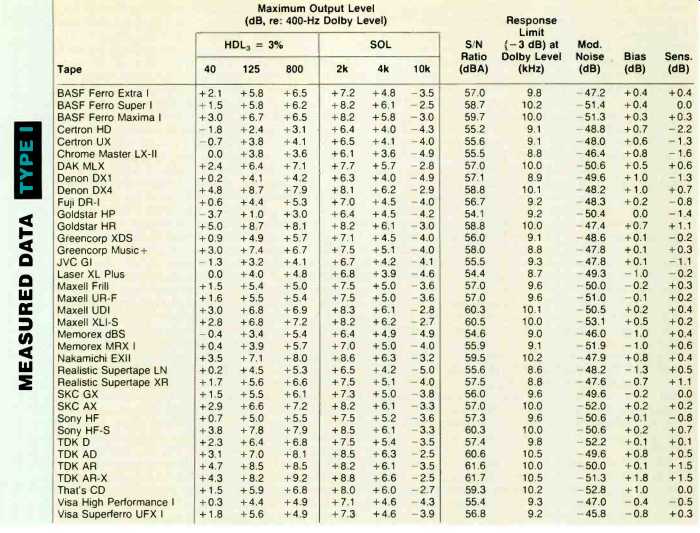
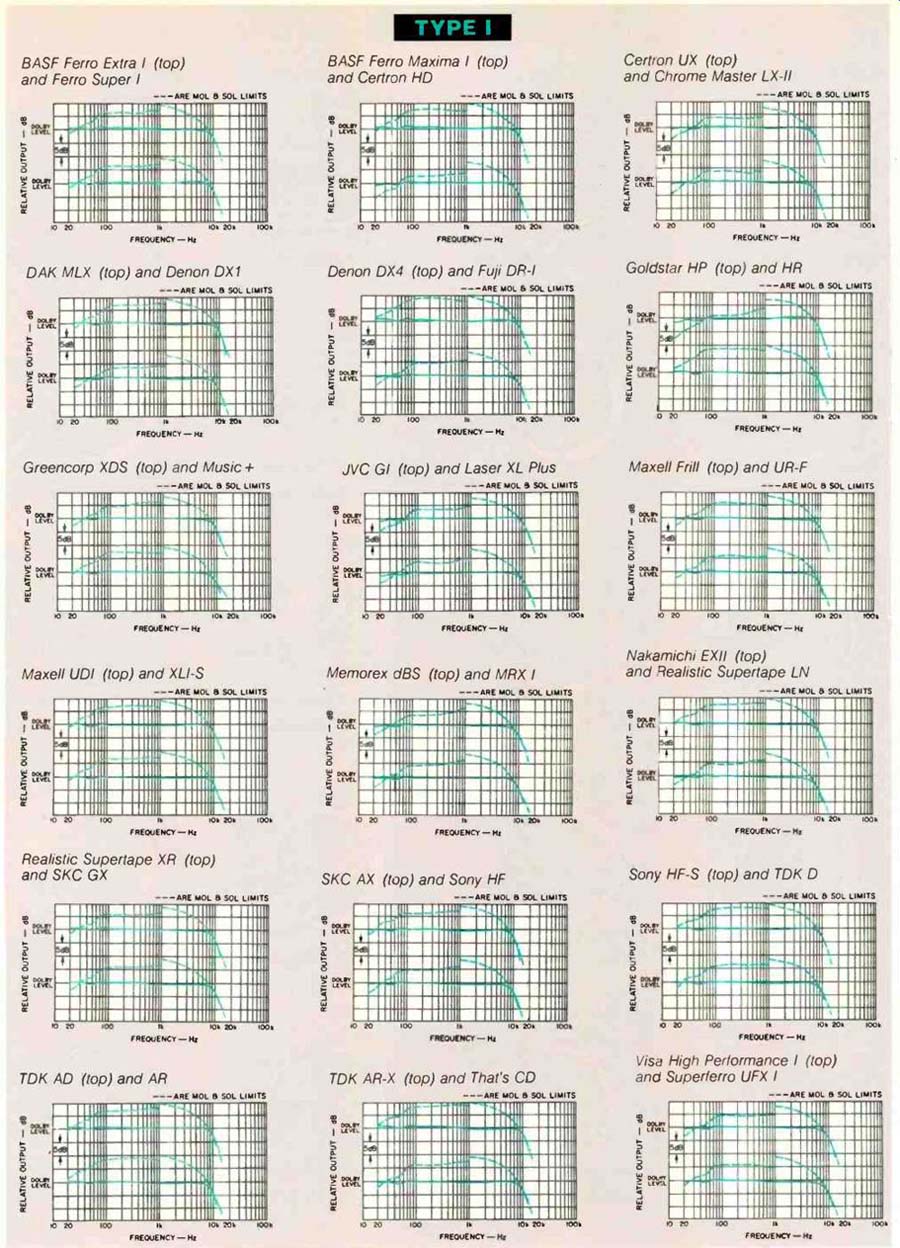
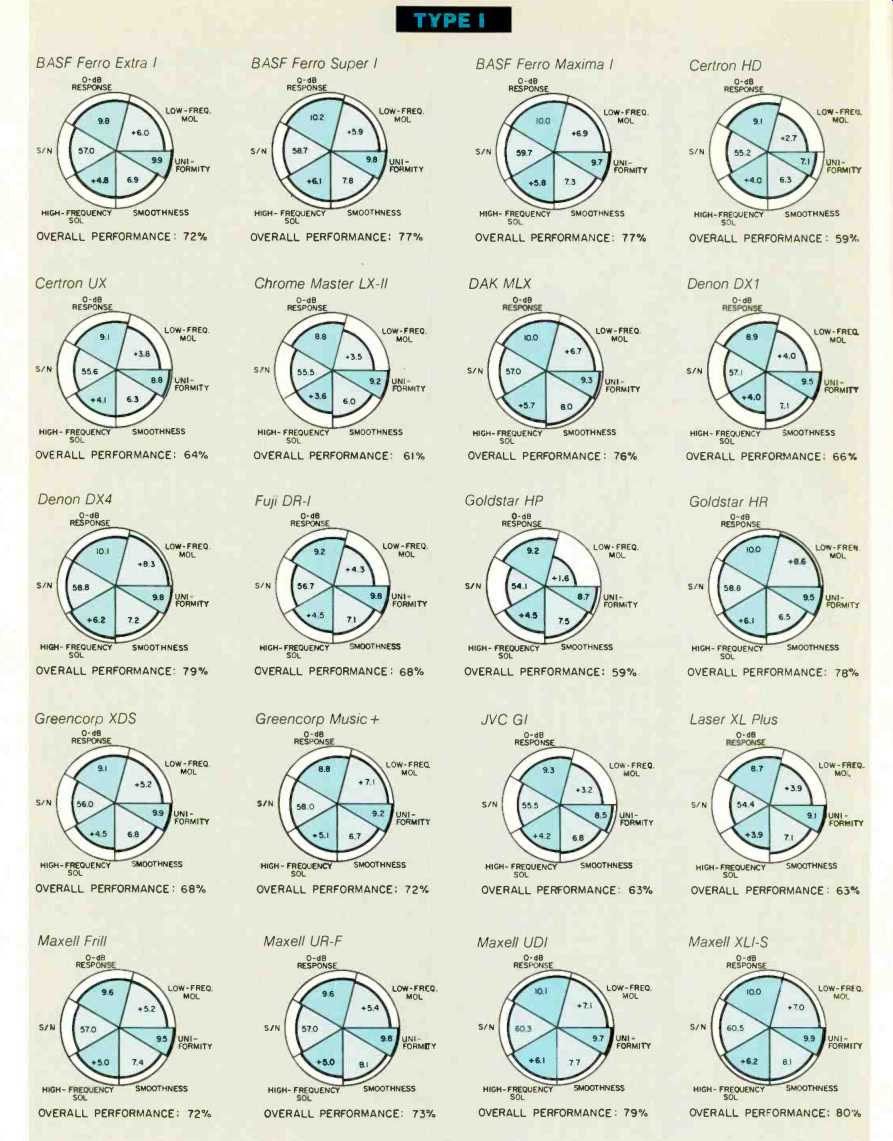
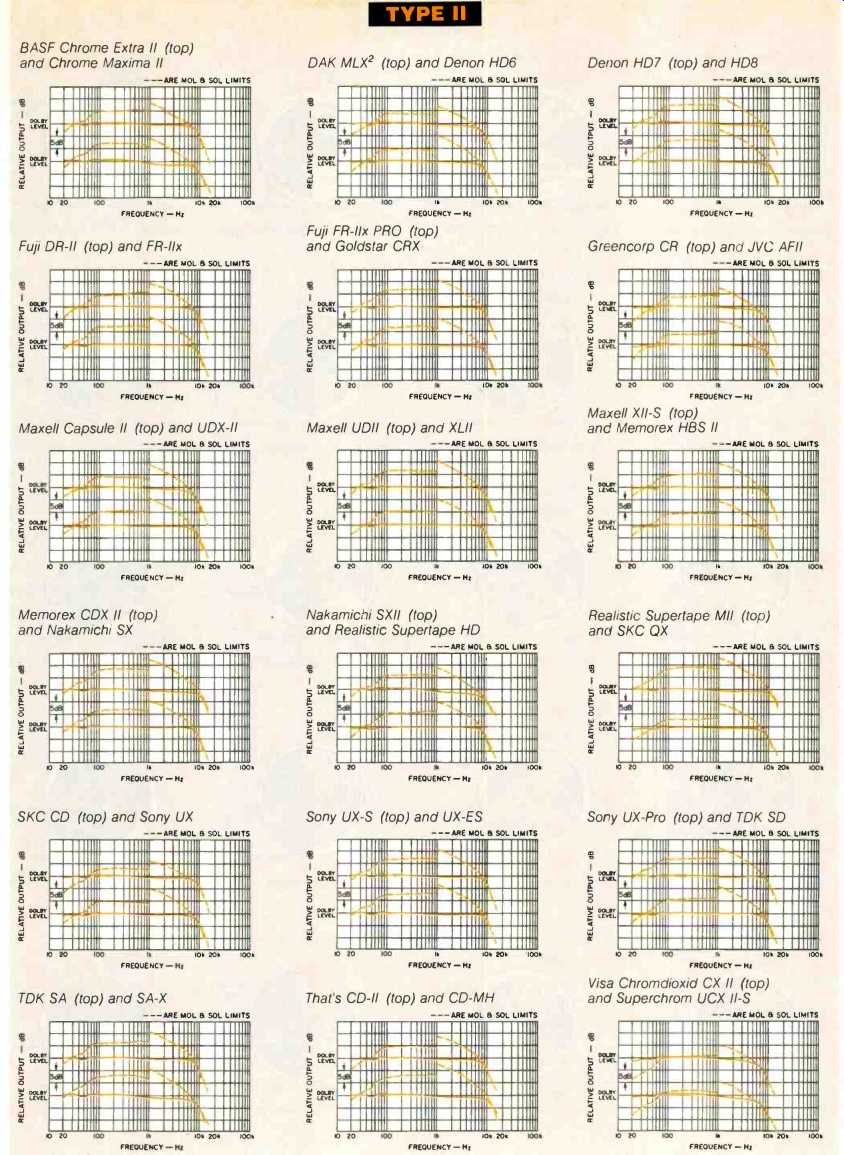
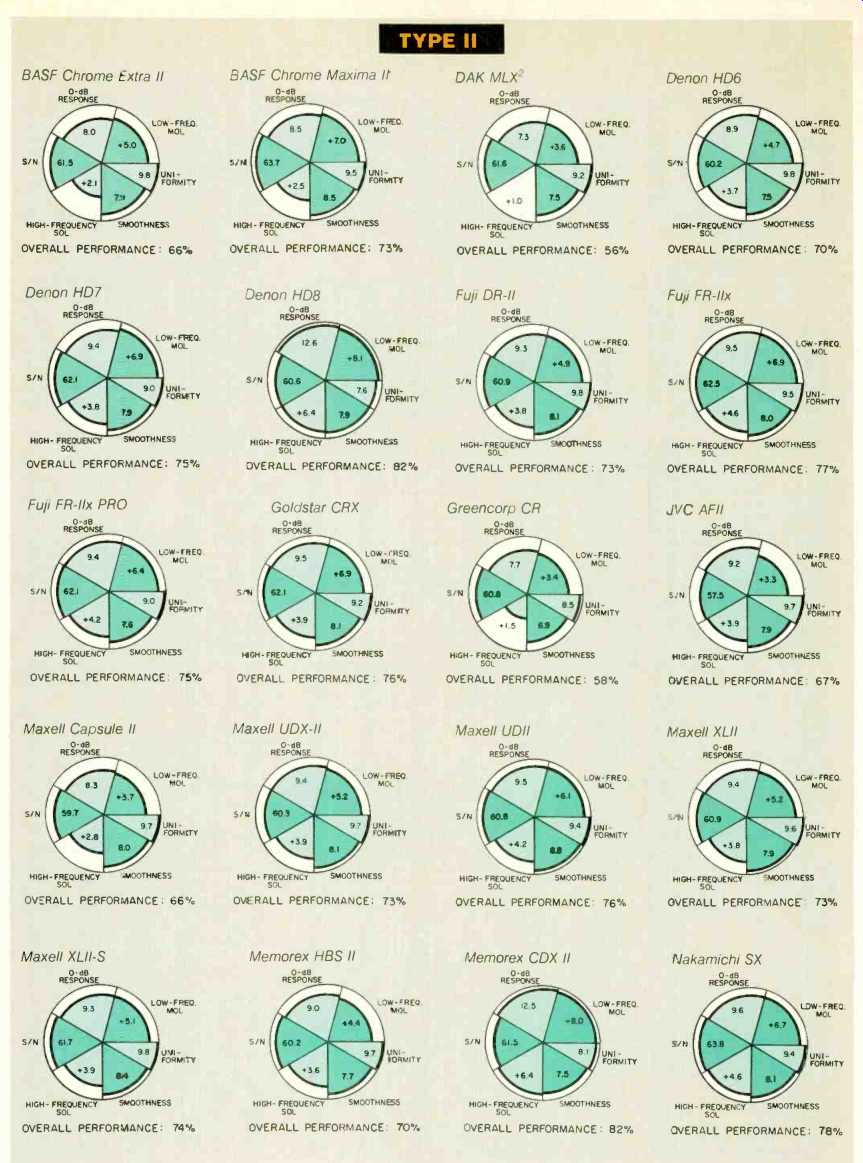
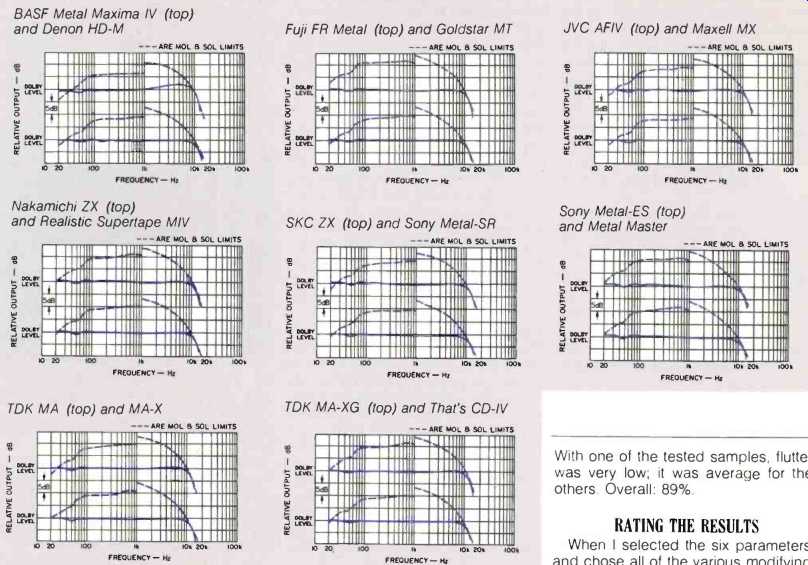
The survey presents measurements on each of the 88 tapes in tabular and graphic formats. The Tables summarize selected data. The rectangular graphs of frequency response at Dolby level show flatness, low-frequency compression, and high-frequency headroom (solid curves); the left-hand dashed curve on each of these graphs shows MOL, while the right-hand dashed curve shows SOL. The pie charts illustrate each tape's performance for MOL, SOL, and four additional parameters.
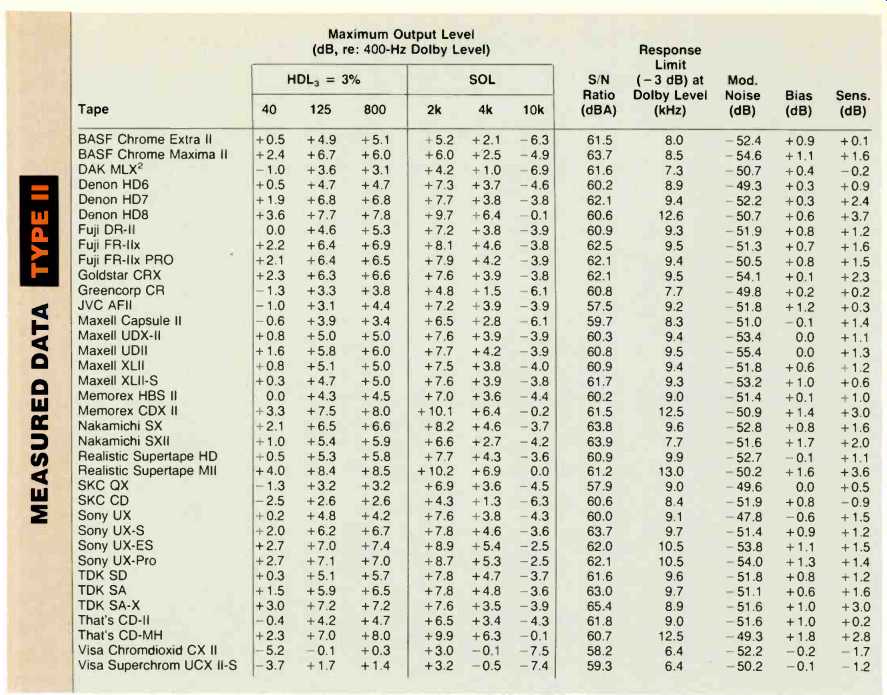
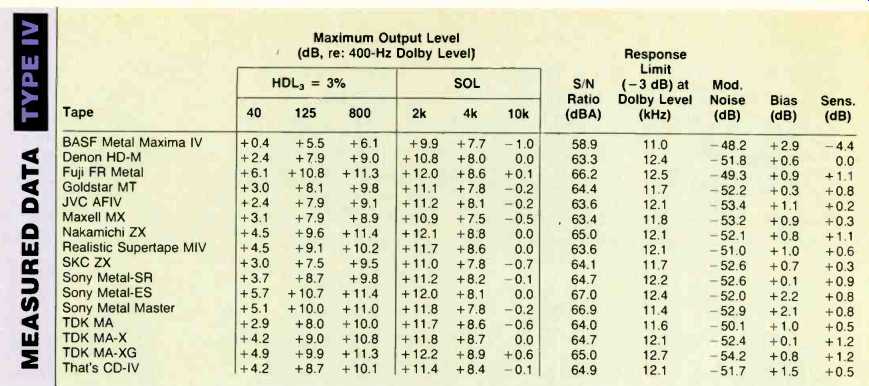
The three Tables list the MOL (3% distortion limit) at 40, 125, and 800 Hz.
I selected 40 Hz because it lies in a frequency region important in music for organ and other sources of low frequency energy. I picked 125 and 800 Hz because this range covers most of the area of generally flat music spectra. Also, most tape/recorder combinations reach their maximum MOLs in the same area.
When I examined the MOL data for all tapes, I determined that all the MOL curves were very similar if I normalized each to its 125-Hz level. The MOL at 125 Hz was a hinge point, as it were, with most MOL curves fairly level between that point and 800 Hz but sloping off much more rapidly below 125 Hz. I should note that some formulations have a noticeable drop in MOL from 800 Hz to 1 kHz: A 1-kHz figure in place of the 800-Hz reading could imply lower mid-band MOLs than actually measured.
The Tables also present SOL data for 2, 4, and 10 kHz. The SOL curves were very similar in shape, particularly within a tape type. When the curves were normalized to 4 kHz, the similarities were even more obvious.
The S/N ratios listed in the Tables are referenced to the MOL at 400 Hz, which is shown in the pie charts. The data for response limits in the Tables shows the frequencies at which output rolls off by 3 dB when recording at Dolby level. The Tables also list modulation noise from a high-level 1-kHz tone. The results given for bias and sensitivity are the averages of the bias and sensitivity values for both sides of all samples.
The Dolby-level response curves sweep from about 19 Hz to a high frequency point several decibels down, where I terminated the X-Y plotting by lifting the pen. I plotted the curves by hand from previously obtained data for MOL (from 20 Hz to 1 kHz) and for SOL (from 1 to 16 kHz). The falling response and SOL curves become coincident at around 10 kHz.
Some small discrepancies may appear in some graphs from hand plotting or because of small plotter shifts, particularly as I lifted the pen. The MOL and SOL curves on the response plots can be used to obtain MOL and SOL figures for frequencies not covered in the Tables. There is a fairly consistent difference between the SOL figures reported here and the 3% TTIM (twin tone intermodulation) distortion limit I have reported in the past. (Both TTIM and the third-harmonic distortion used for MOL are third-order distortions.) By deducting 4 dB from an SOL figure, you will obtain the TTIM limit within about 2 dB. The actual difference between the 1-kHz saturation output limit (SOL) and the lower, third-order distortion limit (MOL) is shown on every response plot.
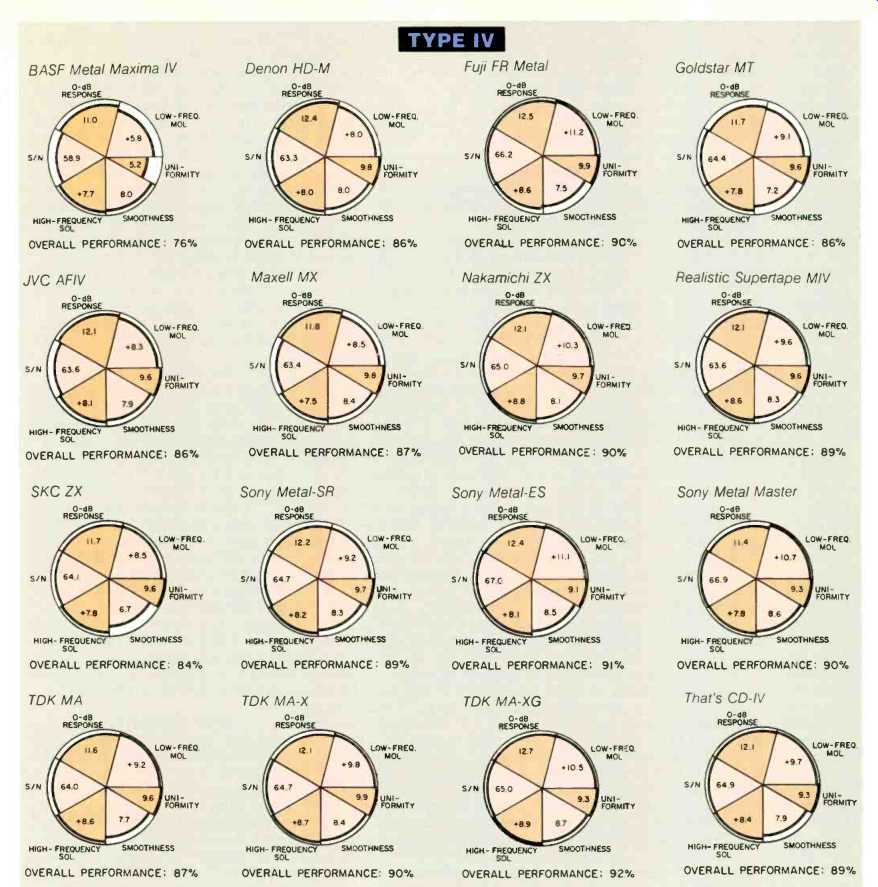
The pie charts are similar to those used in my last survey, but I have made some changes. Three of the six parameters are the same: The 400-Hz MOL ("Low-Freq. MOL"), the-3 dB point at Dolby level ("0-dB Response"), and the A-weighted "S/N." The new parameters are "Smoothness," "Uniformity," and 4-kHz SOL ("High-Frequency SOL"). All of these are self-explanatory except for "Smoothness" and "Uniformity." Since my last survey, I have tried to find better ways of reporting results without being misleading or making things too complicated. My "Smoothness" parameter does not refer to the quality of the tape surface but to various defects which roughen the sound, such as modulation noise, flutter, 3 kHz amplitude variations, and dropouts. "Uniformity" combines ratings for response flatness at-20 dB recording level, 10-kHz skew, deviations in bias and sensitivity from IEC reference, and the variation in bias and sensitivity between samples of a tape.
The angles of the pie segments were selected to correspond to he importance of the parameter. I picked 75° (20.8% of the circle) for 400-Hz MOL and 0-dB response; 60° (16.7%) for 4 kHz SOL, S/N ratio, and smoothness; and 30° (8.3%) for uniformity. In each segment, the shaded area shows the relative performance (in percent) of that tape. The formulas for each parameter are now logarithmic, giving less weight to differences between very good and excellent performance than to those between minimum and acceptable. For example, a 2-dB rise in MOL is given more weight when it increases MOL from 0 dB (Dolby level) to a more useful +2 dB than when it increases MOL from +6 (which is already good) to +8 dB. The total performance figure is the sum of the six parameter percentages, all properly weighted to match their respective contributions (angles). The numbers within each pie segment represent actual measured performance rather than percentage ratings. In "Low-Freq. MOL," the range from 0 to 100% corresponds to levels from +0.3 to + 12 dB. For "0-dB Response," the range is from 4.2 to 15 kHz. The "S/N" range is from 52 to 70 dBA. For "High-Frequency SOL," the range is from 0 to + 10 dB. "Smoothness" and "Uniformity" have numerical ratings from 0 to 10 (0 to 100%), where 10 equals perfect performance.
The brief comments on each of the tapes are arranged alphabetically by brand within tape types. Most of these formulations showed good smoothness and very good uniformity, so no details are given on these parameters unless something was particularly good-or bad.
TYPE I TAPES
Type I tapes can have fairly high MOLs up to 1 kHz or so. Although they do not have high SOLs at the highest frequencies or really extended response at 0 dB, they are nonetheless better than many Type II tapes in these regards. The best-performing Type I tapes, with 400-Hz MOLs of +6 dB or more, have S/N ratios that are a match
for many Type II tapes. The average Type II overall performance rating is 72, and the maximum rating any Type I tape earned was 82%; these tapes' parameter figures (except for smoothness and uniformity) cannot match those of Type IV tapes. Comments on relative performance consider only the 36 Type I tapes, unless stated otherwise.
BASF Ferro Extra I: The performance is well balanced among the various parameters, but lower modulation noise and reduced amplitude variation at 3 kHz would be desirable. Overall, a rating of 72%. BASF Ferro Super I: Improved performance over Ferro Extra I was provided in SOLs, S/N ratio, and 0-dB response.
Smoothness is better because of lower modulation noise. Overall: 77%, well above average.
BASF Ferro Maxima I: Small differences from Ferro Super I can be seen in the Table and the pie charts. Its MOLs and S/N were higher, its SOLs a little lower. Overall: 77%, well above average.
Certron HD: The low MOLs are obvious, particularly the-1.8 dB at 40 Hz.
Notice that tape saturation below 60 Hz pulled the response curve down.
The 59% rating is tied for the lowest for Type I. Certron UX: Its MOLs are better than HD's, but compression is still apparent at the lowest frequencies. Uniformity is also better, helping to bring the overall rating up to 64%, still noticeably lower than the Type I average.
Chrome Master LX-II: Compression at the lowest frequencies shows in the response plot. Performance is undistinguished in all parameters. Overall: 61%, rather poor.
DAK MLX: The tape had good performance in MOLs, SOLs, S/N, and 0-dB response. Flutter was lower than with most other cassettes. Overall, a well above-average rating of 76%. Denon DX1: The response plot shows compression at low frequencies. The uniformity was good, but other parameters were relatively poor, leading to a below-average rating of 66%. Denon DX4: Compared to DX1, this formulation showed very significant improvement in most parameters, particularly MOLs and SOLs. Flutter was lower than with most other tapes. The high rating of 79% is excelled by just five of the other 35 Type I cassettes.
Fuji DR-I: Compression at low frequencies shows in the response plot, while amplitude stability at 3 kHz was excellent. Generally below-average results led to a rating of 68%. Goldstar HP: Its 40-Hz MOL, the lowest of these Type I tapes, is related to the very noticeable compression below 60 Hz. Modulation noise was fairly low, but its level varied widely with time.
 .
.
The pie chart calls attention to the 400 Hz MOL and S/N figures, which contribute to the tied-for-worst overall rating of 59%. Goldstar HR: The results were quite good for most parameters, providing a significant improvement over HP. Smoothness was not very good, however, primarily because of the relatively high modulation noise. Overall, the rating is a far-above-average 78%, bettered by only seven Type I tapes.
Greencorp XDS: In general, the performance was well balanced. Slight compression appears at the lowest frequencies. The below-average results for most parameters add up to a 68% rating.
Greencorp Music + : Improvements over XDS were obtained in MOLs, SOLs, and S/N ratio. Uniformity was slightly lower than with XDS because of the measurable 10-kHz skew.
Overall: 72%. JVC GI: Compression at low frequencies is apparent. Low MOLs and S/N, in combination with so-so performance in other areas, result in a rating of 63%. Laser XL Plus: With the exception of good uniformity and low flutter, performance is poor in all areas. The overall rating earned is 63%, near bottom for Type I cassettes.
Maxell Frill: This C-46 tape, marketed to young people, delivers a fairly consistent level of performance. Slight compression showed at the lowest frequencies. Measured flutter was noticeably lower than for most other cassettes. Overall: 72%. Maxell UR-F: Because the Frill and URF formulations are basically the same, it was not surprising to see a close match in performance. Flutter was lower than for most other cassettes, and smoothness and uniformity were good.
Overall: 73%. Maxell UDI: Performance was good in all areas. Flutter was lower than for most other cassettes. With no weak areas, UDI delivers a high rating of 79%, exceeded by only five other Type I cassettes.
Maxell XLI-S: Performance was fine n all areas. Flutter was lower than for many other cassettes, and modulation noise was the lowest of all Type I tapes. The high rating of 80% is surpassed by only two other Type I tapes.
Memorex dBS: The low MOLs are reflected in the compression below 60 Hz. The high modulation noise caused a relatively low smoothness rating.
Flutter was lower than for many other cassettes, but performance in other areas resulted in a low 65% rating.
Memorex MRX I: This formulation delivered small but worthwhile improvements over dBS. The MRX I did have a noticeably lower level of modulation noise, and the compression was less.
Flutter was lower than average. Overall: 70%, only slightly below the Type I average.
Nakamichi EXII: Good performance was obtained in all areas, as shown in the Table, response plot, and pie chart. Smoothness was slightly low because of some 3-kHz amplitude variations and slight skew. Overall, a far above-average rating of 78%. Realistic Supertape LN: The performance is fairly well balanced but at a relatively low level. Slight compression is evident at the lowest frequencies.
The rating is 66%, below average.
Realistic Supertape XR: Performance in most areas was better than that of LN. The virtual elimination of that tape's low-frequency compression is certainly notable. Supertape XR's flutter was lower than that of many other cassettes, but some dropouts approached audibility. Overall: 71%. SKC GX: Performance was average in all areas with the exceptions that S/N was slightly poorer and flutter was slightly better in comparison to other Type I cassettes. Overall: 72%. SKC AX: In comparison to GX, the performance showed worthwhile, albeit slight, improvements in almost all parameters. The result: AX gets an overall rating of 76%, well above average.
Sony HF: Performance was average in most areas. The relatively low MOLs caused slight compression at the lowest frequencies. Overall: 72%. Sony HF-S: The listing in the Table demonstrates how much better this tape's MOL, SOL, and S/N performances were than those of HF. The better results with HF-S are also apparent in the response plot and pie chart.
The high overall rating of 80% is bested by only two other Type I tapes.
TDK D: Performance was good in most areas. The S/N ratio wasn't impressive.
but the modulation noise was low and steady, a desirable attribute. Flutter was lower than for many cassettes.
Overall: 76%, well above average.
TDK AD: Definite improvements over TDK D appeared in MOLs, 0-dB response, S/N, and SOL. The 10.5-kHz response limit was the best figure obtained for a Type I tape (matched by TDK AR-X). Smoothness was not as good as for D, due to higher modulation noise and slightly deeper dropouts. The high overall rating of 80% is surpassed by just two other Type I tapes.
TDK AR: The MOLs were the highest of all 36 Type I cassettes, and performance in other areas was at least good. Modulation noise was fairly low and was steady in level. Flutter was lower than for many other cassettes.
The overall rating is a high 81%, surpassed by just one other Type I tape.
TDK AR-X: The SOLs were the highest of all 36 Type I tapes, and performance in other areas was at least good. The 10.5-kHz response limit was the best for a Type I tape (matched by TDK AD). Modulation noise was low and steady in level. Flutter was lower than average. The high overall rating of 82% is the highest for all Type I tapes-in fact, it is close to the best for Type II tapes as well.
That's CD: In general, performance was good in all areas. Just slight compression appeared at the lowest frequencies. Modulation noise was low and steady in level, helping to make smoothness very good, the best for all Type I tapes. Overall: 78%, far above average.
Visa High Performance I: The MOLs were somewhat low, and low-frequency compression was obvious. Modulation noise was somewhat high and minor dropouts were frequent. leading to a smoothness rating that is poorer than average. Flutter was lower than for many other cassettes. Overall, a well below-average rating of 67%. Visa Superferro UFX I: The higher MOLs of this formulation reduced the low-frequency compression. Modulation noise was high and minor dropouts were rather common, making for a poor smoothness rating. The below average overall rating of 68% is the net result.
TYPE II TAPES
Many Type II tapes have relatively low SOLs at the higher frequencies, but they usually have higher SIN ratios than Type I formulations. Most Type II tapes also have poorer 0-dB response than the Type I tapes. The fundamental
reasons for all three characteristics are that the greater high-frequency boost in record equalization used with Type II tapes increases the high-frequency saturation (causing poorer SOL and response), while the complementary equalization used in playback results in greater reduction of tape noise (causing better S/N) than with Type I tapes. The average Type II overall rating is 71%. The maximum rating any Type II tape earned was 84%, and Type II tapes' parameter figures (particularly those for 400-Hz MOL, S/N ratio, and 4-kHz SOL) cannot match those for Type IV tapes. Comments on relative performance consider only the 36 Type II cassettes, unless stated otherwise.
BASF Chrome Extra II: Its moderate MOLs were reflected in slight compression at the lowest frequencies.
Low SOLs and somewhat restricted 0 dB response contribute further to its below-average rating of 66%. BASF Chrome Maxima II: This formulation was better than Chrome Extra II in MOLs, 0-dB response, S/N, and modulation noise, although SOLs remained low. Overall: 73%. DAK MLX2: Performance is limited in substantially all areas, especially with low MOLs and SOLs and poor 0-dB response. Flutter was erratic-sometimes quite low, sometimes higher than average. Overall, a rather poor rating of 56%. Denon HD6: Moderate MOLs resulted in slight compression at the lowest frequencies. Performance in other areas was generally average. Overall: 70%. Denon HD7: Improvements over HD6 emerged in substantially all areas.
Modulation noise was fairly low and steady in level. Dropouts were low in value and merely occasional--one of the better results. Overall: 75%. Denon HD8: This unusual formulation provided a balanced, good performance-particularly evident when its pie chart is compared to others. The 0 dB response was second best for Type IIs and Type IVs. The uniformity rating was low because of the very high sensitivity and a response peak near 20 kHz at-20 dB record/playback level.
The high overall rating is 82%, exceeded by just one other .Type II cassette in this survey.
Fuji DR-II: The performance was fairly well balanced, though not impressive.
Somewhat low MOLs caused some compression at the lowest frequencies. Flutter was low; indeed, it was among the best for all tapes covered in this survey. Overall: 73%. Fuji FR-IIx: Worthwhile improvements were shown over DR-11 in higher MOLs and SOLs, better 0-dB response, and higher S/N ratio. Modulation noise was fairly low and very steady in level.
Overall: 77%, well above average.
Fuji FR-IIx PRO: This tape is very close to FR-IIx magnetically, and the two tapes' performances differed very little.
The FR-IIx PRO produced slightly higher modulation noise, but it was steady in level. The small differences led to a slightly lower rating of 75%-still above average.
Goldstar CRX: Performance was fairly well balanced, with the exception of the relatively low SOL rating, characteristic of many Type II tapes. The modulation noise was low and steady in level. Overall: 76%. Greencorp CR: Low MOLs caused compression at the lowest frequencies, SOLs were quite low, and the 0 dB response was among the more limited ones. The tape did not get a high smoothness rating because it had more dropouts than average and occasional high flutter. High skew affected the uniformity rating. The overall rating is a rather poor 58%. JVC AFII: The low MOLs caused obvious compression below 60 Hz. S/N ratio was the poorest for a Type II tape, yet flutter was better than for many other cassettes. Overall: 67%. Maxell Capsule II: In most areas, the performance was just a bit below average. Compression occurred at the lowest frequencies because of the low MOLs. Modulation noise was fairly low and steady in level. Flutter was one of the lowest for all tapes. Overall: 66%. Maxell UDX-11: This formulation had higher MOLs and SOLs, more extended 0-dB response, and lower modulation noise than Capsule II. Flutter was just average, however. The net result is a just-above-average overall performance rating of 73%. Maxell UDII: Moving up a notch in Maxell's line brought further improvements in all major parameters. Uniformity was slightly lower because of high sensitivity. Dropouts were low in value and just occasional; UDII is one of the best formulations in this regard. Overall, an above-average rating of 76%. Maxell XLII: The results were a lot like those for UDX-II. For most parameters, there was very little reason to prefer one over the other. The modulation noise was fairly low and steady in level.
Overall: 73%. Maxell XLII-S: The results were also very close to those for UDX-II. The XLII-S delivered a higher S/N ratio, always beneficial. The modulation noise was low and steady in value; dropouts were few and minor. Overall: 74%. Memorex HBS II: The MOLs were low enough to cause compression at lower frequencies, and SOLs were somewhat low. Other results were average.
Overall: 70%. Memorex CDX II: High MOLs and SOLs delivered uncommon and desirable performance for a Type II tape.
The 0-dB response is well extended and bettered by only three out of all 88 tapes. Higher bias requirements and sensitivity than in the IEC reference tape reduce the uniformity rating. The high overall rating of 82% is bettered by only one Type II tape.
Nakamichi SX: MOLs and SOLs are good, and S/N is better than most.
Modulation noise is fairly low and has a steady level. The combination earns an overall rating of 78%, one of the better scores for Type II tapes.
Nakamichi SXII: The S/N ratio is almost the same as for SX, but everything else is poorer. The reduction in 0-dB response and SOL levels is most obvious. The overall rating is 69%, slightly lower than average for Type IIs.
Realistic Supertape HD: Performance is generally above average, but low MOLs cause some compression at the lowest frequencies. The 0-dB response is quite good, and the modulation noise low. Overall: 75%. Realistic Supertape MII: I wouldn't have thought of Radio Shack as the source of the formulation with the highest Type II MOLs and SOLs, but it's true! The 0-dB response was the most extended of all tapes, including Type IVs. Modulation noise was not particularly low, but it was steady. Uniformity was reduced by high bias, high sensitivity, and a response peak near 20 kHz at-20 dB. The overall rating is 84%, the best for all Type I and II tapes.
SKC QX: Low MOLs are reflected in the noticeable compression below 60 Hz. Most of the other results were below average. Overall: 66%. SKC CD: Lower MOLs and SOLs in comparison to OX were not expected, but the pie charts emphasize the difference. Compression at the lowest frequencies, however, was actually less.
Modulation noise was steady and fairly low, and dropouts were minimal. Overall: 59%. Sony UX: The lowest ranked sample of Sony's Type II line showed compression effects at low frequencies from the low MOLs. The SOLs, while relatively better, were just average. Smoothness was not very good because of high modulation noise and many small dropouts. Overall: 69%. Sony UX-S: Improvements over UX in MOLs, SOLs, 0-dB response, and S/N made this tape much more impressive.
Smoothness was better because of lower modulation noise and very few dropouts. Overall, a good performance rating of 77%. Sony UX-ES: This formulation gave still better performance in MOLs, SOLs, 0 dB response, modulation noise, uniformity, and overall smoothness. The S/N ratio was a bit poorer than for UX. The high overall rating was 81%, exceeded by only three Type II tapes.
Sony UX-Pro: Because this formulation and UX-ES are substantially the same, it is not surprising that their performances matched. Small differences in a couple of the figures dropped UX Pro's rating 1%, but it's still a high 80%. TDK SD: The MOLs were rather low at the lowest frequencies, and compression appears in the response plot. Other parameters were average or above.
Modulation noise was steady. Overall, a 75% rating.
TDK SA: Moving up one position in the TDK Type II line secures some improvement in MOLs and a worthwhile increase in S/N ratio. Uniformity was slightly less because of high sensitivity. The net result was a higher overall rating of 77%, which is good.
TDK SA-X: This tape provided high MOLs and a high S/N ratio-the highest for Type I and II tapes. In fact, S/N is higher than for many Type IV tapes.
The SOL and 0-dB response results, however, were not as good. This tape's overall rating is 76%. That's CD-II: The low MOLs caused compression at low frequencies, and the SOLs were just fair. Other parameters were average or slightly above.
Overall: 71%. That's CD-MH: This Type II formulation had significantly better MOLs, SOLs, and 0-dB response than CD-II. Its S/N ratio, however, was slightly lower and its modulation noise about 2 dB higher.
The uniformity rating was also noticeably lower because of higher bias requirements and sensitivity than the IEC reference, and a response peak near 20 kHz at-20 dB. Even so, CD-MH's overall rating is a high 81%, surpassed by just three other Type II tapes.
Visa Chromdioxid CX II: Very poor MOLs caused obvious compression below 70 Hz. SOLs were also very low; in fact, the 4-kHz SOL was so low that no shading appears on the pie chart.
The 0-dB response was the poorest for all 88 tapes, matched only by the other Visa tape. Overall: 41%, lowest in the survey.
Visa Superchrom UCX II-S: This Visa formulation showed slightly improved MOLs and a 1-dB increase in S/N ratio.
Low-frequency compression was reduced, but modulation noise was actually higher. Although flutter was on the low side, smoothness was affected negatively by poor dropout performance. The overall rating was 48%, second lowest of all tapes.

TYPE IV TAPES
The better metal-particle Type IV tapes stand out as the best overall performers, primarily because of their very high MOLs and reduced high-frequency saturation (which yields greater response extension at 0 dB). Signal-to-noise ratios have been improved since Type IV tapes first appeared, which has increased their advantage even more. With the proliferation of CDs as sources, both at home and via broadcast. performance at the high frequency end has become more critical. Thus, metal-particle tapes are of ever greater interest to the serious recordist. The average Type IV overall rating is 88%; the highest is 92%. My comments on relative performance consider only these 16 tapes, unless stated otherwise.
BASF Metal Maxima IV: The C-120 length of this cassette does offer some possible advantages. I had difficulty, however, setting bias for a flat response at-20 dB. Even with close-to maximum bias from the deck, the response was up 5.3 dB at 10 kHz and up 9 dB at 20 kHz. Lower frequencies were very much over-biased. The 0-dB response shows evidence of the high frequency peaking. Tests on other decks confirmed the excessive output at higher frequencies with any normal amount of bias. Relatively low MOLs and S/N, along with poor uniformity, resulted in poor overall performance.
Uniformity was low because of very high bias and very low sensitivity. Flutter was lower than for most other tapes. Overall, a 76% rating, lowest for Type IV tapes.
Denon HD-M: High MOLs and SOLs, extended response, and good S/N characterize this average Type IV tape. Modulation noise was fairly low and smooth in character. Overall: 86%. Fuji FR Metal: Very high MOLs and SOLs, the third-best S/N, and extended 0-dB response make for one of the best Type IV tapes. The smoothness suffered a bit from the relatively high modulation noise. Overall, a tied-for third rating of 90%. Goldstar MT: High MOLs and SOLs and a good S/N are among the desirable properties shown. The modulation noise was low and steady, but smoothness suffered from somewhat high flutter and some dropouts. Overall: 86%. JVC AFIV: High MOLs and SOLs, extended 0-dB response, and low modulation noise are features of this Type IV tape. Smoothness was helped by low flutter but was hurt more by some dropouts. Overall: 86%. Maxell MX: The high MOLs and SOLs were typical for Type IV tapes. Modulation noise was low and steady and flutter was quite low, both contributing to a good smoothness rating and the overall rating of 87%. Nakamichi ZX: Very high MOLs and SOLs, good 0-dB response, and a high S/N ratio made a good combination.
The modulation noise was low and steady, but minor dropouts appeared occasionally. Overall, a tied-for-third rating of 90%. Realistic Supertape MIV: The nice, high MOLs and SOLs and a well-extended response are above average for Type IV tapes. The S/N ratio is quite good and the modulation noise smooth, albeit not very low. Overall, a rating of 89%. SKC ZX: MOLs and SOLs were fairly high but below average for metal-particle tapes. The 0-dB response was not as extended as for many Type IVs. The S/N ratio was good and the modulation noise low and steady. High flutter and poor dropout performance, however, caused a low smoothness rating. Overall: 84%. Sony Metal-SR: The high ratings for MOLs and SOLs were a bit of a surprise for a tape introduced as a low-cost option. The S/N ratio and 0-dB response were also good, and modulation noise was low and steady. Overall, a rating of 89%. Sony Metal-ES: Very high MOLs and SOLs combine with the best S/N ratio and a well-extended 0-dB response to make a very well-performing tape. Low and steady modulation noise and below-average flutter are additional pluses. Overall, Metal-ES receives a next to-best rating of 91%. Sony Metal Master: I expected the same performance as with Metal-ES, but I got very slightly poorer MOLs and SOLs-still very high. The S/N ratio was within 0.1 dB. The 0-dB response was not as extended (by 1 kHz), but modulation noise was slightly lower.
Overall, the performance rating dropped 1%, to 90%, tying this tape for third best.
TDK MA: Quite high MOLs and very high SOLs make a good combination, but the 0-dB response is not well extended for a Type IV tape. Relatively high, if steady, modulation noise lowered the smoothness rating. Overall, its rating is 87%. TDK MA-X: Quite high MOLs and very high SOLs are combined with good response. The S/N ratio is improved over MA; modulation noise is lower, and also steady. Overall, tied for third at 90%. TDK MA-XG: Very high MOLs and the best SOLs make a potent combination, especially with the addition of a good S/N ratio and the most extended response of all Type IV tapes. Modulation noise was also one of the lowest measured, and it was steady in level.
Flutter was lower than for most tapes.
Overall, at 92%, the best of all 88 tapes.
That's CD-IV: MOLs and SOLs were quite high, and the response extension and S/N ratio were both rather good. With one of the tested samples, flutter was very low; it was average for the others. Overall: 89%.
RATING THE RESULTS
When I selected the six parameters and chose all of the various modifying factors, I certainly believed Type IV tapes would have the highest ratings. I thought Type II tapes might edge out the Type I tapes, primarily because of their higher signal-to-noise ratios. In fact, the average overall performance figure was 72% for Type Is and 71% Q for Type IIs, substantially the same. This is an unimportant difference, to be sure, particularly compared to the 88% figure for the average Type IV. The Type I tapes were generally superior to the Type Its in 400-Hz MOL, 0-dB response, and 4-kHz SOL. The Type IIs were usually superior to Type Is in signal-to-noise ratio and modulation noise. The Type IVs were superior to both other types in all of the above areas most of the time. Keep in mind that these comparisons are of the average results for each tape type. In deciding what tapes you should use, comparisons must still be made between specific tapes.
Do the high-rated formulations sound better on decks other than the Nakamichi 582? I compared the above results (for quite a few tapes) with results obtained using the Nakamichi CR-7A, Akai GX-R99, and Kenwood KX-660HX decks. There were differences from deck to deck, such as noticeably lower MOLs and SOLs and less extended responses on the Akai (and even more so on the Kenwood). The response rises near 20 kHz were nearly the same on the CR-7A as on the Nakamichi 582 that I used for the main tests, but they were lower on the Akai and lower still on the Kenwood.
Skew was less on the Akai (whose record and playback heads share a single housing) and was not a factor on the two-head Kenwood. (Low-skew cassettes should be of interest, however, to anyone who records on one deck and plays back on another.) Despite these differences, the relative rankings of the tapes remained the same, within a small margin of error, on all decks. Based on some of the results, one tape should not be chosen over another just because of a 1% or 2% performance difference. Also, the ratings were based solely on measured performance, ignoring price and the convenience or apparent quality of the boxes, labels, and shells. I was unable to measure some of the claimed advantages of certain shells, such as reduced vibration.
I do recommend a careful review of the data if a change in tape is considered. Give particular thought to the type of music to be recorded. Tapes that showed compression at the lowest frequencies would be bad choices in general but particularly so for organ music and disco (to say nothing of cannon shots). Recording with dbx NR will be most successful if the tape has no such compression. Music with obvious cymbal crashes, synthesizers, etc.
will not record well on Type II tapes that have poor SOLs unless the recording level is kept low. This would be possible with those formulations whose low noise permits reducing the level with little compromise (see "How Hot Are CDs?" July 1989). Type IV tapes, with their superior performance, do yield recordings that are better and easier to make.
My own approach to setting record levels is to make them as high as I can without causing any distortion detectable by careful listening. I know some recordists prefer to approach the problem by setting levels to get the softest passages above the noise level. My own experience is that it's more difficult to find the softest section than the loudest. It is also quite possible that levels set for the softest passages will be too high for the peaks. The majority of critical listeners I know comment on sonic problems caused by high levels, such as harshness, brittleness, and muddiness. Little is said, in general, when the S/N ratio is not quite what is wanted in a quiet passage.
FURTHER CHECKS
To get a better sense of what would happen when using lower priced decks that do not have adjustable bias, I made record/playback responses with the Kenwood KX-660HX, Teac V-500X, and Technics RS-B48R decks.
I left the Kenwood's bias trim pot in its center detent; the other two decks do not have front-panel bias adjustments.
All decks were operated with Dolby C NR to intentionally exaggerate any discrepancies in bias and/or sensitivity between the deck settings and the needs of the selected tapes. I picked tapes of each type that fell into three groups-those with just about the same bias and sensitivity as the IEC reference for their type, those with close-to-reference sensitivity but a 1 dB greater bias requirement, and those with high bias requirements and sensitivity as compared to the IEC reference. The selected tapes were TDK D, Greencorp CR, and Denon HD-M for the first group; That's CD, BASF Chrome Extra II, and Maxell MX for the second group; and TDK AR-X, Memorex CDX II, and Sony Metal-ES for the third group.
The TDK D was an excellent match for the Kenwood deck, but That's CD was not, and the TDK AR-X had excessive boost at the highest frequencies (even at high levels). Greencorp CR and Maxell MX were the best matches for the Kenwood among the Type II and IV tapes, and the other tapes were reasonably good with the Kenwood deck. The Teac V-500X was quite good with TDK AR-X but had terrible droop with TDK D. All the Type II tapes rolled off to some extent on the Teac, but Sony Metal-ES was a good tape for this deck. The Technics deck had good response with TDK D, excessive high-frequency boost with That's CD, and enormous boost with TDK AR-X. Greencorp CR's response was nice and flat on this deck, and Memorex CDX II had excessive boost-which was no surprise, considering its high bias requirement. All Type IV tapes exhibited treble boost with this deck, and I noted fantastic boost with Sony Metal ES. So even on inexpensive decks, these bias and sensitivity differences may cause response deviations, which Dolby C NR would usually exaggerate.
A play-trim control designed to Dolby Labs' requirements can eliminate this exaggeration.
The C-90 length was the de facto standard for all the main evaluations, but I wondered what the results would be if one of the new lengths was used.
To check this, I tried tapes in the C-75 range (including some C-74 and C-76 cassettes), as well as C-100 and C-110 tapes, from Denon, Fuji, Goldstar, Maxell, Memorex, Sony, TDK, and That's. I also checked BASF Chrome Extra II in C-120, though this is not really a new length.
I ran my bias and sensitivity checks for these tape lengths at the same time I tested the C-90s, to make sure of consistent results when comparing lengths. I also checked to see if the new-length samples had the same skew. In the majority of cases there was, fortunately, very little difference in bias, sensitivity, or skew between different lengths of the same tape. Most of the tapes were very close to each other, including Denon HD6 and HD-M (C-75s and C-100s) and HD8 (C-100); Fuji FR-IIx PRO (C-74); Maxell XLII, XLII-S, and MX (C-100s); Memorex HBS II (C-76 and C-100); Sony Metal SR (C-100); TDK SA (C-76 and C-100) and MA in the C-110 length (actually an exact match to the C-90 version's bias, sensitivity, and skew); and the C74 lengths of That's CD-II, CD-MH, and CD-IV. Goldstar's CRX tapes were rather puzzling, as the C-76s had higher bias and much lower sensitivity than the C-90s, while the C-100s had much lower bias. Denon's HD8 in C-75 had somewhat higher bias and lower sensitivity than in C-90. I also compared the new lengths to the C-90s for 125-Hz MOL, 4-kHz SOL, and 0-dB response. In general, little or nothing was lost by using a new length; in some cases, slight improvements accrued. Most of the C-100s did show a small loss in 125-Hz MOL. Goldstar CRX in C-75 and C-100 lengths had noticeable losses in performance for all parameters, making me wonder if the new-length cassettes were really the same actual formulation as the C-90s. The Maxell XLII, XLII-S, and MX in C-100s, and That's CD-II in C-74 and C-100, had greater 4-kHz SOLs and slightly better 0-dB responses. The response of TDK MA in C-110 improved by 1 kHz. In C-74, That's CD IV had higher 125-Hz MOL and slightly better 0-dB response.
I wondered what the so-called real-time counters on my decks would show with the new lengths and therefore used some of these tapes on the Nakamichi CR-7A, the Akai GX-R99, and the Kenwood KX-660HX. The first two decks display both elapsed and remaining time, and the Kenwood displays just elapsed time; all three retain basic time calibrations during fast winds. Many counters that show elapsed or remaining time require the user to select a setting for the particular length, so I set the Nakamichi and Akai decks for C-90 tapes. The Nakamichi showed 46 to 47 minutes remaining at the start of play after the initial calibration for all new lengths, from C74 to C-110. At the end of each tape, the deck displayed about 47 minutes elapsed, with the exception of 39:13 for the C-75 tape. The Akai showed remaining times of from 35:30 to 39:10 for the C-74 to C-76 tapes, 45:03 for C100, and 50:34 for C-110-not always right, but much closer than the results I got with the Nakamichi. The elapsed times were slightly high for the C-74 to C-76 tapes and correct for the C-100 and C-110 tapes. The elapsed times for the Kenwood were close to correct for all tape lengths. For those who like using real-time counters, as I do, a warning: Be careful about what the counter displays with a new length.
Some counters are apt to suddenly re calibrate themselves at unexpected points along the new-length tapes.
FINAL THOUGHTS
Cassette tapes continue to improve, and new distributors and manufacturers offer us more and more choices.
Under many circumstances, a high ranked tape used on a high-quality deck with Dolby C or dbx NR can approach the sound of a Compact Disc.
We all observe DAT players and recorders starting to become more common. The recordable CD is about here, maybe. Are cassettes here to stay? Dolby Laboratories has recently announced the Dolby S-type recording system, specifically designed to utilize a high-quality cassette deck with today's best tape formulations. The combination should provide performance which "subjectively equals that of digital consumer media under home listening conditions." The cassette's future looks good to me.
The recordist has even more formulations to choose from than the 88 covered here, for whatever purpose and whatever type of cassette recorder. I hope the material in this survey truly helps you make good choices.
==========
(adapted from Audio magazine, mar. 1990)
Also see:
By the Numbers: Statistics in A/B testing (Feb. 1990)
Sound from Space--Digital Broadcasts, Digital Components (Feb. 1990)
= = = =