
THE LOWDOWN ON HIGH DEF
JAMES C. DAVIES
[James C. Davies is National Sales Manager of Consumer Products for Barco, Inc., manufacturers of video projectors based in Smyrna, Georgia. ]
Pick up any consumer electronics magazine these days, and the probability is high that it will contain an item on high-definition television (HDTV). Take a look at any electronics trade publication, and you are virtually assured of seeing something about HDTV. Even newspapers carry articles about HDTV on nearly a regular basis. High-definition television is the current hot topic, and it most certainly will continue to command the spotlight in consumer electronics. Unfortunately, much of what is published is misleading and, in some cases, a complete myth.
Perhaps the single most damaging report that has appeared in print was about several public demonstrations of HDTV: Most people saw very little difference between HDTV and NTSC.(our present standard) when they were presented side by side. (When referring to HDTV here, I mean the 1,125/60 standard of 1,125 scanning lines and 60 fields/30 frames per second, the only proposed system for which hardware exists and which can be readily demonstrated.) It is true that when HDTV and NTSC were compared, most people only noticed the difference in aspect ratio (ratio of width versus height-4 by 3 for NTSC, 16 by 9 for HDTV) and not the picture quality.
However, what went unreported was how the demonstration was conducted, and this is the key to why the results were not more dramatic. In a consumer test conducted by Home Box Office in October 1987 in a Danbury, Connecticut shopping mall and in several sites in New York, NTSC was displayed on a 26-inch, high-end consumer monitor; HDTV was displayed on a 28-inch, direct-view monitor. Beyond five picture heights away, viewers were unable to tell the difference in picture quality. The most favorable response came from viewers three picture heights away, and understandably, most of the negative responses came from those viewers who were in the row which was seven picture heights away. Ideally, one should view HDTV from a maximum of three or four picture heights. This distance allows the eye to see the vast improvement in resolution and was an original design parameter for HDTV. Furthermore, viewing a 25-inch-wide screen from 6 feet away will not have the impact that viewing a 75-inch-wide screen from 18 feet will have, even though the apparent picture size is still the same. The average HDTV demonstration being presented to the public does not allow such intimate viewing.
A much more effective demonstration would greatly increase picture size so that sitting within three picture heights would become the norm. Once that happens, you will see overwhelming acceptance of this new technology. In fact, true home HDTV should never be displayed with a picture less than 5 feet wide. (I will refer to picture sizes from projectors in width, since this more accurately describes relative picture sizes-particularly when considering the different aspect ratios of NTSC and HDTV.) To prove this point as well as to foster the advent of HDTV and show just how exciting it can be, the company I work for, Barco, Inc., which manufactures video projectors, put on a demonstration at the 1989 Winter Consumer Electronics Show in Las Vegas and again at the Summer CES in Chicago. In each demonstration, a screen was set up that was 12 feet wide and 63/4 feet high, yielding a perfect aspect ratio of 16 by 9, and a full surround sound system was provided by Fos gate. All of this was put into a living room type of setting, and 1,125/60 HDTV was displayed. The response was overwhelming. Nobody made any negative comments, and the majority only spoke in superlatives. Dale Cripps, publisher of HDTV Newsletter, said that it was "our favorite HDTV demonstration of all time.... Did pictures that large overpower the audience? In fact, when the HDTV pictures came on after a brief showing of NTSC pictures, the audience was not thrown back but rather sat straight up or leaned forward in astonishment. It is this form of HDTV demonstration that will make the difference in the marketing of HDTV." And that is precisely the point. Contrary to what has been reported, when HDTV is presented properly, the pictures are stunning. So much so, that the next two questions almost inevitably are, "How much does it cost?" and "How soon can I get it?" If there is not a large public demand for HDTV right now, it is only because the public has not had proper exposure to this technology. Once you see HDTV properly demonstrated, it is very difficult to go back to NTSC on any size picture.

HDTV creates an interesting phenomenon. Critics state that the aver age person doesn't care whether he can see the blades of grass on a football field or that Dan Rather may have 5 o'clock shadow. The average person, say the critics, thinks television is fine the way it is. I strongly disagree.
There is much more to HDTV than just seeing the blades of grass. Even with NTSC, we can see a noticeable difference between film and video. Video has that certain "live" look to it that film does not, while film has a resolution and subtlety that video lacks. When you take the strengths of both formats and combine them into high-definition television, you come up with a new viewing experience, not video and not film. It is High Definition, and it actually looks better than 35-mm film because it has that "live" look without scratches, dust, or other objectionable "noise" in the picture. The best way to describe HDTV is to say you have a picture that has the liveness or presence of video with the resolution and subtlety of 35 mm film. It is akin to looking out a window. A term has been coined to describe the experience, "telepresence." It is very exciting. And it's addicting. Indeed, the biggest danger in the implementation of HDTV in this country is that we all could become couch potatoes.
One major point of misinformation about HDTV is that the Federal Communications Commission is going to set a standard for HDTV and that it must be compatible with existing systems. In fact, the FCC really does not relish the idea of getting involved in any standards rule-making and most likely will only render a decision on a transmission standard because they have to. What the FCC did say was that whatever transmission standard is adopted, keeping in mind that this only refers to terrestrial broadcasters, it must meet any one of three criteria: (1)
it must be spectrum compatible but does not have to be NTSC compatible, which means that it must work within a 6-MHz bandwidth but does not have to be compatible with NTSC; (2) it can be spectrum compatible and NTSC compatible, or (3) it can be an augmentation type of system, which means the main body of the picture would be sent within a standard 6-MHz bandwidth and detail information and side panels (to give it the wider aspect ratio) would be sent within a different 6-MHz chunk of spectrum. The FCC also stated that broadcasters cannot cease NTSC broadcasting; just how long they are prohibited from turning off NTSC was not stated. But notice that nothing was said as to what production standard HDTV would take. Cable, direct broadcast satellite (DBS), VCRs, videodiscs, etc. are not mentioned, and the companies involved are free to settle on whatever they want. In fact, there is no legal reason why manufacturers could not start delivering HD hardware and software tomorrow. Reason dictates, however, that everyone be in unison when HDTV is introduced-but terrestrial broadcasters are clearly at a disadvantage since there is currently no satisfactory method of delivering full HDTV via their 6-MHz channels without introducing artifacts.
As an interesting aside, coming this year to the industrial video market are HDTV laser videodisc players and HDTV half-inch VCRs. True, they are costly (in the $25,000 to $60,000 range), but they are coming nonetheless. And the standard is 1,125/60. Actually, 1,125/60 is the de facto production standard. Hardware exists off the shelf, and four studios are presently producing 1,125/60 HDTV-1125 Productions, Rebo High Definition Studio, and Zbig Vision, all in New York, and Powder Moon Productions in Salt Lake City. These people are not concerned about proposed transmissions standards, only that they want no artifacts or signal degradation.
Perhaps the biggest deception being foisted on the American public is that we must set our own standard independent of the Japanese and Europeans so that we can rejuvenate our consumer electronics industry. In Washington, politicians are citing HDTV as a magic elixir for all our problems, from the negative trade balance to maintaining our technological lead in the world. Why not control the development in a more creative way? We have the ultimate ace up our sleeve-a lock on virtually the entire world's supply of high-definition software. It's stored in Hollywood. True, it's film, but it is essentially high definition. What good is HD hardware without something to show? It took decades to produce all the films and TV shows that Hollywood has accumulated. All the studios in the world are not going to create sufficient software to meet the immediate demands for high definition.
The United States can control the development of HDTV by controlling high-definition software. And we will have a positive effect on our trade balance at the same time. Let's do what we do best-being innovative in combining technology and marketing expertise.
Since much has been written about HDTV's incompatibility with our existing NTSC standard, there is concern over the obsolescence of all video equipment now in use. While it is true that HDTV is not compatible with existing hardware (although some proposed HDTV transmission standards provide for an NTSC-compatible signal), incompatibility should not be a concern. It is just another standard, the same as Compact Discs presented a new standard for the storage of audio.
When CDs were introduced, no one was concerned that they weren't compatible with vinyl records or cassettes, and no one complained much-at least not publicly. For the past several years, the three have existed side by side and the marketplace is deciding which it likes better. So far, the evidence suggests that CD will win out.
The same will happen with HDTV and NTSC. The two will coexist for a period of time, and I believe that eventually HDTV will win out because it delivers vastly superior pictures.
Can you imagine someone publicly stating that CDs should be compatible with vinyl records? Moreover, can you imagine someone saying the two should be compatible even though current levels of technology would mean the quality of CDs would have to be downgraded to ensure that compatibility? He would probably be laughed out of the room. But this is precisely what is happening right now with HDTV. There are those who claim HDTV should be compatible with NTSC even though all proposed compatible transmission systems that are demonstrable exhibit artifacts, thereby downgrading the quality of the original HDTV images. It doesn't make sense to downgrade a superior technology just for the sake of compatibility; this is defeating the purpose. If compatibility can be achieved without any degradation whatsoever, fine. But no one has shown such a system as yet, so let's keep high-definition TV pure and forget this compatibility business. Sacrificing quality for the sake of compatibility is not my idea of progress.
One proposed solution to the compatibility issue is that of the open-architecture receiver. Simply, this is a television receiver that is capable of displaying both HDTV and NTSC. Therefore, no compromise has to be made in the transmission system since the television set is fully capable of displaying whatever it gets. (Although you would not necessarily have compatibility between HDTV signals and NTSC sets.) There are many models of industrial video projectors that essentially have open architecture, but on a much grander scale. In the computer industry, there are rarely single display and resolution standards within a company's own product lines, much less between manufacturers, so manufacturers of video projectors must build products that can handle anything that is made. This ranges from NTSC on the low end up to exotic, ultra-high resolution CAD/CAM systems and beyond, with resolution specifications far in excess of any proposed HDTV standard.
It is difficult to build projectors with these capabilities, but they do exist and most work quite well. The point ;s that as soon as you start thinking in terms of open architecture, the cost goes up substantially. On top of that, consumers will be confused. And wait until salespeople get hold of the specifications sheet on an open-architecture receiver! Most video salespeople co not yet understand what resolution is, so how could they deal with different sets of resolution specs for the same piece of equipment? One receiver, one standard, thank you. Another argument for totally separate systems.
Why don't we have HDTV consumer hardware and software available now? The technology very definitely exists, and it can be delivered. Of course, it will be expensive at first, but as they always have, costs will come down.
Then where is the holdup? Remember, broadcasters have the largest investment to protect and are in the most precarious position. They are the only ones awaiting a major technological solution to delivery problems, so it obviously behooves them if HDTV's introduction is delayed until such a solution presents itself. One sure-fire way to get something delayed is to get politicians involved. In this case, not only are the politicians involved, but they are woefully misinformed. Their understanding of HDTV and the consumer electronics industry apparently is minimal. Meanwhile, Japan moves ahead full steam, and even Europe pulls ahead with their HDTV program, Eureka 95. What the broadcasters might do is pool some capital in a crash program to solve the technological problems themselves.
Don't try to slow the inevitable by shifting the burden somewhere else, such as to the taxpayer, by requesting government funding for R & D programs.
The consumer is left holding the short end of the remote control by not only having to pay R & D costs through taxes (a notoriously inefficient method)
but also by having to wait years for the results.
High-definition television has the potential to impact the average American in ways we cannot even imagine now.
It will change our lifestyle as television itself did. Let's not lose sight of the objective, which is to implement a vastly improved audio/visual medium for communicating, educating, and entertaining. Let's not degrade it just to protect some specialized interests. Let's not burden it by attempting to use it to cure social and political ills that existed long before. The marketplace is perfectly capable of making decisions--just clear the way to bring on the choices. It's going to happen, and it can't happen soon enough.
(adapted from Audio magazine, Mar. 1990)
==========
ADs:
Starting with the first digital recording of music in 1972, Denon has produced an unbroken string of digital audio breakthroughs.
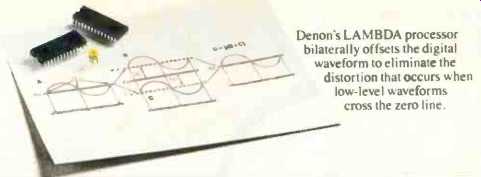
---Denon's LAMBDA processor bilaterally offsets the digital waveform to eliminate the distortion that occurs when low-level waveforms cross the zero line.
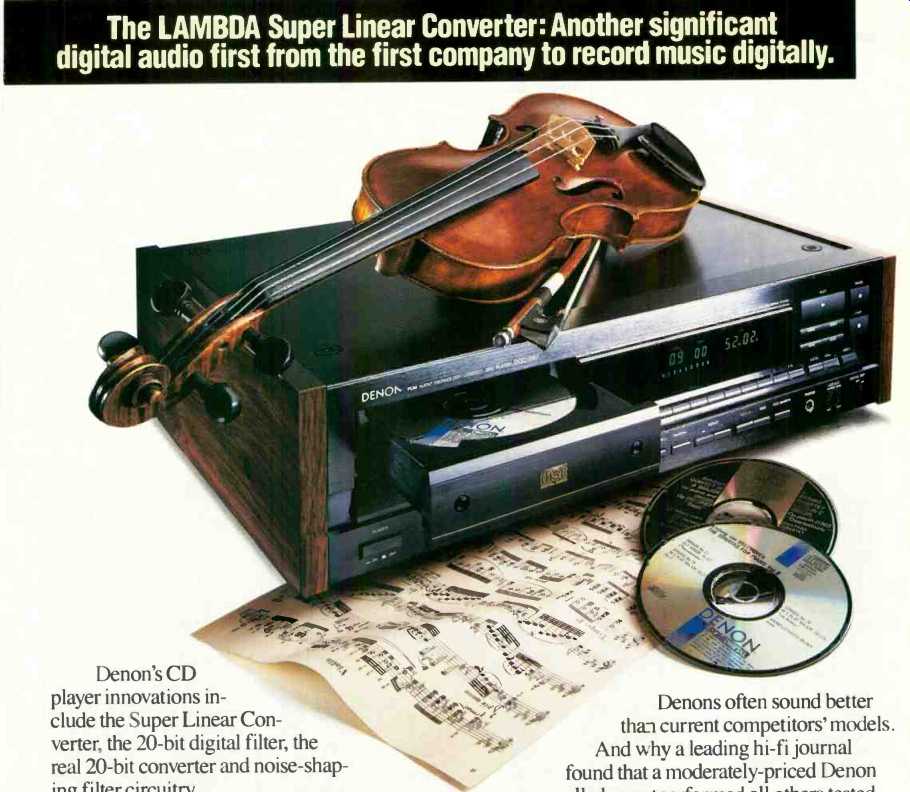
The LAMBDA Super Linear Converter: Another significant digital audio first from the first company to record music digitally.
Denon's CD player innovations include the Super Linear Converter, the 20-bit digital filter, the real 20-bit converter and noise-shaping filter circuitry.
Denon's latest digital advancement is the LAMBDA Real 20-Bit Super Linear Converter in the DCD-1560. The LAMBDA system's digital offset processor and dual 20-bit converters eliminate the most common source of distortion in CD players: the zero crossings of low-level signals.
Denon's consistent leadership in digital audio technology may explain why earlier generation DCDI SUO shown with the optional side panels available for most Denon models.

Prices quoted are manufacturer's suggested retail prices and may vary.
Denons often sound better than current competitors' models.
And why a leading hi-fi journal found that a moderately-priced Denon equaled or outperformed all others tested, including machines costing over $1800. What makes Denon CD players better? Perhaps it's that Denon performs every step in the music chain from recording artists through pressing CDs. And that Denon has concentrated on one thing and only one thing for 80 years.
Music.
Denon America. Inc..
New Road. Parsippany. NJ, 07054
-------------
Martin-Logan
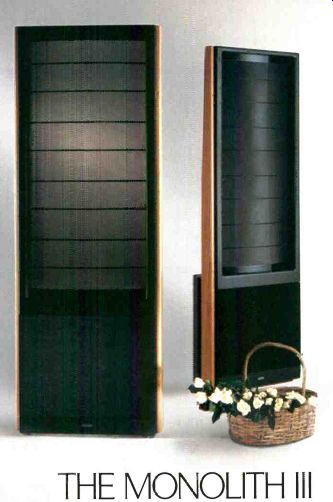
The Monolith III
The Monolith Ill stands alone. Powerful. Imposing. Thrusting you into a world of harmony and purity that both caresses and assaults you in its beauty, truth and timelessness.
The challenge was to maintain the famous Martin- Logan electrostatic purity and still deliver uncompromised levels of power and frequency response. This was achieved by incorporating a massless transducer in a perfectly linear field with no crossovers in the critical music range, yet dispersing energy in a controlled wavepath.
By seamlessly integrating this advanced ESL technology to a tailored superfast subwoofer, a new standard has been achieved.
The challenge now is for you to determine our success. Go, hear, experience the Monolith Ill for yourself.
The electrostatic loudspeaker technology company 913-749-0133
Lawrence, Kansas, 66044
----------------
California Audio Labs Announces The New Tercet mkIII CD Player
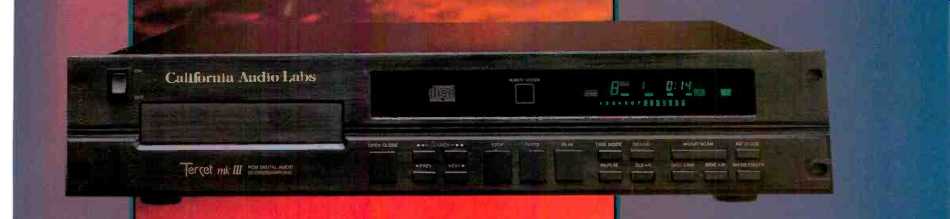

From the company that builds the worldwide reference standard in CD Players.
The all new Tercet mkIII is he definitive statement in solid state CD players from California Audio Labs. At a suggested retail price of only $1,295, the Tercet mkIII is an affordable player with an exciting pedigree. The Tercet mkIII comes from the people who have the most successful high end CD players in the world. Made in America to exacting standards, the Tercet mkIII features separate eighteen bit D/A converters for left and right channel with eight time oversampling.
Of course, the Tercet mkIII also features the new CAL linear drive transport.
California Audio albs
7231 Garden Grove Blvd. Garden Grove, CA 92641
(714) 894-9747
FAX (714) 894-6706
At California Audio Labs exceptional sound quality is a tradition. Now, with more than eighty dealers throughout America, California Audio Labs can be found in high quality audio dealers everywhere.
Just phone or write for more information, or better yet, call your local audio dealer and ask them to let you audition the exciting new Tercet mkIII.
-----------------
AR
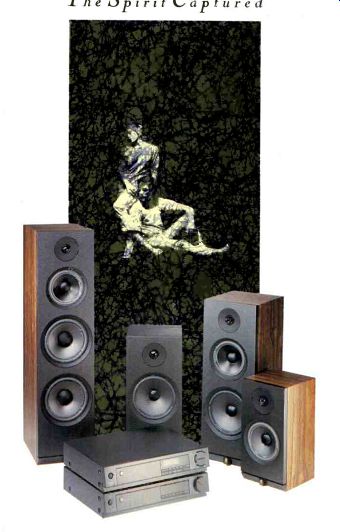
In the AR tradition, another milestone.
AR's designers and engineers achieve the ideal: European Elegance... Exquisite Sound ... Affordable Prices. The quintessence of both sight and sound.
Premiered in Europe now available in America.
-------------
Krell
THE MD-1 CD TURNTABLE

Designed for superior accuracy in digital data recovery, the MD-1 incorporates an extremely accurate CD-ROM laser transport, proprietary circuitry, four-point suspension, and massive machined aluminum chassis construction. Remote control and compatibility with both Fiber Optic and Coaxial output complete this elegant component whose artistic design is matched only by its playback capabilities.
With the MD-1 linked to the Krell Digital EBP-64X, SBP-16X or any other Digital-to-Analog converter, the listening experience is nothing short of spectacular.
KRELL DIGITAL INC.
20 No. Plains Industrial Rd., Suite 12 Wallingford. CT 06496, USA
Phone: 203-294-1213 Fax: 203-294-1235
----------
THE BRYSTON TRADITION--CONVINCING MUSICAL ACCURACY

Gold plated switches and connectors---As in all Bryston products, only the highest quality internal components are employed in making our preamplifiers. Every switch and connector is heavily gold plated for a lifetime of freedom from corrosion. noise and distortion.
Hand matched transistors---Transistors are hand selected and matched for signal accuracy.
Tolerances-formally accepted for mass production are totally eliminated. Internal electronic components are made exclusively for Bryston to meet our exacting requirements.
Phono section--Bryston's unique phono section is divided into two stages to separate high and low frequencies and maintain extremely accurate equalization. This approach allows very high signal input and produces far less noise and distortion levels than those associated with single stage designs.
Direct soldering of components to circuit boards---No internal wiring is designed into Bryston's preamp circuitry.
Components plug directly into boards, eliminating variations in signal travel and wire interaction.
Bryston preamplifiers are hand assembled with precision Bryston preamplifiers combine outstanding function with complete musical accuracy. Whether you select the Model .5B, I 1 B or 12B. each provides an exact duplication of the original recording experience, without distortion or coloration.
All Bryston preamplifiers share sophisticated features designed for unparalleled performance. The Bryston line of high-quality preamplifiers provides low-noise, low-distortion signal control for the world's finest sound systems.
Bryston Marketing Ltd.
==========
= = = =
Also see: