by EDWARD TATNALL CANBY
PLAYING FOR TIMES
Perspective, perspective! I do not mean 3-D, nor even surround sound. I'm talking about the kind of mental perspective we so desperately need if we are really to understand the continuity of our own business. The better the knowledge of the past (and how it turned into now), the more accurately we figure our likely future in practical dimensions. But who has this sort of perspective? Surely not those in high places. As I keep having to observe, our biggest commercial outfits are collectively the most dense in seeing forward for their own interests. All too often, this denseness is cleverly covered up-the miscalculations papered over, the losses in millions quietly absorbed-so that all of us on the outside scarcely notice the difference. A long standing theme of this column!
No--perspective, like genius, can pop up anywhere and in anybody, often the most unlikely. That's a triple pun, please. In any body, any individual person--anybody. Also, frequently, in some cutting-edge body of workers pooling their abilities, a think (and act) tank, which becomes miraculously inspired with useful perspective.
Do we call their products innovative? "Nova" means new, yet even the stupidest misfit product is technically new at some point! What we mean by innovative is "new with perspective," giving a new shaping to the grand continuity that is both past and future. In my browsing through the mass of ill-assorted (i.e., unfiled) sonic and printed material that jams my mailbox, adding to the bigger mass of stuff left from the long past, I keep stumbling on things that contribute to this sort of perspective as I see it, however oddly and unexpectedly. I solemnly count it my duty to bring you a few-just in case to keep you amused, maybe to be helpful. For after all, the finest of man's superior abilities, the ultimate, is the perception of time itself and all that swims along with it. (No animal can do this, not even a dog. Try putting a wristwatch on your canine's front paw.
You think your poochie knows exactly when it's supper time? It's only that inner urge, and the sequence of sounds, sights, and scents that go with the poochish ceremony. Same with those regular trips to the nearest fire plug. Well timed, but not timed! Not, at least, by the dog.)
Item, in the present. I highly recommend to you, in the mag db ("deebee," please), a recent series of narratives concerning those fabulous around-the-world trips of various pop groups for performances in exotic places, largely sponsored by that elderly promoter of things American, Uncle Sam. The adventures of these guys and their gear, the problems of incredible fierceness--with, say, an audience of 30,000 Tongans or whatever sweating under the coconut trees-and the happy (usually) solutions make fascinating reading. For every Mr. Murphy with his Law in the U.S.A., a thousand oriental cousins and African uncles are out there, lurking to jinx all types of reliable audio.

Just the mismatched voltages and plugs are enough to make you gasp. And the aplomb of our audio heroes! The good thing about this db series is that it goes as far as any professional could want into chatty detail about the equipment itself and the troubles encountered, and yet the style is such that any 01 our own readers with a nominal understanding of audio basics can get the drift with ease, db, of course, is a specialist mag for audio professionals, particularly in recording and assorted show biz.
What we learn as to present perspective in these db accounts is the total dependence on audio which belongs with all our major entertainment formats. Somehow, the exotic db venues make this point with drama. Imagine it: In the South Seas, in the hottest and the wettest places, in monsoons and typhoons and 120° temperatures-every spot you've seen in those romantic tourist ads! And maybe the coldest-Lapland? Or North China, where the steam railroad fans now go in winter. All in the day's work and the night's haulage-by plane, ox cart or, for all I know, rickshaw. Definitely, our present all-too-routine big audio is exciting and remarkable in such situations. Gives us present perspective.
Some items from the past. All Audio readers are familiar with large-scale show-biz audio, live, in huge halls or outdoors. It's getting so we can call Woodstock the prototype, the definitive event, though the type had been around awhile by then, growing from large to larger. Alternatively, you can date your modern monster audio from Shea Stadium and The Beatles. Those guys started in small nightclubs, holes in the walls, Liverpudlian, but they ended up with show after show on a huge scale. Maybe their audio was terrible, but without it, there would have been--silence.
Can you imagine The Beatles playing to an audience of thousands with the plugs pulled out? Ten feet away, you would hear nothing but maybe a faint croak from Ringo or a distant falsetto squeak from Lennon. Not even a whisper from the unpowered instruments. Total dependence on audio, whether a proper 120/240 V or, as in db, perhaps 260 V (plus or minus a lot) at 50 Hz (plus or minus a lot). In 1956, on tour in France, I attended one of the early Son et Lumiére shows (Sound and Light), then recently devised in France to show off the superb historical examples of French architecture all over the country. This one was at Vézelay, a highly dramatic early cathedral perched on top of one of those steep, island-like hills that dot central France, each with its hilltop fortress walls, and the town inside, its cathedral high above and gorgeous views in all directions. (The views, of course, were not the original interest, which was safety and strategic military superiority over threatening armies below. Also, the dramatization of assorted objects of pilgrimage such as saints' bones, which could bring thousands and thousands to visit.) It was at Vézelay that St. Bernard, the great preacher, launched the second crusade. He was a spellbinder, it is said-he inspired whole peoples with his orations. More to our point, he spoke to an enormous multitude from the edge of the steep cliffs below the cathedral of Vézelay, people spread out below in a vast sea, all humanity.
The 1956 Son et Lumiére sought, at night, to re-create this astonishing scene via a vast audio setup-loudspeakers over a half mile or so of space-and dramatic lighting. We saw and heard St. Bernard's speech and, even more interesting, we heard all the people down below our vantage point murmuring, shouting, and talking as though they were actually down there, densely packed as far as the ear could hear (but the eye could not see, it being night as we listened). This was done via I don't know how many separate taped tracks, each leading to a speaker mounted inconspicuously somewhere down below or on the side of the steep decline. Next day, I went exploring, trying to find where that compelling, real "people sound" had come from. I managed to find only one speaker, in the middle of a lot of thorny bushes, at a 45° angle. Beautiful job, let me tell you. The rest I couldn't even locate.
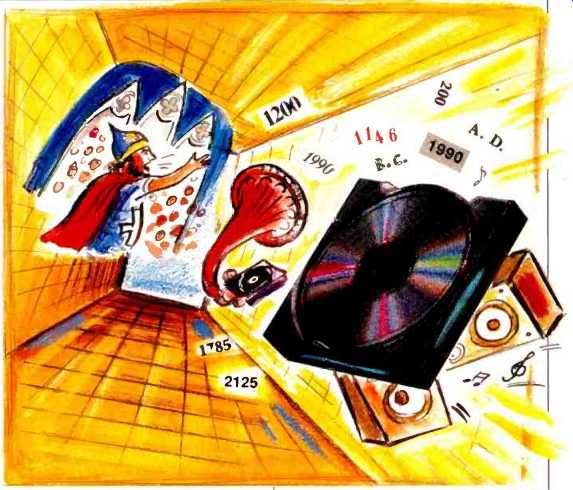
I leave you with only one thought from Vézelay, in the year 1146 when all this happened, more than eight centuries ago. St. Bernard's audience, if I remember my history well, was approximately 300,000 people, outdoors.
Just how, I ask you, could one man, one voice, address 300,000 people to miraculous effect minus audio? What did he sound like; how did he speak? He did-it's a fact.
Let us now move on to the "next to present," almost the full eight centuries after Saint B. A few years before my visit to Vézelay (I've been back since), I spent much of the winter of 1952-'53 in St. Louis-not France, Missouri. It was at this time that I first experimented, knowing next to nothing, in "binaural" sound via that notable first two channel tape recorder, the Magnecord. (Bert Whyte was also on hand, separately, with another Magnecord.) During my stay, I explored, in off hours, that great tract of land called Forest Park-contemporary with New York's Central Park and of similar size-it being only a block from where I was staying. By degrees, it dawned on me that here, right in front of me, was the site of the greatest of World's Fairs, The Louisiana Purchase Exposition of 1904, of which I had vaguely heard. On February 24, 1953, I bought a slim book, published 10 years earlier, Forest Park and Its History, which instantly fascinated me-much of it, including dozens of photos, was devoted to the great Exposition, and I could now see exactly where it all had happened, only 49 years before, right across the way from my window.
St. Louis, in those late days, was still a typical mid-American booster town, full of its own enormous importance, bound for Progress in every area from streetcars to art. Indeed, in 1904, it was a continental hub, the focus of rail lines across the Mississippi to the burgeoning West and just plain exploding at its various expansion joints, one of these being Forest Park. In the mid 1870s, the Park had been set aside far outside the original small town, in an unlikely forest wilderness. By 1904, the town had caught up. The Park was developed-with lakes, golf, tennis, horses, winding roads and all-but the St. Louis moguls had bigger things in mind. It was indeed to be a huge affair and still a fresh and new idea, this grand Exposition with its neoclassic buildings out of Rome via Paris, with added (much added) décor. And, in a single summer, it made money! Believe it or not. The Whole World was represented there, more or less, and St. Louis patted itself in dizzying pride: "How could we ever be so great and world-famous!" The account, in my 1943 volume, is really amusing, so unabashed was all the glory of world achievement.
It was at this Expo that the great organ, which later became the Wanamaker organ in Philadelphia, was set up-with electric wind power. In fact, the Expo was a dazzling exhibit of early electricity in full bloom, the whole place heavily powered and illuminated to an extent that shows dramatically in the photos.
So great was the momentum of Expo success (and only the one summer) that the impetus for big things went on for years. Thus, 10 years after the Exposition, a new idea sprang up: An enormous Pageant, to be presented to millions of people on the ex-fairgrounds via a cast of thousands. It was all about pioneers, great heroes, the Indians, the Spanish, St. Louis (the French king, on his horse up on a high pedestal)--every patriotic idea you can imagine. "The Pageant and Masque of St. Louis" came off on four successive days in late May of 1914.
World War I, a few months away in Europe, could not have been more remote. On each of those four days, the daytime Pageant drew a vast seated crowd--the largest around 180,000--which massed on a bowl-like circular hill before an Expo lagoon. On top of the lagoon was a huge stage more than 800 feet wide, with the Mississippi in front of it--125 feet of water-plus a cast of 5,600, a hidden chorus of 500, and a 100-piece band. The Masque, held at evening, with electricity galore for new stage magic, was sensational. "In the silver-washed dusk, companioned by a brilliant star, the crescent moon like a lantern hung...down the purpling night." That gives you the feeling.
Please note: In all of this, day and night, there was no audio. No amplified narrator, no loud-miked solos, no speeches the same. All purely acoustic and yet on a Woodstock scale! Just like St. Bernard, after almost 800 years. How's that for audio perspective?
==========================
ADs:
THE BRYSTON TRADITION--CONVINCING MUSICAL ACCURACY
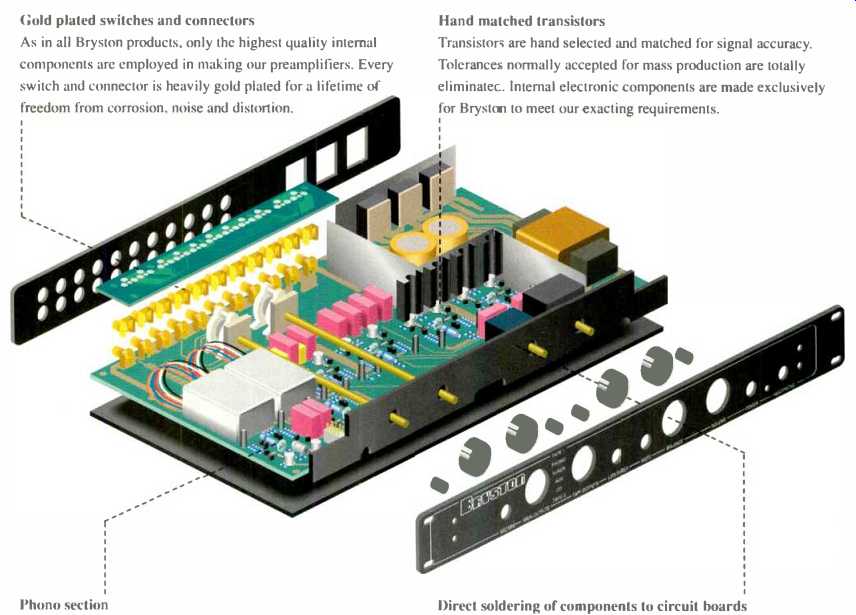
Gold-plated switches and connectors--------------As in all Bryston products, only the highest quality internal components are employed in making our preamplifiers. Every switch and connector is heavily gold plated for a lifetime of freedom from corrosion, noise and distortion.
Phono section---------------------Bryston's unique phono section is divided into two stages to separate high and low frequencies and maintain extremely accurate equalization. This approach allows very high signal input and produces far less noise and distortion levels than those associated with single stage designs.
Bryston preamplifiers are hand assembled with precision Bryston preamplifiers combine outstanding function with complete musical accuracy. Whether you select the Model .5B, 11B or 12B, each provides an exact duplication of the original recording experience, without distortion or coloration.
Hand matched transistors
------------------------
Transistors are hand selected and matched for signal accuracy.
Tolerances normally accepted for mass production are totally eliminated. Internal electronic components are made exclusively for Bryston to meet our exacting requirements.
Direct soldering of components to circuit boards------------------No internal wiring is designed into Bryston's preamp circuitry.
Components plug directly into hoards, eliminating variations in signal travel and wire interaction.
All Bryston preamplifiers share sophisticated features designed for unparalleled performance. The Bryston line of high-quality preamplifiers provides low-noise, low-distortion signal control for the world's finest sound systems.
Bryston Marketing Ltd.
---------------
Also see:
= = = =