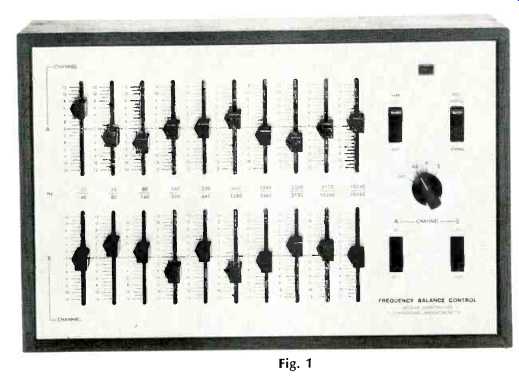
MANUFACTURER'S SPECIFICATIONS: Control Ranges: ±12 dB in each of 10 octave
bands. Channels: Two, for stereo applications. Switches: Four rocker switches-tape
in and out, mono or stereo input, and in/out for each channel. One rotary,
with four positions-power off; AB, with both channels operating; A, with only
the left (A) channel operating; and B, with only the right (B) channel operating.
Dimensions: 12 x 7 7/8 x 3 1/4 in.
Price: $225.00.
Fig. 1
The Advent Frequency Balance Control is a unique active equalizer that can alter tonal balance in your stereo system octave by octave, with each channel separately controllable.
The ability of the user to control each octave independently permits the adjustment of the system to compensate for any deficiencies in the components themselves-and this includes the loudspeakers, as well as any other component. Furthermore, and this is probably more important, it permits compensation for the acoustic environment of the listening room. The Frequency Balance Control (FBC) is a complete tone-control system, but one which offers a flexibility not obtainable heretofore in consumer equipment.
One exception to this was the monophonic Audio Baton which was on the market some years ago as a product of Blonder Tongue. Many of us remember this product, and they appear occasionally in our classified columns, both Wanted and For Sale.
The FBC consists of two separate channels of equalizers. Each channel is preceded by separate sections of the input-level switch which adjusts the gain of the unit to accommodate input signals in the three ranges of 0.5 to 1.0 V, 0.25 to 0.5 V, and less than 0.25 V. This switch and the phono jacks for external connections are shown in Fig. 2, along with the connecting 'instructions. The front panel is fitted with twenty slide controls, each covering one octave for one channel. The octaves are, respectively: 2040, 40-80, 80-160, 160-320, 320-640, 640-1280, 1280-2560, 2560-5120, 5120-10240, and 10240-20480. The scale along each knob is marked in arbitrary figures from + 12 to -12 in a linear fashion. The top row of sliders operates on channel A, and the bottom row operates on channel B, or the left and right channels as we more commonly refer to them. To the right of the two banks of slide controls are the pilot light at the top, the tape in/out and mono/stereo switches next, followed by the rotary switch, and it in turn followed by the two channel on/ off switches.
Circuit
The FBC employs a total of 24 transistors-12 in each channel-and one IC. The input signal is fed to the level selector switch, and then to the base of an emitter follower which drives the ten equalized stages in parallel, as well as an unequalized terminating stage. Each of these stages has a collector-load resistor selected for proper gain for the stage, and each (except the last) is equalized by a pair of capacitors connected from the collector to ground, with the junction between them connected to the junction of two resistors in series which serve as the emitter resistor. The output of each stage is capacitively coupled to the arm of the slide control affecting that particular octave, and the "high" sides of the slide potentiometers are summed together and fed to an operational amplifier to provide sufficient output level. These outputs are then fed. to a level-adjusting potentiometer accessible as a screwdriver adjustment, thence to the in/out rocker switch and then to the rotary switch.
A transformer, bridge rectifier, and an effective filter circuit furnish the power.
The FBC is designed to be connected between the "recorder" output of your receiver or amplifier and the "tape monitor" input if available, or else to the "aux" input. With these connections made, you are ready to experiment with the unit, which will provide a wide variety of control, as shown by the following list:
1. Changing the balance of recordings you have found unsatisfactory for one reason or another.
2. Modifying the response characteristics of a cartridge to complement those of the loudspeaker.
3. Improving the overall musical balance of a speaker.
4. Correcting for some effects of room acoustics and furnishings.
5. Extending the frequency range of loudspeakers.
6. Improving the response characteristics of records, tapes, and broadcasts. These improvements can be made permanent if the material is recorded on a tape recorder.
7. Investigating (and changing, if you wish) the subtle response differences that exist between speakers. (It is literally possible to make the tonal balance of any good speaker sound very similar to that of any other good loudspeaker.
These recommendations are those which accompany the FBC, and offer the user a few ideas to start off with.
We can think of a few more possibilities, such as these: (a) Comparing an unknown speaker's response with that of a known model. Simply adjust the controls of the unknown speaker's channel until the two sound as nearly the same as possible.
The control settings then show the comparative response.
(b) "Reprocessing" mono recordings to give a stereo effect, either in direct reproduction, or in re-recording. Set the controls of one channel for a 10-dB boost at a given frequency--say, 800 Hz, and set the other for a 10-dB droop at the same frequency. Proper choices of the points of equalization and the amounts thereof should result in a satisfactory stereo effect-or at least a pseudo-stereo effect--which could well help your old mono recordings.
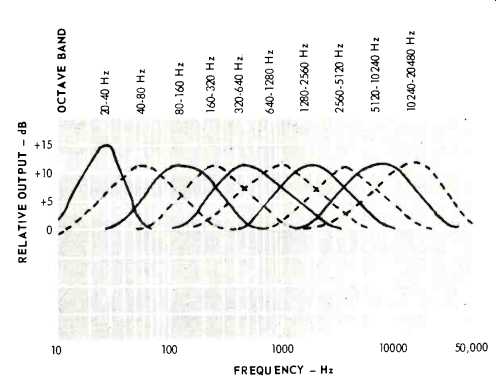
Fig. 2-Showing response with 12 dB increase.
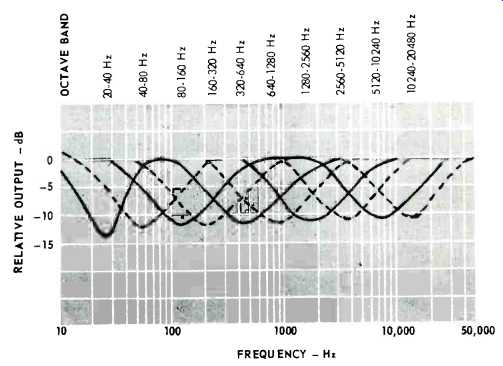
Fig. 3 As above, but with 12 dB decrease.
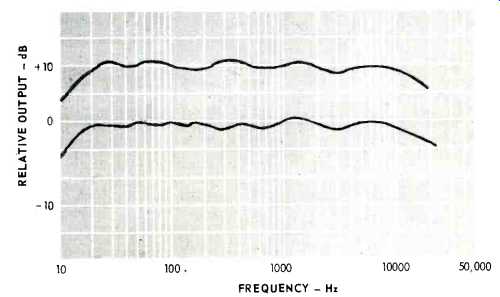
Fig. 4-Response in level position.
Performance
The Frequency Balance Control does all the things that it is claimed to do. It does not have the enormous flexibility of a series of third-octave controls, but it is not likely that it would be used in the same applications as would the much-more-expensive third-octave equalizers. For the average intelligent consumer, however, the FBC is a great help in making his system do what he wants it to do. For a look at the frequency responses available from the various octave controls, study Fig. 2. Each of the curves is the result of moving one slider to the+ 12-dB indication on the scale. Then all the curves were plotted on the same graph. Imagine, if you can, the effect of putting some of the controls at an intermediate position and others at maximum, for example. Practically any desired "tone-control" effect desired can be obtained easily. Now, suppose you compare the "+" curves of Fig. 2 with the "-" curves of Fig. 3.
Mix any desired combination of the plusses with any desired combination of the minuses and try to imagine what sort of responses you can obtain with all of this flexibility.
Suppose, however, you want fiat response. Either throw the applicable switch to cut out the equalizer stages or else set all the sliders at the "0" on the scale. The measured response under this condition is shown at the lower curve in Fig. 4. Even if you move all the controls to the +8 position on the scale, you will get the response shown by the upper curve of Fig. 4. Similar effects are obtained with the minus positions of the sliders.
Figure 5 shows the actual dB of equalization of one control plotted against the scale indication of the slider position. It will be noted that there is somewhat more equalization than the scale indicates, but the scale is simply that, an indication. For the user's convenience, a pad of charts is furnished along with the FBC (and more can be obtained at a nominal price) so the user can indicate settings he found to be especially desirable for any given application.
One final question may come from readers of a more scientific or practical mind. "What is the distortion?" they will ask. With a device of this sort, you could make almost any distortion figure you might want, simply by setting the controls in a certain fashion.
To give a fair answer, however, we measured the distortion with all controls set at "0" on the scale, and at a nominal output level--0.5 volts--we measured a THD of less than 0.5 percent, at up to 1.0 volts of output.
Signal-to-noise measurement was 60 dB with respect to 1.0 volt output in the Lo sensitivity position, and IM was less than 0.5 percent at the same output level. Had we set the control for the measuring frequency at maximum boost and all controls above that frequency at maximum cut, we would expect to get a much lower distortion figure, as we did-less than 0.25 percent. Measurements on any frequency varying device are difficult, , and the Advent FBC is certainly a super "frequency-varying device." We commend it to all serious experimenters for its many technical uses; to all recordists for the effects they can obtain; and to all music listeners who may want to improve their environment of the performance of their equipment.
-C. G. McP.
============
AD:
Advent Frequency Balance Control
A NEW active audio equalizer with a wide range of potential uses, the Advent Frequency Balance Control offers effective alteration and enhancement of program material and of the response characteristics of equipment in the home or studio. The FBC supplies octave by-octave control of audible balance across the full frequency range, governing each of two channels (stereo or mono) individually. Variation per octave is ± 12 dB. Switchable input sensitivity (0.25 V, 0.5 V, 1V).
Signal-to-Noise Ratio better than 60 dB at rated input impedance : 150K ohms. Output impedance: 7K ohms. Gain at 0 settings: Unity.
$225.00*
For more detailed information and a list of Advent dealers, please write: Advent Corporation, 377 Putnam Ave., Cambridge, Mass. 02139.
*Higher in the West.
++++++++++++++++
(Audio magazine, May. 1970)
Also see:
Advent "Smaller" Loudspeaker (Equip. Profile, Dec. 1972)
Advent loudspeakers (ad, Dec. 1972)
Advent Model 300 Stereo FM Receiver (Equip. Profile, June 1977)
= = = =