Classical Record Reviews
by EDWARD TATNALL CANBY
RAVELATIONS
Ravel: Boléro, La Valse, Rapsodie espagnole, Alborada del gracioso. Orchestre National de France, Lorin Maazel. CBS IM 37289, digital.
Ravel: Daphnis et Chloe Suite No. 2, La Valse, Pavane pour une infante défunte. The Houston Symphony Orchestra, Sergiu Comissiona. The Houston Symphony Chorale. Vanguard VA 25022, digital, $8.98.
These two digital LPs cry for comparison and indeed are worth acquiring together for the interesting contrasts and differing values they offer.
Ravel was not only one of the finest orchestrators we have ever seen and heard, but, even more, his music uniquely combines the big sound of the older Romantic symphony orchestra with a special sharp color and detail that comes through well via recording. No wonder his records seem to please.
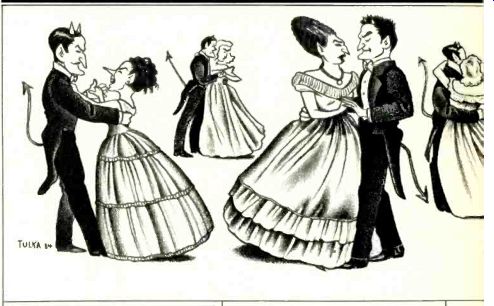
The common item here is the nightmarish evocation of the Viennese waltz, composed just after WWI had destroyed the very source, old-time Imperial Vienna. That is what we hear, and it is the daemonic sound of the waltz in total disintegration that we must record-some job! Climax after climax, each more intense than the last. Even more difficult: A beginning that deliberately is "in the mud" or, as Ravel put it, in a fog. At the concert hall, the first notes invariably blend with coughs and rustlings, not to mention distant buses and taxi horns. (The famed "Boléro," a similar tour de force, is not very different.) On records, on LP, the opening notes blend straight out of surface noise and hall sound; the two necessarily sound together! (On Compact Disc the problem is different. Hall noise alone but a groping for level, the beginnings almost inaudible. Beware! The endings are enormous.) Vanguard's LP waltz begins ingeniously: , Faint, slightly bass-inclined surface sound blending quickly into similar hall sound only slightly louder, in which, as expected, the opening notes of the music are barely differentiated. Very nicely done. CBS's begins more briskly; there is more hiss and less fuss about getting off and away.
You still cannot hear the first notes.
Should you? As far as sound ambience goes, I like the Vanguard better. The French recording has a curiously mono-like sound, rather dry and not expansive.
Vanguard's Houston church gives us a large, relaxed sense of space, adding to the impact of the sharp Ravel orchestral colors. No over-blurring, as often occurs in church recordings. In the same way, Vanguard's big bass drum is startlingly real; in Paris it is thinner and harder, though not unacceptable.
Now we get into performance-it has much to do with the sound, after all. On CBS we have a major national orchestra in a country that prides itself on exactitude in musical technique. In Houston there is a less rigorous playing group, not yet perhaps of first-line quality but not far below. And we have two of those youngish traveling jet-conductors who operate all over the world, almost simultaneously. They are very different, and would be audibly different, I think, even if they switched orchestras.
The Paris players are unmistakably French, highly disciplined, perfectly blended, somehow a bit chilly in the traditional French manner. The winds, also traditionally, allow themselves to play out of tune. They always do. The strings are so perfectly matched you cannot believe it. But on the shrill side, i.e., lots of highs.
In Houston, the players are a bit more rotund, shall I say. Not lumpy but not taut either. Our Romanian maestro (with one "m," Comissiona-strange name) has some trouble whipping them up, but he does it well except for the final climaxes of the waltz and "Daphnis," which lack the ultimate tension. The playing wears well. I liked it better a second time.
Comissiona understands the music better. He knows the European tradition, is a master of the ups and downs, the changing tempos and moods, vital to the waltz but also to all Ravel. Maazel, as always, is chill and tends to whip up climaxes and exaggerate the passages where tensions relax. Too self-conscious, not instinctively (and by training) correct. But if you want the true daemonic endings, "Boléro" and "La Valse," you have to try him.
Both discs will probably end up on CD-better not wait.
Vaughan Williams: The Lark Ascending, Fantasia on a Theme of Thomas Tallis; Elgar: Serenade for Strings Op. 20; Tippett: Fantasia Concertante on a Theme of Corelli.
The Academy of St. Martin-in-the Fields, Neville Marriner. Vanguard VA 25020, $8.98.
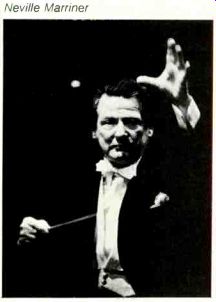
-----Neville Marriner
This one is a Vanguard digital import, out of a British company called Academy Sound and Vision Ltd., recorded in the EMI studios with JVC equipment. Imports were the stuff of early LP, notably after Nonesuch opened up a wide market, and we have to remember that in the classical field the electric 78 shellac was very largely an import business, either direct or by reissue. Now the game is open to all, with small and large U.S. companies competing on equal terms, publicity and distribution aside. It's an interesting contest! Still, to my way of thinking, the smaller outfits turn out the better product, if my employer will take that statement as a challenge. Not always better! But often enough to be noticeable.
The impact of this disc, however, is more a matter of the music, well played by a home orchestra and a conductor in his own bailiwick. English music! Rather neatly summing up a period.
You have to like it to appreciate it.
For strange and abstruse reasons, this music does not go well with the American ear and taste, nor ever has. (More recent British music veers towards internationalism.) Myself, I find it passably dull to very nearly distasteful, though the brain says no and the training agrees. It ought to be good, it is good, the English think it is good.... Mostly I get twisty and itchy when I listen. If I listen hard, do my duty, I can then hear how good it actually is.
The works are largely for strings alone, with occasional violin solo (as in the "Lark") or group of string solos (as in the Tallis piece and the Tippett). From the earliest, Elgar, to the latest (1953), Tippett, this string sound is rich and mellifluous, not in the modern manner forcing the strings into new feats of strenuous difficulty. It all flows beautifully, and Neville Marriner, here with his home players, has a perfect understanding of the British expression. (You see-I really do like the stuff when I finally get tuned in to it.) The early Elgar "Serenade" is outrageously, unctuously Victorian, full of the typical Elgar harmonies; the two early Vaughan Williams items are much concerned with the then-startling "modal" harmonies, supposedly suggesting "ancient" music (Elizabethan) and the music of the Folk, English style. It's old-hat now but still has appeal as a kind of British Impressionism.
As for Tippett, he is a thorough modern who, being British, manages to sound right out of the same tradition, which is a considerable feat. His music suggests a much-layered-over Corelli Baroque-more Impressionistic than the Baroque of either Stravinsky or Bartok, who also tried this game.
I think that the seamless continuity of this sound, straight from 1892 to 1953, is its most impressive aspect. Digital is good for strings, too; it helps sharpen up their brilliant overtone content, always difficult to record without traces (or more) of edgy distortion in the louder parts.
Pillin: Concerto for Strings and Percussion; Reicha: Woodwind Quintet No. 2. The Pasadena Chamber Orchestra and Soloists, Robert Duerr. WIM WIMR-22, $8.98. (Available from Crystal Records, 2235 Wilida Lane, Sedro Wooley, Wash. 98284.) The West Coast, especially down south, is a hive of cross-culture music making these days-everything goes and all mixed up, from super classical to super pop, with TV and film mystique mixed in. Is this a classical record? A real question, and in a positive sense too. Boris Pillin, for instance, is outwardly a 100% "classical" contemporary composer, but the Concerto on this record, dating from 1981, has been used for the soundtrack of the Omstar production, "The Sky Is Falling," with narration by Oscar-winner Cliff Robertson. The solo percussionist here is also a composer and arranger of TV/film music, writes jingles, and plays at the Playboy Club in Los Angeles. It's a giddy world. And here it comes into your living room.
Well, does it? The usual question.
Will it help your enjoyment to know about all those Hollywood-style multi awards in the background? If so, enjoy, enjoy! But most of us still want to listen, or at least use the stuff for background.
Okay, it goes this way. Mr. Pillin's Concerto is not intended as background music. It is very portentous, hinting darkly of all sorts of soulful and ominous agonies, with screeching, dissonant strings and mystic harp tones rather too big for its boots as I hear it.
Especially since it is almost embarrassingly derived from Bela Bartok, who wrote his music for a similar combination of sound producers a half-century ago. An honest tribute, if you want, and skillfully composed too, but Bartok, in comparison, is all lean muscle where this music runs to adiposity.
Dissonant or no, it is basically derivative-which is perfectly okay as long as you keep things within reasonable bounds.
Just to be sure, I played the whole thing twice through. (So you think record reviewers play only the first half inch?) I liked it more the second time` good sign. But it is still too big and not well baked. Cut down by a third, it would be a third better. Oddly, one casual little segment, near the end, thought the most original thing in the piece, quite delightful-a bit of dance like whimsy, a sort of cross between an addled Irish jig and a slow tango.
That's worth the whole record side.
As for Reicha, back in Napoleonic days, out of Prague, Paris and points between, his works are the quintessence of popular music in that era, beautifully written, never pretentious in the slightest degree, and never profound-that wasn't the idea. Goes rather nicely with Pillin's big modern work on the other side, and maybe might point some lessons for the 1980s in Pasadena.
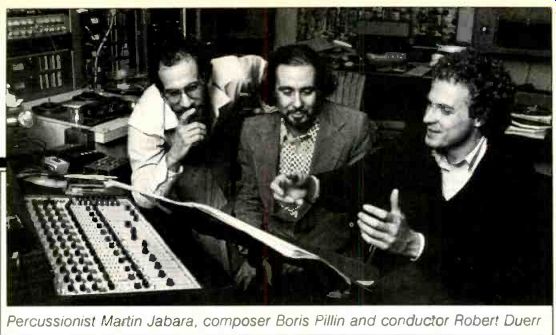
------------- Percussionist Martin Jabara, composer Boris Pillin and conductor Robert Duerr
Xenakis: Charisma; Kasinskas: Phoenix Wind; Effinger: Piano Sonata No. 3; Toensing: Music for Christmas Night; Eakin: Capriccio for Harp and Piano Pizzicato. Columbine Players. Owl 26, $8.98. (Owl Records, P.O. Box 4536, Boulder, Colo. 80306.)
For a long time I have championed the small record labels for their undoubted pioneering in quality music and audio sound. It is good to find this nonprofit label still operating, based in Colorado, still turning out really fine quality sound and interesting music--in the last analysis-for anyone with an ear for sonics. The music is 'contemporary," the list of titles looks forbidding (above). But if you will be brave enough simply to listen, with an occasional glance at the printed explanations, you will be intrigued and pleased-unless, of course, you are looking for background music. This is anything but that.
Can't describe each piece, but all are variously interesting, from the academic but unusual sound of Eakin's work for harp and pizzicato piano (meaning that the pianist gets inside and plucks the strings, along with those of the very similar harp) to an extraordinary piece for solo clarinet accompanied by two of itself, prerecorded, "Phoenix Wind," by Joseph Kasinskas. Cecil Effinger's improvisational, dissonant-Romantic piano sonata is superbly recorded and ever so persuasively played; Richard Toensing's "Music for Christmas Night" is full of slow squeaks and color tones, intriguingly mixed with a Bach chorale. The biggest, most original work, "Charisma," is by Iannis Xenakis, with extraordinarily strong and harsh sounds from a clarinet and a cello. The Columbine Players are all of them superb musicians, which (strangely enough!) makes the listening wonderfully easy.
Music, after all, does "speak" and needs good "speakers." The recording is impeccably fine throughout-no one is likely to do better. Some rhythmic rumble in the bass, at 33 1/3. Cutting lathe? Brahms: Ballades, Op. 10; Rhapsodies, Op. 79. Glenn Gould, piano. CBS IM 37800, digital.
This isn't the place to get into the Glenn Gould controversy, which could go on for volumes. I have always been sympathetic to his extraordinary decision to resort to recordings alone, putting aside the concert world. It was epoch making, if only as an extreme, and still brings the fighting musical blood to a boil-but it is a crucial and vital argument for us who deal in any way in recordings because it gets down to stark elementals. What is the nature of a recording? It seems to me now unarguable that this Gould was one of the great geniuses of the modern piano, both in terms of incredible technique and in the astonishing penetration and intensity--for better or worse-of his musical interpretations. But he chose the (recording) hermit's life and he was probably right. Horowitz could be called just as eccentric in his own way, but he went in the opposite direction and cannot make a pure recording, minus concert audience. If records mean anything at all in music (I think they do!), then we must entertain both extremes and learn what we can from both.
I can say all this because I did not enjoy this record of Brahms. It is strong, as usual, but it is also wrong.
Brahms is not Bach, of another age, nor even Beethoven, whose music is still wide open to varying interpretations, including Gould's. The aural, actual tradition of Brahms playing goes straight back to the composer and his time. What Gould plays is not part of this tradition. Either he put it aside, deliberately, or-more likely-simply does not know it, in his isolation. The music to me is painful to hear because it misses the whole idea! The wonderful, loosely flowing accompaniments are played like so much harpsichord music, loud and clear and pointy, never subordinated. The gorgeously rich Brahms melody, on the other hand (literally), is just notes, one by one, without the long shape. Strong playing but really incomprehensible, even as a reinterpretation of the man. I liked the early works best; they are more flamboyant and virtuosic and so come through better.
If you really want to hear the Gould genius, move on from the two "Goldberg Variations" recordings to his recent record of Haydn piano sonatas. It was that record which convinced me that this pianist was one of the rare, great geniuses. Unbelievable-especially if you happen to have played some of the Haydn in your own simpleminded way, probably making it sound like an ailing player piano. That's the way mine sounded, compared to Gould.
Floyd Cooley-Tuba. Naomi Cooley, harpsichord and piano. Music of Bach, Brahms, Zindars, Russell. Crystal S120, $8.98.
The ever-present danger for record labels like Crystal, Golden Crest, WIM and many more, is to forget the larger audience-in favor of the special group. The tuba has indeed gone through a recent renaissance, almost a rebirth, and takes itself now very seriously-no more comedy, please.
Okay, okay! I'll even listen to Mozart's "Eine Kleine Nachtmusik" for strings as played by a brace of these wind giants. But this record just goes one tiny step too far. The world does not revolve around the tuba, either for you or for me.
I didn't get beyond the first side.
Sorry, because at least the second side has music actually composed for tuba, with a tuba overdub and a wind quintet. But a Bach suite? Bach was the greatest arranger ever, but he wouldn't have gotten to the tuba, which---for all the virtuosity available--still sounds thin and honky when it tries to play a melody in an intelligible middle range of pitch. I can think of dozens of instruments that could do the Bach much more effectively. So, except for tuba enthusiasts, why bother? In the case of Brahms, things are much worse. The "Vier Ernste Gesange," Four Serious Songs, were composed at the very end of his life and are filled with a somber agony, to texts about death. The words and music, as always in Brahms, are one. To blop them out in tuba format is simply a desecration of a man's last musical testament, like, say, applying an early type voice synthesizer to the Gettysburg Address: Can't you hear it?
A Ormandy Conducts Sibelius: Symphony No. 1, Valse triste, The Swan of Tuonela. The Philadelphia Symphony Orchestra, Eugene Ormandy. RCA ARL1 4901, $9.98.
Two of these are acknowledged rereleases (in very small print); the Symphony is new, though evidently not a brand-new recording. It ain't digital.
The whole collection, whatever its technical background, is musically priceless. Ormandy was the last of the "old guard" Romantic conductors who knew Sibelius' music, so to speak, from the horse's mouth. He was, in fact, close to the old man and even took the entire Philly orchestra to his Finland home to play, shortly before Sibelius died.
Sonically, the recordings are a bit enigmatic. RCA is coy with its reissues.
In Europe they tell you the original date, or copyright date. Not here. All the copyrights are 1984, regardless of original, and there is no mention of dates previous to that, as though it were some deep secret. Why? These are excellent updatings and improvements over the earlier release, so why not give them due credit? Thus, confusingly, the two re-releases, though at a somewhat lower cutting level than many new recordings on LP, are excellent in every way, with a grand ambience and perfect orchestral balance. The Symphony, presumably newer (but is it?), is distinctly less good in the orchestral ambience. It tends to sound small, restricted in width, minus a big, spread-out sound. As music it is superb, but sonically the others are better. Perhaps the Symphony was withheld and left unreleased at some past date? Could be.
Let no such petty technical considerations stop you if you want the finest Sibelius recording of our time, far ahead of younger conductors not familiar with the original idiom.
Brahms: Songs and Romances for Chorus. Musica Sacra, Richard Westenburg. RCA ARC1 4916, digital, $12.98.
Richard Westenburg, with a base at the vast Cathedral of St. John the Divine in New York, is the Apple's prime professional choral conductor. He is not in competition with many others, especially the leaders of the city's numerous amateur groups, some quite advanced, including my own chorus.
Musica Sacra is his most professional group. In this country, do professional singers always do a better job with choral music than the non-pros? I try to be objective and, indeed, have much respect for Mr. Westenburg, though I think some of us with less prestige do as good a job in the music he conducts.
By far the best work on this interesting disc is the Brahms music for women's chorus with piano, or with French horn(s) and harp, as accompaniment.
He has an expressive group of women who really feel the music, as does he, their only fault being a typical American lack of blending, not serious in view of the fine musicianship. The instrumental soloists are excellent.
Brahms conducted this type of worn en's chorus at length, hence his considerable output for that medium and his exquisite understanding of the female voice unsupported by male vocalists.
----------Richard Westenburg and members of Musica Sacra
Here we have four songs for women with harp and horns, an early work (Op. 17); 12 songs and romances with piano (Op. 44), rarely heard, and the very best of Brahms; and an even more unusual item, of all things an "Ave Maria," á la Schubert. The Viennese influence, no doubt.
The six songs of Op. 93A, without accompaniment, voices only, are less convincing. These singers, like most, are accustomed to the fixed reference of an instrumental backing; without it they sometimes sing unevenly, out of tune, and their blend suffers. The loud male voices are particularly un-blending in these songs. The transitions, from song to song, are unclear in the pitch, tape editing or no. The sound is coarse and inaccurate, though the dramatic emphasis and diction are more than convincing.
The unaccompanied (a cappella) music is only a small part of the disc.
The rest, with instruments, is first-rate, as it surely ought to be from such a professional group. If you want to hear a new side of old Brahms, try the record. It's digital-which helps no end with the easily overloaded sound of chorus voices, full of violent acoustic TIM, more than any orchestra at comparable signal levels. Digital copes!
=============
Vintage magazine ads, May 1984:
If you can't solder it, TWEEK it! The better the contact, the cleaner the signal. Contact resistance occurs wherever two conductors are fitted together and can seriously degrade electronic signal quality. Tweek" dramatically reduces contact resistance , in every interconnection--audio, video, computer, professional, or industrial. Tweek"--it's serious medicine for your interconnections.
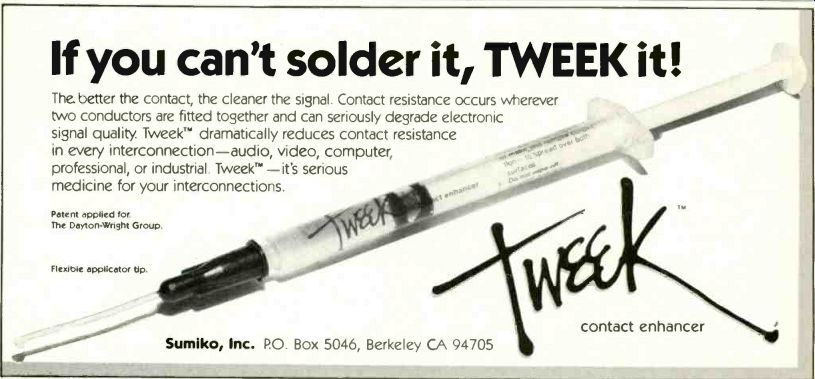
Patent applied for. The Dayton-Wright Group.
Flexible applicator tip. Sumiko, Inc. P.O. Box 5046, Berkeley CA 94705. Tweek contact enhancer
----------------------------
Your tape player deserves Discwasher care as much as your records do.
For well over a decade, Discwasher has provided the music world with superior record care accessories and is most often considered the world leader in record care technology.
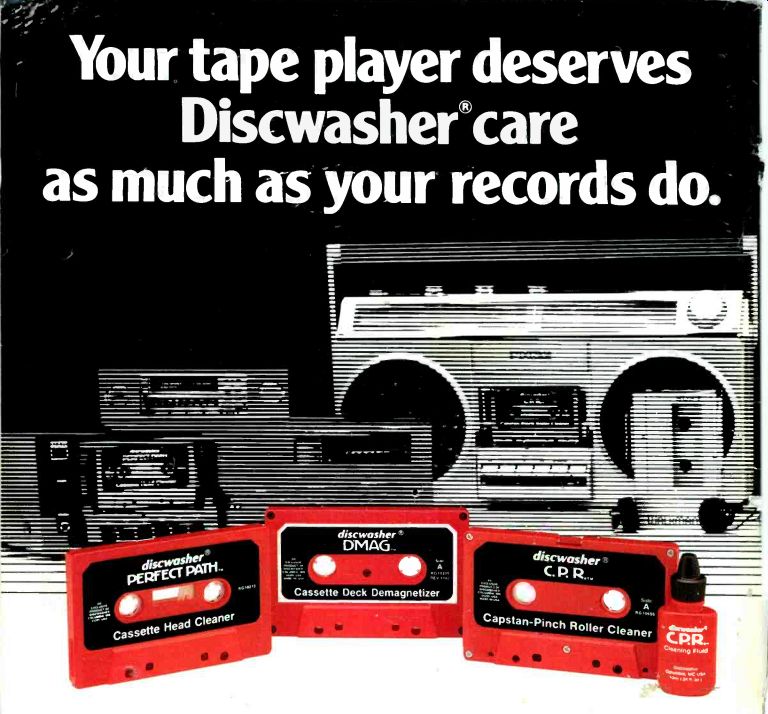
Don't settle for less when it comes to caring for your cassette players.
Discwasher Brand tape care accessories offer a high technology maintenance program for home, car or portable tape players.
The Discwasher Perfect Path,. Cassette Head Cleaner safely removes dust and oxides from tape heads and from along the tape path with a single pass of its unique fiber matrix tape. Through its regular use, Perfect Path will preserve the fidelity and longevity of your player.
The Discwasher C.P.R.,. Capstan-Pinch Roller Cleaner is the only cassette cleaner specifically engineered to properly maintain a cassette player's critical capstan-pinch roller assembly. This scientifically safe system cleans away contamination that can cause jammed cassettes and "eaten" tapes.
The Discwasher D'MAG, Cassette Deck Demagnetizer demagnetizes not only tape heads but capstans, tape guides and other steel portions of a cassette player as well. The unique use of high energy samarium cobalt magnets eliminates the need for batteries or power cords.
When it comes to maintaining the quality sound of your cassette player, trust Discwasher. After all, we've never let you down before! To learn more, write Discwasher for your free copy of "Guide to Tape Care”.
discwasher---1407 North Providence Road, P.O. Box 6021, Dept. AU, Columbia, Missouri 65205 USA. A DIVISION OF JENSEN an EAMARK Company
----------------------
micro-talk
micro-talk from audio-technica, Number 3 in a series
Elliptically Speaking
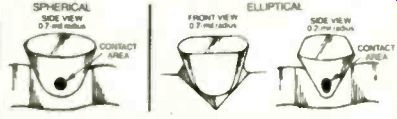
Stylus size and shape are critical to the performance of any phono cartridge. Small is generally better to trace more accurately the highest frequencies. However, if the radius is too small, the stylus will ride at the bottom of the groove, where dirt and debris tend to gather, and noisy playback is the inevitable result. Fortunately, stylus designers have found a way for you to have your cake and eat it too! One Stylus, Two Radii The answer is the elliptical (or BiRadial) stylus. Seen from the front it appears to have the same radius as a spherical tip (usually 0.7-mil) so that it touches the groove walls about halfway down. But from the side, the radius may be from 30% to 60% smaller.
This smaller side radius still tracks halfway down the groove wall, but now can fit into much smaller groove variations. A major difference in elliptical stylus choices is the exact size of this 'side' radius. A-T offers Bi-Radial tips with a choice of 0.2-, 0.3-, and 0.4-mil side radius. The smaller the side radius the more benefits in terms of tracing ability, especially at very high frequencies and at the crowded inner grooves.
For Better Systems Only
While an elliptical stylus better fits the record groove, its small contact area (rather egg-shaped and smaller than the spherical contact area) puts increased pressure on the groove wall for the same vertical tracking force (VTF). For this reason, elliptical styli are recommended only when low VTF can be achieved. This demands a cartridge mechanism with good responsiveness (compliance) and a good tone arm. Fortunately, most modem systems can take full advantage of the benefits of the Bi-Radial stylus.
A Microscopic Look
Since most better styli are almost invisible, and some advertising claims a bit optimistic, you may well question whether you are getting the precision you're paying for.
Which is why we encourage A-T dealers to install sophisticated stereo microscopes designed to display styli correctly. Viewed ultra close-up, A-T styli display accurately dimensioned, well-polished tips. (We don't believe your valuable records should do the final polishing.)The microscope can also display any faults of your present stylus, including the inevitable wear. We urge you to take a close look for yourself at your Audio-Technica dealer. And our next installment will tell you about another class of very advanced stylus designs.
Good listening, Jon R Kelly. President Audio-Technica U.S.. Inc.
1221 Commerce Dr.. Stow, OH 44224. audio-technica.
The World's Favorite Phono Cartridge
-------------------------
Real Radio Throughout your home or office, the Proton 300 FM/AM Radio delivers beautiful high fidelity sound. Real high fidelity, simplified.
FM stereo reception is magnificent with the Proton Schotz Detector. The Radio has separate bass and treble controls.
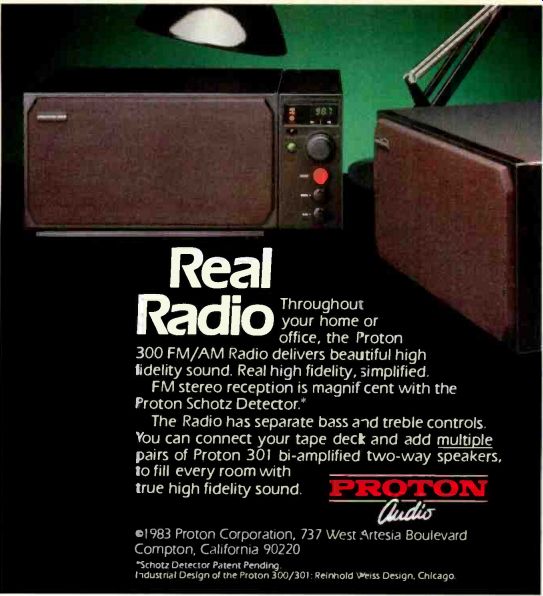
You can connect your tape deck and add multiple pairs of Proton 301 bi-amplified two-way speakers, to fill every room with true high fidelity sound.
Proton Corporation, 737 West Artesia Boulevard Compton, California 90220. Schotz Detector--Patent Pending.
Industrial Design of the Proton 300/301: Reinhold Weiss Design. Chicago.
Now you can awaken to beautiful high fidelity sound. Sound that's never before been heard in something others call a clock radio. But the Proton 320 is something else.
With separate bass and treble controls and a large, full-range speaker. Two independent alarms.
A clock memory so you'll always be on time, even if the power fails. And many more innovative features.
It's sound and time performance so advanced, it can only be a Proton.
Proton Corporation, 737 West Artesia Boulevard Compton, California 90220
Industrial Design of the Proton 320: Reinhold Weiss Design. Chicago.
==========
(Audio magazine, 1984)
More music articles and reviews from AUDIO magazine.
Also see:
= = = =