The annual Consumers Electronics Show will be held from June 28 until July 1 and the IHF will collaborate by organizing three seminars. These will deal with Trends in Sound and Music Reproduction, Marketing, and Business Techniques and they will take place at the New York Hilton on June 29 from 9 to 11:30 a.m. "Trends in Sound Reproduction" will cover the present and future of quadraphonic sound, and one of the panelists will be Len Feldman.
-- -- --
Opera Today Inc., an organization which is experimenting with new forms for opera presents its first New York production at the Armory, 56 West 66th St. from June 8 to the 14th. The opera(?) is called "Spatial Variations on a piece by Benjamin Britton" which involves a tenor and four dancers performing to a quadraphonic recording. It will take place inside a dome of translucent circles on which motion pictures and slides will be projected. The audience will thus be ‘enveloped by the presentation'. The initial recording was made at Sound 80 in Minneapolis because, says Artistic Director Patricia Collins, "It has the most advanced capability we know in recording quadraphonic sound."
------
"Who says no one listens to FM classical music stations?" asks Allen Rockford, of WONO, Syracuse, New York. It seems that this station had a week-end Marathon to raise funds for the Syracuse Symphony Orchestra and they finished up with more than $16,000--way above the $15,000 target. Contributions ranged from 6 cents donated by a two-year-old to three gifts of $500. Last year's figure was just over $10,000 so somebody out there must be listening ....
-- -- --
The Acoustic Research Contemporary Music Project was initiated some months ago and its purpose is to sponsor recordings of present-day composers whose works would not otherwise be heard.
The prospectus states "the aim of the project is to provide composers with direct access to as large an audience as modern technology can offer, and to give listeners an opportunity to hear music of today, chosen by composers on the basis of musical criteria alone." The first series, consisting of fourteen broadcasts and six records, will be available in September and will include works by Milton Babbit, Edwin Dugger ( both using synthesizers) , and contemporary chamber music by Stefan Wolfe,. Arthur Berger, and Peter Westergaard. The records will be made by Deutsche Grammaphon and the low price of $2 each is made possible by Acoustic Research assuming the responsibility of for distribution.
-- -- --
Altec Lansing held Spring Clinics for its sound contractors in three locations during April--Washington, Kansas City, and San Mateo--to familiarize them with their Random Access School System and other systems designed for use in hospitals. Further information relative to Acousta-Voicing, with particular attention to loudspeaker directivity patterns and efficiency, was presented as part of the company's training program in the many aspects of sound-system design. The Clinic was attended by over 100 at Washington, and similar numbers were expected at the other two locations. I have been lucky to obtain an article on The general subject from Altec's Don Davis, and it will appear in the August issue.
-- -- --
According to Schwann, the most popular classical record of 1969 was the Angel recording of Vaughan Williams' Sea Symphony (LPO and Sir Adrian Boult) . This symphony was often played as a finale in Gilbert" Briggs' live-vs.-recorded music demonstrations. At one affair in London's Festival Hall, there was not enough power available from the amplifiers to do justice to the tremendous climaxes, so for the last few minutes the recording was reinforced by the Festival Hall organ. In announcing this, Gilbert said, with a poker face, "You may have noticed the organ in the background-but what's 3 dB between friends?"
------
To those who still find themselves thinking in cps instead of Hz (I do myself sometimes) I append the following formula which I have jealously guarded for some months. It appeared originally in Electronics News and they claim it came from--of all people--the National Forestry Service!
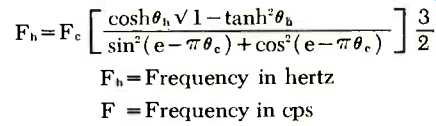
According to the NFS: it makes hertz to cycles conversion a "sinh."
-G.W.T.
=========
Dear Editor
A DC Loudspeaker
Dear Sir,
Robert Berkovitz, in his "Loudspeakers--Past and Present" ( Audio, April 1970) fails to mention the Direct Coupling (DC) Loudspeaker invented by Sanford Fisher and myself back in 1958.
An essential feature of the loudspeaker system was a tank of pressurized air (in excess of 300 psig) and vacuum pump. These were controlled by an elaborate arrangement of electrically controlled valves ( the prototype used valves from an old washing machine) which were energized by a sensitive integrator circuit ( using tubes, alas-transistors were still too expensive and unreliable back in those days!) which would open the valve connected to the air tank when the average d.c. level of the signal was positive, and would open the valve connected to the vacuum pump when the average d.c. level was negative. The design goal of the entire system was to have a valve response time of less than 1/40 of a second (25 milliseconds). Used with a regular speaker system that could reproduce down to about 20 Hz, the valve arrangement would extend the frequency response down to pure d.c.
We felt then (and still feel today) that flat response down to pure d.c. was essential for a hi-fi reproduction of wind and brass instruments, as well as organ music. When one stands directly in front of a trumpet player, for example, there is a steady flow of hot air which represents a d.c. wave. For utmost reproduction, we therefore must provide for d.c. reproduction in the entire hi-fi system.
Sadly, the Direct Coupling Loudspeaker never achieved the popularity we hoped for, primarily because engineers in the amplifier and recording industries never produced the other needed components with d.c. response-amplifiers, cartridges and cutting heads, and records. I am presently working on a complete recording chain capable of response down to d.c.
-PETER A. STARK, Mt. Kisco, N.Y.
I can well understand the reluctance of recording and broadcast engineers to throw out their transformers and coupling capacitors.... However, the DC response theory is an interesting one and it would seem to be a promising field for research.
My wife says "isn't it enough to have four loudspeakers in the room without having the hot breath of trumpet and tuba players down our necks?
-Ed.
=====
4-channels on earphones!
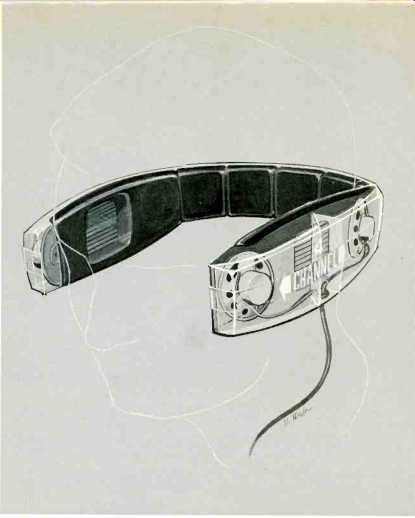
4-channels on earphones-without growing another pair of ears? Yes, it's true, the earphones shown above are not a dream--they really work! They were invented (and patented) by Jon Fixier whose original idea was to improve ordinary two-channel stereophones. He states "Stereophonic headphones suffer from one rather annoying characteristic, that is: the listener perceives the sound as emanating from the center of his head. Thus, while stereophonic phones do produce differential left-right characteristics, they do not produce a true panorama of sound." The original concept was to remedy this defect by using multiple transducers to produce a more spacious sound. Well, of course the reason why the sound is unrealistic with stereophones is simple: when you listen to two loudspeakers your left ear hears sound from both left and right loudspeakers and vice-versa.
Thus the sound is unnatural ( not so with true binaural signals--but that's a different story). Some years ago, Ben Bauer of CBS came up with a phase- and frequency-dependent crossfeed system that mixed the two channels and restored the status quo.
(See Audio, November, 1962 ) However, the multiple transducer system was a definite improvement-probably because of acoustic mixing, and it was natural that the inventor should turn his attention to the possibilities of 4-channel sound. Various methods were tried but the illustration above shows the final version. The dynamic transducers are mounted on a sub-panel and the sound travels round the front and then out via the small grille. A partition is mounted at the rear of the speakers to act as a separator. It is a little difficult to see how the system works but it is claimed that is possible to localize sounds coming from a room (in which are placed four microphones) with a high degree of accuracy. As soon as production samples are available, we will carry out complete tests and will publish our findings. Until then, those enthusiasts who really must listen to quadraphonic sound on earphones will have to use two pair!
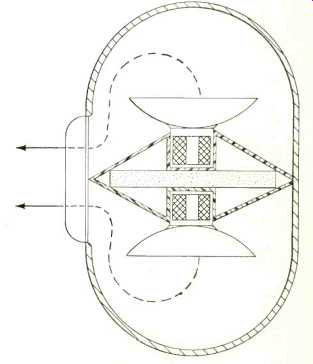
Fig. 1--Taken from the patent specifications of the original two-channel
version. The drawing shows one earphone with two transducers, one of which
can be used to inject signals from the other channel to reduce the left-right
effect. Transducers are apparently closed-back types and the low-frequency
response will be somewhat attenuated
====
ADs:
A lot of people don't know that a cartridge that's great for one high fidelity system could be disastrous for another.
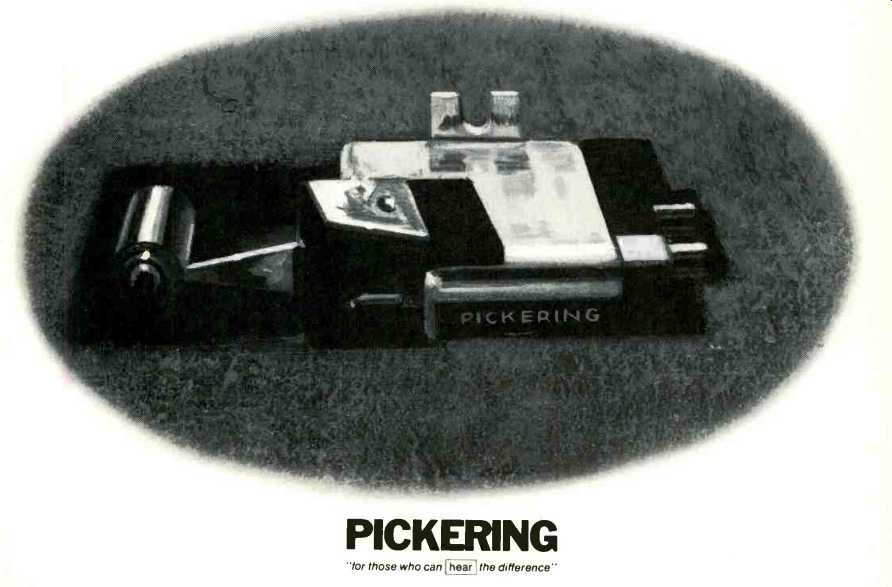
That's why Pickering has done something fantastically simple.
We've developed Dynamic Coupling Factor--henceforth known as DCF. All it is is a complicated name for an uncomplicated way to select the best cartridge for your system.
It is your guide to the selection of that cartridge based on its intended application in playback equipment--just as horsepower is the guide to the proper engine for a vehicle.
It works like this. You own an XYZ model record changer. What cartridge do you pick? Not the $29.95 model because it isn't designed for the capability of your XYZ player. Not the $60.00 cartridge either, for its quality cannot be realized in that unit.
Our chart-available to you free-reveals that you need our model XV-15 with a DCF rating of 400 for optimum performance. This means that you will get 100% of the music from your records. Not 50% or 75% but all of the music capable of being obtained from your particular playback unit.
Technically, what we've done is taken virtually every high fidelity record player and pre-analyzed the vital variables for you; those affecting cartridge design and those related to the engineering features of the various turntables and changers.
So now all you need to be well informed on cartridges is to send for our DCF application guide containing our recommendations for what cartridge you use with which record player.
And next time you walk into a high fidelity salon, tell the man: "I'd like a Pickering XV-15 with a DCF of 400." Or whatever.
Pickering cartridges are priced from $29.95 to $60.00.
For your free DCF chart, write DCF, Pickering & Co., 101 Sunnyside Blvd., Plainview, N.Y. 11803.
PICKERING -- for those who can hear the difference
---------------------
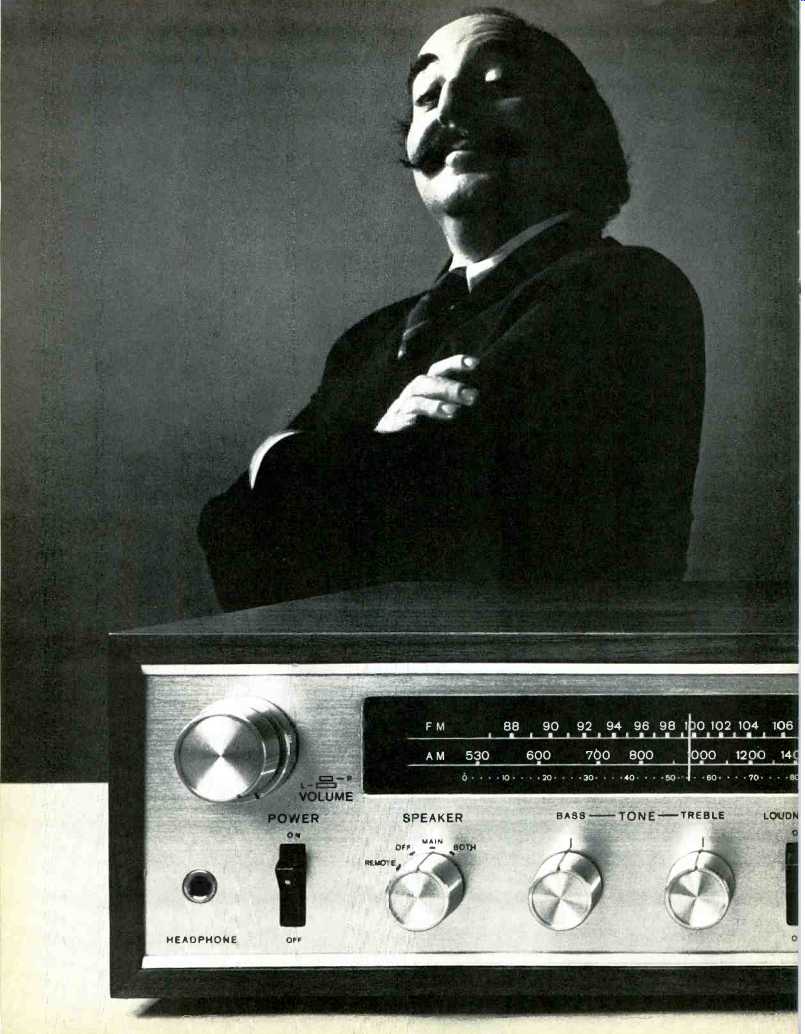
Introducing... The Stereo "Deceiver"
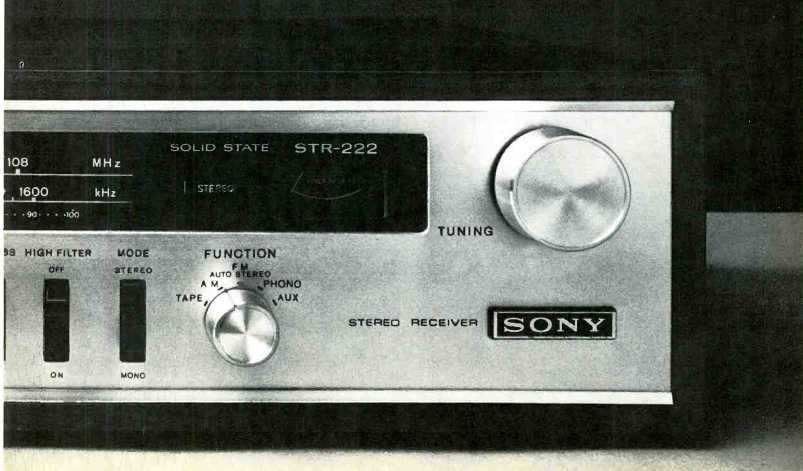
It looks straightforward enough. But, the clean front panel of the new Sony 222 FM Stereo/FM-AM receiver hides a simple, but effective circuit. A tuner section sensitive enough (2.0uV for 30dB quieting) to bring in even the weakest stations free of distortion. An amplifier that puts out 24 watts IHF at less than 0.8% distortion both channels operating into 8 ohms. Plenty of power. And a frequency response of 20 to 50,000 Hz + 3dB for clean reproduction from the bottom to the top of the audible spectrum.
The Sony 222 is devoid of frills. But all of the essentials are there-even a few essential extras like speaker selector.
switch, a signal strength meter, a high filter, a stereo indicator light and a stereo headphone jack.
Now the grand deception. The S149.50* price which includes the walnut case. It's far less than you would expect to pay for such performance. It sort of makes purchasing the Sony 222 a rather straightforward decision.
Sony Corporation of America, 47-47 Van Dam Street, Long Island City, N.Y. 11101
Suggested List
SONY 222 FM STEREO/FM-AM RECEIVER
---------------------
BACK TALK
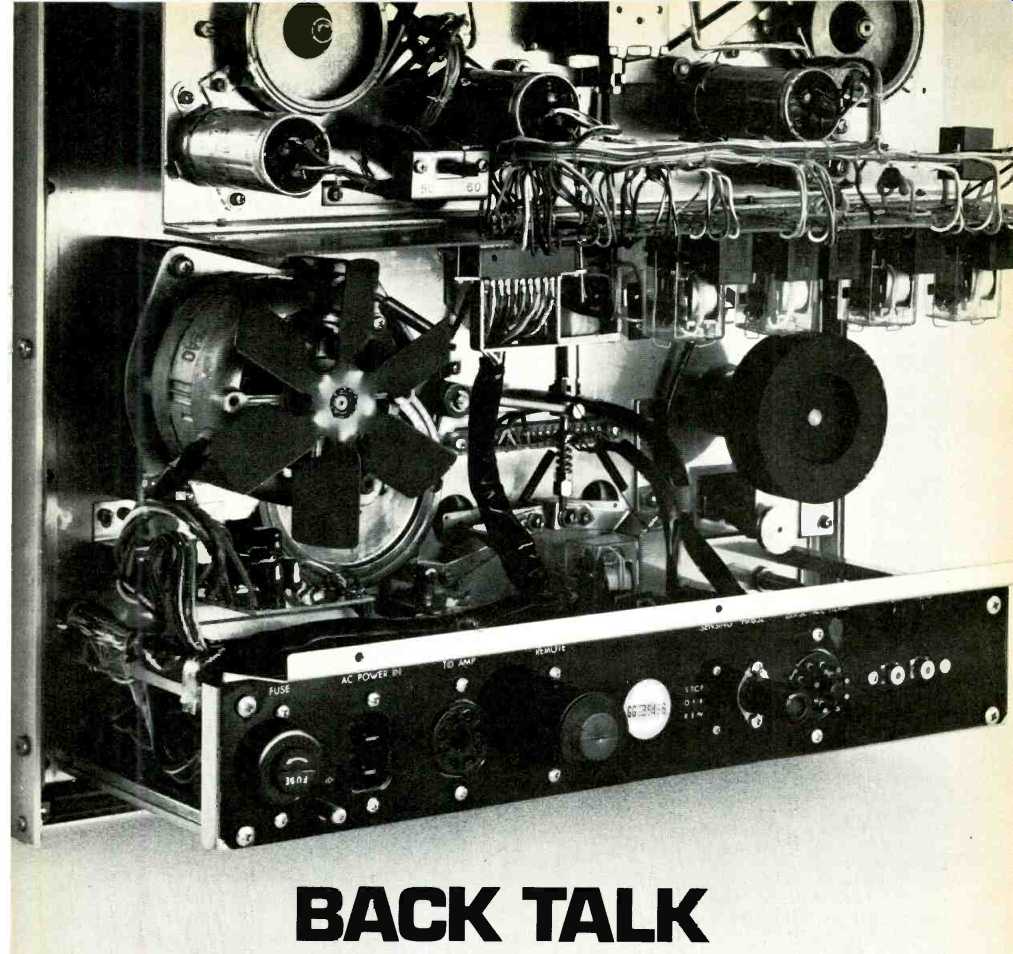

When it comes to building sound equipment from the inside out, you could call us the component company. You see, we're one of the few tape deck manufacturers who make all our own critical components from heads to motors and most of the electronics.
After all, who knows better than we do what it takes to make a TEAC?
For instance, our heads are hyperbolic, not conventionally rounded. This means more intimate tape contact, less tape tension, better sound reproduction. Hyperbolic heads are the shape of things to come and the only kind we'd think of using.
Meanwhile, we still buy outside parts for certain purposes. The ones we buy, we buy because they're the best. The ones we make, we make because they're the best.
And most of the time, we've got it made.
TEAC
TEAC Corporation of America
2000 Colorado Avenue, Santa Monica, California 90404
-------------------
Sony
How to recognize a stacked deck.
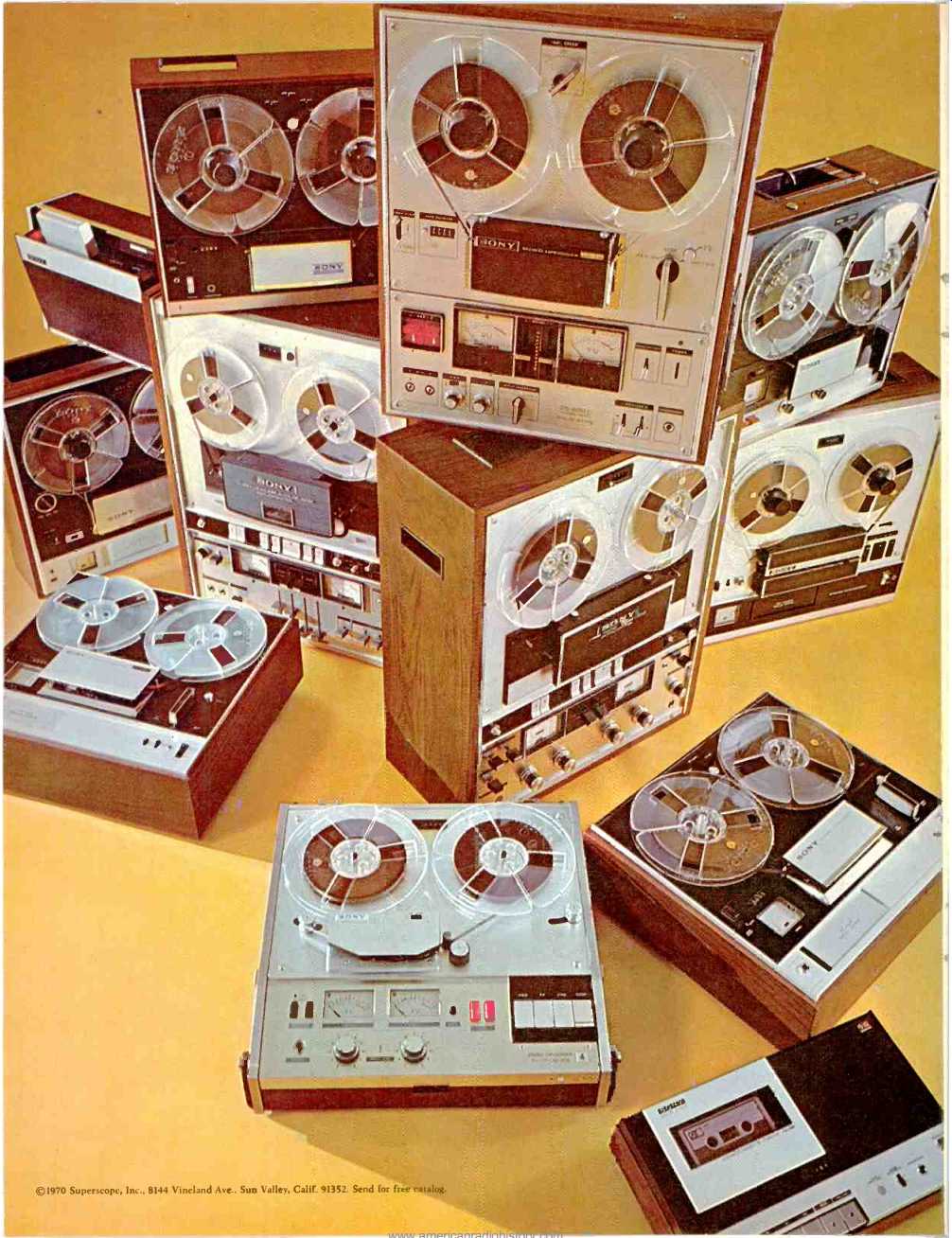
No matter how elaborate your home stereo sound system is, it's incomplete without a tape deck. And Sony/Superscope brings you the most complete line of stereo tape decks in the world. Decks that fit all pocketbooks, that suit particular systems, that meet specific needs. And every Sony/Superscope deck-regardless of price-is the finest money can buy. Each instrument is flawlessly crafted, with rigorous testing at every step of construction. Then each instrument undergoes a complete series of quality assurance tests-performed by skilled technicians at one of the most modern and sophisticated tape-recorder test facilities in the world. So you may be sure that the Sony/ Superscope product you purchase will give you years of trouble-free service.
The Sony/Superscope deck that's exactly right for you is at your dealer's now.
SONY SUPERSCOPE. You never heard it so good.
----------------
Stanton
THE CARTRIDGE KILLER.

This man doesn't have time to baby the tools of his trade. Not with a commercial, a traffic report and time check breathing down his neck. He's got to keep those records spinning fast and furious. And, if he kills a cartridge or two along the way, well that's how it goes Until now.
Meet the Stanton 500AL-the cartridge that's tougher than disc jockeys. Here is the workhorse of the broadcast industry. We designed the entire stylus assembly to withstand the rugged demands of back cueing and the kind of handling that would quickly ruin ordinary pick-ups. Yet its high restoring force and tracking reliability is accomplished without sacrifice of professional standards for frequency response, output, channel separation, etc.
The Stanton Model 500AL is just one of many cartridges engineered by Stanton for the varied and critical applications in the fields of broadcasting and recording. For nothing less than Stanton performance and reliability would meet the needs of the engineers who have made Stanton
-The Professional Standard.
For free literature write to Stanton Magnetics, Inc., Terminal Drive, Plainview, L.I., New York 11803
---------------
Number 80 in a series of discussions by Electro-Voice engineers

THE COMPUTER TURNS THE CORNER
JOHN R. GILLIOM
Chief Product Engineer, Loudspeakers
Almost all audio design engineers agree that--given the state of the art-a straight trumpet will outperform a re-entrant trumpet of the same effective length and flare. This is because re-entrant horns invariably exhibit losses at some point due to cancellation of energy at the bends of the horn.
But our first experience with computer-aided horn design indicates that most of the problems associated with re-entrant horns result from imperfect translation of standard horn formulas to actual products.
Optimum energy transfer is achieved when the horn flare follows precisely the desired formula (hyperbolic, exponential or other). But folding a horn twice presents a formidable problem in layout to achieve this end. For instance, literally hundreds of calculations are required to achieve a single bend-yet these are necessarily based on a gross approximation that can only be refined by repeating the calculations again and again.
As a result, most horns are actually compromises between the ideal theoretical shape and the practical limitations of available design time. Obviously, where extensive computation is needed for design, the computer becomes an essential tool.
In order to utilize the computer, a two-stage program was written, taking into account every basic design parameter. Included were throat diameter, overall diameter, overall depth, material thickness, inner tube length, surface characteristics, desired flare rate, number of bends, etc. Once all these factors agreed with the basic design objectives, the computer then was asked to print out coordinate points for the surface boundaries.
These dimensions were stated in a specially-devised format that permitted easy translation by a draftsman into a finished drawing. In this way, the Electro-Voice PA 12 paging horn was born.
Laboratory tests showed a dramatic improvement in measurable sound characteristics when compared with conventionally designed horns of this class. In addition to smooth high frequency response and higher level (especially at high frequencies and at cut-off) intelligibility was markedly improved. It is interesting to note that these performance gains were made without an increase in cost.
Aside from the period needed to write the basic program, design time for the horn of the PA12 was dramatically shortened. The final printout of dimensions took only 11 minutes of terminal time, using up just 31 seconds of computer time. It is anticipated that further use of the basic program for other horns will provide similar benefits for the complete family of E-V re-entrants.
For reprints of other discussions in this series, or technical data on any E-V products, write: ELECTRO-VOICE, INC., Dept. 603A 602 Cecil St., Buchanan, Michigan 49107
A SUBSIDIARY OF GULTON INDUSTRIES, INC.
-------------------------
Garrard introduces an automatic turntable especially for the discerning poor.
At Garrard, we recognize that as high fidelity components have become more refined, they've also become more costly.
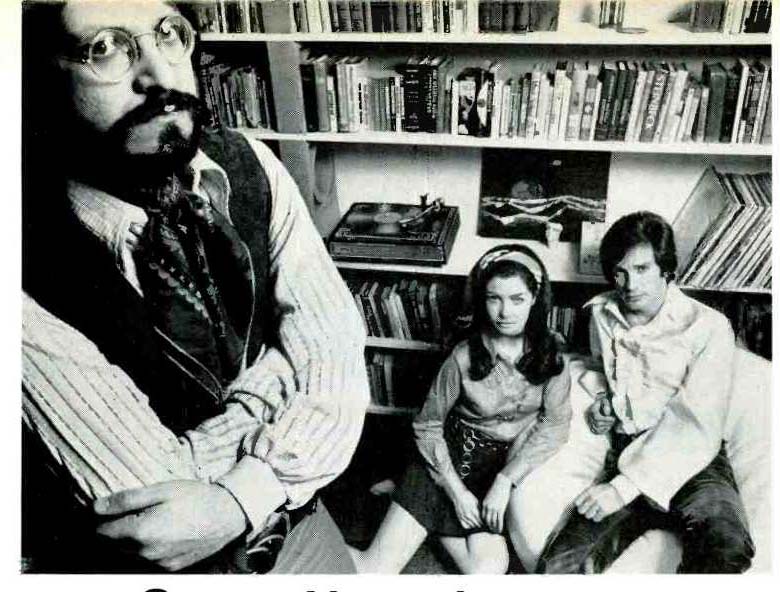
As Alan Say, our Chief Engineer, puts it, "A house, a motor car and a stereo rig are the three weightiest purchases many chaps make in a lifetime.
"And, today, it can be a toss up as to which is number three." Unfortunately, there are those with an ear for good music, and the desire to indulge it, who are not blessed with limitless means.
For them, we offer the SL72B. At $89.50 it is, without question, the world's greatest value in an automatic turntable: Son of SL95B Our SL72B is a slightly modified SL95B, at present the most highly perfected automatic turntable you can buy--regardless of price.
The turntable is a bit smaller, the tone arm is simplified, and we've eliminated the ultra-precise counterweight adjustment screw.
But the 72B has the same revolutionary two-stage synchronous motor as our 95B. With an induction portion to reach playing speed instantly, and a synchronous portion to guarantee unvarying speed.
It has the same patented sliding weight anti-skating control to provide permanently accurate settings.
It has the same viscous damping of the tone arm descent in both manual and automatic play. And can be cued in either mode.
It has the same two-point record support, a Garrard exclusive that assures the gentlest possible record handling.
All in all, a degree of refinement quite impossible to find in any other turntable near its price.
Mass produced, by hand Despite our place as the world's largest producer of component automatic turntables, Garrard steadfastly rejects mass production methods.
At our Swindon works, final assembly of the 72B, like the 95B, is in the hands of nineteen men and women.
Hands, not machines.
Each person who assembles a part, tests that finished assembly.
And four of every nineteen final "assemblers" do nothing but testing.
Before each unit is shipped, it must pass 26 final checks that cover every phase of its operation.
Thus, remarkably few compromises have been made to achieve its remarkable price.
$40 saved is $40 earned Still, the 72B is not the ultimate automatic turntable.
Our 95B bears that distinction. But at its price of $89.50, the 72B represents a saving of $40. A significant difference to all but the affluent.
To quote Alan Say, "If a penny saved is a penny earned, $40 is a bloody raise in pay.
"The 72B is the automatic turntable with almost everything for the man with everything save money." From Swindon, with love The care that goes into a Garrard is preserved by a heritage that often spans two and three generations at our works in Swindon, England.
That care does not vary with turntable price.
You can select with confidence from six component models starting with the 40B at $44.50 and running to the SL95B at $129.50. Your dealer can help you match a Garrard to your system.
British Industries Co.
---------------------
= = = =
(Source: Audio magazine.)
Also see: Editor's Review (July 1970)