Audioclinic
Joseph Giovanelli
Maximum Volume Control Setting Versus Power Output
Q. I own a four-channel synthesizer which controls both the amplifiers of my system. If each amplifier is set at full volume and if all volume is controlled via the synthesizer, do the amplifiers heat up and produce their average amount of distortion as if they were playing at full volume constantly? Or is the distortion and "wear and tear" on the amplifiers a function of the volume determined by the setting of the control on the synthesizer?
-Richard Bearoff, Carlisle, Pennsylvania
A. The fact that you set the volume controls on your power amplifiers to their maximum settings has nothing to do with their producing maximum power. The power delivered by any amplifier is determined by the amount of actual signal present at the input of the amplifier. This input signal is determined by the amount of signal produced by the preamplifier. What I am saying is that if the volume controls of the power amplifiers are turned up fully and if there is no signal presented to their inputs, the amplifier will not generate any significant output power.
The only signal it will produce is its own internal noise, present in all electronic equipment. This noise is generally so low as not to be heard in the loudspeakers. Fully advancing the volume means that if the synthesizer produces one volt of signal, this voltage will be fed unattenuated into the input of the power amplifier. If it happens that one volt is needed to drive the power amplifier to full output, under the conditions I have described, the amplifier will deliver its maximum output power.
When the volume control of the synthesizer is reduced so that it is now supplying 0.1 volt, however, the power amplifier will produce considerably less power output than its maximum possible output, even though its volume control is set to its maximum clockwise position.
If the volume control on the power amplifier is tuned down, the amount of voltage supplied by the synthesizer is attenuated before it can affect the power amplifier. Again, if we have a power amplifier which is capable of maximum rated power output at a signal level of one volt, and if the synthesizer is producing this one volt, the amplifier will now not produce full output power because its volume control has been set lower than maximum.
Therefore, the power amplifier is receiving less than the full signal from the synthesizer.
While what I have said is true, there may be other considerations which would keep you from setting your power amplifiers' volume controls to their maximum clockwise positions. If the synthesizer produces noise (as all electronic gear does) and if your power amplifiers have fairly high gain, this noise might appear as a high in the loudspeakers all the time, regardless of the setting of the controls of the synthesizer. The noise can be reduced by decreasing the volume control settings of the power amplifiers to a point where the hiss just disappears.
If the two power amplifiers are of different manufacture, their characteristics may be different enough so that, with their volume controls wide open, each would produce a different amount of output power, given the same input signal voltage. The result would be channel imbalance. You would have to correct for this by adjusting the volume controls of the "stronger" power amplifier.
Degrading of Electrolytic Capacitors
Q. Is it true that electrolytic capacitors wear out gradually if left in a non operating condition? Such could easily be the case with consumer-type electronic audio gear which may not be operated for extended periods of time. How insidious for an amplifier to wear out just sitting there-say, perhaps in storage, for a considerable length of time!
-Steven Heinisch; Prior Lake, Minnesota
A. When an electrolytic capacitor is not used, most of the time its capacitance does not change much. Its voltage breakdown point, however, will gradually fall. This fact can cause trouble when a piece of equipment has not been operated for long periods. In some instances, the capacitance may also decrease.
+++++++++++++++
Tape Guide
Herman Burstein
Connecting Heads
Q. Would you tell me the best way to connect two record heads to one recording channel? Should they be connected in series or parallel, and is an isolation network necessary? Please inform me if there would be problems such as insufficient record or bias current.
-John K. Behrens; Eagle Pass, Texas
A. I would advise against connecting your record heads either in parallel or series because of problems of bias and signal current. It seems that the logical thing to do is to split the audio signal and feed it through isolating resistors to each recording head. The proper value of the isolating resistor would depend on the impedance of the record head. Perhaps you can determine this experimentally or with the aid of the tape machine manufacturer.
You will have to compensate for signal loss due to the isolating resistors, and this in turn will require readjustment of the record level indicator, unless the audio signal is split at a point prior to the indicator. Finally, you will have to make provision for feeding sufficient bias current to the extra record head.
Three Motors
Q. I would like to obtain information on the advantages and disadvantages of three motors in a 3-head tape deck over a single motor in a 3-head deck. Is the much higher price of a 3-motor tape deck really worth it?
- I. R. Ligon; Toronto, Ontario, Canada
A. From the point of view of performance, a 3-motor tape recorder offers little if any advantage over a high quality 1-motor unit. In fact, if the machine is to be portable, the 3-motor unit is at a disadvantage, being heavier.
On the other hand, a 3-motor recorder does tend to be more rugged and better able to withstand the full-daily kind of use that a commercial recorder is exposed to. Usually the 3-motor unit has faster, and perhaps smoother, rapid wind. Also, it tends to be a less complex affair in mechanical respects, therefore less subject to breakdown.
All-in-all, though, for home use, a well-made 1-motor recorder appears to be quite adequate for high fidelity. Some of the most highly regarded home machines have but one motor.
1/2 Mil Tape
Q. I have been taping operas from the Saturday afternoon broadcasts onto an Ampex 2100 tape deck, using Irish 1/2 mil polyester tape. I have noticed that, contrary to the manufacturer's claim, after a year the recording deteriorates and develops what I call "warbles" in the treble range. The effect is sometimes startling. I have taken the matter up with the distributor, but with no satisfaction. I should add that in general the tapes play back many times without apparent deterioration; the problem occurs only after a year, and does not discriminate between often or seldom used tapes. I plan to switch to either 3/ 4 or 1 mil polyester tapes in the hope that this may help eliminate the undesired sounds. It will be quite a job, as I have over 30 operas nicely taped and edited Any suggestions you can offer to help me build up a permanent library will be mast appreciated.
-John A. Stees, Mainland, Pennsylvania
A. It seems that 1/2 mil tape of any brand is a good thing to stay away from. The NAB (National Association of Broadcasters) standards state that 'h mil tape is "not recommended." Therefore I suggest that as quickly as possible, before deterioration sets in, you transfer your valued recordings which are still in good shape onto 1 mil or 1 1/2 mil tape of good quality.
Note:
Mr. Ivan Berger (of Popular Mechanics, New York, N.Y.) points out a "goof" in my answer to Mr. Jose F. Reyes in the March issue. He states that since the Sony TC-100A and Crown CSC 9350M are both cassette recorders, "they're perfectly compatible. Stereo cassette recorders have both tracks of each stereo pair side by side, covering the same area. So both stereo heads will automatically read the mono track, and a mono head will automatically read both stereo ones." Correct, of course!
-H.B.
++++++++++++++++
Behind The Scenes
Bert Whyte
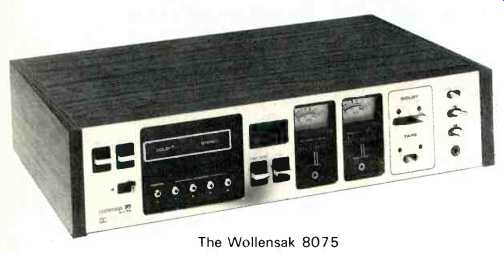
------The Wollensak 8075
THE 1973 Consumer Electronics Show in Chicago, the 3M Company demonstrated a prototype 8-track cartridge recorder featuring Dolby B noise reduction and new circuitry to utilize a special high performance tape formulation. This unit is now in regular production and is available as the Wollensak Model 8075. I have been using one of these recorders for some months now, and it is obvious that it represents a significant step forward in 8-track cartridge technology.
Since its introduction in 1965, the 8-track cartridge has been the predominant medium for car stereo. In the past several years, a steadily increasing number of people have been installing cartridge playback units in their homes, thus getting "double duty" from their commercially recorded cartridges. While this made economic sense to these people, they soon found that the playback of cartridges in the home revealed sonic flaws in this medium which were not apparent in the much noisier environment of their cars. The principal problem was, of course, the poor signal-to-noise ratio with its obtrusive tape hiss, along with restricted high frequency response and some distortion. The quieter ambience of the home also made any wow and flutter problems more obvious.
The 8-track cartridge was designed as a playback medium, but as is common with all magnetic tape formats, people soon wanted the ability to record their own programs. Thus the 8-track cartridge recorder came into being and since the cartridge is an endless loop configuration, with four 2-track stereo sequences, on the early models there were timing problems.
To be frank, those original cartridge recorders were so difficult to use, and the results so mediocre, that "rolling your own" cartridges simply wasn't worth the trouble. Nonetheless, some companies persevered on the idea of a cartridge recorder, principally Telex and Wollensak. While improvements in these units were slow in coming, I think it is safe to say that they have reached their culmination in this Wollensak 8075, and have finally made cartridge recording a practical proposition.
The Wollensak 8075 is an attractive looking unit, with all controls easy to handle and in practical groupings.
There are many refinements and little niceties to make life easier for the cartridge recordist, but let's look at the principal features. Foremost, of course, are the Dolby B noise reduction facilities. There is a three position switch in the Dolby section.
In the record/play position, a red signal light indicates the Dolby circuit is active in either mode. Dolby record and playback levels are factory preset. A check with my Dolby reference level cartridge revealed the playback to be "right on the money," with left and right meters indicating exactly 0 VU. The "off' position of the switch affords normal non-Dolby record and playback. The third position of the switch is for FM decode and record.
Yes, the 8075 "gilds the lily" by enabling the decoding of Dolbyized FM broadcasts. On the rear of the unit are left and right channel Dolby FM calibration controls. When the FM station broadcasts its 400 Hz Dolby tone, the controls are adjusted to read 0 VU on the meters. When recording a Dolby FM program, the switch is in the FM decode position. If the Dolby record/ play position was used, you would be Dolbyizing a Dolby signal ... and that is a "no-no." All Columbia cartridges are now Dolbyized, as are some selected Ampex cartridges and as played back through the 8075, those I auditioned were impressively quiet.
While the recorded Dolby music cartridges were of generally good quality, the most satisfying sound quality resulted from recording my own copies of Dolby "A" open reel tapes.
On a more usual home recording activity, I was really impressed by the excellent sound of the Dolby cartridges I made of some high quality disc recordings. The Wollensak 8075 has a tape equalization switch for regular "high output/low noise" cartridges and a position marked "special" for the new 3M super high performance cartridges. No details of the "special" tape oxide are available, but presumably it is some variant of the new high density gamma ferric oxides now coming into vogue. In any case, with the machine set up for the specific bias and equalization of the tape, the performance is very high indeed. How about 30 Hz to 15 kHz, ± 3 dB for a cartridge? 3M has used a B and K '/3 Octave Analyzer to show that the new high performance tape is better than 10 dB over regular tape at 16 kHz! This special 3M cartridge is in very limited supply at the moment. 3M did supply me with some however and, when used in conjunction with the Dolby noise reduction, the recordings are really outstanding. The sound in all cases was clean and wide range with little or no distortion. And of course ... blessed thing in a cartridge ... virtually no tape hiss. How quiet is the 8075 with Dolby? Better than 60 dB at 4000 Hz and above, better than 59 at 2400 Hz, better than 56 dB at 1200 Hz.
The Model 8075 has illuminated VU type meters which read record and playback. The recording level controls are of the slide type. It is best not to trust the markings on the panel to set levels. Wollensak recommends using a mono signal, which is all right, but it is better to use a discrete frequency tone. For example, when recording phono discs, I used the CBS Labs STR 100 test record, which has left and right 1000 Hz 0 VU @ 3.54 cm/sec. reference levels. I found that you cannot set the meters at 0 VU or overload will result from average level discs. With levels set at minus 3, S/N was optimum, distortion not apparent.
As mentioned before, timing and fitting of program material to the four stereo sequences has always been a tricky thing with cartridge recorders.
While this problem has not been completely resolved in the Model 8075, sequencing has been greatly simplified.
There are two switches for AUTO EJECT and REPEAT which work interdependently. Logic circuitry is incorporated here and, depending on the position of the switches, there are various play and record options. For example, with REPEAT switch On position ONE, the machine will record the selected track and then eject. If the REPEAT switch is in the ALL position, the cartridge will be recorded tracks one through four in sequence and then eject. Of course there will be the switching click, and very minute loss of signal as the machine switches from sequence to sequence. In addition to the eject/ repeat logic there is a digital counter registering in minutes and seconds.
If you are a real stickler for timing accuracy and maximum utilization of sequence tape length, you can use a technique I used to sequence cartridge masters at RCA. I should add that this works only with typical pop recordings which are banded on each side of the phono record. Classical works require a much more complicated process with special equipment.
In any case, assume a 60-minute cartridge, which ideally would mean four 15-minute sequences. Figure on 14 min. 50 second sequences as more realistic and manageable. Now add up the total time of the selections on the record.
If the time is more than the total length of the cartridge, eliminate a selection whose time is enough to bring the total below the required time span. Now it will not be possible to record the selections in the same order as they were on the disc recording.
Choose a group of selections which total in time as close as possible to the 14 min. 50 sec. sequence. Now record the disc onto open reel tape, preferably with Dolby noise reduction. Each selection on the disc is separated by a 5-second spiral, which naturally will be blank on the tape. By editing the tape to the groups of selections you have chosen and then deleting or adding blank tape between the selections, you can usually bring each sequence to the exact timing. After assembling the tape, it is then recorded onto the cartridge. An admitted pain, but in this way you won't cut into any of the music.
The Model 8075 also features a fast wind facility. I can see the value of this, but my personal feeling is that this upsets the conformation of the endless loop tape pack and can give rise to audible wow and flutter. Incidentally, the Model 8075 has a wow and flutter spec of 0.1% weighted rms, which is about par for most cartridge machines. Unfortunately, part of this spec is dependent on how good the cartridge itself is in terms of free tape flow. Far too often, the combination of the machine and the cartridge add up to audible wow.
The Wollensak Model 8075 has many other exemplary features that make for easy handling and good quality recording. This may raise the hackles of the companies which issue recorded music cartridges, but with the quality of this unit, it sure is nice to record your own programs, especially for use in a car. The Dolbyized cartridges played on non-Dolby equipment in a car sound fine, because if the hiss seems excessive, you can turn down the treble control, which gives you a form of noise reduction without losing highs.
All in all, the Model 8075 is a fine example of the new breed of cartridge recorder.
+++++++++++++++

---- The B&K 1/3-Octave Analyzer display indicates the peak music at each 1/3 octave. Top photo shows display with Scotch brand High Output Low Noise tape.
Bottom photo shows display with new Scotch brand Special High Performance tape, which was found to be better than 10 dB over regular tape at 16 kHz.
+++++++++++++++
Audio-ETC
Edward Tatnall Canby
Signals and Noises
IF A NOISE annoys an oyster, will it annoy me? What is noise-would the noise that Dolby eats up, and Burwen and dbx, be a sound an oyster might enjoy? If I seem mixed-up, it's because I have a pair of noise treaters on hand, one of them a batch of words, treating noise, and the other a consumer type box, the same. And so different! How could I help but think of the oyster.
A play on words is one thing and a noise another. The audio man has a nice, pat definition in front of his nose when he sets out to treat what he calls noise. But move yourself a millimeter away and you are into philosophies and aesthetics, into music and non-music, and into a great deal of noisy hot water. Oyster stew. What is noise? Ever tried out music on a dog or cat? No reaction, though a dog may raise a questioning ear to a speaking voice in the loudspeaker. The cat, like the oyster, just looks annoyed. Yet try a fire siren on your dog and get his reaction--nine out of ten docile house puppies turn instant wolf and let out gut-tearing wails of grief-or is it joy? Hard to tell. You should hear them in New York City, right out of the steppes of Russia or maybe the Alaskan North Slope, where they recorded that marvelous wolf-howl disc. Something atavistic in this sound. Back to primevality. Noise? Not for a wolf. Not for a dog, nor for me.
There's wolf in every human being.
First time I played that wolf howl in my living room, all by myself. I rar'd back and let go with my own wolf howl, right in sync. It felt good. It belonged in me and out of me, the call of the wild, the clan, kindred souls communicating! Enough to stand the hair on end. I think maybe this is the original of the art of singing, which is a major part of music. Controlled wolf howl? Probably. Just as language is controlled bark, whine and growl.
I am a real wolf, I guess. Old hound dog near me in Connecticut; on a still night he sends out his CQ challenge, WOOF, wowowowowow, and waits for an answer. Sometimes I answer him, and I can hear the pleasure in his next, which is perceptibly higher in pitch.
A fellow soul! Good doggie.
I think the most useful definition of noise in this area, as in much else, even in audio, is non-communication.
Noise, practically speaking, is meaningless sound. Meaningless to whom? Can't get out of it that easily, you see. If I can communicate with a dog, can you communicate with Stravinsky? One man's noise is another's communication.
What kind of noise, then, do we selectively reduce in audio equipment designed for the purpose? The audio circuitry leaves the wolf howl untouched.
Also Stravinsky. That is signal, not noise. Communication, you see, is directly at the nub, in the very meaning of the word signal, clearly related to signify. It means something. If we agree on any aspect of noise, it is that we do have common modes of intercommunication in sound and it is these which provide us with signal.
Noise has been defined and redefined and it is amusing to see how self-serving all such definitions are, in the name of objectivity. Words are that way-they fill a need. They define things after the fact. First the fruit and then the apple. What is a tree? That's a tree, right over there, though its prehistoric forebears had no name at all and didn't mind in the slightest.
How do you define a hill as contrasted to a valley? Nature couldn't care less, and the only boundaries between the two are man-made and man-thought.
Nature is, man defines.
And so in audio, noise is the meaningless, therefore the unwanted, stuff, unwanted for whatever reason-as opposed to the wanted, the significant signal. Ours not to reason why. (Ours but to do and die!) That's good engineering. Further, noise, generally, is electronic "sound" that leaks in or generates itself uninvited additively.
Or destructively. Yet the signal can be noise. We generate it in shades of pink, white and gray, in fine contradiction. Nobody yet, to my knowledge, has hooked up a Dolby A noise reduction unit to a white-noise generator to see which could outdo the other. The reason is clear enough if you understand the "wanted" in our field is interchangeable with "original," both being signal rather than noise. But as you'll see, even here we walk on eggs.
I have here those pages of noise treatment, from a correspondent who has come at me from so many angles I haven't always realized he was one and the same, Morris Knight. Look back in March, p. 88, and you will find my capsule review of New York Brass Quintet Plays Knight, on the Now label. I used the word noise. Mr. Knight isn't sure I made my meaning clear, though he does think my (75 word) review was "thoughtful and well written" which, considering I said his music contained "vast stretches of chicken-like cluckings and scratchings," was rather decent of him, you'll admit.
I liked it. "Such a range of brass noises you'd never guess," I said.
Well, I knew what I meant, though not according to any audio definition.
This was brass music with (a) un-pitched sounds-grunts, clucks, burps. In music, noise often means unpitched sound.
And (b) non-standard, i.e., new and novel sounds not in the normal brass communication, over and beyond the expected musical language-hence, noise. Hmmmm. Yes, I'll stand by it.
Maybe "brass sounds" would have been more neutral; but also less descriptive.
You see what is involved in writing capsules. Words work overtime.
Mr. Knight sent me three pages of his own comment on noise, plus two in duplicator purple, noise definitions.
"People do not like noise. By definition it is unwanted sound." Cyril M. Harris, Ph.D., Handbook of Noise Control, 1957. So noise is undesirable sound? Too sieve-like, that definition. "Noise, in a sense, is the totality of all sounds within the range of hearing to which attention is not directed" My italics.
-Joseph L. Hunter, Acoustics, 1957.
O-ho-so that's why I always say that background music for my ear is so much noise. A new factor, attention vs. inattention. If you don't attend, you don't communicate. Tell that to Dolby! So you see what I mean. All this is very subjective.
How about distortion? Distortion is noise, if you will, when it is added to or alters the signal or the signal perception. (Those two are different.) My first reaction, years back, at the time of the sudden appearance of the pocket "transistor" on our streets, parks, on the beach, was that suddenly, here was a wanted distortion, tolerated, invited, yet monstrous in terms of audio measurement. Small power, large overload.
(Less in recent years as improvements have come along and power is greater.) People who carried these radios invariably turned them up far beyond the overload point into the agonized scream range. Did they wince? Of course not! This was desirable sound, if mainly for status. (But isn't plenty of hi fi that?) So look out-noise can be signal; so can distortion. The fuzz generator. One begins to wonder whether the "original" is getting to be no more than raw material, like the "original" of a multitrack pop recording.
And there's John Cage. A ballet, with deliberately overdriven loudspeakers squalling a hideously distorted live piano pickup. I groaned, but I got the point. Or his music for thirteen (?) radios, randomly and simultaneously tuned on stage, another thought-provoker and another kind of noise-or signal. Randomness. Is it communication? He makes it so, and he is right.
Nobody is ever bored by Cage. Though, like the oyster, we are often annoyed.
Now Cage could be called esoteric or avant-garde but you can't call a transistor radio esoteric. And so I've long thought that its squeal is the finest walking illustration I know of the meaning of music, art and entertainment, and the best paradox around, too.
Morris Knight goes me one better.
"The sound of surf and wind at an ocean beach can only objectively be measured as noise (it very much consists of non-period pulses, therefore non-pitched) (See?), yet populations as far as recorded history discloses have particularly sought this sound (noise?); furthermore, it has often been described as a curative." Can one imagine having this "noise" cut off at a beach? As a matter of fact, a radio playing "music" at the beach is often a very great intrusion ... it becomes unwanted "sound." Good! And what about a crowded beach where a dozen (or thirteen) radios compete for air space to the point of What? Meaninglessness? Noise? All Cage did was to take that idea into the concert hall and ask you--what about it? This sound, too, exists. It is.
You name it. And so we have enough of a paradoxical jumble here to last a month. As for me, on the beach, I want the ocean sound and I hate the radios, singly or in multiple, clear or distorted.
I go there to absorb sun and listen to white noise. White signal? Maybe it's just as well that engineers like those at Dolby, Burwen and dbx stay strictly inside their audio technology-which is where I will confine myself from this point on.
Sitting on my table, underneath Morris Knight, is the "signal preserver" that started all this fuss, the dbx 154, all function and no aesthetics. Except in the looks. A small box, 9 x 10 and weighing nothing much; yet inside there are four discrete channels of highly sophisticated dbx signal preserving.
Each is controlled by three simple push buttons, no more, REC, BYP and PLAY. That's all. Code-in, decode-out or bypass. The dbx 154 is "top of the line" in a new configuration of dbx equipment designed to complement the quality "home" or semi-pro recording equipment still burgeoning all over.
There are other models for different needs but all share one really unique feature. These noise reducers are compatible with all existing dbx professional equipment. Same characteristics.
Now that is something. A free interchange, in terms of dbx noise (?) processing, between all sorts of four track home-style equipment, light-duty, semi-pro, super-duper-and the ultimate, the all-out heavy stuff in the pro studio.
(Heavy in performance reliability, not weight.) It spreads a glorious recording potential, right across the board, and should extend the usefulness of the four track quarter-inch tape, stereo or quadraphonic, into new areas.
If I am right, you see, increasing numbers of virtually pro recordists are already making use of the compact four track quarter-inch tape for what amounts to professional recording, as standards for the medium continue to rise both in the tape itself and in equipment performance. But there are barriers left. Noise, the kind of noise we are talking about, is going down and down, S/N getting better, even without special treatment. Even so-with four narrow tracks on one narrow tape, and cassettes notwithstanding, the perfectionist tends to feel that some noise reduction circuitry would be a good thing, to remove any little micro residue that just might somehow creep in. After all, look at all the half-inch and inch- and two-inch tapes in the "real" pro field. If they need it ... ? With a bit of noise control, we could really call ourselves pro in most respects, at a tenth the cost. What we can afford.
Dolby? The obvious first thought. The Dolby success is twofold; first its clever world standardization, right from the beginning and, second, the fact that Dolby does not touch the signal at all except at its lowest levels. That's safety and sonic insurance and it has built up immense confidence. For your 10 plus dB of S/N improvement in Dolby A, you get a whale of a bargain in sound and total signal purity. Dolby B does equivalently well in its area. But you must make a choice if you intend to process your four-track recording in some near-pro fashion. The two Dolby circuits are not compatible. You record in Dolby B and you decode in the same-or you go all-out and buy the A, which ain't hay, I assure you. Not really intended for our intermediate area.
As most of us know, dbx goes a lot further than Dolby in noise reduction, up to 30 dB. But at a definite, tiny, yet considered risk. Dbx treats the whole signal with compression and expansion; the signal does not remain untouched. It get miraculously well re stored, though, especially considering the untidy history of past attempts at this approach. Just amazing. But dbx would be the first to say it is possible that a very acute ear, in some particular kind of signal, might conceivably notice a minute A-B discrepancy between signal IN and signal OUT. Depends on the sound. And of course, the ear. It's that sort of risk. Minus A-B, you are very unlikely to notice anything at all.
Try for yourself. I've listened. I haven't heard anything wrong. Signal goes in.
Signal comes back out, minus noise.
Period. A small, calculated risk in exchange for a whale of an S/N advantage, and the dbx control method, the signal squared and then an antilog "average" taken as the level indicator (did I get it right?), seems to work astonishingly well.
And now--compatibility between "consumer" dbx and dbx professional.
I couldn't wait to try. I've been muttering testing--testing into a channel or two of the dbx for some time but now I have a much better project in mind, a challenge as always. Coming up. Last year, my Canby Singers recorded with the tiny, battery-powered Nagra IVS in stereo for the second time, and with a new fillip, cheap electret mics from Electro-Voice. We threw out the expensive ones in their favor and we were absolutely delighted. So our third session this year will go this way: (1)
Four electret mics, bottomed price; (2) my TEAC 2340 four-track quarter inch quadraphonic recorder, still on hand; and (3) the little dbx 154, to encode the four-track session. How's that? Not even an oyster could object.
If this works, it'll be straight back to the processing studio and, hopefully, on to a disc, just like for real. Could be! You should try too. I see a great future for this dbx kind of consumer/pro compatibility and I look forward to taking a risk on it myself. Wish me luck.
P.S. One item at a time. Burwen goes further. Where dbx compresses signal around 2:1, Burwen goes up to 3:1, they tell me, for an incredible advantage--total silence in the background.
I heard it-remember the kettledrum demo? Scared me out of my wits. But there is an inevitable additional risk of signal alteration. Try Burwen, and see. I like the way these noise people talk to you, not only about themselves but informatively about the other outfits. They are honest and they give you real information, a choice of different parameters to suit differing needs. Wish everybody in hi fi would talk this way.
Good for our business.
+++++++++++++++++++
Editor's Review
APPARENTLY many readers of Audio are nostalgia buffs, judging from the response to Arthur Shifrin's article in our April issue. Quite a few have written to Mr. Shifrin, in care of the magazine, while many others commented favorably in letters or on the Reader Service Card. Such feedback, either positive or negative, is always welcome because it helps us gauge the amount of reader interest in various subjects, and ultimately gives you a magazine you'll find more interesting.
Be that as it may, the nostalgia buffs took it on the chin this spring, as one of the main producers of music away from home announced that it was getting out of the business. The Wurlitzer Co. said that it was discontinuing production of jukeboxes, of which it has made some 750,000 since it began in 1934. The firm says that the business is no longer profitable because there aren't enough places to put jukeboxes anymore and cites urban renewal and most particularly the demise of the neighborhood tavern. Wurlitzer estimates that about 45,000 jukeboxes were sold last year by the four major firms in the business, which the firm says is down from about 60,000 produced five years ago. Wurlitzer's three rivals disagree that a trend is in the making.
The first jukeboxes appeared in the 1930s and contained only 10 records, as compared with the 200 common today. Each play cost a nickel, and there was no selection; the patron could only hear whatever disc was next in line.
Russell Mawdsley, president of the Music Operators of America (MOA), the industry association, feels that jukeboxes have a good future. Basic to this, Mawdsley feels, is the restyling of the machines to help them fit in with the decor of today's chic restaurants and cocktail lounges.
Knowing what customers want to hear is also important to making money with jukeboxes. The man who operates the unit locally relies heavily on such industry publications as Billboard or Cashbox which list tunes frequently played by area of the country and type of location in which the jukebox is installed, as well as music type. The "top ten" dominates such lists, but country and western has about 15 per cent of this market and is gaining.
Guides to Recordings--The Schwann Record and Tape Guide folks have released a 20-page Basic Record Library of Jazz, a selective list of especially important jazz recordings made from 1920 through 1973. All of the discs listed are still current and available through retail outlets. The list is arranged by decades, with a brief historical introduction, and supplementary artists' listings are extensively cross-referenced. Also included is a list of selected reference books and magazines about jazz recordings and performers. The Basic Record Library of Jazz was edited by Richard Seidel, former curator of the Institute of Jazz Studies at Rutgers Univ., and is available at record shops for 50¢ or from W. Schwann, Inc., 137A Newbury St., Boston, Mass. 02116 at 75¢ for individual copies.
JNP Audio Tapes, a division of Jeffrey Norton Publishers, has released a new 64-page catalog listing over 1,000 spoken-word tapes which they have available, with most priced at $11.75. Basis of the series is Sound Seminars, formerly owned by McGraw-Hill, which includes the YMHA-WA Poetry Center Series of live recordings of contemporary poets, writers and critics.
Another major source of titles is the Pacifica Foundation, which owns a network of four listener-supported FM radio stations. Subjects included range from Abnormal Behavior to Zen, while speakers include S.I. Hayakawa, Margaret Mead, Winston Churchill, Norman Mailer, Paul Goodman, Alan Watts, and a host of others. The catalog is available free of charge on request from Jeffrey Norton Publishers, Inc. 145A East 49th St., New York, N.Y. 10017.
Armstrong Awards Eight FM radio stations will share $4,000.00 in prize money for winning programs in the 10th Annual Armstrong Awards competition for excellence and originality in FM broadcasting. First place awards of $500 and a bronze plaque in the commercial stations division went to WPST, Trenton, N.J., for "The Unfair, Impractical Equal Time Law and Fairness Doctrine," in the community service category; WRVR, New York City, for "Rockefeller's Drug Law," news; WTIC-FM, Hartford, Conn., for "The Listening Room" series, music, and WFMT, Chicago, for "A Legacy of War," education.
Winners in the non-commercial station division, who received similar awards, were: KPFA, Berkeley, Calif., for "The Little People, or Think Big," community service; WOSU-FM, Ohio State Univ., for "Municipal Court Series," news; WITF-FM, Hershey, Pa., for "The Opera: Der Ring Des Nibelungen," music, and CBL-FM, Toronto, for "Aldous Huxley and Beyond," education. E.P.
ADs:
Sansui
Put your favorite record on the large 12" aluminum platter of the new Sansui SR-212 automatic return turntable and you will be pleased with the results. You'll be pleased with the ease of operation. A cueing control that lets you place the arm at any point on the disc and go "automatic” from there. You'll be pleased with the reliability and rugged construction of the SR-212's belt-driven full size platter powered by a 4-pole synchronous motor.
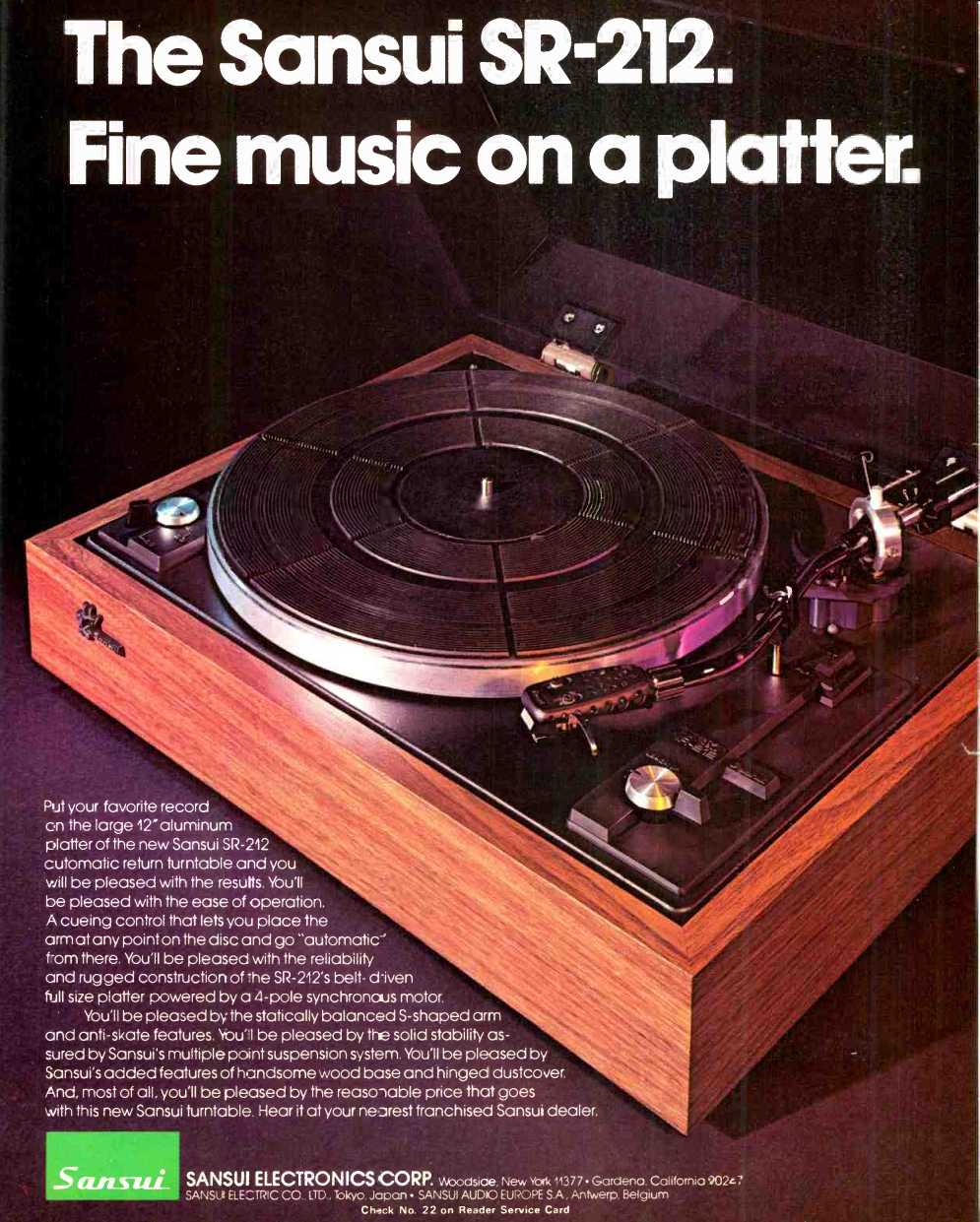
You'll be pleased by the statically balanced S-shaped arm and anti-skate features. You’ll be pleased by the solid stability assured by Sansui's multiple point suspension system. You'll be pleased by Sansui's added features of handsome wood base and hinged dustcover.
And, most of all, you'll be pleased by the reasonable price that goes with this new Sansui turntable. Hear it at your nearest franchised Sansui dealer,
SANSUI ELECTRONICS CORP. Woodside, New York 11377; Gardena. California 90247; SANSU Electric Co , LTD , Tokyo., Japan; SANSUI AUDIO EUROPE, Antwerp. Belgium
++++++++++++
Kenwood
Soundsational Advice
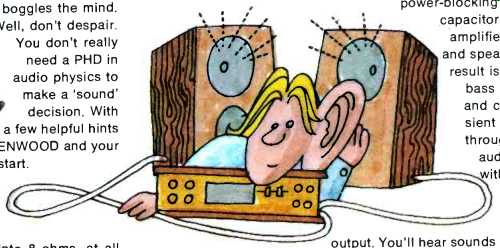
You'd really like to move up to a good stereo system, right? But you find stereo components confusing. So many names. So many claims. So many specifications to read. It fairly boggles the mind.
Well, don't despair.
You don't really need a PHD in audio physics to make a 'sound' decision. With a few helpful hints from KENWOOD and your own two good ears you can be off to a flying start.
Power is Important, But ...don't get caught in the numbers game.
There is only one meaningful power output rating: RMS continuous power output per channel, both channels driven into 8 ohms, at all frequencies from 20 to 20,000 Hz. Many receiver manufacturers quote power output for mid-band frequencies only, i.e. at 1k Hz. An amplifier that can produce 50 watts at 1k may fall short of that capability at the extremes of the audio spectrum where power is most vitally needed for quality reproduction.
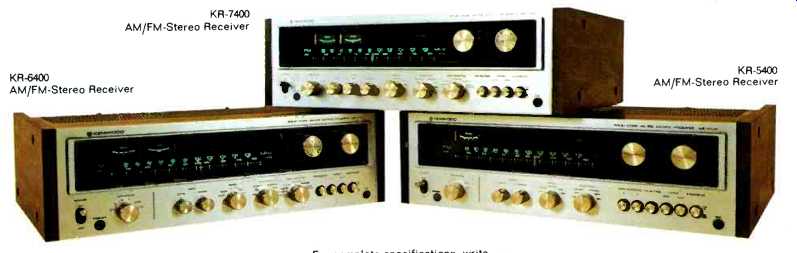
KENWOOD gives you the powerful facts on its new top three:
RMS CONTINUOUS POWER
20-20k, 8 ohms at rated THD KR-7400 63 watts per channel (x2), less than 0.3% KR-6400 45 watts per channel (x2), less than 0.5% KR-5400 35 watts per channel (x2), less than 0.5% And for comparison, shows IHF power ratings at 4 ohms:
KR-7400 KR-6400 KR-5400 290 watts 240 watts 150 watts
Nothing Comes Between You and the Music with KENWOOD's Direct-Coupled, Pure Complementary Symmetry Output Circuitry
As important as power is to good sound, power alone is not the only factor in determining quality. KENWOOD engineers utilize the most advanced concepts in audio circuitry to assure the finest sound reproduction. For example, consider the importance of direct coupling: By utilizing a massive power transformer and dual positive and negative power supplies, KENWOOD engineers have eliminated the power-blocking coupling capacitor between amplifier outputs and speakers. The
Ç(q result is fantastic bass response and crisp transient response throughout the audio range, with minimal distortion even at full rated output. You'll hear sounds from your favorite records and tapes that you never knew were there!
A Tuner Section You Can Really Tune In To KENWOOD's reputation for creating fine tuners is reflected in the tuner sections of these superb receivers. There are all sorts of esoteric reasons for this like MOS-FET's in the front ends, low-noise transistors, solid state IF filters, and a phase-lock loop MPX circuit. What it all boils down to is the best darned FM and FM-stereo reception you've ever enjoyed. In fact, even the AM sounds great! In every aspect of performance from preamp to power amp to tuner, the new KENWOOD stereo receivers are the finest around. But don't take our word for it. Visit your nearest KENWOOD Dealer, and let your ears be the final judge.
KR-7400 AM/FM-Stereo Receiver
KR-6400 AM/FM-Stereo Receiver
KR-5400 AM/FM-Stereo Receiver
For complete specifications, write:
15777 So. Broadway. Gardena, Calif. 90248
72-02 Fifty-first Ave., Woodside, NY 11377
(adapted from Audio magazine, Jul. 1974)
Also see:
iar--Classroom to Studio (Aug. 1974)
THE GRAMOPHONE: Basis for an Industry (Jun. 1974)
= = = =