Dear Editor
Dear Sir:
I noted with interest your comments in the May issue equipment report on the AR receiver. I would like to point out that although the MPX measurements were "better than your test equipment" your measurements can be interpreted in a more meaningful way. The AR MPX design is characterized by the fact that residual cross talk is almost entirely residual distortion. ( Most good MPX detectors share this characteristic). Since you measured 0.5% distortion this implies that at that frequency separation should be 46 dB. We have actually seen units with 0.1% distortion and a separation of 60 dB, and have even approached this through the complete FM signal chain.
Since amplifier performance is generally better than 0.25% harmonic distortion, a comparable standard of MX stereo quality is obviously needed for overall system performance. Our experience proves with care it can be obtained with added separation as an additional side benefit.
ROBERT GRODINSKY
Consulting Engineer
Acoustic Research, Inc.
In my experience, most MPX distortion is due to non-linearity of some kind but in a well-designed detector, crosstalk would then become a significant factor. A distortion of 0.1% is incredibly low and up to now, figures of this order have only been achieved by special ‘counter' circuits. I would certainly agree that stereo receiver distortion ought to be comparable with that attained by the amplifier.
In fact, I would go further and say that broadcast transmission quality should be comparable too. Unfortunately, with few exceptions it is not.
-Ed.

-- “If left-front is out of phase with right ear, switch leads on one speaker. If right rear and left-rear are out of phase with left-front...."
=============
Editor's Review
Much of the space in this issue is devoted to Commercial Sound and the article by Don Davis on the uses of a computer calculator in system planning is of particular interest. Computers are going to be employed more and more in this field and I note that Bell Telephone Laboratories have been using one to measure room characteristics. The computer traces the paths of 300 rays which radiate from an omni-directional sound source in a simulated room. Each ray is tracked by the computer as it bounces off the ceiling, floor, and walls. Each time a ray hits an absorbing material its energy is reduced and the computer keeps an account of the energy remaining in each of the rays. So far, the studies have shown discrepancies with reverberation time calculations taker by conventional methods-and quite large ones at that. Readers who are interested can find further details in the February issue (Part 1) of the JASA ( The Journal of the Acoustical Society of America ) One day we may be able to use computers for the accurate evaluation of loudspeakers: with the present state-of-the-art there is no way to evolve a set of specifications which will guarantee that the sound produced by system A will sound identical to system B. In other words, it is possible to have two loudspeakers which will give identical results from conventional tests in terms of frequency, distortion, transient response with tone bursts, dispersion, and so on-but will still sound different. One reason is phase differences and another is the presence of small resonances that do not show up on the normal frequency runs.
Yet another possibility is Doppler distortion-easy enough to measure with a spectrum analyzer but much more difficult to evaluate in terms of relative distortion.
-What will the Hi-Fi setup of the future be like? This idle speculation was prompted by a demonstration of new prototype radio and TV models by Panasonic recently. Among the fascinating products was a tiny portable 1 1/2-inch screen TV with built-in AM/ FM radio, a battery operated portable Color TV set, a direct-drive phono turntable using an ‘electronic commutator' motor and an AM-FM radio with digital clock. This is a clock with a difference-you don't even have to look at it. Just press a switch and a voice announces the time... . In the mornings it can be programmed to give the time for two minutes, then switching on the radio.
It can be set to play radio programs with time announcements every hour if so desired. How is it done? Not by tape as I had supposed-but with two magnetic discs, one for the hours and the other for minutes. When the call switch is pressed down, a motor drives the magnetic head to the correct position. Very ingenious... .
And then there is the neural hearing concept.
Two doctors in New York have evolved a system whereby sound is transmitted direct to the nervous system, bypassing the ears entirely. Small disks called ‘trans-dermal devices' are placed each side of the head and these are fed with a modulated r.f. signal. The head becomes in effect the dielectric element between two plates of a capacitor and the signal is detected by a complex process involving the cochlea and the nerves themselves. The cochlea normally converts a mechanical signal into an electrical one, but here its function is reversed.
The r.f. carrier is usually in the 30to 100-kHz range and the actual power is quite low. I heard the system some months ago and although frequency range went above 20 kHz and down to 30 Hz, the quality of reproduction was not up to Hi-Fi standards. However, work is still going on and who knows what impact such ideas may have in the future?
--Two High Fidelity Shows have been announced by the IHF, the first to take place at the Westbury Island Inn from September 15 to 22 and the second at the Newton Marriott Motor Inn ( near Boston) , from October 29 to November 1. The German High Fidelity Institute also announced a Hi-Fi Show and I must confess I found their description more picturesque. Says the information leaflet "Chaotic bedlam is completely erased by the use of sound-proof listening studios ... it is a rich and pure part of Hi-Fi '70 and not as it so often happens regrettably, a pseudo-cultural Show." No danger of pseudo-culture here, not even in Boston-but we certainly have a lot of bedlam to erase!
--G.W.T.
===============
ADs:
Altec Lansing
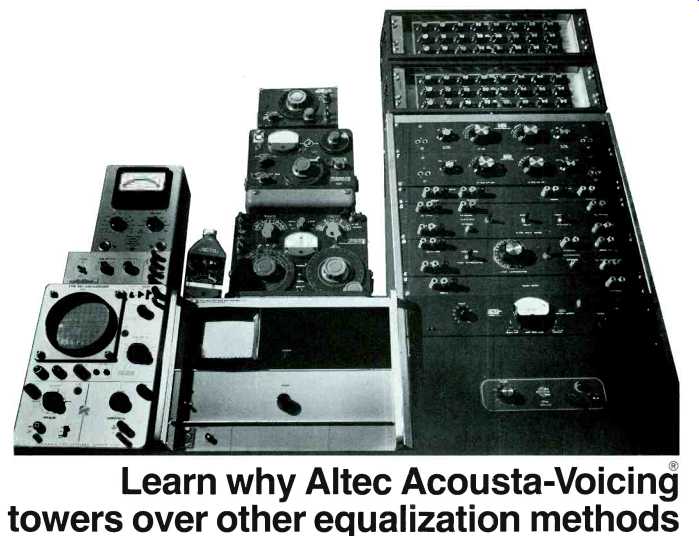

Learn why Altec Acousta-Voicing towers over other equalization methods Why go through expensive experimentation? Altec has more than 100 fully equipped and trained Acousta-Voicing contractors with over two and a half years of experience and a thousand successful installations.
No one else can make this statement.
Ask for a demonstration in your studio and learn about real time analysis where it counts--your studio!
To: Altec Lansing, 1515 South Manchester Ave., Anaheim, California 92803.
I'd like to have a free demonstration of Altec Acousta-Voicing in my studio-including a frequency response curve that will show me all the ups and downs. Please have an Altec Sound Contractor contact me to set up a demonstration date.
----------------
Sony
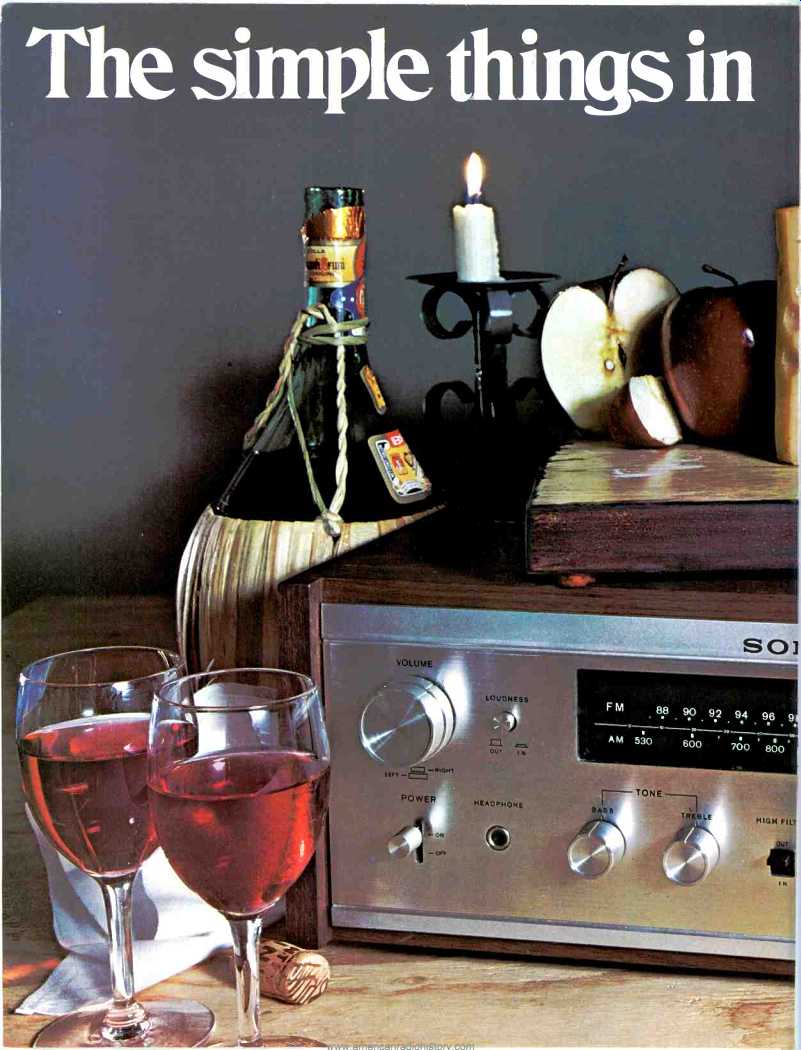
The simple things in life.
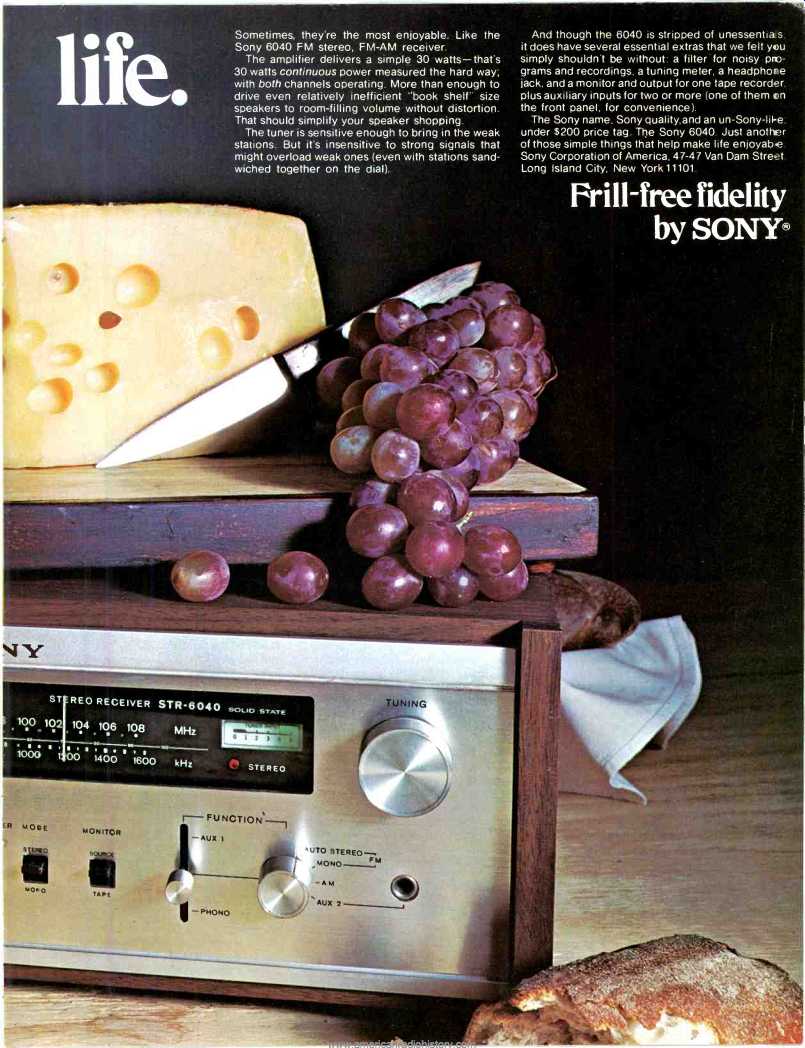
Sometimes, they're the most enjoyable. Like the Sony 6040 FM stereo, FM-AM receiver.
The amplifier delivers a simple 30 watts--that's 30 watts continuous power measured the hard way; with both channels operating. More than enough to drive even relatively inefficient 'book shelf" size speakers to room-filling volume without distortion.
That should simplify your speaker shopping.
The tuner is sensitive enough to bring in the weak stations. But it's insensitive to strong signals that might overload weak ones (even with stations sandwiched together on the dial). And though the 6040 is stripped of unessential.
it does have several essential extras that we felt you simply shouldn't be without: a filter for noisy programs and recordings a tuning meter, a headphone jack, and a monitor and output for one tape recorder, plus auxiliary inputs for two or more (one of them on the front panel, for convenience). The Sony name. Sony quality and an un-Sony-lit-e. under $200 price tag. The Sony 6040. Just another of those simple things that help make life enjoyable.
Sony Corporation of America, 47-47 Van Dam Street Long Island City, New York 11101.
Frill-free fidelity by SONY.
--------------------
AR / Acoustic Research
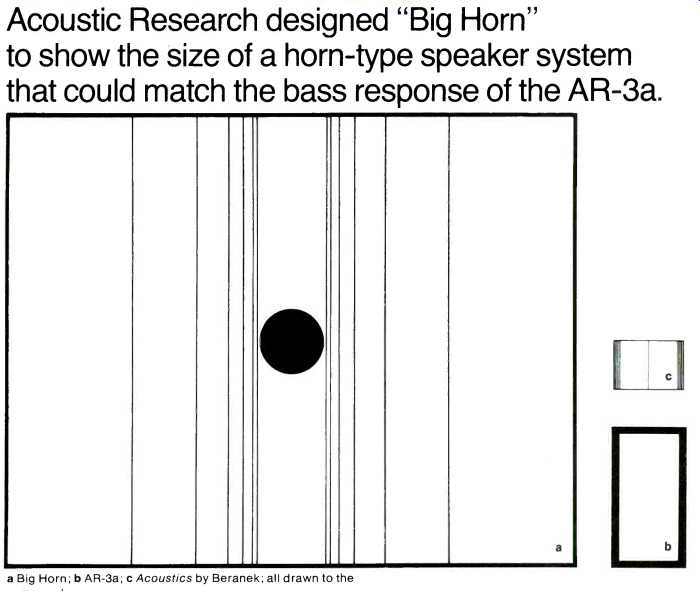
Acoustic Research designed "Big Horn" to show the size of a horn-type speaker system that could match the bass response of the AR-3a.
a. Big Horn; b. AR-3a; c. Acoustics by Beranek; all drawn to the same scale.
When the AR-3a is placed against a wall, its frequency response is flat to below 40 Hz, and continues even at lower frequencies with very low distortion. To design Big Horn, we turned to page 268 of the standard text, Acoustics by Leo Beranek*, to find the equation used to calculate the size of a horn with a cutoff frequency of 40 Hz.
As shown in the scale drawing above, Big Horn is 7 feet high and 9 feet wide; its depth would have to be greater than either of these dimensions. A pair for stereo would take up slightly more space in a living room than two VW buses. Yet, played at the same loudness, the only audible difference between them and a pair of AR-3a systems would be the slightly rougher response of the Big Horns due to reflections inside them. Other than that, the Big Horns should sound excellent; they would simply be not quite as good, and much more costly than AR-3as.
Complete technical data for the AR-3a is available free on request.
McGraw-Hill, $14.50. Acoustic Research, Inc. 24 Thorndike Street, Cambridge, Massachusetts, 02141, USA.
------------------
Thorens
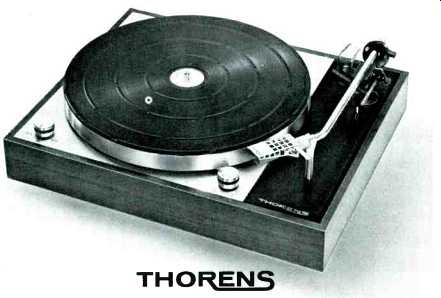
TD-150 MARK II INTEGRATED TRANSCRIPTION TURNTABLE
You pay for what Thorens leaves out.
And you'll never miss them. Like rumble. Or wow and flutter. Irregular turntable speed. Damaged records, chipped stylus.
The Thorens TD-150 Mark II is for people who take their music seriously. People who refuse to accept the many imperfections of ordinary sound reproduction. This is how Thorens has championed their cause.
Record wear reduced... Stylus life extended
Several Thorens features provide this. Positioned at the front is the Cueing Synchronizer. It lowers the tonearm gently and precisely into the groove. The Anti-Skate Control then makes certain the stylus is positioned exactly on both walls of the groove. And when you change turntable speeds (33 1/3 and 45 rpm) the Speed Glide Adjustment does it rapidly and smoothly without jolting the stylus.
Rumble, wow and flutter are eliminated
The flywheel action of the 12 inch, precision balanced, non-magnetic platter absorbs the slightest variations in speed and eliminates wow and flutter. The long and resilient drive belt system of the synchronous motor in combination with a unified suspension system for the tonearm mount and turntable assembly routs rumble effectively.
Constant Turntable Speed
Dance of the Hours never sounds like Danse Macabre. The double 16-pole synchronous motor always maintains its speed regularity, providing constant, smooth, in phase precise speed.
Plays records the way they were recorded
Records are cut at a 15° tracking angle. The best performance is achieved when they're played back at this angle. The low-mass plug-in shell permits you to adjust the tracking angle of a cartridge accordingly. You're always assured perfect tracking force since the tonearm can he adjusted to track as low as t gram, and is always in perfect balance.
So you see, when you pay for what Thorens leaves out, you receive superb performance and reliability. But then you expect unexcelled quality from Thorens. And you get it.
TD-1 50 Mark II, complete with tonearm and walnut base ... Only $130.00. For more details, see your Thorens dealer, or write to: ELPA MARKETING INDUSTRIES, INC. New Hyde Park, New York 11040
----------------
Pioneer


You can pay a lot more to get a lot less.
If you know any 2-speed manual turntable that costs $129.95 and also gives you automatic operation ... two motors ... belt drive precision ... drift-free plug-in shell tonearm ... lateral tonearm balancer for equalized stereo sound ... high compliance magnetic cartridge with diamond stylus ... oiled walnut base .. hinged dust cover...12" dynamically balanced platter ... automatic stylus protection lead-in device .. . automatic stop, return, repeat ... oil damped cueing ... adjustable stylus tracking force then buy it.
Pioneer Electronics U.S.A. Corp.
140 Smith Street, Farmingdale, New York 11735
PIONCER PL-A25 WEST COAST: 1335 WEST 134TH ST., GARDENA, CALIF. 90247
CANADA: S. H. PARKER CO., 67 LESMILL RO., DON MILLS, ONTARIO
----------------
Electro-Voice

Number 81 in a series of discussions by Electro-Voice engineers
PUTTING ON THE HEAT
LARRY SALZWEDEL, Loudspeaker Project Engineer
Because two basic characteristics-material fatigue and heat dissipation-limit the ability of a transducer to withstand high acoustic power levels, the design of a new class of high-reliability, high-power drivers was centered on these two areas.
While the voice coil of the new drivers is of conventional copper, it is protected by a new polyester insulation that is unaffected by temperatures in the neighborhood of 300°F, typical of continuous high-level operation. The coil is mounted on a coil form of Kapton polyimide plastic (described in an earlier article [#72] in this series) and then cemented to a heavy-duty phenolic diaphragm. Centering of the entire assembly with unusually high accuracy is the result of precision fixturing, plus a system of automatic thermal compensation.
Of special interest is the magnet structure, which employs a cast, one-piece ductile iron pot structure. This permits better heat transfer than conventional bolted or glued assemblies.
A series of radiating fins are cast into the structure to increase the surface area, and serve to reduce the gap temperatures as much as 40°F. The elimination of multiple parts also improves production uniformity by decreasing cumulative "stack ups" of tolerances.
The driver design eliminates the usual decorative outer cover, since this was a source of trapped air that held heat inside the structure.
The pot structure is also painted black to further increase prompt radiation of heat generated inside.
While some of these measures may seem extreme, rigorous testing has provided proof of the validity of this approach. A standard Model 1823 high-power driver easily withstands 300 hours of continuous operation in siren service with an input of 75 watts square wave. This compares with a typical life of 16 hours for all other similar drivers tested to date. For sine wave input, maximum power is 90 watts.
In addition to the availability of the new E-V Model 1823 driver for use on conventional reentrant, multi-cell, and sectoral horns, two special horns (Model AR400 and Model AR500) have been developed. These horns are expressly suited to siren applications for vehicular service (either exterior or concealed)
and can be used on emergency vehicles, in audio warning systems, for marine fog horns, etc. Full information on horns and drivers for inclusion in high-power systems is available on request.
For reprints of other discussions in this series, or technical data on any E-V products, write: ELECTRO-VOICE, INC., Dept. 803A. 602 Cecil St., Buchanan, Michigan 49107 USA. A SUBSIDIARY OF GULTON INDUSTRIES. INC.
------------------------
SCOTT
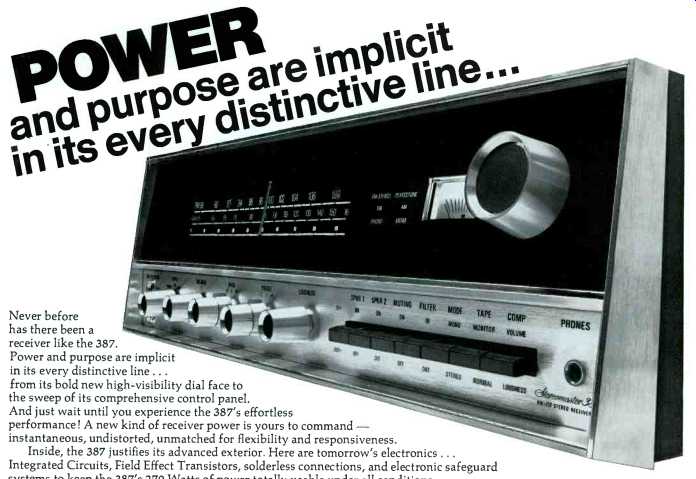

Never before has there been a receiver like the 387.
Power and purpose are implicit in its every distinctive line .. . from its bold new high-visibility dial face to the sweep of its comprehensive control panel.
And just wait until you experience the 387's effortless performance! A new kind of receiver power is yours to command instantaneous, undistorted, unmatched for flexibility and responsiveness.
Inside, the 387 justifies its advanced exterior. Here are tomorrow's electronics ... Integrated Circuits, Field Effect Transistors, solderless connections, and electronic safeguard systems to keep the 387's 270 Watts of power totally usable under all conditions.
Decades of manufacturing experience and engineering skill have gone into the 387. But to really appreciate how its designers have totally rejected the ordinary, you must see it and hear it.
SCOTT 387 AM/FM STEREO RECEIVER
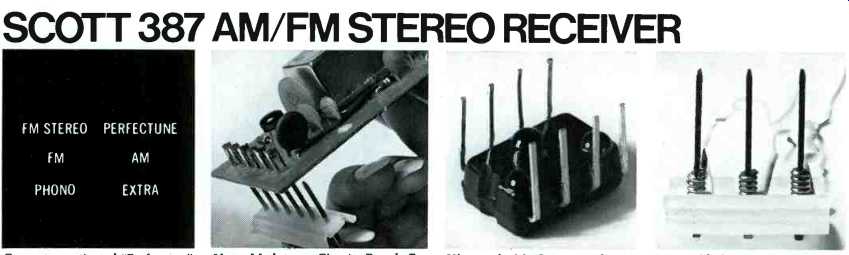
Computer-activated "Perfectune" light: Perfectune computer decides when you're tuned for the best reception and lowest distortion, then snaps on the Perfectune light.
New Modutron Circuit Board Exchange Policy: Takes over after your warranty expires; insures quick, inexpensive replacement of any plug-in printed circuit board for as long as you own your Scott unit.
Ultra-reliable Integrated Circuits: Seven IC's are included in the 387 ... totaling 91 transistors, 28 diodes, and 109 resistors.
New solderless connection techniques: Tension-wrapped terminal connections plus plug-in circuit modules result in the kind of reliability associated with aerospace applications.
SCOTT 387 SPECIFICATIONS
AMPLIFIER SECTION: Total power (±1 dB) 270 Watts @ 4 Ohms; IHF music power, 220 Watts at 4 Ohms; 140 Watts @ 8 Ohms; Continuous output, with one channel driven, 100/100 Watts @ 4 Ohms; 63/63 Watts @ 8 Ohms; Continuous output, with both channels driven, 85/85 Watts @ 4 Ohms; 55/55 Watts @ 8 Ohms; Harmonic distortion, 0.5% at rated output; IHF power bandwidth, 10 Hz 38 kHz; Hum and noise, phone, -70 dB.
TUNER SECTION: (FM); Usable sensitivity (IHF), 1.9 uV; Stereo separation, 40 dB; Capture ratio, 2.5 dB; Signal/Noise ratio, 65 dB; Cross modulation rejection, 80 dB; Selectivity, 42 dB.
TUNER SECTION: (AM); Sensitivity (IHF), 4 uV @ 600 kHz; Selectivity (IHF), 32 dB.
Price: $449.95 Accessory case, extra.
Prices and specifications subject to change without notice.
SCOTT. For detailed specifications, write: H. H. Scott, Inc., Dept. 35-08 111 Powdermill Road, Maynard, Mass. 01754 Export: Scott International, Maynard, Mass. 01754. 1970, H. H. Scott, Inc.
----------------------
RCA
Discovery in the art of performance.
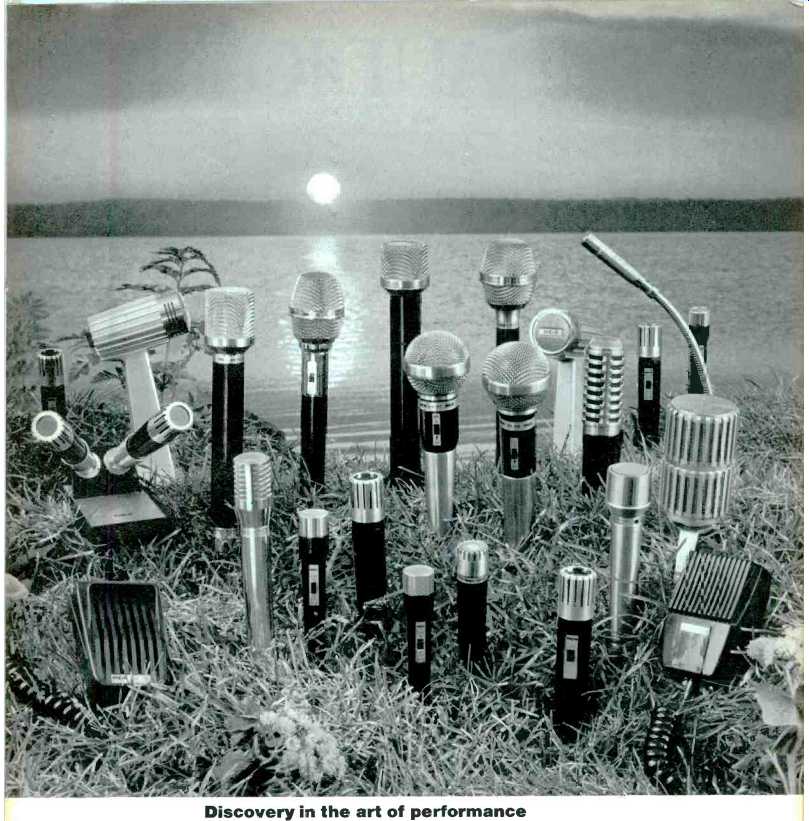

Find your sound! The Starmaker collection not only includes microphones for many different applications, but--even more important-microphones to enhance the personal techniques of professional performers as well.
You can choose characteristics like "flat" frequency response. Tapered low-frequency response. Switchable Bass Roll Off. A host of others. To make "today's" sound come alive-close up or far out.
That's the way it goes up and down the Starmaker line (at optional list prices from $12 to $93). For pop, rock, and classical performers. At concerts, theatres, night clubs. In reel-to-reel and cassette home recordings. For discussion/panel, paging, P.A., CB, and ham applications...you name it.
To get specific, ask for the new Starmaker brochure 1S1056 at your RCA microphone distributor or, write: RCA Electronic Components, Commercial Engineering, Section 14H/J10, Harrison, New Jersey 07029.
And, remember, for further professional needs, RCA also produces the renowned BK and SK microphone lines.
(Source: Audio magazine.)
= = = =