MANUFACTURER'S SPECIFICATIONS
Facilities: SQ, Ambience and Stereo.
Frequency Response: 5 Hz to 100 kHz ± 1 dB.
Distortion: Less than 0.025%.
Hum and Noise: -80 dB rel. 250 mV.
Price: Model A, $39.95; B, $74.95; C, $99.95.
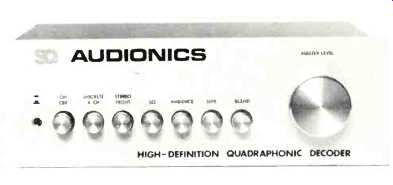
It is generally conceded that logic type quadraphonic decoders, that is, those using "gain riding" circuits to enhance separation, give the best all-round (sorry!) results. It is also true that many people object to the "pumping" action inherent in the cheaper types of semi-logic units. Full-logic decoders, such as the Sony 2020, are free from this defect but they are relatively expensive, and if classical music is the main interest, a good non-logic unit will give very acceptable results. One can also be used to add ambience and a sense of spaciousness to ordinary stereo records-or tapes for that matter. The Audionics 106 is made in Great Britain by TATE who specializes in matrix techniques (more from them later this year when they will release a "directional enhancement system") and it is available in three versions: Model A consists of a circuit board minus power supply, switching or hardware; Model B includes these items but is minus cabinet and panel, and Model C is the complete version as tested. It is a small unit, measuring about eight inches by six inches by just over two and one-half inches high. The MASTER volume control is on the right-the large knob-and to the left is a row of seven push buttons. They are the ON-OFF switch, DISCRETE 4-CH, STEREO, SQ AMBIENCE, TAPE, and BLEND. The discrete 4-channel is for tape inputs-in other words, the decoder is switched out of circuit. The ambience switch applies a smaller proportion of the signals to the rear channels and in a different phase relationship from the SQ mode. It is intended to create a surround sound from ordinary stereo records, although it does have other uses. The tape switch replaces the tape monitor switch on the receiver or pre-amplifier as this is switched to the decoder.
The SQ circuit is the basic matrix designed by CBS but Audionics claims that the frequency response, phase relationships and distortion are better than the original specifications. This was borne out by the tests.
Performance
Figure 1 shows the output versus distortion and it will be seen that distortion is insignificant below 2 volts or so. In most cases, the signal input would be on the order of 200 mV where the distortion is well below 0.05%. Insertion loss is less than 1 dB. Frequency response was 1 dB down at 4 Hz and 60 kHz, and 10 kHz square wave resolution was excellent with only the slightest trace of rounding. Phase relationship was within 3% over most of the audio band, increasing at extremes but still well under the 10% specifications at 20 Hz and 20 kHz. Hum and noise was 82 dB (ref. 200 mV output). On test, the 106 C came well up to expectations; overall sound quality was audibly unaffected by noise or distortion.
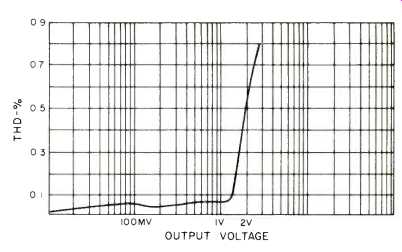
Fig. 1--Output versus distortion.
The blend control operates on the rear channels and tends to cancel the rear center image, thus a vocalist will sound more sharply defined to the front when the blend control is used.
It was found that some Sansui (QS) and old (relatively) E-V discs sounded better with the ambience position-others seemed more realistic on the SQ mode. But this is a matter of personal taste, room acoustics, and speaker dispersion characteristics. Summing up, the Audionics 106 C is a well made, inexpensive unit with a higher standard of performance than the average non-logic decoder. The only criticism I would care to make concerns the volume control-it felt too stiff and uneven. It is a four-gang component and it is mounted on the circuit board, but I feel it really ought to be a little better!
-George W. Tillett
(Audio magazine, Aug. 1974)
Also see:
Ortofon MC 2000 Phono Cartridge and T 2000 Transformer (Equip. Profile, Dec. 1984)
Micro Acoustics 630 Phono Cartridge (Mar. 1984)
Phono Equalization Kits--various models (Mar. 1979)
= = = =