THIS ISSUE is our Annual Directory number and more than 40 pages list the specifications of amplifiers, receivers, loudspeakers, and other components. Even so, the list is far from complete-some manufacturers do not like to give us details of new products until they are on the market, others, such as McIntosh, do not want to be listed for reasons of their own, and then there is always the problem of space. I would like to emphasize once again that the figures given are supplied by the manufacturers themselves and are not the results of our tests.
Please note that we had originally intended to include a five-page section on microphones in this issue, but it was cancelled at the last moment because of the space considerations mentioned above. This directory will appear in the December issue, together with articles on microphone use.
Small speaker systems are reviewed in this issue, and comments on this comparison method of evaluation will be welcomed. Our equipment reviews are generally recognized throughout the world as being absolutely impartial and strictly factual. They are carried out with great care by highly qualified engineers with many years experience. We make many criticisms and occasionally our reports disclose discrepancies between manufacturer's claims and the hard facts, but even so, we are sometimes asked why we do not print really bad reviews-real stinkers. Well, we do get bad products and we tell the makers so. Usually the design is modified or the product withdrawn from the market. Loudspeakers cause most of the trouble, as it seems that anyone who knows a dynamic speaker has a magnet and a voice coil feels competent enough to put two or three in a cabinet and thereby hope to make a fortune. Time and time again, I have attended demonstrations where such speakers have been confidently compared with KLH, AR or other well-known systems with spectacular results. Sometimes the level controls have been turned down on the competitor's speakers but more often than not the New System using Special Phase Compensated Crossovers or New Acoustic Principles turns out to have a nasty bass resonance or a whopping great peak in the upper mid-range-or both . . . So really, there is no sense in wasting the time and space on them--even if we do lose some advertising.
Among the products now being tested are the following: Phase Linear 400 amplifier, Sherwood 7100 receiver, Harman-Kardon Citation 14 Dolby tuner, Revox A77 Dolby recorder, Sony 2000F preamp, TEAC TCA-42 and 3340 recorders, and Scott 433 tuner and 477 receiver. Loudspeakers include the Infinity 1001, Scott Design 51, Eastman/Martin Crescendo, ESS VII, Design Acoustics, Jensen 4, AR LST, Fairfax FTA-2, Empire 7500, Rogersound RSL 28, EPI 201A, small Advent, and SAE Mk 12.
New York Hi-Fi Show
The next IHF Hi-Fi Show will take place in the New York Statler-Hilton from September 28th to October 1st. Times of admission are 4:00 to 10:00 p.m. on Thursday and Friday, 2:00 to 10:00 p.m. on Saturday and 12:00 noon to 7:00 p.m. on Sunday.
A.E.S. Convention
This year, the A.E.S. Convention will be held at the New York Waldorf-Astoria Hotel and it looks as if Vanguard's John Woram will be a very busy man. On Tuesday, he will be chairing the quadraphonic sessions when papers dealing with several aspects will be presented, and later in the day, at 7:30 p.m. to be exact, he will be the chairman of a general meeting. Panelists have not yet been announced, but John tells me that a number of subjects will be discussed.
Suspension Acoustique
Eurythmics is the term generally used to describe "harmonic bodily exercise with music," but a French company, Audax, uses the term to describe their speaker systems. Come to think of it, the term is not that inappropriate as these musical exercises are usually suffered by pregnant ladies and the French word for pregnant and speaker enclosures is the same, enceinte. A disturbing thought.
-G.W.T.
=========
THE WORKBENCH (Heathkit stuff)
Heathkit Frequency Counter Model IB-101
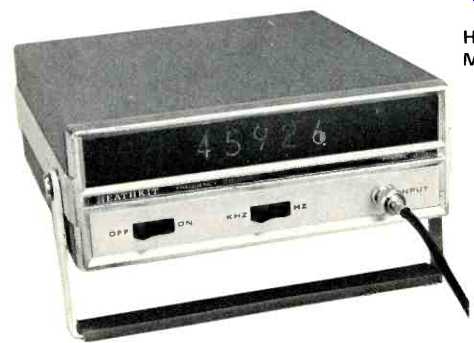
Fig. 1--Note the simplicity of the controls-only two rocker switches, one for power and the other for switching from Hz to KHz.
MANUFACTURER'S SPECIFICATIONS
Frequency Range: 1Hz to greater than 15 MHz.
Accuracy: +1 count ± time base stability.
Gate Times: 1 Millisecond or 1 second, with automatic reset.
Sensitivity: 1 Hz to 1 MHz less than 100 Mv, rms; 1 MHz to 15 MHz-less than 250 mV, rms after 30 minutes operation. Trigger Level: automatic.
Input Impedance: 1 megohm shunted by less than 20 pF.
Time-Base Frequency: 1 MHz, crystal controlled.
Readout: 5 digits plus over-range indicator.
Dimensions: 8 1/4" wide x 3 3/8" high x 9" deep (exclusive of handle).
Weight: 4 1/2 lbs.
Price: $199.95 (kit).
Most experimenters or practitioners in the audio field have little familiarity with digital techniques, but most of them will have often found a need for accurate measurement of frequency. Analog-type frequency meters have been around for a long time, but their accuracy is usually limited to ± 1 percent of a meter scale, whereas a digital instrument has an accuracy of ± 1 count-which at 1 MHz, for example, is an accuracy of one ten-thousandth of 1 percent.
Anyone who builds oscillators, square-wave generators, or any similar equipment, needs some form of frequency measurement in order to calibrate the dial. Of course, one could use a scope and Lissajous figures against the 60-Hz power line frequency to get up to, perhaps, 1200 Hz, and with an intermediate generator set at 1200 Hz could continue upward to as much as 24,000 Hz, assuming a 20 to 1 Lissajous figure on the scope screen, but even then he would have to interpolate to prepare a useful scale over the entire audio spectrum. If one correctly calibrated oscillator is available, one can compare the new one with the old, again using a scope, or possibly a heterodyne method, but any of these methods is primitive and time consuming.
The frequency counter is the elegant answer to the problem of calibrating an instrument and has been for a number of years. But they have been expensive devices, usually above $500 for a five-digit model. Some counters are capable of measuring intervals of time as well as frequency, and prices can easily run up in the two- or three-thousand dollar range. This Heath kit measures frequency only, but is a most useful instrument for the audio lab.
We have used this unit to measure the frequency of the bias oscillator in tape recorders by simply attaching a small inductance to the input leads and placing in close proximity to the erase head. We use it continually to measure speed variations of turntables equipped with vernier controls, playing a 1000-Hz tone on a record and noting the frequency at the normal position, then varying the vernier to a maximum and minimum positions and noting the reproduced frequency. We have used it to calibrate square-wave generators, as well as to check other generators which may have been factory calibrated. We have found it a most useful device.
The Circuit
The IB-101 consists of 26 integrated circuits and 7 transistors, as well as a MOSFET (metal oxide semiconductor field effect transistor) and 6 diodes. Five display tubes provide the readout capability of eight digits in a simple operation. Suppose you are measuring a frequency of 11,245,987 Hz. You place the range switch in the kHz position, and the instrument indicates 11245; then you change the range switch over to the Hz position, and the indication is 45987 with the over-range light on, which shows that the frequency being measured is larger than the five-digits of the display. This is the result of the operation of any digital counter-the count starts with the units, is stepped to the tens, the hundreds, the thousands, and finally to the ten-thousands. After that, there are no more counters available so the over-range light goes on if the switch is in the Hz position. The accumulation of any count starts with the units first, of course. By combining the two indications 11245 and 459.87, you end up with 11,245,987, a total of eight digits.
The input signal is fed to the input amplifier, a 40673 MOSFET which has integrated gate-protection circuits which protect against overload, and thence to a Schmidt trigger which shapes the input into a square wave. This is fed to a high-speed single flip-flop IC which counts the unit pulses.
The output of this IC is fed to additional flip-flops making a total of five decade counters which feed buffer-storage IC's and their outputs are in turn fed to the five decoder-driver IC's which control the display tubes, converting the binary-coded information to decimal in the process. The gate circuit consists of a 1 MHz crystal followed by three decade counters, each of which divides the input frequency from the crystal by 10, with the result being tapped off to reset the input-frequency counters every millisecond for the kHz position of the switch, and again by three more decade counters which provide a reset signal every second for the Hz switch position. A regulated power supply provides 3.5 volts for all the counters and gate circuits, 36 volts for the MOSFET, and 170 volts for the anodes of the display tubes. The latter is the only non-regulated voltage from the power supply. The overrange circuit is actuated by an inverter transistor which triggers additional flip-flops every time the carry signal from the fifth counter is energized, and is a neon lamp which illuminates an "over" on the otherwise black panel. At the other end of the panel are two legends which are illuminated "Hz" or "kHz" depending on the position of the switch. The panel is a "smoky" black plastic sheet which occupies the upper half of the front panel. The lower half is an anodized aluminum panel which accommodates the power switch at the left, the Hz-kHz switch in the center, and a BNC input connector. This explanation of the operation is considerably simplified, but those interested in a more thorough description can read the information contained in the kit instruction book.
Construction
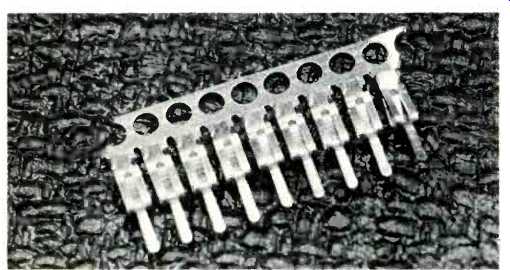
Fig. 2--Close-up of a section of the formed strip which serves as sockets
for the 26 ICs. The bottom pins are inserted in predrilled holes in the
circuit board and soldered in place.
Then, with a furnished jig, the upper portion is broken off, forming seven (or eight) up-standing receptables for each row of pins.
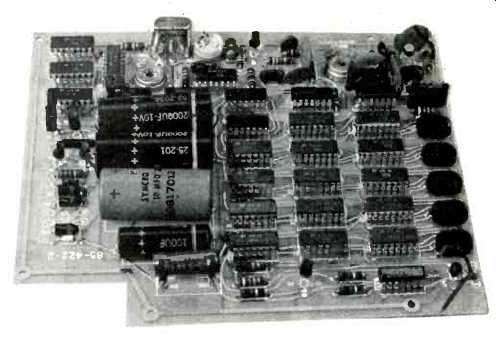
Fig. 3--View of the chassis before installing the case. The five ovals
at the right are sockets for the numerical display tubes.
Construction of this instrument follows the usual Heathkit procedure-the printed-circuit board is assembled first. With the 26 IC's used-some with 14 pins and others with 16, there are 384 separate pins to be accommodated. Mindful of the difficulty the average constructor would have in soldering these in place, and the further difficulty if any one of the IC's had to be replaced, Heath furnishes a strip of pin receptacles such as those shown in Fig. 2. These are cut into lengths of either seven or eight and inserted in holes in the circuit board and soldered-actually not a particularly difficult job if instructions are followed carefully. Then when these are all in place, a "jig"-like tool is used to break off the solid part of the strip just above the receptacles, leaving the latter standing up from the circuit board ready to receive the IC's. When these are all in place, the completed circuit board is as shown in Fig. 3. One caution--don't lose or discard any of these receptacles on the strip. We used the 384 required and had only the nine shown in Fig. 2 remaining.
On the whole, this project, which should take about six hours to complete, is a thoroughly worthwhile one, and the satisfaction of having an. accurate counter available makes future work with any frequency-generating device more interesting and more accurate. We have found it to be an extremely useful addition to our stable of instruments.
For those who want a still higher frequency limit, there is another kit which will provide accurate scaling to 175 MHz.
This unit, IB-102, divides the incoming frequency by 10 or 100 to increase the upper limit. A 1:1 switch position provides a straight-through path for the input signal for measurements over the range of the counter. For those working in the radio frequency ranges of FM stations, this is also a useful addition to the lab equipment.
-C. G. McProud
Speaker of the House
The idea of radiating r.f. power through the house power wiring is not new-in fact we have had intercom units using this principle for many years. But Concepts Plus, a Los Angeles-based company, has gone a stage further in designing stereo extension speakers to work this way. The transmitter operates in the 3MHz band and is housed in a small "black box" which is connected to the extension speaker terminals of your amplifier or receiver. The frequencies used are 2.30 MHz and 3.12 MHz-so they are spaced far enough apart to avoid crosstalk. Figure 1 shows the inside of a transmitter unit. The two resistors are 8 ohm loads for the amplifier.
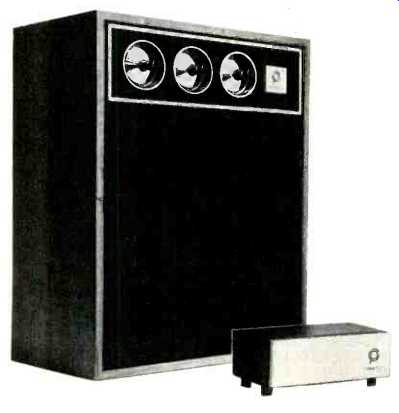
Figure 2 shows the inside of the top section of the speaker unit which houses the receiver and amplifier. The speakers fitted are a 6-in. bass unit and a 3-in. tweeter. Output measured just over 6 watts from 100 Hz to 10,000 Hz falling off slightly to 5 watts at 40 and 15 kHz. Distortion was 1.5% at 6 watts. Both bass and treble controls are fitted and they had a range of 20 dB at 60 and 10 kHz respectively.
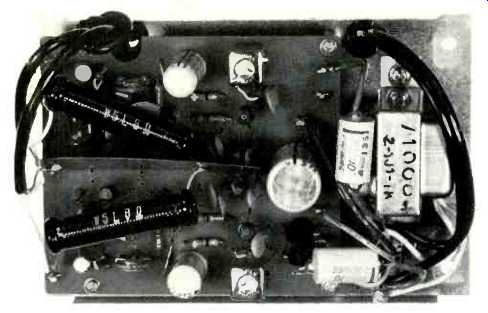
Fig. 1-Inside of the transmitter unit.
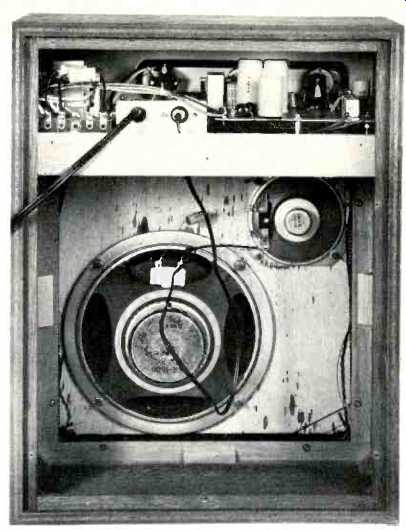
Fig. 2-Inside of the speaker unit.
In my tests, an amplifier power of 5 watts was more than sufficient to put a signal anywhere in the house with excellent signal/noise. A lot depends on the characteristics of the power wiring, the self-capacity and so on, but a receiver with 10 watts output should produce a good signal under the worst possible conditions-unless, of course, there is more than one wiring circuit. The overall sound was surprisingly pleasant and well-balanced although some frequency doubling occurred below about 100 Hz. As a matter of interest, I disconnected the two load resistors mentioned above and then connected the transmitter to a tape recorder which gave an output of just over 1 volt rms. It worked very nicely, although the received signals had some background-as might be expected. The extension units are very attractively styled in walnut with a black facia panel with chrome and blue trim and knobs to match. Though the Concept Plus units can not be considered hi-fi in the strict sense of the term, they would be good for use in a sick room, a kitchen, out on the patio-or indeed anywhere within striking distance of an a.c. outlet. The price of a transmitter and a pair of extension units is $129.95, which is very reasonable, and I need hardly mention that any number of units can be used with a single transmitter. Makers are Concept Plus.
-T.A.
=========
ADs:
hk
The first tuner that can tell the difference between music and noise.
Since the function of FM tuners is to bring in FM stations, tuners have traditionally been designed to bring in the strongest signals possible.
This seems like the height of common sense. It isn't.
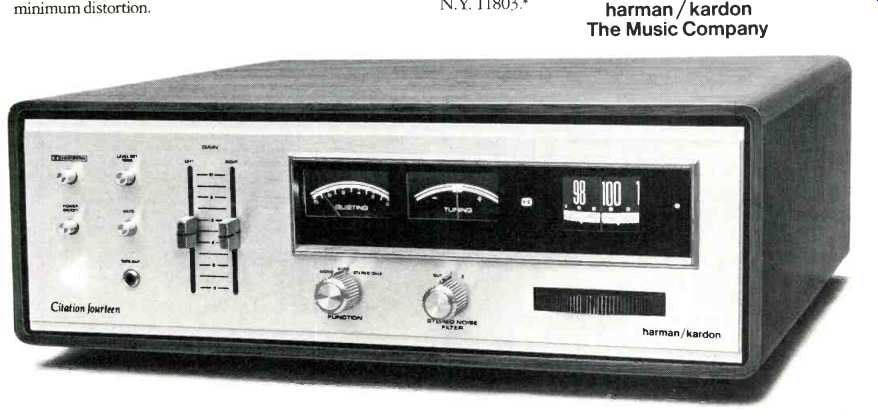
Signals, weak or strong, are often noisy. So even after you pull in a strong signal, you may have to deal with the problem of noise polluting the music. Since your tuner can't tell you which is which, you have to rely on instruments that have failed you in the past. Your ears.
Not with the new Citation 14.
Ours is the first tuner with a quieting meter (patent pending). It tells you exactly how much noise is accompanying the music. This lets you adjust the tuning dial, or your antenna, to the precise point where quieting is at a maximum.
(It's sensitive enough to detect a 1° rotation of your antenna.) But Citation 14 does more than just tell you how noisy a signal is. It's the first tuner with a multiplex circuit that senses any phase error in the pilot signal, and then readjusts the circuit for maximum separation and minimum distortion.
Once Citation 14 has brought in the cleanest possible signal, it won't add any noise of its own. Signal-to-noise ratio is-70dB. And to make things even quieter, it's also the first tuner with a built-in Dolby noise suppressor.
But to really appreciate all these firsts, you first have to record off the air.
Since it is so noiseless, you can produce recordings of close to master-tape quality. It even has a 400-Hz tone oscillator to let you match levels with the station you're recording. So you don't have to make adjustments every time the music changes.
Still, at $525, Citation 14 obviously isn't for everyone. Like Citation amplifiers, preamplifiers and speakers, it's designed for people who can't tolerate even the suspicion that there's anything in their music but music.
But if you are such a person, there's finally a tuner as intolerant as you.
For complete details and specifications, write Harman/Kardon Incorporated, 55 Ames Court, Plainview, N.Y. 11803.
harman/kardon--The Music Company. Distributed in Canada by Harman/Kardon of Canada, Ltd., 9429 Cote de Liesse Rd., Montreal 760, Quebec.
----------------
Sony
There goes your last excuse for not getting into 4-channel.

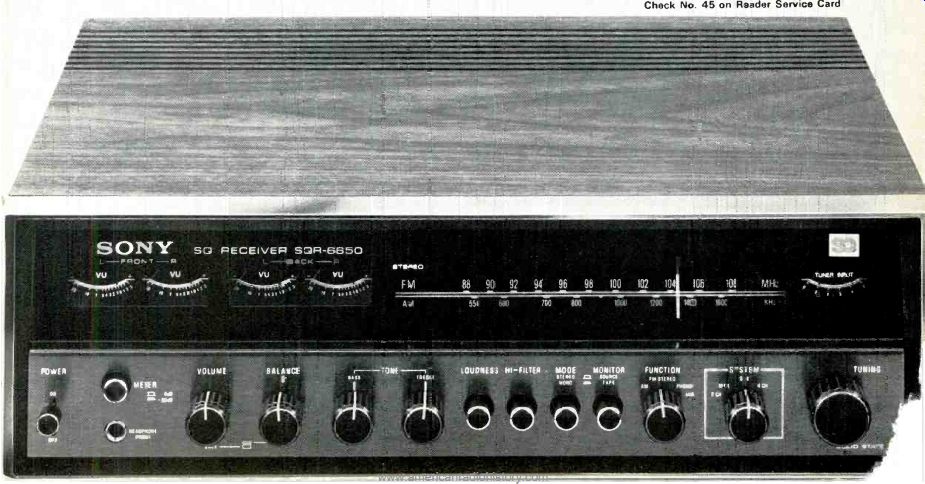
Whatever reason might be holding you back from getting into 4-channel now, just won't hold water anymore. Not with the introduction of the Sony SQR-6650 receiver.
Compatibility with today's 4-channel systems? No problem. The SQR6650 has everything you need: FM, AM, four power amplifiers, simplified controls including 4 VU meters for balancing your system, and two separate four-channel decoding circuits.
One is for SQ, and one is for all the other matrix systems on the market.
Just plug in a turntable, connect four speakers, and you're ready to enjoy four-channel sound from discs ( or tape with an additional quadraphonic player deck). Or enjoy stereo or derived four-channel sound from stereo broadcasts and recordings.
Availability of records or tapes? Plenty! Schwann Catalog lists more than 100 four-channel records, 200 Quad 8 tapes and the list grows everyday, if FM is your favorite source of music, the hours devoted to 4-channel SQ and matrix broadcasting is growing.
Still a bit skeptical? Consider this: the SQR-6650 has a built-in "Doubting Thomas" insurance. Flick a switch and the four-channel, 32 watt (RMS into 8 ohms) amplifier becomes a 50 watt stereo amplifier (25+25W RMS), thanks to Double-Stacked Differential circuitry.
FM reception is superb: 2.2uV IHF sensitivity, 70dB selectivity, for example. And the preamp section has all the controls for stereo, four-channel, or mono: high filter, loudness compensation, independent bass and treble controls for front and back.
That leaves only cost as your excuse.
And it's a weak one. The SQR-6650 costs hardly more than stereo receivers of comparable facilities and specifications, $329.50*. Enjoy 4-channel row. It's ready at your Sony dealer. Sony Corporation of America. 47-47 Van Dam St., Long Island City. NY.11101.
*Suggested price. SONY SQR 6650
---------------
ELAC
Elac / Miracord has spent a million dollars to bring you NOTHING.
True "NOTHING" would be the elimination of everything that interferes with the perfect reproduction of sound. So, the closer you get to "NOTHING" in sound, the better stereo equipment you own!

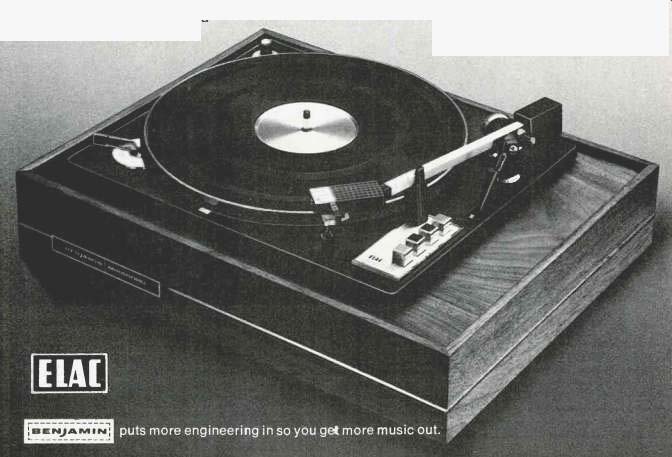
The ELAC 50H MARK II comes closer to the "NOTHING" in sound reproduction than any other automatic turntable. And for good reason. You see, we've spent a million dollars in research to eliminate motor noise, vibration, rumble, wow, and distortion. The closer we get to "NOTHING", the better it is for you. With rumble down to-40db, wow down to 0.06% and flutter to 0.02%, we're really coming close to "NOTHING”.
And we've even reduced record wear. Imagine an automatic tone arm that lowers so slowly, so lightly to your records that you can hardly tell when it touches the groove. You certainly can't hear it. At your command, a touch of the exclusive pushbutton control picks the arm up automatically and a silicone-damped piston lowers it lighter than a floating feather to your record. It's the ultimate in protection for stylus and record.
Benjamin Electronic Sound Corp., Farmingdale, N.Y. 11735.
A division of Instrument Systems Corp. Available in Canada.
Benjamin ... puts more engineering in so you get more music out.
-------------
marantz
If the loud in your stereo gives her a pain in the head get a Marantz.
It's not that she's got super-duper sensitive hearing (like that spotted beagle two doors down), it's because most women hear better than men, so when she screams turn down the sound what she really means is turn down the damn distortion because the distortion is driving her bananas.
Not so with Marantz stereo. Take the Marantz 2270 stereo AM/FM receiver for $549.95. It delivers a walloping 140 watts RMS power at less than 0.3% distortion...which means virtually NO DISTORTION. And because Marantz measures distortion at continuous full power through the whole listening range-it won't bring tears to her eyes or a pain to her head. NO MATTER HOW LOUD. Other companies measure power and distortion only in muddle listening range. So they quote their highest power and lowest distortion only in the middle. But on the low and high sides their power is down and their distortion is up. So if you pay for 140 watts be sure you get 140 watts at both ends and in the middle.
With Marantz you get exactly what you pay for. If all you need is 30 watts, take our model 2215 for $249.95. Want twice as much power? Our model 2230 gives you 60 watts RMS for $349.95. And our model 2245 at $449.95 delivers 90 watts RMS. ALL FULL RANGE CONTINUOUS POWER. No matter which model you choose, remember this.
You're getting Marantz quality. The same quality that goes into the magnificent Model 19 FM stereo receiver (shown that costs $1200. YES. That's right, a cool $1200! But it is the absolute, ultimate, very best there is.
Visit your Marantz dealer. And take your wife along. (Or that spotted beagle two doors down.)
We sound better.
=======
Panasonic
Your next receiver should have 3 things missing.
The input transformer.
The output transformer.
And the output capacitor.
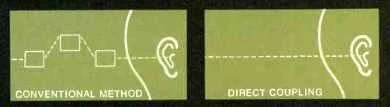
Because when you cut those three things out of a receiver, you cut down on a fourth thing. Distortion. We do it with a sys em called direct coupling.
And Panasonic puts it in all its FM/AM FM Stereo Receivers.
With this system the amplifier circuit is coupled directly to the speaker terminals. To improve transient response and damping.
So there's less than 0.8% harmonic distortion. To help you hear only the sound of music.
The sound of the SA-6500 is really something to listen to. With a full 200 watts of power (IHF). To fill even a high room with music. And there's also a power band width of 5 to 6,000 Hz.
The SA-6500 also has two 4-pole MOS-FET's. That provide 1.8 uV FM sensitivity. To pull in FM stations that are too weak or too far to make it on their own.
Integrated circuitry and a crystal filter improve the capture ratio.
And there are low-filter, high-filter, and loudness switches. So the music comes out closer to the way it started out. And an FM linear dial scale and two tuning meters.
To make the music you want just a little easier to find.
You can also find that music on the SA-6200. With 150 watts of power. Plus 2 RF stages and 6 IF stages. To provide selective station tuning. And there are PNP low-noise silicon transistors in the differential amplifier drive-stage.
To give almost noise-free performance. No matter who's performing.
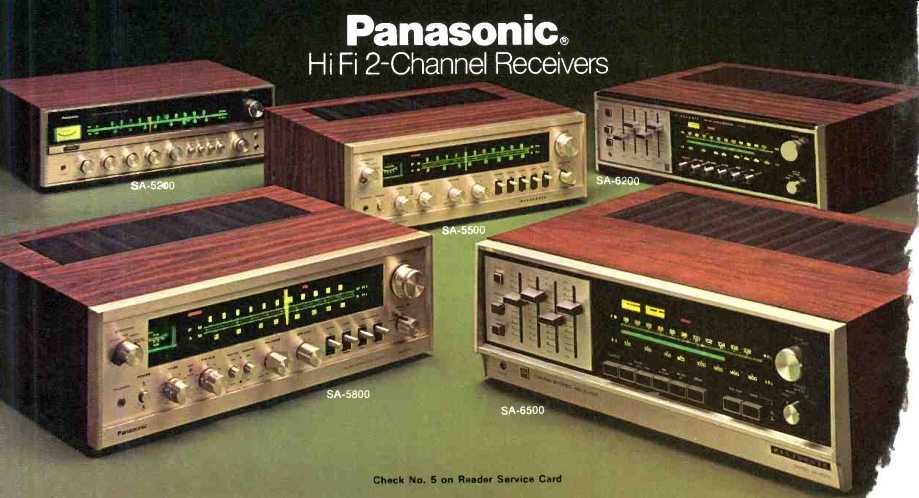
For less money you can still get a lot of power. From our SA-5800. With a full 100 watts. The SA 5500. With 70 watts. Or our newest receiver, the SA-5200. With 46 watts. And some of the features you'll find in our more expensive stereo receivers.
So before you get your next receiver, see your franchised Panasonic Hi-Fi dealer. He'll show you what should be missing. So you don't miss out on anything.
FOR YOUR NEAREST FRANCHISED PANASONIC H-FI DEALER, CALL TOLL FREE 800 243-6000. N CONN., 1-800 882-6500.
Panasonic HiFi 2-Channel Receivers
======
Stanton
The Pick -Up Pros.
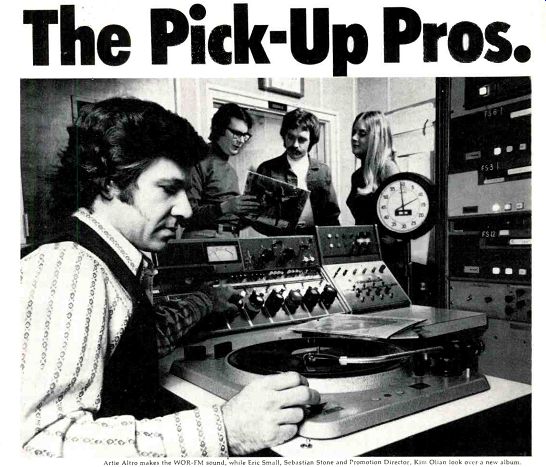
Artie Altro makes the WOR-FM sound, while Eric Small, Sebastian Stone and Promotion Director, Kim Olian look over a new album.
WOR-FM, the country's leading FM/Stereo rock station, has been using Stanton cartridges since its inception.
Program Director Sebastian Stone likes the smooth, clean sound the Stanton delivers; the way it is able to pick up everything on the record so that the station can assure high quality transmission of every recording.
Eric Small, Chief Engineer for WOR-FM, likes the way that Stanton cartridges stand up under the wear and tear of continuous use. "We standardized on Stanton a couple of years back," Small said, "and we haven't had a cartridge failure since. Studio Supervisor Artie Altro concurs.
Whether you're a professional or simply a sincere music lover, the integrity of a Stanton cartridge delivers the quality of performance you want.
There are two Stanton professional cartridge series. The Stanton 681 Series is engineered for stereo channel calibration in record studios, as well as extremely critical listening. The 500 AL Series features design modifications which make it ideally suited for the rough handling encountered in heavy on -the -air use. In fact, among the nation's disc jockeys it has become known as the "industry workhorse." All Stanton cartridges afford excellent frequency response, channel separation, compliance and low mass and tracking pressure. And every Stanton cartridge is fitted with the exclusive "longhair" brush to keep grooves clean and protect the stylus. They belong in every quality reproduction system-broadcast or high fidelity.
For complete information and specifications on Stanton cartridges, write Stanton Magnetics, Inc., Terminal Drive, Plainview, L.I., N.Y.11803. Stanton All Stanton cartridges are designed for use with all two and four -channel matrix derived compatible systems.
----------------
Empire
How it works.
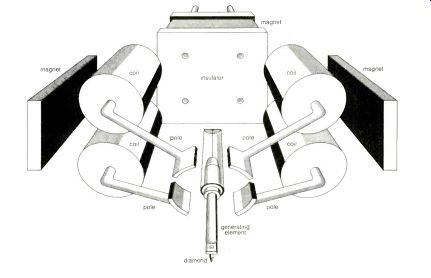
If you know how moving magnetic cartridges are made, you can see right away how different an Empire variable reluctance cartridge is. With others, a magnet is attached directly to the stylus, so that all the extra weight rests on your record. With Empire's construction (unique of its type), the stylus floats free of its three magnets. So naturally, it imposes much less weight on the record surface.
Less record wear.
Empire's lightweight tracking ability means less wear on the stylus, and less wear on your records. Laboratory measurements show that an Empire cartridge can give as much as 50 times the number of plays you'd get from an ordinary cartridge without any measurable record wear! HI-Fl SOUND MAGAZINE summed it up very well by calling the Empire cartridge "a real hi-fi masterpiece ... A remarkable cartridge unlikely to wear out discs any more rapidly than a feather held lightly against the spinning groove." Superb performance.
The lightweight Empire cartridge picks up the sound from the record groove with amazing accuracy. Distortion is minimal.
(None at all could be measured at normal sound levels with Empire's 1000ZE/X and 999VE/X.) AUDIO MAGAZINE said of the Empire cartridge "outstanding square waves... tops in separation." HIGH FIDELITY noted "... the sound is superb. The performance data is among the very best." While STEREO REVIEW, who tested 13 different cartridges, rated the Empire tops of all in lightweight tracking.
"X" Designates newest improved version.
World Famous Long Playing Cartridges
For further details write: Empire Scientific Corp., Garden City, N.Y. 11530. USA
= = = =
(Source: Audio magazine.)
Also see: