JOSEPH GIOVANELLI
Connecting a Power Amp to a Tape Loop
Q. I own an integrated amplifier that has two tape monitor loops. I would like to add another power amplifier and connect it to the integrated amplifier.
Can I connect it via the tape monitor?
-Keith Ling, Dunwoody, Ga.
A. You should not connect a power amplifier to your integrated amplifier via the tape monitor output jacks. The reason is that the integrated amp's volume and tone controls would be inoperative as far as the second power amplifier is concerned. Unless there is a set of pre/main connections on your integrated amplifier, I cannot think of a convenient way to connect the power amplifier to it.
Inner-Groove Distortion
Q. Please shed light on the problem of inner-groove distortion, its causes, and how to get rid of it. I have observed this problem with two turntables and three cartridges.
-Brent Jarvis, Colchester, Vt.
A. Since a record turns at a constant number of rotations per minute, the groove's linear speed (in inches per second) is greater at the outside of the disc than at the inside, because the groove's circumference is greater at the outside. This means that the signals at the inner groove are crowded more closely together, which makes them harder to track. At the same time, the inner groove's more sharply curved radius makes it more critical that the stylus be exactly tangent to the groove than is the case at the outer grooves. If you listen to classical music, you'll find that many pieces come to loud, crashing climaxes. This places the most heavily cut signals, which are hardest to track, at the inner grooves.
Finer edged styli, such as the hyper elliptical, MicroRidge, van den Hul or similar types, can track the closely packed inner-groove details a bit better than other types. If your current cartridge does not have such a stylus, perhaps you could get one for it.
Aligning the cartridge so that the stylus is tangent to the groove at or near the inner grooves is crucial, especially with these newer stylus types. Some cartridge makers, such as Shure and AKG, supply alignment gauges with their higher priced models. Your turntables probably came with alignment gauges too, though many such gauges are rudimentary and hard to use. There are also a number of good alignment gauges on the market, such as Mobile Fidelity's Geo-Disc, Telarc's Omnidisc, and Dennesen's Soundtracktor. Or perhaps your dealer might check and adjust your turntable's cartridge alignment for you.
Destroying Loudspeakers
Q. I keep "knocking out" the diaphragms in my tweeters and destroying the passive radiators in my woofers. My speakers are highly efficient.
Dealers have told me my problem is that I don't have "clean" power and that I need a high-powered amplifier.
What are your thoughts?
-Fred R. McCarroll, Harriman, Tenn.
A. Your problem is that you are listening at such a high level that you are damaging your speaker systems, either by directly overdriving them or because your power amplifier is driven to clipping. Clipping will likely damage tweeters, but it cannot be suspected as the "instrument of destruction" of your passive radiators, since these will be damaged only by severe mechanical motion.
You say your speakers are rated as being highly efficient. Thus, you must be listening at extremely loud levels indeed. I do not think that "cleaner" amplifier power is the answer; the cure for your problem is to listen at sound levels which will save both your loudspeaker systems and your ears.
Of course, I am assuming that your system is located in a typical listening room. If you are operating your equipment in a large theater or hall, that puts a different light on the matter. Under those conditions, I think you should use a second power amplifier and additional loudspeakers. By so doing, you can reduce power input to each loudspeaker and distribute the sound more evenly throughout the listening area.
Impulse-Noise Reduction
O. Please explain how effective impulse-noise limiters are.
-Skip Tillinghast, Fredonia, N.Y.
A. Impulse-noise reducing devices are highly effective if you want to remove only transient sounds, such as pops or ticks. It is the nature of such sounds which makes it possible for the device to recognize the difference between them and the music. Not even sharp, percussive music has the steep attack that a pop has. If, however, your problem is steady-state background sound, the device will be of no use.
Steady-state background noise is usually removed by introducing a fixed, high-frequency roll-off, or by introducing a variable roll-off which is dependent on the instantaneous amplitude of the program. I have heard of some esoteric comb filters and computer aided techniques which have been developed for dealing with this problem, but, to my knowledge, these schemes have not found their way into any consumer audio equipment.
Groove Hopping
Q. When using my turntable, I set the stylus down ever so carefully, using the table's damped cueing lever, in the grooved portion of a record. I nevertheless notice that the tonearm jumps in and out of three or four grooves before finally settling down. I hear the hops as rapid clicks coming from my speakers. The same thing happens when lifting the tonearm, again via the cueing fever. I am concerned that this will damage both my stylus and my records.
-Name withheld
A. If the clicks you hear from your loudspeakers really indicate that your stylus is groove hopping, I believe you have a problem with the cueing lever.
If the cam which lifts and lowers the tonearm is not parallel to the turntable or if the anti-skating adjustment is seriously off the tonearm may drift rather than rise and fall straight as it is supposed to. It is also possible that what you hear from your loudspeakers is the result of overdriving your system because of the strong, low-frequency pulse which can be produced when the cartridge touches the surface of the disc. Overdriven components can produce unwanted sound from the system as an artifact of the overload.
===========
ADs:
Who says you can’t take it with you? Toshiba's Beverly Hills boom box makes it easy to carry out the lifestyles of the rich and famous. With it you can take a wealth of sound and features anywhere--to the beach, the country house or the south of France.
It provides the luxury of a built-in compact disc player that's better than you’ll find in some home systems.
It offers the extravagance of two cassette decks with high-speed recording capability.
The indulgence of a 5 -band graphic equalizer.
Stereo -wide sound enhancement. A detachable 2 -way, 4 -speaker system. All included in a sophisticated design, handsomely appointed with high-tech LED indicators.
Hear how the other half lives. Get the Toshiba RT-7096. And wherever you go, you can do it all in style.
In Touch with Tomorrow---TOSHIBA
---------------
The view from NEC's new 46" projection TV is breathtaking. Your favorite TV stars have never shone so brightly. Or so clearly. And the sky has never been bluer.
While these improvements are visible even to the untrained eye, the breakthroughs responsible are hidden deep within. That's where NEC's own high-powered picture tubes create a brighter image. Liquid cooling keeps them at the peak of performance. For crisp, clean colors, we improved the phosphors.
And NEC's all-glass, optically-coupled lenses keep things in perfect focus.
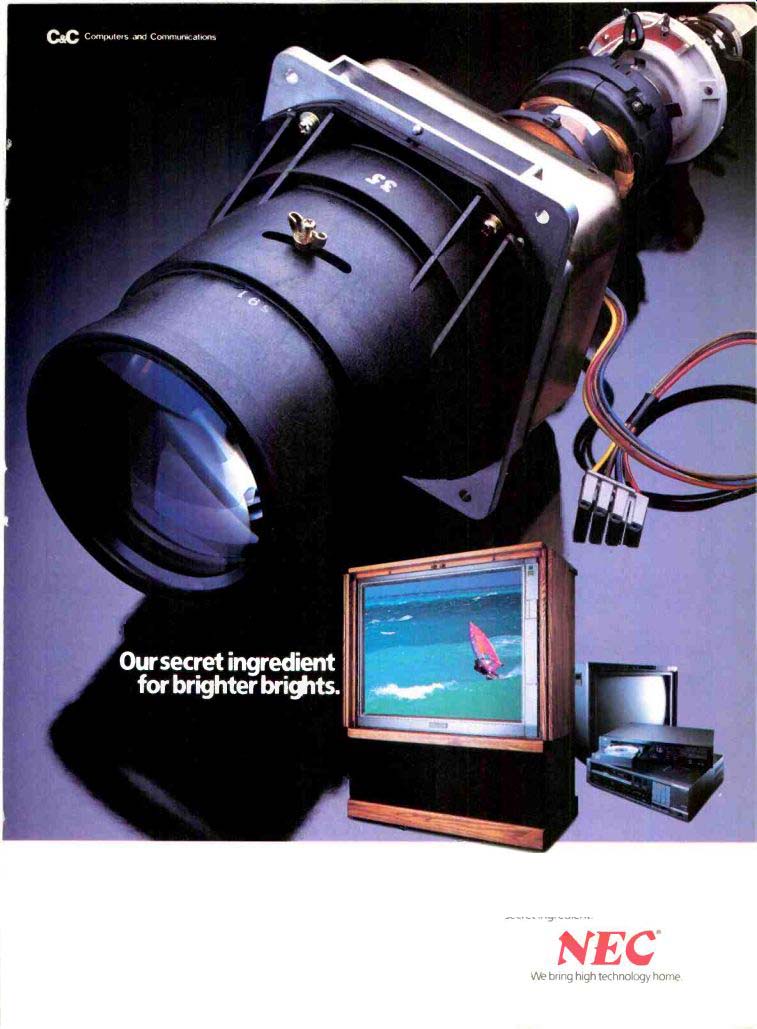
It shouldn't surprise anyone that the company behind this brighter projection TV is NEC. After all, we've been at the forefront of high-technology video for years. In fact, NEC's professional theater system is the world's largest projection TV This provideo expertise is our real secret ingredient.
NEC. We bring high technology home.
NEC Home Electronics (U S A ), Inc .1255 Michael Dive, Wood Dale, 4, 60191
Model P1-4650EN with 46' screen. measured diagonally Cabinet finished in genuine wt oeroer TV reception simulated.
= = = =
Also see:
Compact Discs -- Recordings of Import (Oct. 1986)