by BERT WHYTE
ANALOG ANNOUNCEMENTS
As always, there are so many new products at the CES that I can provide little more than token coverage, even in the categories I find of major interest. Thus, without further preamble, here is a further sampling of new audio equipment and developments.
More and more people are beginning to realize the importance of acoustical control in listening rooms.
Monster Cable responded to this by introducing Soundex One acoustic-control wall panels, Soundex Two freestanding acoustic-control panels, and Soundex Three hanging acoustic-control panels. All of the panels are constructed of one-inch thick, high-density fiberglass mixture, with an absorption coefficient of 0.90. They are covered in a special porous acoustic fabric in a variety of colors. The free-standing panels can be connected by special hinges to form a quasi live-end/dead-end wall behind and to the side of a speaker or possibly act as room dividers. Needless to say, the use of these panels in CES demo rooms was de rigueur. A 30-inch wide by 84-inch high left and right set of panels cost $1,400. The hanging Soundex Three panels can help control standing waves in a room and are available in 60-inch wide x 26-inch high and 60-inch wide x 34-inch high sizes. Of course, all three types of Soundex panels can be intermixed according to the acoustic requirements. All these new ideas in the control of room acoustics are great.
Krell's top-of-the-line KMA-2001 monophonic, Class-A, 200-watt power amplifier has had a number of refinements, including the use of Discrete Technology Lab's Distech interconnect cables for all internal wiring. Speaking of Distech wire, this interconnect cable and a speaker cable are the brainchildren of Sal DeMicco, head of Discrete Technology Lab. The excellent Acoustic Engineering AIR-2 power amplifier is also internally wired with his cable. A number of other high-end preamps and amplifier manufacturers will be wiring their units with Distech cable in the near future. Pentagram loudspeakers and the VMPS ribbon loudspeaker are internally wired with the Distech speaker wire.
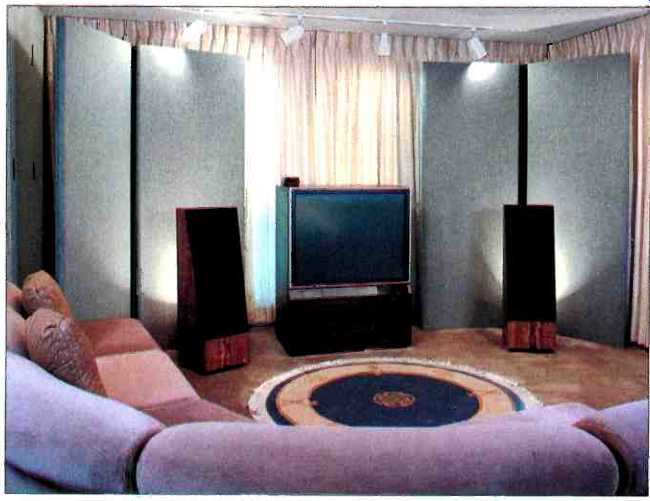
--------- Monster Cable's Soundex panels
Sal manufactures another product, Soundsorber acoustic panels. These are 4-inch thick, foot-square polyurethane foam panels with deeply sculptured wedges. On one wedge running down the center line of the panel, there is a narrow slot leading to a hollow semi-circular chamber. This is, in essence, a Helmholtz resonator, and apparently it increases the effectiveness of the absorption. Years ago, there were some heavy 3/4-inch thick wood panels made in Germany, which had similar slot resonators cut into them at two-inch intervals across the length of the panels. In fact, a number of concert halls in Germany and in other European locations are extensively paneled with this product. These Soundsorber panels seem to be very effective for acoustic control and have had an enthusiastic reception for both commercial use and consumer use in the home. Information on Distech cables and Soundsorber panels can be had from Sal DeMicco, Discrete Technology Lab Inc., 2911 Oceanside Road, Oceanside, N.Y. 11572.
Last month, I reported on new models of Compact Disc players. Before I leave the digital domain, a note on the new Sansui Tricode PCM digital audio processor, Model PC-X11. This is a slimline unit, less expensive ($900) than the original Sansui processor. It features the same EIAJ-standard, 14-bit linear encoding and has the same data-reading capability that permits digital audio recording even in a VCR's Extended Play mode. Thus, with a T160 videocassette, eight hours of digital recording is possible. All the usual EIAJ digital audio performance parameters apply. Recording level is monitored with a double-row LED display, there are microphone inputs, and direct digital copying is possible with a second VCR. On a cost-per-minute basis, the PC-X11 can provide digital recording that is cheaper than an audio cassette recorder using premium-formulation cassettes.
Speaking of audio cassettes, according to RIAA statistics, 1983 sales of prerecorded cassettes surpassed those of LP records for the first time. As for cassette recorders at the SCES, they were legion and have become ever more sophisticated, even at lower price levels. A typical example was the new JVC Model DD-VR9, that features a quick auto-reverse system utilizing their Flip Reverse Head, which is said to provide highly accurate playback in both directions of tape travel, and what JVC calls a Jewel Lock to prevent head misalignment. The three-head recorder has ceramic-clad Sen-Alloy heads, and their B.E.S.T. (bias, equalization, sensitivity, tape) optimization system is provided, as are Dolby B and C. Other features are direct-drive transport with pulse-servo motor, digital recording-level display with peak hold, and a whole array of convenience functions, even-would you believe?-a motorized slide-out control panel! It is all yours for $800. Like any dedicated audiophile and music lover, I'm always keenly interested in new preamplifiers and amplifiers.
As usual, there was no dearth of these products at the SCES, including several that could qualify as bargains and some that are in the most rarified levels of high-end audio.
The ever-astute David Hafler introduced his new DH-120 power amplifier. This Class AB unit uses MOS-FET output transistors and is rated at 62 watts per channel into 8 ohms from 20 Hz to 20 kHz. A flip of a switch bridges it to double this power in the mono mode. Minimal negative feedback is used in the circuit, and it is claimed there is sufficient current output for 2 dB of IHF Dynamic Headroom. David has designed his DH-120 amplifier with quite a number of convenience features. On the rear panel are separate right and left output controls to facilitate biamplification applications, the stereo/mono switch for bridging, and main and auxiliary speaker outputs for simultaneous operation of two sets of speakers. Of particular interest is the stereo-ambience circuitry to recover ambience signals in recordings and feed them to the auxiliary speaker outputs. A pair of speakers fed from these outputs, positioned to the sides or rear of the listening position, provide the well-known Hafler-Effect ambience enhancement.
Another MOS-FET power amplifier is the Tandberg TPM 3006A, a 150-watt per channel unit (8 ohms, from 20 Hz to 20 kHz), incorporating many of the principles espoused by Dr. Matti Otala.
The 3006A employs no negative feedback whatsoever and has a super-fast 500 V per µS slew rate. TIM and DIM are said to be unmeasurable. A toroidal power transformer is used in this high-current amplifier design (more than 25 amperes per channel). All audio stages use discrete circuitry, (no ICs), and capacitors are polystyrene and polypropylene, while metal film resistors are used. The MOS-FET output transistors are kept linear by a Voltage Comparator Servo Circuit, and d.c. is eliminated from the output by what Tandberg calls a Thermic Servo Loop.
This 25-pound amplifier is user-bridgable for a mono output of 410 watts into 8 ohms. At normal 150-watt per channel stereo operation, THD is said to be less than 0.02%. Obviously, the Tandberg TPA 3006A employs circuitry and components much favored by high-end devotees. At $995, this amplifier should garner much attention.
The Mark Levinson ML-2 pure Class-A amplifier has long been regarded by many audiophiles as a sort of "dream amplifier," a design of ultra-high fidelity and extravagant cost. The well-heeled owners of these exotic amps loved them, but often expressed their desire for a new Mark Levinson Class-A power amplifier with more than the 25-watt output of the ML-2: At the Raphael Hotel in Chicago, Mark Levinson Audio Systems was demonstrating a prototype of the ML-15 power amplifier that will become the "flagship" of the Levinson line of power amplifiers. The ML-15 is not a replacement for the ML-2, which will be produced as long as there is a demand for them, and like the ML-2, it is a monophonic amp.
The ML-15 is a completely new design, incorporating a number of unique circuit features. The massive power supply has sufficient computer-grade capacitors to control any crest factor. It is claimed that the linear d.c. regulator, with followers, which supplies all stages, including the output, can handle even the most highly reactive loads and has specifications comparable to the highest quality laboratory power supplies. The Levinson company claims that the new driver circuitry features a four-transistor configuration that reduces all types of distortion. Audio pre-drive current of greater than 6 amps is available so that the output stage is not limited by performance of the earlier stages. Sufficient bias is used in the output stage to provide 100 watts into 8 ohms in pure Class-A operation, and 50 watts into 4 ohms, also in the Class-A mode. In Class-AB operation, the ML-15 furnishes 200 watts into 4 ohms and 400 watts into 2 ohms.
All these figures are over the full 20 Hz to 20 kHz audio spectrum. Levinson states that a 20 Hz pulse with a repetition rate of 500 nanoseconds will produce a peak power output of over 2,500 watts! Peak current is rated at 63 amperes; you can always use it for arc welding! As noted, the ML-15 is a mono amplifier, so you need a pair of them for stereo; it will be available in the fall at the rather heart-clutching price of $9,000 the pair! Other Levinson developments include improvements and refinements to the ML-6A preamplifier (present 6A owners can have their units retrofitted) and a new amplifier designed specifically for impedance loads of 1 ohm.
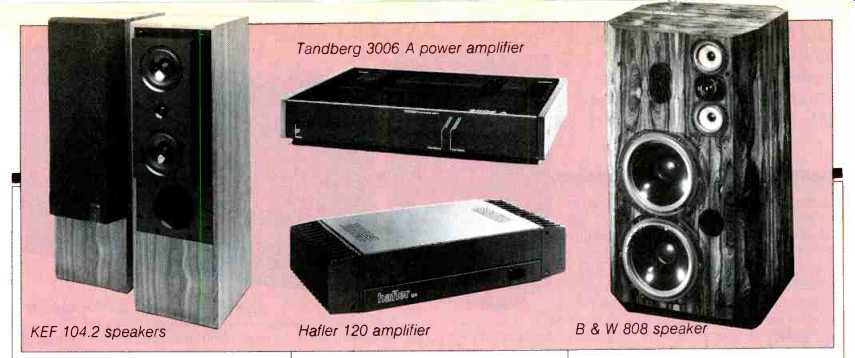
----------- KEF 104.2 speakers; Tandberg 3006 A power amplifier; Hafler 120 amplifier; B & W 808 speaker
Bill Conrad and Lewis Johnson of conrad-johnson design were giving a first-rate demonstration of their new pride and joy, the Premier Five mono tube amplifier. This unit uses eight EL-34 tubes to achieve 200 watts minimum into 4, 8, or 16 ohms from 30 Hz to 15 kHz with no more than 1% THD or IMD. A massive power supply and no current limiting enable the amplifier to drive high-amplitude music transients into reactive speaker loads. Frequency response of the Premier Five is -0.5 dB from 20 Hz to 20 kHz and hum and noise-so often a problem in tube amplifiers-is a very low 96 dB below full power output. Driving Infinity RS-1 speakers, the Premier Five had a very smooth, clean sound, with a big sound stage and superb front-to-back dimensionality. It is clear that the Premier Five is an exceptionally musical amplifier. A pair of these 81-pound Premier Five amplifiers is $6,000. At the Krell exhibit, Dan D'Agostino was proudly demonstrating his new PAM-3 preamplifier. This very likely will be one of the most versatile of the high-end preamps on the market.
There is a moving-coil phono input that features 16 separate impedance adjustments. Another input is provided for moving-magnet cartridges, and there are inputs for tuner, auxiliary, tape one and two and,, for the first time on any preamplifier, a special input for Compact Disc playback which includes a compensating circuit to correct the phase inversion and phase shift present in the output stage of CD players. This circuit is adjustable for various brands of CD players, and authorized Krell dealers will be able to make these adjustments. The tape facilities permit the recording of one program while listening to another. The high-level stages of the PAM-3 use a high-current, low output-impedance approach, providing the ability to drive cables of great length. All gain stages in the PAM-3 use discrete components and are separately regulated. All components in the PAM-3 are computer or NASA grade with a quality-control tolerance of 1%. The frequency response of the PAM-3 is very wideband, ranging from d.c. to 2 MHz. High-level voltage swing is more than 10 V rms. A weighted signal-to-noise ratio on phono is-110 dB. The PAM-3 is expected to sell for $2,850.
At Electrocompaniet, the charming and urbane Karen Sumner was on hand, giving-as always-a most civilized and musically satisfying demonstration. The Ampliwire Two A and Ampliwire Mono amplifier have been further refined and, in combination with the Preampliwire One or Two preamps, are even smoother and more musical sounding than before, while maintaining high definition.
Spectral brought forth a $1,495 DMC-5 preamplifier with many of the features of their more expensive units, but incorporating some interesting new technology as well. The unit has megahertz-wide power-band and sufficient gain that most moving coil cartridges can be used straight in without a head amplifier. Selectable cartridge loading is available by means of DIP switches.
The unit is claimed to have extremely fast rise and settling times.
As usual, there were more loudspeakers demonstrated at the SCES, at least at the Conrad Hilton and McCormick Inn, than any other product category. Also as usual, most of them were eminently forgettable. Herewith a report on a few interesting designs.
Acoustat has been concentrating on a series of electrostatic loudspeakers that are relatively tall, standing an imposing (and possibly intimidating to some people) 7-feet, 10-inches high.
Now they have introduced the Model One, their first single-panel electrostatic speaker, scaled down to a more modest six feet in height, 11 inches in width by 3 1/2 in depth. Of course, with this reduced diaphragm area, bass response would be reduced. Thus, the Model One is sold only with the companion 18-inch subwoofer cube whose floor-loaded, 10-inch driver provides bass response to below 30 Hz. Overall frequency response is said to be ±3 dB from 30 Hz to 18 kHz. A 75-watt amplifier can produce an SPL of 108 dB at 15 feet in a 14 by 18-foot room.
The Model One sounded very clean and transparent, with Acoustat's usual sharp transient response and really good imaging. Price is $1,195 per pair, including the subwoofer.
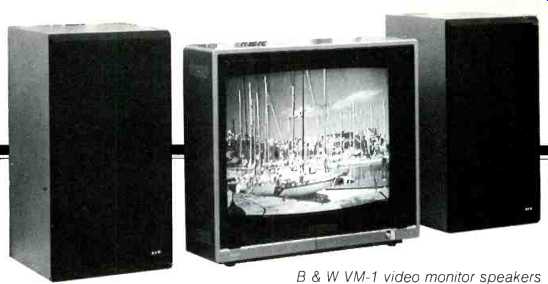
---------------- B&W VM-1, video monitor speakers
Apogee Acoustics were at the Raphael Hotel demonstrating their new Scintilla full-range ribbon loudspeaker.
Smaller at 57 inches high by 30 inches wide and less expensive at $3,500 than its big brother, it has retained most of the performance parameters of the original design. The Scintilla uses the same ribbon concept for woofer, mid-range, and tweeter, with 6 dB per octave internal crossovers. Although the Scintilla can be biamplified, it can also be driven by a single stereo amplifier. At the demo, a 100-watt per channel Krell was used, and it is claimed that 110 dB SPL at 4 meters can be attained in a 14 by 27-foot room. Frequency response is rated at below 30 Hz to over 25 kHz. Interestingly, the Scintilla's impedance can be either 4 ohms or 1 ohm, switch-selectable! As noted earlier, Mark Levinson has a new amplifier specifically designed to operate into 1 ohm. Cosmetically, the Scintilla is as visually striking as the Apogee.
Clements Audio Systems, of Dallas, Texas, was demonstrating a hybrid ribbon/dynamic-driver speaker. The speaker uses a 28-inch ribbon, which is directly driven .(no transformer required) with tri-polymer cone bass drivers in a patented compression-line bass-loading system. Very little information on this speaker, as I write, but what I heard sounded pretty good, with clean fast transients, but with some resonant colorations in the upper bass that should be damped.
KEF was showing a new speaker of quite a radical design, the Model 104.2. This is a columnar speaker with such unusual things as two bass drivers mounted cone-upwards, separated by a non-ferrous alloy bar, inside the enclosure. They operate in a push-pull configuration, which KEF terms a "Coupled-Cavity Bass-Loading System." The entire low-frequency output is radiated by a duct placed below the mid- and high-frequency enclosure, the duct effectively becoming a 5-inch air piston. The mid- and high-frequency drivers are in a separate enclosure, flexibly mounted to the front of the main enclosure. Most interestingly, the two midrange drivers have no chassis (basket)! The diaphragm assembly is fixed directly to the enclosure, with the magnet systems being bolted to the rear of the enclosure. There is a great deal more to say about this unusual speaker, which I unfortunately was unable to hear when I visited their room. Obviously, an early audition is in order.
B & W had a lot to show at their press conference, not the least of which was their new Model 808, which becomes the flagship of the line. It was designed in response to requests from record companies (particularly EMI) for a speaker with all the desirable characteristics of the 801F (now virtually the official monitor speaker for the classical recording activities of most of the major record companies) but with the ability to operate at very high output levels, e.g. 120 dB plus! The Model 808 is not an update of the 801F, but is an entirely new design, purpose-built to satisfy the record companies' requirement. Thus, new bass drivers were designed, as were new Kevlar midrange drivers and a new high-efficiency tweeter. All were configured through extensive use of laser interferometry and computer interface studies, and the new cabinet and crossover were similarly designed. I am deliberately glossing over the same details of the 808, since the exigencies of time at the press conference allowed but a tantalizingly brief audition of it. Nonetheless, the stentorian, but ultra-clean blast of some pop and rock music I heard was enough to anticipate that the Model 808 will become a classic speaker in the tradition of the 801F. B & W, cognizant of the increasing popularity of component video monitors, and the imminence of the new FCC-approved stereo TV transmissions, also introduced the VM-1 and VM-2 video monitor speakers. These speakers are specially designed with no magnetic field by using driver shielding. Placed in cheek-to-jowl adjacency to the sides of the video monitor, there was no picture distortion whatever. These are true high-fidelity speakers, with a sensitivity of 90 dB SPL at 1 meter for 1 watt into 8 ohms; power handling of the VM-1 and VM-2 is 75 watts and 100 watts respectively.
Frequency response of the VM-1 is 50 Hz to 20 kHz; the VM-2, 30 Hz to 20 kHz. The VM-1 is a 2-way speaker; the VM-2, a three-way unit. Both units use a 26-mm polyamide tweeter and a 200-mm diameter bass-midrange driver with specially impregnated composite short-fiber cones. Distortion in both models is less than 0.5% third harmonic from 90 Hz to 20 kHz at 96 dB SPL. I have already used the VM-1 model with a video monitor and the performance is quite remarkable. The fidelity of reproduction from Dolby stereo movie videocassettes is far superior than with the speakers furnished with the video monitor. Best of all was a live TV transmission of the United States Marine Corps Marching Band on the Fourth of July. After all, TV sound is wideband FM, and the crisp tattoo of the snare drums, brazen blare of the trumpets, shimmering cymbal clashes radiating myriads of high-frequency harmonics, and the solid, satisfying whump of the bass drums were thrilling in their realism. And this was only mono! Perhaps by next Fourth of July it will be broadcast in stereo!
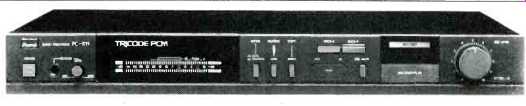
-------------- Sansui PC-X11 audio processor.
John Marvoskis introduced his Janis System Three mini-subwoofer. This unit is an 18-inch cube, employing a new 12-inch polypropylene cone driver. Crossover point is 100 Hz. At 30 Hz, harmonic distortion is under 1%. The-3 dB point is 24 Hz. The response of this mini-subwoofer is almost identical to the original Janis W-1 model but with less output. The price of the W-3 subwoofer is $500 in standard walnut or oak; rosewood is $75 extra. The Interface 1 A crossover and a 45-watt amplifier are sold only as part of the System Three, with the W-3 subwoofer and Interface 1A priced at $795 complete.
John had teamed up his new W-3 mini-subwoofer with Quad ESL-63 and, alternatively, the new Duntech PCL-3 wall loudspeakers. The W-3 mated particularly well with the PCL-3. On my Crystal Clear recording of Virgil Fox playing French organ music, the mighty 32-foot pedal tones were reproduced with awesome sonority and accuracy, while the Duntech reproduced the State Trumpets of the Ruffatti organ with brazen clarity, cutting through the thick texture of sound from the multitude of pipes. Best of all, the organ sound above the 100-Hz crossover was singularly free of the nasal colorations which so many speakers impose on organ music. Obviously, the new Janis W-3 mini-woofer and the Duntech PCL-3 are a very synergistic combination.
The Duntech exhibit was right next to the Janis room. Warren Weingrad, of W & W Audio (importers of the Duntech wall loudspeakers), was on hand to demonstrate the big brother of the Duntech PCL-3, the new PCL-5 wall loudspeaker. You may recall my rather unbridled enthusiasm for the Duntech PCL-3 wall loudspeaker in the April issue. I was impressed most of all by the accuracy of the speaker and its utterly neutral, uncolored sound. I readily admit that I am ultra-sensitive to resonant colorations in a loudspeaker, believing this to be the single greatest flaw that corrupts the illusion of reality in most loudspeakers.
I was enthusiastic about the PCL-3, but the PCL-5 is, at the very least, an order of magnitude better. How did the PCL-5 sound? In a word, marvelous.
With its efficiency, it can play quite loudly. Warren was playing a Telarc CD of Michael Murray organ music and the great clarity and huge sonority of the pedal bass prompted people to claim a subwoofer was being used! Transient response is outstanding--the piano in the "Trio" recording I reviewed in the May issue had a naturalness most people found hard to believe. String tone was smooth, sweet, and blessedly free of edginess. Above all, there was a tonal neutrality, with lovely delicate flute passages un-besmirched by a-musical coloration. Warren's room was always crowded and reviewers from the little magazines were bugging him for review speakers.
Even the relatively brief audition I had of the PCL-5 has convinced me that John Dunlavy deserves a tip of the hat for his extraordinary audio engineering design work.
+++++++++
THE BOOKSHELF
Handbook of Noise Control, Second Edition, edited by Cyril M. Harris.

McGraw-Hill, 720 pp., $43.50. The first edition of the Handbook of Noise Control appeared in 1957 and also was edited by Dr. Harris. There have been a great number of changes in noise control since that time, of course, but this second edition is not really an updating of the earlier version. In general, there is a reduction in the amount of space devoted to industrial noise and vibration control but a considerable increase in the coverage of legislation and regulations. To some extent, there has been a corresponding shift in the general interest of the public concerning noise. Much of the depth of the first edition is missing in several areas, as might be expected from the reduction in pages from over 1,000 to 720 and the addition of new subjects.
There is noticeable updating in the material, and the new type face and illustrations make for much easier reading. The total of 45 chapters is divided roughly this way: Four chapters on the properties of sound and sound fields, three chapters on measurements and standards, six on hearing and conservation, four on the effects of noise, three on vibration and its control, four on absorption and insulation with coverage on building problems, five on various types of equipment and machinery, four on construction and transportation equipment, 'our on community responses and the law, six on various types of regulations, and one chapter on environmental impact statements. The 23-page index is quite good, an essential part of this handbook. Specific chapters, which would be most helpful to audio engineers or studio acousticians, include "Sound in Enclosed Spaces," "Sound Absorptive Materials," "Airborne Sound Insulation," "Structure Borne Sound," "Noise Control in Buildings," "Fans and Blowers," "HVAC Systems," and "Ventilating Systems for Small Equipment." Plans for locating a studio may be aided by information contained in the chapters on transportation noise, which include a fair amount of level data, as well as some spectra. This is not an inexpensive book, and quite a few of the sections will not be of much interest to Audio's readership. Because of the considerable meat in the chapters mentioned above, however, there is good value per dollar even for those with a limited need for an understanding of noise control.
-Howard A. Roberson
++++++++
ADs:
Yamaha
NOW YOU DON'T HAVE TO PAY AN ARM AND A LEG FORYOUR EARS.
Becoming an audiophile has always had its price.
We have a way of lowering it.
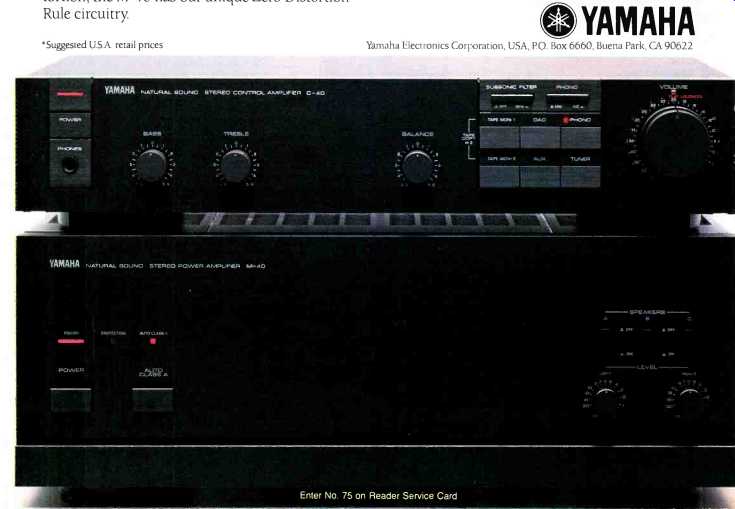
Introducing two of Yamaha's new high-end separates-the M-40 power amplifier and the C-40 pre-amplifier.
Both have the highest state-of-the-art circuitry and features. For the highest quality sound reproduction possible.
But at a lower price than ever before possible from Yamaha.
For pure sound combined with pure power, the M-40 uses our exclusive Auto Class A circuitry. It automatically switches from pure Class A operation to Class AB when music peaks require high power levels. So purity is never sacrificed for power.
To eliminate crossover distortion during switching, as well as transistor non-linearity distortion, the M-40 has our unique Zero Distortion Rule circuitry.
The C-40 uses ZDR in the phono EQ section. For the purest phono reproduction possible.
And to effectively capture the quieter passages that today's digital sources are capable of, the M-40 has a phenomenal 127dB S/N ratio.
The result is exceptionally pure and accurate musical reproduction.
Which is in keeping with the C-40's and M-40's basic, audiophile-quality sound reproduction--pure and simple.
And at $350 for the C-40 and $400 for the M-40, affordable.
So visit your Yamaha dealer. And satisfy your ears. Without having to sacrifice any other part of your anatomy.
----- Newly designed speaker terminals make either heavy-gauge audiophile cable purpose-or standard-gauge cable a snap to connect
YAMAHA---Yamaha Electronics Corporation, USA P.O. Box 6660 , Buena Park CA 90622.
----
(Source: Audio magazine, oct. 1984; Bert Whyte )
= = = =