by Bert Whyte

AUTUMN IN NEW YORK it's the title of a popular song, and it is traditionally the beginning of the audio "season." It is when we have the fall convention of the Audio Engineering Society, this year being held at the prestigious Waldorf-Astoria, and when we have the "flagship" show of the Institute of High Fidelity, the venue this year being the Statler-Hilton. As I write this, the AES convention is but a few hours away, and I am feeling very frustrated. Most of the writers I know are great procrastinators. I admit that I am quite notorious in this respect. All of us who write for monthly magazines submit our material several months in advance of publication, and we have a tendency to "wait-for-the-latest-information" before we turn in our articles. Inevitably, we must face up to the inflexible tyranny of copy deadlines. Hence my frustration, as there are so many things of interest at the convention, that had I another day or so ... Ah, well! I'll just have to keep things in my memory bank until next month.
With the growing importance of quadraphonic sound, there is unusual interest in the AES convention this year. Many people I know, who don't normally attend the technical sessions, are planning to go to them this time. The interest is understandable with an opening day session on quadraphonic sound chaired by my friend John Woram of Vanguard Records, with such provocative papers as Al Grundy's "Mathematics of Quadraphonic Matrices," friend John gargle's "4-2-4 Matrix Systems: Standards, Practice and Interchangeability," Peter Tappan's "Can We Hear Four-Channels via Headphones?" Then there is Mark Gardner of Bell Laboratories with his "Some Single and Multiple-Source Localization Effects," Takeo Yamamoto of Pioneer describing a "Quadraphonic One-Point Pickup Microphone," and Rex Isom of RCA with "An Analysis of the Frequency Modulation of the Carrier in Discrete Four-Channel Records." As if this wasn't impressive enough, later on in the convention are such things as a panel on four-channel broadcasting, a paper on logic enhancement of matrixed quad, another on recording techniques for SQ quadraphonic discs, and the inventor of the Shibata stylus in person on the technical requirements of phono cartridges for proper playback of CD-4 discrete four-channel records. As you can see, some pretty high-powered engineering talent is involved in many aspects of quadraphonic sound.
Speaking of the CD-4 discrete disc, there have been some new developments that warrant a progress report. I mentioned a couple of months ago that JVC and Panasonic were going to produce a new generation of demodulators for the CD-4 disc employing phase-lock-loop circuitry. Mr. Bob Dunn of Panasonic was kind enough to send me one of these new demodulators, along with a new semi-conductor quadraphonic cartridge with Shibata stylus and, most importantly, technically updated versions of RCA discrete discs. The demodulator is more compact than the earlier JVC unit, with clean, simple styling. A selector switch on the front panel has a position for four-channel auxiliary input (i.e. discrete tape), another for the CD-4 disc, and one for stereo discs. There is a so-called "radar" light above the selector switch which goes on when the high frequency carrier is fed into the unit. The rear panel has various input and output receptacles for the PHONO and AUX front and rear, plus a sensitivity calibration control set at the factory. The output of the cartridge feeds into the demodulator, and the outputs of the demodulator into the high level inputs on a four-channel receiver, integrated amplifier or pre-amplifier. It is worth noting that in using the demodulator, the phono pre-amp section of the receiver, amp or pre-amp, is by-passed.
With all due respect to Panasonic, whose phono pre-amp in the demodulator is clean and quiet, I don't think it would be as good as the phono section of really high quality pre-amps.
This raises the prospect that it' the CD-4 discrete disc becomes a viable and stable market entity, the manufacturers of the high class units may have to build demodulator circuitry into their phono sections. The semiconductor cartridge is claimed to have response from l0 to 50 kHz. One takes a little time to get used to such an extended high end claim, but there is no question that it picks up the carrier with ease. Used with conventional stereo records, the cartridge gave excellent results.
RCA calls its discrete discs by the trade name "Quadradisc." Two have actually been released, even though most of the new demodulators, or related equipment containing the new demodulator circuitry, will not be marketed until October of this year.
The hi-fi press is quite familiar with these discs, having heard various versions of them at a number of demonstrations. The pop disc is APD 1-0001, entitled "Hugo Montenegro/Love Theme From The Godfather," which is slightly misleading since there are eight other selections totally unrelated to the "Godfather." In any case, we are told that the album was specifically recorded for the quadraphonic format, and there is indeed clever and logical positioning and localization of the various instruments or groups of instruments on the four channels. The classical Quadradisc is ARD 1-0002, with Eugene Ormandy and the Philadelphia Orchestra, entitled "The Fantastic Philadelphians, Vol. 1." Produced by my former RCA colleague, Max Wilcox, this features Chabrier's España, Dukas' The Sorcerer's Apprentice, Saint-Saëns' Danse Macabre, and Mussorgsky's Night on Bald Mountain.
The important thing here is that this is a true four-channel ambient classical recording and it is a welcome relief from the hokey stuff RCA tried to foist on us in the classical Q8 cartridges.
Now follow this . . . until quite recently, all the sample Quadradiscs were cut with the JVC CD-4 equipment in Tokyo. The recordings of Montenegro and Ormandy that I received were down 6-8 dB from standard stereo level. They were also variable in respect to noise. Some were not too bad, while others had a lot of ticks and pops as well as odd swishing and thumping sorts of noises. In addition to being down in level, the classical recording suffered from bass attenuation. In the face of these shortcomings, RCA installed the special CD-4 cutting equipment in its studios at 1133 Avenue of the Americas in New York, which is slightly amusing inasmuch as the cutting speed necessary to the process of putting the 30 kHz carrier on the lacquer is approximately 11.33 rpm! Now that the CD-4 cutting equipment is close to hand, RCA has evidently been doing extensive testing, for the updated Montenegro and Ormandy recordings I was sent are very significantly improved over the previous samples. RCA now claims that the Quadradiscs are cut at normal "plus three" stereo level. To check this I played the new discs at a comfortable room-filling level, and then without touching the gain controls, played the previous sample discs that had been cut in Tokyo. Sure enough, there was roughly an 8 dB difference in level.
Quadraphonic expert John Eargle was my house guest the day before the AES convention, and we did a lot of comparative listening to the New York and Tokyo versions of these two CD-4 discs, as well as having a very stimulating discussion on various aspects of the discrete discs in particular and the quadraphonic scene in general. I can tell you that John and I were very impressed with the combination of the new phase-lock-loop demodulator, new cartridge, and the quadradiscs cut in New York. The Montenegro disc was really quiet. The master was Dolbyized of course, so no hiss intruded. But in addition, the record surfaces were astonishingly quiet, with only an infrequent tick or pop reminding you that you were listening to a record. This improvement is attributed to the use of harder record compounds and improved lubricants in the compound, plus the experience RCA has gained in pressing these new discs. John and I had the impression that the updated Ormandy recording was still slightly down in level, and the surfaces on the disc were a bit noisy. However, we also noted that the bass had been restored almost to normal, with bass drum in several parts of the music reproduced with solidity and impact.
The sound we heard from these discs was for the most part nice and clean, and this plus the improved output and less noise, made for very pleasant listening. The separation between the four channels and the "discreteness" of the pop disc were beyond cavil. The same could be said of the classical disc with the rear ambience nicely handled and obviously kept within the fusion limits of the brain.
John and I feel that RCA has most of the parameters under control. The only claim not yet fully substantiated is that RCA statement that they can cut up to 26 minutes per side; neither of the discs we listened to had more than 20 minutes per side. One fly in the ointment, which might slow up marketing plans, is the availability of the Shibata styli, which, it is said, are very difficult to grind. However, it must be noted that the people at Pickering/Stanton recently gave a demonstration of their quadraphonic cartridge, which featured a modified version of the Shibata stylus, and it worked very well indeed. In fact, to me, their cartridge had a smoother, more "open" sound than either the JVC magnetic cartridge or the Panasonic semi-conductor cartridge.
John and I concluded that on the basis of what we heard, and assuming that sufficiently rigorous quality control was exercised by RCA to maintain a consistent level of excellence, the CD-4 discrete disc is an eminently marketable item. One by one, the problems of the discrete disc seem to have been resolved. This is the big leagues, and there is a great deal of money at stake. In light of present technology and the pressure that RCA is under to make the CD-4 disc succeed, it would be surprising if the remaining problems proved insurmountable.
I had thought I would be able to bring you the rest of the story on the upgrading of automotive stereo cartridge systems, but I have run into a few minor snags that must be resolved before committing the story to paper.
Bear with me 'til next month.
==============
ADs:
You can. In 4-channels. With a Panasonic discrete system. Panasonic chose discrete as its 4-channel standard for a lot of reasons.
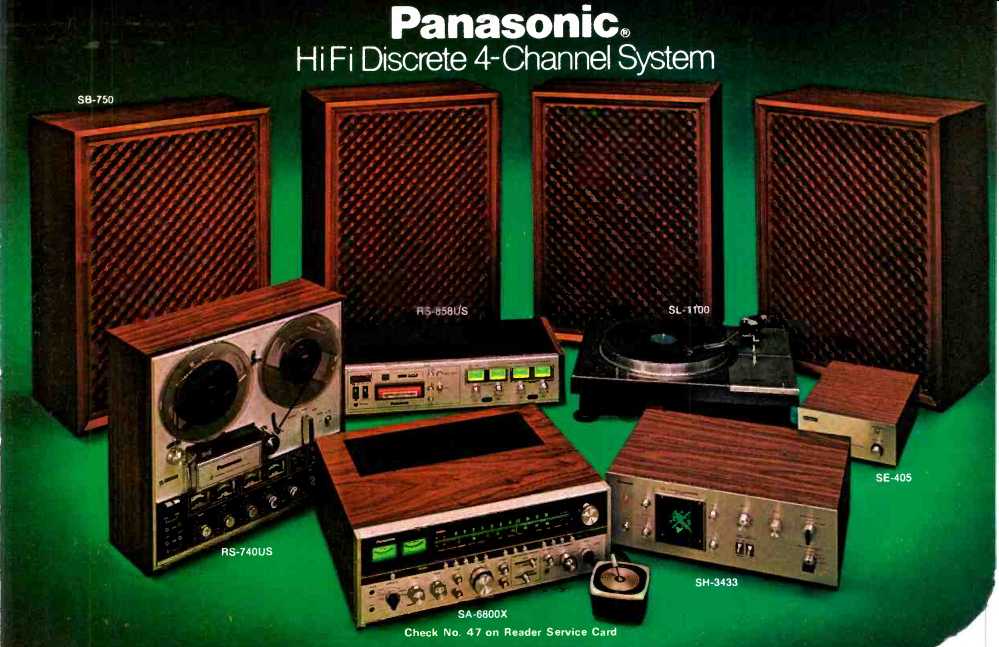
First, it has the highest degree of speaker separation and steady sound positioning of any type of 4-channel system. And in addition to playing discrete 4-channel tapes and records, a Panasonic discrete system enhances the sound of stereo tapes, records, and radio. Because of our Quadruplex circuitry.
Start with one of our 4-channel receivers. Like Model SA-6800X. It has Panasonic's Acoustic Field Dimension. That lets you adjust the speaker separation electronically. Plus a full 300 watts of power (IHF). You'll also need a tape deck.
For 8-track cartridges, there's the RS-858US. It plays and records 2 and 4-channel cartridges. With four separate input level controls.
And 4 VU meters. If you want all that in reel to reel, there's our 4 channel deck, Model RS-740US. It has Hot Pressed Ferrite heads, noise suppressor systems and other features. That add up to a frequency response of 30-23,000 Hz at 7 1/2 ips. And an S/N ratio of better than 50 dB. If you want records, you'll want the SL-1100 direct-drive turntable. With wow and flutter of less than 0.03% WRMS. And the SE-405 demodulator for Compatible Discrete 4-channel (CD-4) records. Like RCA Quadradiscs.
As well as matrix 4-channel, stereo and monaural records.
And our speakers, Model SB-750 are. 3-way air-suspension systems.
With 5 speakers in each enclosure.
Two domed tweeters. Two domed midranges. And a 12" woofer.
We can also let you see 4-channel sound. On our 4-channel audio scope. Model SH-3433. The screen will show you how much sound you're getting from each channel.
You can see our discrete 4channel components at your franchised Panasonic Hi-Fi dealer. The man who can make your wishes come true. But this time in 4 channels.
FOR YOUR NEAREST FRANCHISED PANASONIC HI-FI DEALER, CALL TOLL FREE 800 243-6000. IN CONN., 1.800 882-6500.
=======
Radio Shack
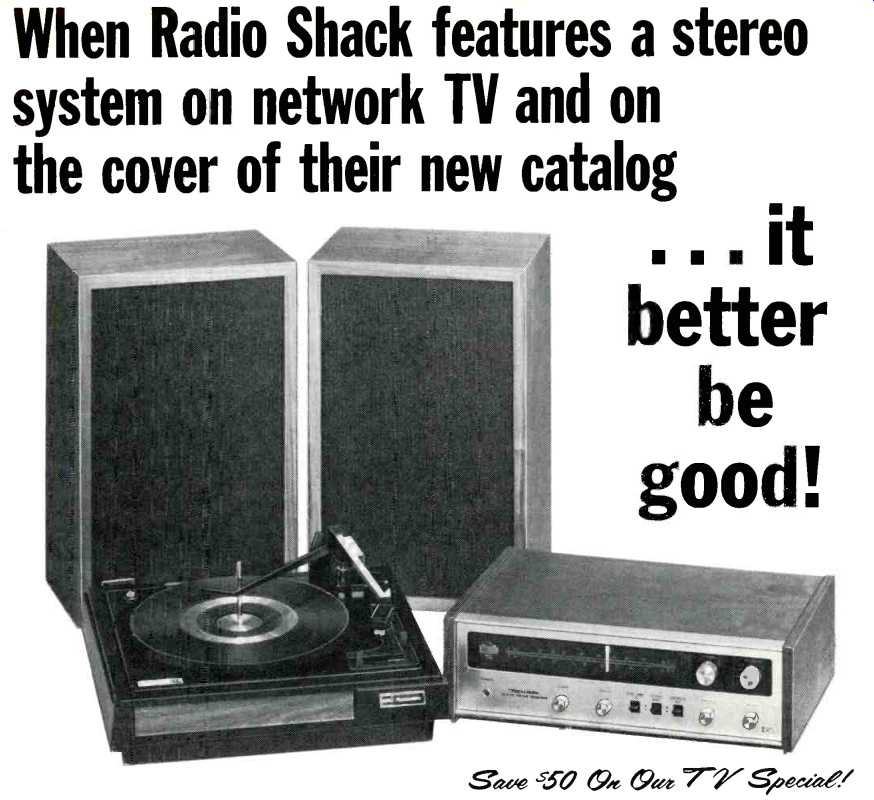
When Radio Shack features a stereo system on network TV and on the cover of their new catalog … it better be good!
We're showing off this all-Realistic system to millions upon millions of viewers this fall on NBC and CBS pro football telecasts. With that kind of exposure, every component in it had to be selected with painstaking care to deliver what we feel is best-for-the-money performance, style and features. We call it our "TV Special" on our 1973 catalog cover and it's very special indeed! Heart of this system is our STA-18 AM/FM Stereo Receiver, rated at 25 watts and boasting some very special features for its price-center-channel FM/signal-strength AM tuning meter, tape inputs and outputs with monitor, dial pointer that changes color to show FM stereo broadcasts. The bookshelf-perfect MC-1000 speaker systems have acoustic-suspension design, full 20-20,000 Hz response. Our LAB 12A 4-speed turntable handles your records with gentleness and precision. It is complete with a factory-installed base and diamond magnetic stereo cartridge.
The cabinets are made of oiled walnut wood; everything supplied for instant easy hook-up. Stop in, see it and hear it at any one of our over 1600 stores in all 50 states.
Reg. Sep. Items Price: $279.90
System Price $229.90
FREE '73 Catalog See What's Really New in Stereo, Communications, Hobby, Parts, Kits, Antennas, Tools, Much More.
At Your Nearby Store or Write Dept.: AIX.
RS and ALLIED RADIO STORES
-A TANDY CORPORATION COMPANY P.O. Box 1052, Fort Worth, Texas 76107
=======
(Audio magazine, 1972; Bert Whyte)
======
Behind The Scenes (Sept. 1972)
= = = =