Service vs. Features
Dear Sir:
In another leading hi-fi magazine an editor stated that frequency-of-repair records would be of little use in rating hi-fi products, and your articles-while informative and well-written-tend to stress the same attitude. I can understand this and agree, but only because present hi-fi practices make such analysis and comparison impossible.
Nowhere else in this country do I see such a high-turnover industry as yours. Products are obsolete in a matter of months as manufacturers bring out and advertise to death new products which have genuine improvements and added features. Service and reliability are hinted at but never stressed-it's always looks, performance, or features which come first.
And at the same time your industry seems plagued with service problems. I have YET to find a company which really considers service important. Their service centers are always understaffed with indifferent personnel who are overworked and frankly don't give a hoot about your product or your problems.
Indeed, why should they? The customer won't keep the product long anyway, the serviceman feels, since it gets obsoleted so quickly. In part, this is true. The mass advertising I get barraged with every time I pick up a hi-fi mag does nothing but make me miserable by telling me what a junk heap my present rig is. And it makes me even madder because it keeps promising things which the equipment simply cannot do no matter HOW good it is!
The result, Mr. Editor, is cynicism and distrust. I no longer believe what companies say; why should I? Friends and I never take our gear in for service. We either repair it ourselves or junk it wastefully for some "improved model" which dissatisfies us in some other way. Music is not important anymore; only the gear is important.
This practice does make comparisons of service and reliability impossible. But I wish you and other editors would challenge this wasteful practice instead of getting swept up into its very core.
-K. Wiley Rochester, N.Y.
There is some truth here, but the fact remains that manufacturers who make unreliable products do not remain in business. The dealer does not want to buy products that eat up his profit in the service workshop! In my experience, present-day hi-fi equipment with plug-in circuit boards, modules, and so on is a lot more reliable than it was back in the days of high voltages with transformers burning up, capacitors breaking down--not to mention tube failures! Nevertheless, there is considerable room for improvement-too many designers work on the assumption that their products will never, never need servicing. Especially some tape recorders that need a can opener to get at the innards.
-ED.
The Discography Predicament
Dear Sir:
As a collector of records since the late twenties, it is indeed frustrating to pay top dollar for discs, or tapes, and discover the omission of the composer, lyrist, artist, soloist, vocalist, orchestra, conductor, etc.; to say nothing of the "misleading" information on the label or jacket.
I must go back to the old 78 shellac days to find composer and lyrist listed on the label, together with the show, revue, or film the selection was written for, as well as the artist (orchestra, vocalist, or both). Some foreign labels, notably HMV, Odeon, Polydor and English Decca, even listed the publisher, recording date, and location.
With the advent of the LP, all of the above disappeared from the label, although the 45's (and 45 EP's) retained most of this for a few years; the LP introduced the beautiful and artistic jacket with less and less discography and more and more nonsensical patter, having absolutely no reference to the content, but rather about the LP title, cover, acoustic effects, or the supposed "mood" of the music.
With the introduction of prerecorded tapes, the situation became worse; open-reel (at the outset) was more like the old 78 rpm shellac labels (because adequate space was available on the label of 7 in. reels) but with the intercalation of 8-track cartridges and cassettes, practically everything disappeared from the labels (space?) and box or jacket (inventory?). Complaints of quality control, both about discs and tapes, are increasing to the point that disc/tape manufacturers are starting to "listen," but still results are not forthcoming. Again, foreign-produced discs/tapes far exceed their American counterparts in quality control, sonics, engineering, processing and discographies and at competing prices.
My interest now is centered on a recording catalog (disc/tape) that at least lists the entire selections on an LP, or tape, and not the present standard of simply stating a "few" selections, followed by the well-worn phrase "and 8 more."
This is not meant as being critical of the "so-called Bible" of the industry, the Schwann Record & Tape Guide, nor The Harrison Tape Catalog, Listen Magazine and others that are doing a creditable job. They are doing an excellent job on what they set out to do, namely a catalog listing of available discs/tapes and prices, when the manufacturers discontinued issuing their own catalogs. Now, with the voluminous number of discs/tapes being released, it is amazing the job they are doing. Schwann comes the closest to listing each selection, in their monthly "New Listings," but again it is inadequate. Miss a month and you've had it and Schwann catalogs are not easy to obtain.
I feel strongly enough about this dilemma to, with the encouragement of other readers and the disc/tape manufacturers themselves, encourage and promote the publication of a complete catalog/discography combination similar to the excellent RCA Victor Catalog circa 1940-41 which was of the type outlined above.
Your views may be expressed through this "Letters to the Editor" column, or the writer direct. Record/ tape manufacturers' views and opinions are especially solicited, as their willingness and cooperation will be required, to make available their documented data for compilation of such a catalog.
-A. F. McNaughton, Jr. 22 Blake Street Keene, New Hampshire 03431
Mechanical Minds?
Dear Sir:
Please write so women without mechanical minds can understand enough to buy the right equipment and how to use it.
-Jane B. Cantor, Montebello. Calif.
But what would women's lib say about writing down to the ladies?
-Ed.
================
THE WORKBENCH
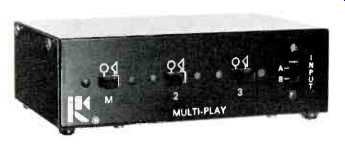
Russound/FMP SQB-2 Multi-Play switch
Many older receivers and amplifiers don't have facilities for remote speakers, and when they do a good proportion present the user with a MAIN versus REMOTE choice so that loading is always high enough to be tolerable to the amplifier. But the enthusiast will quickly find that he wants to have both main and remote speakers playing-and if he doesn't, his wife will.
To complicate matters, she may want to have another set playing in still a third location. (We won't discuss the amplifier's reaction to this idea!) It's easy enough to hook up two speaker systems in parallel or series/ parallel, but with a third set things start to become a little sticky. Even if you stick to two sets, there really isn't much latitude for switching ON and OFF, and it really doesn't make much sense to have the patio speakers on with a foot of snow out there. And if you just pull the speakers out of the hook-up, you've destroyed that impedance balance you wanted.
To handle these problems, the SWB-2 has its circuitry arranged so that it can handle any combination of three sets of speakers at once and still present the amplifier with at least a four ohm load. In addition, this black box has a dual input system allowing two amplifiers to be hooked up to it. This can be used for A-B tests of two receivers (or amplifiers), switching between separate sources (a simple way to bring the TV output into the system), etc.
The back of the SWB-2 has the 10 two screw terminals necessary to accommodate the wiring up of three pairs of speakers for output and two amplifiers for input.
In practice, these terminals are somewhat closely spaced and would benefit from a barrier strip since, as the instruction sheet mentions, "a short circuit at the switchbox ... could cause damage to the power amplifier." Marking the various terminals as to Amp A or B, Left or Right speaker system, and signal or ground would speed installation, as would use of screw-type or spring loaded posts rather than terminals which require a screwdriver.
After checking for possible shorts, we put the SWB-2 through its paces and it worked "as advertised." Controls were juggled to switch back and forth between a moderately powerful integrated amplifier and a "lightweight" receiver-no problems. Speaker pairs were switched from completely off to all three on and again there was no trouble. Switching was positive-click on, click off. If you need a switch box, consider this one; it works.Price: $13.20 postpaid.
-E.P.
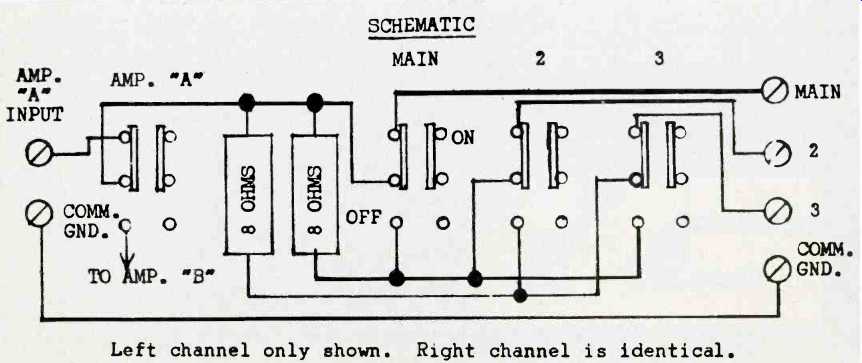
------------SCHEMATIC MAIN: Left channel only shown. Right channel is identical.
================
(Source: Audio magazine.)
Also see:
= = = =