-----------
In my report on the June CES, I inadvertently left out of my coverage of the special British exhibit the name of Celestion, which is now being distributed in North America by the Canadian firm, Rocelco. Celestion is, of course, one of the oldest and most respected loudspeaker manufacturers in Britain, and if you read The Grammophone or Hi-Fi News and Record Review, the two pre-eminent English audio magazines, you will have seen ads for Celestion's Ditton speakers many times. Rocelco will be handling both Celestion's Ditton range and their new UL range of speakers through a much expanded dealer network, and in many parts of the country, the Celestion speakers are already appearing in selected audio shops.
-----------
A FEW WEEKS ago I was rearranging tapes and adjusting shelves, in the never-ending quest for more space to cope with my always expanding library, when I came across "old number one" itself.
This is what the "ancient order of audiophiles" fondly calls the first prerecorded stereo tape ever issued by a major record company, RCA's 1954 release of Fritz Reiner conducting the Chicago Symphony Orchestra in Richard Strauss' Also Sprach Zarathustra. This justly famous tape was, and is, a great performance and a sonic spectacular. It was in half-track stereo, of course, two channels in line, covering the full width of the 1/4-in. tape, with tape speed at 7-1/2 ips.
I played this 21-year-old tape and was pleased to note that it had gained its majority gracefully, with but a slight "cupping" of the tape and minimum shedding of oxide. Sure, it was hissy...but the sonics were still remarkable for their lucidity, general cleanness, overall rich sonorities, and the splendid orchestral balances the engineers achieved in the superb acoustics of Chicago's Orchestra Hall.
This was one of the great recording halls in the world, before the lamentable reconstruction in 1966, which henceforth ruined it as a recording venue.
Listening to this tape, a lot of memories bubbled to the surface, and I recall the cynics and skeptics of that time saying things about stereophonic sound that have a familiar ring today, "It's just for you far-out hi-fi freaks," "It will never get off the ground," "It's too expensive," "Who needs it?" etc.
The more reasonable types said, "Yes, it's great. ..no question about that...but it will never be a factor in the market until you can give us the same stereo on a phonograph record." As we all know, it took four long years until, in 1958, Westrex came up with its 45/45 system, and we had a stereo disc. But only the most charitable would say that it was a quality product. In truth, it left a great deal to be desired, with much development work necessary to achieve the fidelity of reproduction acceptable to critical audiophiles. There had to be improvements in the stereo cutterhead and cutting amplifier, etc., to say nothing of the improvements needed in stereo playback cartridges.
It must also be remembered that most engineers had little or no experience in recording stereo and, for many engineers, old ideas and procedures died hard ... and learning this new recording philosophy was often a prolonged and painful affair.
As With Stereo
Obviously, this stereo scenario sounds very similar to what has been happening with quadraphonic sound since its introduction. It was in 1969 that Seymour Solomon and his Vanguard Record Co. ushered in the quadraphonic era by releasing discrete four-channel, open-reel tapes.
Needless to say, this new sound was enthusiastically condemned by the usual intra-industry mossbacks and doom-sayers. Their epithets were of the same pungent variety that were leveled at stereo, "Too impractical," "Too damned expensive," etc. One could hardly argue with them with respect to expense, since a four-channel tape machine, four channels of amplification, and four loudspeakers added up to a very costly package. The quadraphonic tapes were expensive too, ranging from $12 to $18 per 7-in. reel, and there were not many titles available, a situation which unfortunately has only marginally improved today.
It was apparent that to make quadraphonic sound more accessible to the consumer, it would be necessary to develop a means of reproducing this great new sound from a phonograph record. From any technical viewpoint, this was obviously going to be a most formidable task, far more so than was the case with stereophonic sound. (After all, we did have the 1933 stereo experiments of Dr. Blumlein of EMI as at least some sort of an approach to the problem.) A four-channel disc had to be a venture into totally uncharted areas of phonograph record technology. There was first of all the question of compatibility of such a four-channel disc with existing stereo and monophonic equipment.
The idea of reproducing four channels of sound for a single record groove was mind-boggling; believe it or not, there even were experiments using specially cut discs with parallel tracking stereo cartridges, a la Emory Cook in the old binaural days! In 1970, Peter Scheiber startled the industry with a demonstration of a four-channel disc, utilizing what came to be known as a 4-2-4 matrix encoding process. The output of a four-channel discrete tape was fed into a special "encoder" which matrixed (mixed) and phase-shifted the four signals in a precise mathematical relationship, reducing them to two channels. In playback, the two signals were fed into a decoder, where complementary dematrixing circuitry restored the signals to the four-channel mode, purportedly the equivalent of the original quadraphonic input signals. Critics were quick to point out that "You just can't mix four colors of paint together and then separate them back into their original hues." The analogy was crude, and they did not take into account psychoacoustic factors at work in the playback process, which helped to "deceive" the ears into apparent restoration of the original sound field. Nonetheless, the devotees of discrete quadraphonic tapes considered the matrix, at best, a compromise. In spite of this, Pete's matrix idea stimulated a great deal of interest and, in short order, we had the Scheiber/Feldman-Fixler/ElectroVoice joint involvement in the 4-2-4 system. Then came Ben Bauer and Columbia Records with their SQ matrix disc, followed by Sansui with their QS matrix disc. This set the stage for a long period of development and refinement of matrixing technology.
However, to complicate matters, the Victor Company of Japan entered the four-channel disc sweepstake with their CD-4 quadraphonic disc, whose principal virtue was that there was no "mixing" of the original four-channel tape signals, as each of the 4 channels on the disc remained "discrete" and precisely localized in their respective quadrants.
At first glance, this CD-4 system seemed to satisfy the requirements of a true discrete quadraphonic tape/phonograph record interface.
But the CD-4 system was such an ultra-sophisticated, technically complex affair, that although the discs made with it indisputably reproduced discrete quadraphonic sound, there were many problems within the system that adversely affected some basic playback parameters.
New Cutting Gear All the foregoing has been a rather long preamble to the "meat" of this column, to wit: The ongoing development of the CD-4 system, including a visit with John Eargle in Los Angeles, and a tour of the JVC CD-4 Cutting Center and RCA's Hollywood studios, wherein I saw the new JVC Mark-3 Modulation System and its RCA counterpart known as the "Quadulator." John is a consultant for all of the CD-4 record manufacturers, and conveniently, his JME Associates office is in the same building as the JVC Cutting Center and the RCA studios.
I think it is safe to say that some time ago the SQ and QS matrix systems have reached a level of technological maturity. In SQ, the various logic aids to channel separation have been reduced to IC chips, and there are highly sophisticated decoders in the Paramatrix of CBS Labs, the Tate DES design, and the Shadow Vector unit from Audionics. Sansui's QS has its advanced Vario-Matrix decoders and a commanding lead in terms of synthesizer functions.
On the other hand, as noted, the sheer complexity of the CD-4 system has revealed problems which have somewhat slowed its development.
Diligent research and experience with the system have gradually resolved these problems. It is the thrust of this article to discuss the breakthroughs represented by the new jointly developed JVC and RCA CD-4 modulation systems, and the resultant high quality of discrete quadraphonic sound that has been achieved.
In the CD-4 discrete quadraphonic disc system, four audio signals are fed into a signal processor and are converted into sum signals, left-front plus left-back and right-front plus right back, and difference signals, left-front minus left-back and right-front minus right-back. The difference signals are used for angular modulation of a 30 kHz carrier, and then superimposed on the sum signals before going to the lathe cutter head. The 30-kHz carrier is FM (frequency modulated) from 30 to 800 Hz, phase modulated from 800 Hz to 6 kHz, and is again frequency modulated from 6 kHz on up. High frequency range in the system extends to 45 kHz, hence the need for playback cartridges with response to 50 kHz.
The name of the game in CD-4 performance is base-band or normal stereo response in combination with the carrier-band response. Ideally, nothing should interfere with the recovery of the 30-kHz carriers. In the earliest days of CD-4, there were numerous problems, total playing time was about 22 minutes per side, overall levels were down 4-5 dB from normal stereo levels, bass response was restricted. All this mainly as a result of the frequency response and crosstalk characteristics of the cutterheads available at that time. This was also one of the reasons for cutting the lacquer master at approximately one-third normal speed. The limited inside cutting diameter of about six inches (across the center hole) and subsequent time reduction was also caused by the contour of the cutting stylus and width of the burnishing facets. Presently, styli that are used for CD-4 cutting have back angles of 35 degrees, rather than the usual 45 degrees, and burnishing angles are now close to 30 degrees. Burnishing facet width has been appreciably reduced and all this adds up to the ability to cut to diameters of less than five inches, with satisfactory carrier information over the 20to 45-kHz range.
Distortion Reduced Another problem frequently encountered was certain kinds of distortion, mainly the result of interaction between the base-band and the carriers. "Type One" distortion can be described as carrier erasure due to excessive levels and subsequent heavy base-band modulation, and it shows up audibly as sharp, crackling sounds. When the one-third cutting speed was commonly used, it was "suggested" to avoid Type One distortion that tape masters not exceed +2 VU. At the present half-speed cutting, tape levels of +6 VU can be used with minimum Type One distortion. The use of the aforementioned new contour cutting styli also reduces this kind of distortion. It should be mentioned here that demodulators like the Technics SH-400 have a special high speed muting circuit, which effectively masks the sound of carrier dropout. Type One distortion can also result from too low a tracking force (Shibata styli and 2 gram force are recommended) and from excessive harmonic distortion in the playback cartridge which might appear in the carrier frequency and confuse the demodulator.
"Type Two" distortion really is a form of intermodulation or "beat" distortion, generally caused by rear channel information leaking into the front channels, or vice versa, and this insufficient carrier separation produces a "buzzing" sound, particularly affecting low frequencies like bass notes. Type Two distortion is almost totally a product of the playback cartridge and not the CD-4 cutting system. Cartridges with but 10 - 12 dB of separation in the carrier range would be suspect.
All this talk of distortion sounds horrific, but it must be noted they were problems uncovered in the first operational period of CD-4 technology. Either through improvements in the cutting system, in playback equipment, or on current CD-4 recordings, these Type Two distortions have virtually disappeared.
In 1970, the first CD-4 cutting modulation system was housed in three large racks, with myriads of controls, and the cutting speed was one-third of normal. In 1974, the JVC Mark-2 CD-4 system was introduced, and had shrunk to a single rack and cutting speed had gone to half normal (16 rpm). When I walked into the JVC Cutting Center in Los Angeles in May of this year, John Eargle showed me the new JVC Mark-3 modulation system, housed in an attractive console 40 in. H by 52 in. W by 34 in. D. Among the major features of the unit are reduced cost, now at a level that independent cutting studios can easily acquire one; new signal conditioning equipment, using a new phase modulation principle; the ability to interface with any cutting system on provision of input/output switching; wider dynamic and frequency range of the modulator, thus lowering distortion; automatic signal conditioning of both low and high frequencies to optimize transfers for any kind of program material; a new type of carrier level control, which does not require an extra set of advance heads on the tape transport, and automation which reduced operational controls from 65 on the Mark-2 to just 15 on the Mark 3.
In the same building in the RCA studios, Joe Wells proudly showed me their new CD-4 Quadulator. Since the new phase modulation system is the result of a joint RCA/JVC/Matsushita project, the same system is used in the JVC Mark-3 and the RCA Quadulator.
The Quadulator occupies only 13 in. of space in one standard 19 in. rack.
While the Quadulator performs the same functions as the JVC Mark-3, it is even simpler to operate and is especially set up to interface with equipment normally used in RCA studios. It is good to know that the RCA New York studios will soon receive a Quadulator, and we can then expect some really fine CD-4 recordings.
The item of major importance in the JVC Mark-3 and the RCA Quadulator is the use of a special selected frequency divider type of phase-locked loop, instead of the serrasoidal modulator used in the previous systems. In the JVC Mark-3, the PLL has simplified the circuitry, eliminated the delay time, and widened the dynamic range. Among other important ad vantages in the Mark 3 is that in the previous systems the four audio signals were processed by limiter circuits, where as they now are first converted into sum and difference signals, and then these signals are processed by the signal conditioners which automatically control the level of the signals. The sum-signal conditioner controls its level so that nonlinear distortion due to over-amplification does not occur in playback; the carrier band signal conditioner prevents over deviation.
Another item which contributes greatly to higher quality CD-4 discs is the use of the new Ortofon DSS731 and Neumann SX-74 cutterheads that have diamond cutting styli, rather than the usual sapphire styli. Their use is said to provide discs with much smoother frequency response, better S/N ratio, and with fewer variations in group delay characteristics. Lasting up to 10 times longer than sapphire types, the diamond cutting styli also give higher lacquer production rates with less down time.
As a result of all these improvements, we now have a CD-4 disc of superb quality. There are no longer any playing time limitations and recorded levels are within 2 dB of regular stereo discs. The new, harder, lubricated, anti-static CD-4 pressing compounds are capable of producing really quiet discs. One looks forward to their use in regular stereo discs. The concomitant improvement in CD-4 playback equipment, new generations of phono cartridges, like the Pickering XUV/4500.., which can track CD-4 discs at one gram with superb separation, and the aforementioned Technics SH400 demodulator which incorporates PLL, high speed muting, easy meter locking and calibration of separation and carrier signals combine to make CD-4 listening a real pleasure.
I have two experimental CD-4 discs made with the RCA Quadulator, Carly Simon's Hot Cakes and Stephan Michael Schwartz (dig that title), and I have the same recordings made with the previous modulation system. The difference is absolutely startling. The new discs are virtually noiseless, gone is the sense of "strain," as if you were expecting to hear some distortion at any moment. Everything is wide open and "airy," the sound is very clean, levels are up, bass is deep and solid, and dynamics much wider. This certainly is impressive audible evidence that the CD-4 system has come of age ... a viable quadraphonic product, and discrete to boot!
Dear Editor:
More Toolmakers
Dear Sir:
Thank you for publishing the article on Syn-Aud-Con in the September issue. We felt that your readers might be interested to know who the latest Syn-Aud-Con sponsors are: United Recording Electronics Industries General Radio Co.
Shure Bros., Inc.
Sunn Musical Equipment Co.
Sescom, Inc.
Emilar Corp.
Syn-Aud-Con puts a lot of emphasis on their sponsors because they give wholehearted support of this advanced education and because of the important services they offer the industry in their own right.
Carolyn Davis Syn-Aud-Con Tustin, Calif.
Real Loads for Amps
Dear Sir:
I would like to express my pleasure in reading the article by Mr. De Marinis "How Valid is the FTC Preconditioning Rule?" in the September issue. I would like to point out that so far none of the articles on this subject has mentioned that all the amplifier tests, as well as preconditioning, are done with resistive loads, 8 ohms in most cases, while amplifiers are designed to operate into a complex impedance load. Most speaker systems are complex loads, commonly showing phase shifts of 60 degrees in the lower frequency range, where a good portion of the audio information is contained.
Dissipation in the output section of the amplifier can be considerably higher while driving such speaker loads than while driving resistive loads. This, in turn, means higher heatsink temperatures than indicated by the measurement with resistive loads under program source conditions.
Based on the fact that for a reduction of 10° C of the transistor junction temperature, life of the transistor will approximately double, and the fact that a 25° C decrease in case temperature excursion will increase thermal cycling ratings almost an order of magnitude, depending upon the type of transistor used and operating conditions, I don't think that the FTC rule is all that unreasonable. It is true that consumers are paying slightly more, but in my opinion improvement from a reliability standpoint could be well worth the additional cost.
Miroslav Glogolja; Hillsborough, N.J.
The author replies:
I basically agree with Mr. Glogolja. A couple of times in the article I mentioned that reliability considerations were an entirely different matter, and I tried to avoid confusing that subject with the matter of an FTC test for OUTPUT POWER capability.
The problem for designers of good, reliable amps becomes horrendous when you realize that we have no control over what the user will connect to the output or input of our product, how he will set the controls, or how much air circulation will be available. More heat sinking certainly helps, but there are other ways to address the problem. Sensitive thermal protection is one approach which has been made very difficult by the FTC ruling.
The various engineering solutions to this maze of problems is one of the factors which determine amplifier quality and cost. It's an important part of a competitive free market. Freedom of design should not be distorted by the side effect of a government ruling. This discussion, if allowed to run its course, would fill several issues of Audio magazine, but thanks for the opportunity to comment.
-Joseph De Marinis, GTE Sylvania Batavia, N.Y.
Gee, Thanks
Dear Sir:
I couldn't help writing to tell you what a "Godzilla" of a magazine your September issue was. First, a review of Ampzilla that reveals how an amp sounds as well as looks on paper. (Jim Bongiorno, please keep those prices down, at least until I get ahold of your amp!) Then, an excellent article by Joseph DeMarinis that reveals the FTC preconditioning requirement is as ridiculous as requiring the welterweight boxing champion to do 10 rounds with a heavyweight, and then immediately defend his title in another match. The article on bi-amplification was concise and informative, and revealed little bias in the direction of any manufacturer's products.
George Tillett's piece on cassette decks (and their relation to open-reel) was refreshingly different from the approach the "other" stereo magazine would take to the same subject-and it was concise and informative. Only the last paragraph revealed a little of the consumer approach, but perhaps it was written in response to an editorial request to keep the article under X words but still have a pretty ending. Finally, Ed Canby gave me some new binaural thought, not too "techno-freakish." By the way, please have fun-loving (Datsun 260Z?) Richard Heyser review the Dahlquist DQ-10 and the Magneplanar soon. (If you have to edit this letter for space, please leave in the last sentence, for I respect Heyser's reviews, and would like to compare my findings against his really accurate ones.)
-Bob Katz; Hartford, Conn.
harman/kardon
Fine amplifiers produce excellent square waves.
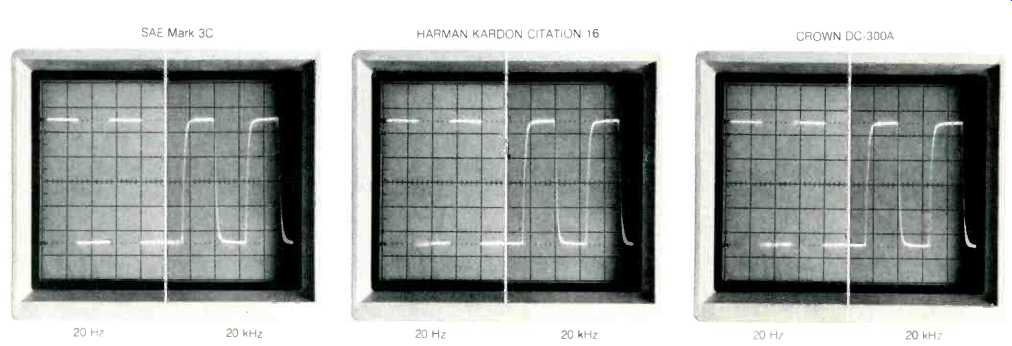
One receiver matches the square waves of fine amplifiers.
The finest separate power amplifiers produce excellent square waves. Quality oriented designers and engineers know that square wave response is profoundly useful because it is a precise projection of musical quality.
Not only does the square wave "mirror" the quality of sound, but it is, in a unique way, sound itself. The square wave possesses the complexity of a musical wave form.
Both have a fundamental and a series of harmonics that have a set relationship to one another. The square wave must be able to pass through the amplifier without damage if the musical wave is to pass through undamaged.
Square wave measurements do not replace conventional methods of testing components. Yet it can be said that an instrument which fails to produce excellent square waves is limited in musical authenticity.
[All square wave measurements 10V peak to peak]
The new Harman Kardon 430 receiver displays square wave response that is indistinguishable from the finest power amplifiers. A listening test will reveal that the 430, in all but absolute power levels, is the sonic equivalent of any individual component system your dealer can demonstrate.
The implication of a comparison with conventional receivers is obvious.
The square wave reproduced here is not that of the 430 power amplifier section alone. Amazingly, it is the square wave achieved by the 430 amplifier and preamplifier operating together! The 430 AM/FM tuner is consistent with the outstanding performance quality of the amplifier and preamplifier.
It is sensitive, receiving even distant stations with ease and without distortion. The tuner is also characterized by excellent selectivity and signal-to-noise ratio.
The 430 functions with two separate power supplies, one for each channel-the Harman Kardon "twin-power" concept. No matter how much energy is called for by dynamic music passages, performance of one channel is not affected by the other.
At Harman Kardon, technical advances are pursued not for their own sake, but as methods of predicting and improving music quality. It is in this context that we have prepared our literature on the 430 as well as our booklet: Square Wave Analysis of Audio Amplifier Performance.
Your Harman Kardon specialist dealer can supply both. Or write to us directly at: Harman Kardon, 55 Ames Court, Plainview, N.Y. 11803.
++++++
Empire
The Empire 598 III Turntable Created by concentrating our total effort on a single superb model.
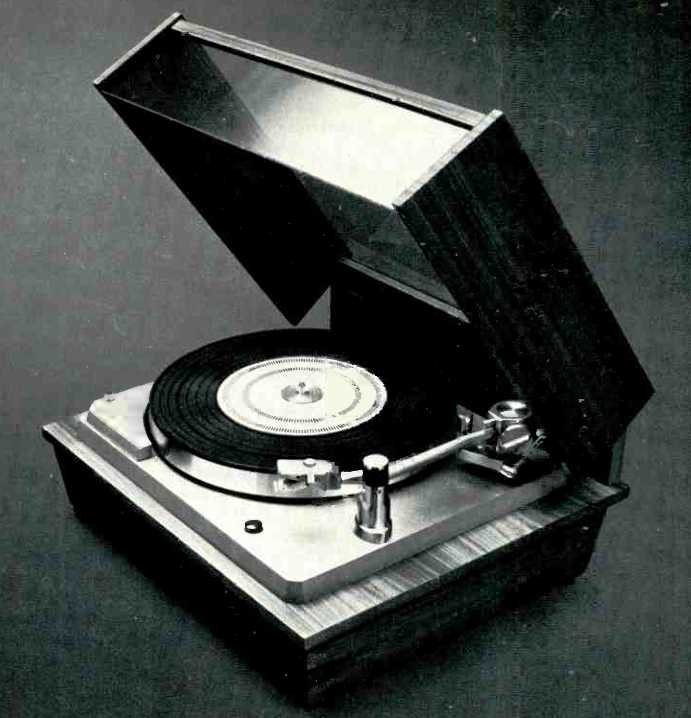

The Motor
A self-cooling, hysteresis synchronous type with an inside out rotor, drives the platter with enough torque to reach full speed in one third of a revolution. It contributes to the almost immeasurable 0.04% average wow and flutter value in our specifications.
The Drive Belt
Every turntable is packaged only when zero error is achieved in its speed accuracy. To prevent any variations of speed we grind each belt to ± .0001 inch.
The Platter
Every two piece, 7 lb., 3 inch thick, die cast aluminum platter is dynamically balanced. Once in motion, it acts as a massive flywheel to assure specified wow and flutter value even with the voltage varied from 105 to 127 volts AC.
The Main Bearing
The stainless steel shaft extending from the platter is aged, by alternate exposures to extreme changes in temperature, preventing it from ever warping.
The tip is then precision ground and polished before lapping it into two oilite, self-lubricating bearings, reducing friction and reducing rumble to one of the lowest figures ever measured in a professional turntable;-63 dB CBS ARLL.` The Suspension Piston damped, 16 gauge steel coil springs cradle the arm and platter. You can dance without your stylus joining in.
The Tonearm
The aluminum tubular design boasts one of the lowest fundamental frequencies of any arm, an inaudible 6 Hz. Acoustic feedback is unheard of, even with gain and bass turned all the way up.T he vertical and horizontal beating friction is 1 milligram. This allows the arm to move effortlessly imposing only the calibrated anti-skating and tracking force you select.
The Cartridge
Empire's best, the 4000D/III, wide response cartridge is a standard feature.
The capabilities of this cartridge allow you to play any 4 channel or stereo record at 1 gram or less. And the frequency response is an extraordinary 5-50,000 Hz, with more than 35 dB channel separation.
The Controls
The coordinated anti-skating adjustment provides the necessary force for the horizontal plane. It is micrometer calibrated to eliminate channel imbalance or unnecessary record wear.
Stylus force is dialed with a calibrated clock mainspring more accurate than any commercially available stylus pressure gauge.
A true-vertical cueing control floats the tonearm up or down hum a record surface bathed in light.
At Empire we make only one model turntable, the 598III, but with proper maintenance and care, the chances are very good it will be the only one you'll ever need.
'Independently tested and recorded in High Fidelity's 1974 Test Reports.
Write for your free catalogue: EMPIRE SCIENTIFIC CORP. Garden City, N.Y 3.1530 Mfd. U.S.A.
++++++++++++++
BASF
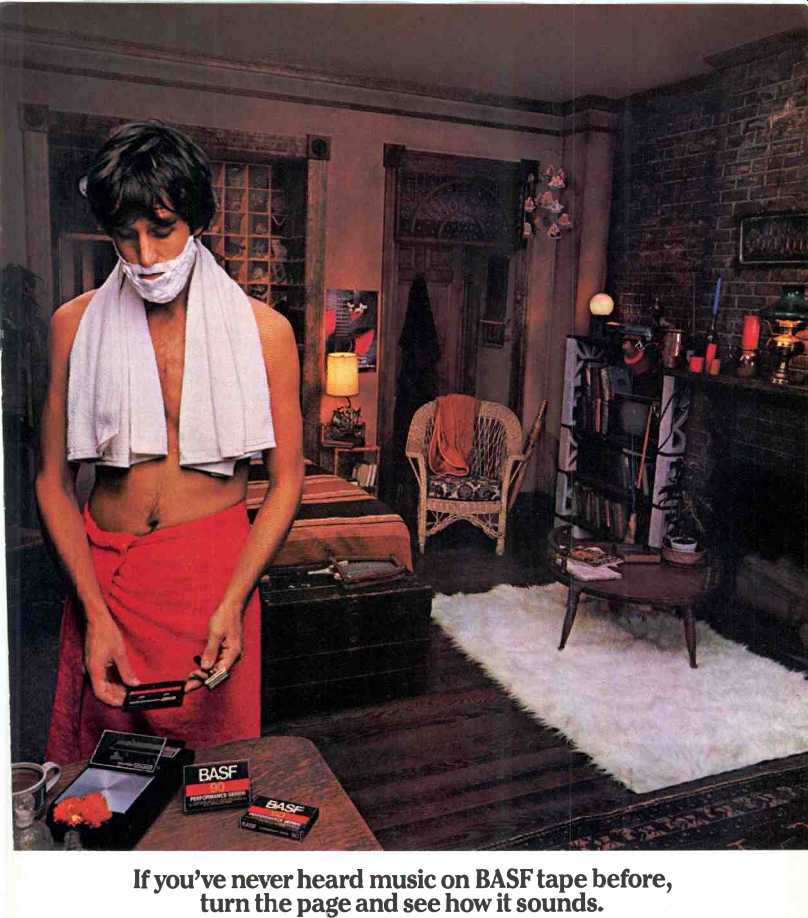
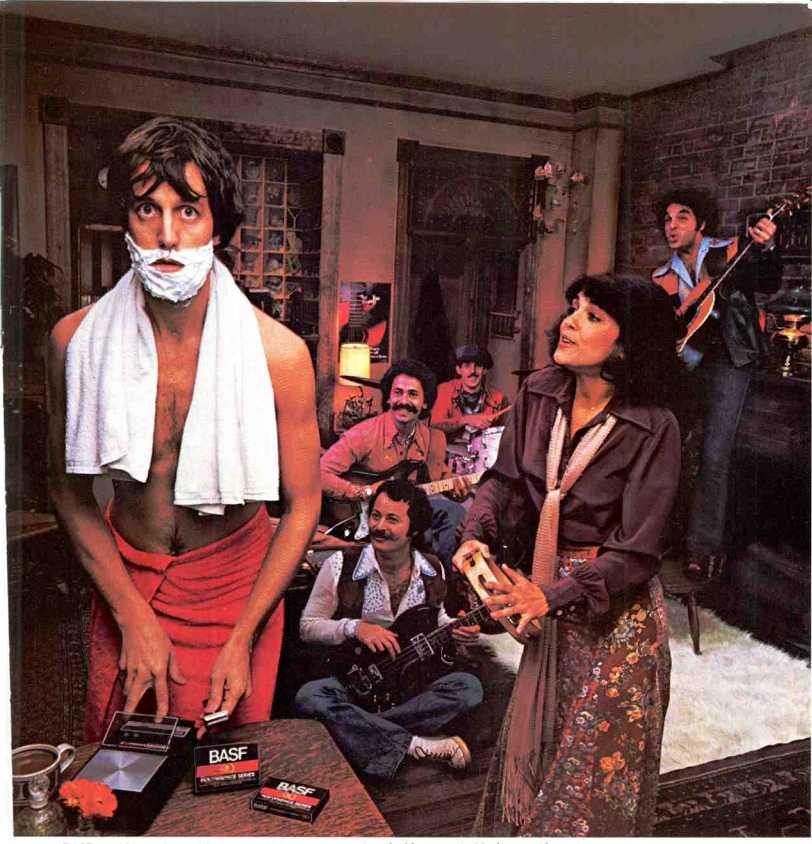
If you've never heard music on BASF tape before, turn the page and see how it sounds.
BASF sound is so clear and true, nothing comes between you and the music.
What you experience when you listen to music you record on BASF tape is simply this: the music. Pure and clear.
How does BASF make this phenomenal clarity happen? By polishing the tape. Literally.
When tape is made, it has thousands upon thousands of tiny bumps and ridges that can cause background noise. By getting rid of most of them, we get rid of most of the noise as well.
And to make sure the sound you do hear is all there, we give the tape incredible range and response by using a highly magnetizable dense oxide coating.
Of course, when you listen to music this rich and clear, you don't just hear it. The music happens.
(Which may come as a surprise if what you've been experiencing until now is background noise.) Now if all this sounds too good to be true, there's something we'd like to point out. BASF invented audio tape in the first place. Giving us lots of time to perfect it.
So it isn't surprising we sound so much like the original. You see, we are the original.
BASF. We sound like the original because we are the original.
++++++++++++++
Get inside digital electronics!
Bell & Howell Schools now offers you two fascinating learn-at-home programs that can equip you with professional know-how in the expanding field of digital technology!
The world of electronics is an astounding place-a world that, in the short span of 70 years, has taken us from a simple mechanical age into an age where electronic sophistication has actually helped man set foot on the lunar surface.
One area of this space-age technology that has been successfully harnessed for consumer and industrial use is digital electronics. It is this breakthrough that has given us such remarkable new products as tiny pocket calculators and digital-display wristwatches. And now, you can learn about some of the many extraordinary applications of digital electronics in two special learn-at-home programs from Bell & Howell Schools.
Start your exploration of electronics at home! With these exciting home learning adventures from Bell & Howell Schools you'll experience the true thrill of discovery as did such electronic pioneers as Thomas Edison and Dr. Lee DeForest.
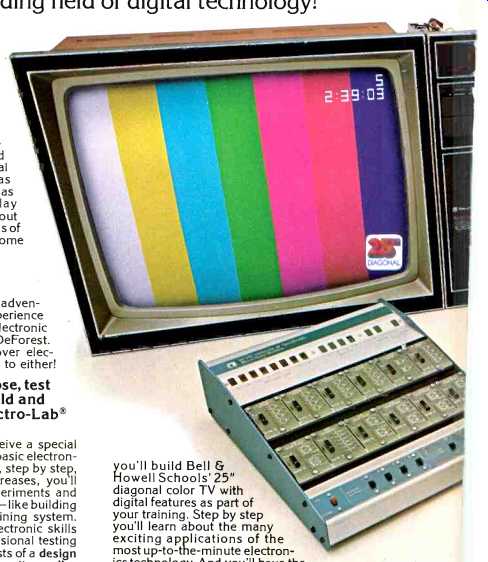
And think about this ... they didn't discover electronics in a classroom, and you don't have to either! Whichever program you choose, test new electronic theories as you build and experiment with the exclusive Electro-Lab electronics training system! With your very first lesson you'll receive a special Lab Starter Kit, so you'll be able to see how basic electronic principles actually work in practice. Then, step by step, as your understanding of electronics increases, you Il actually be able to perform your own experiments and work on fascinating projects from "scratch'-like building the exclusive Electro-Lab electronics training system.
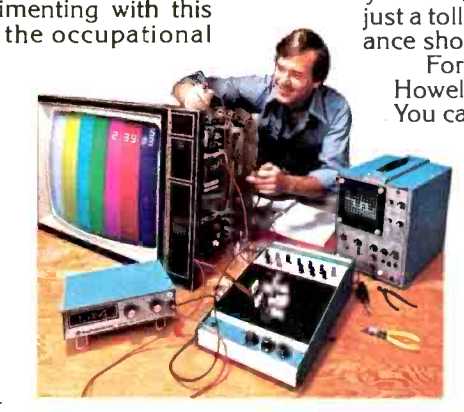
This important project helps you learn electronic skills through "hands on" experience with professional testing equipment. The Electro-Lab® system consists of a design console to help you learn how to hookup circuits-a digital multimeter for measuring electrical voltage, current and resistance. And a solid-state "triggered sweep" oscilloscope that, among other things, you'll use to analyze the operation of tiny integrated circuits. The "triggered sweep" feature locks in signals for easier reading.
I. HOME ENTERTAINMENT ELECTRONICS
Learn how digital technology is being applied to home entertainment products-build and experiment with the new generation 25" diagonal color TV with digital features! To learn the most advanced electronics technology you must work with up-to-date training tools. That's why you'll build Bell & Howell Schools' 25" diagonal color TV with digital features as part of your training. Step by step you'll learn about the many exciting applications of the most up-to-the-minute electronics technology. And you'll have the confidence in knowing that the advanced skills you're learning will be valuable for years to come.
"Hands on" training will help you understand advanced applications of digital technology! Your "hands on" training will give you a professional's understanding of how this advanced technology works. How features such as on-screen, digital display channel numbers and a digital time readout in hours, minutes and seconds are possible. You'll learn to program an automatic channel selector so that it skips over lead channels and "homes-in" on the channels of your choice. And, how "state-of-the-art" integrated circuitry and the 100% solid-state chassis add immensely to your understanding of circuit theory and TV servicing techniques.
You'll also become thoroughly familiar with the technology behind features such as digitally-automated tuning, and the outstanding color clarity of the Black Matrix picture tube.
By actually building and experimenting with this exceptional equipment, you'll gain the occupational skills, specialized knowledge-and the self-confidence that could open up exciting new directions for you!
II. DIGITAL INDUSTRIAL ELECTRONICS
Our exclusive digital trainer will help you discover today's exciting applications of digital electronics in industry. Industry is constantly finding new applications for digital technology.
Today, this technology is helping to set new standards of accuracy and providing a more precise method of control in refining, food processing, transportation and in manufacturing plants.
Now Bell & Howell Schools has a learn-at-home program that could get you involved in the industrial uses of this challenging technology. The program provides a solid background in basic electronic principles and the opportunity for you to experiment and learn with the Bell G. Howell digital trainer.
This remarkable piece of equipment lets you set up and examine a range of complex digital circuits like those in use in industry today. You will work with circuitry which has many of the numerical and process control applications used in a number of today's most sophisticated manufacturing operations.
Bell & Howell Schools is with you every step of the way! You'll be pleased to know that, throughout all of these dynamic Bell G Howell Schools' programs, you're just a toll-free phone call away from expert assistance should you need it.
For even more personal attention ...Bell & Howell Schools has a truly unique idea. You can attend in-person help sessions scheduled in over 50 major cities at various times throughout the year, where you can meet and talk with fellow students and receive additional assistance from an instructor.
Once you've completed this program, your skills in electronic troubleshooting could lead you in exciting new directions. While we cannot offer assurance of income opportunities you can use your training: to seek out a job in the electronics industry, to upgrade your current job, or as a foundation for advanced programs in electronics.
Now... audio/quadraphonics... first home program of its kind! It's another first from a leader in home learning. Bell & Howell Schools proudly introduces America's first learn-at-home program in audio electronics featuring the exploration of quadraphonics. It's the 4-channel "wraparound" sound system that has opened a new era in audio technology! You'll actually build Bell & Howell's 4-channel audio center including amplifier and FM-FM Stereo receiver as a part of the development of professional knowhow in this exciting and promising new field. Get more details now... check the appropriate box on card and mail today!
Why not aim yourself in an exciting new direction today-just check the Bell & Howell Schools' program you're interested in and... Mail the postage-free card right away! We'll see that you get more details! Taken for vocational purposes, these programs are approved by the state approval agency for Veterans' Benefits.
+Cabinet and speakers available at extra cost.
Simulated TV picture/test pattern.
"Electro-Labor" is a registered trademark of the Bell & Howell Company.

If card has been removed, write:
An Electronics Home Study School
DeVRY InSTITUTE OF TECHROLOGY ONE OE THE BELL and HOWELL SCHOOLS
4141 Belmont, Chicago, Illinois 60641
+++++++++++++
dlscwasher GROUP
The Precision Cleaning Instrument for Today's Styli
Today's advanced styli are remarkably sensitive, and every manufacturer specifies that cleaning is essential for maximum performance.
Introducing SC-1. The SC-1 is a graceful walnut handle from which you can push a small tang. At the end of this tang is a calculated-density brush of black nylon with enough rigidity to clean waxy deposits-yet with enough "give" to eliminate cantilever damage. There is also a silvered mirror that magnifies the stylus, cantilever, and cartridge mounting for total perception of your pickup system.
All of this retracts into the walnut handle for elegant protection.
The new SC-1 for only $6.00, at audio specialists nationwide that carry Discwasher products.
BRUSH SIDE MAGNIFYING SIDE
dlscwasher GROUP
DISCWASHER, INC. 909 University Columbia, Mo., USA

++++++
(Audio magazine, 1975; Bert Whyte)
= = = =