by C. F. Kerry Gaulder
Chief Engineer, Source Engineering, Wilmington, Mass. 01887.
Fifty years ago, you could bring home a complete recording of Rigolet to or Aida, put it on a record changer, and sit back while the entire work played through without further attention to the records or mechanism. Despite the conveniences we have now that weren't available then, ironically this is not possible today.
True, the fidelity was far from high.
The recordings were electrical, but the reproducer cut off at perhaps 4,500 Hz; if there was bass equalization, it came from resonance between the tonearm and the stiff needle suspension. As for other aspects of "convenience," the 1928 Rigoletto set (HMV C 1483-7, etc.; Vic. M 32) consisted of 15 discs weighing in at about 11 pounds, and the 1929 Aida (HMV D 1595-1613, etc.; Vic. M 54), comprising 19 discs, at about 15 pounds. (Today, there would be only three discs, at a little over a pound; tomorrow, who knows?) The music was interrupted every four minutes or so for a change cycle lasting 20 seconds. Nevertheless, you could relax while an entire work, up to three hours of music, played without effort on your part.
The machine which made this possible was by no means the only example of a record changer that played both sides of a disc. Many experimental changers were built during the late 1920s, generally using two turntables 45 degrees from the horizontal and mutually at right angles. The stack was placed on one of these, and after the top side of one disc was played, the record was transferred to the other turntable and the reverse side played.
None of these large, costly, and tricky devices ever saw production. Just be fore the war, RCA Victor announced a "Magic Brain" changer which featured a single pickup with dual needles and first played the underside of the stack (rotating the disc by means of rollers) before dropping each disc in turn to the regular turntable. The contemporary paper record jackets illustrate this device, although I have never seen the device and it may not have been in production at all. A few such devices were actually manufactured (not by RCA) during the early LP era, but they were not satisfactory.
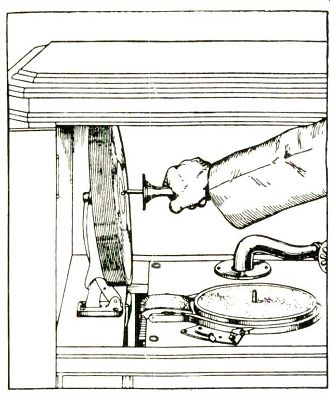
------ Victors Automatic Orthophonic Victrola used a loader to stack
discs on a magazine from which they were fed.
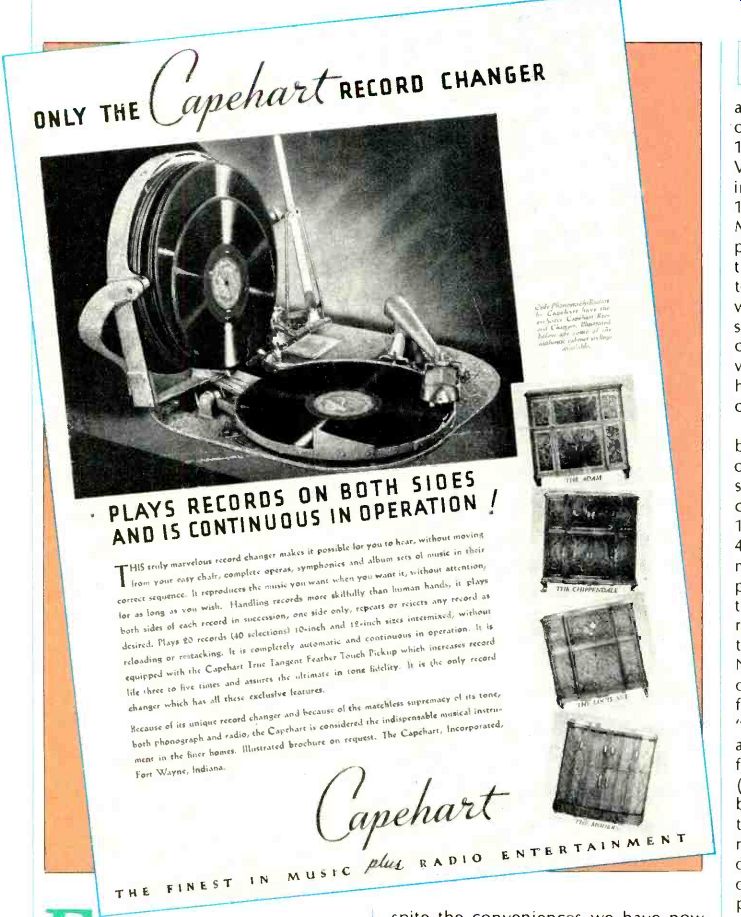
On the other hand, there was one mechanical marvel, the Capehart, which was highly successful, remaining in production from 1930 to 1948. It performed the remarkable feat of liter ally turning each record over, and there was never more than one disc at a time on the single turntable. In a sense, it was the only true record changer which has ever been offered the public, in that it accommodated albums as they actually were at the time and did not demand that long works be pressed in any special sequence. It would, incidentally, play both 10-inch and 12-inch discs inter mixed in any sequence.
The first commercial automatic changers were made in 1927 by the Victor Talking Machine Co. in the United States and by its affiliate HMV (the Gramophone Co.) in England.
They both used acoustic reproducing systems and discharged records in turn into a hopper. But in other respects, these machines were quite dissimilar.
Victor's Automatic Orthophonic Victrola required records be stacked on a magazine from which they were fed, one at a time, to a ring which lowered them to the turntable. After each record was played, the rising ring discharged it into a hopper before accepting the next disc. Unlike the Victrola, the HMV Automatic Gramophone would play intermixed 10-inch and 12-inch discs. It had a stack beside the turntable and a suction arm which lifted the topmost record off the stack and carried it to the turntable. After the disc played, the arm deposited it in a hopper before returning for the next disc. (Incidentally, the exponential-horn acoustic reproducers of these instruments sounded a great deal better than many contemporary electronic systems and, if anything, did less dam age to the records.) In 1928 Victor introduced an electric version of the same machine, using a magnetic pick up on the same tonearm in place of the sound box. HMV waited until 1930 to introduce the Automatic Electric Gramophone No. 12, which was a redesigned version of the suction-operated changer, but with shorter arm travel and a true electrical pickup. The HMV machines are illustrated respectively in the contemporary catalog and in Ernie Bayly's book The EMI Collection (of early record-playing equipment). Mr. Bayly states that the HMV machines had a disconcerting habit of flinging records across the room!
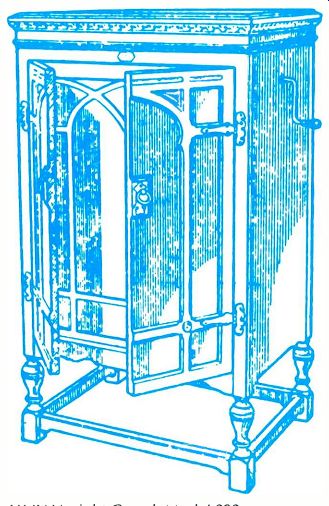
-----------HMV Upright Grand, Model 202
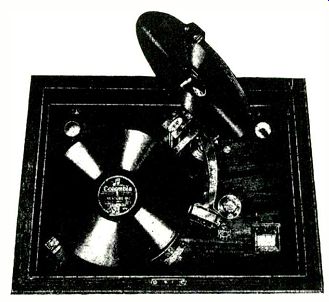
----------The HMV played up to 20 records, 10 or 12 inch, in any prearranged sequence.
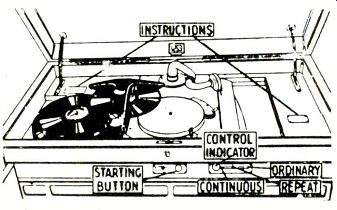
-----------G. Wilson's book showed the English Columbia 604 with the arm in the up or loading position.
Neither these machines nor the English Columbia "drop" changer then under development (illustrated from a 1932 book, Gramophones, Acoustic and Radio, compiled by G. Wilson of the still very much extant English magazine The Gramophone) would play both sides of a disc in sequence.
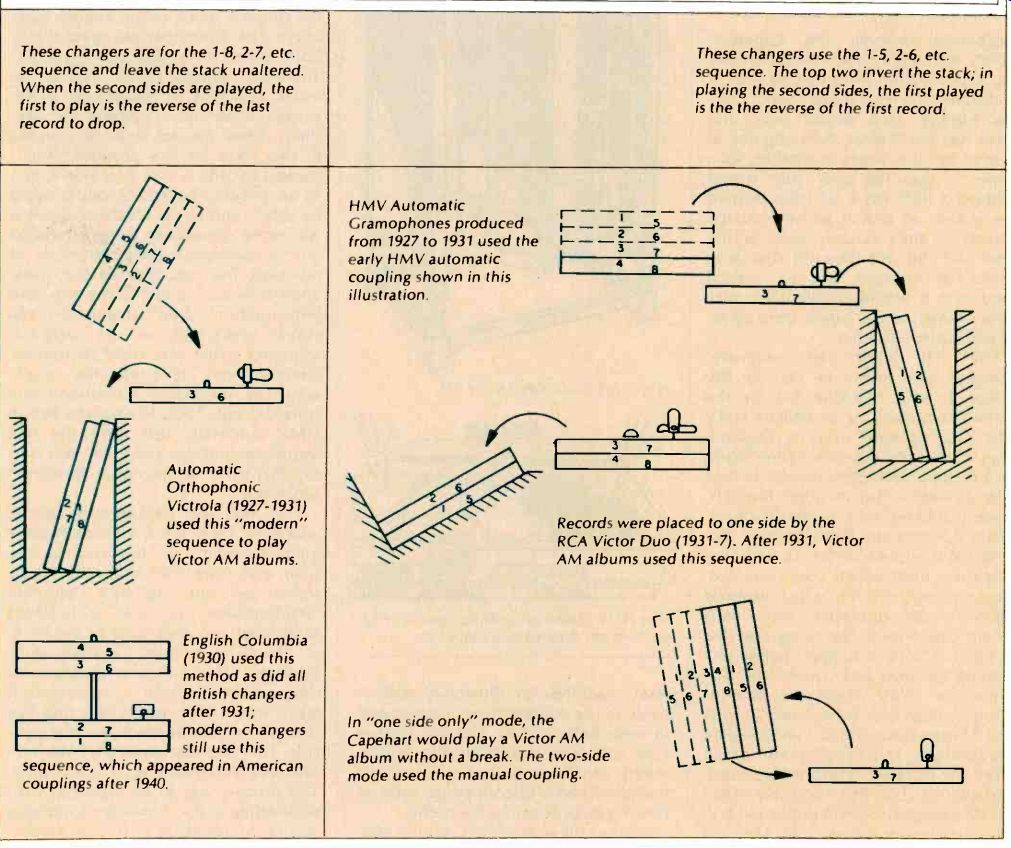
Therefore, longer works had to be made available in sequences which would allow the changers to play them. A four-disc set could be coupled in two ways for this purpose: Side 1 backed by side 5, side 2 by side 6, and so on; or side 1 backed by side 8, side 2 by side 7, and so on. Of these, the first was more convenient if the operation of the mechanism had the effect of reversing the sequence of the stack, and the second (which is the one used with modern "drop" changers) if the stack remained in its original sequence. The two HMV Automatic Gramophones reversed the stack, while the Automatic Orthophonic Victrola did not. Thus, the earliest British HMV automatic sets used the first sequence, and the Victor AM sets (until 1932) used the second or "modern" sequence.
This was the background against which, in 1928, the Columbia Phono graph Company of New York (at the time, and from 1925 until 1931, con trolled by Louis Sterling's Columbia Graphophone Co., Ltd., of London) built what was described to me by R. D. Darrell as a "Rube Goldberg contraption." This unit was designed to drop a record from a near-vertical stack, lower it by means of a ring like that of the Victor machine, play one side, turn the disc over, play the second side, and then eject it to a hopper.
The process was to be repeated with succeeding discs. American Columbia was then marketing, with only moderate success, a line of radio sets and electric record players (with electronics from the Kolster Radio Co.). The firm decided that the cost of engineering this prototype for production was too high for that not very profitable branch of its then otherwise financially successful activities.
Enter Homer E. Capehart. Later a senator from Indiana, he had begun in 1928 to market a 56-selection jukebox called the "Orchestrope"; this enterprise had prospered, and in 1929 he decided to enter the home-entertainment market by buying the Columbia patents. Capehart re-engineered the changer for 1930 production in an interesting way--instead of ejecting re cords into a hopper, the machine re placed them on the stack. The space occupied by the changer was thus significantly reduced, and there was another consequence, good or bad de pending on the point of view--the machine could not "know" when it had played through the stack once, and would go on playing indefinitely unless some outside agency intervened. It would accommodate up to 20 discs, 10-inch and 12-inch in any order, providing up to 180 minutes of music before repeating.
Another useful feature added was a one-side-only mode. By this time, Vic tor's AM automatic couplings were well established, and they had to be taken into consideration. One minor nuisance was that the discs were re placed on the stack the "other way round," effectively in reversed sequence. That is, the machine would play sides 1-2-3-4 of the four-disc example, but the fifth side would be the reverse of side 1, that is, side 8. So the machine would play the stack as 1-2-3 4-8-7-6-5, unless the operator intervened.
=================
Album Sequencing for Changers
These changers are for the 1-8, 2-7, etc. sequence and leave the stack unaltered. When the second sides are played, the first to play is the reverse of the last record to drop.
Automatic Orthophonic Victrola (1927-1931) used this "modern" sequence to play Victor AM albums.
English Columbia (1930) used this method as did all British changers Q after 1; 2 modern changers still use this sequence, which appeared in American couplings after 1940.
These changers use the 1-5, 2-6, etc. sequence. The top two invert the stack; in playing the second sides, the first played is the reverse of the first record.
HMV Automatic Gramophones produced 1927to 1931 used the early HMV autom coupling shown in this illustration.
Records were placed to one side by the RCA Victor Duo (1931-7). After 1931, Victor AM albums used this sequence.
In "one side only" mode, the Capehart would play a Victor AM album without a break. The two-side mode used the manual coupling.
==================
A lucky accident (from Capehart's point of view) occurred in late 1931 to remove this irritation. In conjunction with its new 33'/3-rpm LPs, Victor had introduced a new and appalling changer as part of the "Duo" series of reproducers. In this model, all discs were initially stacked on the turntable.
Each record in turn, after its top side was played, was literally scraped over the rotating stack (scuffing it grievously) and slid into a padded bin. This had the effect of reversing the stack, which could then be picked up, turned over, and replaced on the turn table to play the second sides of the discs. Victor's older AM albums required restacking before the second sides would play in proper sequence on this machine, so from 1932 until 1940 AM albums were pressed in the 1-5, 2-6, etc. couplings.
In passing, we may note that in 1931 HMV began production of a "drop" record changer, which is shown in Gramophones, Acoustic and Radio. I once owned one of these incredibly well-made and powerful devices, which could easily crush a record that happened to catch in its jaws. Then the next year, Garrard introduced another type of drop record changer (illustrated from an E. H. Scott console in my collection). As a result, in the United States Victor went from the 1-8, 3-7, etc. couplings to the 1-5, 2-6, etc., while in Britain HMV and Columbia (both now part of EMI) went the opposite way.
Victor's new couplings were very convenient for Capehart, because the machine would then (and until 1939) play any American album all the way through, in the proper sequence.
The first Capeharts, like all of the other electric record players of their day, used a primitive precursor of the modern moving-iron (induced-mag net) cartridge. But there was a massive needle chuck and armature, so the damping material had to be made of very stiff material to raise the resonant frequency to an acceptable range of 4 to 5 kHz; the needle behaved like a compliance. As a result, very large needle pressures, often greater than those of acoustic machines, were required for proper tracking. The Victor "Duo" used almost half a pound, even on the Vitrolac LPs, which thus had a very short life. The earliest (1930) Capeharts also had power amplifiers, but no radios. The lack of a radio was not un common at the time, but by 1933 it was almost impossible to sell such an instrument without one, so a very good radio set was included. This model and its successors, the prestige-laden "Four Hundred" series, became established as the home-entertainment center for those who remained well-off (there were some, of course) in the depressed '30s.
By 1933 Homer Capehart had been forced out of the company named for him; he went to Wurlitzer, which was making jukeboxes as substitutes for its once lucrative theater-organ business.
Capehart's former company was taken over by the Farnsworth Radio and Television Corp. and concentrated on home entertainment.
An advertisement from the October, 1938 issue of Country Life & The Sportsman (a suitable choice because of its well-to-do readership) shows the later prewar Capehart changer with a crystal pickup, which at that time was in general use in the United States.
This wasn't true in Britain, where its inadequate treble was unacceptable and where the magnetic pickup was being steadily improved; the half-pound ironclads had given way to two-ounce lightweights with quite reasonable treble response. The Capehart's tonearm is rigidly mounted in the pivot bearing, and only the head is free to tilt vertically. Notice the parallel motion which keeps the head tangential to the groove. Although tracking error is still a relatively small factor in distortion, as it certainly was in 1938, it still received a good deal of attention. Unlike other more serious problems, it is fairly easy to explain and is solvable in a manner obvious to the naked eye. (The parallel-motion idea was revived a few years ago. In the postwar years, Capehart sensibly abandoned its "True Tangent" pickup system.) About this time, RCA Victor and other American manufacturers introduced drop changers very much like the inexpensive models of today. During the winter of 1939-40, Victor began to issue albums in the drop sequence as well as in the manual and what it called "slide automatic" sequences; the new (actually old) sequence was issued in DM albums. (After 1941, special pressings had to be ordered for slide automatic changers.) While owners of Capeharts would never have a real problem so long as the albums were still issued in the manual sequence, there was always the possibility that they might purchase or receive gifts of the wrong type of al bum. At any rate, Capehart felt obliged to provide some means of turning the changer off after a predetermined number of playings.
This was incorporated in the more expensive prewar models via a stepping switch that could be preset by the operator; this was simplified in postwar models through the use of a mechanical ratchet wheel.
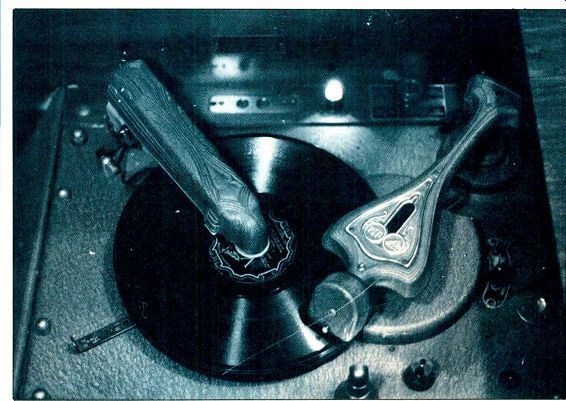
--- RCA Victor's Duo was made from 1931 to 1937. Note huge pickup head.
My changer was originally essentially like that in the advertisement, but it was taken from an electrically good (including the old 42 to 50 MHz FM band) but physically poor 1941 con sole of the less costly variety (no play control). One has the choice in such cases of trying to restore the equipment to mint condition or adapting it to present-day requirements. In this instance, I opted for the latter course.
The cabinet was in very poor condition, and the changer itself needed extensive repairs since many of its pot-metal parts had rotted between 1941 and 1979. Such a changer is a very desirable possession to one who, like myself, has a large number of manual-sequence 78-rpm discs. Restoration would have meant in effect not using the machine, because the "featherweight" pickup was hardly accept able for use on now irreplaceable re cords; it tracked at three ounces (say 90 grams) and cut off at 5000 Hz. So I decided to go the whole hog and adapt the machine to accommodate modern cartridges.
This entailed making the cabinet shown; amateurish, no doubt, but neat and sturdy. It was also necessary to make a completely new pickup which would not have to turn the original heavy pivot. A friction drive frees the pickup when it is playing, and lifts and turns it during the change cycle. The arm had to have the correct offset and overhang for a 10-inch pivot distance, so no standard arm could be used; I made it from scratch. It now accepts interchangeable cartridges in inserts also used with an Elac "umbrella" drop changer.
It was also necessary to make a new trip mechanism; again, the original was too stiff to be actuated by a modern cantilever assembly. Fortunately, the original trip mechanism was not part of the pivot (see the advertisement picture). The only work done by the pickup is to interpose an arm so that a pin on the turntable can do the work of putting the mechanism into cycle; the trip is of the velocity type, and works with any run-off groove, including those of large diameter. Play control was added by means of a stepping switch actuated by the trip solenoid and separate units and decades rotary switches.
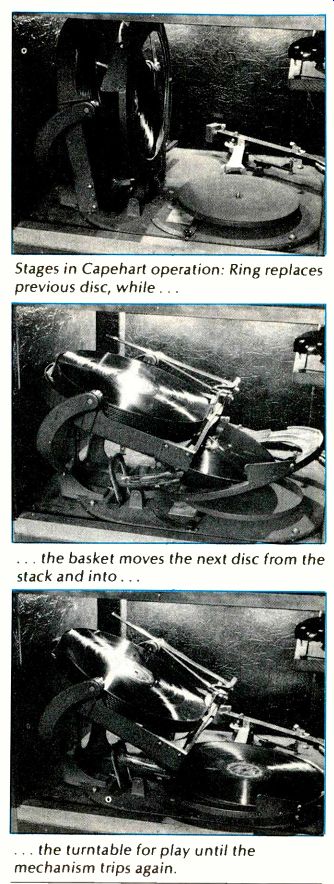
------ Stages in Capehart operation: Ring replaces previous disc, while .. . . the basket moves the next disc from the stack and into... ... the turntable for play until the mechanism trips again.
The new pickup was originally in tended to track in the usual way with the cantilever supporting the head, at about 8 grams, which it did very satisfactorily. However, until about 1937 there were no feed or lead-in grooves.
With a heavy pickup there was enough friction to cause the needle to "skate" into the first music groove, but with 8 grams on hard shellac there is almost no friction (on vinyl it's another matter, of course). A small brush was added to the head in such a way that, with the needle on the rim, the bristles are in the first music grooves, and in two or three revolutions they drag the needle into the groove. As a consequence of experiments with optimum tracking, however, the brush is now so arranged that it does most of the work of supporting the head, so the force has been increased to about 20 grams.
The bristles bend to the point at which the force on the cantilever is about 8 grams, measured by the deflection of the cantilever relative to the cartridge.
Greatly improved tracking is obtained, especially with warped records. The ostensible cleaning function of the brush, though of course present, is trivial compared with its other duties! Apart from repairs and a few out-of-sight holes, the original parts of the changer were not modified. They were removed altogether and kept, new parts being made where necessary, so that it would be possible to "restore" the changer to its original appearance.
The Capehart pickup, a pretty thing in its way, is displayed on a shelf inside the playing compartment.
The machine is in daily use and, once the rather tricky adjustments which prevent it from taking bites out of records were completed, has proved very satisfactory and reliable. Rumble in particular is remarkably low, considering the massive motor; the leather universal joint and long effective turn table bearing (about 7 inches) provide excellent isolation.
Could a similar device be made to day for LPs? Undoubtedly; and the fact that for operas only 12-inch albums now have to be handled would simplify the task somewhat. It would not have to be anything as massive or complex; compare a modern drop changer with a drop machine of the early 1930s and imagine comparable improvements.
Altogether, the Capehart was a remarkable machine. Its greatest appeal was in the 1930s, when it alone of all changers would play any American album, even those containing both 10-inch and 12-inch records, all the way through in proper sequence. It began to lose ground at the end of the decade, when inexpensive American drop changers appeared. There were also difficulties with the rough postwar "knife-edge" pressings which had be gun to replace the smoothly rounded prewar rims (I cured these with a little work with a Swiss file.) But the appearance of the LP in 1948 doomed the Capehart; it probably cost too much to make by that time, as well.
No other changer has ever played both sides of a disc in such a satisfactory way, none has ever been gentler (with proper adjustment, otherwise, disasters happen), few have been better made, and probably none has remained in production with only minor changes for anything like the Capehart's 18-year span. Truly, it was a Mechanical Marvel.
(adapted from Audio magazine, Nov. 1980)
Also see:
PROFILE---Paul Klipsch Arkansas Speaker Maker (Aug. 1980)
= = = =