BERT WHYTE
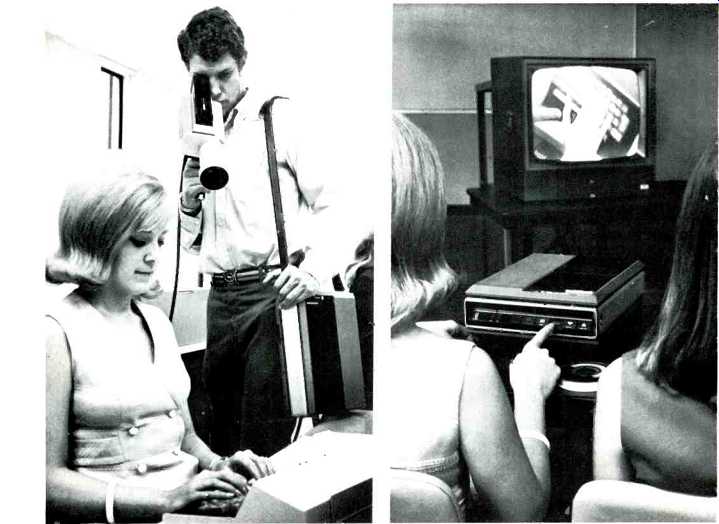
---------Various business training and communications video recording applications are possible with video cartridge recorders, such as the Ampex Instavision system. Here a skilled keypunch operator demonstrates correct procedures which are recorded for later viewing.
About a year ago I reported on the introduction of the Columbia "EVR" television cartridge system. You may recall that this is basically a playback only system, in which Columbia-processed pre-recorded material will be sold to the owners of the cartridge playback unit.
Much was made of the impact this kind of system would have in the industrial and educational markets, where specially recorded material on almost any conceivable subject would be offered. Columbia even had a "tie-in" service with the New York Times set up to cover the educational aspects of the system. The biggest market envisioned of course, was John Q. Public. Here again the variety of subject material that could be offered was endless, but there was a distinct emphasis on the possibilities of obtaining a library of major company movies. Like many new developments, things have not moved as fast as Columbia had envisioned. However, the EVR concept got a good boost with the recent announcement by 20th Century Pictures that they would make available to the EVR library their feature films that were older than five years from original release date. This automatically provides a vast backlog of films that could be offered on EVR cartridges.
Not to be outdone by Columbia, RCA recently announced their "SelectaVision" system, which is also a playback only concept offering pre-recorded material to the public and specialized markets. The RCA system is one of the most technologically sophisticated devices ever contemplated as a consumer product. It is too complex to go into detail here, involving as it does such "far out" concepts as holograms and laser beams. The playback unit employs a low-power gas laser to "read" the pictures, and there has been comment in some quarters about some possible hazards of having such a device in the home. Nothing has been proven about this, one way or the other, and it probably can be placed in the same category as radiation from TV sets. In any case, in "laboratory format," the Selecta-Vision system works as advertised. It faces the same problems as the EVR system in respect to movie libraries and other specialized material for pre-recorded release.
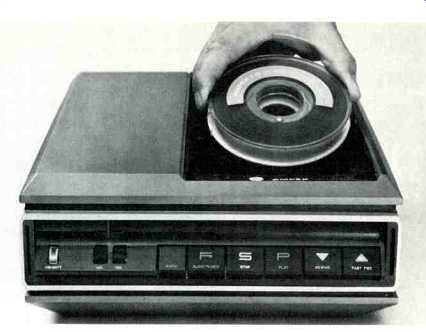
-- The new Instavision recorder-player uses standard half-inch wide video tape enclosed in a circular plastic cartridge 4.6 inches in diameter by 0.7 inches thick.
Several months ago, Audio reported on the Teldec video disc system, and as I write this, it has had its first demonstration in this country at the Audio Engineering Convention in New York. Apart from the technical triumph of a video disc, and its commercial advantages, there exists the distinct possibility of a discrete four channel stereo disc. With 70 khz capability at 33 1/3 rpm bandwidth is certainly not a problem. From the strictly video aspects, we have here too a playback only system, and just because it is a disc rather than a cartridge doesn't lessen the ramifications of this concept.
The latest entry into the video cartridge sweepstakes is the Ampex Corp. with their "Instavision" system, and after seeing it demonstrated I must say that I am very impressed. In my opinion the Insta vision system has several clear-cut advantages over competing systems, but quite apart from that, this also appears to be a system ready for production. There is nothing ephemeral about this development! Target date for the Instavision system is mid-1971 and there would seem to be no obstacles to its introduction at that time.
The big point of departure between the Instavision system and competing cartridge units is that it can record and playback video information. This is possible because the Instavision system uses conventional half-inch magnetic tape. The tape is housed in a 4.6 inch diameter by 0.7 inch cartridge, which is self-threading on Instavision recorder/players. The complete Instavision system consists of a miniature videotape recorder 11 x 13 x 4.5 inches that weighs less than 16 pounds complete with common flashlight or re chargeable batteries, a hand-held monochrome camera with zoom lens that weighs less than 5 pounds and has a electronic viewfinder which actually is a tiny television receiver so that one can frame scenes precisely and view what is being recorded, and of course, the video cartridge. Standard with each recorder or player is a separate power pack that houses an A/C power converter for plug-in operation, a battery recharger and optional electronics for color record or playback. The power pack is designed as a base for the recorder during any of these operations and probably would sit on top of the TV set in use. The recorder is detached from the base for portable use. The Instavision system is to be sold in several formats. A monochrome playback only unit is expected to cost $800, a monochrome recorder/player or color player will be $900 and a color recorder/ player is ticketed at an even thousand dollars.
The Instavision recorder/player operates on the helical scan basis and conforms to "Type One" standards for half-inch tape. The Type One standards have purportedly been adopted by such manufacturers of half-inch magnetic tape equipment as Sony, Phillips, and Grundig.
As such, the Instavision cartridge is compatible with conventional reel-to-reel recorders embodying the Type One standards. The cartridge will permit 30 minutes recording time at the 7.5 ips Type One standard, or 60 minutes in extended mode, which is 3% ips. Blank cartridges are expected to sell for less than $13.00. The cartridges permit fast forward or rewind operation with the complete run through of the tape in less than a minute.
The recorder/player may be miniature, but it has a full complement of controls.
Pushbuttons control motion with Play, Stop, Rewind, Fast Forward. There is an audio/video record button, volume control, tape tracking control and a meter for video level and battery check. There are secondary controls for tape tension, head clean, extended play switch, and camera trigger. Stereo playback is possible with two separate audio channels. Some performance figures for the system are video resolution on monochrome of 300 lines and for color, 240 lines. Signal-to-noise ratio is 42 dB. Both slow motion and stop action are possible. The monochrome camera, which is expected to cost about $400.00, has a trigger grip which activates camera and recorder simultaneously.
How good is the record and playback quality? What I saw in New York was by far the best in terms of clarity, good contrast balance, brightness ratio, of any video cartridge system I have encountered thus far. This smallest and lightest video cartridge looks like a cinch to use. At the demonstration Ampex had a typical skinny New York model, and she had the recorder slung over her left shoulder with the strap provided with the unit. She held the camera with her right hand and steadied it with her left hand as she photographed another model. We could see the head and shoulders of the girl being recorded in the tiny receiver screen of the viewfinder. It took just a few seconds for the tape to be rewound 'and the unit placed in the power pack, which was attached to a large screen TV set through the aerial input. The picture quality was really excellent. A cardioid mike is furnished with the camera, which of course records the sound synchronously with the video. Ampex then played back cartridges of several color shows that had been copied from the master video tapes and the results were just sensational. It was just about the best video color I have ever seen . . . with great color balance and fidelity, clarity and brilliance.
Ampex looks at their cartridge Instavision system as functioning in the area . of closed circuit TV for industrial and educational applications, and for repetitive programming in the same areas; for instantaneous response, in the use of material just recorded and for home entertainment via either pre-recorded cartridges, or from portable recordings, or from "off-the-air" recording. As far as pre-recorded material is concerned, Ampex has to deal with suppliers in the various media, just like any of the competing systems. They state they have been having "fruitful" conversations with Columbia Pictures, so one would assume eventual availability of feature films.
Special new high speed tape duping equipment is now being designed and it is expected that the cost of the prerecorded video cartridges will be competitive with that of other systems. Of course the big plus for this Instavision system is the ability to record. With the top model, the thousand-dollar recorder/ player, one can record color "off-the-air," although it will be necessary to get a TV service man to connect your unit to the video output of your TV set. One can certainly envision that the more alert manufacturers of TV sets will furnish a jack on their sets for this purpose. One can think of endless uses for video photography with the black and white camera.
The real breakthrough will come when relatively inexpensive color cameras become available. Present color cameras are very big and range in price from about $50,000, to the least expensive unit recently announced by SONY at about 4500-5000 dollars. The goal is a color camera around 500 to 800 dollars, which I am told will probably be feasible in a few years. Ampex has stated that the thousand dollar cost of the top Instavision unit is predicted on a certain initially small volume, and that substantial reductions in price can be anticipated with increased volume. Thus the day may not be far off when one can take along a portable unit and record in color and in synchronous sound, the joys of a vacation, and on returning home, there is no wait for films to be developed ... merely connect the unit to your TV set and you are ready to relive the big moments of your vacation. Or take the Instavision recorder to your son's Little League game, and later the same day, view in "living color" on your TV set, your little hero knocking in a few runs. And if he whiffs instead of hitting, you can record him over and over, play it back until he learns to correct his mistakes. This is another advantage of the Instavision system in that if what you have recorded is only of transitory value to you, you can erase and reuse the tape repeatedly without any diminution of quality.
Even with the Instavision system as presently constituted, with monochrome camera, "off-the-air" color recording, and the facility to play back pre-recorded cartridges, Ampex has unquestionably come up with a real winner. I, for one, am looking forward to using the Instavision equipment at the earliest possible moment.
(Audio magazine, Dec. 1970; Bert Whyte)
= = = =