Editor's Review
The AES convention attracts more and more people every year and this year's attendance was at least fifty percent up on last year's.
There were sixty-seven exhibitors at the Hotel New Yorker and although there were some complaints regarding the choice of venue, I imagine everyone was well satisfied with the results.
Seventy-five technical papers were presented--the most popular being the Teldec video record demonstration, the recording session given by the New York AES section, and John Chownings "Simulation of Moving Sound Sources" using computer techniques. The `panning' of various electronic and other sounds round the room was most effective. I myself was particularly interested in Percy Wilson's talk on British contributions to audio during the past years, as I had known many of the people so well. John Eargle's talk and demonstration of quadraphonic sound derived from existing two and three-track master tapes was also worthy of mention.
Sound quality as a whole was very much better than we have heard on previous years. (A lot of truth in the old story of the shoemaker's children! ) The four large loudspeakers systems in the hall were designed by Rectilinear and they used some new Becker speaker units. Bernie Beck of the latter company was in charge of the Public Address system, a duty he performed most efficiently. Upstairs in the smaller rooms, the quadraphonic demonstrations by JVC, Electro-Voice and Scheiber proved very popular.
At the annual banquet, several awards were given out. The John H. Potts Memorial Medallion went to Rudy Bozak, and Dr. Beranek in making the presentation cited his "outstanding achievements in the field of audio engineering." Arthur Haddy of the British Decca company received the Berliner Award, and Citations were given to Marvin Camras and John D. Colvin.
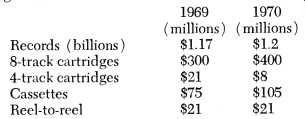
The Recording Industry of America (RIAA) has just issued an estimate of 1970 record and tape sales. Here they are compared with the 1969 figures:
1969 1970
(millions) ( millions )
Records (billions )
$1.17
$1.28-track cartridges $300
$400 4-track cartridges $21
$8
Cassettes $75
$105
Reel-to-reel $21
$21
Records and eight-track cartridges show a healthy gain--so do cassettes, with reel-to-reel just holding their own and four-track declining. Next year will undoubtedly see a further increase in cassette sales due to the Dolby and Crolyn innovations, but whether the demand for reel-to-reel tape will go up or remain static is anybody's guess.
We must be doing something right! Circulation of Audio increased from 47,966 in 1968 to this year's figure of 87,497 ( average monthly sale). This is very gratifying and we hope to show a similar increase next year. The larger the circulation, the more advertisers, and more advertisers mean we can have a larger magazine. As I have said before, we want to print more articles for beginners as well as sophisticated technical articles for the knowledgeable. More space would also allow us to publish even better equipment evaluations and reviews.
Opera lovers will be pleased to learn that the opera record reviews by Richard Freed will become a regular feature. Another recent innovation, the "London Letter" by Donald Aldous, was well received and will appear from time to time.
-----------It used to be fairly easy to make predictions about the future-videophones, space travel and all that. But now? lust look at what has happened during the past thirty years or so with the development of atomic science, the invention of lasers, transistors, computers and the vast complex technology of the Space Age.... In just 29 years' time, it will be the year 2000-but I will not attempt to make any prophecies. As the year 1971 is just around the corner, we at Audio will content ourselves by wishing you all a Merry Christmas and a Happy New Year. Especially to R. F. of Washington, D.C., who meticulously annotates all our typographical errors; to J. C. of Silver Springs, Md., who is distressed when we use Latin-Greek hybrid words, and to Robert Walker of Los Angeles ( where else?) who believes the moon is shaped like a turtle and has written a book to prove it!
-G. W. T.
===================
Dear Editor
Dear Sir,
I am offering below a few comments on the subject of Doppler effect in loudspeakers. I have studied this effect for several years in a casual manner and have made a number of actual measurements on the sound field of long throw loudspeakers.
First we should note that it is relatively easy, if one uses Massas charts, to see that the total distortion due to Doppler effect depends not only on the amplitude of the modulating signal but on the frequency difference as well. Thus, very approximately
f_ Distortion = A f, percent
Where A is about .33, f2 is the modulated, i.e. higher, frequency and f, is the modulating, i.e. lower, frequency.
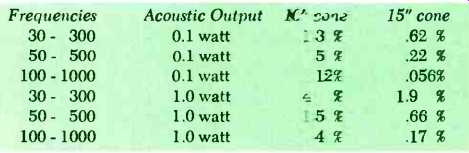
If the ratio of the higher to the lower frequency is 10, e.g.: 50 Hz and 500 Hz, which is not unreasonable, we get the following levels of distortion.
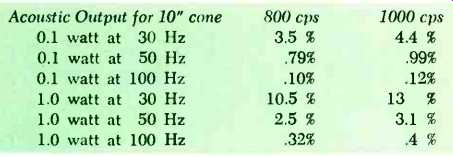
Or if we hold the upper frequency at 800 and 1000 hz but vary the lower frequency, we get Some of the figures in the above tables seem rather large. However, be assured, that they have been measured and agree reasonably well with theory. Also, we may note at this point that the distortion, or modulation phenomenon, if you prefer, is clearly audible.
One must conclude that this form of distortion is real and of significance now that we have extended bass response, small but long throw cones, and substantial acoustic output demands.
There are two approaches we can use to minimize this type of distortion. One is to use larger cones or several small cones to make up the equivalent area. The second is to reproduce a limited frequency range with each cone. These rather obvious solutions have been used by many high quality systems such as Bozak and others for over 25 years.
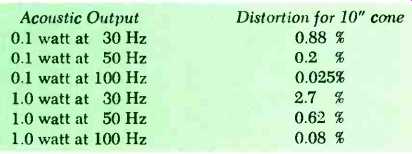
If we limit the low frequency cone to 200 cps maximum, we find the following distortion figures.
-----
These latter figures look much more acceptable since distortion of less than 1% is quite hard to hear unless it is of a very peculiar or obnoxious type.
We must of course ask the question, is all this audible in real, music; program material? Since the distortion can be measured, it ought to be audible or are we perhaps less perceptive than we like to think. The following experiment was performed. Three acoustic suspension. 10" long throw speakers of very high quality were used in an A-B test. One speaker, with a 1000 to 1200 Hz crossover point was used in the regular manner. It was considered to have some faults in the midrange sound. That is, the 400 to 1000 Hz voice range was not considered as perfect as it might have been. Two identical speakers were connected with two amplifiers and a variable electronic crossover.
When the crossover was set at 1000 Hz the two speaker and single speaker systems sounded identical. As the crossover frequency was lowered to 800, then 400 Hz, etc. the sound of the two speaker system changed appreciably. There was a clear difference between the systems when the crossover was set at the 200 to 500 Hz range. And in fact the two speaker system was judged to be much more natural in sound. The hollow sound of the single speaker had vanished. The only reasonable interpretation of this experiment seems to be that the lower frequencies were somehow distorting the 500 to 1000 Hz range of frequencies in the single speaker. When they were removed and reproduced by a separate speaker an immediate improvement was noted.
An interesting side comment might be the fact that the test speakers have recently been greatly improved by changing the crossover frequency to 500 to 600 Hz.
This has reduced the modulation distortion possibilities by a factor of about two.
Sincerely, R. A. Greiner, Professor, University of Wisconsin
================
ADs:
Handsome is as handsome does.
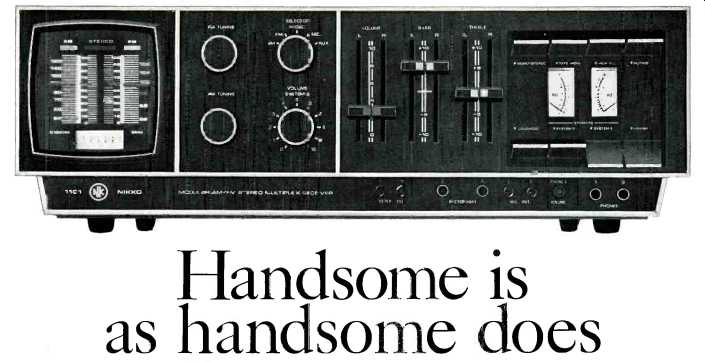
Nikko 1101 AM/FM Stereo Receiver 200 watts $399.95 list
1 ceramic and 2 crystal filters provide greater sensitivity and higher selectivity
FET booster strengthens received signal at the antenna
Unique FET demodulator in AM section increases sensitivity and reduces spurious response and cross modulation
4 FET's in FM front end minimize spurious response and cross modulation
Black-out glass panels light up as functions are selected
Separate AM and FM tanning eliminates needless dial spinning
Reliable silicon power transistors deliver 200 watts of clean, pure music power
Spring-loaded connectors eliminate the need for tools when changing speaker or antenna connections
Muting circuit eliminates between-station background noise and hiss
Computer-type plug-in circuit boards
Dual headphone outputs and microphone inputs
Professional separate slide controls for volume, bass, and treble of each channel
Separate stepped volume control for remote speaker system
If that handsome brute is a bit much, check these beauties:
NIKKO--Nikko Electric Corporation of America, 5001 Lankershim Blvd., North Hollywood, Calif. 91601.
Manufacturers of a full range of receivers, pre-amp/amplifiers and tuners that deliver the cleanest, purest sound in their price range. Hear them at your Nikko dealer's today.
-------------------
Thorens TD-125 3-Speed Electronic Transcription Turntable
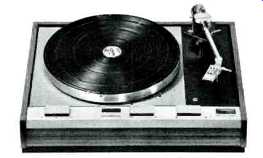
Innovation in design is the keynote to the remarkable performance of the Thorens TD-125.
But then, you expect innovation from Thorens.
And you get it.
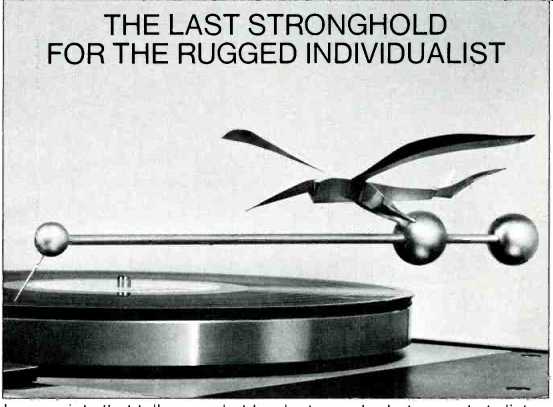
THE LAST STRONGHOLD FOR THE RUGGED INDIVIDUALIST
In a society that tells you what books to read, what records to listen to, what fashions to wear, Thorens offers an alternative. Select the tonearm and cartridge of your choice to use with the TD-125. This offers you the flexibility to change over conveniently to any tonearm and cartridge your system requires. Chassis tonearm installation is simply and precisely achieved. High Fidelity (Sept. '69) acclaimed the TD-125 "...as the best three-speed manual we've yet tested." Here are some of the reasons: 3 speeds (16 2/3, 33 1/3, 45 rpm) ... Wien bridge oscillator for precise speed control... Tonearm mounting incorporated in shock mounting of platter... Controls independent of shock mounting ... 16-pole synchronous belt-driven motor ... Dynamically balanced 7 lb., 12-inch non-magnetic platter ... The World's Finest Transcription Turntables
Thorens-Franz AG., CH 5430 Wettingen, Switzerland. U.S. Distributor: ELPA MARKETING INDUSTRIES, INC., New Hyde Park, N.Y. 11040.
= = = =
(Source: Audio magazine.)
Also see: