STEREO REVIEW'S SELECTION OF RECORDINGS OF SPECIAL MERIT BEST OF THE MONTH
Orlando Paladino:
A Dream Cast for a Haydn Opera Buffa of Mozartean Freshness ORLANDO PAL ALAND was Haydn's one real operatic success in his own lifetime, and it is probably his best theater score. It has been neglected for a long time, however, even compared to some of the lesser Haydn operas that have been printed and revived in recent years, perhaps because, great master piece of the musical stage though it is, the opera also turns out to be outrageously un-stageworthy.
Orlando was written for a projected visit of Russian nobility to the Esterhazy estate in Hungary where Haydn was employed (for thirty-odd years) as Kapellmeister, and it was clearly in tended as entertainment of an important sort. The libretto, based more or less on Ariosto's great Italian Renais sance poem Orlando Furioso (The Madness of Roland), is labeled "dramma eroico-comico"--an extraordinary designation that reminds us of the tragi comedies of Shakespeare or, more to the point, the dramtna giocoso of Da Ponte and Mozart. Indeed, we find many extraordinary features in Orlan do that remind us of Don Giovanni:
Pasquale, Orlando's stuttering squire, sings a number that is astonishingly like Leporello's catalog aria; elsewhere, in a state of abject terror, he is required by his master to address a supernatural being-just like Leporello. There are a supernatural statue, a charming peasant girl of the Zerlina type, and a Donna Anna character who is eagerly chased by our anti-hero (she prefers her sappy tenor boy friend instead).
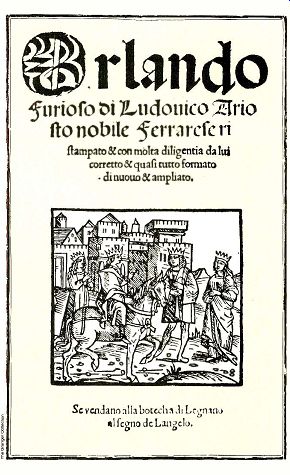
------ Title page of the third edition of Ludovico Ariosto's Orlando
Furioso, published in Milan in 1524.
These characters spend their time looking for and running away from the mad Orlando, but in the end it takes super natural forces to tame the outcast.
In this single opera Haydn seems to have demonstrated a truly Mozartean skill at composing extended scenes as well as delineating a human-comedy array of characters and types-a pair each of major soprano, tenor, and baritone roles plus a mezzo-soprano sorceress and a one-aria bass part. All very Mozartean. It takes nothing away from Don Giovanni to speculate that its authors must have been familiar with the earlier work. It was hardly un known, for it had some twenty performances at Esterhaza and major performances, mostly in German, in twenty major Central European cities. Librettos were printed and widely circulated and manuscript versions must have been around. The work was published only in 1972, however, and this is in dubitably its first recording. What took so long? The obvious diagnosis is that dread affliction of the musical theater, terminal pain-in-the-libretto. Nunziata Porta's "dramma eroico-comico" is, Ariosto or no, a hopeless farrago of burlesque scenes utterly innocent of any dramatic qualities. It is redeemed by only one thing: Haydn's music. But this is, without a doubt, a genuine musical redemption. Porta's librettistical hodgepodge brought out qualities in Haydn that much better texts did not: a warmth and even passion which, combined with real musical scope, produced a score that has truly epic and dramatic qualities, even in the midst of the slapstick heroics. The ravings of Orlando, the baritonal posturing of the terrible King of Barbary, the faint hearted tremblings and lyrical out bursts of the lovers, the pastoral lyrics of the shepherdess, the magic music of the sorceress, the swagger and pathos of Pasquale-all are depicted musically on a level that only Mozart ever reached consistently. My favorite is Orlando's third-act aria after he is given to drink from the River of Forgetful ness (in order to cure his madness).
Eroico-comico here achieves an epic level.
This is a dream cast, vivacious, musical, vocally beguiling and fresh-
sounding, perfectly Haydnesque. Per haps George Shirley in the title role makes the deepest impression; his singing is rough and penetrating at the start, but in the end it is also simple and suggestive of profounder qualities in a role that might otherwise seem merely silly or "stylish." None of the other parts offer this kind of opportunity, but the two buffo baritones are vocally amusing and musically excellent. Claes H. Ahnsjo (everybody's favorite classical tenor), Gwendolyn Killebrew (the only dark, serious voice in the cast), and two delicious sopranos named Arleen Auger and Elly Ameling (!) all sing with unending and exquisite lyricism.
The Lausanne Chamber Orchestra sounds like a first-class classical ensemble given the benefits of first-class direction and recording. The buffa spir it is perfectly captured--more so, per haps, than it ever could be in the theater. Here, in our opera without walls, in our theater of the mind's eye, is the freshest, newest, most wonderful eighteenth-century opera buffa per formed just the way it ought to be.
-Eric Salzman
HAYDN: Orlando Paladino. Arleen Auger (soprano), Angelica; Elly Ameling (soprano), Eurilla; Gwendolyn Killebrew (mez zo-soprano), Alcina; George Shirley (tenor), Orlando; Claes H. Ahnsjo (tenor), Medora; Benjamin Luxon (baritone), Rodomante; Domenico Trimarchi (baritone), Pasquale; Maurizio Mazzieri (bass), Caronte; Gabor Carelli (tenor), Licone. Lausanne Chamber Orchestra, Antal Dorati cond. PHILIPS 6707-029 four discs $35.92.
Wholehearted, Knowing, Altogether Magical Music Making at Ninety-plus
USUALLY, when we speak of "vigor" in performances recorded by a pianist in his ninetieth year, it is generally understood to mean "very energetic for a man of his years." But the vigor that is so striking on Artur Rubinstein's new RCA disc of Beethoven's Sonata in E-flat, Op. 31, No. 3, and Schumann's Fantasiestucke, Op. 12, is the sort that would be remarkable from a musician of any age--not headlong and breathless, but charged with subtlety, wit, and profound understanding.
This is perhaps best epitomized in the scherzo of the Beethoven sonata, whose easy, good-humored swagger, shot through with the most exquisitely judged dynamic shadings and superb rhythmic control, creates an impression of inspired spontaneity that makes us forget all about Rubinstein as per forming middleman. The contrasting expansiveness of the preceding allegro and the elegance of the succeeding menuetto are no less fully realized, and the aristocratic vivacity in the marvel ous presto finale sets the final seal of conviction on a musical realization that leaves nothing unsaid-or, one might better say, leaves no miraculous factor of the work uncelebrated.
In the Fantasiestiicke, too, Rubin stein does not hold back on the vigor, but he seems to be telling us that music needn't be viewed as some frightening ly fragile thing wrapped in a gossamer haze for its poetry to be felt. Like the sunlit presentation of the Beethoven, this is wholehearted, knowing, altogether magical music-making. Considerations of vintage aside, this is Rubin stein at his best-which means Beethoven and Schumann at their best, too. Since the piano sound itself is absolutely first-rate and the surfaces exemplary, anyone with ears should be hard put to find a reason for denying himself the exceptional pleasure this disc affords.
-Richard Freed
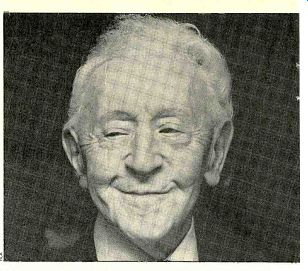
----- ARTUR RUBINSTEIN: looking pleased with himself-as well he might.
BEETHOVEN: Piano Sonata No. 18, in E-flat Major, Op. 31, No. 3.
SCHUMANN: Fantasiestticke, Op. 12. Artur Rubinstein (piano). RCA ARLI-2397 $7.98, 0 ARSI-2397 $7.98, ARK I-2397 $7.98.
Alfred Brendel's Beethoven Has Character Without Idiosyncrasy
As he did for his performances of the Beethoven piano sonatas, Alfred Brendel brings to his new Philips re cording of the five piano concertos (and the piano part of the Choral Fantasy) a combination of élan, intelligence, wit, and tenderness that makes the end result altogether stimulating to the mind and nourishing to the soul. These interpretations have real character without idiosyncrasy.
In the C Major Concerto, the opening movement goes with irresistible flair and brio, reaching a high point in Brendel's terrific solo sweep down the keyboard into the recapitulation. In contrast, the slow movement emerges as the acme of poised Classicism, and it is followed by a finale that, while filled with rhythmic tension, never becomes uncomfortably taut.
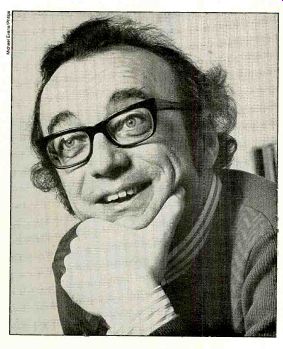
- ALFRED BRENDEL: stimulating to the mind and nourishing to the soul.
That sort of comment applies in general to all the concertos here. The earlier B-flat Concerto is scaled down to Mozartean proportions and an appropriately sparkling transparency. The glory of the C Minor is its noble slow movement, and this gets its full due un der Brendel's fingers. His handling of the finale is surprisingly restrained in the early pages but develops in properly cumulative fashion as it proceeds.
In the opening of the G Major Concerto, Brendel attempts-with considerable success-to achieve a compromise between the Classic and the Ro mantic view of the music. Again, it is the great dialogue slow movement that comes off most movingly. In the first movement, Brendel, like Emil Gilels, uses Beethoven's second, lesser-known cadenza.
In the Emperor, Brendel finds a most effective middle way between proto Lisztian display and Classical discipline. It is a pleasure to hear the some times galumphing finale go with such flow and nuance.
The Choral Fantasy, that strange work anticipatory of the Ninth Sym phony finale, comes off delectably here as the jeu d'esprit it seems to have been intended to be. Brendel swarms up and down the keyboard as if he were Beethoven himself improvising (which is what happened at the work's 1808 première), and the choir acquits itself well in Christoph Kuffner's text in praise of music and the human spirit.
Haitink and the London Philharmonic provide sterling orchestral partner ship for Brendel's pianism. As to re cording quality, things fare best in the first two concertos, less well in the last two. The recording of the C Minor seemed to my ear to be troubled by muzzy bass in the first-movement piano-orchestra climaxes-a problem, I suspect, stemming mainly from the reverberation characteristic of the re cording locale.
-David Hall
BEETHOVEN: Piano Concertos Nos. 1-5; Choral Fantasy, Op. 80. Alfred Brendel (piano); London Philharmonic Choir; London Philharmonic Orchestra, Bernard Haitink cond. PHILIPS 6767 002 five discs $44.90, 0 7699 061 three cassettes $26.94.
Ron Carter Quartet: Have We Found The Modern Jazz Quartet's Successor?
ALTHOUGH it turned out, in the end, to be an above-average example of the genre, I must confess that I listened to Ron Carter's last album for CTI with great apprehension: he had been transferred to the company's pop-oriented Kudu label, and he was treading-albeit delicately-on disco territory ("Anything Goes," Kudu 25). Then came the move to Milestone and an al bum called "Pastels" (Milestone M-9073) which featured Carter playing superbly against Don Sebesky's slightly-above-Muzak string arrangements, a throwback to earlier CTI sessions.
Both of these were of some jazz interest, even though they did pander to broader tastes, but neither can begin to approach the Ron Carter Quartet's new "Piccolo," an album that embodies all the qualities that make jazz an enduring, vital art form.
Ron Carter, who will be forty this spring, started-as his playing gives evidence-on the cello and received extensive classical training before entering the jazz arena. He played with Chico Hamilton, Cannonball Adderley, Jaki Byard, Eric Dolphy, and Miles Davis in the Sixties and has appeared on more than four hundred recordings over the past ten years. The present quartet is about two years old and quite unlike any group jazz has spawned: the two basses-Carter on a piccolo bass and fellow Miles' Davis alumnus Buster Williams in delicate rapport on the larger, regular acoustic kind-give it its unique sound. Carter makes much use of the bow, and he and Williams, never less than superb, are at their best when they are playing countermelodies. Superb is also the word for the work of pianist Kenny Barron and drummer Ben Riley.
"Piccolo" was recorded at Sweet Basil, a New York club, during two nights last March, and engineer Jim Stern deserves a bow for capturing this fine quartet so well. The program ranges from the 1930 Tin Pan Alley hit Three Little Words to Thelonious Monk's Blue Monk, Oscar Pettiford's Laverne Walk, and Carter originals.
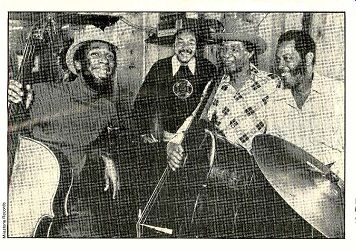
- RON CARTER QUARTET: left to right, Carter, Kenney Barron, Buster Williams,
and Ben Riley
Most endearing of the last are Saguaro and Tambien Conocido Como, reflecting Carter's previously demonstrated love of Spanish music. The sophistication, swing, and high-caliber musicanship offered by the late, lamented Modern Jazz Quartet are to be found in the Ron Carter group, and a commensurate popularity will surely follow.
-Chris Albertson
RON CARTER QUARTET: Piccolo. Ron Carter (piccolo bass); Kenny Barron (piano); Buster Williams (bass); Ben Riley (drums). Saguaro; Blue Monk; Laverne Walk; Three Little Words; Little Waltz; Tambien Conocido Como; Sun Shower.
MILESTONE M-55004 two discs $8.98, CI 8161-55004 (Z) $9.95, 5161-55004 (Z) $9.95.
Townshend/Lane: A Collaboration Alive, Friendly, And Inventive
PETE TOWNSHEND, the once and future Godfather of Punk, and Ronnie Lane, who was smart enough not to have gotten involved in the recent Small Faces comeback bid, have come up with a fascinating and altogether lovely collaborative album for MCA.
The word "collaborative" is a bit mis leading, however, for in "Rough Mix" the British veterans sing together on only two tunes. Although Townshend and Lane are linked by friendship and a common devotion to the teachings of Meher Baba (the Silent Cal of the spir itual set), their musical approaches are strikingly different. Think of this effort, then, as two halves of two unfinished solo albums.
Lane's music is only marginally rock-and-roll. He is intent on exploring and expanding the possibilities of the English folk tradition, and his songs ...
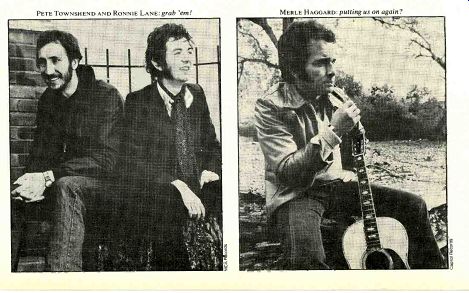
-------------- PETE TOWNSHEND AND RONNIE LANE: grab 'em! MERLE HAGGARD: putting us on again?
... here-particularly Annie and Nowhere to Run-despite their seeming primitivism, have the same kind of purposefully haunting, almost elegiac mood that Rod Stewart's work exhibited before he started working with American mu stars. It is decidedly un-commercial stuff all the same, and Townshend is to be commended for giving it the kind of exposure his name ensures.
Townshend is to be commended as well for his own contributions to the al bum. His new songs may not be as epochal as anything he's done with the Who (or even the best things on his earlier solo effort, "Who Came First"), but they are worthwhile on several levels, not least of which is their indication that Pete has finally come to terms with (a) middle age and (b) his nervous ness about the territorial encroachment of the Sex Pistols' Johnny Rotten. Mis understood, for example, finds the Old Punk concerned with his status in the neighborhood,, vowing to be feared and to make people cry when he puts them down-which is sort of refreshing coming from rock's premier Mr. Nice Guy.
More important, the music here is so ingeniously put together and filled with such fresh energy (my nomination for the Addictive Rock Riff of the Year Award: My Baby Gives It Away) that Peter can go one-on-one in a Battle of the Bands with the Jam any day.
"Rough Mix" is by no means perfect --the title tune is a throwaway blues work-out, and Street in the City, the orchestrated centerpiece of the record, is an uncomfortably sentimental slice of Moody Blues-style kitsch-but in its best moments it is so alive, so friendly, so inventive, that the lapses hardly matter. In short, it's a gem, and you should grab it immediately, no matter which
- Steve Simels
PETE TOWNSHEND/RONNIE LANE:
Rough Mix. Pete Townshend and Ronnie Lane (vocals and instrumentals); Eric Clapton (guitars and dobro); Henry Spinetti (drums); other musicians. My Baby Gives It Away; Nowhere to Run; Rough Mix; Annie; Keep Me Turning; Catmelody; Misunderstood; April Fool; Street in the City; Heart to Hang On To; Till the Rivers All Run Dry. MCA-2295 $6.98, C) MCAT-2295 $7.98, MCAC-2295 $7.98.
Haggard the Populist: Another Win for Up-to-snuff Style And Personality
MERLE HAGGARD must be one of our more talented populists. He's been paid handsomely for it, and that, theoretically, is supposed to undermine populism. In fact, until about two al bums ago I'd begun to wonder whether booze and high living weren't getting to him, but he must still remember pretty precisely how it felt to be an ordinary working man or something, for the title song here is a bona fide piece of populism. He wrote four of the others too and didn't goof too badly at picking out the rest, and, yes, one of his new ones will raise eyebrows: I'm a White Boy, it's called. It's one of those that, well, could be taken two different ways.
Haggard has the ability to seem to mean it, and yet he seems to be putting us on at the same time (of course you remember his Okie from Muskogee).
There's a touch of that in this one, al though what it mostly seems to be is a typically populist reminder, if we need ed one, that poverty is color-blind.
Anyway, there's personality and style in what he does, when he's up to snuff as he is in this album. His band, the Strangers, is one of the better country bands. It's super here in the title song, and no slouch in any of the others, and the production is of that good, neutral kind that you can't hear. Artistically, it's the second winner in a row for Hag.
-Noel Coppage
MERLE HAGGARD: A Working Man Can't Get Nowhere Today. Merle Haggard (vocals, fiddle); the Strangers (instrumentals). A Working Man Can't Get Nowhere Today; Making Believe; Blues Stay Away from Me; Got a Letter from My Kid Today; When My Last Song Is Sung; Moanin' the Blues; Goodbye Lefty; Blues for Dixie; Running Kind; I'm a White Boy. CAPITOL ST 11693 $6.98, C) 8XT-11693 $7.98, 4XT-11693 $7.98.
========
Also see:
Source: Stereo Review (USA magazine)