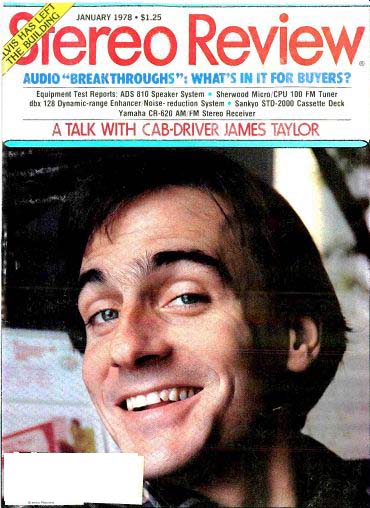
JAMES TAYLOR
By Rick Mitz
RIGHT at the start, there is something you should know about James Taylor, some thing that will forever change the way you feel about rock superstars, taxi drivers, and life in general. And that something is this: James Taylor drives a yellow cab.
True, it doesn't have a meter in it. He doesn't charge a fare, and he certainly doesn't accept tips. And he did have the light on top surgically removed. But that's what he drives-a yellow cab.
"It's a good car. I don't care what happens to it. I drive it. Anyone can drive it. The baby sitter can drive it. A total stranger can drive it, because I don't have any great love for the vehicle. Which is why I love it so much."
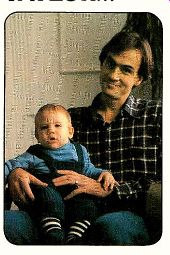
Now, maybe the taxi isn't the love object highest on James Taylor's list these days. Perhaps his family and a few friends and-oh, yes-his music come first. But you ought to know that it's 'way up there. You should also know that James Taylor doesn't wear glasses that light up, he rarely destroys hotel rooms, and his favorite groupies are his two children, whom he adores.
And what he'd really like to do (his latest preoccupation) is run a brewery.
He's already got a name picked out: Taylor's Lighthouse Lager.
In the meantime, though, he brews himself a cup of tea. He's in his white New York kitchen, huddled over the boiling water, communing with the tea leaves. As he dunks the tea bag in and out of his cup, he looks all knees and elbows. But there's plenty of in between too. At six feet three inches, taut and tight, James Taylor has the body of a long distance runner.
In the pop durability contest, the marathon race of the music business, Taylor has completed more than his share of laps. While other performers have long since pooped out, James is still running. Not from, but to.
At thirty, he's already into his eleventh year as a successful musician, and that's quite a track record. He is a pioneer in a business littered with followers. When he first started, he was dubbed the "New James Dean." Now, neophyte musicians are touted as the "New James Taylor." He is an institution, and he has also become an industry, complete with posters, T-shirts, souvenir books, and all the other trap pings of adulation. In short, he's got just about everything: fame and success, good health and good looks, a lot of talent, and a lot of love.
IF you look closer, though, you will find a man bothered by self-doubt and insecurity, a man who is supercritical of himself, as easily wounded by the bullets of the press as by the lack of them on the weekly record-rating charts. "If I have a successful album," Taylor says, "it'll make a difference in a whole year. If an album doesn't do so well, it hurts." According to that criterion, Taylor has had a lot of good years. It began, of course, with the song Fire and Rain in 1970, a painfully lonely and lovely an them that heralded the transition from the acid-hard Sixties to the mellow-soft Seventies. Now more than a dozen hit songs later-Don't Let Me Be Lonely Tonight, Long Ago and Far Away, How Sweet It Is, and Handy Man among them-James Taylor is still with us. He has survived and thrived in a business that eats up its musicians like popcorn. Unlike the scores of singer/ songwriters who have faded from public view and are now driving taxis because they must, James Taylor is still up there on top, driving a taxi by choice.
For example, his latest album, "JT," first went gold, then double-platinum, and is swiftly heading for uranium. His "Sweet Baby James" was Warner Bros.' hottest-selling album at more than three million copies until Fleet wood Mac came along and edged it out.
All told, Taylor has sold more than eleven million records, and by the time you finish reading this sentence, he'll undoubtedly have sold a few dozen more.
The man may sing, but he doesn't of ten talk publicly. Although he's surprisingly articulate, interviews with Taylor have become so rare they're al most extinct, killed off by careless typewriters who twisted the words and garbled the sense of a more than usually complicated story.
Says Taylor: "I think what the press has found to sell in me has been my self-destructiveness. They spent a lot of time--and I'm guilty of it too--talking about my hospital days and my drug problems. That, coupled with songs like Fire and Rain, has created an image of someone who is having a hard time. They found that salable. It was really overdone--things simply never were that bad. But if people came into my house and saw me playing with my kids . . . well, that wasn't a salable image; everybody has kids. Of course, nowadays, everybody has kids who are strung out on dope or in a mental hospital. So I guess it's time for me to move along to another character-if I want to keep those cards and letters coming."
SITTING and sipping his tea (the beverage would later change to beer, then to coffee, then back to tea again), Taylor talked generously and thoughtfully.
He perched himself on the edge of a couch in the den. The sounds of music, children laughing, phones ringing, and vacuum cleaners whining wafted their way into the conversation. In a sky high apartment overlooking Manhattan, James Taylor somehow managed to be quite down-to-earth.
"There is no doubt that success has made me happier with myself. A psychiatrist I used to see, and occasionally go back to visit, said to me that nothing succeeds like success. It's true. It in creases your self-image and it makes you feel more confident. You perform better. You know, I've had my problems, and you tend not to fall back into those problems or onto old crutches.
So success is really great, and I thank everybody who contributes because it really increases my self-esteem. I have found, though, that when it hasn't been too easy for me, it's because I'm taking myself too seriously. It never hurts to lighten up, to de-emphasize the urgency of the situation. Because there's just not that much to worry about." He gingerly moves his cup onto the floor. Against one wall of the den is a beautiful antique baby bed. Against another is a desk piled with memos and newspaper ads to be approved, promotional pictures, and business correspondence. James Taylor, Inc....
"I am more business conscious now. And I've squared up somewhat. I guess it came about from being in the business such a long time. In ways, it may be poison. But I think you square up as you get older and pick up a family. If you make money and accrue things, you tend to become more conservative, and I think responsibility squares you up too." He picks up the cup and looks at a few tea leaves that have escaped from the bag and are floating on the top.
"I think I'm probably much more guarded in my personal life than I am in a song lyric."
"Things are different now than they were seven or eight years ago. Today the music business is much more a business, there's much more competition. It seems to me that things are very tightly packed and there's very little room to move around any more. It seems like, if someone goes up, some one else comes down: it's very close to a total saturation point with popular music.
"It's a whole different thing from the romantic idea we used to have of being a rock star. It's sobering for a guy like me who at one point had the romantic idea of being a 'troubadour.' It sure is an education to see what goes into selling records. It really is a matter of sink or swim. Nice guys, in a sense, finish last. That's not to say that you have to be a rat to do well in this business.
What I mean to say is that you have to blow your own horn. And that's really all I'm doing anyway. I would be deluding everybody including myself if I said I were not.
"But an artist doesn't necessarily have to grow up and take care of him self. I mean, I have relatively few responsibilities, and I have the luxury of not having to yell at anyone, and it's my good fortune in life to be able to take a bath rather than make someone else take a beating. I get paid for doing what I love, so I'm in the catbird seat."
TWELVE years ago, Taylor was far from that catbird seat. He went to New York in 1966 to form a band (which disbanded after one year) called the Flying Machine. Then, in 1968, he arrived in London, an unknown street musician trying to peddle a demonstration record. He ended up recording his first album for the Beatles' Apple Records.
Although well-received critically, it didn't sell well. He left the label, re turned to the U.S., and signed with Warner Brothers (today he records for Columbia). In 1970, "Sweet Baby James" was released, and music history took a little turn.
Music history took a turn. . . ? Taylor doesn't like to hear that kind of talk.
"It still doesn't seem to me that I was doing anything different from the other people around me. I was listening to folk music in Boston and Cam bridge. It was really acts like Peter, Paul, and Mary, Bob Dylan, Ian and Sylvia, the Kweskin Jug Band, Tom Rush, and the Kingston Trio that brought folk music to popularity. You know, it's actually all folk music, what we listen to today. It has a self-made tradition, people who go out and shop for their own education rather than having one delivered to them. Sure, I'm a folk musician. And it's not only because I can't read or write music; it's because I'm a product of the happenstantial kind of random musical environment that I grew up in. I was influenced by the people we called folkies. I was introduced to and strongly influenced by black music. I was introduced to jazz a little bit. And the country music that I heard on the radio down South-these were pretty much what I listened to all the time. And I consider all of that whatever roots I have." He's branched out from those roots.
Today there is a whole James Taylor style, characterized by rich melodies and the careful melding of music and lyric. A song such as his Sunny Skies, for example, has been consciously crafted for effect, with its dark lyric fused to a joyous melody. But the distinguishing trademark of his style is self-revelation through lyrics. Carly Simon's songs are similar in that respect.
In fact, it's been said that if you listen to James' albums and then listen to Carly's, you can figure out what's going on in their relationship at any given time. James laughs at the suggestion: "Well, then you probably know as much about our relationship as we do. . . ." He is reluctant to talk about his song lyrics, though, and when asked to de scribe a song, he'll talk about the chord changes rather than the mental changes that went into the writing.
"I think I'm probably much more guarded in my personal life than I am in a song lyric. But it's not like really being open in a song; it's not like relating directly with someone. A song is a form, you know, it's like something that you're putting in the air, and if it's a personal statement, that's okay-if that's the type of thing you're trying to do. In other words, if I were to explain myself to you, it would be as if to elicit some response from you. But you don't do that in a song. There is no interchange. It's just a statement. Oh, I get a lot of mail, and I suppose some people do respond to a song in that way. Some people write me and tell me they like my songs or they'd like me to come over for dinner or that they're in a tight jam-and that's the closest thing to an interchange in a song." He pauses for a moment. "But you know, they're gonna do it anyway they're going to try to figure out who you are from the lyrics of a song. If you try to be a star and you're in the public eye, they're going to do it. And it's not just a matter of whether they'll be right or wrong in their assumptions. Obviously they're going to be wrong, but how wrong they're going to be is the question." Another rest, another sip. "There is a songwriter's place. There is a place you are at when you write a song, and I'm not there all the time. I'm there twelve times a year. Or less. I don't know if it has to do with alpha rhythms or biorhythms or what food additives they've been popping into you. I don't know what goes into you to allow you to reach that state of feeling so that you can write a song. And the song's lyrics are not necessarily the views of the person who's doing the writing. That's just the state. Different songs happen different ways." One source of mild discontent for Taylor is that he hasn't written a hit song for some time. "I've had mostly oldies as hits for a while now. I really haven't had a big record since Don't Let Me Be Lonely Tonight. Carole King wrote You've Got a Friend, and then there were a string of oldies-Mocking bird, How Sweet It Is, and Handy Man.
I would very much like to have a hit with something I've written myself." What Taylor forgets, of course, are the songs he's written that have been hits of varying degrees-songs like Mexico, Shower the People, and, of course, his latest, Your Smilin' Face, which he calls "bubblegum" and which he wrote for his daughter. Also, he's hard at work writing songs for Working, a musical theater adaptation of Studs Terkel's book, scheduled for Broadway.
But whatever he sings, his concert audience loves it, showing their appreciation with loud cheers, paying homage to him with standing ovations and lighted matches, sporting his picture on their T-shirts. Taylor became something of a sex symbol with his slow, sensual version of Handy Man.
And so his photo hangs on a lot of thirteen-year-old girls' bedroom walls lately. "I don't really put much time into thinking about that," he says shyly.
"But I don't mind being hung on walls--in fact, it pleases me to think about being hung on a young girl's wall and to have her look at me. That's fine." THERE is, of course, nothing about a picture on a bedroom wall that gives any clue whatsoever about what it took in terms of work and sheer nerve to get there.
"Performing-it's terrifying. And it has to stay that way. You really need that energy and that urgency, or else you'd get complacent after a number of years doing it. You'd just lay back and nothing would happen. But if you're ready, if your throat is in good shape and your head is in good shape, and you know that the arrangements are there and your instruments are together and your sound and lights and every body are all organized, then it's all okay.
"What I say to myself before I go on stage is that I'm the right person to be here now-you know, that this is my job. The performance that's about to be given is my performance and no body else can do it. And I just sort of get into a frame of mind where I'm fated to do it. It's sort of like Zen archery-there's the target and I'm the arrow, and there's the space to be covered between the two of us. Sometimes walking on stage becomes an out-of-body experience. I start to come around the guy wire that's holding up the backdrop, and the curtain and the monitors are on my right. The stage manager is holding up his hand with the headset on, waiting to tell the spotlight operator to hit me, and the house lights are out and the audience is beginning to make some noise. And then the stage manager points at me-the spot hits the corner, and II come around the corner, and every step is like it takes . . . a vision of myself rises about three feet out of my body. I purposely go into a song that's familiar to me-it'll either be You Can Close Your Eyes, Sweet Baby James, or Riding on a Railroad something that I can sing if a lion is chewing my foot off. And by the time I've done a couple of numbers, it's cool, you know. I can always be drawn forward by the music and become ex cited, but I try to keep myself a little cool.
"I think you have to be in as good shape as you can to give a show. I quit smoking about three years ago, and it takes about three years for your voice to feel the effect of no cigarettes. I'm not a terrific singer. I've got a pretty good instrument, and I've got a good musical sense and I phrase well. But I don't have a good enough voice that I can abuse it. If you're given one of those terrific instruments by whoever passes them out, then you can do any thing to it and still sound relatively okay. But in my case, a little rest makes all the difference." Taylor's on-stage patter is sparse.
"It used to be that sometimes I would say silly things on stage, things like, 'I know you'll like this song because it sounds like all the rest of my stuff.' I guess I really do feel, though, that if I had put out five instead of eight albums in my career, today I would have five really good albums. And three albums of stuff that maybe I would have want ed to leave off. I think my favorite al bum is ' Walking Man.' Then comes the
‘Gorilla' album, but I'm used to loving ‘Sweet Baby James.' I like ‘JT' too." Critics have always had a lot to say about Taylor's albums. Many performers claim they don't read their reviews or, if they do, they just don't care. Taylor wishes he felt that way.
"I listen to my critics and absolutely read my record reviews. I try not to read beyond my name in print, but when I read something, I take it seriously, even though I know better. I re member one review that said the re viewer was tired of my stuff, that it was all the same, it was all romantic pap and I was beating myself and wasn't taking any chances-that I was boring.
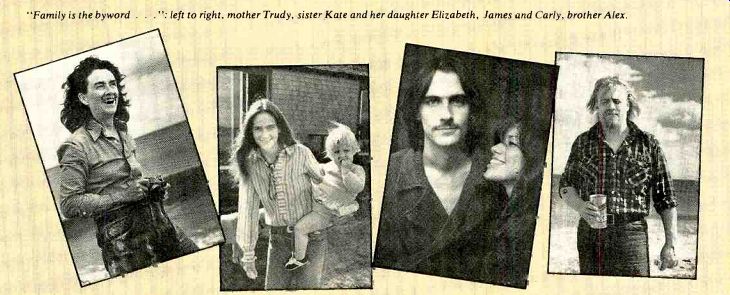
---------- "Family is the byword . . .": left to right, mother Trudy, sister Kate and her daughter Elizabeth, James and Carly, brother Alex.
--------------- TAYLOR...
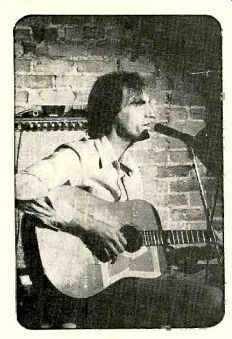
"I purposely go into a song that's familiar to me . something that I can sing if a lion is chewing my foot off."
That review just poked a hole right through the bottom of things for a couple of days. But that's what you set yourself up for if you're playing for the public. You takes your chances. . . .
Generally, though, I've been well treated by the critics." While music critics have written about his professional life, another kind of journalist-the gossip-monger-has taken aim at his private life, trying to spot anything controversial in his past, zeroing in on his problems, even his marriage to Carly Simon which is all very strange, because he lives simply and conservatively, and their marriage is durably old-fashioned.
Perhaps his reluctance about accepting the role of public personality goes back to Taylor's early experience with fame. He started out as a musician and quickly ended up as a media figure.
While most other young men his age were still sitting in classrooms, James Taylor was sitting on the cover of Time magazine.
"I think that the early success and recognition really froze me up," he says now. "The Time magazine thing was a big deal. I don't know that there were a lot of rock-and-rollers on the cover of Time. Back then it was a big thing. I can't remember it that well. But in my career, a lot of things that have happened have been amazing, and I haven't really noticed them happening.
When I turn away from them a little bit, when I get some distance, then I notice them.
"Now it all just seems kind of natural. I don't know about anything else besides being famous. It's about perfect, you know. If I want to, I can al ways find someone to recognize me in a place if I need the advantage of being famous. If someone won't take my check, for example, then just give me five minutes and I'll find someone who's heard You've Got a Friend.
Somebody in the place will know of James Taylor-enough to consider cashing my check. There are about two or three things that it's worthwhile being famous for.
"As far as being bugged on the street or not allowed to eat in a restaurant or stuff like that, I haven't got that problem. I guess I change my appearance enough so that people just don't recognize me. Or, if they do, they're just very kind about it. I hear people com plain about what a bummer it is to be famous, and I think that when that hap pens, it's usually because someone's handled it poorly. People who recognize me usually have positive feelings about me. I may be proved wrong to morrow, but my fame doesn't carry much notoriety with it."
FAME is something that seems to run-no, gallop-in Taylor's large, ex tended family. In addition to Carly, James has two musical brothers, Livingston and Alex, and his singing sister Kate, and then there are Carly's song bird sisters Lucy and opera diva Joanna. When Carly and James first got together, it was as much a musical merger as a marriage. It's practically impossible to turn on the radio without hearing some Simon or Taylor singing-sometimes even together or in as sorted multiple-choice combinations.
Taylor speaks of his wife in a low, loving voice.
"Carly is an extraordinary person to know because she is probably as positive as anybody you will ever meet.
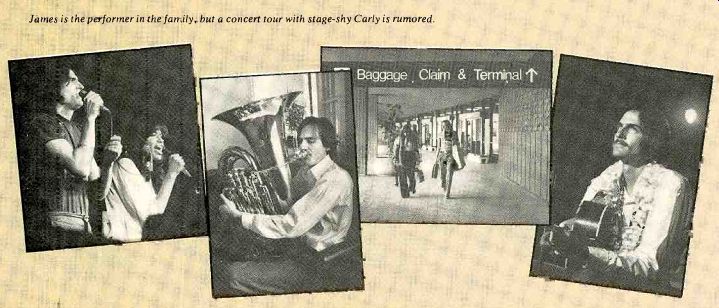
-------- James is the performer in the family, but a concert tour with stage--shy Carly is rumored.
She's really a bouyant personality and she refuses to let criticisms of her get her down. Maybe it's just her happiness and positiveness that the press like to criticize, but they're missing the point 100 percent if they're looking for someone to knock down. I mean, Carly's really a seeker, you know. People don't really see her as such, because they have this image that they're trying to color in. They have an outline in their minds that's been given to them by some cultural lie somewhere of what someone's supposed to be like.
And she doesn't fit that outline. She is the most remarkable person I've met.
"I'm sure that I would have bottomed out a few times had it not been for Carly. Her positiveness has definitely counteracted my negativeness.
She can suggest an alternative and positive way of life." James is also having an ongoing love affair with his brothers and sister.
"They're really exceptional people, you know. I don't know how it turns out that way, but Kate, Livingston, Alex, and Hugh (his only nonmusical sibling) are all . . . if you knew any of –
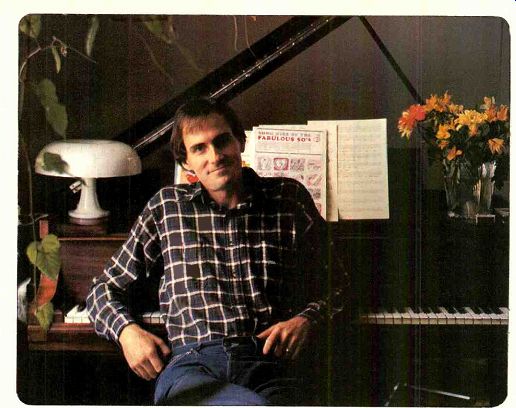
-them, you'd know what I mean. Maybe we're so close because of our being close in age; we're five children born within seven years. We grew up feeling in ways either special or alienated. My mother really felt she was from the North, but we grew up in a small academic town in North Carolina and maybe we just sort of got real tight for that reason. We didn't have a lot of neighbors or anything; we lived out in the country. Today, I don't make friends easily, and I have only three or four friends whom I consider terribly close. For the rest, it's just my brothers and my sister." Family is the byword at Taylor's homes-both his apartment in New York and his house on the New Eng land coast. People predominate more than things. Two bicycles-twenty speeds between them-sit in a corner of his apartment hallway. Elsewhere, the furnishings are simple. His living room, for example, consists of a sort of maze made out of couches, a colorful Richard Lindner print over the fire place (under which is propped a snap shot of Carly with her longtime lyricist-collaborator Jacob Brackman), some stereo equipment, a piano, and a coffee table. No sable rugs on the floor, no crystal chandeliers on the ceiling.
"I'm aware of heat loss in my home and I'm aware of gas mileage in my car-and financially it doesn't make a damn bit of difference, you know. I think it's just a matter of what you're used to. It's just what I feel comfort able with. I mean, if you ride down town in a chauffeured mother-of-pearl 1975 Lincoln Continental limousine and step out with your shades and white suit and your mink coat and your gold coke spoon and strut into the Ritz de Ritz, people are gonna say,
`Heyyy . . there goes somebody . . . ahhh. . .' But that wasn't the way I was brought up. I think it's fine to flaunt it-if you want to. Bad taste is terrific; people love to see some flash it's a real crowd pleaser. But I don't think I could handle it. I guess I have a feeling that there is a finite amount of things to go around, and that If I take too many of them, it will amount to taking them away from somebody else.
My father and mother told me not to waste and taught me that greed was an ugly thing. It won't keep me from rid ing in a limousine, but it will keep me from buying a Cadillac." A carpenter knocks on the door of the den to announce that he wants to install a light fixture. Taylor looks around the house for another room in which we can sit and talk. But some one's already in the kitchen, and Carly and the children are in the living room where Sarah is showing-and-telling how she can leap from the window sill onto the couch. She's a regular tinker-
bell. The baby is sleeping quietly. So James walks into the babysitter's room and, once he gets there, realizes that he has very little left to say.
PERHAPS there really is very little left to say about James Taylor. The hundred-odd songs he's recorded speak and sing-for themselves, already testifying to a long and fruitful career in the music business. But what about the future? Recently, Taylor's been doing a little record production (an album for his sister Kate) and a lot of work on Working. There's also been some whispering-heavy breathing is closer to it-about a possible concert tour with stage-shy Carly. Maybe James Taylor, the country boy from North Carolina, will become a music mogul. Or write a symphony. Or take up tap dancing.
Who knows? In a career peppered with the unpredictable, James Taylor just might give it all up and go off some where to brew his Lighthouse Lager.
Or decide to put the meter back in his yellow cab. There's a song in there somewhere.
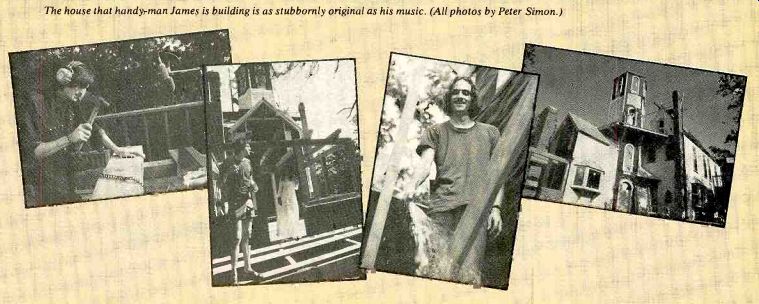
-------The house that handy-man James is building is as stubbornly original as his music. (All photos by Peter Yawn.)
Reviewed by: CHRIS ALBERTSON, NOEL COPPAGE PHYL GARLAND PAUL KRESH
PETER REILLY STEVE SIMELS JOEL VANCE
LYNN ANDERSON: I Love What Love Is Doing to Me/He Ain't You. Lynn Anderson (vocals); instrumental accompaniment. We Got Love; Desperado; Sunshine Man; He Ain't You; The Angel in Your Arms; and five others. COLUMBIA PC 34871 $6.98, PCA 34871 $7.98, PCT 34871 $7.98.
Performance: Professional
Recording: Good
Lynn Anderson is one of the real pros of the c-&-w scene, but she's never boring or mechanical about it. Oh, she's not above the muffled sob, the pleading tone, or the forlorn self-righteousness that seems to be built into c-&-w; it's just that she, handles it all with a touch of briskness and humor. She's changed scarcely at all since her 1971 hit, I Never Promised You a Rose Garden, and this latest is another smoothly commercial bit of fluff that in other hands might have turned into lint. Taking no commercial chances either, Columbia has given the album a double title after the two songs most likely to succeed.
My bet is on He Ain't You, into which Ander son injects flickers of asperity that suggest she's gotten. to be quite an actress in a field that generally requires only melodrama. P.R.
THE BABYS: Broken Heart. The Babys (vocals and instrumentals); vocal accompaniment. Wrong or Right; Give Me Your Love;
--------------
Explanation of symbols:
= reel-to-reel stereo tape
= eight-track stereo cartridge
= stereo cassette
= quadraphonic disc
= reel-to-reel quadraphonic tape
eight-track quadraphonic tape
Monophonic recordings are indicated by the symbol
The first listing is the one reviewed; other formats, if available, follow it.
-----------------
Isn't It Time; And If You Could See Me Fly; and six others
CHRYSALIS CHR 1150 $6.98.
Performance: Fair
Recording: Excellent
The Babys aren't punk rockers; they're more kiddie rockers who take themselves seriously as they sing about . . . oh, you know, love 'n' life 'n' girls with dope habits 'n' other esoteric stuff like that. It's all fairly loud and kind of klutzy. The recording is quite good, for the producer and the engineer knew their business when it came to miking the instruments and getting good separation. Unfortunately, their efforts were wasted. J.V.
LUCIO BATTISTI: Images. Lucio Battisti (vocals); instrumental accompaniment. To Feel in Love; Song to Feel Alive; Keep On Cruising; and four others. RCA TFLI-1839 , $7.98, TFS1-1839 $7.98, TFK1-1839 $7.98.
Performance: Squeaks by
Recording: Good
Lucio Battisti looks like a moody Italian stallion, but he has a high voice (often accompanied here by his own dubbed-in background vocals) that makes the least of the songs he writes himself-and they aren't much in the first place. A heavy Italian accent fails to add charm to forgettable, overlong ballads about how good it feels to be alive, in love, and in Southern California. It is just possible that the whole thing was ground out on a pasta maker instead of in a sound studio. P.K.
HARRY CHAPIN: Dance Band on the Titantic. Harry Chapin (vocals, guitar); instrumental accompaniment. Bluesman; Country Dreams; My Old Lady; Manhood; I Do It for You, Jane; Mismatch; We Grew Up a Little Bit; and seven others. ELEKTRA 9E-301 two discs $11.98.
Performance: No wonder it sank
Recording: Good
Harry Chapin is in his usual form here-this time distended into a two-disc set that runs well over seventy-two minutes-which is to say that the only thing more pompous and portentous than his songs is his performance of them. A brief sample from the title track will serve: "Jesus Christ can walk on the water/Where a music man will drown/They say that Nero fiddled while Rome burned up/Well I'll be strumming as the ship goes down." That particular little gem takes only a minute or so of playing time. The other seventy one are also filled with Mr. Chapin's "strumming" and his illuminations of such subjects as My Old Lady and Manhood ("I was laughing horizontally/In my loose and lusty youth"). This listener's reaction is a certain panic, rather like awakening from a nightmare in which one has been drowning in an oatmeal sea. P.R.
CHER: Cherished. Cher (vocals); orchestra. Again; Dixie; Thunderstorm; Pirate; L.A. Plane; Send the Man Over; and five others. WARNER BROS. BS 3046 $6.98, M83046 $7.97, M53046 $7.97.
Performance: Ah, sweet misery . . .
Recording: Good
The greatest improvement on Cher's latest al bum-the only improvement, since she still can't sing-is that she's getting into the kind of material her public can have a wonderful weep with. Peter Allen's fine She Loves to Hear the Music, that ironic, sadly true song about a girl who is letting her life pass by because she's so "into" music and musicians, turns out to be just Cher's meat and potatoes, dramatically and lyrically. She misses the irony by a mile, bypasses its truth and reality, and isn't quite securely on key through most of it, but oh boy, it's the kind of girl-talk that won't leave a dry eye in the beauty parlor.
Send the Man Over is the saga of a little back woods girl stranded in Hollywood trying to make it as an actress who is forced (oh mi-gawd!) to turn part-time hooker since the calls aren't coming through from Metro and Warners. Certainly this is Cher's high point: it has all the hard-breathing, dreary pizzaz of an old Lana Turner epic-and something of the same irresistible, gaudy fascination. When she intones the lines about hearing footsteps in the hall after turning mama's picture to the wall, you know that at last she has found her true métier-c-&-w schmaltz in a glossy Hollywoodish package. If she has the smarts she seems to have, Cher will ask Loretta Lynn to whip up some real gaspers for her. Loretta could probably use a few good laughs, Cher could use the money, and the rest of us could all enjoy a good, glamorous cry. P.R.
CHICAGO: Chicago XI. Chicago (vocals and instrumentals). Baby, What a Big Surprise; Policeman; Till the End of Time; Vote for Me; Take Me Back to Chicago; and six others. Columbia JC 34860 $7.98, JCA 34860 $7.98, JCT 34860 $7.98.
Performance: And on and on and on . . .
Recording: Expensive
Would you believe it? " Chicago XI"? Any thing of any real interest that this group was doing surely faded at about "III" or "IV," but their public, easily the most loyal since Edgar Cayce's, continues to buy their albums in astonishing quantities. Listening to "XI" was-surprise, surprise-very much like listening to "X" and "IX" and "VIII" and so on. And on. For sure, they don't change the formula much, but the exactitude with which they reproduce the same sound from album to album has me suspecting that Caribou Ranch, where this was recorded and mixed, is actually Clone Haven, and that the real Chicago is off somewhere joyously living it up on their royalty checks and probably even going to live music concerts once in a while. The al bum is gorgeously and expensively produced, also as usual. Gee; just think . . . their next one will make an even XII! P.R.
DAVID ALLAN COE: Tattoo. David Allan Coe (vocals, guitar); instrumental accompaniment. Just to Prove My Love for You; Face to Face; You'll Always Live Inside of Me; Play Me a Sad Song; Hey Gypsy; and four others.
COLUMBIA PC 34870 $6.98, PCA 34870 $7.98, PCT 34870 $7.98.
Performance: Good
Recording: Good
David Allan Coe here turns his attention to how complicated (what an array of feelings!) a relationship can get. Of course he doesn't call it a sissy word like that, but still it's a switch for Coe, who usually tells you over and over how mean he is. Only one song here, really, dwells on being bad, and that's not one of Coe's simplistic ones but one of Mickey Newbury's anti-hero sort, San Francisco Mable Joy. In spite of the fact that Coe's progressive-country rival Waylon Jennings clobbers Coe at the art of covering Mable Joy, most of "Tattoo" is pretty well done. It doesn't show quite the passion Coe can call up on the subject of whuppin' asses, you understand, but he's a bona fide singer who can freshen up slightly used melodies, and some of these are still under warranty. N.C.
COUNTRY JOE AND THE FISH: Reunion. Joe McDonald (vocals, guitar, harmonica, trombone); Barry Melton (vocals, guitar, mandolin, dobro, synthesizer); David Cohen (keyboards, guitar); Bruce Barthol (bass); Gary Hirsh (drums). Come to the Reunion; Time Flies By; Stateline, Nevada; Love Is a Mystery; Dirty Claus Rag; Not So Sweet Martha Lorraine; Thunderbird; and five others. FANTASY F-9530 $6.98, 8160-9530H $7.95, 5160-9530H $7.95.
Performance: Updated
Recording: Good
Country Joe's new album is rather hyper aware of change, extinction, not being able to go home again, and the way we were-which makes it a better reunion album than, say, the one Quicksilver did a year or so ago that tried to pretend nothing had changed since 1969.
The group is mellower than it used to be, the sound is augmented here and there with strings, and the lyrics are given to poking gen tle fun at how they, as political round pegs, fit into the square holes of the late Seventies.
"Lookin' angry, that's me having fun," drummer Gary Hirsh writes for McDonald to sing, "leading a band to save the whales" (Joe's cause nowadays). But then the bassist, Bruce Barthol, is both kidding and serious when he says in Insufficient Funds that there's only one thing left for poor people to do:
"We'll have to start eatin' the rich." Fortunately, in musical terms the album is more ap pealing than the thought of roast leg of Rockefeller or--yuck--Getty steak. Though the al bum works best as nostalgia despite itself, it does suggest the band could stay together if they want to and give the present and the fu ture, as well as the past, a going-over. Both McDonald and Barry "The Fish" Melton make better music in this company than they do out of it, and I'd like to hear what happens if they stay reunited long enough for a few more broadsides. N. C.
CRYER AND FORD: You Know My Music. Gretchen Cryer and Nancy Ford (vocals); instrumental accompaniment. Big Bill Murphy;
You Know My Music; Last Day at the Job; You Can Kill Love; Natural High; I Don't Want to Be Free of You; and four others. RCA APL-2146 $7.98, APSI-2146 $7.95.
Performance: Very good
Recording: Excellent
There's an air of distinction and quality about the work of Gretchen Cryer and Nancy Ford.
Their scores and songs are consistently solid, craftsman-like efforts that might not always send you out of the theater humming them but often give you something to think about. The same applies to this collection of their songs.
Last Day at the Job is about a woman who, at sixty-two, decides to quit her lifetime job as a bank teller and just enjoy herself. The protagonist of Big Bill Murphy is a suburban commuter who is quietly but quickly getting sloshed on the way home: "Lately I've heard so much talk/About women wanting to be free/And I just can't help but wonder, honey/ What about me?" These are relatively good examples of the real-life situations Cryer and Ford deal with, and they perform them excellently against a complementary orchestral background. So, where's the rub? Well, the songs do get a bit boring after a while, and the album itself has a salon quality about it that forced me into a strained listening position hoping like hell my chair wouldn't squeak.
But there's no denying that Cryer and Ford are talented women, and for those who like to get all dressed up mentally and sit at attention, they're probably dynamite. P.R.
( Continued on page 112)
DOOBIE BROTHERS: Livin' on the Fault Line. Doobie Brothers (vocals and instrumen tals). Nothin' but a Heartache; Little Darlin; Echoes of Love; There's a Light; Chinatown; and five others. WARNER BROS. BSK 3045 $7.98, M83045 $7.97, © M53045 $7.97.
Performance: Plastic funk
Recording: Average
I once considered doing a magazine article en titled "Now that we've all had a good laugh, let's disband the Navy" but discarded the idea because I could see that the title would be far and away the best thing about it. So it is with this album. I find I don't mind the Doobie Brothers as much as I used to, but that doesn't relate to their being more interesting as much as it doer, to what disco and punk rock and such things have done to the rest of pop music. The group still seems to ride mainly on crossing watered-down soul with that amorphous Southern California non-style of rock, and if their lyrics are emptier than usual here, blame it on the times. I don't mind having to listen to it, but I surely wouldn't buy it with my own money. N.C.
FIREFALL: Luna Sea. Firefall (vocals and instrumentals); instrumental accompaniment. So Long; Just Remember I Love You; Sold on You; Someday Soon; Just Think; Getaway; and four others. ATLANTIC SD 19101 $7.98, TP 19101 $7.98, 0 CS 19101 $7.98.
Performance: Lifeless
Recording: Good
Firefall's first album contained a quite lovely version of Steve Stills' It Doesn't Matter. "Luna Sea" has nothing like that. Instead, it for the theory that country-rock as a form has become so absorbed into the musical mainstream as to have achieved MOR status (hence Firefall's hit singles, which didn't sound a bit out of place on the radio surrounded by Barry Manilow and Foreigner). If you'd enjoy an album that has nothing to recommend it except that it sup ports critical theorizing, this should be just your cup of tea. S.S.
THE DAVID GRISMAN QUINTET. David Crisman (mandolin); Tony Rice (guitar); Darol Anger (violin, mandolin); Todd Phillips (mandolin); Bill Amatneek (bass). Blue Midnite; Pneumonia; Fish Scale; Richochet [sic]; Dawg's Rag; and three others. KALEIDOSCOPE F-5 $6.98.
Performance: Very good
Recording: Very good
These are weird tunes. No label fits them; some of them sound like jazz, traditional fiddle stuff, old show tunes, and European gypsy music all at once. Crisman wrote or helped write all but two; Tony Rice of the quintet wrote one of the others, and Artie Traum wrote Fish Scale. The David Crisman Quintet is about as "different" sounding as its music, at least in this time and place, and could turn out to be one of the more influential instrumental groups to come along lately.
Every member of the group is impressive, violinist Darol Anger and Grisman especially so, and the album is ardently melodic. In a weird way.
MERLE HAGGARD: A Working Man Can't Get Nowhere Today (see Best of the Month, page 83) LINDA HARGROVE: Impressions. Linda Hargrove (vocals); instrumental accompani ment. Hangin' On; Impressions; Mem'ries; Mexican Love Songs; Not Even for Love; If You Will Walk with Me; and four others. CAPITOL ST-1 1685 $6.98, 8XT-11685 $7.98.
Performance: Not bad, for burned toast
Recording: Good
"Impressions" features some moderately entertaining performances by Linda Hargrove, a c-&-w diseuse with a wryly raunchy style and an ability to write such amusingly sulky songs as, for example, Not Even for Love (he can stay in New Orleans, she's headed back for the red hills of Georgia), Mexican Love Songs (they and the beer are responsible for her waking up in the morning with a cowboy who takes up three quarters of the bed), and the disenchanted-and very funny-Nashville, You Ain't Hollywood. Her what-the-hell lyric readings have the morning-after solemnity of benumbed nerve endings and a certain singed indignation-like burned toast served on a pa per plate. P.R.
CAROLE KING
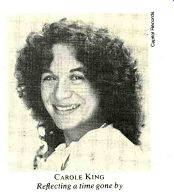
Reflecting a time gone by
CAROLE KING: Simple Things. Carole King (vocals, keyboards, guitar); orchestra. Simple Things; Hold On; In the Name of Love; Labyrinth; Hard Rock Cafe; and five others.CAPITOL SMAS-I1667 $6.98.
Performance: Inappropriate
Recording: Good
The generation that Carole King mesmerized has grown a bit since the phenomenally suc cessful "Tapestry" of 1971. The "Me Decade" that Tom Wolfe so brilliantly described is finally drawing to a sighing end with the slow, painful realization that the "outside" world is at the door, demanding that its dues be paid. King hasn't changed, though. "I never want to stop being a child," she sings here in the title song. The melodic structure of most of her songs and the style in which she performs them have an oppressive struggling-to-get-free quality which is always quickly and neatly resolved in the last few bars. There was a time, and that quite recently, when introspection and soul searching were appropriate. But this kind of precious, totally self-involved tender loving care of one's own teeny-tiny emotional world has gotten to be a bore. Every time Ms. King tries to draw me into her conservatory, fern-filled and steamy with feelings, my first listening impulse is, "Not today, honey, I have a headache." The difference between a true woman of the Seventies, such as Janis Ian, and Carole King is the difference between gut reactions to a real world and the moony intellectualizing of the steadfast little girl sitting at the piano picking out one "poetic" cliché after another about "life." Pop music is meant to reflect its time, but Ms. King's music reflects a time gone by.
P.R.
MARILYN McCOO AND BILLY DAVIS, JR.: The Two of Us. Marilyn McCoo and Billy Davis, Jr. (vocals); instrumental accompani ment. Look What You've Done to My Heart; Wonderful; My Very Special Darling; Night-song; The Times; and four others. ABC AB-1026. $6.98, C) 8020-1026 (H) $7.95, 0 5020-1026 (H) $7.95.
Performance: Compatible
Recording: Good
Marilyn McCoo and Billy Davis, Jr., are cute but not corny and ostentatiously compatible.
They have emerged from their summer TV variety show as one of the golden celebrity couples of the day, a sort of Captain and Tennille of a funkier feather.
Though they sing with enviable bounce and spirit, their recorded efforts on this and their previous album are not terribly exciting. Ms. McCoo coos appealingly, and Mr. Davis lends strut and swagger to their efforts with his somewhat nasal singing. Perhaps television, with its emphasis on the visual (they are an extremely attractive pair) is their true province. Bereft of that extra dimension, they sink to a level of pleasant but mindless mediocrity.
P.G.
RECORDING OF SPECIAL MERIT
THE NIGHTHAWKS: Side Pocket Shot.
Nighthawks (vocals and instrumentals); instrumental accompaniment. Are You Lonely (for Me Baby); Slow Down; I Keep Cryin'; James' Hawaiian Punch; Honky Tonk Queen; I'll Get the News; and five others. ADELPHI AD 4115 $6.95 (from Adelphi Records, Inc., P.O. Box 288, Silver Spring, Md. 20907).
Performance: Very good
Recording: Good
A two-fisted, frisky combo with a sense of humor, the Nighthawks offer original material for the first time on this, their fourth album.
Their songs are lean and spare, designed to allow as much room as possible for instru mental fills and passages. The best items are Tramp on the Highway, I'll Get the News, and Love's So Hard (to Understand), the last being especially persuasive. Mixed in with the originals are hearty workouts on Are You Lonely (for Me, Baby), a mid-Sixties shouter written by Bert Berns, and-a happy sur prise-guitarist Leo Kottke's Vaseline Ma chine No. 2 performed by Jim Thackery.
The combo is crisp and driving as always, with the rowdy sense of fun that distinguishes them. Lending notable support are pianist Dave Maxwell of the James Cotton Blues Band, the horns from a Pittsburgh group called the Rhythm Kings, and pedal-steel guitarist Tommy Hannum of the Roslyn Moun tain Boys, a country band from Washington, D.C., where the 'Hawks headquarter. J. V.
PIPER: Can't Wait. Piper (vocals and instrumentals). Can't Wait; Drop By and Stay; See Me Through; Little Miss Intent; Now Ain't the Time; and four others. A&M SP-4654 $6.98, AAM 4654 $7.98, AAM 4654 $7.98.
Performance: Slick
Recording: Excellent.
Sometimes there's really no point in intellectualizing over a record, and this is one of those occasions. It's contrary to all my most cherished prejudices, but it turns out that I like "Can't Wait," Piper's second effort. Considering it dispassionately, I know that it's just another of those tedious Sixties pop-revival albums made by a band of dubious sincerity (they're managed by the folks who brought us Kiss) whose imagination is limited to endless rehashes of Lennon and McCartney. (Billy Squier, who fronts Piper, is capable of a lot worse; as a member of the Side winders he once perpetrated a surf-guitar version of The Flight of the Bumblebee.) Even if I believed these guys were serious, there is simply no way that any band today can come on like a real Sixties group convincingly singing about high school and adolescent love. This is 1978, and the context for such songs and sentiments no longer exists. Sing about such things and you sing in a vacuum.
But, as I said, I like this record anyway.
For blatantly second-hand melodies, these are awfully seductive, and Piper really has a flair for all the little, almost subliminal production
touches that made the records they loot so enthralling. Why Piper should hit me this way when, say, Dwight Twilley and Pezband, who do the same sort of thing, leave me cold, I haven't the foggiest. It probably has some thing to do with my DNA coding. S.S.
RECORDING OF SPECIAL MERIT
DIANA ROSS: Baby It's Me. Diana Ross (vocals); instrumental accompaniment. Gettin' Ready for Love; You Got It; Baby It's Me; Too Shy to Say; Your Love Is So Good for Me; and five others. MOTOWN M7-890R1 $7.98.
Performance: Radiant
Recording: Excellent
Her latest record finds the invincible Diana Ross in a state of infectious euphoria. She and her arrangers have turned the mood of the blues inside out so that the entire album glows with a warm radiance that is especially refreshing. "I'm getting ready for love, she sings, and proceeds to sail blithely through a series of ballads that deal with love requited rather than the pining and yearning that make up so much of the pop-vocal repertoire nowadays. There are a few downbeat interludes, such as The Same Love That Made Me Laugh, but most of the time everything here seems to be going right for Diana. Her style is more polished, less primitive, less mannered than it's ever been. Can it be that we're head ed into a renaissance of sophistication and subtlety in the pop-music business? Not that the songs here are old-fashioned-far from it.
Most of them are in an idiom that grows directly out of the soul approach this singer her self helped make popular, while Stevie Wonder's Too Shy to Say is an affecting ballad that transcends the manner of the moment and gets a most moving treatment. This new, tam er, warmer Diana is a welcome visitor, and the whole program is distinguished, despite the lush arrangements, by a spirit at once exhilarating and pleasantly civilized. P. K .
RUSH: A Farewell to Kings. Rush (vocals and instrumentals). A Farewell to Kings; Xanadu; Closer to the Heart; Cinderella Man; and two others. MERCURY SRM-I-1184 $6.98, MC8-I-1184 $7.95, MCR4-1-1184 $7.95.
Performance: High-energy
Recording: Good
Rush is a Canadian trio that over the past few years has played to a lot of packed houses on tours. They are a high-energy, heavy-metal, rock commando squad who've built a large following in the Midwest, the South, and parts of the Eastern Seaboard through those in-person appearances.
All of which leads up to the flaw in this al bum: what Rush does on stage doesn't quite come across in a studio-made recording. Nor does their material. "A Farewell to Kings" is a loosely developed "concept" album whose theme is ambiguous; most of it seems to have to do with a suffocating society in which goodness and morality and so on are not re warded. The trio is evidently serious about all this and delivers it with controlled vehemence, but Geddy Lee's high-pitched vocals sometimes collapse into mere keening-and that off-key. I would have enjoyed the album more if Rush had been a little more specific about what they intended to say; as it is, their ...
----------------
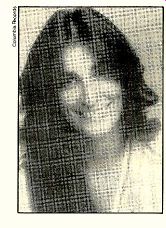
Karla Bonoff: Category of One
METAPHOR, identifying and categorizing, tracing roots-all those techniques we use to persuade ourselves we understand things-sometimes don't work. Something comes along and puts the kibosh on analytical thinking. For example: Bonnie Raitt's version of a song called Home was for me the other shoe dropping where Karla Bonoff's song-writing talent was concerned-Linda Ron stadt's inclusion of three other fine Bonoff songs in an earlier album being the whump, metaphorically speaking, that set this up. But what an inelegant, inexact, inadequate way of looking at it. So's every other way I've tried.
Now I have Bonoff's own debut album for Columbia, "Karla Bonoff," introducing four more of her songs and her voice, and I still can't figure out where her viewpoint, style, or whatever you want to call it came from or where it might go.
I have no doubt about her ability to keep on writing songs I'll like. One can use metaphor to talk around it, saying something like, "I have no doubt she will go to the well again." But the question is, which well its she going to? Where do the songs come from, what are their influences? Kenny Edwards, Ronstadt's friend and bass player, produced Bonoff's al bum and gave the songs an instrumental con text similar to the one Peter Asher's been giving Ronstadt's albums. Edwards seems to see the music as rock, but not primitive rock. The instrumentation is dense but not disorganized;
he and other Ronstadt musicians such as An drew Gold (and Bonoff herself, on guitar and piano) take great care in getting a fairly ordinary series of chords miked just so and placed just so among the other sounds. He keeps the instrumental elements from fighting with one another and apportions emphasis and priori ties carefully. He gives the beat the pronunciation one expects in rock-but the under standing seems to be that he chooses to do it that way; the songs don't necessarily require it. They'd have come off just as well done a number of other ways.
These songs are not very complicated: their melodies don't involve off-the-wall chord progressions, and the lyrics are fairly easy to track-no arcane metaphors or tricky Faulknerian language here-and deal generally with the basic feelings associated with relation ships. Yet the words and music seem new and fresh to the pop scene, and distinctly Bonoff.
It could be that she absorbed ideas about melodic progression from listening to classical music; hers has a flow that suggests an aware ness, on some level, of relationships and possibilities that might not occur to someone whose "schooling" was listening to the three-chord ditties that dominate the radio.
Or she may have learned more from pre-rock pop music than most songwriters her age have. But nostalgia has practically nothing to do with the appeal of her music. The dramatic buildup she likes to create (she definitely prefers the chorus to the bridge, structurally, and is smart enough to avoid repeating the chorus so much that it gets blunted) is a characteristic, ail right, but the way she does it seems to come from no particular time or place. Above all else, the songs seem organic (in the folkie I-really-mean-it sense), where most songwriters working with the same ingredients would turn out stuff that sounded manufactured (in the Tin Pan Alley sense).
HER singing style is still developing. Her voice is pleasant but not yet decisive about some of the moves it makes. Strategically, it would have been advantageous to get this one out before Ronstadt and Raitt had at her songs, as it now seems Someone to Lay Down Beside Me, Lose Again, and If He's Ever Near were tailor-made for Ronstadt and that Raitt was born to sing Home. Bonoff's version of I Can't Hold On, my favorite among the remainder (she didn't write Flying High and Faces in the Wind), is the first version of it I've heard, and now it will take some doing to dislodge the notion that this is the version of it. This first-come, first-served advantage might have accrued to the other songs, but then she may actually have written them with Ronstadt and Raitt in mind. It's to her credit as a songwriter, if not as a strategist, that they sound as if she did.
It may be to her credit also that I can't find her roots. If we can't classify and pigeonhole her way of doing things-"Oh, that's Karla Bonoff and she synthesizes the blues and Gregorian chants" or whatever-then we might tend to listen a little more alertly to the song itself. So far, that's the main thing she needs an audience to do.
-Noel Coppage
KARLA BONOFF. Karla Bonoff (vocals, guitar, piano); Kenny Edwards (bass, guitar, mandolin); Russ Kunkel (drums); Andrew Gold (guitar, keyboards); Dan Dugmore (steel guitar); other musicians. Someone to Lay Down Beside Me; I Can't Hold On; Lose Again; Home; Faces in the Wind; Isn't It Al ways Love; If He's Ever Near; Flying High; Falling Star; Rose in the Garden. COLUMBIA PC 34672 $6.98, PCA 34672 $7.98, PCT 34672 $7.98.
------------------
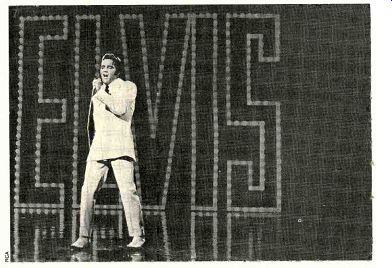
Elvis Has Left the Building
ELVIS PRESLEY was many different things to many different people-such was the nature of his special gifts and powers-but above all else, as three widely varying new al bums suggest, he was a religious man. Indeed, this may be the only part of the Elvis mythos that everyone agrees on. Both Merle Haggard's "My Farewell to Elvis" and J.D. Sumner and the Stamps' "Elvis' Favorite Gospel Songs" contain tributes to Elvis that stress his religiousness. Presley's own final album, "Elvis in Concert," is highlighted by his reading of the gospel song How Great Thou Art, which also appears on the Sumner album; ac cording to Sumner, Elvis always called it "my song." These three new releases are just the crest of the first wave of Elvis-related albums we can expect to see released in the coming year.
It is pointless to ask whether they were done for money or for love, since they were obviously done for both. Fallen country stars have always inspired a rash of tribute albums there were more than a dozen for Hank Williams-and country traditions die hard. Be sides, Elvis was tastelessly and relentlessly commercialized (with his blessing) all his per forming life, and there is no reason to expect anything different now.
Of the three, the Haggard album is the toughest to get a fix on. From Graceland to the Promised Land-with its catchy little acoustic riff, its country fatalism, its recurring Christian motifs, and the obligatory bank of strings for emphasis-is a memorable enough eulogy. For the rest, Haggard covers the spectrum of Elvis songs, from rock-'n'-roll to schmaltz, ending with a rather pointed Are You Lonesome Tonight? and a brief spoken farewell.
Now, Merle Haggard is many good things, but he is not a good rock-and-roll singer, and he knows it. While he does ape Elvis slightly in phrasing and delivery, for the most part he gives all the material a straight country treatment. The results are mixed, but not too good overall. Perhaps the single best effort is In the Ghetto, a late-Sixties ballad written for Elvis by Mac Davis that was one of the King's few forays into social commentary. Not surprisingly, the song lends itself well to mainstream country arrangement and instrumentation, and also to Haggard's grainy voice. I also like Haggard's interpretation of That's All Right (Mama), though it has little in common with the Presley version and will undoubtedly displease purists. The song requires a sort of diffident arrogance-like saying "Who cares?" when you care, really, but can't come right out and say so. Elvis put this across one way, and Haggard does it effectively another way, with Buddy Emmons' biting dobro work helping him along.
Besides these two cuts and the opener, however, "My Farewell to Elvis" is full of near misses. Haggard lacks the creamy resonance needed for such songs as Love Me Ten der and Blue Christmas, and the tunefulness of his version of Don't Be Cruel undermines the song's meaning. His double-tracked vocal and strong, hard-rock guitar solo give Heart break Hotel an appropriately eerie tone, but in the end it's overdone. Finally, he fails to catch the humor inherent in Jailhouse Rock and Blue Suede Shoes, and any tribute to Elvis that misses his humor catches only part off the man.
Ironically, the best of these three albums is not only the hardest one to obtain but also the one that will probably appeal to the smallest number of potential buyers in the first place.
But "Elvis' Favorite Gospel Songs" by J.D. Sumner and the Stamps provides a convincing argument that in this age of orchestras and synthesizers the human voice can still be the most impressive instrument of all. Sumner sings in a rumbling bass so compelling that it almost conceals his few minor difficulties with phrasing. He has a moan that makes him sound more black than white, and his two main solo numbers--Take My Hand, Precious Lord and the magnificent These Hands--are masterpieces of distilled emotion.
Though Sumner is the top attraction, the Stamps' lead singer Ed Enoch (spotlighted most dramatically on I Can Feel the Touch of His Hand) and tenor Gary "Buck" Buckles (whose best solo is on Walk with Me) aren't far behind. Buckles is particularly interesting since his singing style is so close to Presley's own. While much has (rightfully) been made of Presley's original fusion of country and blues, his stylistic kinship with Buckles-and there's no telling which one influenced the other-indicates just how crucial an element in that fusion gospel music was all along.
There is further evidence for this in His Hand in Mine (Enoch sings the solo part here), a gospel song that Elvis considered secularizing when he first began singing it. He eventually decided not to, but he would have needed to change only a few words to make it a roman tic love song. And, since Sumner and the Stamps don't always follow strict gospel conventions, the romantic version could have used the same arrangement they present here.
The cut from "Elvis' Favorite Gospel Songs" that has so far attracted the most attention is Elvis Has Left the Building. This was the announcement always made at the end of Presley's concerts to fans calling for an encore, and in Sumner's tribute it becomes a perfect metaphor for his passing. The cut is a five-minute recitation bound to jerk tears from Miami to Seattle, from Bangor to San Diego. In short, it can't miss. Like Haggard's From Graceland to the Promised Land, Elvis Has Left the Building expresses a fatalism about Elvis' death: his fans may have demanded more of Elvis than he could provide, it says, but basically his death was as much a part of God's plan as his life. So what if in recounting Presley's career Sumner gets the chronology wrong a couple of times? Who could possibly get upset that he compares Vernon Presley to God because both gave us their only begotten sons? This is potent stuff, all the more so because of its utter simplicity, and it is probably the Elvis tribute that will endure longest.
Actually, the only flaw in "Elvis' Favorite Gospel Songs" is that they're all slow. The choice of material may have been determined by Presley's own preferences, but surely he liked at least one up-tempo gospel shouter. In any case, including one for variety would have made the album easier to listen to.
THE one cut on "Elvis in Concert" where the King truly delivers is How Great Thou Art. It was a struggle for him, but he hits every note just right, phrases delicately, and all in all turns in a thrilling performance. Those who saw the CBS-TV special (aired October 3, 1977) that accounts for half of this double album (the rest is from various shows during Elvis' final tour) will probably recall that this was the only song he seemed to be really concentrating on as he sang it. How Great Thou Art is the kind of slow, "big" song that (ac cording to Felton Jarvis, his producer) Elvis most enjoyed singing in his last years. Such songs gave him a chance to stretch out and show off, using both the full range of his voice and his knack for timing and phrasing.
The album begins with the rocking See-See Rider, which is all misplaced freneticism (and rather distant-sounding to boot) until Elvis seems to grab hold of it halfway through, and it ends with the schmaltzy And I Love You So. Throughout the four sides it is the grandiose "big" songs that get the better performances, which means that such dreck as Hawaiian Wedding Song is treated with real passion while meaty numbers like What'd I Say and Johnny B. Goode are tossed away. Both of the latter consume less than a minute each--about the same amount of time it takes Elvis to introduce his father to the audience.
The only real rocker that gets better than a perfunctory run-through is Jailhouse Rock; more typical is the way he handles Hound Dog, which he wanders in and out of several times. What we are left with is Elvis-as-bland-crooner, whose greatness is assumed but wasted on the likes of If You Love Me and the pleasantly jaunty Trying to Get to You. His introduction to the I Got a Woman/Amen medley shows he still had some of the fiery maverick in him, but he seems to have done it only to prove he could; once he's proved his point, he dissipates the atmosphere and scuttles right back into blandness.
Those looking for evidence of Presley's physical condition during his final shows won't find that here either. On television, his much-discussed weight problem didn't seem that bad (much more telling was his face, which looked like it belonged on an aging drag queen). On the record, he does have to huff and puff as he reaches for some notes, and he even misses a few; but that isn't unusual in a live recording, where there's only one take on each song and overdubs aren't allowed.
Most of the time he seems plagued more by boredom than by any problems with his voice.
As How Great Thou Art demonstrates, he could still sing as well as he wanted to--he just didn't want to sing well very often, apparently. It's of no special significance that he blows the recitation in the middle of Are You Lonesome Tonight? and ad libs some cornball gag lines. That wasn't unusual for Elvis-in fact, it was one of his greatest charms-and he did exactly the same thing in some of his greatest shows. Nor does it matter that Sinatra's My Way had been so recently added to his repertoire that he had to read the lyrics because he hadn't yet memorized them. It's another of those "big" songs, and he could have sung it any time after his 1969 comeback and it would have seemed just as appropriate.
IN sum, "Elvis in Concert" is just another piece of Elvis product. It has a smattering of bright moments, but most of it preserves meaningless rote performances by a man who had nothing to prove. Had Elvis not died be tween the time it was recorded and the time it was released, it would attract no more special attention than any of his many other dubious albums. But his fans, of course, will not want to be without it.-John Morthland MERLE HAGGARD: My Farewell to Elvis.
Merle Haggard (vocals, guitar); vocal and instrumental accompaniment. From Graceland to the Promised Land; In the Ghetto; Don't Be Cruel; Jailhouse Rock; Love Me Tender; That's All Right (Mama); Heartbreak Hotel; Blue Christmas; Blue Suede Shoes; Are You Lonesome Tonight? MCA MCA-2314 $6.98, C) MCAT-2314 $7.98, MCAC-2314 $7.98.
J.D. SUMNER AND THE STAMPS QUARTET: Elvis' Favorite Gospel Songs. J.D. Sumner, Ed Enoch, Ed Hill, Gary Buckles, and Larry Strickland (vocals); instrumental accompaniment. Elvis Has Left the Building; Known Only to Him; His Hand in Mine; These Hands; Walk with Me; Sweet, Sweet Spirit; How Great Thou Art; Take My Hand, Precious Lord; I Can Feel the Touch of His Hand; He Touched Me. QCA 362 $6.98 (from QCA Records, 2832 Spring Grove Avenue, Cincinnati, Ohio 45225).
ELVIS PRESLEY: Elvis in Concert. Elvis Presley (vocals, guitar); vocal and instrumental accompaniment. See-See Rider; That's All Right; Are You Lonesome Tonight?; (Let Me Be Your) Teddy Bear/Don't Be Cruel; You Gave Me a Mountain; Jailhouse Rock; How Great Thou Art; I Really Don't Want to Know; Hurt; Hound Dog; My Way; Can't Help Falling in Love; I Got a Woman/Amen; Love Me; If You Love Me (Let Me Know); O Sole Mioat's Now or Never; Trying to Get to You; Hawaiian Wedding Song; Fairytale; Little Sister; Early Morning Rain; What'd I Say?; Johnny B. Goode; And I Love You So. Plus comments by Elvis and his fans and a special message from Elvis' father, Vernon Presley. RCA APL2-2587 two discs $13.98, 0 APS2-2587 $13.98, APK2-2587 $13.98.
-------------------
Billy Joes: Looking Back
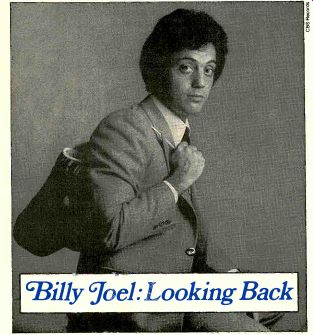
THE title of Billy Joel's newest release, "The Stranger," may echo the Albert Camus novel, but once into it you soon discover that it is much more like a Remembrance of Things Pasta, an Italian-American nostalgia trip. True, it has a directness that Proust would probably have found appalling, but it gives the listener a unique opportunity to get into the head and feelings of a now grown-up ex-greaser through a group of songs that are at once a love letter and a farewell to youth, by turns touching, mordant, funny, gross (new sense), melodramatic, and naive.
One indication that this is a real world that confronts us is the fact that none of these songs could possibly be sung convincingly by the thirty-four-year-old classically trained ac tor who plays "Fonzie," either of the young Beverly Hills matrons who play "Laverne" or "Shirley," or any of the other commercially confected personalities from Fernwood and beyond that the media have been offering up to satisfy that strange new longing for blue-collar times and places that never were.
"The Stranger" works because Joel knows his territory firsthand. Beginning with Movin' Out (Anthony's Song), you know that the testimony you are about to hear is the truth, the whole truth, and nothing but. An ambitious kid works in a grocery store, saving his pennies for he knows not what. "Mama Leone left a note on the door/She said, 'Sonny, move out to the country.' " But, Sonny asks, "Who needs a house out in Hackensack?/If that's movin' up, then I'm movin' out." He goes on to question just what everyone else in the neighborhood is doing with what they've earned ("He's tradin' in his Chevy for a Cadillac"), and comes to the angry and defiant conclusion that all he knows is what he doesn't want.
Another closely observed vignette is Only the Good Die Young, in which the tensions of sexual urge and sexual guilt are beautifully sketched. A young Casanova half cajoles, half pleads with a girl to let him ease her off her virgin pedestal with a technique as time worn as it is dishonorable, pretended hurt feelings, pious illogic, and all. What really gets him is that her mother has warned her about him: "(All) I could give you was a reputation/She never cared for me/But did she ever say a prayer for me?" It is such accurate little touches that make Joel's work a delight.
Scenes from an Italian Restaurant is a lot moodier but no less candid. It is an eight-
minute monologue about running into a buddy from the old neighborhood and catching up on what's happened to everybody-mostly to Brenda and Eddie who were, to the narrator, the Scott and the Zelda, the golden kids of the hang-out set: "Nobody ever looked finer/Or was more of a hit at the Parkway Diner." Of course they had married-and divorced:
"Brenda and Eddie had had it/Already by the summer of '75." The melody for this greaser Tristan and Isolde (and-Joel is a melodist, something rather rare in Seventies pop) is in the hazy, smoky, yearning style of his own Piano Man, dust particles filtering through afternoon sunlight. Much of the impact of the song comes from the tone of resigned acceptance (that's the way things turn out) in which he sings it, the kind of sarcastic wisdom with which a man looks at the boy he was.
There are a couple of things here that don't work in the way they were probably intended, but they still carry weight because of Joel's performing intensity. The most ambitious is the title song, a thoroughly respectable failure that attempts the almost impossible-describing the stranger within us who knows all our secrets, shares all our lies, and tries to hide us from ourselves and from other people. It is a rather too abstractly presented attempt to ape the log-cabin philosophizing of a Harry Cha pin or an Elliot Murphy. Joel's best work is too real and too wise for him to bother with such solemn chit-chat.
A WORLD apart from this kind of introspection is the melodramatic She's Always a Woman, about one of those five-and-dime Loreleis who can do an honest man in with the flick of a beaded eyelash. It gets fairly silly before it cranks down to its masochistic end, but then even greasers must have some myths to live by. Everybody Has a Dream (see what I mean?), Get It Right the First Time, and Just the Way You Are, are all good tracks only slightly below the very top grade of Scenes and Movin' Out.
The production by Phil Ramone and the orchestrations by Patrick Williams serve Joel and his work perfectly by intruding not at all; there's not a "cute" gimmick to be heard any where in the album. Joel is singing better than I've ever heard him before, with an accent on clear-clearer-clearest diction and an avoidance of his old habit of underscoring "big" lines with an extra mood chord or two on the piano. "The Stranger" isn't a particularly showy or innovative album, but it is bone-honest, filled with a very privileged kind of insight, and as gritty as life.
The next time a young greaser sideswipes your car, gives you the finger, and roars off into the sunset, remember that' he is probably one of those Anthonys cursed with the strong premonition that his personal sunset will be gin promptly at the end of his teens. Billy Joel seems to be about the only artist who is pointing out what this sad little sociological foot note means in human terms, and that, I think, is important.
-Peter Reilly
BILLY JOEL: The Stranger. Billy Joel (vocals and piano); orchestra. Movin' Out; The Stranger; Just the Way You Are; Scenes from an Italian Restaurant; Vienna; Only the Good Die Young; She's Always a Woman; Get It Right the First Time; Everybody Has a Dream. COLUMBIA JC 34987 $7.98, 0 PCA 34987 $7.98, PCT 34987 $7.98.
----------------------
Lily Tomlin: Appearing Nitely
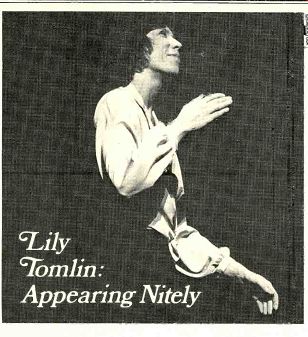
WHEN Lily Tomlin's Appearing Nitely opened on Broadway last year, I was dubious; except for Richard Pryor, who defies any simple categorization, stand-up comedy seemed to me to be a dying art. Humor has al ways been the most subjective of affairs, and the cultural fragmentation of the Seventies has ensured that most of us can no more agree on what is funny-or, at least, safe to laugh at-than we can agree on anything else. I per sonally never found many thigh slappers in such popular comic institutions as the Firesign Theatre, Monty Python, Saturday Night Live, or even Woody Allen, and I was not about to take anyone's word that a one-wom an show with an array of characterizations as diverse as Tomlin's could live up to its hype.
But when I saw Appearing Nitely I realized that I had underestimated her gifts, not just as a comic but also as an actress and a writer.
"On Stage" is a recording of highlights from the show, and it reveals both Tomlin's virtuosity and her limitations. The album has been conceived (rather condescendingly) as a mock "night on Broadway," complete with the voice of a "Mr. Theater Goer" who in vites the listener along: "My cab is waiting.
Won't you join me? . . . The crowd is elegantly dressed. What a glamorous gathering!" Whether this is supposed to add a touch of camp or to make the folks out in the boonies feel they're really getting a taste of the Great White Way, it's irritating. The only function it serves is to help introduce two of Tomlin's new personae, the Shopping Bag Lady and the UFO Guy.
It hardly seems worth the trouble. Appearing Nitely's most audacious creation-the quadraplegic who is determined to travel cross-country by wheelchair and to go hang gliding off the California coast-was better conceived and far more incisive than either the Shopping Bag Lady or the UFO Guy, yet she has been left off the record entirely. It would be nice to be able to applaud Tomlin for her compassionate understanding of some of the most pathetic and wretched people in our big cities, but her portrayals of these two just don't work. Her down-and-outers seem far more like Walt Disney's Goofy than like the despair-maddened humans sleeping on the sidewalks and endlessly muttering to them selves that I encounter every day in New York. Whatever the bag ladies and UFO crazies really are, they aren't cute, which is what Tomlin makes them.
... in her ability to tell us about ourselves lies her true genius.
Cuteness has afflicted Tomlin's characters ever since Laugh-In's Edith Ann (the little girl in the huge chair), and here it undermines many of the one-liners as well. Most of these, in fact, are simple reversals of clichés-for in stance, "I worry that drugs may have made us more creative than we really are." Fora show celebrated for its brilliance, there are altogether too many clichés. Tomlin's famous telephone operator, Ernestine, shows up, but do we really need to be told again that the phone company is an inefficient monopoly gagging on its own technology? (For that mat ter, is it really true?) The "Dixie cups and a thread" line is lifted straight from Lenny Bruce, who satirized the phone company a lot more pointedly twenty years ago.
Glenna--A Child of the 60's, a twenty-one-minute routine that takes up half the record, is many people's favorite. You can probably guess most of the contents from the title alone: Beatles, drugs, protest marches, en counter groups, and so forth, all ending neatly with Glenna marrying a lawyer and having a Mexican maid-a joke worthy of Norman Lear, perhaps, but not of Tomlin at her best.
Whatever the routine's resonances or revelations, they come more from Tomlin's vocal inflections than they do from the material it self; the only time it even comes close to saying something interesting about the Sixties is when a stoned Glenna turns off Vietnam news in order to watch I Love Lucy reruns. We never learn exactly what Tomlin's attitude to ward the Sixties is: nostalgic affection? thinly veiled contempt? mythic awe? Perhaps we are still too close to the period, still too stunned by the disintegration of that decade's promise, to understand it. Tomlin's is not the only failed attempt to interpret it for us, but it might have been a more interesting failure. As Glenna herself might say, it's sooo . . . obvious, mannn. . . .
TOMLIN'S real strengths come through in two routines that by themselves make "On Stage" worth buying. Lud and Marie Meet Dracula's Daughter and Tell Miss Sweeney Goodbye are both classic pieces of heightened autobiography and high comedy, featuring a novelistic eye (and memory) for such details as the exact size, shape, and texture of clothes and the contents of school lunch buckets. They convey a sense of life as it was actually lived in a specific time and place (the Fifties, interestingly enough) that far transcends cliché. As Tomlin spins these child hood fantasies, she has the power to cancel your awareness that you are listening to a record and to pull you inexorably into her private yet somehow universal world. Just where many comedians turn self-indulgent, Tomlin creates authentic American folklore out of her most intimate material, giving us an oral history that goes beyond comedy to touch the heart and show up Glenna and the like for the cheap and basically lazy confections they are.
I hope that Lily Tomlin will ease away from the wisecracks and glib stabs at social criticism and share more of her autobiography with us in the future. It is the story of all our lives, and in her ability to tell us about our selves lies her true genius.
-Lester Bangs
LILY TOMLIN: On Stage. Lily Tomlin (comedian); Norman Rose (voice of "Mr. Theater Goer"). Mr. Theater Goer and Shop ping Bag Lady; Mrs. Judith Beasley; Lud and Marie Meet Dracula's Daughter; Ernestine; Tell Miss Sweeney Goodbye; Shopping Bag Lady and UFO Guy; Glenna-A Child of the 60's; Lily and Shopping Bag Lady. ARISTA AB 4142 $7.98.
--------------------
+++++++++++++++
... point remains, if not a closely guarded secret, certainly one that is well chaperoned. J.V.
RECORDING OF SPECIAL MERIT
SANFORD-TOWNSEND BAND: Smoke from a Distant Fire. Ed Sanford and John Town send (vocals, keyboards); instrumental accompaniment. Smoke from a Distant Fire;
Oriental Gate (No Chance of Changin' My Mind); Shake It to the Right; Squire James; Does It Have to Be You; and four others. WARNER BROS. BS 2966 $6.98.
Performance: Excellent
Recording: Excellent
Good things come to those who wait. The Sanford-Townsend Band's first album was re leased more than a year ago to no great response. It was filed away and forgotten. Then a song from the album, Smoke from a Distant Fire, began to make a little noise on the radio.
After the cut was released as a single and scored high on the charts, the album was reissued. It deserves a better response this time around.
The group plays a well-blended mixture of rock and jazz, they write exceptional material, and their performances are crisp and clean with a socking swing to them. Townsend's lead vocals are forceful and exciting; he is able to sing at the top of his range without exhausting himself or the listener, and when he hits a high note there is a joie de vivre to it that brings a grin.
The material is outstanding (especially Smoke), the arrangements throughout are spicy and surprising, and the band's lilting, biting execution is faultless. Don't pass up this second chance to hear a brilliant group. J. V.
THE STAPLES: Family Tree. The Staples (vocals); orchestra. Hang Loose; Color Me Higher; Boogie for the Blues; Family Tree; and four others. WARNER BROS. BS 3064 $6.98, M83064 $7.97, M53064 $7.97.
Performance: Very good
Recording: Good
The consistently solid, honest kind of musicianship and the tightly coiled ensemble and solo performances that the Staples have been giving us over the years are something of a rarity in the music biz, where quality standards seem to be in the offhanded charge of a cross-eyed pizza-dough twirler. The Staples (Pop, Mavis, Cleo, and Yvonne) have delivered another very good session here, particularly the title song, which has an extra measure of that warm gutsiness that is so identifia ble in all of their work. Boogie for the Blues is a slick, free-wheeling performance with some especially bumptious and funny wheedling by Pop to "get up and move." The Staples have been around for quite a while, and each new album clearly shows the reason why. P.R.
STEELY DAN: Aja. Steely Dan (vocals and - instrumentals); Chuck Rainey (bass); Tom Scott (saxophone, lyricon); other musicians. Black Cow; Aja; Deacon Blues; Peg; Home At Last; and two others. ABC AB-1006 $6.98, 8020-1006(H) $7.95, 5020-1006(H) $7.95.
Performance: Excellent, but . . .
Recording: Excellent
I have mixed feelings about this latest outing from Steely Dan. I admire the musicianship and writing talents of Donald Fagen and Walter Becker, the two remaining members of what was once a six-man group, but I don't hear anything here that measures up to some of the intriguing and slightly spooky tunes they've done before. To be fair, I'm still hung up on Pearl of the Quarter, from their "Count down to Ecstasy" album, which I consider one of the best ballads of the decade.
The seven selections in "Aja" are not so much pop songs as they are mood pieces taking a more or less jazz direction. In the title track particularly, the lyrics are unfathomable, though they serve as a nice excuse for some nifty instrumental work by the first class jazz sidemen backing Becker and Fa gen. The two strongest songs are Black Cow and Deacon Blues. In the former, a man contemptuously dismisses a lover who is doing her best to ruin herself. The latter is about a fellow who decides to become a jazz musician, and it contains the album's best lyrics.
The arrangements and performances are colorful and persuasive throughout, especially the solo instrumental work by Tom Scott, Wayne Shorter, Michael Omartian, and Becker himself, and Fagen's vocals, as always, personify the eerie world of bent characters that he and Becker summon up in their writing. The project is musically successful, then, but I still miss Steely Dan's songs. J. V.
PETE TOWNSHEND/RONNIE LANE: Rough Mix (see Best of the Month)
DWIGHT TWILLEY BAND: Twilley Don't Mind. Dwight Twilley Band (vocals and instrumentals). Here She Comes; Looking for the Magic; That I Remember; Rock and Roll 47; and five others. ARISTA AL 4140 $6.98.
Performance: Good
Recording: Good
When Dwight Twilley and his bandmate Phil Seymour were growing up in Tulsa, Oklahoma, in the mid-Sixties, they were much impressed by the Beatles. This led to their emulating John and Paul's tight vocal harmonies.
After a few false starts in the recording business, the Twilley group landed on hometowner Leon Russell's Shelter label a few years ago, where they hit with a single, I'm On Fire.
Then and now, the band plays straightforward, occasionally decorated rock, with similarities to the Beatles not only in vocal harmonies but also in song construction and the sound mix. The music is aimed at the young adult and late teenager, and Twilley's efforts seem designed to entertain and exploit that audience by exposing them to some of what they missed by not being around during the Beatles era. But to anyone who was around when the Liverpudlians held happy sway, Twilley's music will sound like an old story twice told. J. V.
RECORDING OF SPECIAL MERIT
DENNIS WILSON: Pacific Ocean Blue. Dennis Wilson (vocals, keyboards, drums); Ed Carter (guitars, bass); Earle Mankey (guitars); Bruce Johnston (vocals); other musicians. River Song; What's Wrong; Moonshine; Friday Night; Dreamer; Thoughts of You; Time; and five others. CARIBOU PZ 34354 $6.98, 0 PZA 34354 $7.98, PZT 34354 $7.98.
Performance: Lush
Recording: Likewise
--------- DENNIS WILSON: A stunning, California-lush solo effort.
Dennis Wilson, like the rest of the Beach Boys, has learned an awful lot about the potential of the studio from his big brother Brian. And, since Brian probably knows more about recording studios than anyone else in Christendom, it's not surprising that Dennis' debut solo project should be so stunningly put together. The sound of it is as California-lush as anything the Boys have come up with in the Seventies, with ethereal vocal choirs, relentlessly layered instrumentation, and snippets of melodies that suggest strange, primitive chants. Dennis has matured into quite a convincing r-&-b singer, and his hoarse, husky vocals here are almost irresistibly attractive.
What he lacks, however, is a real point of view. For all the (apparently sincere) world-weariness of some of the lyrics, especially What's Wrong and Friday Night, which suggest the kind of self-doubt that we hardly expect from an ambassador of the West Coast Good Life, Dennis just isn't-yet-able to focus on anything really compelling. Nor does he match his brother's flair for turning person al anguish into moving, even if naive, universal statements. For an over-reacher, though, he makes some really lovely noises. Give this a B-plus and wait for a sequel. S. S.
DISCO
JERMAINE JACKSON: Feel the Fire. Jermaine Jackson (vocals and bass); Tower of Power horn section; other musicians. You Need to Be Loved; Strong Love; Git Up and Dance; and six others. MOTOWN M6-888SI $6.98, 7-888HT $7.98, 7-888HC $7.98.
Performance: Buoyant
Recording: Well balanced
It is all but impossible to regard Motown mogul Berry Gordy's son-in-law as just another ...
-------------------
Randy Newman
ACCORDING to my Webster's International, irony is "a sort of humor, ridicule, or light sarcasm which adopts a mode of speech the intended implication of which is the opposite of the literal sense of the words." They might have gone on to say that though this rhetorical form is a popular weapon among politicians and other jaw-boners, it is not a very common mode of expression among songwriters. Except for Randy Newman, who has just dumped "Little Criminals," another heavy load of irony, on America's doorstep and is lurking over there just around the corner waiting to be misunderstood-again.
"Misunderstood" refers to the big trouble with irony; whether you deal in the Light or the heavy variety, and however carefully you balance yourself along the razor edge of your intention, a whole lot of perverse people are going to miss the point and take you literally.
And others, even more perverse, will get your point-but fervently wish that you hadn't made it. "Again" refers to Newman's last re lease, "Good Old Boys" (1974), which was widely-perhaps inevitably--misunderstood since there was more than a suggestion of un resolved ambiguity in Newman's own attitude toward his subject matter and a good deal of language that was not what one would exactly call ... um--- lyrical.
"Little Criminals" runs the gamut from no irony at all to light irony (one's own foibles), medium irony (other people's foibles), and heavy irony (society's foibles). Through it all thread several other themes-the Failure of the American Dream (is there anybody be sides me who is having trouble figuring out just what that was supposed to be?), the movies (in their myth-making aspect), and the usual Newmanisms, bits and pieces of verbal Americana (mostly catchlines from songs).
Newman's voice is unremarkable-which is another way of saying that he doesn't have one. What he has is a splendid instrument of communication, a hoarse, husky, smoke-
cured whisper that can sound confidential, confessional, even conspiratorial. He speaks the modish rock dialect (no final g's, no "a" in "about," no "be" in "because") fluently and without self-consciousness, and he has a uniquely characteristic, oddly endearing habit of chopping off the ends of lyric lines short windedly, , as if with a tape editor's knife. His lyric gifts are so compelling that they tend to draw attention away from his musical ones, which are just as outstanding but subtler.
Most of his melodies are habit-forming on first hearing, and his arrangements have a lapidary quality-perfect setting, perfect fit that permanently pre-empt the listener's affections. To top all this off, he has surround ed himself with the Eagles and others of Los Angeles' most skilled (and therefore ubiquitous) session gypsies, a tight little circle of super-pros of the kind that rise and soak up all the work wherever the competition is stiffest.
(What do they call themselves, I wonder? Sons of the Holmby Hills Pioneers?) There are no songs here that one could call less than beautifully crafted, but the spectrum is impressively broad and the listener is bound to be drawn more to some than to others. Baltimore (". . . a hard town by the sea") is about a dying city, a vision grim enough to get this album banned in all of Maryland, but then the song might be about any metropolis any where that woke up one morning to find that it had fallen irrevocably behind in its housekeeping. I'll Be Home is that winsomely consoling ("You can always count on me") gospel tune Harry Nilsson sang so brilliantly on his "Nilsson Sings Newman" album (RCA LSP 4289). Newman's performance here is good enough, different enough, to make me prefer both. But is he kidding? THE tension in Newman between the obscurantist impulse and the desire to communicate is nowhere more apparent than in the fine In Germany Before the War. It is one of the medium ironic songs (other people's foibles), but it ends up, largely because of its obsessively beautiful Kurt Weillish melody, pathetic as well. It is about-very allusively-the old German movie M, in which Peter Lorre starred as a child-murderer. It presents an interior landscape only hinted at in the film Eros run amok in an inappropriate vessel, imprisoned in a squat, ugly figure behind the little round windows of Coke-bottle glasses. It neither adds to nor takes away from the song to know this (I had already replayed it compulsively about ten times before I tumbled to the plot); just remember that most native Los Angelenos are, like Newman, movie ridden ("Guess who I ran into at the laundromat to day-Olympe Bradna!") and that they reach almost instinctively, when they do reach, for film metaphors. Better such fiction than such fact as Charles Manson or Son of Sam.
Jolly Coppers on Parade is, I suppose, lightly ironic too-an example of the condescension with which the grown man sees the child he was-but do I detect just a slight hint of "police brutality" as well? Newman tips his hand on the punkish Kathleen by subtitling it "Catholicism Made Easier." He needn't have bothered, for the lyrics (who could possibly, these days, take "I've always been crazy about Irish girls" seriously?) make it clear that the target is romantic cliché in that candy-box territory somewhere between Hollywood and Tin Pan Alley. The cameo Old Man on the Farm is probably straight; it is touching even if it isn't, and the melody is haunting. You Can't Fool the Fat Man didn't reach me lyrically, but the down-river flavor of the jazz arrangement is mighty tasty.
THE title song, Little Criminals, is a rocker, a piece of "American Dream" irony only slightly relieved by its black-comedy joke. It will be misunderstood, but you can't say that Newman doesn't take chances. Rider in the Rain is a spoof, a mock-heroic cowboy song (what kind of cowboy works in his uncle's feed store one day and is off rapin' and pil lagin' across the plain the next?) probably in tended to demythologize some of that sentimental Old West claptrap still triggering tear ducts on the Late Show. Pokin' cows is a nasty job for nasty people, but I predict that Rider will go straight to the hearts of old Gene Autry fans anyway.
Another "funny" song is Short People, and it will probably give Newman more trouble than anything else on this set. It is a kind of bigot's national anthem, a portmanteau that will accommodate any prejudice. If Newman is not already concocting his own additional verses (Tail, Thin, Fat, Old, Young, White, Black, Red, Grey, Gay, and, yes, Straight People), then somebody sooner or later is going to do it for him with gusto in finished-basement sing-alongs from coast to coast. Mis-understood again (ask Archie Bunker about that).
Sigmund Freud's Impersonation of Albert Einstein in America is also American-Dream-Ironic, a grab bag of neatly inaccurate history, national-anthem tags, and pop fantasy guaranteed to find friends only among the al ready persuaded. It ends with the line "And may all your Christmases be white," one of those monumental non sequiturs of the ironic mode that I think of as a "dorothy" (after Dorothy Parker, author of the most perfect example of the genre: "And I am Marie of Rumania"). Perhaps best of all, this bitterly comic mini-tirade of disaffection is mounted against a Salvation Army band background that makes all its artfully contrived jingoist vulgarity glitter like a chromium chamber pot.
BEST for last, as usual: Texas Girl at the Funeral of Her Father is quite simply one of the grandest inventions I can ever remember en countering in American pop music, an art-song jewel of passionately understated lyrical and musical yearning approaching the sub lime. It's my kind of Mozart and I'm not kidding.
-William Anderson
RANDY NEWMAN: Little Criminals. Randy Newman (vocals and keyboards); other musicians. Short People; You Can't Fool the Fat Man; Little Criminals; Texas Girl at the Funeral of Her Father; Jolly Coppers on Parade; In Germany Before the War; Sigmund Freud's Impersonation of Albert Einstein in America; Baltimore; I'll Be Home; Rider in the Rain; Kathleen (Catholicism Made Easier); Old Man on the Farm. WARNER BRos. BSK 3079 $6.98, 0 M8-3079 $7.98, M5-3079 $7.98.
============
...struggling young artist in search of recognition. That he grew up as one of the ubiquitous and precociously sexy Jackson Five means that his deck was already stacked with aces when he severed professional connections with his brothers last year to strike out on his own. Yet Jermaine Jackson possesses a large enough talent to merit respect in his own right.
His decision to leave the Jackson family group was on target. Jermaine had outgrown the group musically, as this album indicates.
Backed here by the Tower of Power horn section, he comes across as a high-energy per former who infuses his songs with an infectious, boyish fervor that never supplants his emphasis on solid singing. He has listened well to his gifted contemporaries, and there are stylistic traces of Stevie Wonder in his music, particularly in the ballads I Love You More and Some Kind of Woman. But he's at his best on two up-tempo stompers, Feel the Fire and You Need to Be Loved. Jermaine is indeed germane to the continually evolving sound of youth. P.G.
THE TYMES: Diggin' Their Roots. The Tymes (vocals); instrumental accompaniment. Who, What. When, Where, Why; As Time Goes By; I Can't Explain; I'll Take You There; Kunta Kinte; and three others. RCA A PL I-2406 $6.98, APS1-2406 $7.98, APK1-2406 $7.98.
Performance: Predictable
Recording: Good
The Tymes project a certain drive and vigor in their music, providing pleasantly danceable but undistinguished fare. Though they sing well and have a lead female vocalist who is above average, there is little to set them apart from many other groups who do the same kind of thing. There are two rather interesting tracks here, I Can't Explain What's Happenin', a disco ditty featuring a background riff that sounds as if it was lifted from a Stephen Sondheim musical, and Kunta Kinte, a seven-and-a-half-minute condensation of the twelve-hour TV drama Roots. P.G.
RECORDING OF SPECIAL MERIT
ADAM WADE. Adam Wade (vocals); instru mental accompaniment. Shine On Silver Moon; Dancing for Dimes; Five Will Get You Ten; Russell Never Had a Chance; Two Be came a Crowd; I Could Write Sweet Love Songs; and five others. KIRSHNER PZ 34919 $6.98, PZA 34919 $7.98, PZT 34919 , $7.98.
Performance: Rapturous
Recording: Good
Ever since the early Sixties, when Adam Wade abandoned a budding career as a bio chemist to assault the fortress of entertainment, he has hovered just at the edge of really making it. One problem during the early days was that his silken tenor voice too closely resembled that of Johnny Mathis, who cast a mighty shadow over other male balladeers.
Furthermore, Wade often seemed to be in less than full control of his fine, natural vocal instrument. He was unable to come up with a style that would readily distinguish him from other good but hardly outstanding singers.
Though he achieved some success on the night-club circuit, recording opportunities remained few, and he became sidetracked in such peripheral activities as acting, filming commercials, emceeing beauty pageants, and briefly hosting the TV game show Musical Chairs.
Those who have remained Adam Wade fans through all the uncertain years should rejoice at the release of his new album, which, at last, seems to be the perfect vehicle to introduce this gifted singer to a broader audience. Maturity has mellowed him as an artist, and he now has a full grasp of popular vocal nuances. Obviously, this is a disco album, but of an exceptionally high quality. That all too familiar danceable beat is subtly underplayed, permitting Wade to explore the full range of his voice and style.
Many of the tracks feature him in an up-tempo setting, but there is a substance to the lyrics that is readily digestible. Potent messages are tucked into such songs as Dancing for Dimes and Russell Never Had a Chance.
For those who remember the Adam Wade of old, who stood out as a sort of more muscular Mathis. the bonus is Two Became a Crowd, an almost painfully tender lament for love lost. This type of song has always been Wade's true forte, but he has also expanded his scope, which should enhance his appeal to old and new fans alike. P.G.
OTHER RECOMMENDED DISCO HITS
TINA CHARLES: Sweets for My Sweet. COLUMBIA PES 90432 $6.98.
FANTASTIC FOUR: Got to Have Your Love. WESTBOUND WT 306 $6.98. ISAAC HAYES: A New Horizon. POLY DOR PD1-6120 $6.98.
THE JACKSONS: Going Places. EPIC JE 34835 $7.98. RIPPLE: Sons of the Gods. SALSOU L SZS 5514 $6.98.
(List compiled by David Mancuso. owner of the Loft, one of New York's top discos.)
========
Also see:
Source: Stereo Review (USA magazine)