COMING ATTRACTIONS
CAR stereo has really grown up in the past few years. An impressive level of quality and innovation was apparent in the car-stereo products exhibited to dealers by the top manufacturers at this summer's Consumer Electronics Show. These products should be on dealers' shelves ready for you this fall.
The main topic of conversation at the show, however, was not the products or the design innovations, but a factor that could have enormous influence on the car-stereo business-AM stereo. The FCC's recent decision to allow the "free market" to choose between five competing AM-stereo systems has created a variety of problems (see STEREO REVIEW, June 1982, page 58).
Various companies and groups seem to be choosing sides (AM-stereo formats, that is), and, from what we have seen, the two major candidates are the Magnavox and Harris systems.
Harris seems to be the system preferred by many broadcasting people, and the Magnavox system seems to be the choice of many receiver manufacturers because it is expected to be cheaper to build in. A number of manufacturers (Pioneer, Alpine, Clarion, Ford, Delco, General Electric) and a parts supplier (National Semiconductor) have stated that they would prefer the Magnavox system but have also added that they do not plan to go into production with any system at this time.
The consensus is that AM stereo could be stillborn if no broadcasters or manufacturers decide to force the issue soon. The manufacturers think the AM broadcasters should go first because they are the ones whose business needs it the most, but broad casters see no reason to broadcast in AM stereo until there are radios that can receive it. Most of the car-stereo manufacturers are not too eager to stick their necks out for AM stereo when they are doing okay with out it.
Despite the recession, the car-stereo business is actually doing quite well right now.
Total sales last year were in the $2-billion-plus range. That means it is as big if not bigger than the home audio field. The lure of potential profits has encouraged many home audio manufacturers to move into car stereo in the past few years. This year, Sansui, JVC, Proton, Acoustic Research, JBL, and B&W introduced lines of car-stereo speakers or components for the first time.
Theories abound as to why the autosound business is doing so well. One theory is that in these hard times people are enhancing existing cars with new sound systems rather than buying new cars. Another is that up grading home audio seldom makes a dramatic audible difference, whereas an investment in car stereo does provide a major sonic improvement over the radios found in most cars. The reason is probably a combi nation of these and other factors such as the car enthusiast's wish to "accessorize" his vehicle.
There were several noticeable trends in the products being offered at the CES, among them the proliferation of DNR (Dynamic Noise Reduction) from National Semiconductor, the availability of many better-quality loudspeaker systems, and an increase in the availability of high-quality automobile-audio separates systems.
Since its introduction last year DNR has spread as fast as manufacturers could get it into production. Already, according to National Semiconductor, there are more than twenty car-stereo companies producing thirty-four different DNR-equipped models. Its popularity is based on the fact that it works on any audio signal and needs no en coding or decoding as do Dolby or dbx noise-reduction systems. DNR is a variable dynamic high-cut filter that operates except when the high-frequency music content is strong enough to mask the noise. Among the companies using DNR in products they showed at CES were Audiovox, ARA/Motorola, Audiotek, Blaupunkt, Boman, Clarion, DEG/Lear Jet, FAS, JIL, Metro-Sound, Sparkomatic, and Tancredi. There will probably be many more in the future.
There were a number of other products that stood out at the show. Panasonic has a line of in-dash units with "Ambience," a circuit that adds delay and response shaping to the left-channel signal to make it appear to come from outside the driver's side window, giving the driver the sense that he is centered between the speakers. Proton introduced the two in-dash units that were promised at the last show. Both have the Schotz variable-bandwidth PLL-tuning circuit and the NAD "soft clipping" circuit.
Sansui, Kenwood, Alpine, and Sony all offered matched-design separates.
Both B&W and Acoustic Research introduced small-enclosure speakers that can be mounted on the rear shelf of a car. Jensen introduced what must be the thinnest 6- x 9-inch three-way ever, just 1 25/32 inches deep. Clarion introduced a unique rear-shelf three-way with an upward-firing woofer and separate tweeter and midrange drivers mounted horizontally in rotating turrets on each end of the speaker.
THERE was also a noticeable increase in the output power available from some of the in-dash units, and many more accessory power amps have become available. Alpine introduced three bridgeable amps, the most powerful rated at 50 watts per channel in stereo and more than double that in mono. If that seems inadequate to you, then Audio-Mobile has an "amp rack package" of three stereo amplifiers and related crossovers mounted on an aluminum plate that collectively put 340 watts into 4 ohms for about $1,900; they also have lesser models for those whose budgets and ears can't cope with the big time.
In respect to car stereo the Summer CES was a very interesting show, and the next few months promise interesting developments as well. Everybody seems to be hedging his bet about what is going to happen with AM stereo, but it's safe to say that if it does come to pass it will add a new dimension to the field.
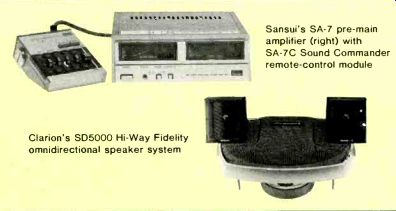
-------- Clarion's SD5000 Hi-Way Fidelity omnidirectional speaker
system Sansui's SA-7 pre-main amplifier (right) with SA-7C Sound Commander
---------
ADs
--------
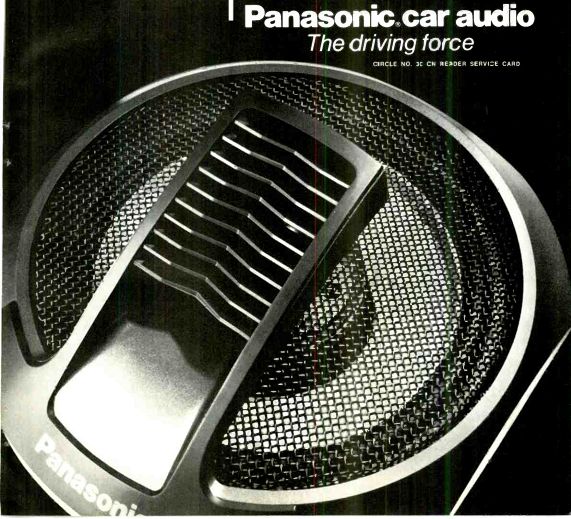
From the Driving Force: A new angle in Panasonic speakers solves some old problems in car stereo performance.
The Panasonic EAB-069 car speaker system and its smaller version, the EAB-049, represent a new and different approach toward improving car stereo performance Notice the unusual angle of the horn tweeter. It projects higher frequencies in music directly at the listener: frequencies sometimes lost within the confines of a car. At the same time, a diffuser channels the lower frequencies down the length of the passenger compartment.
Accurate bass reprod. requires a treament all its own. So an upward-firing woofer is used to maximize bass frequency projection. Working together, the angled horn tweeter and upward firing woofer enhance the stereo image and achieve exceptional sound-reproduction.
And how much power car these speaker systems take? The EAB-069 handles a hefty 60 watts. The EAB-049. 30 watts. And these compact. low profile speaker systems can be used in separate airs or as a powerful complementary foursome.
Angled horn tweeter speaker systems. Part of the entire line of high quality, innovative car speakers from Panasonic.
Panasonic car audio. The driving force.
------
Also see:
CES 1982--The latest hi-fi trends and product introductions.
NEW PRODUCTS--Roundup of the latest audio equipment and accessories
Source: Stereo Review (USA print magazine)