HOW TO HANDLE RECORDS: From jacket to turntable and back without dust or damage.
By David Ranada
Phonograph records have been around in disc form for about ninety-five years, so long that you'd think the proper way to handle them would be encoded in everyone's genes. But it's not unusual to see even a so-called audiophile wrest a disc out of its jacket or liner with all the finesse of someone removing an English muffin from its package. No wonder disc-care accessories sell so well.
Fingerprints are oily and dusty, so you should learn to handle records in such a way that your fingers (or any other parts of your hands) never touch the grooves. Also, static charges on records actually attract dust particles which lead to increased numbers of ticks, pops, and skips. The procedures for handling records recommended here thus revolve around two basic considerations: first, to avoid damaging the grooves, you should rub, pinch, squeeze, scuff, or otherwise manhandle the disc as little as possible; second, to reduce the amount of dust attracted to the disc you should minimize the time it's exposed to the open air. The latter requires speed, and that takes practice. The pictures on these pages are a guide to a quick, tried-and-true way to get records out of their jackets and sleeves, onto turntables, and back again. They are only suggestions, and you should feel free to invent other ways of handling records efficiently and easily without damage or dust.
------------
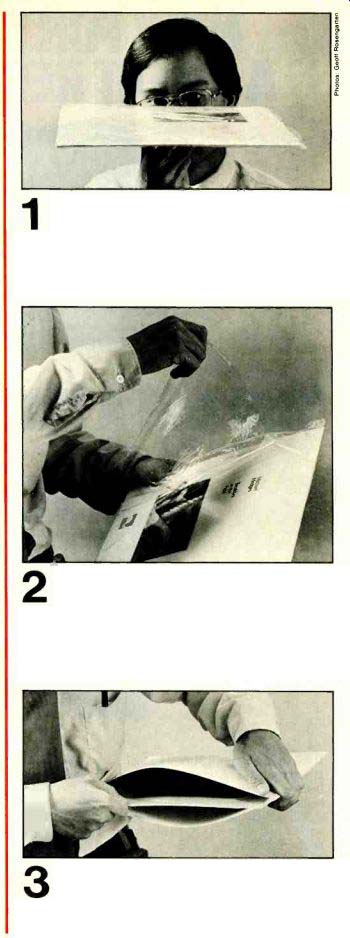
1. Buyers are not permitted to handle records at all in most stores, and consequently it is impossible to examine a record for visible traces of pressing defects before buying it. But there are some precautions you can take to avoid getting a warped record. While you are in the store, look for a flat jacket with no bent or dented corners. Beware of a dished jacket because the record inside it is likely to be equivalently warped. Jackets whose spines are bent should also be avoided.
2. Completely remove the shrink wrap from around the album; don't just make a slit in the side. Shrink wrap can keep on shrinking after the cover is opened, applying warp-causing forces to the album cover and to the disc itself. Some recent audiophile pressings come with loose-fitting heavy-plastic envelopes that don't have to be discarded. But make sure that such envelopes don't crumple to make lumps between discs when they are sitting (vertically, well-packed, completely supported on both sides) on your record shelf.
3. A good way to withdraw a record (in its sleeve) from a jacket. Bow open the album with your hand and body, and pull the disc out by grasping a corner of the inner sleeve. Squeezing that portion of the inner sleeve with the disc inside it can press any dust caught between the sleeve and the disc into the grooves.
-----------------
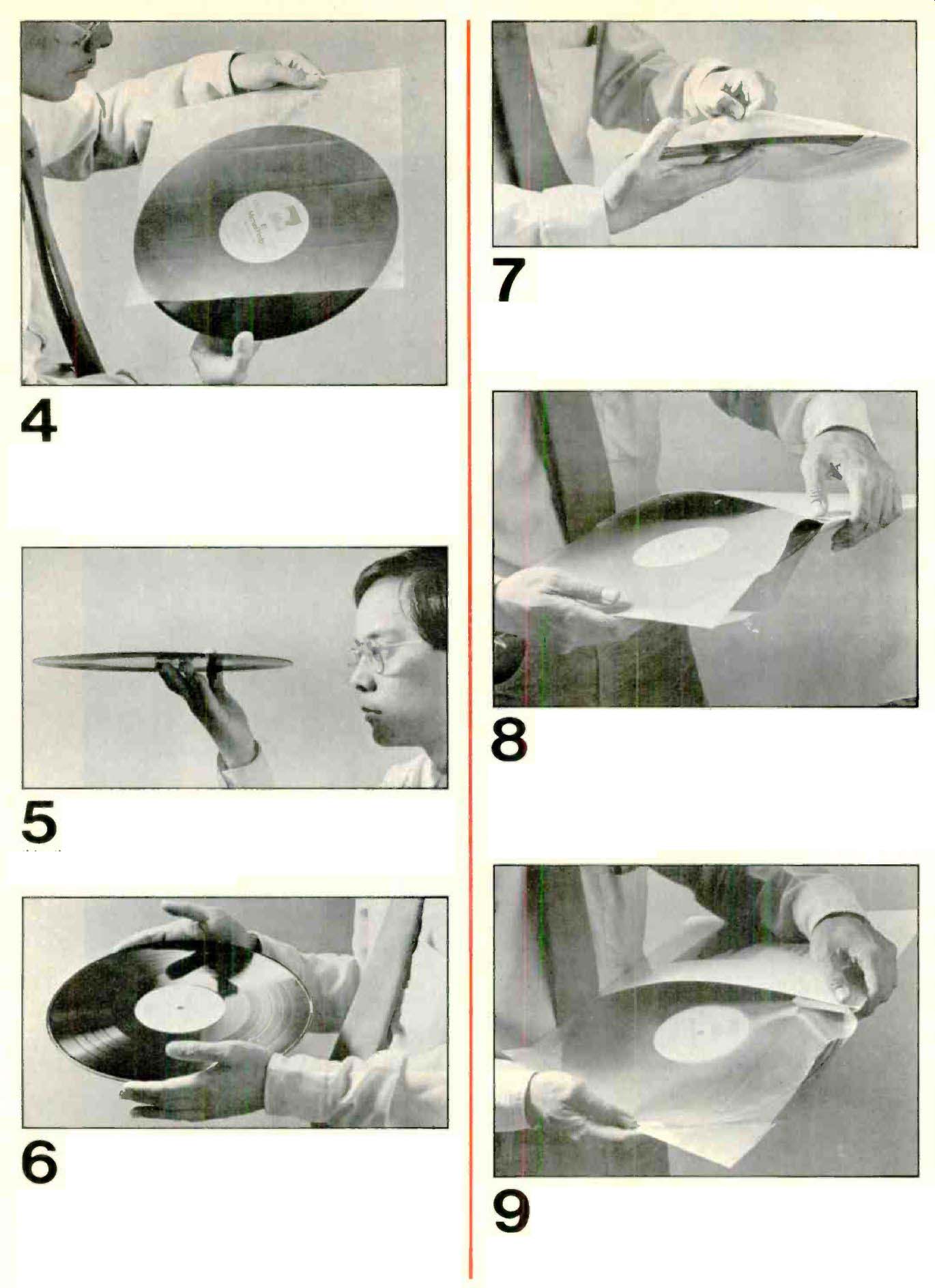
4. In removing the disc from the inner sleeve let it slip into your hand with as little friction from the sleeve as possible. Do not insert your hand into the sleeve at any time. Any grit on your hands can easily be attracted to and deposited on the record and sleeve. In this picture the fingers of my right hand are touching the outside surface of the inner sleeve. When the sleeve is completely drawn off, the disc should already be sitting correctly in the hand.
5. This is the classic record-holding grip: thumb on the edge as a "latch," fingers on the center label for balance and support. Your hands don't have to be large to do this, though it does take a little practice to hold a disc this way with confidence.
6 Another classic disc grip, one more suitable for placing the record on a turntable. Changing between this grip and the previous one is simple; as the free hand catches the rim, the fingers on the center label are retracted. As soon as possible after putting the disc on the turntable, close the turntable dust cover and replace the inner sleeve in the album so that the sleeve won't pick up dust. If you are concerned with keeping dust off your records, always play your records with the turntable dust cover down.
7. Replacing the record in its sleeve is essentially the reverse of getting it out. In this case the sleeve might have to be pulled over the disc. Again, do not put your hands into the sleeve. Try to arrange the flexing of the inner sleeve so that the disc is supported mostly by the edges and the sleeve rubs as little as possible over the surface of the record.
8. Slide the inner sleeve and record into the jacket, taking care not to squeeze the disc in the inner sleeve. Note that the opening of the sleeve is toward the top of the jacket. When re-inserted in this way, the sleeve keeps the record well isolated from dust. Inner sleeves are basic protective devices for your records. Never discard the sleeves that come with your records unless you replace them with others that are made of plastic or are plastic lined.
9. Some collectors fold the corners of the inner sleeve to make it easier to reinsert in the jacket. (Many record companies do this too.) If the corners are folded back far enough to overlap the edge of the disc, the practice increases the chances of warping the record, and therefore I do not recommend it.
---------------
Also see:
Link | CES 1982--The latest hi-fi trends and product introductions.